Home Blog Page 434

What Grinds Our Gears: The WiFi in SFU Residence ghosts me more than my dates

0
The only high speed my laptop gets is the velocity with which I throw it out the window. Illustration: Maple Sukontasukkul/The Peak

By: Paige Riding, News Writer

When I lived on Residence this past school year — you know, before the world went to shit and everything closed or went online — I shared a common enemy with hundreds of SFU students. And no, it’s not finding your TA on Tinder. It’s the WiFi in that concrete box I called home for six months. 

Picture this: you’re writing up an assignment on Google Docs (unless you’re a sociopath who writes on Microsoft Word, or even worse, PAGES) and all of a sudden, the dreaded “Trying to connect” graces the top of your document with its burning, misanthropic blue box mid-sentence. Fantastic. The only thing saving my laptop from being chucked out of Towers are these tiny windows that wouldn’t let me if I tried.

In a sick, ironic twist of fate, after all the money I spent to study here at SFU I don’t actually get to do the damn studying. I had hoped that the statistics wouldn’t lie and that living on campus would actually help my GPA. That’s kind of hard to do when the WiFi here is so poor that getting through one YouTube video about the literature I didn’t read for my exam the next day won’t load. How rude.

Yes, the WiFi is bad everywhere at this university. SFU Secure hurts everyone. But on SFU Res? It’s like a rain cloud on a sunny day. And it ends up causing a lightning storm. And that lightning strikes your house. And your house gets set on fire. And, well, you get the point — your paper still isn’t finished 

SFU, fix your WiFi. We have family and friends at home to FaceTime. We have Fullmetal Alchemist: Brotherhood episodes to stream. Oh, and we also have homework to do. Make use of those Residence and Housing fees you rack up each semester, hmm?

It’s time for government intervention against the spread of false information

0
Freedom of speech should stop at the point that it endangers people’s lives. Illustration: Reslus/The Peak

By: Anna Kazi, SFU Student

As the total number of coronavirus cases in Canada rises to approximately 79,112 (at the time of writing) people are increasingly looking to social media for news, information, and entertainment. While the increased use of social media is positive in the context that people are using it to get the latest information regarding the pandemic, it is also being used to disseminate fake news online regarding COVID-19. To counter fake news, the Canadian government is considering introducing fake news legislation. This is a necessary measure to protect people from misinformation, especially as more and more Canadians rely on social media as their primary source of news.

Misinformation on the COVID-19 pandemic takes many forms. According to some Facebook posts, consuming cocaine and methanol is the ultimate solution to coronavirus. As examples of fake news, these remedies are increasingly disseminated by people online. Moreover, some manipulators are misleading people by creating conspiracy theories regarding COVID-19, such as the now infamous “Plandemic” video. While some social media platforms like Facebook are taking measures to curb the spread of COVID-19 misinformation, it is long past due for our government to step up and do its part. Misinformation is a global issue that needs to be countered by legislation, as it puts the lives of many people at risk. 

No example of this danger is perhaps more pertinent than the recent protest in Vancouver that called the coronavirus pandemic “fake news.” Both the protest and the misinformation that fueled it were spread on social media to help gain participation and coverage. If the fake news legislation were to be in place, it would be a criminal offense to knowingly spread misinformation and conspiracy theories — including those regarding the pandemic. This would have contained the misinformation to small pockets of communication, and limited the number of protestors at the event in close proximity with the potential to spread the virus. 

Given the current COVID-19 circumstances, government intervention in the spread of fake news is necessary in order to prevent people from harmful activities based on dangerous misinformation. In Iran for example, nearly 500 people died after following inaccurate advice on social media to ingest methanol (a poisonous industrial alcohol) as protection against catching coronavirus.

There is of course a valid argument to be made that legislation against what can be shared on social media might curb freedom of speech. People may be hesitant to express their thoughts on coronavirus for fear of being criminalized for accidentally sharing something untrue. Similarly, we shouldn’t uncritically allow the government to determine what is and isn’t good for us to consume in terms of media. However, there comes a time when the government must be responsible when the citizens obviously cannot, and the issue of public health and safety is definitely one of those times. If the focus of elected officials should be on protecting people with more hospitals and personal protective equipment for healthcare workers, then it should also be their focus to protect citizens from dangerous misinformation. 

Protecting peoples’ lives should be the top priority of the government. Part of that is recognizing that providing an authentic, truthful, and objective news sharing environment is just as essential as building hospitals.


CONFESSIONALS: Yoga taught me to let go and steal my neighbour’s mail!

0
Illustration of a closed envelope, with the text, “Confessionals”
ILLUSTRATION: Marissa Ouyang /The Peak

By: Michelle Young, Staff Writer 

Cat pose, Sphinx pose, Ragdoll . . . I inhale and exhale, and I feel all my negative energy leave me. Exiting through my palms, slipping through my fingers — just like my career has. I become nothing, everything. 

During quarantine, we’ve all turned to different coping mechanisms. I started doing yoga. And I am liberated — seriously. You can do anything when you’ve moved on from the crushing guilt of stealing all your neighbours’ mail!

Let me start from the beginning. Like my online YouTube instructor says, my yoga practice means following in the footsteps of Zaheer (that bald anarchist man from The Legend of Korra), fluttering away from all my worldly desires. Any time I had an issue with this, I knew the cure: more yoga. Feeling overwhelmed by my shortcomings? I would do yoga and be instantly at ease, reminded that I didn’t need talents, just Mountain pose. 

Soon I added mediation into my routine. Rapidly, I could feel the change in the bedroom air — it smells pungent. Of course, constantly meditating and focusing on my breath did cause me to miss a few deadlines. In fact, I’m now being charged with tax evasion. 

However, through my heavily appropriated and whitewashed yoga journey, I learned to accept my failings and allow the stars to carve the path that’s meant for me. Because I’ve realized now, I’m not in control. And that’s why I don’t have to regret compulsively stealing my neighbour’s packages. It’s not me, it’s the universe working its magic through me.

Taking the Amazon packages was strictly about cleansing my neighbours’ bad vibes, a kindness. The UPS ones were harder to justify, but I told myself that the delivery items were just more compatible with my aura than theirs. Eventually I realized that it’s OK to have just one worldly desire. I mean, my instructor is asking his subscribers to Venmo him $500 per video. 

Recently I began shopping for celestine and selenite crystals to cleanse the energies of my filched products. So many bad vibes bouncing around with COVID-19 on the loose . . . We need to protect ourselves and each other. I have also urged my friends and family to examine their own auras during these trying times and use essential oils to boost their physical and spiritual health. However, they have completely dismissed my wisdom and told me I should return my hoarded pile of stolen mail. How rude! 

Upon further examination, I decided to cut their negative energy out of my life. I have dropped out of school, too, as they wouldn’t let me pay tuition with my priceless energy-cleansing crystals. Even so, I have placed my fate into the hands of the stars — just as they’ve placed my neighbours’ expedited parcels into the hands of me. 

It’s scary, as I really am on my own now. My instructor went to prison last week, just like Zaheer. In the comment sections of his videos, they’re saying that what he was teaching us wasn’t even really yoga, since he didn’t have his “300-hour certification” or any knowledge at all beyond what wikiHow said.

Star Wars: The Clone Wars finale gives fans the ending they’ve been waiting for

0
The Clone Wars integrates fan-favourite characters into new untold stories. Image courtesy of Disney.

By: Nathaniel Tok, Peak Associate

After 12 years, the final story arc of Star Wars: The Clone Wars (TCW) has aired to critical acclaim, allowing fans, myself included, to get closure on how their favourite characters survive the deadliest conflicts in Star Wars mythos. With fast-paced, action-packed sequences and heart-wrenching scenes, TCW ends the way it always played out, both with a whisper and a bang.

Although fans already know the main events (the fall of the Galactic Republic, and the destruction of the legendary Jedi Order) that take place in the galaxy far, far away, showrunner Dave Filoni does not sideline the story we already know to tell his own. Instead, he integrates the two brilliantly by telling the fans another side of the story we thought we knew so well. 

In TCW, the story revolves around the Clone Commander, Rex, and Ahsoka Tano. Rex is the Clone liaison officer, and Ahsoka is the former Jedi apprentice of Anakin Skywalker, the main character of the Star Wars movies. This final arc of TCW is not a story about the big players and events in galactic history like Anakin or the Emperor, but how the events the main characters unleash affect those on the ground — the individual Clone soldiers and Jedi. 

The Clone Wars highlights Ahsoka’s strength of character. Image courtesy of Disney.

Even after eight seasons, the character development remains intriguing. The easygoing comradery and banter that Rex and Ahsoka have with each other is gratifying to watch due to the six seasons of having their relationship develop on screen. Having spent six seasons establishing Rex’s loyalty to both his men and Ahsoka, the viewer is able to empathize with exactly how distraught Rex is when he’s caught between his friendship and orders he receives from his chain of command. One of the following scenes shows Ahsoka comforting Rex and, to me, is one of the best scenes in Star Wars for how it portrayed the strengths of Rex and Ahsoka — the value they each place in their friendships, Ahsoka’s ability to stick to her ideals, and Rex’s faith and openness towards Ahsoka.

The use of masterful animation and voice acting in TCW really brings the characters to life. I’ve been watching the show since it first came out in 2008, and it has been amazing to see how far the animation has come. The animation is so good that the lines are truly blurred when seeing Anakin in animation and Anakin in the live-action film. 

The soundtrack, which is so important to any show, is also world-class. Kevin Kiner, the composer, brings in his own pieces in perfect harmony with those created 15 years ago by John Williams when Revenge of the Sith first came out. At times hopeful and heroic, at times somber and in anguish, and at times, almost bleached out, to let the dread the audience is meant to feel, take over. The music helps the audience remember what is occurring in the concurrent timeline of Revenge of the Sith, as well as tying emotions produced by the two shows together.

The wide praise for the ending of TCW shows that dedicated storytelling and cinematography still pay off with fans. The second-to-last scene slows down the pacing after an entire episode of action-packed life or death scenes, and perfectly encapsulates the uncertainty of Ahsoka as she ponders her fragile future. Likewise, fans treated to such a spectacular ending will be left hoping that Star Wars can continue producing shows of this caliber. 

I would encourage anyone not opposed to becoming emotionally invested to watch TCW. It is available to stream on Disney+.

Image courtesy of Disney.

Board Shorts: May 15, 2020

1
Image: Irene Lo

Written by: Zach Siddiqui, Humour Editor

Disputes over new role of Legal Liaison Officer 

Mohamed was appointed as Legal Liaison Officer (LLO), a newly created role designed to work with the executive council to process and approve SFSS staff requests to seek legal advice. Staff members’ legal advice would, as per the motion,  “be sought through the Legal Liaison Officer with the approval of the Executive Committee, prior to a lawyer being contacted.” 

During discussion of the motion, staff present raised concerns about the motion’s practicality and intent. Aside from concerns about the timeliness of approving requests, Edmunds and SFSS Executive Director Sylvia Ceacero questioned whether the motion was in line with the union collective agreement; included in staff job descriptions is the authority to seek legal advice autonomously in the course of SFSS work. 

Board members stressed that the motion was about keeping the Board informed, not about any distrust of staff. 

“This is more a matter of, as our responsibility as a board of a student union, we need to make sure that we’re intertwined with the decisions being made,” says Balqees Jama, At-Large Representative. 

Board reinstates vote tracking for board resolutions

Effective immediately, the Board resolved to once again list in their meeting minutes how specific members voted on each issue: for, against, or abstention. According to the motion, this move is rooted in the Board’s desire for transparency and accountability as per the SFSS’s guiding principles, allowing “the membership to better hold Board members to account for their individual and collective decisions.”

Vote tracking at the SFSS has had a somewhat tumultuous history. In February 2019, the 2018–19 Board of Directors voted to begin listing individual directors’ votes, only to reverse the decision in April of that year — a move then-incoming president Giovanni HoSang called a “slap in the face.” A motion to restore vote-tracking was lodged in May 2019, only to be referred to the governance committee, who discussed the issue in meetings through July and August 2019. In February 2020, the Board moved to list numerical ratios of how the Board votes on motions, without disclosing specifically which directors voted for what. 

Board departs from Carver model, looks into more hands-on governance model for directors

The Board resolved to work on transitioning the society away from their current policy governance model, based on the Carver model: a governance system that works by delegating all day-to-day operations to staff while having boards focus purely on governance and management. “This model resulted in a continued decline in useful knowledge and skill sets of Board members,” reads the motion.

The motion that was carried mandates the governance and executive committees to look into a new administrative model, with their findings to be presented to the Board within 30 days.

The SFSS originally committed to following the Carver model in 2015, a move which Corbett Gildersleve, currently the Vice-President Finance and previously the Applied Sciences Representative of the 2015–16 Board, now believes to have been a mistake. 

“Under policy governance, the divide is too stark,” says Gildersleve. “In the resulting years, Board members know very little about their own organization, how it works, and what problems it’s having.” He further elaborated that this effect cascaded through successive years, as directors would have progressively less information to pass on to their successors.

Board appoints new directors to committees and liaison, chair, officer positions 

Of the 19 motions on the agenda, nine involved appointing the new 2020–21 Board members to serve on various pre-existing committees. Under current SFSS policy, directors are each required to serve on at least two committees while in office. 

The Board also appointed Osob Mohamed, SFSS President, and Shubhangi Jain, SFSS administrative services manager, to be the two new Staff Liaison Officers (SLOs). 

Several new roles were created. Gabe Liosis, Vice-President University Relations, was appointed as Vice-Chair of the Board, authorizing him to convene and chair Board meetings in the absence of Mohamed, the main chair. Jennifer Chou, Vice-President Student Life, was appointed as the official Board Liaison to the Council. (While serving in a liaison role between Board and Council was already included in the Vice-President Student Life’s duties, it was not previously treated as a distinct position.) 

An homage to the stuck-at-home heroes: how neighbours have helped a lonely person feel a little less lonely

0
Illustration: Cora Fu

By: Kelly Chia, Features Editor

Dear neighbours,

I have to admit, I haven’t really made the effort to know you too well. I’ve moved a few times since coming to Canada, and this feels like the first time my family has really settled into a neighbourhood. It’s probably because of all this moving that I’ve never really made the effort to get to know you better. I had always thought that my family wasn’t the kind of household to deliver baked goods and host neighbourhood parties anyways, and I was content with that.

Thinking about it, I probably know you best through your cats. Surprisingly, they tell me how tight-knit you are. I’ve learned things like how Tommy, the tabby cat, probably constantly visits because he used to live in this neighbourhood. Finnigan, Coven, and Luna, the black cats that look like they’ve formed a band, are all from the same litter and adopted by different owners here. It’s clear that you’ve been here for a lot longer than I have, which made it really intimidating to get to know you better. To be fair, it’s not like I tried to change that, since I spent most of my time in school or with my friends.

Then, when I started self-isolating during COVID-19, things changed, to say the least. Every day seemed monotonous, and as I’m sure many people can relate to, the parts of my life that I had taken for granted as nothing more than background noise were gone. There were no more neighbourhood kids running up to my dog when I walked him. There were no more yard parties, or kids screaming as they played tag with each other. There was something eerily melancholy about the caution tape decorating the playground swings and slides. 

Truly, I felt out of touch with my reality. I expected to feel the emotional pressure of the pandemic sooner or later, but I had not expected it to come from where I lived. For all the rationalizations and Zoom calls in the world reassuring me that what I felt was normal, I didn’t know how to start grounding myself when everything around me looked so different. I knew that I needed to process these complicated feelings, but I could not have anticipated the tidal wave of anxiety in the face of a world that had become so foreign so quickly.

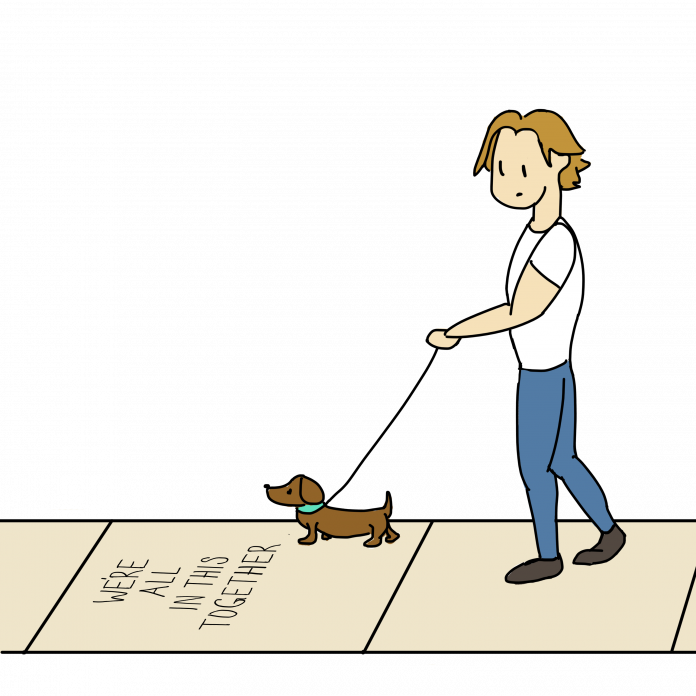
That’s when you gave me something real to hold on to — I started seeing encouraging messages messily rendered in chalk on sidewalks and driveways reassuring me that I was not alone. “We’re all in this together,” one message would read. “You’ll be okay,” another read. I had seen all the same sentiments on social media before, but something about knowing that someone went out of their way to make another stranger feel good with their own hands made these messages feel so much more special. It sounds dramatic, but looking at something tangible that I could touch and feel right in front of me pulled me out of the pool of social media and bad thoughts that I had been stuck in for weeks. “That’s right,” I thought. “These people are going through the same thing I am.” 

Photo: Kelly Chia

Of course, the whole world was going through this and worse, but this grounded me. It made me feel like I had something in common with this community and that I belonged here more than anything in the two years I had lived here. When days came and went in a city that had never been quieter, you gave me the solidarity and honest hope that could only come from a group of people also desperately trying to come to terms with what we were facing. You coloured my unnaturally quiet world in chalk, and I could not be more grateful for that.

After that small epiphany, my days were a little less monotonous. When I walked my dog, I started looking for updates to the community project posted on the elementary school walls, and I smiled at the large caricatures playfully calling a neighbour an old fart on their birthdays. These were small but important reminders that there was still life hustling around me, they were just more creative about it.


So, thank you. I know you don’t know me, and I don’t know you either. All I know is that I will always remember how in a time when everything felt like too much, your small action of goodwill helped me get back on my feet.

Love,

Kelly

Political Corner: Political discourse should be focused on pandemic response, not opportunism

1
Conservative MP Derek Sloan has been called out for racist comments. Photo: Meghan Balogh/The Whig-Standard/Postmedia Network

By: Connor Stephenson, Peak Associate

The Hall & Oates song “Out of Touch” is definitely not a reference to a certain subset of 21st century Canadian politicians, as the song was originally released in the 1980s. But if we ignore the temporal incongruities, it definitely could have been. The rhetoric that is being deployed by some Canadian Conservative politicians to attack the Liberal government in general, and its handling of the pandemic response specifically, is definitely out of touch with our new reality. 

A select few of Canada’s federal Conservative MPs have opted for a hyper-prejudice approach at a time that demands cooperation and critical evaluation of protocols. These are opportunistic, partisan attacks that undermine the Liberal response to an ever-evolving crisis. Derek Sloan is one Conservative in particular whose comments have exemplified the disconnect between political talking points and the general public’s need for non-partisan cooperation. 

Sloan, an MP for Norfolk County in Ontario, has recently questioned whether Canada’s chief public health official Theresa Tam was working for Canada or China, in reference to her comments in support of the World Health Organization. The answer to that question is obvious to anyone not engaging in divisive politics, but Sloan’s inability to suppress his partisanship at this current time perhaps speaks to petty political ambitions rather than the good of the nation. It is relevant to keep in mind that Sloan is amongst the candidates currently vying for leadership of the Conservative party.  

Initially, Sloan’s comments received no condemnation from the leader of the official opposition, Andrew Scheer. Only after extensive criticism, both from members of opposing parties and his own, did Scheer address and condemn Sloan’s comments. 

Although Scheer will not be the leader of the official opposition for much longer, this is in no way stopping him from personally launching his own irrelevant attack on the Liberal administration that anyone of similar political status would balk at. 

Scheer feels it is appropriate during a pandemic to revert back to his old talking point about eliminating the federal carbon tax. This is in spite of the fact that most Canadians are OK with a carbon tax now that a rebate has been tagged on, and the fact that the government has much bigger issues to deal with right now. The irrelevance of his comments during this public health emergency seem to be lost on him. This leaves me wondering what political advantage he perceives he could gain with this rhetoric. 

The aforementioned comments are by no means the only hyper-partisan politics used by some Conservatives. Retrospectively, it might have been ignorant of me to think that unprecedented times such as these would evoke political cooperation. However, it is now apparent that partisan rhetoric is a habitual tool that is not easy for some to consciously overcome.

Ways to support your mental health

0
Illustration: Sabrina Kedzior

By: Devana Petrovic, Staff Writer

For students, looking after our mental health can often be overlooked — it has been especially the case with the global uncertainty we’re facing and the stresses of an unideal learning situation. Before social isolation, I can vouch for how much easier it was to maintain a sense of emotional stability and to utilize coping mechanisms for the sake of my mental wellness. Nonetheless, the past couple of months for me have consisted of putting in the emotional labour towards reworking how I support my own mental health. Although I am aware that these may not be applicable to everyone and I am by no means an expert, I have found these activities and practices to be particularly helpful.


  • Keeping in contact with close friends 


It may not seem like it’ll be particularly useful for your mental health, but talking with your friends online during a time like this can do wonders for your well-being. It is also likely that if you aren’t feeling OK, your close friends may share some of the same struggles. If you’re comfortable, try reaching out to the friends who you trust to disclose this information with. I have found frequent FaceTime calls and keeping in contact with my friends over social media to be the absolute saviour in these isolating times. 

It also doesn’t have to be a serious conversation. If you aren’t up to talking about your mental health struggles, I highly recommend engaging in virtual games like playingcards.io and scribbl.io while on a video call. Forget about all the bad stuff and unwind. You deserve it.


  • Discovering new hobbies and interests


I know this sounds like one of those unrealistic beauty guru tips that don’t consider the extremity of real life issues, and believe me, I understand why you would think that. But hear me out: I recently got into collaging and it has been the only activity that has managed to immediately alleviate some intense moments. 

Since I had never really been into collaging beforehand, it got me excited for how I could continue to pursue this hobby. Having something new that allows you to plan and anticipate additional engagement is a wonderful distraction and method of allowing yourself to practice mental wellness. It doesn’t have to be collaging, but if there’s an activity you’ve always wanted to try, but you’ve never really gotten the chance, allow yourself to explore it.


  • Spending time with family/roommates


For obvious reasons, this one mostly applies to people who live with others. As someone who’s typically quite busy and is out of the house majority of the time, suddenly being at home a lot was a strange thing to adjust to. However, after some time, I discovered that I could not actually spend the entirety of this pandemic secluded in my bedroom from the rest of my family. In fact, I found that arranging a daily time specifically for the purpose of spending time with my family members, to be beneficial. 

Of course it’s important to have personal boundaries and to distance yourself when you need to, but including instances of family time has been a significant factor in my mental wellbeing. Your family members or roommate(s) are probably also feeling the heaviness of social isolation, so you might as well provide each other the comfort of your togetherness. 


  • Getting exercise or going outside 


Since there’s nowhere we can really go these days, it’s pretty easy to feel glued indoors. After all, grocery stores are terrifying right now. But if the weather is good and you’re feeling up for it, try transferring your work area to the outdoors. Even better, if you’re open to it, go on a bike ride or a walk. Getting some kind of exercise or even just stepping out of your house can help you cope with the pandemic stress. As much as I have always dreaded the idea of a family walk, I have to say it has helped me understand the importance of fresh air. 

If you’re not up to going outside but still want to exercise, there are many different ways you can accomplish this from the comfort of your own home. While I could go on about these different ways, The Peak released a separate article detailing ways to stay active indoors during quarantine.


  • Taking a break from the news/social media 


I want to be clear that this does not mean you have to abandon the news altogether, but that distancing yourself from the constant updates is healthy. These are unprecedented times of great anxiety and unforeseeable outcomes, it is essential for your clarity of mind to have those boundaries with checking news outlets and social media. It is important to be up to date on the newest measures and announcements, but it’s not necessary to be constantly checking the internet. 


  • Looking after your body and hygiene


With not having to show your face anywhere other than the occasional Zoom call, not looking after your body, hygiene, or appearance may seem incredibly tempting. Admittedly, this is a weird thing to include as a mental health coping mechanism, but with relevance to the circumstances of remote life, it is helpful to your wellbeing to put in the energy towards taking care of your physical health. I have found that on the days where I put in the extra effort towards taking care of my body, my headspace tends to follow suit as well. Self-care is more than just face masks and bath bombs, it includes actively looking out for your physical health as well. 

If you find yourself struggling with your mental health, remember that as an SFU student, you still have access to health and counselling services. The MySSP app, for example, offers free 24/7 virtual counselling. SFU’s Health & Counselling is also offering emotional support groups. If you’re looking for a creative outlet, the clinical counsellor in Health & Counselling, David Linskoog, is hosting a game of Dungeons and Dragons targeted towards building social skills and fighting back depression. You can email him at [email protected] if you’re interested!

The Canadian Mental Health Association also provides resources, including hotlines and crisis centre responders you can speak to if you feel like you need to seek help. 


“peasants i am leaving you for something better”: A Simon Fraser story

0
Illustration by Tiffany Chan

By: Hannah Davis, Peak Associate

I gaze at my reflection in a silver spoon in Mackenzie Café, untangle a perfect curl from my mile-long natural lashes, and chuckle at a measly peasant boy who walks by me, completely unaware of my innate superiority. 

“You see,” I coo at my spoon reflection, gently caressing her distorted figure in my makeshift mirror, “you are better than these fools. Because you are transferring to UBC. HAHAHAHAHA!”

People turn and look; I do not care, and I bat my eyelashes at all of them, scoffing indignantly. They will be stuck on this burning dumpster mountain forever, while I, I, will escape and find success at a far loftier institution.

Last semester was my fourth try applying for a transfer to the University of British Columbia. After much grovelling and begging, they’ve finally let me in, and now I know, as I’ve always suspected, that I am above grovelling and begging to anyone, duh. I spin around, taking in the whole room of people . . . Wow! Unbelievable, isn’t it, that I am the only person at SFU who knows how to apply for a transfer. 

I kick my unfinished hash browns to the floor, and yell at some pathetic cockroach person to eat them. Of course she does not do it, because she respects me too much to subject me to such a horrible vision as someone eating FLOOR FOOD! I chuckle to myself again and point to my SFU hoodie, as I continue to stand on the table where I know I’ll be seen. I address the room, and this time everyone stops to look at me, adoration and admiration dripping from their eyeballs like tears. 

I announce my important announcement: “Does anybody want my hoodie? I am donating it to charity, and THIS,” I gesture grandly around the room at all the students and at the beige walls, “is MY charity.” I point at a boy, who I suspect envies me the most. I peel my hoodie off like a king would undress and toss it at his head.

“I won’t be needing that anymore, you FOOL,” I wink saucily at the swine boy and tell him to take good care of the hoodie as I pull a paper out of my pocket to show the room my UBC acceptance letter. 

“Behold!” I bellow, and thrust the scroll in the swine boy’s face. He squints and reads aloud:

“We regret to inform you . . .”

What did he say? Panic swells in me and I jerk the paper away from his silly face. I look at the letter again and cannot believe what I am seeing . . . “Rejection” . . . “tough decisions”. . . Do my eyes deceive me!? 

I look at the boy and point pointedly. “YOU! BOY! Can you read?” He tells me he can. And I believe he might be right, because even a university like SFU would only accept students if they are at least mildly literate. 

I look at the room and the eyes that gaze upon me. “Fellow peers . . .” I solemnly announce, “I have made a grave error. It turns out that I am just like all of you.” I walk around the room and gently caress each person’s face, like the nuns in Newsies. It’s time to accept who we truly are. We, the lowly worm people.

And I am the first to collapse to the ground and writhe in the dirt of the Mackenzie Café floor.

And I am happy. 

The art of exchanging letters

0
Illustration: Maple Sukontasukkul

By: Molly Lorette, Peak Associate

Does anyone else remember when getting mail used to be exciting? Getting a birthday card in the mail with a bill tucked inside used to be the most thrilling experience as a kid. These days, while getting a package due to my unquenchable online shopping habits gives me a nice dash of serotonin, my mail mostly consists of bills, bills, flyers, and more bills. 

I’m not 100% clear on when the highly coveted art of writing letters died out, but it certainly precedes how long I’ve known how to read and write. Apart from the occasional thank you note to grandma, I was never an avid letter writer until a few years ago.

Then I started pen palling. To put it simply, pen palling has gifted me the joy of checking the mail again. Cards from grandma are certainly fun, but now that I have treasured friends sending me heartfelt letters, I have even more joy associated with my mailbox. If you’re at all interested in creating some cool friendships with people across the globe, I would highly recommend seeking out a pen pal or two.

With the internet being so expansive, I’m not clear on why it never struck me that there would be a thriving pen palling community nestled amongst its landscape. However, upon being introduced to it via Tumblr, I was intrigued.

Typically, I’ve found that social media has been a great tool for meeting new people. Currently, the Instagram hashtag #penpalswanted has 76.6k posts, and I’m certain that similar hashtags exist across Twitter and other related platforms. Personally, I sought out a Tumblr blog that permitted submissions where I could post a short description of me and my interests so I could find like-minded people. The benefit of submission was that I was able to protect my identity, and only responded to people if I genuinely felt a connection with them. Naturally, the idea of disclosing my address to a complete stranger was also quite frightening, so I emailed with a lot of them prior to actually exchanging anything. All that stuff that was drilled into our heads about internet safety? Use it. Unless you feel comfortable with someone, do NOT disclose your address. Use that coveted common sense.

I’m not going to lie and say that my experiences are 100% always positive. It’s pretty common that people might stop communicating after a while or may never send a single letter in the first place, which can be disheartening if you take the time to craft a package for them. I even had a long-distance relationship with a pen pal like the hopeless romantic that I am. Unfortunately, that didn’t work out for me and I would not recommend it. That being said, I’ve managed to build some lovely lasting friendships with a few amazing people from across the globe. 

There’s something quite special about writing a letter to someone. It’s rare to get to know someone purely through paragraphs on pages, and it creates a really intimate space between the two writers. Given that my letters tend to span several pages, I find that I end up communicating to my pen pals in a candid and vulnerable way about my life. Even though I’ve never met them in person, we’ve still managed to craft a close friendship built upon opening up to one another. Communicating socially with people face to face isn’t always smooth sailing, so there’s something truly unique about getting to know someone purely from the physical letters and trinkets that they send to you. Think I’m getting too sappy? Wait until you hear about the wall in my room I literally have dedicated to taping up the amazing things my lovely friends have sent to me.

In the modern world, returning to letter writing has been really therapeutic for me. Building lasting friendships existing purely through these exchanges has given me a very interesting outlook on the ways in which we can all communicate and build trust. 

If you’re sitting around home missing some social interaction, check out what your local pen pal network can offer you!  Establishing meaningful human connections is vital now more than ever, and now is a great time to seek it out. If pen palling doesn’t interest you, I would also suggest writing a letter to a friend. At the very least, you will bring a spark of joy into someone’s mailbox.