Home Blog Page 368

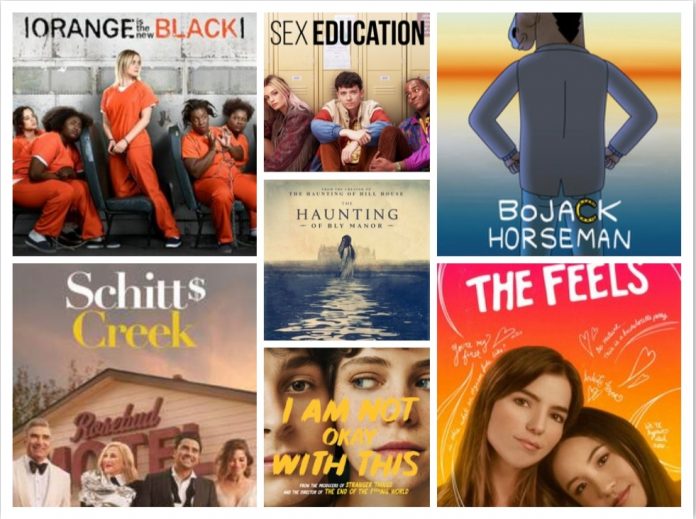
Shows and films with inclusive LGBTQ2S+ representations

0
Shows for your next Netflix night in. IMAGE: Sara Wong / The Peak

By: Dev Petrovic, Staff Writer

  1. Orange Is the New Black (OITNB)

A bit of an oldie now, but this show is a classic queer favourite. Based on a novel, the show takes place in a women’s correctional facility and follows the stories of several incarcerated women. With intersectional representations of primarily trans folks and women-loving-women, from the very first episode, OITNB is packed with gay content. I particularly appreciate that OITNB delves into accurate struggles that are often not portrayed on television, such as a trans character’s difficulties accessing hormones while incarcerated. The first couple of seasons are especially very well written: it is engaging, humorous, and oftentimes, wholesome. One thing worth mentioning, however, is that the show is also quite heavy in content — there are depictions of violence, mental health issues, trauma, and abuse. So, if that doesn’t feel like something you can get on board with, you can always skip towards the gay scenes — there’s no shame in that!

2. The Feels

The Feels is one of my all-time favourite hidden gems on Netflix. This sex-positive film with Constance Wu and Angela Trimbur features a soon-to-be-married lesbian couple and their friends at a bachelorette getaway. While The Feels is technically a romantic comedy, it does not follow a lot of the conventional plot structures that are usually seen in Hollywood. The best part about this film is that the entire theme is orgasms. Pretty great, right? Besides the entertainment value, the orgasm theme is written to be empowering and encourages healthy and open dialogue about sex — I have yet to see a film that does this as well as The Feels. The characters in the film are believable and genuine, I almost felt as though I was watching a vlog compilation of a group of friends instead of a movie.

3. BoJack Horseman

This critically acclaimed animated series follows the life of the titular protagonist, a previously famous sitcom actor that struggles with a complicated, traumatic history and substance abuse. Brilliantly written and serious in dialogue and content, this is probably the only show I have encountered that includes a leading support character who is asexual. Although it is a supporting character that is represented as openly asexual, there is quite a bit of a storyline that goes with it and I especially appreciated the educational aspect of the writing, which attempts to debunk a lot of the public’s misconceptions of asexual folks. Overall, despite the show’s mixed reviews, BoJack Horseman, is a genius one-of-a-kind series.

4. I Am Not Okay With This

Sadly, this show only ran for one season and the episodes were short. That being said, this is a good show to binge-watch because it can, quite literally, be finished in a matter of hours. I Am Not Okay With This follows a teen character coming to terms with their newly discovered superpowers and their sexuality. The writing is serious and clever, balancing the dramatic elements with comedic ones. Binge-worthy and with complicated characters, what more can you ask for? Probably another season.

5. Sex Education

This popular coming-of-age show features diverse LGBTQ2S+ characters and their struggles with sexuality. Best of all, the dialogue is sex-positive, openly communicates queer issues, and the characters are all lovable and memorable. Sex Education is funny, addicting, and a wholesome watch. Also, season three is on its way, so there’s something to look forward to when you find yourself finishing the entire show in two days.

6. Schitt’s Creek

Two words: Dan Levy. Don’t you want to watch it now? Schitt’s Creek is a much-loved Canadian comedy that depicts a semi-dysfunctional, but lovable family. Schitt’s Creek features a pansexual main character and, later on, his gay partner, portrayed by Dan Levy and Noah Reid respectively. Seriously, this show is so articulately written and funny, there is no reason not to watch it.

7. The Haunting of Bly Manor

Not to spoil anything, but get your tissues ready for this one. This horror-drama show is a women-loving-women favourite and features beloved actresses Victoria Pedretti and Amelia Eve. It was incredibly refreshing to see a queer couple as the centre of a thriller series, and for the representation to be so accurately depicted. This chilling follow-up to The Haunting of Hill House is more of a love story than a thriller, but believe me, that is a good thing. 


Getting comfortable with sex and intimacy

1

Written by: Kelly Chia

My journey to becoming comfortable with sex has been a bit . . . tenuous, to say the least. For a long time, I thought I didn’t have to think about sex. Fresh out of high school and entering university, I had only just become comfortable with the idea of my sexuality. But sex? I hadn’t had my first kiss yet, and I didn’t know where to start. In the kind of relationship I wanted to have, I knew I wanted to connect to my partner in that way, but that was the extent of it.

I was lucky in that I had a lot of resources readily available: safe sex supplies and learning resources, a group of supportive friends, and no one to force me through the threshold when I wasn’t ready. 

The hardest part of being comfortable with sex was knowing how to have a conversation about it in complete understanding of its intimacy.  I felt that it was a complex and scary thing that I didn’t know how to contend with or talk about, so I didn’t. 

It wasn’t just that I couldn’t talk to my friends about it; I couldn’t even admit to myself that I was interested in sex. 

It just felt too vulnerable. The things that I liked, the parts of my body, and my curiosity were surrounded by a fog in my mind. They existed but felt disconnected wholly from my day-to-day life. As soon as I knew that the thoughts were there, I’d shut them off.

When I entered my first romantic relationship at 21, I decided to try and figure out what interested me. We had our first kiss and I blushed for weeks, feeling like the human embodiment of fizzy pop. As things proceeded, I gradually felt that tinge of fear flare up.

Asking my partner to slow down after a make out session, I found that I genuinely didn’t know what I was scared of or how to express it. So I started writing a journal entry (aptly named “Sexuality”) about all the fears I had after we made out. I’m Chinese and my partner’s white, and I wanted absolute certainty that he was not fetishizing me. 

I was scared at even the thought of pregnancy. I had never tried anything penetrative before, and I was worried about the pain — I mean, I continue to struggle with tampons. 

But mostly, I was afraid of the vulnerability. No one had seen my body before, and I wasn’t even fond of looking at it too closely. 

Finally laid out in front of me, the fog started clearing up a bit. I reviewed my entry, then told my partner everything I was concerned about. It was embarrassing, but it felt like such a big weight off my shoulders. We continued to have heart-to-heart conversations about how we both felt. 

My partner never once made me feel inadequate or awkward for expressing my worries — in fact, he told me his own. We talked about our fears, boundaries, and how to signal to each other that we wanted to slow down. How we didn’t always feel great in our bodies, no matter how attractive we found each other. Having a safe space to openly communicate my worries and have them be addressed changed everything. 

Why hadn’t it been that easy to talk about my boundaries earlier?

I realized then that part of my discomfort with sex was due to a habit of shutting out the times when my boundaries were breached. I had known consent was important but over the years, my own hold on the word and its meaning had eroded. I do not mean to understate the importance of consent, but rather to emphasize how difficult it can be to realize that it’s being breached. 

The truth is, I shut a lot of memories out of my mind to avoid thinking about how I had been uncomfortable in the past. How in high school, there had been many touches and glances that I was silent about. How there were many weird conversations that I laughed off or ignored. It took me years to even realize that one particular interaction I had wasn’t okay, and even longer for me to admit it. 

I realized that I had been willing to compromise my comfort to keep the peace in these interactions by not speaking out. I didn’t know what to do when my comfort had just been a bit breached, especially when I only realized in hindsight that it had been breached.

None of these events rung the alarm bells I had been warned about, so it just became another thing for me to be quiet about. I felt like a bystander in my own body sometimes. It’s hard to admit but because of this, I did things I was uncomfortable with without fully realizing it, and probably would have again if I hadn’t thoroughly confronted what my boundaries were. 

That conversation was the first time I truly understood that my partner and I should both have equal say in our intimate relationship — a relationship where I felt like my body was mine again. I was in control of its boundaries, not a reluctant gatekeeper watching people casually trespass them. And this revelation meant everything, because I finally understood what a relationship was supposed to be.

Sex and all its worries was never something off limits for us to talk about, and though that should be the bare minimum, our explicit communication was very tied to my comfort. 

As soon as I could name my worries, I became more comfortable talking about talking about sex with my friends. That was key — part of my discomfort was that sex was on a sort of taboo pedestal. 

They kindly talked to me about sex, exchanging stories about its weirdness, reassuring me about my concerns, and gave me advice when I asked. No, I wasn’t weird for not initially being a fan of penetration, even just with tampons. Yeah, sometimes breasts are unevenly sensitive. Their constant support gave me more confidence, both in my body, and to stand up for myself.

As I continue to learn about this part of myself, my comfort comes back to my anatomy. I continue to write to myself about sex. The earlier journal entries are a bit funny to look back on: even in writing, I was visibly uncomfortable describing what felt good to me. Seeing the record of the things that I liked, disliked, or felt unsure about all helped validate my experiences. 

I am endlessly grateful for having a partner that understands all of these things and is steadfast in learning to listen to my signals, as I am learning his. But we also laugh! Not to mock each other, but rather to acknowledge when things are funny because they sometimes are in sex.

My journey unfolds with love, no matter its speed or how many pauses we need. Being able to express to my partner my wants and worries without being afraid of the consequences has given me a lot of comfort navigating my first time. Sometimes we get it wrong but we’re both invested in making each other feel comfortable, safe, and good. 

Most importantly, it has given me back the confidence to own my body, and that has meant everything.

Top Ten worst Valentine’s Day dates

0
Very calm, very cool. Nothing wrong here. Illustration: Siloam Yeung / The Peak

By: Juztin Bello, SFU Alumnus

  1. Your aggressively single friends

Your “single” friends will probably just mind their business on Valentine’s Day, because, shocker, it’s just another weird cash-grab, hetero holiday. Your “aggressively single” friends? Oh boy. Get ready for weeks of “We don’t need to be in relationships! We can take each other out!” or “I just call February 14 ‘buy myself chocolate day’!” or, even worse, “I love finger-banging myself to fictional anime boys as a way to fill the void of romance. Really, I do!” Just know that if you get invited to a Valentine’s Day-adverse wine night, your cue to leave is when the first person starts crying and doom-swiping on Tinder. You’re better off going home, crawling into bed, and not so unironically listening to “Love Story” by Taylor Swift.

2. The high school “hero”

High school feels like a million years ago, right? Well, not to the high school “hero.” This date might’ve gone well — if you had managed to get a word in. But between his recapping of high school debauchery tales, showing you pictures in his yearbook (he brought all four?), and his slideshow presentation of his best high school football plays, you’ll likely be as silent as he is about world issues. You’ll sit there hearing him talk about his peak, while willing yourself to not look at his widow’s peak and hairline that are just as checked out as you are.

3. DiscreetHungTop

Pro: DiscreetHungTop on Grindr did the easy job of providing you with all of the important information. Plus, despite hiding his age, you can tell he’s older because of his photo’s angles, and thus must have money. Older = money. Sound logic. 

Con: this exchange will definitely come up later in therapy when discussing the correlation between your fixation for older men and your strained relationship with your father. And of course, the biggest con of this date will be the constant ringing of his phone — it’s his wife, asking whether he’s on his way back yet from the health foods store. 

4. Your partner you’ve been meaning to break up with but there are just too many holidays back-to-back during the winter

It’s December and you’re getting ready to finally ditch the ol’ ball and chain. But then you remember Christmas is coming up, and it’s a great chance to get free shit. So you wait. Then January rolls around. It’s time. But then again . . . who wants to make someone else go through heartbreak to start their year? Not you, of course. You wait again. Then comes February. It’s finally time. Just kidding. Valentine’s Day is approaching. Guess you’re stuck adhering to societal expectations of another consumerist holiday as a method for flaunting your failing facade of a relationship. You better hope that your significant other doesn’t have some weird appreciation for St. Patrick’s Day — but then again, might as well wait it out ‘til after so you can still Get Lucky. 

5. The rebounder

“Just got out of a long-term relationship,” their Tinder bio will say. This should have been a red flag, but seeing as you’re a red flag yourself you figured, why not? Two negative red flags = a positive. Simple math. But as you sit there in your one good dress shirt and you mention how the food tastes good, your meal will be completely overpowered by the bitter saltiness of a recently scorned ex, aggressively pointing out that their ex also thought food tasted good. Was this a good rebound attempt? Na.

6. A date set up by your friend in a relationship

You know how your friends get bored of their own stale relationships so they try meddling with your affairs? They could try setting you up with a friend from their work, old college buddies, or the person your friend definitely just wants to know the dick size of for their own pleasure. But at a certain point, this concept is truly just an insult. “They’re perfect for you,” your friend will say about this date who showed up three hours late wearing a “Proud Furry” pin. This date is looking pretty ruff.

7. Your ex (because why not)

Look. This is probably not a good idea. But then again, when were you ever about listening to “good ideas” anyway? This should be simple since your ex is probably still liking and commenting on your photos and will hit you up with the occasional drunk text. Just be sure to catch them on a good day to ask them out again when the drunk text is “I miss you so fucking much” instead of “i miss that deep hole” for optimal results. And if anyone asks, you’re doing this for closure, not because you’re touch-starved and like putting yourself through emotional disdain for the thrill.

8. The passion project

You know that basic exercise as a kid where you took blocks of different shapes and put them into the correct holes that fit? Yeah, clearly you don’t, because right now you’re trying to take this absolute square of a person and jamming them into the star you want them to be. Newsflash, genius, that square will never be the shape you want no matter how hard you try. I regret to inform you that your idealizations will leave you with two unfilled shapes this Valentine’s Day: your heart, and your big, backdoor circle. 

9. Super Mari-oh no

You know what sounds like a good Valentine’s Day date idea? Going over to someone’s house, lying sexily on their bed, and then watching as they strip to their undergarments and . . . game. If you go out with a gamer, chances are you’re used to someone playing games with your emotions — perhaps someone used to using codes and inputs just to cheat. Try not to get too jealous about them romancing a pixelated person in a video game while you’re there; it’s only fair they give their attention to both of their dates, of course. Just remember to have your protection ready before hard drives start heating up; you don’t want to catch any viruses. 

10. The bad influence(r)

You may see people online who flaunt promo codes for H-list brands that no one uses while amassing a whopping less-than-100 followers. This, of course, is a wannabe influencer. Well, if you want to take a wannabe influencer on a date, chances are their influence on said date will be bad. They’ll take numerous photos of their food, ask you to take photos of them, and make the waiter take photos of both of you (that they’ll probably just end up cropping you out of). Just be warned, there are no filters in real life — which means your date won’t censor themselves about their wrong takes and problematic worldviews. If you want a 10% chance of lasting fully through this date, use promo code #HELP to order something you’re allergic to as a way out. 

How SFU’s mishandling of sexual assault excaberated my trauma

0
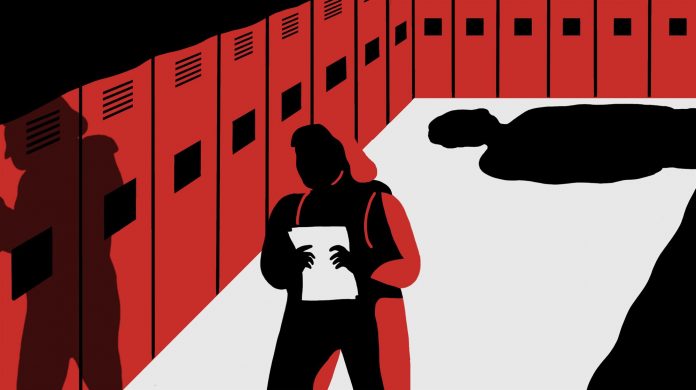
Illustration courtesy of Julien Posture.

Written by: Sarah Russo

Content Warning: heavy discussion of sexual assault, mentions of suicide

Three days into my time at SFU, I was sexually assaulted. I’ve heard people compare going to university to beginning a brand new chapter of your life. In high school, I always looked forward to setting off on my own and having a fresh start. But my brand new chapter was tainted and miserable, shifting my life’s genre from a coming-of-age to a tragedy — and SFU’s lack of action ensured that it stayed that way for over eight months.

I was assaulted on Labour Day weekend. SFU’s Sexual Violence Support & Prevention Office (SVSPO) was closed for the holiday, and I didn’t know where to turn. I had told my best friend about it but, halfway across the country settling into her own new chapter, she wasn’t equipped to deal with something so awful. I don’t remember how I found MySSP, but I downloaded the app and was connected to someone to talk to. 

I sat in my concrete dorm room, bawling my eyes out, summoning the courage to type out: “I think I was sexually assaulted.” I expected  comfort. Instead, I was asked about my phrasing: why “I think”? I explained that I was still trying to grasp what had happened, and that I felt like it was my fault. The person on the other end asked me where that stemmed from. I made a crack about Catholic guilt. They asked me more questions about religious trauma until I thanked them and deleted the app. I needed validation, support, confirmation — even just to be told “it’s not your fault” — but all I received was interrogation. 

In the grand scheme of things, this was absolutely miniscule. In the coming months, I would be put through hell. I would be strung along by the people investigating my case for eight months. I would have to drop out so I didn’t kill myself. I would be told by an RCMP officer that I was “young and beautiful” and that “not all men are like this” during a conversation in which he told me that there was no evidence to support my report to the police. 

The failure of the MySSP app was the first time that SFU failed me as a survivor, but it certainly wasn’t the last. 

When classes started, I was able to get in contact with the SVSPO and get the validation I needed and deserved. Yes, what happened was sexual assault, and no, it was not at all my fault. From there, I sought to move forward. I was asked about whether or not I might want to report what happened to me, and my answer was an adamant no. 

I knew that with adapting to my cross-country move, living on my own for the first time, starting university, and processing my trauma, I didn’t have the emotional strength to go through the reporting process, and that was fine by me. 

Then, at the end of September, I found out about the other girls. In over just a month of being on campus, the student who assaulted me had attempted to assault and harass three other women. I was the first. I knew then that the assault wasn’t my fault, but I still couldn’t help but blame myself for not saying anything about it. After about a month of research and breakdowns, I decided to report my sexual assault to both SFU and the RCMP. 

The beginning of the reporting process made me feel more fragile than ever. Accompanied by my case manager at the SVSPO, I went to the Maggie Benston Centre to describe what happened to me that night in explicit detail to a total stranger. They would talk to him after and go from there. I was told — or rather warned — that the person conducting the investigation was new to this and as such, I was supposed to communicate if something was or wasn’t working. In essence, I was a lab rat. 

As the investigation began, interim measures were implemented. He was moved out of my building and forbidden access to it. He wasn’t allowed to contact me or be within 50 feet of me. Finally, I was allowed to choose three separate hours a day during which he would not be allowed in the dining hall. At first, this was ideal. The main place I had seen him was at the dining hall and it had become my main source of anxiety

It was nice to know that there were pockets of time that he wasn’t allowed in there. I’ll never know if he didn’t check the time or if he did it out of spite, but he violated this rule several times. I started being unable to go to the dining hall without my friends scoping it out first, even during the hours he wasn’t supposed to be there. When classes ended, I was unable to get breakfast before my exams. When the second semester started, before new hours were implemented for my new schedule, I sustained myself on granola bars and burgers my friends procured for me from the dining hall. 

I reported the assault in early November. When I asked about the timeline of the investigation, I was given vague answers. Eventually, I was told that the investigative report would be submitted to the university between the last week of January and the first week of February. After that, it would take four weeks to make a decision. By this time, it had been four months, and while that wasn’t ideal, with an end date in sight, I thought it would be bearable.. 

Over the course of those months, however, my mental health took a sharp decline. I spent my mornings sobbing, unable to get out of bed. I barely went to class for fear of seeing him on campus, and when I did go to class, I would cry my way through it. Despite having those designated dining hall hours, I couldn’t bring myself to go. He’d violated the interim measures before. Why wouldn’t he again? I continued to rely on my friends to get me food, supplementing it with Pocky from the vending machine. I had reached a horribly low point, but I had faith that the report would be filed with the university at the end of January, and all would be well. 

On February 6, I received an email from the investigator telling me that the report would take longer than anticipated. When I pressed for a timeline, I was told that the report itself would take another week, which meant another five weeks before I would get an answer. 

On February 9, I went to the hospital because I was afraid I would hurt myself. I felt out of control. 

On February 11, I flew home for reading week early, despite having classes for the rest of the week. I knew if I stayed and was triggered by something, I wouldn’t make it home. On the way to the airport, I had a scheduled call with the person in charge of the investigation. It would be delayed further, and they were not able to give me a timeline. 

I withdrew from classes that semester, and flew back to campus after reading week to collect my belongings and move back home. It killed me to be leaving my friends, and I felt like a failure. But ultimately, I knew what was best for me. 

On March 9, I received an update: the entire process was to be completed in April. It wasn’t just the report being submitted and having to wait four more weeks — I was supposed to receive an answer. On March 31, I received another one: despite the COVID-19 pandemic, the process would not be delayed. That had marked nearly five months since I had reported it. 

On April 27, I received word that the report had been submitted and that the process would be completed as a whole by the end of May. The extensions were agonizing. My mental health wasn’t getting any better. I started my applications to other schools.

I held onto that date for the entire month. May 31. Finally, it would be done. As they’d told me back in late 2019, the decision-maker would have four weeks to decide whether or not he would be found guilty. 

May 31 came and went with radio silence. On June 2, I received yet another email: it would take longer and no, they could not give me a date. At least they told me, like they did in every email, that they “acknowledged the impact” this had on me. As if I believed it at this point.

It was June 19 when I finally got an answer— over eight months since I’d reported it and over ten months since the assault itself. Even the RCMP had given an answer to me before that, and they had ignored my phone calls for five months of the process. 

Although I’m not allowed to tell anyone aside from my family and “a trusted friend” what the outcome was, I think the fact that I’ve remained at SFU speaks for itself. 

SFU certainly isn’t the worst institution in the world when it comes to sexual violence. I’ve heard horror stories of schools silencing survivors or blaming them. For what it’s worth, the school inadvertently gave me an amazing support system. I will forever be grateful for the people working at the SVSPO. 

They connected me with a designated sexual violence counsellor at SFU Health & Counselling. They got a professor to allow me to retake a quiz I’d failed because I had seen my abuser on campus and spent the night shaking instead of studying. I would not have passed my first semester without that sort of help; I would not have survived my terminated second semester either. However, things would not have been so bad if I had not been so mistreated by the administration in the first place. 

It has been over a year since both the assault and the report and I’m still alive. I turn 20 soon but I remember not even thinking I’d make it to 19. I have PTSD, anxiety, and depression, but I’m coping with it. I’m still an SFU student, working towards getting my degree. You might think this is an uplifting ending, and maybe it is. I’m happy, for the most part. However, I don’t think I’ll ever truly get closure. 

It’s not because the police didn’t find any evidence. I always expected the worst. It’s because I am not allowed to name the man that found my protests inconsequential. I am not allowed to warn any of his romantic pursuits of what he did to me. I’m not even allowed to know all the consequences that SFU gave him, and the ones that I do know of, I’m not allowed to talk about. In speaking up, I’ve been silenced. 

I write this in fear of backlash. I write this in fear of losing my scholarship. 

I write this in fear of allowing SFU to treat more survivors this way because they have not been held complicit. 

I write this in confidence that it’s time for this to change.

Beedie’s School of Business affordability guide aims to aid housing in Metro Vancouver

0
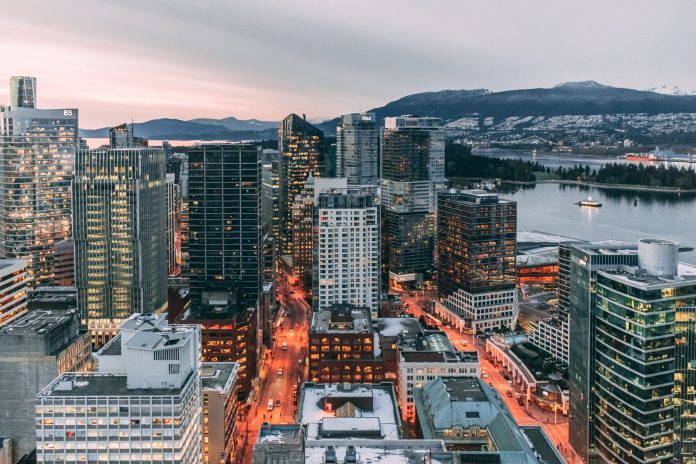
PHOTO: Aditya Chinchure / Unsplash

Written by: Jaymee Salisi, News Writer

SFU’s Beedie School of Business and the Vancouver Economic Commission (VEC) have joined in efforts to develop a guide to affordability in Vancouver. Based on various levels of income, the guide’s objective is to provide a realistic representation of the cost of living throughout different cities in the region.

Finding comprehensive data regarding housing affordability in Vancouver can often be a challenge as most of the data available has not been updated, according to Beedie professor Andrey Pavlov. “Since living in Vancouver, as in any city, requires multiple expenditures for food, shelter, taxes, childcare, there is no single source that can provide desegregated and consistent information,” Pavlov told The Peak in an interview. 

By identifying housing costs across the Lower Mainland, the guide can help citizens and businesses navigate locations best suited to them. Information regarding the cost of housing, labour markets, taxation, child care, income, spending, and transportation were gathered to create a coherent economic depiction of life in Metro Vancouver. According to Pavlov, the guide can also determine areas that are “most desirable for housing supply increases and/or transportation infrastructure improvements.”

Researchers concluded that owning basic lower-priced property — which can be referred to as the 25th percentile — offered reasonable and safe housing. For single family homes, Vancouver West required the highest household income in the 25th percentile at $325,643 annually for a mortgage to be approved by the bank, while Langley held the lowest requirement at $118,072. The guide also presents average rental rates ranging from 3+ bedroom units in West Vancouver costing up to $3,753 to bachelor units in Surrey for $898. 

“There are [many] neighbourhoods and market segments that are still relatively affordable for somebody with good employment,” Pavlov explained. However, he added that these neighbourhoods may not be as convenient as some houses are priced higher due to better commuting time or housing quality. Compared to similar cities, prices in Metro Vancouver do not necessarily vary greatly, but he thinks they “[offer] relatively limited housing variety.” 

Pavlov stated that “a vibrant and growing city should offer a very wide range of housing options in order to accommodate people of all financial means and tastes.” Although he doesn’t see much desire from BC’s government “to help increase housing supply,” he suggested that  renewing real estate and creating more accessible accommodation could improve affordability in Vancouver. 

The full Affordability Guide can be found on the Vancouver Economic Commission website.

Beedie student bails on Valentine’s Day date to check stocks

0
PHOTO: Gilly / Unsplash

By: Paige Riding, Humour Editor

February 14, 11:32 a.m.

Baby Girl💦 — heyyy baby, happy valentines day! <3 hope your morning is going well and can’t wait to see you tonight. i’m gonna look so good for you mwah mwah I’ll order Anton’s to the house around 6:00 don’t be laaaate

February 14, 11:41 a.m.

Boo Thang❤️ — gm i can’t wait to see you in that new dress you’ve been talkin bout mmm yo can u send a pic for me rq

Boo Thang❤️ — plz?

Boo Thang❤️ — please baby? for me?

February 14, 3:23 p.m.

Baby Girl💦 — I was running errands i’m so soo sorry bb I promise I’ll make up for it tonight 😉 😉 we can cuddle and watch a movie awww

February 14, 4:11 p.m.

Baby Girl💦 — Are you excited? I just started getting ready, I’m so excited to see you I miss you soOoo bad

February 14, 5:14 p.m.

Baby Girl💦 — Why aren’t u responding on v-day?? I did my hair in curls like you like 🙂

February 14, 5:24 p.m.

Baby Girl💦 — HELLOOOO? Jake??

February 14, 5:30 p.m.

Baby Girl💦 — Where the fuck are you? This is so shitty of you.

February 14, 5:49 p.m.

Baby Girl💦 — The food is almost here, I got your favourite, plain spaghetti so u can put ketchup on it 🙂 pls let me know when you’re almost hereeeee

February 14, 5:57 p.m.

Baby Girl💦 — Wow. This is worse than when you didn’t wear your suit to my sister’s Quinceañera bc your only one was dirty from your photos from that stupid fucking Beedie conference!!!!!! PICK UP YOUR PHONE.

February 14, 6:10 p.m.

(8 missed calls) from: Baby Girl💦

February 14, 6:12 p.m.

Baby Girl💦 — don’t even bother calling me. fuck you.

February 14, 8:29 p.m.

Boo Thang❤️ — damn b sry i was so into these Dogecoin stats it’s off the charts like u wouldnt believe, it’s so complex but so sick like you wouldn’t get it but like whatever trust me these stock trends rly inspire me as an entrepreneur fr fr

February 14, 8:42 p.m.

Boo Thang❤️ — ya ok i can try telling u about them but not sure u would get it

February 14, 8:43 p.m.

Boo Thang❤️ — YO in that minute it went up by a tenth of a cent b thats pog ya anyways so basically the stock market is like a fishtank. big fish against bigger fish. gotta keep on that grind u know like i’m always on my game it’s so tough but someone gotta do it

February 14, 9:22 p.m.

Baby Girl💦 — … 

February 14, 9:23 p.m.

Baby Girl💦  changed contact from Boo Thang❤️  to Capitalist Pig🐷

BC experiences COVID-19 vaccine shortage

0
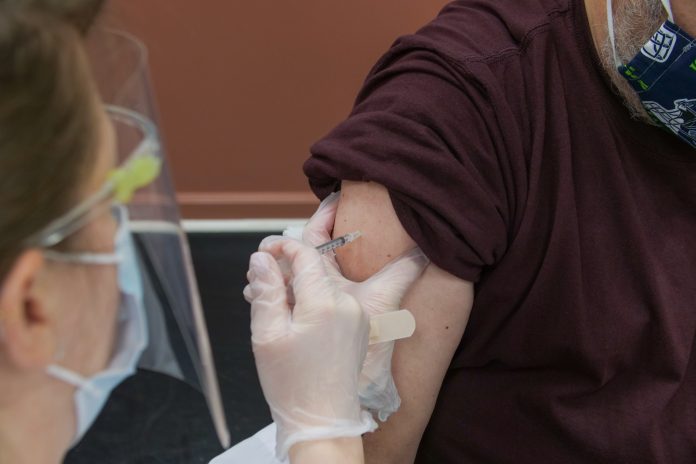
PHOTO: Stephen Cornfield / Unsplash

Written by: Karissa Ketter, News Writer

A shortage of Pfizer-BioNTech and Moderna COVID-19 vaccines is forcing the provincial government to alter their distribution plan. Dr. Bonnie Henry attributes this to delays in production and delivery. This has forced health officials to extend the time period between each dose. Previously, Pfizer’s doses were administered 35 days apart, but have now been extended to 42. 

According to Global News, health officials were told that the shortage of vaccines experienced in January is expected to continue into February. In the Vancouver Sun, Henry said she is extremely concerned. “We do not have enough vaccine[s] to protect everybody who needs our protection right now and we are not going to get that until a few weeks on.”

On January 26, 2021, the First Nations Health Authority (FNHA) put out a statement noting that the “global delay in receiving vaccine doses from Pfizer may affect the start date of some vaccination clinics in British Columbia First Nations communities.” While the FNHA primarily received the Moderna vaccine because it can be stored at a higher temperature and administered in rural areas, the statement notes that “in some regions, the regional health authority has provided Pfizer vaccines to support community clinics.”

Indigenous communities, residents and staff of long term care facilities, and health-care workers are priority groups in phase one of BC’s rollout. On January 27, 2021 the BC Center for Disease Control (BCCDC) website reported that starting in mid-February they plan to be ready  for phase two — where seniors aged 80+ and Indigenous seniors aged 65+ — will be vaccinated. However, BC Nurses’ Union president Christine Sorensen told the Vancouver Sun that she understood that phase one would be completed by the end of March. 

CTV News stated that Health Canada may be able to approve a third vaccine, AstraZeneca, by mid-February with hopes to receive 20 million doses. They also report that Canada has pre-ordered 10 million doses of the Johnson and Johnson vaccine, pending approval, with the potential to receive 28 million more. The Johnson and Johnson vaccine only requires a single-dose.

The Government of Canada reported that as of January 21, 2021 British Columbia had distributed 144,550 vaccines. They also noted that the total number of vaccines distributed across Canada is 1,119,225 — largely to health-care workers, adults in Indigenous communities, and long-term care home staff and residents. 

For more information on Canada’s Immunization Plan, visit the Government of Canada or the BCCDC website. 

Melania Trump does not deserve a redemption arc

1
The First Lady should not be the first to have our sympathy. Photo courtesy of Andrea Hanks via Wikimedia Commons

by Kyla Dowling, Staff Writer

Since the Trumps’ glorious eviction from the White House, a lot has changed. Dogs are in the White House again, Biden has reversed the transgender military ban, but for some strange reason, people are still trying to defend Melania Trump. This defense ranges from celebrities like Chrissy Teigen praising her fashion on Twitter to The Hill publishing a piece on how she “deserved better.” 

Let’s get this straight: Melania Trump is not a victim here. She is an adult woman married to an authoritarian. It doesn’t matter that the media says it might be a transactional relationship or that she is gearing up towards divorce, she is still choosing to stay in the relationship. She stood by for four years as her monster of a husband let hundreds of thousands of Americans die of COVID-19, separated children from their parents at the border and put them in detention camps, and incited a deadly riot on the US Capitol. At best, she is a bystander. At worst, she is complicit.

At best, she is a bystander. At worst, she is complicit. 

We also cannot forget that she is her own person outside of her husband with her own beliefs. She is a “birther,” someone who believes that Barack Obama forged his birth certificate and was not eligible to be the president. She only believes sexual assault allegations when there is hard evidence. The woman whose fashion choices people are praising is the same woman who wore a jacket that read “I really don’t care, do u?” while on her way to a border detention facility.

Melania Trump could not be more clear about her viewpoints, and yet she garners sympathy. There have been plenty of memes of how uncomfortable she looks around her husband, and even a once-trending #FREEMELANIA hashtag, but what for? It doesn’t matter if her relationship with the former president is for appearance and nothing else, she still makes it a point to stand by him. It’s easy to paint her as a victim; white women, throughout all of history, have been seen as docile, virtuous, damsels in distress. But while Michelle Obama had to endure countless criticisms when her husband was president, Melania is viewed as an innocent person trapped by her big, bad husband. 

Now that she’s left the White House, people are pushing for her comeback. They’re pointing towards the good she’s done, like speaking out about racial harmony once, and . . . that’s about it. But as America moves forward with a new administration into a new era, it’s important not to let Melania Trump continue to play the victim. Terrible people can have good qualities. That doesn’t mean they should be praised for them, or, god forbid, that their actions should be forgotten because they have a single redeemable trait. And that certainly doesn’t mean they should have a platform — especially right after their power has been rightfully stripped from them.

SFU x UBC: a forbidden love

0
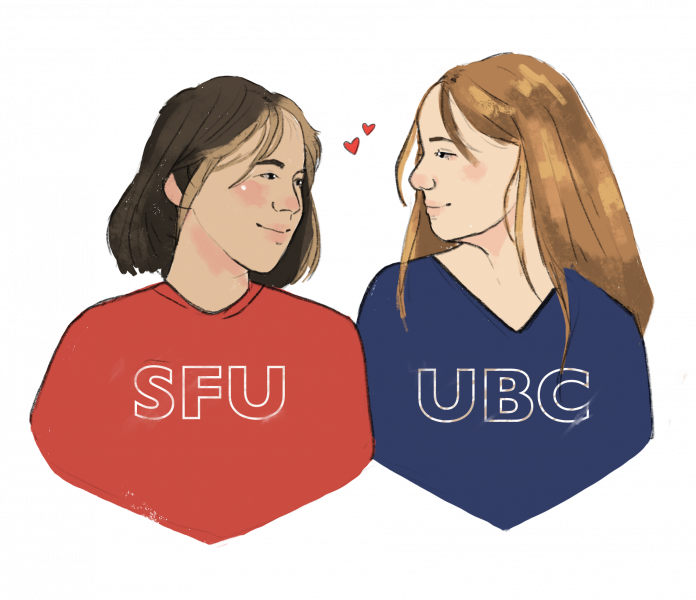
ILLUSTRATION: Shaheen Virk / The Peak

By: Alex Masse, Staff Writer

Vancouver’s January air struck through the bones, the same as always. That is to say, it was cold, but if you expressed this to anyone outside the Lower Mainland, they’d laugh at you. 

She pulled her scarf tighter and, with numb fingers, sent her fifth text in as many minutes. 

You’re 20 minutes late now. 

It was embarrassing, but being here hit a nerve. The sun was on its way out, its scarlet rays peeking through the stationary SkyTrain cars across the street. Soon even that would be gone, and she’d be alone in the dark, in the middle of nowhere. 

And then she heard her. “Oh my gosh, sorry, I missed a bus on the way back from lecture.” 

SFU didn’t even turn around. “That wouldn’t be a problem if you just let me meet you on campus, UBC,” she muttered. 

UBC either ignored the aloofness, or didn’t notice. She joined SFU on a bench by the bus stop, sidling up beside her. 

“You know this is how things have to be, Si,” she said, smiling almost apologetically. Her tone was soft, but she still snuck in a note of force. Classic UBC. “We have to be careful about who sees us.” 

SFU scoffed. “Are you still burned over what happened last spring break?” 

“UVic just about saw us holding hands!” UBC shot back, her eyes wide. “He would’ve told everyone. And you know how our parents would’ve reacted. My mom has a bumper sticker that says ‘Proud UBC Parent’ on her Tesla, for goodness sake. I’m sure yours are just as loyal.” 

SFU’s parents would be overjoyed if she brought anything with a pulse home. It’d be taken as proof her classmates not only existed, but were more than a bunch of raccoons in trench coats. She tried that one already. The options are slim on a commuter campus, unfortunately.

“We really should talk about things, Bee,” SFU said out loud finally.

UBC poked her in the ribs. “Okay, I get you’re a communications major, but—”

“Communication, singular.” 

“Wow, such a difference,” UBC teased, leaning in closer. Even in the cold, she was a beacon of warmth, her own little hearth. SFU leaned away: she didn’t trust herself not to melt. She gets a McDonald’s within walking distance of her and she’s this charming? 

“Do they, like, remind you guys to talk to each other because you’re stuck on that mountain all the time?” 

SFU rolled her eyes. “You’re so pretentious.” 

“And I’ve earned that!” UBC exclaimed, a mischievous grin on her face. “Go on, Si, tell me: who’s the number one university in BC, again?” 

“Who’s the most comprehensive university in Canada, according to MacLeans?” SFU shot back. 

UBC groaned. “What does that even fucking mean?” She prodded SFU again, so hard it actually kind of hurt. Under all the blouses and cardigans, she was buffer than she had any right to be. Probably thanks to carrying all her stupid overpriced textbooks. “This is why I can’t take you back to my parents, you know.” 

That’s why?” SFU barked out a laugh, all bitterness and no humour. “I thought it was because I’m not from your school. You know, we aren’t even that different. You’re from an upper-class Vancouver suburb. I’m from an . . . almost upper-class Coquitlam suburb. Well, technically Burnaby but, like, the lines kinda blur — um, yeah. We both spent all of high school overachieving and being the best just for no entrance scholarships. A couple years from now, we’ll both be in crummy studio apartments, digging our way out of debt.” She was out of breath by the last sentence. She hadn’t even known all those feelings were writhing around in her. Probably under all the Zoom fatigue. 

For a long time, UBC just stared, digesting her words. SFU got the feeling she wasn’t used to being disagreed with. She was the top — uh, on top of things all the time.

Finally, and rather grudgingly, she said, “Yeah, I guess I could’ve taken to someone like Douglas, huh?” 

“Hey, don’t knock Douglas!” 

UBC snickered. “I thought we agreed I could have my superiority complex as long as I didn’t use it on you.” 

God. They had agreed to that, hadn’t they? SFU pinched the bridge of her nose. “What do I see in you?” 

“You see what I am: the best.” 

“Modest, too,” SFU muttered. “You’re such a jackass.” 

UBC’s head rested on SFU’s shoulder. “Yeah, but I’m your jackass. You love me.” Her hand slipped into SFU’s, their fingers intertwining. “You know, if you’re so hellbent on being open like that obnoxious Convocation Mall of yours, how about a real date?” 

“A real date? What, a UBC engineering party where I’ll never see you again among all the Christophers and stock market talk?” 

“NO!” UBC said, her life flashing before her eyes. “We’d have to go somewhere cheap, because I just paid tuition.” 

You did? Or your parents did?” 

UBC glared up at her. “You’re literally no different.” She perked up. “Hey, what if I took you to my dorm? You deserve to see what an actual university campus looks like.” 

“We have three campuses, actually!” SFU objected. 

“Oh, please. That Silent Hill looking hellscape? And is SFU Surrey even real?” 

“Geez, Bee, Silent Hill jokes stopped being funny years ago. Stop living in 1908.” 

Snow began to fall from above, light as a kiss on SFU’s bare skin. 

“You know,” SFU said, “I could show you all the places they’ve filmed stuff. Because apparently our campus is a dead ringer for sci-fi dystopias. So . . . your place this week, and mine the next?” 

UBC smiled, and suddenly the cold meant nothing. How could it, when she looked at her like that?

Board Shorts — January 15, 2020

0
Image: Irene Lo

Written by: Karissa Ketter, News Writer 

The Board takes action to reform the temporary pass/credit/no credit grading system

SFU administration recently announced that they are introducing a new, temporary pilot grading system: pass/credit/no credit (P/CR/NC) for the Spring 2021, Summer 2021, and Fall 2021 semesters. University Registrar and Executive Director, Student Enrolment pro tem Kathryn Verkerk noted in her email to students that while not all details had been finalized yet, they are aiming to give students autonomy over which courses they want to use this grading scheme for up to 12 units. However, students are limited to choosing program electives and not required courses. 

The SFSS Board discussed that they felt this system was flawed. Student senate members had introduced a motion to “reinstate the original pass/fail grading scheme that was used as an emergency response to the emerging coronavirus pandemic back in March 2020,” as noted by VP University Relations Gabe Liosis. He said that “Since then students have been calling on SFU to bring back this grading scheme [ . . . ] up until about a few weeks ago these calls were largely unheard. And so a motion was put forward to senate by students senators to try and bring it back.”

Liosis noted that the SFSS Board has heard feedback from students that the grading system only being available for electives may present some problems for students. “There are a lot of questionable components to this new grading scheme that are really frankly confusing and will present logistical issues going forward,” said Liosis. 

VP Finance Corbett Gildersleve questioned whether this system will be applicable for students in general studies programs or students with undeclared majors. Liosis added that this may also present a variety of issues for students that will use this grading system and then potentially change their majors in the future as using that option for an elective may now become a prerequisite.

The system works by having students request alternative grading prior to the last day of class. At that point they are assigned either a pass, credit or no credit. 

System breakdown:

  • Pass is where credit is awarded but CGPA is not affected for a grade that would otherwise be above a C-
  • “Credit” allows credit to be awarded and CGPA still is not affected for a grade that would otherwise be below a D. However, students may not use courses with a “credit” grade as a prerequisite for other classes. 
  • The “no credit” option is awarded to students who have failed the class but it does not affect their CGPA.

Liosis noted that while at the Senate meeting, SFSS Chair Osob Mohamed “attempted to move an amendment to expand the scope of the grading scheme to all courses not just elective courses, however, that amendment failed.”

This prompted Liosis to bring forth a motion to the SFSS Board to direct all faculty representatives to speak with their respective faculties about the current grading system. He reported that in the memo discussed at the Senate meeting, it was indicated that each program is permitted to “expand the scope of the grading scheme within their program.” 

“What I believe is an important next step is working with individual departments and faculties to try and do this at a much smaller level because clearly it did not work at the institutional level,” said Liosis. 

The Board voted unanimously to call on individuals departments to encourage expansion of the P/CR/NC grading system. 

The Board received a presentation from MeaningfulWork

CEO of MeaningfulWork, Raaj Chatterjee, discussed the potential for the SFSS to use their tech systems. MeaningfulWork is an online platform supported by the SFU Coast Capital Saving Venture Connection that “matches skilled corporate employees with nonprofits and charities for volunteering.” 

According to Chatterjee, it is difficult for students to get involved with campus clubs and it is time-consuming for clubs to recruit the right people for their initiatives. He told the SFSS Board that their program can aid students in figuring out their goals and career paths.

Their platform works by having students register with their information and interests. Clubs also register with the website and outline what positions they are currently looking to fill. “The idea for this hub is to match students to club opportunities that align with their skills and their passions,” said Chatterjee.

Chatterjee noted that MeaningfulWork has done a beta project with over 10 clubs at SFU to test the website and they are hoping to work with the SFSS to expand the scope of their Opportunities Hub at SFU. 

The Board asked MeaningfulWork to develop a formal proposal to be considered at a later date.