Home Blog Page 354

The future of India and Canada’s trade, commerce, and investment

0
ILLUSTRATION: Shaheen Virk / The Peak.

Written by: Saman Dara, SFU Student

Trade, commerce, and investment between India and Canada has been taking place for decades. The Beedie School of Businesses event, moderated by dean Andrew Gemino, covered the Indo-Canadian trade relationship, commerce, and investment. The three guest panelists Zoish Bengali, Manoj Kohli , and Sukesh Kumar also focused on the untapped potential of the relationship.

All three panelists have a great deal of experience in different sectors of India and Canada’s bilateral trade and were enthusiastic about further inspiring India’s and Canada’s joint ventures. They provided deep insights for understanding the trade relationship, seizing business opportunities, and what to expect for the years to come. 

Kohli is currently serving as the Country Head of SoftBank India. He was also involved in the development of renewable energy in India, including solar and wind projects. Previously, Kohli was the CEO and managing director of Bharti Airtel, the third largest telecommunications company in the world. 

The second panelist, Bengali, is an international trade expert with a focus on Asia. She has 15 years of experience advancing bilateral trade, and is now responsible for Forestry Innovation Investment’s (FII) Market Initiatives Program with the purpose of expanding export markets for BC wood to multiple countries including China, Japan, Korea, India, and Vietnam.

Lastly, Kumar is an audit partner with KPMG, a global organization of firms offering audit, tax, and advisory services. Kumar is actively involved in the Canada-India Business Corridor as he their National Leader of India Practice in Canada. Often engaged in policy dialogue, his various positions in organizations like Canada-India Business Council and The Indus Entrepreneurs (TiE) have secured the Canada-India trade corridor. 

Apart from formal trade agreements, Canada and India have tremendous social and cultural ties. Canada is home to the eighth largest population of the Indian diaspora, and immigration has been drastically increasing. In Canadian universities, 34% of all international students come from India. Moreover, many socio-cultural trends like Bollywood, yoga, and plant-based foods have initiated trade and commerce. 

Today, trade agreements from India to Canada have opened channels for various industries, including pharmaceuticals, jewelry, mechanical appliances, engineering products, software development, and steel to name a few. From Canada, India acquires wood pulp, electrical machinery and equipment, mineral fuels, fertilizers and much more. 

Bengali rightfully portrayed India as an established economy which “does not like to be far behind in emerging trends and opportunities.” Thus, bilateral trade between the two countries has never been more important. In particular, Bengali mentioned that business programs which would aid Canada and India trade relations should be prioritized. She referenced the Make in India,, an initiative launched in 2014 with the goal of “transform[ing] India into a global design and manufacturing hub.” Bengali explained, “Canada has the resources [India] need[s] to fulfill these requirements.”

Kholi and Kumar spoke on the expansion of the tech and smartphone industry, in which India is the largest and fastest growing digital consumer market. It is estimated that India’s internet users will rise by 40% and smartphones users will double by 2023. Kholi explained,“Physical infrastructure is weak in India. Therefore, digital transactions are picking up much faster than any other country of the world, and can be exploited by Canadian exports to India,” which means that the two counries can potentially continue toI complement each other’s strengths.

All three panelists agreed that there are some trade barriers, however. For BC’s forest industry exports to India, Bengali said there is a disadvantage for Canadians as it takes 60 days to trade from the west coast of Canada. Meanwhile, it takes two weeks for Europeans. Nonetheless, she expressed hope within the high end niche market for Indian consumers who are willing to pay the price, especially in trend with the rise of North American inspired luxury home furnitures and interiors.

Governments from both countries should be motivating exporters and importers alike to build a strong foundation for the future. According to Kohli, India’s manufacturing quality and affordability have dramatically increased, and Canadian businesses should be exploiting this opportunity. 

Instead, many Canadian businesses and levels of government are largely relying on the US, EU, and Mexico for trade. Kumar mentioned that India is the second largest start-up ecosystem, which will be a great opportunity for Canadian businesses to diversify their markets. A shift of focus by different levels of government and businesses should reveal these long term benefits.

With a population of over 1.3 billion and the fifth highest GDP in the world, the panelists were in agreement that India has the human resource and Canada has the materials to form a stronger alliance for both countries to reap the benefits. This is greatly important as by 2025, India is to become the third-largest consumer economy, from which vast options of talent, manufacturing, and digitization will be provided from India to countries globally. Consequently, Canadians should expect competition in pursuing future business relations as other countries see India’s potential. It is clear that the market opportunity is available for Canadians. 

Gemino and the panelists avoided discussing specific events, such as the Farmer’s Protests, and how they impacted bilateral relations. Prime Minister Trudeau showed support for the peaceful protests in December which strained the relationship between the two countries. Recently, Prime Minister Modi’s willingness to facilitate supplies of COVID-19 vaccines is repairing India and Canada’s diplomatic ties. This is a big development as signified by Vijay Thomas, President of Indo-Canada Chamber of Commerce. 
“Sometimes politics leads to a better trade relationship, but better trade too can lead to a better political relationship. This development will help remove all irritants between our two countries.”

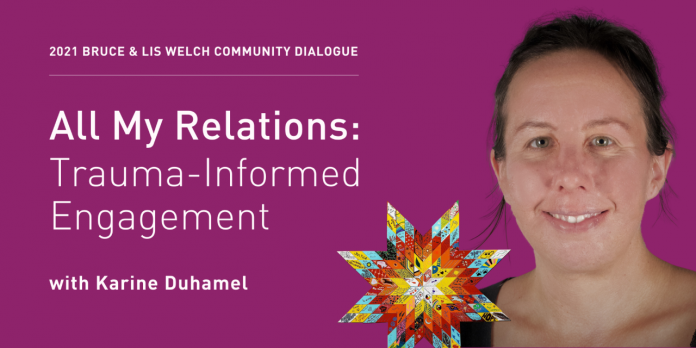
Dr. Karine Duhamel on the importance of trauma-informed approaches to private and public engagement

0
Illustration courtesy of SFU Morris J. Wosk Centre for Dialogue.

Written by: Gurleen Aujla, Peak Associate

This year’s Bruce & Lis Welch Community Dialogue event explored the importance of a trauma-informed approach in both our private and public engagements and how to best put our learnings into practice. 

The sold-out event featured Dr. Karine Duhamel, an Anishinaabe-Métis woman currently working as an independent consultant and historian. She is the director of research for the National Inquiry into Missing and Murdered Indigenous Women and Girls (MMIWG), and is working in partnership with the Government of Canada to create the MMIWG National Action Plan. The event was facilitated by Ginger Gosnell-Myers, a fellow in Decolonization and Urban Indigenous Planning at the SFU Morris J. Wosk Centre for Dialogue. 

Trauma-informed engagement is all about relationships —  your relationships to the past, to others, and to the world as a whole. Trauma is often thought of as simply an individualized experience, and while that may be true to some extent, the community also experiences trauma collectively.

When discussions take place around sensitive and deeply impactful issues, it is of utmost importance to utilize a trauma-informed process of engagement to ensure that those at the table are not reliving their trauma and to prevent an endless cycle of trauma. 

At its heart, trauma-informed engagement is a fundamental shift in how we approach the process of healing and moving towards the transformation of society through relationship-building, humility, respect, and the recognition of deeply embedded trauma-inducing structures. 

Duhamel touched on a few key themes during this event: the notion of individual human beings, the Western lens placed on trauma, and the characteristics of a trauma-informed approach.

Human Beings or Humans Being? 

Duhamel told us about her grandmother, the daughter of a residential school survivor, whose family spent a large part of their lives trying not to be or look Indigenous. Duhamel’s father passed away when she was 20 years old due to cancer and because of the trauma of that experience, their relationship dynamic completely shifted and she “felt like she didn’t really know him.” 

After going through these experiences, Duhamel talked about reconceptualizing the notion of the individual human being simply as being human. Highlighting the togetherness of people allowed Duhamel to better understand the process of healing and her grandmother and father as “humans in a relationship with the world and the circumstances around them.” 

Understanding that we are all interconnected as “one body moving through space and time” is a central component of trauma-informed engagement. Putting this principle into action means listening — really listening — to elders, survivors, and knowledge keepers. It is about forming deep connections and relationships with others, in an attempt to understand our unifying threads. 

The Western Narrative of Trauma

The most problematic narrative of trauma is that the knowledge of Indigenous peoples is centrally grounded on the trauma they have experienced. This “deficit-based framework” does not serve the purpose of community connections and healing. Rather, it focuses on individualized experiences and not the contributions to inter and multi-generational trauma and society’s perpetuation of systemic violence and racism. 

Duhamel emphasized the “unique knowledge” of Indigenous peoples having lived through both individual and collective trauma. This “experiential knowledge [ . . . ] allow[s] for understandings of systems, of policies, and of the conceptualization of problems and causes in a way that can’t be known by people who haven’t experienced it.” 

We need to be willing to be led by the real experts. Framing trauma-informed engagement in this light of valuing experiential knowledge will ultimately lead to more inclusive and impactful actions informed by those it seeks to serve. We must embrace trauma-informed engagement “not as a checklist, but a process, [as] a part of relationship-building,” and move forward, together. 

Characteristics of a Trauma-Informed Approach

Each circumstance in which a trauma-informed approach is being used is unique to those engaged. However, Duhamel highlighted a few key elements, such as being comfortable with being uncomfortable. Acknowledging the inherent value of experiential knowledge also means embracing uncertainty. Duhamel recalled her experience with the National Inquiry into MMIWG and having to get to a point where they were comfortable “being led by family members and survivors.” 

This goes hand in hand with humility and acknowledging that “you don’t know what you don’t know.” Duhamel drew attention to the importance of spending time learning about the people you are working alongside and the “unique context from which [their] experiences emerge.”

Another key element of a trauma-informed approach to engagement is creating safe spaces. Discussing topics that are polarizing or harmful can lead people to act upon their trauma, even when their intentions were not to harm anyone else. This is a natural part of the process and you want the space to be a “place of honesty [ . . . ] for whatever truth comes out, even when it’s a really hard truth, to inform the solution going forward.” Duhamel best put it, “safety doesn’t mean comfortable.”  

In practice, the principles with which we approach trauma-informed engagement must be co-developed with the communities engaging with the process. Setting up the systems and processes which value experiential knowledge is a fundamental step. 

Conclusion

In closing, Duhamel did a skillful job of explaining her decades-long work and the multi-faceted experiences of Indigenous people in a way that highlighted the core of trauma-informed engagement. We are all bound to make mistakes, but understanding the intentions behind our actions and the systems that impact trauma is a key principle to keep in mind. As Duhamel said, “The experience of living is a process of coming together and it was always meant to be.”

This event was hosted by the SFU Morris J. Wosk Centre for Dialogue as part of their 2021 Bruce & Lis Welch Community Dialogue series, an annual event dedicated to exploring complex community issues through an intersectional lens.

SFYou: Beveland-Dalzell siblings

1
Aaron and Heidi wear matching outfits on the day they are working in the same school. Photo courtesy of Ronald Nazal.

Written by: Yelin Gemma Lee, Peak Associate

Alumni featured: 

Name: Heidi Stooshnoff/Heidi Beveland-Dalzell (She/her/hers)

Departmental Affiliation: Bachelors of Science and Biology (2009); Bachelors of Education, minor in Environmental Sciences (2010); Masters of Education in Educational Practice (2020)

Hometown: Coquitlam (traditional unceded territories of the Kwikwetlem First Nations)

Occupation: Math/Science teacher with a specialty in Special Education (SpEd) 

Name: Aaron Beveland-Dalzell (They/them/theirs) 

Departmental Affiliation: Bachelors of Arts, minor in Creative Writing (2019); Bachelors of Education, minor in Curriculum Development (2020)

Hometown: Coquitlam (traditional unceded territories of the Kwikwetlem First Nations)

Occupation: Teacher Teaching On Call (TTOC)

Amidst Covid-19, Aaron Beveland-Dalzell graduated from the Professional Development Program (PDP) and joined their older sister Heidi Stooshnoff in the teaching field as colleagues and co-founders of Black Educators BC (Black Ed). They both aspired to become teachers after being impacted by one during their K-12 years: a pivotal experience that now influences the values they carry into their own classroom. 

“I didn’t love school — I really didn’t like most teachers. I was very aware of the fact that teachers talked about their students, and so once you were labelled a pain in the butt, that teacher was going to tell the next teacher [ . . . ] and your leash was kept very tight from the beginning,” Heidi recalled. 

“But I had a handful of teachers that didn’t do that to me, and so I think I went back into teaching to make that not the case for other students. I wanted them to know I didn’t care if they were actually a pain in the butt, I would not only like them but appreciate them [ . . . ] identify with them [ . . . ] and go to bat for them [ . . . ] That’s why it means so much to me to be a teacher; to be that teacher for other people.”

Aaron recalled a similar experience in grade six, being inspired by the first Black teacher they ever had, after which they began liking school and admiring great teachers.

“It was the first time I had a teacher who saw me — really saw me — and encouraged me to be myself. It changed my life,” Aaron said. 

“When I was subbing in their school, I hunted them down at lunch and we had a heart to heart, which I’ve wanted to say to them for years: [ . . . ] ‘thank you for all of the little things that you did, and all the stuff you put up with [ . . . ] I remember 9/11 because it was the first day you were ever late to class.’ It was the first time I saw a teacher cry, the first time a teacher opened up about their personal life.”

Aaron and Heidi keep these moments at the centre of their own values. 

Heidi currently teaches at Connex Alternative School in Maple Ridge, where she feels empowered to centre human-to-human relationships with students who don’t fit into the boxes of mainstream education. Aaron and Heidi both expressed that the Alternative setting —  which allows the time to invest in one-on-one relationships with students — is much more lenient in structure than mainstream schools and a place where they can best teach by their core values.

 “I think that teachers need to look holistically at students because if somebody is being [challenging], there’s probably a good reason for it,” Heidi said. “Teachers need to understand that behaviour has reason and purpose, and let go of the ego of being an educator. Kids need to be given the chance to be kids: make mistakes, be forgiven, and know that you’re not going to [hold a grudge against them].” 

Although Aaron currently floats around two districts as a full-time teacher teaching on call (TTOC) and experiences different classrooms each day, they also centre their pedagogy (teaching methods) on their core values of authenticity, humility, and compassion. It was their aforementioned teacher, whose authentic expression inspired them to embody their own genuine self. 

Recalling a time they lost their patience in a classroom, Aaron said, “I lost my cool and for that, I can apologize. And by putting myself in that position, I think I encourage other kids to do that too. You’re literally modelling it: show compassion, apologize first.” They added,“[If you] model humility, they’re more likely to [show] it.”

As a non-binary teacher, Aaron introduces themselves with their pronouns at the beginning of class to make themselves visible as a LGBTQIA2S+ ally. This has helped students feel comfortable and they’ve had students ask them for guidance on navigating gender. 

“By being a visible representation for them, I empowered them to step out into the light,” said Aaron. 

Aaron and Heidi co-founded Black Ed, an affinity group for local Black teachers. They recall its conception as a conversation they had during the Black Lives Matter protests, which they summarized as having all their white friends reach out to them and realizing “Oh, I’m everybody’s only Black person.” Both siblings believe it’s an invaluable addition to the teaching community.

“The motto of [Black Ed] is: ‘Connect. Uplift. Empower,” Heidi explained. “[It] is an affinity space for Black [teachers] who are working in a white space. They’re in positions of authority, trying to mold young minds, some of [whom] are also racialized. How do we do this? How do we be true to ourselves? When these things come up in our classrooms, how do we handle them? You just feel ready to engage in ways you might not have [otherwise]. Racial fatigue is a thing that happens, especially in the midst of Black Lives Matter.”

Aaron explained the intergenerational discrimination that happens in schools; their students’ experiences are no different from what they experienced, as well as educators 20 years their senior experienced. 

“[This] affinity space was something I never had before. I made my first Black friend at age 23, and all of my learning how to navigate race basically came from my sister and my mother,” Aaron said. “It’s great to learn how to teach from other teachers, but [to learn] how to be a Black teacher, you have to go to other Black teachers.” 

Aaron stated that they have only ever had two Black teachers, both at the same time, at the same school, in the entirety of their 23 years of education. Heidi affirmed this by revealing that she never even saw a Black teacher, until she became one. Black Ed started out with about 19 members at its founding in June of 2020, but now, only eight months later, has expanded to 77 members.

When asked about how they feel having worked in the same school together on multiple occasions already, they both expressed excitement.

“Working alongside Heidi has been a surreal experience. I’ve literally spent my entire life learning from her,” said Aaron. “Heidi is exactly the kind of teacher I expected her to be: patient, charismatic and sassy. But this has been her first opportunity to see me teach, and I feel a lot of pride teaching in her presence. [ . . . ] There’s nothing quite like teaching alongside your sister and mentor.”

“It’s the best! I’m just so proud of them,” said Heidi. It’s so cool for me to see the teacher that they are already in their baby months of education. I can say at this point in time, nobody understands my context as well as Aaron does. As a Black person in a district, as a young person in a district, as an educator with the same core values [fighting] the same battles that I fought and [having] the same uncomfortable conversations that I’ve had.”

Study shows the response to COVID-19 in Canada disproportionately affects women

0
PHOTO: SJ Objio / Unsplash

Written by: Kyla Dowling, Staff Writer

Women are disproportionately impacted by the COVID-19 pandemic, according to SFU health sciences research associate Dr. Julia Smith. A co-lead on the Gender and COVID-19 Project, Smith has been gathering data since the beginning of the pandemic to inform the policy response to COVID-19. 

The data revealed that frontline workers — the majority of whom are women — are overwhelmed with their work, mental health, and care work in the home. 

Smith explained responsibilities such as taking care of children and elders primarily fall on women. She said, “Women are giving up work so they can take care of children, elderly relatives or, in some cases —  if they’re frontline workers — they’re giving up work because they’re worried about infecting elderly people who are vulnerable.” 

She said this has a great financial cost, “Sometimes they’re giving up work because they can’t manage both.” 

In the Ebola outbreak in West Africa, “women became poorer than men disproportionately and it took longer for women to recover economically.” The COVID-19 pandemic is acting similarly, and Smith acknowledged COVID-19 acts differently across demographics. 

A large number of women have been unemployed since the pandemic began. Smith cited this as a concern because, “the longer people have been unemployed, the harder it is for them to get back to work, so we need to start asking questions about the long term economic effects.” 

The Gender and COVID-19 Project, which is funded by the Bill & Melinda Gates Foundation and the Canadian Institute of Health Research, has two goals. 

The first revolves around documentation. Using the Gender Matrix, a research tool designed as a framework to be populated by data, Smith and her colleagues intend to record the gendered impacts of the pandemic response. 

The second goal is policy analysis, which Smith described as using the data “to shine a light to policy makers to show the wide-ranging effects that policies have and encourage them to take a more gender-based approach.” 

Smith said in Canada, COVID-19 has not derailed progress towards gender equality — though it has amplified the need for it. “COVID-19 has made things even more urgent [ . . . ] We need accessible and affordable childcare. We need equal pay for equal work. We need affordable housing and access to clean water, including Indigenous communities.” 

You can find more information on the Gender and COVID-19 Project by visiting their website.

Senate Report: March 1, 2021

0
Photo from Peak archives

Written by: Karissa Ketter, News Writer 

Endorsement of the Burnaby Mountain Gondola

Last senate meeting, president Joy Johnson announced SFU is “working really hard to advocate for the gondola [ . . . ] to improve transportation up onto Burnaby Mountain.” Johnson remains “confident that this is the right project and the right time.”

“I wanted to give a real shout out particularly to the students who have been working hard,” said Johnson. She acknowledged SFSS president and senator Osob Mohamed, for her work raising awareness with the media

Johnson also recognized vice-president external Joanne Curry, who has been engaging with Burnaby City Council, as well as Burnaby mayor Mike Hurley.

Johnson said, “We are encouraging people to write letters into the mayor and Council of Burnaby [ . . . ] to advocate for this really important infrastructure for Simon Fraser University.”

Brief on data breach 

Senator Daniel Leznoff requested a briefing on the recent data breach. Leznoff asked for context such as source, intent, potential for ransom, and intervention with law enforcement. 

Johnson replied, “I don’t have a full answer to your question. I do know that there was a ransomware request but we had all the data backed up so we didn’t need to pay any ransom.” She reported that they have been working with RCMP.

According to Johnson, “There have been similar attacks to universities across Canada. Other universities are really experiencing a great deal of difficulty.” She said SFU is continuing to think carefully about data breaches in the future. 

Senator Colin Percival, who specializes in computer security, said, “[With] these sort of widespread attacks, people are going after money.” He acknowledged there are some organizations that undergo targeted attacks for information, yet concluded this attack is not likely consistent with this goal. 

Calendar Committee alters semester instruction day guidelines

Senator Stephen Spector proposed a motion to recommend that the guidelines for the amount of instructional days fall between 60 to 63. This is to replace the guideline of strictly 63 instructional days which has been in place since 2003. 

Spector explained, “The requirement to have 63 days of instruction worked fine, until the Olympics,” which is when the provincial government mandated a spring semester reading week. 

At this point, Spector said SFU “quickly ran into a situation where there simply weren’t enough days in the year” to maintain the strict 63 instructional day requirement as per the 2003 motion, which also required classes to begin on a Monday.

The policy would allow for some flexibility while aiming for the full 63 days. Senator Daniel Leznoff voiced concerns that overtime instruction would be compromised if calendars are repeatedly approved at 63 days. 

The motion was approved as each calendar will be approved individually by the senate. Johnson noted that if there are concerns around instructional days, they can be discussed when the semester arrives.

SFU’s pandemic promises have not been actualized

1
Petter’s words last year have been proven to be hollow. Photo courtesy of Greg Ehlers

by Dev Petrovic, Staff Writer

It’s been just over a year since we put campus life on hold and transferred our school lives online. It’s also been just over a year since SFU promised to maintain a certain standard for students, despite this virtual shift. Yet, the standard SFU claimed to be committed to maintaining isn’t supporting students as promised. 

In April of 2020, former president and vice-chancellor Andrew Petter released a statement in which he addressed how SFU is planning on “remaining engaged” throughout the pandemic. He stated that SFU has sought to uphold their “high standard of support for students through new channels, expanding communication and, just as importantly, listening.” While I can appreciate the optimism in this statement, based on what has happened since, it is entirely unclear what systems of support Petter was referring to. 

Certainly, the heightened use of Zoom and Canvas couldn’t count as a channel for student support. Other than the use of these platforms, SFU continues to function the same way it did at the beginning of lockdown, and it’s questionable whether this is a high standard.

It doesn’t seem that SFU has implemented the “listening” aspect of this statement either. As far as I’m concerned, it feels like an ongoing battle to be heard by the administration. I am not the first to express that the lack of communication between the administration and students has not improved over the course of COVID-19. These vague statements don’t actually promise anything of concrete value. 

The statement mentions that SFU has added resources in housing, financial support, and mental health. SFU set up an Urgent Response Fund, which was available for students requiring access to technology, to afford travel expenses to return home at the beginning of the pandemic, and living expenses for students disconnected from family or support systems. I don’t doubt that the fund was of assistance to some students, those who received the fund’s support are more than deserving of the financial assistance. On another note, it seems as if the fund only applied to a certain body of students with very particular extenuating circumstances, which can be limiting in a time where so many students are struggling. 

Students who are just barely getting by and/or don’t fit the criteria for the fund are left behind from receiving support from SFU even though they would greatly benefit from the aid. Besides, SFU isn’t even losing money with the initiation of this fund — it all came from alumni donations. There really isn’t very much stopping SFU from expanding the criteria for who can receive this fund. The tuition increases that went forward despite the concerns students expressed regarding financial stability during the pandemic especially didn’t help this exclusion. 

Additionally, the form of ongoing mental health support that SFU prides itself on rests on the apps MySSP and Here2Talk. However, these apps have received a lot of negative feedback around their lack of truly assisting students with their mental health. They are also not a replacement for quality in-person counselling services — which are currently unavailable due to campus restrictions. Supporting students during a global crisis takes more effort than pushing the already available phone services or simply reminding students to prioritize their mental health. I expected SFU to introduce some alternative options for students who are facing mental health obstacles at this time. These alternatives could include increased attention towards video call counselling, or an adjustment in the student healthcare insurance plan so that students can gain better access to a registered clinical counsellor. Alas, this clearly never happened. 

SFU has neglected to fulfill the empty words they promised students. Moving forward, this will continue to be an issue once classes resume in-person unless SFU finally decides to implement feedback given by the student body. Petter said that SFU had made it their “mission to do everything we can at this time of crisis to support our communities.” Though it’s clear that SFU has not done everything they can to support the SFU community.

New president and vice-chancellor Joy Johnson has not been in the role for very long, and although she’s made her own promises, we have yet to see concrete changes in mental health services and in the virtual learning experience. Of course, changes to this degree can be a long process, but it’s important that we as students don’t forget to hold the SFU administration accountable for failing to commit to what they promise to do. We are paying thousands of dollars for them to serve us, after all. It isn’t fair to feel like we can’t believe anything they tell us. Hopefully Joy Johnson will be more willing to communicate and listen to student concerns because we deserve to feel like we matter, not like we’re being lied to.

SFU professor discusses “the motherhood penalty” in the workplace

0
PHOTO: Camylla Battani / Unsplash

Written by: Karissa Ketter, News Writer

“My focus this [International Women’s Day] was to debunk the language of choice that is so often used to frame how women navigate their impossible slate of labours,” said SFU sociology professor Dr. Amanda Watson in an email interview with The Peak. 

This includes the “motherhood penalty” which “refers to gaps in pay, stigma, the long-term consequences of inadequate benefits, and their absence in leadership.”

The wage gap between men and women persists in our culture predominantly because women commonly seek flexible work arrangements so they can look after their children, Watson said. Society often frames this obligation as a choice for mothers in our culture — the language of choice for working women is “more meaningfully imagined as a strategic way to cope with sexist labour divisions and family precarity,” explained Watson. 

Watson acknowledged the “motherhood penalty” is much greater for Indigenous women, women of colour, queer and trans women, and women with disabilities since they “already experience negative perceptions of their competence in male-dominated workplaces.” 

This extends to young women — who may not want children at all, but are consistently seen as potential mothers, Watson said. The result is being “judged as less committed to their jobs on top of sexist and racist stereotypes about women’s competence and commitment.”

Watson said to take International Women’s Day to “think about how to educate ourselves about our unchecked biases and how these play out in organizations and society at large.

“Workplace organizational culture can do a lot to destigmatize family-friendly policies, especially by having senior leadership equitable culture,” said Watson. 

She explained part of this social shift should include men in leadership roles being mindful of scheduling meetings and opportunities for business development to take place at appropriate times for all employees. 

“There is so much that can be done to shift both the ‘motherhood penalty’ in paid work and the unequitable division of unpaid work in families that has been laid bare by the [COVID-19] pandemic,” said Watson.

“If I had a magic wand, the first thing I would do is launch comprehensive child care programming that is universally accessible, affordable, high-quality, and diverse.” Watson explained this has proven to “immediately reduce inequality between women and families.” 

She reported “several studies in the US and Canada have now indicated that single mothers have been hit harder than other parents in the pandemic with respect to job loss.”

This is because stay-at-home measures resulted in children’s facilities — daycare, childcare, or school — being greatly affected in March 2020. “Since women are less likely than men to work in jobs that can be done remotely and [single-parent] households are far more likely to be headed by women, single mothers were particularly hit,” said Watson. 

Throughout the pandemic, the federal government of Canada altered their qualification requirements for parental leave, said Watson. She added, “I think it will be interesting to see if we come out of this crisis with the much-needed updates to the policy that scholars and policy experts have been calling for.”

In relation to International Women’s Day, Watson said it’s an “anti-racist, feminist, New Year’s Eve, where we take a look at where we have come in the struggle for equity over the past year, and recommit ourselves to the struggle for the year to come.” 

Watson’s first book, The Juggling Mother: Coming Undone in the Age of Anxiety, is available now. She is currently working on her next book, researching the Birthstrike.

2021 Faculty of Communication, Art, and Technology holds undergraduate conference

0
Photo courtesy of Simon Fraser University.

Written by: Jaymee Salisi, News Writer 

On March 5, 2021 the eleventh annual Faculty of Communication and Technology (FCAT) undergraduate conference was held online. The conference provides students within the faculty the opportunity to showcase their ideas and interests in a community forum. 

With 63 projects and 84 student presenters, this year was the faculty’s largest conference. Keynote presenter Jeff Ward and a panel of four FCAT alumni shared career stories and offered advice to students.

During the panel’s discussion about the alumni’s current jobs, user experience designer and School of Interactive Arts alum Sean Warwick advised students to maintain a connection with colleagues throughout their academic careers. He said the interactive arts field is “a lot smaller of a community once you get out into the world.” 

To prepare for jobs out of university, panellists emphasized students should “be creative with getting experience,” whether through attending networking events, collaborating with faculty professors, or offering to help with social media at a current job.

Communication alum and marketing coordinator Tiana Marconato said jobs often look for writing samples. Her recommendation was for students to draft press releases independently or to reach out to local media outlets for publication.

Student attendees asked how selective they should be when looking for jobs. Kathleen Estanislao, digital marketing manager, advised job seekers to connect with existing workers at the job they are applying for to learn about the work environment before accepting an offer. 

The four alumni agreed it is important to have some flexibility because “your first job isn’t necessarily going to define your career [but] ultimately, you want to be happy on some level.” 

In his presentation, Jeff Ward spoke about his experience as an Indigenous entrepreneur, web designer, and software developer. He discussed the importance of centering values and ethics around work to ensure balance and fulfilment.

Ward currently works with nonprofit organizations, charities, and Indigenous initiatives to focus on “the impact of others through technology.” He helped develop an app called Next 150, which aims to advance reconciliation by educating users about the Indigenous land they are on.

Students asked Ward whether he finds value in career advisors with varying opinions from his own. He told students to look for people with “a diverse range of inputs.” He said it is important for people to balance their surroundings with others who can provide different perspectives, as well as with people who have similar views to maintain core values.

After the speeches, students shared their work. Presentations were split into two blocks, lasting one hour each. There were eight different rooms with an average of four projects being presented in each of them. Rooms were organized by theme, ranging from crisis disaster response to interactive design and media arts. 

Some speakers explored the narratives presented in certain news outlets, and others brought forward solutions to individual and global issues.

The event concluded with FCAT dean Carman Neustaedter thanking participants for their efforts in organizing the conference.

Don’t rush into post-grad life

0
Throwing your cap should lead to freedom and exploration, not stress. PHOTO: Vasily Koloda / Unsplash

by Alex Masse, Staff Writer

The spring semester is almost at a close, and many students at SFU are one step closer to graduating and entering what many hail as the “real world.” For many people, this is a scary endeavor, especially with the pandemic bringing anxiety to new highs. However, even outside of a global crisis, students should not feel the pressure to rush into another occupation right after graduation, but  should use the time as an opportunity to regroup.

There’s a misconception that after completing the years-long marathon of a degree, students have to immediately dive into the lifelong journey of retaining employment. But making quick decisions from a pressing feeling of having to be productive could hurt in the long run and may lead to taking a job that isn’t a good fit. Often, the first offer a student gets is not going to be the best one, and the last thing they want is to end up in a job they hate.

Obviously some students have financial pressures that lead to taking that first offer. Many can’t afford to wait for the perfect opportunity to fall into their hands, or to take a break to recover from school. Not to mention the negative effect the pandemic has had on student job opportunities. However, this haste shouldn’t be an expectation for all.

Graduating from university is an incredible achievement, and something many people never manage to do in their lives. I’ll be the first in my family to do so, and I’m sure I’m not the only one in that boat. University is a long, challenging journey and completion alone should garner celebration. 

Post-grad anxiety is also a very normal feeling. Even if people don’t talk about it, the worries are still there. Anxiety rising during this pandemic isn’t a good thing by any means, but if there’s one thing to take from that, it’s that students aren’t alone in their concern.

There are people who are trying to destigmatize solutions for this anxiety. Regrouping at home after graduation, for example, allows for saving money, alongside providing the most valuable currency of all: time. It’s not the most glamorous thing to do immediately after donning the cap and gown, but if it’s an available option, it can be a great occasion to reflect on both the past and future in preparation for the latter.

Management researcher David Burkus said in a TED talk that “so many college graduates immediately start wanting to make all their dreams come true at once — this can go wrong in many ways.” He’s right: there’s nothing wrong with being ambitious, but expecting to walk into a perfect life after graduation often leads to stress and burnout — not an ideal situation to be in.

Post-graduation life should be seen as a time of celebration rather than one of duress. There should be time for reflection, instead of rushing towards the first offer you receive. That post-grad life you want will come, but rushing to get there is not worth the hardship it may bring.

Survey compensation is a must

0
Survey compensation can benefit both survey takers and creators. PHOTO: Lukas Blazek / Unsplash

by Victor Tran, SFU Student

Once in a while, students get emails asking them to complete surveys for SFU, external companies, and even other students. Even though these surveys can be completed in students’ free time, they still demand time-consuming labour, with some surveys taking up to 15–20 minutes to complete. Because of this, survey compensation should be required, as it will not only pay for our labour but also increase response rates.

Every survey estimated to take 10 minutes or more should come with compensation for the best chance of success. Spending more than 10 minutes on a survey without any rewards can be a real pain, especially surveys with 40–50 questions, which can be demanding on a person’s time and attention. Consequently, the longer the survey, the worse the answer quality. Survey abandonment rates also increase with longer surveys, with 7–8 minute surveys seeing completion rates drop to as low as 5%. Survey compensation could solve this problem effectively.

With survey rewards, participants will have more incentive to finish a long survey. Though survey prizes may not sound appealing to businesses and schools who have to pay for them, the effect can be beneficial to both students and survey creators.

The most popular survey prizes are direct rewards and indirect rewards, each with pros and cons. Direct rewards (either monetary or non-monetary) are prizes given directly to the survey taker. This kind of reward can be very effective — especially for students — as free stuff can be appealing. Yet, not all free rewards are enticing to everyone. For example, if a person who doesn’t own a pet sees the reward is a voucher for a pet store, they may not take the survey. Survey creators can solve this issue by letting survey takers choose a more relevant reward. This can be done by working with a wide range of product suppliers to diversify the reward pool or launching a reward survey to indicate the most wanted prizes. Thus, survey creators may obtain a wider range of results as more people flock into filling in the questions for relevant compensation.

However, direct rewards have the potential to hurt the survey results. People might rush through the questions just for the rewards or complete irrelevant surveys — like if a person who doesn’t own a pet completes a pet store survey. Survey creators need to compensate their ideal patrons in an appropriate way to get optimal results.

Indirect rewards have the potential to do that. These rewards are when survey creators make a charitable donation in the participant’s name. This type of reward may not be as effective as direct rewards in increasing response rates. However, indirect rewards can potentially increase the quality of the survey results. Participants may want to complete the survey to help others and therefore won’t rush through them for self-interest. Surveys with indirect rewards would be perfect for students who want to help others easily by exchanging their time and effort to complete a survey.

For student-run surveys, due to the costs of this kind of compensation, it might not be possible to offer rewards. Instead, students could choose alternative options such as making the surveys shorter for an increased response rate. Yet, with large corporations and organizations like SFU, compensation is a must for all participants. Not only because of benefits brought to both parties, but also for the labour demanded from survey participants.

Compensation is needed for the benefit of both participants and survey creators. Students give their labour and time for the benefit of survey creators; thus compensation is needed to pay off that labour. However, they have to acknowledge that the type of compensation can make or break survey results, requiring an adequate method to give it.