Home Blog Page 341

SFUnexplained: The hair-raising truth about SFU’s construction

0
PHOTO: Chris Ho / The Peak

By: Clarence Ndabahwerize, SFU Student

Listen up, sheeple! SFU builds stuff for themselves, not for our wellbeing or our general interest. A lot of you may say you aren’t surprised, but what comes next will blow your minds! 

Recently uncovered documents mysteriously emailed to The Peak have revealed that SFU administrators were, at the time of the university’s founding, made aware of a hidden stash of exquisite furs buried by Simon Fraser himself somewhere on Burnaby Mountain. Apparently, the university just so happened to be built on top of this stash and was aptly named after the man who buried the stash beneath it. The furs are rumoured to be worth several million dollars, and SFU will apparently use the money acquired to partake in even more construction. Don’t believe this? Here’s your evidence!

A whole chunk of the campus is below ground?!

This was the strategy they used to start digging right before students’ eyes. Robert C. Brown Hall is actually a confusing labyrinth simply because whoever constructed the building was just digging an inglorious hole to unearth the stash of furs. When they didn’t find it, they just built a whole building at the digsite!  

How far do you think they’ll take this? They won’t even stop when someone accidentally falls in one of these holes because they’ll be labelled as off-limits construction zones with signs telling people to “keep out!”. I should know — I’ve been trapped in the pit across from the residence buildings for the past three years!

And it doesn’t end there . . .

Why do you think the construction workers keep digging huge holes before they build something? Think it’s the “contractors” laying a “foundation”? It most certainly isn’t! Those aren’t even real words!

Every hole dug at the beginning of a new project is just another opportunity for our administrative overlords to find the elusive stash. The genius in this is that they can visit the construction site in broad daylight to check whether the “X” on that particular occasion marks the spot! Of course, they’ll even get high-viz vests and safety helmets while doing so . . . 

Finally, the timing . . . 

This has been going on for so long that eventually, someone else had to begin shouldering the costs for the greater good (i.e., finding the stash of exquisite furs). Why do you think tuition has been going up over the years? More buildings equal more holes to be dug which equals a need for more money! And the stash of fur makes the benefit to the institution outweigh the cost to the students! My fellow students, we’ve all been tricked! We can’t go on like this! I urge you to take this matter— and a shovel — into your own hands. These furs are the key to a cheaper tuition, less construction, and a Cruella De Vil-esque fashion sense.

BC introduces three days of paid sick leave

0
PHOTO: BC NDP / Flickr

Written by: Jaymee Salisi, News Writer 

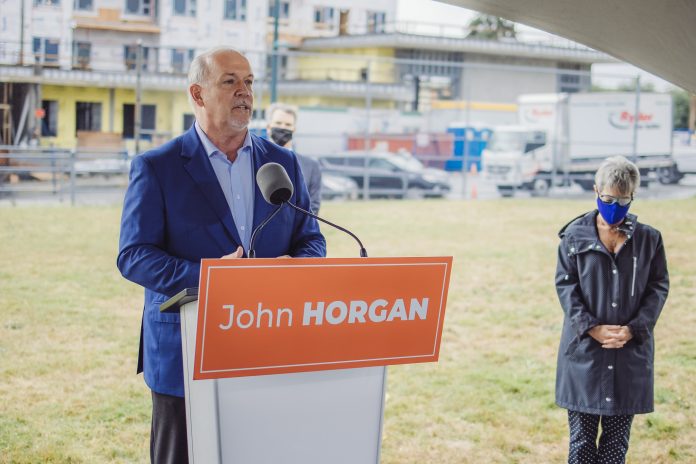
The BC provincial government announced a program requiring employers to provide part-time and full-time workers with three days of paid sick leave, if they are unable to work due to COVID-19 or possible exposure. The program begins once the legislation passes and will be implemented until December 31, 2021. 

Employers will be required to pay employees their full wage. If a person’s workplace does not have an existing sick-leave program, WorkSafeBC will provide up to $200 per day. Details on the reimbursement program will be available in June 2021. 

In an interview with The Peak, director of the labour studies program Kendra Strauss said 53% of workers in BC aged from 25 to 65 do not have access to paid sick days.

Strauss said this number “rises dramatically among the lowest paid workers.” She conducted a survey with the Canadian Centre for Policy Alternatives which revealed that paid sick leave is unavailable for 89% of workers earning under $30,000 annually.

The people working within this pay grade include those in the food industry, retail, and the cleaning sector.

If workers need more than three days, a separate federal sick-leave benefit application is available to them. However, employees would receive their first payment 28 days after applying. 

“For a lot of people that’s a really big barrier,” Strauss said. “People living paycheque to paycheque might not make rent or be able to buy groceries.

“Especially during COVID, three days is not enough. It does not provide enough time for people to stay home and self isolate if they have to.” 

She added, “Seven days is really the minimum we should be looking at for a permanent policy. I personally would like to see a model that ensures the costs are shared with employers so that the government and public are not paying employers who don’t offer these benefits.”

Although there is no precedent for paid sick leave during a global pandemic, Strauss recommended that BC’s provincial government draw on policy models made by various labour organizations in the province. The BC Federation of Labour and the Worker Solidarity Network proposed the implementation of at least seven to 10 paid sick days.

“Canada really lags behind other countries in terms of paid sick leave.”

Strauss expressed concern with providing government-funded options such as the $200 reimbursement for workers without a program for paid sick leave. According to Strauss, multimillion-dollar corporations making money during the pandemic can still choose to let the government pay for their employees paid sick leave.

The government reimbursement option is “another program that we as taxpayers are paying for,” Strauss said.

She said she understands that small- and medium-sized businesses may need government support. However, she is concerned about large corporations using government assistance when they can afford to compensate their employers. 

More information about the paid sick-leave legislation can be found on the website for the government of BC.

Three quick ‘n vastly underwhelming student meals on a budget

0
ILLUSTRATION: Shaheen Virk / The Peak

By: Paige Riding, Copy Editor

Breakfast: Breakdown-fast Bowl

You’ve seen the unsolicited breakfast bowl posts gracing your Instagram Explore Page. They’re right beside the equally undesired (or so you tell yourself) anime fan art of Naruto and Goku making out. For this recipe, you will need all the fruit you bought after swearing you’d eat healthily this week that’s now going bad.

Ingredients:

  • One browned banana stinking up your whole kitchen (“That’s not my banana,” you think, passive-aggressively glaring at your roommate until you realize it is.)
  • One bell pepper (Ha! Just kidding. That isn’t a fruit. Wait . . . )
  • Three apples purchased at different times (You put a bag of oranges over the old ones and forgot you had them. You told your mom you had meal prep down, but just look at you. Pathetic.)
  • One cup of yogurt (Yoghurt? Youhgourkt?)

Directions:

  1. Open the banana, inevitably smooshing the end into a browned pulp. Decide the fruit is past the point of no return. Throw it away. Feel insurmountable guilt. 
  2. Cut up the rest of your fruit. Stare in disgust at your pathetic collection.
  3. Pour the yogurt into a bowl. Realize with dread there’s dried-on food from last night’s dinner on it.
  4. Assemble fruit on top. Watch in agony as all the pieces sink into the yogurt. Serve immediately (but it’s too late).


Lunch: “Ramen”

Do you ever crave instant ramen then realize you already ate your last packet in an assignment-induced fever dream? Fear not. This ramen substitute will satiate your need by only sacrificing your self-respect and the entire “ramen” concept along the way.

Ingredients:

  • Minimum seven-week-old opened angel hair pasta package (It only took you one meal to realize why it was on sale. It’s sat untouched in your cupboard ever since.)
  • Countless accumulated soy sauce packets (“Wow, I really should use those,” you kept thinking. But you didn’t. Because you are you.)

Directions:

  1. Boil angel hair pasta according to directions. Do the noodles go limp when you grab them with tongs? They are ready. (I will not make a going-limp-in-your-hand joke.)
  2. Add as many soy sauce packets as desired. (I will not make a your-hand-is-all-sticky-now joke.)
  3. Enjoy (?).


Dinner: Gotta Be Beef Burger

What better way to end your isolated day, exactly the same as the one before, than with a burger that’s exactly the same as any bland burger you’ve ever eaten?

Ingredients:

  • The last end piece of a loaf of bread (You forced yourself to eat the first one when you started the loaf, but now you’ve left the last piece for a while. It haunts you.)
  • One Kraft Singles slice (The plastic wrap must still be on to mimic your textbooks this semester.)
  • A burger patty (Vegetarian options also work. I do not know any that work.)
  • Wilted spring mix (Man! You just bought that!)
  • Ketchup (What, do you measure how much you put on a burger? Pretentious ass.)

Directions:

  1. Cook patty in oil over medium-high heat. Scroll through your phone for too long. Check patty. Realize it is now reminiscent of a hockey puck. Ruminate. Eat it anyway since you can’t afford to waste it like the banana.
  2. Prepare “bun” and toppings. Attempt to squirt ketchup on bread. You forgot to shake it. Now your bread is soggy with ketchup water. Mmm. Add cheese. Add wilted spring mix. (You swear it was totally fine, but you forgot the first rule of spring mix: either eat it with every single meal for three days, or wait until the fourth and face its rotten wrath.)
  3. Add charcoal patty. Fold bread over and enjoy.

Online classes are the superior choice for hot student summer

1
PHOTO: Compare Fibre / Unsplash

By: Nancy La, Staff Writer

Staring out my window wistfully as the beautiful sunshine streams through the window, I snap out of my daydream as the alluring blue hue of my Zoom call beckons me. 

Nothing speaks summer like staring into little rectangles on a screen. In fact, to those who diss summer classes and complain about not being able to go outside for some Vitamin D (or to a social gathering for some Vitamin “D”), I present them with: the perfect connection. Who cares about Chad from Beta Lambda Pi when you could strike up a much more satisfying relationship with four bars of sweet, sweet WiFi?  

Summer classes also provide the perfect excuse for when I don’t want to join my friends’ online game (you know, the one game where you have to carry all your teammates). The excuse of “I have class later” is perfectly legitimate since I do, in fact, have class later. A four-hour lecture until 9:30 p.m., actually. 

“It’s all worth it,” I say to myself. Guess who’s going to graduate early and never deal with SFU again? Me! Because I’m taking these sexy summer courses, I get to graduate in five years instead of the usual eight. 

While other people are out flexing their summer bods, I’m flexing my student bod. That’s right — instead of bench pressing and sweating; my workout routine includes furiously typing my papers and slapping the submit button before 11:59 p.m.. It’s an exercise in both mind and body with minimal sweat, and there’s no better workout out there for the hot summer weather.

There’s no need to worry about finding the perfect summer outfit when the camera only captures up to my shoulders. I get to save money on clothes and not have to worry about an OOTD. Nobody can tell I have an embarrassing number of Pokémon T-shirts over Zoom. Plus, I get to wear them without people thinking I’m avoiding adult responsibilities by indulging in a childhood game. That is totally not what my Pokémon obsession is about.

Without summer classes, I also would not have realized the importance of my relationship with my desk plant, Phil. Who else will be here with me through thick and thin, watching over me like a guardian angel without complaint? You wish you had this kind of healthy relationship with your plant, but you can’t have it because you decided to abandon yours for “real people.” 

As you can see, the benefits of summer classes outweighs those of not taking them. I hypothesize that it takes at least three courses in order for you to see their benefits. The time for hot student summer is here, and it’s here to stay, my friend. Don’t just take my word for it, go and enrol classes to try it out yourself!

Spending an afternoon in Abbotsford? Visit Banter Ice Cream

1
This locally-made ice cream is un-cone-ditionally good. Image courtesy of @bantericecream via Instagram

By: Harvin Bhathal, Peak Associate

Growing up in Abbotsford, I associate some of my fondest memories of the city with eating ice cream in summer. While that could be said for almost any city, 72% of Abbotsford is located within the Agricultural Land Reserve, meaning farms (and dairy farms) are central to its culture. 

There are lots of good ice cream shops throughout the Lower Mainland, but Banter Ice Cream, which opened in Jubilee Park in July 2020, has quickly become my favourite. Created by a local couple, Laura and Zach Janz, the ice cream shop is one of the city’s best attractions for spending a sunny summer afternoon.

Laura Janz told The Peak their ice cream is made in-house using “as many ingredients from the Fraser Valley as [they can].”

Open every day of the week from 12 p.m. to 9 p.m., they offer a variety of flavours. These include classics such as melted chocolate and sweet cream to more unique options like hibiscus blood orange creamsicle and rhubarb cardamom cream. 

All of their flavours also come in take-home pints.

According to Janz, their most popular flavours are lemon curd, marble malt chocolate cookie dough, and sea salt caramel ribbon.

My personal favourites are their vegan blackberry crumble and vegan freckled strawberry flavours. The texture and the freshness of their ingredients really stand out.

Janz said their vegan ice cream “is made with a coconut milk base which makes it rich and creamy.” Living on a berry farm myself, I can tell when berries are at their freshest and when they are not, and Banter Ice Cream passes the quality test.

Banter Ice Cream launches four new flavours per month, and Janz shared that July’s batch of flavours is berry-based: blueberry basil, blackberry chèvre, strawberry hazelnut crunch, and elderflower raspberry. This July launch will fittingly coincide with the one year anniversary of their storefront opening. The berry flavours also represent their local roots at downtown Abbotsford’s farmer’s market.

If their creative flavours with fresh ingredients aren’t enough to convince you, what about their homemade waffle cones? These separate Banter from other ice cream shops in the Lower Mainland. The batter is made from scratch everyday and they’re made to order in front of you. As a result, the waffle cones are crunchy yet soft. The aroma is incredible too. It takes over your senses in the best way possible. 

The recipe for their waffle cones is a secret, but I detect a hint of vanilla. They’re also sweeter than most cones that I’ve tried, which definitely plays a part in their quality. 

Banter Ice Cream is busy 7–9 p.m. daily and all day on weekends. Janz said, “Expect a lineup if it’s hot and sunny.”

While Abbotsford may seem quite a ways away for those that live in Vancouver, Burnaby, and the surrounding cities, Banter Ice Cream is worth the trip. If you’re passing through Abbotsford, you definitely need to stop at Banter Ice Cream.

“Diaspora Stories” explores circulation and identity

0
Carmen Aguirre and Nuno Porto discuss what it means to be Latinx. PHOTOS: Carmen Aguirre, Peter Wall Institute for Advanced Studies, Museo Chileno de Arte Precolombino

By: Michelle Young, News Editor

Hosted in partnership with the Vancouver Public Library and Vancouver Latin American Cultural Centre, Diaspora Stories: How Circulation Defines Latin America was held over Zoom as a part of the Racism(s): Latin America & Identity series. These events aim to “explore the diversity of identities that form the Latin American experience.” 

At the webinar, Nuno Porto, curator at the Museum of Anthropology, presented objects from Chile. “My idea was to invite you to think of the circulation of things as a form of diaspora,” he said. Porto added that when thinking of museums and their objects, the significance is not in their material value, but rather the people behind them. 

“People made these objects, people eventually gave these objects to someone else, people collected them,” he explained.

The second speaker, Carmen Aguirre, detailed her experience being raised in exile from Chile. “My relationship to the land, here in Vancouver [ . . . ] is very different than an immigrant’s relationship to the land,” she began. Had it not been for the 1973 coup in Chile, she said, she and her family would never left. For that reason, Aguirre referred to her family as visitors in Canada — they aimed to return to Chile as soon as they could. 

“We couldn’t bring many things with us,” Aguirre said. She presented some of the objects her family brought with her: Diaguita (South American Indigenous peoples) blankets, a tiny handmade hat of horsehair, and a miniature tea set, among other items. “For me [these] meant Chile and the return to Chile.” 

As Aguirre spoke about leaving things behind and taking things with her, I reflected on my own family’s experience. Although my parents had the privilege of immigrating to Canada before Venezuela’s extreme economic collapse, they also foresaw a bad situation and knew they had to leave. They thought they would be able to return one day too. My parents waited for many years in hope that things would improve, but now that hope has faltered. 

I thought of the things they brought with them to Canada — my mother’s jewelry, photos, collectible cans. Aguirre said her “house is a museum,” and I was reminded of my dad’s apartment, where he has prints, books, and an array of knick-knacks that he’s attached to. 

I reflected on how nostalgia has shaped our family’s relationship to material items. As someone who has never particularly been attached to my belongings, I considered how grateful I am to curate the things I own. I recognized that I could collect objects without fear of losing them

Though the experience of diaspora ranges with each individual, I think nostalgia connects many. For some, the nostalgia is for their previous lives. For others, it may be longing for a life that was never experienced. At least for me, I have always wondered what my life would be like if I had grown up in the same country my parents did — that is to say, a Venezuela that isn’t plagued by food shortages, blackouts, and unrest

Concluding her presentation, Aguirre spoke about her family’s possessions once more: “They are my identity. These objects are tied — every single one of them — to a very specific memory and story [ . . . ] my roots are in Chile, these objects are the closest thing that I have.”

Climate research needs to be embedded in social justice, experts say

0
Photo courtesy of Simon Fraser University

Written by: Karissa Ketter, News Writer 

SFU Public Square held a webinar to platform the voices of climate advocates, researchers, and policy-makers. The event highlighted climate justice and the barriers of embracing equity within policy making. 

Event moderator Am Johal described the event as “a response to a growing problem as more and more research is being done to learn more about the impacts of climate change [ . . . ] There’s been a failure to adequately integrate equity and justice in our response.

“The pandemic has highlighted the many ways in which inequity is deeply embedded in our society. How climate change affects certain [groups] more than others, tells us the same story.”

Eugene Kang, an environmental lawyer, explained that climate justice integrates equity and intersectionality into climate change. This approach puts environmentalism within the same conversation of politics and power dynamics such as “white supremacy, patriarchy, ableism, and colonization.”

Over the past few decades, the top 5% of wealth “was responsible for about a third of the increase in emissions,” according to the BC Office of the Canadian Centre for Policy Alternatives senior economist Marc Lee.

“The carbon footprint of the wealthiest among us is so much larger than those at the bottom.” 

Lee highlighted that society’s response to the climate crisis will need to be inclusive of a variety of socioeconomic conditions, in order to be effective. For example, Lee noted while some individuals can switch to electric cars, others in lower income households ride the bus. Therefore, suggesting lifestyle changes such as buying electric vehicles is applicable only to those already socioeconomically advantaged.

“We want to think about structural changes like shifting to more complete communities [ . . . ] that levels the playing field,” said Lee.

Researchers noted a need for climate studies to collect demographic data to understand what communities and people are being affected. “We need to have information on who those people are and their lived experiences,” said SFU professor Andréanne Doyon.

This approach can help researchers take data and use it to formulate policy recommendations with real world knowledge of the systems at hand, Doyon explained.

Lee said part of his work in the Climate Justice Project includes examining inequality within climate policies. 

For example, having established that the climate emergency affects lower income people disproportionately, it is often assumed that disadvantaged groups will be more vulnerable to climate change. 

Instead, Lee calls on researchers to look for “stories about empowerment and resilience and transcendence” within marginalized groups. 

Climate change was built on “the rapid industrialization” of the west and a “rise in capitalism,” explained climate justice activist Anjali Appadurai. 

The climate crisis continues to be worsened by the systems of the global north being imposed on the global south, she said. 

The global south’s climate justice movements are “resisting structures that are pillars of the Western neoliberal economic world order that has been imposed on those countries as part of a post-colonial agenda,” said Appadurai.

“That model is based upon the extraction of natural resources and exploitation of human labour. That was only possible because of colonialism. Colonialism was what made the capitalist exploitation of land and labour possible in the first place — by stealing Indigenous lands,” said Appadurai.

Elected leader within the Squamish nation Khelsilem emphasized the importance of collecting data correctly to measure the success of climate justice practices and then using that data to create plans, targets, and implementation strategies that “would materially benefit people in communities in our society that have not historically benefited.”

“Our movements must [ . . . ] have strong international solidarity, because climate knows no borders, and it must be rooted in the context and the knowledge of the deep inequities that created and exacerbated the climate crisis. That’s the only way that we will get through this,” said Appadurai.

Meet the Team: Summer 2021

0

Vancouver non-profit offers free HIV self-test kits to increase equitable health care

0
Photo courtesy of the Community-Based Research Centre

Written by: Michelle Young, News Editor and Carter Hemion, Staff Writer 

The Community-Based Research Centre (CRBC) now offers up to three free self-test kits for HIV. Gay, bisexual, transgender, queer men, non-binary, and Two-Spirit British Columbians are eligible to recieve these self-test kits by participating in the CBRC’s Sex Now 2021 survey

Approved by Health Canada, the testing kits involve “a one-minute, finger-prick blood test.” 

Chris Draenos, a research manager for the CBRC said the kit “allows them to make the choice of how they want to test, where they want to test, who they want to disclose to, without having to participate in a health-care system where there’s barrier access.” Surveys suggest self-testing is preferred over other methods, such as in-person clinics. 

HIV self-testing was approved in November 2020 in Canada — oral HIV tests are currently unavailable.

Due to clinic closures, over 50% of LGBTQIA2S+ patients have missed appointments related to HIV and STD testing, Draenos said. “Even before COVID-19, there were access issues with HIV testing.”  

“Aside from that, there are structural reasons why people aren’t able to access testing.” He explained this includes lack of government health insurance and discrimination.  

“There’s also a lot of HIV stigma out there still. The criminalization of HIV is a huge barrier to people accessing testing. There’s fear of what might happen afterwards and many of the policies are still rooted in the ‘80s and ‘90s — science has moved on since then,” Draenos said.  

SFU professor and LGBTQIA2S+ health-care expert Travis Salway elaborated that stigma is intersectional. It relates to race, sexual orientation, gender identity, immigration, and sex work. “They all play a role because HIV — historically — hasn’t been evenly distributed throughout our population. Some groups have been more burdened than others. 

“HIV, as a virus, shouldn’t be different from any of the other infectious diseases that we’re contending with in public health — but it took on a particular meaning because the first visible cases were among these groups of people that were disfavoured by society,” Salway explained. 

In comparison to earlier outbreaks, there are now treatments and preventative education available for HIV. 

“But history lingers, so even though we have shifted our understanding of HIV [ . . . ] people still equate HIV with homosexuality and using injection drugs.” Salway added this stigma surrounds HIV and conversations of testing and safe sex. In turn, it can make conversations about HIV difficult — which is “one of many ways” the LGBTQIA2S+ community faces bias.   

Draenos explained that to begin to address HIV stigma, health-care providers should be trained to aid the LGBTQIA2S+ community to understand their experiences. He said this includes understanding the difference between sex and gender expression. 

Salway said sex education plays an important role in addressing stigma surrounding sexual orientation and gender identities. In regards to the self-testing kit, he said that while it signifies progress, “it’s just one step along the way.” The next steps would involve access to at-home health services, affordable medication, and providers who understand their needs. 

“Stigma really thrives on silence,” Salway said. “The antidote becomes talking.”

VANDU calls to revise drug decriminalization policies

0
Photo courtesy of Jean Swanson via Twitter

Written by: Karissa Ketter, News Writer

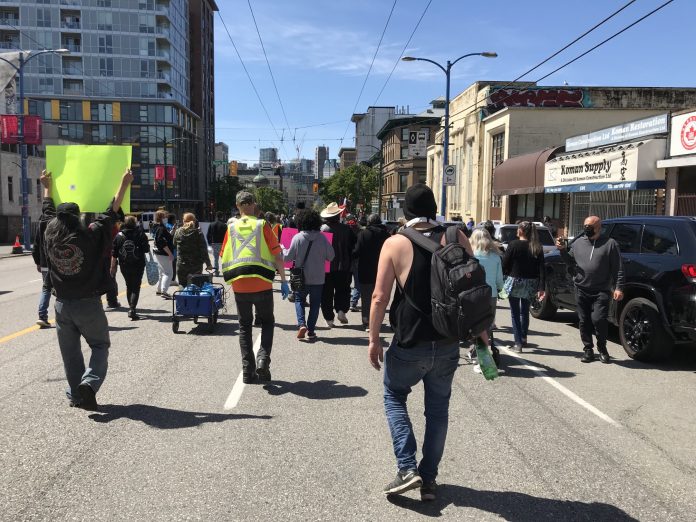
The Vancouver Area Network of Drug Users (VANDU) and allied organizations held a press conference on May 11, 2021 calling on the City of Vancouver and Canada’s federal government to revise their newest drug policy proposal. The new Vancouver model was recently submitted to Ottawa for approval and asks for Vancouver to be exempt from the federal Controlled Drugs and Substances Act. It’s described as a form of decriminalization that takes a health-care-based approach. 

The City of Vancouver proposes individuals be able to hold a certain amount of illegal drugs without being charged for simple possession. This model includes a voluntary referral system through which drug users can access support services if they choose.

“Decriminalizing the simple possession of drugs should help to destigmatize drug users. This stigma often prevents them from seeking help,” according to the City of Vancouver.

Scott Berstein, director of policy for the Canadian Policy Drug Coalition, said the current model has “serious flaws that will undermine its intended health and social benefits.”

One of the issues outlined includes the “lack of input from people who use drugs. Because of this, the Vancouver model fails to reflect the realities of current drug use,” said Berstein. 

Caitlin Shane from Pivot Legal Society said, “The people who most need the benefit of decriminalization — folks who are poor, unhoused, racialized — these are the folks who are remaining unprotected and overcriminalized [in the new model].”

Another flaw is individuals carrying “unrealistically low”  amounts of the drug. These thresholds “seriously undercut the intended benefits of the current proposal because [they’re] not based on reality,.” said Berstein.

According to Shane, the City of Vancouver also said the data they used in creating the drug threshold policies was out of date.

“Basing a precedent setting based on bad data is reckless, anti-scientific, and dangerous,” said Berstein.

The conference presentation noted concerns with the Vancouver Police Department (VPD)’s involvement. “This is a conflict of interest as the whole point of decriminalization is to remove police from the process, not bring them closer to it,” said Berstein.

VANDU called on the City of Vancouver and Canada’s federal government “to meaningfully engage people with lived experience and allow them to co-develop a vision for decriminalization.” They asked to update thresholds to accurately reflect drug use patterns and terminate VPD relations in regards to drug policies. 

“There is no legal requirement that police or law enforcement be anywhere involved in this process and yet the Vancouver Police Department has been given the final say,” said Shane. 

“Police have demonstrated time and again that they are far more invested economically and otherwise in protecting their own power, budgets, and image over and above the lives of people who use drugs.”

Kali Sedgemore, an outreach worker, also addressed concerns with how the Vancouver model disproportionately affects youth, as it allows the VPD to continue intervening with youth in Diversion Pathway programs. The voluntary referral system to support services for adults is not made available to young people at this time.

“We all know that means involuntary care [ . . . ] Youth don’t need involuntary care, they need harm reduction support,” said Sedgemore. Involuntary care is used when offenders refuse or are too ill to legally consent for rehabilitation, forcing them to be admitted.

The City of Vancouver reports that harm reduction strategies such as prevention and treatment strategies have produced an increase in people seeking treatment. 

Sedgemore also noted concerns with how the Vancouver model would increase risk for Black and Indigenous youth. The Vancouver Sun reports that 2014 data shows Black and Indigenous people are overrepresented in drug use data. 

Harsha Walia, executive director of the BC Civil Liberties Association added, “Racial inequalities exist in many aspects of Canadian society, including the economy, education, health care and more.” She noted the over-criminalization of Black and Indigenous people in BC as “both a symptom and a cause of systemic racism.”

The SFSS noted this concern in their BC Police Act Review in April 2021. They said youth who use drugs “have experienced disproportionate harm due to policing instead of receiving support.” They also encourage transformative justice in BC, “challenging the notion that increasing police presence and practices will increase safety.”

When asked if VANDU has seen any sign of hope of working with the City of Vancouver to revise their policies, host of the Crackdown podcast Garth Mullins said, “I haven’t seen any yet.”

According to CBC, Vancouver mayor Kennedy Stewart said that there is not enough time to revise the new drug decriminalization policies before the federal election. 

In response to the policy’s critiques, the City of Vancouver issued a statement: “The Vancouver model, as a whole, takes a leading approach to decriminalization that is well considered, compassionate, and based on local data, with the goal of reducing stigma and transitioning to a fully health-focused approach to substance use.

“The exemption we are seeking is the first of its kind in Canada [ . . . ] We respect the views of VANDU and other groups, welcome their continued advocacy, and hope we will continue to work together to update the model.”

Mullins said, “Decriminalization is not enough — we need to get [a] safe supply because we have had record overdoses in this past year.” However, “removing police is key — it’s an important first step.” By removing the police from the lives of people who use drugs, it “invites us to rejoin society.”