Home Blog Page 303

Hollow Twin reflects on the past in their new EP, Soft Hearts

0
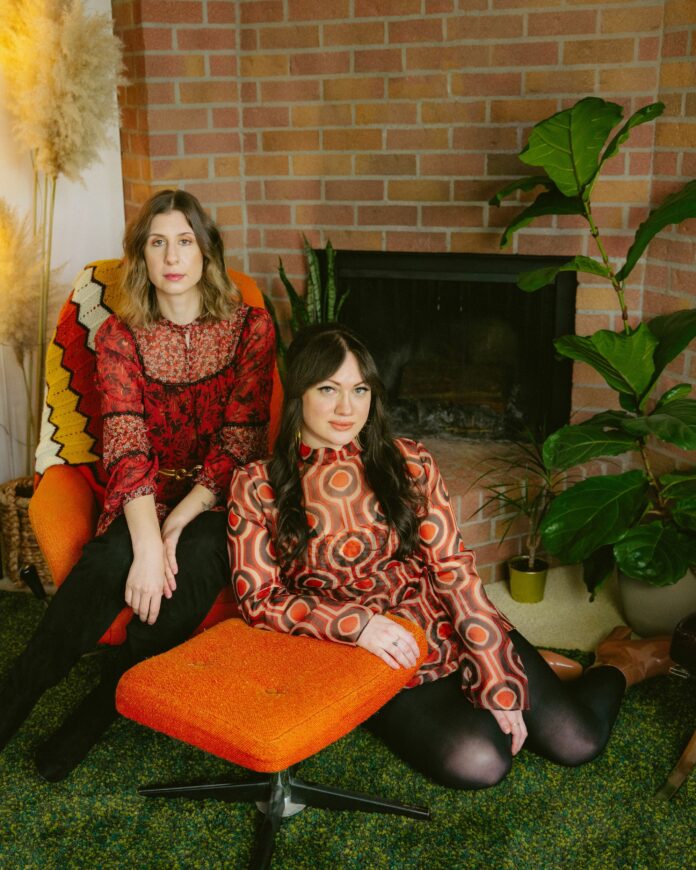
Emmalee (left) and Becky (right) sit on or by fuzzy orange furniture, set in front of a brick fireplace and flanked by potted plants
Emmalee Watts (left) and Becky Wosk (right). Photo: Reagan Jade

By: Kimia Mansouri, SFU Student

Based in Metro Vancouver, Capricorn moon duo Emmalee Watts and Becky Wosk — aka Hollow Twin — just released their new album, Soft Hearts. In it, the harmony of the instruments and their connection to the vocals are as haunting as the lyrics themselves. 

While listening to Hollow Twin, I was reminded of Hozier, Florence and The Machine, and Aurora. You can expect a lot of acoustics, string instruments, and a kickass bass with Hollow Twin. Their sound is a comforting and calming sadness that cuddles and weighs you down. 

If I were to describe Hollow Twin as an animal, it would be the Thestral from Harry Potter. While only those who have witnessed death can see them, Thestrals are clever and gentle creatures. The darkness, depth, and spirituality of the band has the same energy. 

It’s clear Watts and Wosk have an extraordinary bond that brings out this energy. The duo explained their music is inspired by talks about spirituality, being old reincarnated souls, a connection to the universe, and their interaction with the paranormal. Going by the intention and ambiance of the music, the artists decide what feels right and let the creative process flow naturally. “It was really free-flowing also in the studio because we said ‘this is what we’re imagining in this space,’ and then Laura Reznek and Jonah Ocean, who are our string players, would just freestyle,” Wosk, Hollow Twin’s lyricist, said.

Wosk explained that Soft Hearts “is an ode to us being sensitive and empathic and trying to be vulnerable. Well, not even trying. Just being vulnerable humans, and allowing that vulnerable side to come out through our music and be demonstrated and displayed to an audience that hopefully can connect with that and know that they’re not alone in those feelings of vulnerability.”

Wosk confirmed most of Soft Hearts “was written during the pandemic, or just the beginning of the pandemic even, and so it’s a reflection of a lot of feelings and having time to actually sit and look back at a lot of things that have happened in my life and I kind of tried to make it into a story that is something other people can connect to.” Similarly, according to the band, “Mother,” “Young,” and “Lying” all explore an introspective, ethereal, and cerebral depth of vulnerability that takes you down memory lane.

While some people might think Hollow Twin’s music is sad, I think there’s a proper setting for it. Hollow Twin gets you to sit with your emotions and embrace the darkness as a form of meditation. “I want to make people to feel something,” Wosk said.

Alongside the new album, the band has a lot of new merchandise coming out — sweatshirts, T-shirts, stickers, and tote bags. The physical copy of the album is on CD and includes bonus songs “Bound by Blood” and “(Don’t Fear) The Reaper.” Though they’re awaiting confirmation, fans can expect a full band show on April 14 if COVID-19 restrictions are lifted.

Student-Athlete Advisory Committee mental health campaign nominated for NCAA Award of Excellence

0
The group’s multi-year campaigns aim to bolster the mental health of student athletes. Photo: Marcel Straub / Unsplash

By: Luke Faulks, Staff Writer

After gymnast Simone Biles bowed out from the vault and uneven bars during the 2021 Tokyo Olympics, comments poured in supporting the star’s decision to put her mental well-being first. During any given competition, athletes are subjected to enormous pressures — from having to perform in front of crowds of screaming fans, to representing their team and making good on their own expectations. Add on to those pressures the strange and unpredictable rigors of a two-year pandemic, and you end up with growing and often unaddressed mental health struggles for athletes

 In October of 2019, SFU’s Student-Athlete Advisory Committee (SAAC) began running a series of mental health campaigns, starting with the “find your why” campaign. Developed with Health and Counselling, the campaign was aimed at sharing what helps SFU athletes keep moving forward. In 2021, an expanded campaign focused on resilience in mental health. SAAC “held group Zoom discussions, developed supports such as journal writing, meditation, and podcasts.” It also funded its own workshop centred around addressing issues impacting the mental health of Black and Indigenous students. It’s a program that’s now been recognized and nominated for an award by the NCAA.

Another important step forward, said track athlete Emily Chilton of SAAC’s Media Team, was hiring Charlie Law as a mental health caseworker for student-athletes.

While there’s no official measure of the extent to which student-athletes were affected by the campaign, SAAC president and golf team Captain Ryan Stolys says the feedback they’ve received has been positive. Stolys said SAAC is “confident we were able to reach a significant portion and believe our efforts resulted in a positive impact on many based on the feedback we received.”

Former SAAC member, Marina Cummiskey, says working to provide mental health services yielded personal benefits. She said the campaign required her to “not only reflect on my own mental state through researching and compiling various resources, but reciprocally gave me the sense of connection and community I was hoping to provide my peers.” Cummiskey added her involvement helped reinforce her interest in pursuing athletes’ mental health in her graduate career. 

On January 22, the NCAA will be announcing its pick for the Division II Award of Excellence which recognizes “community engagement and student-athlete leadership.” SFU will be competing alongside 26 other schools for a $2,500 first-place prize “intended to be used for future SAAC initiatives or community engagement events.”

 “Mental health is not something that can simply be ignored,” said Stolys. Looking ahead, the success of the program has inspired the SAAC to continue work to better student-athletes mental health, with a focus on burnout. Chilton says to expect a “Mental Health March,” adding the “goal is to give student-athletes the tools to recognize burnout, and some actionable tips to help prevent it.”

Students interested in catching up on past campaigns or attending future events can check out SAAC on social media, including Instagram and Twitter

All students should be taught climate literacy

0
A photo of the Stanley Park seawall. A pedestrian path separates the image into ocean and forest, and a small lighthouse is anchored in the foreground. The sky is slightly overcast, and almost blends into the sea.
Every day we see nature. It’s time we learn about it too. PHOTO: Kyle Thacker / Unsplash

By Tasha Romeyn, SFU Student

Properly educated, young people hold great potential to mitigate the effects of climate change. The environmental movement — which seeks to promote the responsible use of resources — has been gaining momentum, but how many students have time in their schedules to research climate education? Rather than shifting climate education onto students, we should build it into class hours.

By implementing education that creates connections between individuals and the environment, Vancouver can foster the development of pro-environment “green skills.” Manifesting in things like learning how to vocalize opposition to certain environmental policies, or in the recognition of the impacts of certain actions, green skills are necessary in pushing for the constructive change needed to protect our surroundings.

A good place to start is by facing what’s tangible — get to know your surroundings! Nature is all around us, and recognizing its presence is a great beginning to realizing its importance. It wasn’t until university that I learned about the Salish Sea — and I’m not alone in this. A survey found that less than 50% of Vancouver residents were able to identify the body of water that neighbours us.

Our ties to the environment cannot go untaught, especially in a coastal city like Vancouver. Rising sea levels make people on the coast increasingly vulnerable to displacement. Contamination and stormwater runoff have lowered the ocean’s water quality, making some shellfish unsafe for animals and humans to eat. An understanding of the extent to which we are affected by the ocean is critical for the survivability of coastal cities and should be an essential part of environmental education in BC. With a recognition of the impact that climate change will bring, people will be more motivated to enact change.

Through a guided tour of Stanley Park, I learned that the white berries which grow on many of the bushes we pass along the seawall have been historically used by Indigenous peoples for medicinal purposes. The wood makes a cleansing tea wash for babies and tea from the root can be used for post-natal wombs. Before this, I had never ever heard of the snowberry! Now, I look out for them any time I visit a park the way I look for a familiar face in class.

Climate education is impactful in even a short period of time. Students coming out of a one-year climate education course were found to have reduced their individual carbon emissions by nearly three tons per year. Educated individuals are further better equipped to lobby for the regulations necessary to prevent the climate crisis from worsening — 71% of greenhouse gas emissions since 1988 can be sourced from just 100 companies.

The climate crisis needs consistent education, and students need to understand their place in climate change. Helping students realize the broader effects of their choices by establishing immediate connections to the land, however, encourages engagement with the climate crisis in a thoughtful way. Whether that be from including climate education as a part of our degree requirements or in city-sponsored education programs, we need to learn about the environments around us. Only then will we feel empowered and compelled to protect the world that we (should all) know and love.

Humour is an overlooked tool in creating social change

0
Someone is holding toilet paper rolls over their eyes like binoculars. They are straight-faced, and it’s a very funny-looking photo.
A good chuckle can really change the way you see things. PHOTO: Cottonbro / Pexels

By: Sara Brinkac, Humour Editor

Ah humour, a beauty of a concept and a wonderful spice to life. What’s there to say about humour that hasn’t already been said? It shows intelligence (sometimes), it diffuses tense situations (most of the time), and it brings joy to our lives (all of the time). Humour is so extraordinarily versatile in its social uses that we often overlook just how powerful it can be in enacting social change. But who can blame us? Humour is a famously elusive topic and it can be tough to see how a joke about an orange can change your perception of the grocery industry.

As both The Peak’s humour editor and general human being, I have spent a lot of time thinking about funny; I’ve always surrounded myself with funny, and (to some readers’ disagreement) I like to think I am funny. But despite my credentials, I’ve always had a tough time pinpointing what humour is exactly. What makes something funny at its core? Why is it meaningful? What makes up one’s sense of humour? 

In my reflections, I almost always come back to the social importance of humour. Chiefly, how humour allows us to look at a situation from many perspectives. Through a curated perspective on life, humour allows us to see absurdities in our actions — as demonstrated by the video works of John Wilson — or be surprised by shifts in our perspective. You see tomato, I see Tom: a toe — and he’s handsome too. 

The ability to look at an object in many different ways is invaluable for developing understanding, and with understanding comes dedication to change. A 2017 study from the American University compared the impact of traditional information based documentaries and the comedy series Stand Up Planet on viewers. “People learned more about the global development issues by watching the traditional somber documentary, but they felt more watching Stand Up Planet,says lead researcher Caty Borum Chattoo. 

While it goes without saying information and informed actions are crucial to social change, so is emotional engagement. We understand there is chaos all around us, but monotonous presentation rarely stimulates. Humour allows us to change the narrative and speak with a more nuanced social tone that we as a species naturally resonate with. It’s when we are confronted with the absurdities of our actions that we begin to recognize those patterns in our everyday life and make efforts to change with a lighter heart. 

A terrific advocate for mental health can be found in the off-kilter comics of Alex Macdonald. Known on social media platforms as alecwithpen, his works are at once deeply personal and charmingly funny — prompting us to reflect on our journeys towards mental wellness. Oglaf, a sex-positive comic, has won accolades for its depictions of LGBTQ2A+ people of various races; showing us explicitly that sex is both funny and worthy in whatever forms it may take.

Humour reminds us there is always a different way to look at things, and there is always room to be surprised. When we start making light of our situations we begin to accept that our initial perceptions and (perhaps pragmatic) rules of reality are not all that stands. We can go easy on ourselves and others — heck — we can even accept that others have a beneficial view on life we hadn’t previously considered. And you know what that sounds a lot like? Empathy. One of my favourite ingredients in a stew I like to call social change.

SFU joins $24-million Indigenous-led global research project to protect biodiversity

0
an Indigenous fern in BC
The project aims to record how Indigenous peoples protect and preserve their land’s biodiversity. PHOTO: Debbie Ballentine / Flickr

By: Luke Faulks, Staff Writer

On January 12, 2022, SFU announced it would be joining Ărramăt, a “six-year, $24-million project” led by Indigenous peoples to protect biodiversity and investing in Indigenous research. The project will collaborate with universities worldwide.   

Dalhousie University assistant professor Sherry Pictou, Mi’kmaw from L’sɨtkuk, is among the principal investigators. “The research builds on the momentum and opportunities created in Treaties, by the Truth and Reconciliation Commission, the National Inquiry into Missing and Murdered Indigenous Women, Girls, and Two-Spirit People, and the United Nations Declaration on the Rights of Indigenous Peoples. We want to harness that momentum in ways that can create fundamental change to the status quo around biodiversity and health.”

The Peak reached out to Ărramăt for more details but did not receive a response. The Peak spoke with two Ărramăt project leads from SFU to find out more. 

Health science professor John O’Neil helped write the proposal for Ărramăt. After a successful pitch to the New Frontiers in Research, O’Neil has become one of six principal investigators working alongside international researchers and scholars. The project is based out of the University of Alberta, which is receiving $24 million for the endeavor. New Frontiers in Research is funded by the Government of Canada and is meant to provide funding for interdisciplinary research.  

According to O’Neil, beyond the substantial financial support, what sets the project apart from other efforts to tackle declining biodiversity is where funding is going. “Most of the funding is going directly to Indigenous governments, Indigenous organizations, [and] Indigenous communities to do the research.” The plan is for Indigenous groups to catalog their practices for protecting “biodiversity in their regions in order to protect the health and well-being of their communities.” Unlike other research projects of this scale, O’Neil says a university’s role in Ărramăt entails co-ordinating research efforts and funds, rather than leading the research itself.

With $24 million, O’Neil said the plan is to have nearly 140 “place-based projects.” These are the projects that will be run almost entirely by Indigenous communities. 

“Pretty well every eco-zone on the planet is represented in this project,” said O’Neil.

Health science associate professor Maya Gislason was brought on board as an expert in the relationship between ecological and social systems for the betterment of overall health. She suggests an overwhelming amount of conservation work is being done by an Indigenous minority. “We’ve got 80% of biodiversity stewarded by [5–6]% of the Indigenous population on the planet.”

Gislason explained the project aims to “bring those knowledge holders to the foreground. However, Gislason expects issues of institutional colonization in this project. “The scale and the scope and the Indigenous-led dimension of the project, it’s going to help challenge and surface out some of those systems that are not yet ready to actually do decolonizing work.”

The project, according to O’Neil, aims “to fundamentally change the way Indigenous knowledge is viewed as part of the global efforts to promote biodiversity” and intends to complete by 2027. 

The different pathways include recognizing Indigenous rights, decolonizing education systems, repairing the relationships between humans and nature, exploring Indigenous medicine, and strengthening Indigenous food and water systems. Each pathway is intended to address a specific wrong committed against Indigenous groups and the environment, from “poverty and economic exclusion” to “wild species disease and conflict.”

The project’s next steps involve establishing the research infrastructure to ensure the success of the endeavor. Ărramăt’s first big hurdle is to navigate the distribution of funds to Indigenous partners. The original proposal to the New Frontier in Research cemented the principles that guide the project, like notions of healing through a healthier environment, “but the actual practicalities of doing it need a lot of work,” according to O’Neil. Communication with research partners and hiring to translate the proposal’s principals into actionable research is next on the docket. 

Updates on Ărramăt can be found on the project’s website. Past webinars can be viewed through the site’s Events page, and the Story Map offers visitors a chance to scroll through the group’s mission in detail.

It’s time to end your dysfunctional relationship with Instagram

0
A photo shows someone holding a mobile phone. On the screen, a TikTok notification bar is asking: “Do you want to uninstall this app?” The person’s thumb hovers over they “Okay” button.
Putting distance between yourself and social media isn’t easy, but it’s worth it. PHOTO: Krystal Chan / The Peak

By: Ciara Reid, SFU Student

Ending a dysfunctional relationship is difficult, but things are usually better once you’re out. This was my experience in beginning the process of deleting my social media after two years of increasingly unhealthy use. 

Before the pandemic, my relationship to Instagram was as healthy as my relationship could be to a platform that causes damage to people’s mental and emotional well-being. Sure, I was constantly comparing myself and my life to those of the people I followed, but at least my time spent on the app was limited and my life outside the app was satisfying. And before COVID-19 , I wouldn’t have even considered downloading TikTok because I knew just how addictive it would be.

With lockdown, things changed. In the absence of other things to do, I spent hours on Instagram. I downloaded TikTok. Before I knew it, I was spending massive chunks of my day on social media. And I was feeling way worse. I was addicted. 

My addiction persisted beyond lockdown. In every free moment, I had my phone in-hand. I felt like I was looking for something: a laugh, the dopamine hit of a new “like” or a feeling of connection. But once my phone was down, I felt empty and frustrated — like I had achieved nothing. I had so many interests I never had time to explore, and I felt very alone. 

A 2017 survey showed social media is associated with worsened anxiety, depression, loneliness, and body image. While TikTok has yet to receive the same damning reviews, I can say from experience it is addictive. 

In a 2021 interview, Stanford psychiatrist Anna Lembke noted most people are at risk for social media addiction: because of its ease of access and the dopamine rushes it sends through our brains. What’s problematic, says Lembke, is that the more we are exposed to these dopamine rushes, the higher our “baseline” becomes — we feel the need to consume more. According to Lembke, after using social media we are “plunged into a dopamine-deficit” which — in addition to the constant comparison and FOMO we experience when using social media — leaves us feeling awful. 

None of us are truly unaware of how social media affects us. The evidence of its detrimental potential is everywhere. However, cutting ties with our social media accounts is not as easy as we might hope. Many platforms are designed to be as addictive as possible, and quitting them has been likened to dropping a cigarette habit.

I chose to delete my Instagram and TikTok because I no longer wanted to be on platforms that encouraged me to compare myself to others; I no longer wanted to feel the guilt of never exploring my interests because all my time belonged to social media.

We all owe it to ourselves to take a step back and assess our relationship to these apps. Irish podcaster, Blindboy Boatclub, puts it perfectly: substance use (and here I would include social media) is not inherently problematic or damaging: what can be problematic is our personal relationship to substances. As Blindboy argues, emotional awareness of how and why we use something, and the impact of its use on our lives, is essential. 

Lembke suggests taking prolonged breaks from social media to combat its addictiveness. And my process started with intermittent week-long breaks. This process made it easier to move toward outright deletion, fueled by my refreshed understanding of what’s best for my mental health. To facilitate the distancing process, apps like Forest and Digital Detox offer motivations to spend time away from social media. 

To be honest, I am worried about loneliness. I know I am losing some connection, and I have yet to see how this will feel in the long term. But damn, it feels good to have my time back.

Need to Know, Need to Go: Jan 31–Feb 13

0
Illustration of a blue calendar, with "Need to Know, Need to Go" written on top
Arts & Culture events to catch around the city. Image courtesy of Brianna Quan

By: Gurleen Aujla, Peak Associate

World Community Film Festival | February 5–13 | Prices Vary | Online and in-person

Attend the 31st World Community Film Festival from the comfort of your own home! A non-profit based on Vancouver Island is hosting BC’s longest-running social justice documentary festival. The 11 films spotlight women journalists in India, community connections to land and food, harm reduction in the Kainai First Nation, and socialism in economics. Viewers can purchase an all-access pass through the festival website, starting at $25, or individual film admissions starting at $8. 

CreativeMornings Vancouver: David Robinson | February 4, 8:30 a.m.–10:00 a.m | FREE | Online 

Vancouver’s CreativeMornings is hosting award-winning sculptor David Robinson for a breakfast lecture. CreativeMornings hosts monthly talks highlighting local creative talent and providing a space for individuals to connect. Robinson uses a variety of materials in his sculptures, often adding “psychological and mythological twists to his subjects.” Register for the talk on the CreativeMornings website.

The Secret of the Red Envelopes | February 3, 6:30 p.m.–7:30 p.m | FREE | Online

In the spirit of Lunar New Year, the Vancouver Public Library (VPL) is hosting a workshop on crafting your own lucky red envelopes. As a symbol of good luck and prosperity, they ward off evil spirits. The event will be hosted by Jeffrey Wong, vice-president of Wongs’ Benevolent Association, and Doris Chow, co-founder of the Youth Collaborative for Chinatown. Participants can register on VPL’s website.

SFSS explains decision to close Student Union Building

0
a study space inside the SUB building
The debate for closing the SUB took three hours. PHOTO: Kriti Monga / The Peak

By: Karissa Ketter, News Writer

On January 20, 2022, the SFSS emailed the student body informing them the Student Union Building (SUB) will be closed until February 18, 2022. In their email, they wrote, “In regards to high COVID-19 cases across the province and the return to campus mandated by Simon Fraser University (SFU), the SFSS Council does not believe SFU is taking appropriate measures to protect our membership.

“It is unfortunate that we have to make this decision, however, our concerns are the safety and health of those on campus.”

Former SFSS president Gabe Liosis and vice-president external relations Matthew Provost spoke with The Peak to discuss the Council’s decisions.

“We don’t believe that the university is doing enough to protect students,” said Liosis. He thinks the university’s mentality is that students are “going to get COVID-19 at some point. So you might as well just get used to that fact and move on with your life. We at the SFSS strongly disagree with that sentiment, and believe that it doesn’t really espouse the philosophy of community care.”

Liosis noted the Council was hesitant to close the SUB and their debate spanned over three hours. “So this was not an easy decision,” said Liosis. The Council recognized “The Student Union Building is a risky setting” because it encourages students to interact with others in close proximity where they cannot guarantee their safety. 

The motion to close the SUB was carried with 32 councillors voting yes, 9 voting no, and none abstaining to vote. 

“Our call on the university right now is that the Spring 2022 semester remains online until at least the Omicron wave peaks, and we see significant decline in the number of cases and hospitalizations,” said Liosis. 

Liosis reported the Council will determine at its February 16 meeting whether or not they will extend the closure. The criteria for this decision is currently unclear but Liosis predicts it will include factors such as COVID-19 cases, hospitalization rates, and their confidence they can guarantee safety for staff and students in the SUB. 

Liosis also predicts when the SUB does open, it will do so at reduced capacity. 

Prior to announcing the complete closure of the building, the SUB had been functioning at a reduced capacity. For the Fall 2021 semester, the SFSS re-organized and reduced seating to accommodate 150 people. Liosis noted the building can hold up to 1,000 individuals.

Provost noted some of the concerns that were outlined by fellow councillors at their meeting. Primarily, the concern around taking away space from students which will force them to cluster in other areas. 

SFSS’ decision to close the SUB has been met with some backlash on social media. “Students are now forced to overload into other areas of campus, which might increase the risk of COVID-19 transmission as it will be harder to physically distance,” said a student who started a petition to reopen the SUB. “The SFSS, a ‘student-focused’ organization has failed the students of SFU again as it seems like this move is a political move rather than a move that looks in the best interest of students.”

The SFSS statement noted, “We fully acknowledge the importance of the Student Union Building to both the mental and social health of those who use the building. However, we cannot and will not risk the lives of our staff and membership. We are not willing to contribute to a potential increase in COVID-19 case numbers on campus, and will not bear the brunt of decisions made by the university.”

The SUB was designed for social gathering. Provost noted that their staff has been forced to consistently remind students to social distance and wear masks properly. “We cannot guarantee that there won’t be exposure or transmission in the SUB.

“The truth is, this is not and will not continue to be enough without SFU also doing their part. It is unfortunate that we have to make this decision, however, our concerns are the safety and health of those on campus,” read their statement.

For updates on the SUB’s reopening, visit the SFSS website.

Poets+ is the future of Vancouver’s poetry scene

0
Portrait shot collage of, from left to right, Tawahum Bige, Tin Lorica, Jillian Christmas, and Justin Percival
Remember these artists; they’re going places. PHOTO: Arts Council of New Westminster

By: Alex Masse, Peak Associate

Released on January 14, Poets+ is the creative brainchild of the Arts Council of New Westminster, Fifth Chord Studios, and Tawahum Bige, the project’s curator. It’s a one hour showcase of emerging poets of colour that takes on “themes of identity, oppression, and reconciliation.” True to form, the event held a land acknowledgement in its video description, honouring the unceded traditional territories of the Coast Salish peoples of the QayQayt (qiqéyt) Nation, as well as all Coast Salish Nations. 

“I wanted to highlight BIPOC artists in the scene that not only are brilliant poets, but do so much more beyond that whether comedy, music, community advocacy and to give them the space to exemplify it,” Bige said.

Four poets performed back-to-back, sharing a variety of stories in a spectrum of styles. The piece opens with works from Justin Percival, a Nisga’a poet, who was born and raised in Vancouver but considers himself a visitor to the land. His poems touch on living in Vancouver, addiction, and hope. His style is rhythmic and driven, his natural flow undoubtedly a product of his background as hip-hop artist EnigmaDaPoet. As the grandson of a residential school survivor, Percival is personally connected to the themes of oppression and reconciliation, and his poetic repertoire holds memorable intensity. 

Up next is Tin Lorica, a queer Filipinx comedian who’s brought laughter all over the local scene, co-hosting comedy shows and even featuring on a Just For Laughs stand-up compilation album. They’re no stranger to poetry, having released a chapbook, Soft Armour, in 2020. In Poets+, their vivid imagery and cool flow paints pictures of diaspora, familial trauma, mother tongues, mental health, and — at one point — “the mistake of hooking up with a white boy.”

Third on the roster is Tawahum Bige. As a Two-Spirit Łutselkʼe Dene, Plains Cree poet, spoken word artist, and hip-hop musician, they’ve taken on stage and page alike. Bige shared music and poetry, including their debut single, “Shedding,” a hip-hop track with an energized flow and lyrics that snapshot both righteous emotion and beautiful, anti-colonial imagery. Bige’s words are born from life experiences, be that going through the court system as a land protector or growing up Indigenous in a colonized land. 

The showcase closes with Jillian Christmas, a queer creative facilitator and award-winning poet. Her body of work covered intimacy, healing, mental health, living as a woman of colour, and the racism she and others — family and strangers alike — have dealt with. She also brought some music to the stage, a one-woman symphony of a ukulele and drum kit. Christmas’ poetry is a lush, full-body experience, and some of the work showcased can be enjoyed in print in her poetry collection, The Gospel of Breaking

The whole piece is worth watching, and shows just how much can fall under the umbrella of what poetry is. Bige claims a major inspiration for Poets+ was to break down barriers between art forms. Poets+ may be just the beginning. 

“I hope it makes a big splash into the local scene and encourages more work like this! And truthfully, the intersections of poetry with other art forms is always an interest of mine and so it was really wondrous to get to move my own creative ethic forward,” Bige said. 

Poets+ is a beautiful look at the future of poetry in the Lower Mainland and the potential it has to uplift diverse voices and perspectives, because they have plenty to give and a beautiful way of doing so. It’s a medley of talent and names to keep an eye on.

View Poets+ on the Arts Council of New Westminster’s YouTube channel.

un/settled exhibit prompts students to create thought-provoking book display on Black artistry and solidarity

0
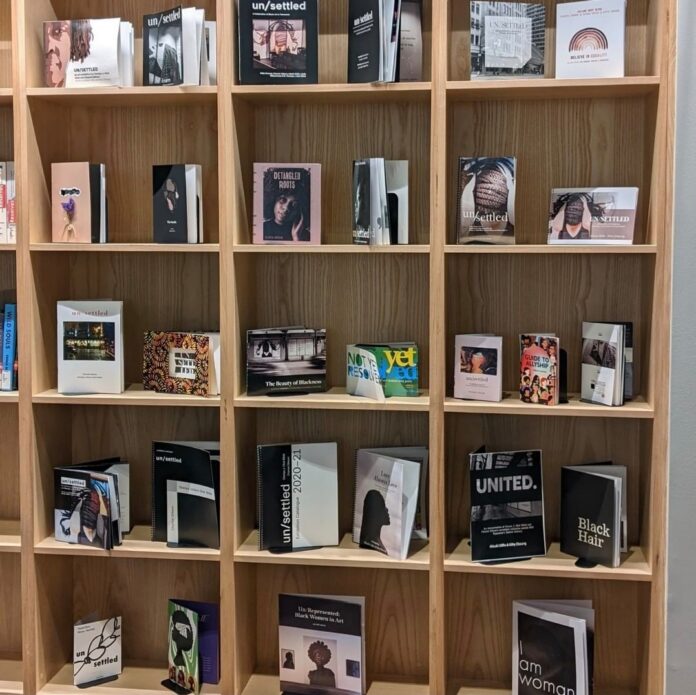
A tall, wooden bookcase filled with self-published books.
These books were made during a publishing class. Photo: @sfupublishing via Instagram

By: Sara Wong, Arts & Culture Editor

un/settled was a 240 foot installation celebrating Black womanhood, produced by Chantal Gibson and Dr. Otoniya J. Okot Bitek at the SFU Belzberg Library. Although it is no longer on display, the impact it had was profound. Inside the library, a book exhibit created by Fall 2021 publishing students showed work “based on, or in conversation with, un/settled.” 

“It’s a proposition for someone who wants to reflect on what it means to be unsettled. Because we should all be unsettled,” explained Dr. Okot Bitek in The Lyre. Using a variety of mediums, from poetry to guidebooks, the print and digital books class (PUB 331) aimed to further dialogue on Blackness in public space. 

As Peak contributor Linda Kanyamuna said about un/settled, “It’s important to recognize the urgency of solidarity in the scope of racial justice, and that standing in solidarity for Black lives is a communal effort.” And like Gibson noted in The Lyre, “The facelessness of the portraits created space [ . . . ] for others to identify with and find their own meaning in the work.”

In an interview with The Peak, some of the PUB 331 students discussed their book designs and what they took away from this assignment.

Rowina ChanThe Guide to Allyship

“Designing The Guide to Allyship was my response in sharing a how-to on becoming a compassionate and empathetic friend, family member, coworker, and so forth,” Chan explained. “The concept of community was something that resonated with me.”

Her pocket guide features open-source text about supporting communities of colour, which was created by Jamaican American writer and designer Amélie Lamont. It also includes illustrations by Latinx digital artist Pablo Stanley, which are accentuated by the die-cut cover. This feature allowed Chan to play with the interactiveness of her book, which was meant to reach a wide audience.

The die cuts were done by hand in order to stay on budget — a decision that made production challenging, yet satisfying at the same time. “My professor [ . . . ] was very generous and patient in offering her Cricut to do the die cuts, and it was truly a rewarding learning experience for both of us when it was our first time experimenting with the machine,” Chan said.

The Guide to Allyship would not have come to fruition without the incredible help of the teaching team, Mauve Pagé and Erin Chan,” she continued. “The technicalities with file formatting and design layout for printing are something I will carry with me for future projects.”

Melissa Ho — SFU Library resource book

Did you know SFU libraries are open to the general public as well as students? After discovering this, Ho decided the concept of her book would be to highlight the services these libraries offered, especially as they work to amplify BIPOC voices.

“Through interviews with Leanna Jantzi, head librarian of SFU Fraser Library, and Megan Sorenson, librarian for SFU publishing, I got to better understand the role of SFU in communities and how libraries have shifted from being exclusive places for the privileged to what they are today,” she said. 

“Growing up, buying new books was tough for my family due to financial reasons,” Ho added. “I wish I’d known the SFU Library was open to the public before I attended SFU, because I would’ve flipped through all the design books you couldn’t find at public libraries.”

Due to “personal matters regarding mental health,” Ho produced a digital book instead. “Pagé was extremely compassionate and understanding to accept my book beyond the due date,” Ho said. Though she did not get to print, the extra time allowed her to produce something she was genuinely proud of.

Alyssa LalaniDetangled Roots

“The concept of my publication was to embody the beauty of Black hair in an art book while educating readers on issues of hair-based discrimination,” Lalani said. “I was especially inspired after reading Linda Kanyamuna’s article in The Peak.”

Lalani’s work combines scribbly line art illustrations and expressive typography to represent natural hair. Though the design is quirky, a great deal of thought went into each element. For instance, the typeface — VTC Bayard — draws inspiration from 1963 March on Washington for Jobs and Freedom signs. This connects to the book’s theme of unravelling discrimination’s roots.

“The class went beyond mere graphic design principles and forced you to think about the story you are trying to tell,” Lalani said. “Mauve Pagé is an extremely talented book designer and I learned a lot from being in her class and having her critique my work.”

Knowing her project would be on display challenged Lalani to do something new with the book’s materiality. She ended up using coptic stitching for the binding, which added texture and mirrored Gibson’s technique of braiding thread in un/settled. “It was a little surreal seeing my book on the SFU publishing Instagram. I remember thinking to myself ‘wow, I really made that and it’s out in the world now,’” said Lalani.

Stefanie Pengun/settled poetry book

Wanting to directly honour the source material, Peng opted to create a poetry book with Dr. Okot Bitek’s work. “I’m not a Black woman, so I wanted to use the words written by a Black woman to convey the message of un/settled rather than using my own,” Peng said. Aside from highlighting Dr. Okot Bitek’s poetry, the book features greyscale photographs of nature and Black skin “to emphasize and spotlight the idea of Blackness.”

Peng also emphasized how personal these projects were. “This work had more meaning and weight than anything I’d ever worked on in school. It was simultaneously great and pressuring,” she said. During the process of designing her book, Peng sought to answer a variety of question prompts such as, “Why do I want it to look or feel this way?” and “What is its place in this world?” To her, it was important that what she showcased was evocative.

“Having my work up in the library for everyone to see in connection to the un/settled exhibit makes my work feel tangible and important, like the messages I weaved into it have some direction to go,” she said.