Home Blog Page 275

How to pick up dates in your major

0
candy hearts
Ditch the candies and start using this sweet talk. PHOTO: Laura Ockel / Unsplash

By: Tamanna T., Staff Writer

There’s been a lot of sex talk in this issue of The Peak — but let’s face it — there’s always a lot of  sex talk in your life but rarely any sex action. No worries, though. Getting it on only takes a change in perspective and a hearty drive to turn that frown upside down. Take your classroom for example — where you see chalkboards, we see a room chalk full of potential lays. So here’s a quick How To guide to help you secure some sweet sweet warm meat — enjoy!

Major: History

Pick-up Line: “Careful where you go, because that ass is a weapon of mass destruction.” 

Pro Tip: History majors can be notoriously flirtatious, because all they’ve got is time on their hands. Their brains are like mini-encyclopedias of dates, so feel free to ask them about all the sexiest years to get them in the mood — 69 A.D. seems to work every time. 


Major: Biology

Pick-up Line: “If I was a virus, I’d infect you with my love.” 

Pro Tip:  To the Biology majors reading this: it’s probably best to avoid this one for a few years. But if you do decide to use it, we suggest asking for a vaccine card and ID first. 


Major: Physics

Pick-up Line: “Hey, wanna go dancing? Because I can put your inertia in motion all night long.” 

Pro Tip: Sometimes, pick-up lines aren’t always the best way to a physics major’s heart. But if you buy them a couple beers and let them give you an in-depth explanation of how lasers work, this is often enough to create both figurative and literal heat every time.   


Major: Earth Sciences 

Pick-up Line: “Here’s my number if you ever want your world rocked.”

Pro Tip: If there are three things Earth Science majors love more than anything its volcanoes, minerals, and sex. Just keep tying back anything they say about these three subjects to the other and you’re bound to be creating friction in the sheets all semester long. 


Major: English

Pick-up Line: “Charles Dickens might have given you Great Expectations, but I can sure meet them.”

Pro Tip: English majors love anything convoluted. Really try to get them to read in between the pick up lines as much as possible. This will engage both their brain and libido. We have also seen great success in people who frequently — and correctly — use whomst in their sentences while sipping loose leaf tea out of a mason jar.


Major: Film Studies

Pick-up Line: “Are you into suspense films? Cause I can show you groundbreaking ones from Hitchcock and my . . . (cock).” 

Pro Tip: Film Majors truly believe that they can seduce someone by overexplaining a movie, and to someone outside their major, they’ve never been more wrong. But approach the hottie in your film seminar with your opinions on the colonialist implications of early 20th century travelogues and get the director to call “action” because you’re about to get some.

Horoscopes February 14–18

0
An illustration of a girl with long flowing hair. Astrological signs and stars shine around her.
ILLUSTRATION: Marissa Ouyang / The Peak

By: Sara Brinkac, Sexpert

ARIES: Unfortunately we don’t have a lot of sexual energy to use for your prediction since you’re a total virgin. But we can assure you that you will have sex . . . at some point . . . soon(ish)?

TAURUS: When people keep offering to eat you out, you need to stop assuming it’s just poor grammar. Also, we get that you love a free meal but that doesn’t mean your partner doesn’t want one too. 

GEMINI: I don’t know why you think it’s such a good idea to have sexual partners practically double your height but that’s OK. The commuters at the bus stop are getting a real show when you try to 69 with the blinds open.

CANCER: You seem to be a big fan of car sex. But always in the most uncomfortable cars and oddest locations. Next time you’re in the market for a partner, treat yourself to a nice Mazda 3 hatchback with fold down seats. We hear both the car and driver have great mileage.

LEO: We understand you need a first date idea for you and the cutie in your class. May we recommend skipping the tedious coffee, hopping over the boring first kiss, and instead just bringing a blanket to your next lecture? While your eyes are on the slides learning, allow you and your date’s hands free range, all while conveniently shrouded under a Doctor Who quilt. Whoever said “partner projects were hard work,” was more right than they knew.

VIRGO: It is highly advised you start adding a 20 minute pre-coital stretch routine to all your future sexual encounters. You aren’t the nimble jungle cat you once were and you’re about three reverse cowgirls away from a pulled hammy. 

LIBRA: No one said you couldn’t sweeten up your sex life on a budget. Go ahead — grab the frozen strawberries, crack open the Cool Whip, and drench your partner in No Name Chocolate Syrup. What’s that? What about edible underwear? We recommend looking into the great number of licorice weaving tutorials out there for the sexually and creatively inclined. 

SCORPIO: If you have been offered a fancy seafood dinner in Yaletown this week, do not go. The combination of oysters and wine is not the aphrodisiac concoction you are looking for. However, if you do decide to move ahead with this, all we can do is beg you not to go down on anyone.

SAGITTARIUS: That guy in your friend group you think no one knows you’re having sex with? Literally, everybody knows. But no one really minds, and frankly most people are supportive of it. It’s not worth being embarrassed over and it’s definitely not worth shoving him in the closet every time you hear a knock at the door. It’s time you own up to your relationship with Trevor.

CAPRICORN: Think twice before you try heating up your sex life this week. We’ve seen how nonchalantly you’ve handled candles in the past and are concerned that your partner’s desires won’t be the only thing burning that night. 

AQUARIUS: We’re so happy to hear that things between you and your partner are going fantastic in the oral sex department — but please — keep in mind that your walls are thin and your roommate is a lonely Aries.

PISCES: Word on the street is you and your partner are the “Hansel and Gretel” of butt plugs. We love to see you two expanding your sexual and rectal horizons but maybe try not to leave a trail of lost buttplugs in your wake. If you are really having that hard of a time keeping track of them, we hear keychains can be extremely convenient.

Top ten places to have sex at SFU besides the avocado

0
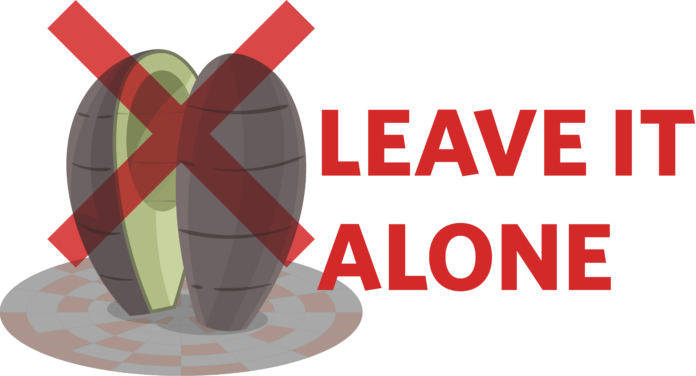
A picture of the SFU Avocado crossed out with the words “Leave it alone” beside it
The avocado has had enough of you. ILLUSTRATION: Alyssa Umbal / The Peak

By: Luke Faulks, Staff Writer

1. Quietly, under the covers in your dorm room

 Listen, you don’t have to be an exhibitionist, here. It’s perfectly acceptable to have regular old vanilla sex with a partner/real good buddy in your dorm room. If it’s any consolation, it’s still something the new federal conservative leader will privately consider to be “deviant.”


2. AQ Level four stairwell

The perfect middle-ground for any sexual romp around this is a great location for all you potential consumaters. Avoid the bottom of the AQ stairwell’s “call security on me” kinda vibe, avoid the strenuous climb to the top that leaves you completely spent (not in the fun way) and choose the level four stairwell! You retain the quiet nature of a stairwell, the general seclusion of a concrete abode and not to mention a nice view* of the AQ!  

*Please be advised windows have been known to work both ways.


3. Literally anywhere in the Goldcorp Arts Centre

Join all the other sexually liberated arts students on campus and become a busy little worker bee in the sex hive that Goldcorp was always designed to be. Go ahead — do the devil’s tango in the dance studios, bang someone’s box in the concert halls, and even feed your partner’s reel in the movie theatre — have fun with it! 


4. The Student Union Building

There’s no reason why bonkin’ can’t be a political message. Hop into the SUB, throw together some of the modular couches in the nap room, and start thrusting your signature onto your partner’s change.org petition!


5. The Burnaby Mountain Park parking lot

Did you know SFU has a specified make-out point that’s not a metal statue children play in!? Just a short walk/drive from campus and you’ll find the parking lot for Burnaby Mountain Park. Pull up in your parents’ car and start contributing to the melodious moans of about 40 other couples who had the exact same idea today! 


6. The SFU Library’s fifth floor

Some say the best revenge is living well, but obviously, those people haven’t had sexy times in the library’s quiet floors. After years of librarians shushing us into shape, why not shatter the carefully curated silence of SFU’s quiet areas with some riotous shagging?


7. On the football field

Danger? Check. View of a starry sky? Check. Comfortable lying position? Check(ish). For your next sexual rendevous, we reccomend the middle of the SFU football field in all its LED glory. Let the muffled cheers of bus passengers whipping by and disgusted glances of strolling families get you and your partner in the mood for some nefarious nookie. 


8. DIY in your dorm

You may have the dorm room but not the partner to match. Don’t let that stop you from partaking in self-care though. It’s time you start testing the plumbing, polishing the bannister, churning the butter —  you get the point. Treat you and your hand to a nice night in — light a couple candles, put on some early Justin Timberlake tracks, and have a simple evening of private pleasure — you two deserve it!  

Wait, I have more. Giving yourself the low-five. Choking the chicken. Coming into your own. Pulling the taffy . . . OK I’m good now. 


9. The Harbour Centre lounge area that overlooks Port Vancouver

We’ve talked about the excitement around getting caught. But what about straight-up danger? There’s no bigger stage in the Lower Mainland, and no better window for the whole city to see your sexhibitions than the Harbour Centre lounge area. We strongly encourage all readers to give this location a try and make as many euphemistic puns as possible surrounding docks, harbours, and precious cargo to really set the mood.


10. The Avocado

Who am I kidding? It’s an absolute classic for a reason. Go ahead and make a pit stop with your partner tonight. Just please clean up after yourself this time.

Upcoming FCAT Conference to showcase student projects and voices

0
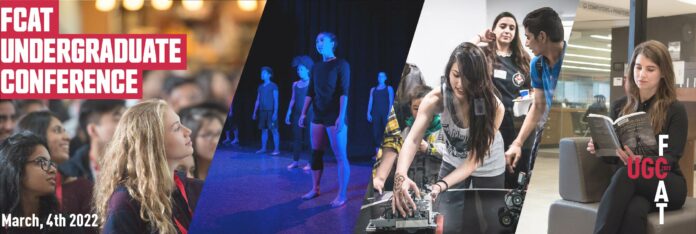
a horizontal panel in three parts, each part has students watching or presenting a project
PHOTO: Courtesy of Victoria San Martin

By: Karissa Ketter, News Writer 

SFU Faculty of Communication, Arts and Technology (FCAT) is setting the stage for their annual Undergraduate Conference on March 4, 2022. 

Students from any FCAT school — contemporary arts, communication, interactive arts and technology (SIAT), or publishing — were able to submit projects from “Fall 2021 or a previous semester.” The FCAT conference website explains “the conference is an opportunity for students, faculty, staff, and industry members to come together, share knowledge, and build meaningful connections.”

The conference allows for submission of art exhibits, films, research papers, live performances, or co-op work reports for consideration. School ambassadors will select a curation of student projects to be showcased at the conference and invite selected students to present their projects. 

Jacob Lee is one of the students hoping to present at the conference. A fourth year communication major, Lee submitted his research on the way the COVID-19 pandemic has been represented in news media. In a statement to The Peak, he outlined his presentation. “My project was a research paper that investigated the origins of COVID-19 and how certain news outlets covered this issue.

“I conducted a framing analysis on 40 total news articles from CNN, CGTN (news outlet from China), and Fox News, to see how each outlet framed this issue. I found that by doing this, I would be able to uncover some of the underlying political motives that each news outlet had when covering this topic,” said Lee. 

Judy Yae Young Kim is also a fourth year communication student who submitted research on Twitter’s artificial intelligence translators. “Before the implementation of Twitter’s automatic translations (powered by Google), the international K-Pop fandom had to rely on the power of fan translations. Now with automatic translations, the fandom relies on fan translations less, which brings up a concern to those translators that received celebrity treatment.

“People have this idea that in first or second year classes, you might not be as able to be ‘creative’ since you’re still learning the ropes of Communications Studies. I think my project challenges that notion because I was able to take something I am interested in (K-Pop) and turn it into a school project,” said Kim.

“Since FCAT is such a diverse faculty, the conference is a great way to bring students together from different departments and explore the faculty’s overall academic excellence and achievement,” said Lee. 

The Peak reached out to Victoria San Martin, communication, design, and event assistant, to find out more.

The conference “is a celebration of all the hard work that students put into their courses,” said San Martin.

The conference has been hosted since 2013. This year, it will be held virtually through the online conference-hosting platform, Hopin, to keep community members safe and reduce the risk of COVID-19 transmission. 

“One of the coolest things about it is there’s projects from films, dance performance, or research papers. There’s even some video games from our SIAT students. So it’s really exciting to see the amount of projects and different things that you can experience at the conference,” said San Martin. 

The keynote speaker at this year’s conference is award-winning Cree Filmmaker, Dr. Jules Koostachin. She completed her PhD in gender, race, sexuality and social justice at the University of British Columbia with a focus on Indigenous documentaries and relationships to storytelling.

“She’s going to be talking about her experience, her journey, and how she’s gone to find her voice in this area of the arts. And then she’ll also be tying that into sharing wisdom she has with the students who come to the conference,” said San Martin.

The FCAT conference will also have a question and answer panel with SFU alumni from each of the FCAT schools. There will be 39 students presenting a total of 20 projects at the conference.

For announcements on how and when to register for the conference, details will be uploaded to the FCAT conference’s website and their instagram, @fcatatsfu.

SFSS Spring 2022 Referenda: Equity Through Democracy

0
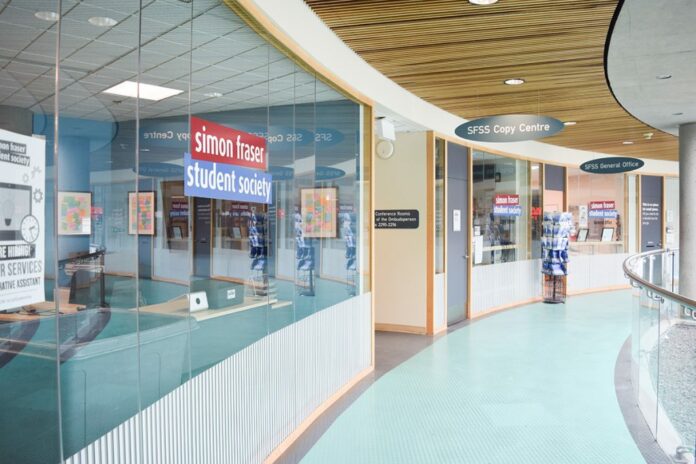
Simon Fraser Student Society office in Maggie Benston Centre.
Voting for the establishment of these fees will happen February 15–17 and be available through SFU Mail. PHOTO: Chris Ho/ The Peak

by Balqees Jama, SFU Student

Editors note: The author is president of SOCA and is currently advocating for this referendum.

The Simon Fraser Student Society (SFSS) 2022 Executive Elections are currently underway and among the five referenda questions, two are about establishing long-term financial supports for constituency groups that support Black, Indigenous, and disabled students on campus. A referendum is a vote by students towards a specific question, often to support a cause. 

These groups consist of Students of Caribbean and African Ancestry (SOCA), the First Nations, Métis, and Inuit Student Association (FNMISA — formerly FNSA), and the Disability and Neurodiversity Alliance (DNA). This student referendum would establish two new fees that would enable them to better support their membership: the SOCA Black Student Support Fund and DNA Disabled and Neurodivergent Student Support Fund. Additionally, there would be an increase to the already established First Nations, Métis, and Inuit Student Association Fund fee that was created in 2002 by referendum. These fees would total $3.50 per full-time undergraduate student and $1.75 per part-time undergraduate student for each semester.

The pool for funding is yet to be established, and would be based on student enrollment. 


How will these fees help us help our communities?

There are some specific culturally relevant resources and activities that these groups do now that would be bolstered by the establishment of these fee levies.


Events 

This includes cultural nights and festivals, workshops for people to learn either within or outside the community, and social gatherings, among others. 

For example, at SOCA, we host the Black History Month panel discussions, create and support other Black History events on campus, and organize the Annual Black and African Diaspora Cultural Night or Formal Dinners. These are hosted to create a safe environment for the varied Black communities to come show up and #Slay royally. 

The FNMISA holds a Term Dinner which is an opportunity for the community to join together, share in a meal, and end the semester in a nice way. 


Advocacy

This would include a myriad of advocacy initiatives to support marginalized constituents. For instance, SOCA has launched many campaigns pushing SFU to ensure there is increased Black racial equity on campus including:

All of these campaigns have tremendous long-term impacts for Black communities on campus, setting up systemic and permanent structures to support Black community success. 

Or, we could look at the FNMISA’s “Let Us Speak” campaign that highlighted the need for the FNMISA and Indigenous students to be properly included and consulted for the creation of the First Peoples Gathering House. There has also been advocating for increased safe spaces for Indigenous students via No Cops on Campus on all three campuses. 

Lastly, DNA has had many advocacy wins: 

DNA is currently garnering widespread media attention with their most recent statement on the Return to Campus, which advocates for hybrid learning and centring disabled and immunocompromised SFU community members in COVID-19 policy.


Resources and Programming

This fee will aid continuous programming such as peer mentorship and support for the community, faculty and staff; bursary contributions; educational, equity, diversity, and inclusion, and decolonizing workshops and seminars. Along with sharing resources, this allows students to know how to access support on campus from a specific equity lens serving these unique communities. 


Operations and governance

This is needed to ensure the staff supports are adequately provided and that SOCA, FNSA, and DNA continue to be run with direction by Indigenous, Black, and disabled members of the groups. These include staff support training, governance training, collaboration with community groups on campus relations, and physical office supplies and furniture for the spaces to be continuously relevant.

These fees will help provide long-term sustainable support for equity-seeking constituency groups to continue serving students. This fee levy is to be designated by SFSS as an opt-out fee, so if students are not able to afford the $3.50 fee, students could opt out of paying. However, due to the collective efforts of students coming together, a lot of support would be given to serve these equity communities, led by these communities.


Your Support Matters!

Every student can take part in supporting communities on campus by supporting the work that these groups do. Just as our predecessors had laid the groundwork for community support, we can ensure future students can come to campus, have these spaces, and call SFU home.

In total, 43 student groups, 13 SFSS candidates, and 2 SFSS parties have endorsed the campaign. This shows that student groups and their leaderships are ready and willing to support and care for, and empower communities to continue to thrive. Now we implore all students to support these groups as these referenda questions go forward. 


What to do from here?

1) Students can vote! There will be a link to vote in SFU Mail February 15–17 

2) Students can message others to vote

3) Students can follow @sfudna, @sfu.fnmisa and @sfusoca on social media!

Learn more: https://bit.ly/RefFAQs 

You can find more information about the SFSS referenda here: https://sfss.ca/elections/referenda/ 


Eight Questions with SFU softball

0
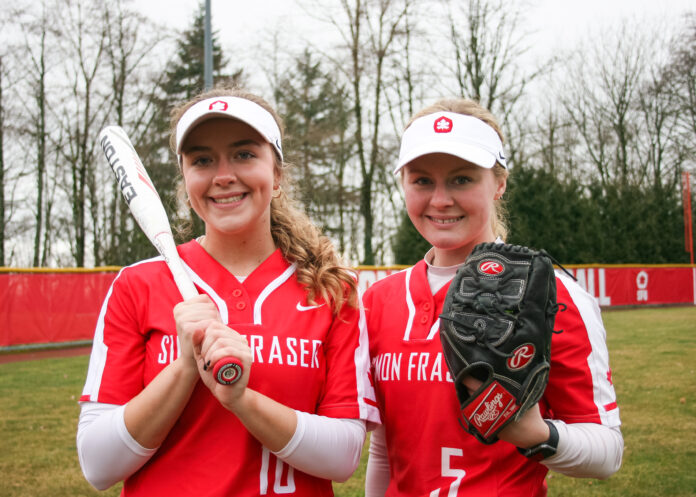
SFU softball players Rebecca Kirkpatrick and Lauren Schwartz pose with a bat and glove in uniform on the field.
SFU’s sophomore outfielder and junior infielder take a trip down memory lane to reflect on their style of play and most memorable tournaments. Photo: Gudrun Wai-Gunnarsson / The Peak

By: Kelly Chia, Staff Writer

On February 18, the SFU softball team is heading to Arizona to play five games in the Cactus Classic tournament. They are entering the tournament ranked fifth out of seven teams in the Great Northwest Athletic Conference. After welcoming a group of nine freshmen and a transfer pitcher in January of 2021, the team is raring to compete together after opting out of last season. 

The Peak was able to get to know two SFU softball members: Rebecca Kirkpatrick and Lauren Schwartz. Kirkpatrick majors in Criminology with a minor in Physical Geography and GIS systems, and is studying for her Forensic Sciences certificate. Meanwhile, Schwartz is among the newcoming class, transferring from Bellevue College in Washington. She has a double minor in English and Kinesiology.

P: What do you like most about the culture of softball competitively?

K: I like how every game is different. One person could be dominant in one game, and it could be a completely different person [the next].

In one game, it could be a pitcher’s duel where it’s a low-scoring game, and then all of a sudden it could be a 10–10 ball game, so it can flip very easily.

Schwartz laughed.

S: Yeah, I guess that’s both a pro and a con in some ways.

I like how relaxed it is, but then the moments of excitement are super exciting. Especially playing outfield, you are mostly standing around, but when you have to make a play, it’s super important.


P: Is there a misconception about softball that you’d like to clear up?

S: There’s always the baseball/softball comparison everyone makes. I don’t know, at this point, I’d say they’re hard in different ways.

K: People think baseball and softball are really slow sports, so they must not be as physically exhausting. But they are very physically exhausting! We play double headers, so we can be out in the field for twelve hours.


P: What’s your most memorable moment as a softball athlete competing in tournaments?

S: My first thought would be, in my last season of club softball, we won provincials. We were down seven-nothing in the last inning, and we came back and won it. That’s always been a memorable one for me

K: For me, it would be from my freshman year here. Six of us that are on the team right now played in something called the Canada Cup. We ended up playing junior team Chinese-Taipei in the finals, and we ended up winning. It was pretty cool because Team Canada and Team USA were watching us.


P: What do you think your strengths are as players?

S: One thing I can always control is my energy on the field. I guess that would be a strength — no matter how I’m playing, I try to keep that energy up. 

K: My strength is more of the mental side of the game: I know a lot of strategy plays, so I bring more of the mental aspect of the game.


P: What do you do to feel ready beforehand?

S: Music keeps us all loose.

K: Baseball and softball are actually really superstitious sports. If you’re doing well, you have to put your bat in the same position.


P: Is there a particular superstition around something that you [can’t] do?

S: Foul line.

K: Yeah, you can’t step on it. You always have to hop over it. Honestly!


P: What seniors have left the team? How has that affected you?

S: We had two important seniors leave last year: Amanda Janes and Kate Fergusson. They contributed a lot — Amanda especially was a huge leader on the team. I literally only knew her for four months, but you could tell she was really prominent on the field. We miss that a lot, but it was only two people. With the incoming freshmen, we have a lot of talent!

S: I’m really excited to see our freshmen play. I think they’re going to have a lot of success this year. Our sophomore class, too, [who] didn’t get to play last year. Our pitcher has been doing a lot of good things in practice.


P: Do you have any advice for students wanting to play softball in university?

K: You have to work harder than anyone else, and want it more than anyone else. Even if you aren’t the best on your team, or you are the best on your team and aren’t getting noticed, you have to put yourself out there. Make contacts and go talk to people. A lot of good athletes, especially undersized athletes, get [overlooked] easily, so you have to be the one winning for yourself.

You can check out the softball team play their first home game of the season against Central Washington on February 26.

February 2, 2022 — Councillors discuss special meeting to re-open SUB early

0
outdoor shot of the new SFU stadium
PHOTO: Krystal Chan / The Peak

By: Karissa Ketter, News Writer

The Council discusses special meeting to re-open SUB early

Mathematics councillor Ben Tischler submitted a motion to hold a special meeting on February 9, 2022 to discuss re-opening the Student Union Building (SUB) early. 

Tischler reported he found through a Mathematics student survey only 20.96% of members were in favour of closing the SUB whereas 70.04% were against the closure. 

“Closing the SUB completely is not the answer, by doing that we limit the availability of space on campus which can lead to more crowding and, of course, with crowding, more COVID-19 transmission,” said Tischler.

Sociology and Anthropology (SASU) student representative Kayla Chow reported that SASU held a survey where they found that most students agree with re-opening the SUB “to reduce congestion on campus.”

The original closure of the SUB was scheduled to take place until February 18, 2022. Tischler’s motion also included pushing the SUB’s re-opening date to February 14. 

Matthew Provost, vice-president external and community affairs, said the SUB building staff and SFSS executive committee is already prepared to open the SUB by the originally proposed date. 

Vivian Ly, SFU Disability and Neurodivergent Alliance executive member, was not in support of having a special meeting to speed up the SUB reopening. “You don’t need a whole other meeting for the SUB to be open, literally just four days earlier. Council would be wasting time having a meeting,” said Ly. 

“The SUB being opened or closed is not going to make hallways less busy between classes, which is when they are most busy — that is an SFU issue — it’s not going to make lineups any shorter for food,” said Women’s Centre representative Nim Basra. “What it will do is put the SFSS staff at risk and create unsafe conditions for many students because there will be people who refuse to wear masks and social distance.”

Former SFSS president and councillor Gabe Liosis said, “I do not believe that it’s wise to call a meeting next week to consider a motion to open the SUB early [ . . . ] There’s a reason why the timeline was established for February 18, and why that timeline has been given in advance: that’s so that our staff can prepare the communications to go to membership, saying that the building is open.”

After a debate that stretched for over two hours, the final motion to hold a special meeting was not carried. The SUB is still currently scheduled to be opened on February 18, 2022. The vote was rejected with 16 votes in favour, 19 votes against, and 2 abstentions. 

For updates on the SUB re-opening, visit the SFSS website.

Food for Thought: The addictiveness of food porn

0
Person in thinking pose with a thought bubble overhead featuring an illustration of a ramen bowl with “send noods” on it
Food porn isn’t limited to social media. ILLUSTRATION: Alyssa Umbal / The Peak

By: Sara Wong, Arts & Culture Editor

Content warning: discussion of eating disorders.

Currently, #foodporn has 279 million posts on Instagram. What does that mean, besides the fact that foodies like to put out a lot of content? Food porn isn’t just a trend. The act of glamourizing dishes has been used for decades by marketing agencies to tempt consumers. From glistening hamburger patties to oozing egg yolks, food is inherently sexy.

Similarly, depictions of preparing and eating food are often made provocative. Remember Salt Bae? Or Kraft’s risqué “send noods” promotion? You can also find examples in classic literature! Writing about the Iliad, scholar Michele M. Sordi notes “the emphasis on eating food in the Iliad focuses our attention on the body, on the restoration of vigor, and the replenishing of ambition for kleos [glory].” While the story is about the Trojan War, Sordi’s observation touches on a universal experience — to eat is to nourish our bodies; the relationship between food and physicality is intrinsic.

Comparing food porn to actual porn can be fun, but it’s important to recognize its negative social impact as well. Like its human-centred counterpart, food porn presents an idealized model that can lead to unrealistic expectations. In pursuit of a milkshake with the super thick consistency shown in fast food commercials? Food stylists reveal the ads actually use dyed mashed potatoes or a mixture of shortening and confectioner’s sugar — definitely not something you want to suck on. 

Food porn continues to become more sensational with the prevalence of social media. While some of this content promotes nutritious meals (one of my favourites is @chez.jorge — an Instagram influencer creating vegan takes on pan-Asian dishes), a vast majority of food porn normalizes unhealthy eating habits. 

Studies have shown that food ads on social media can be linked to increased risk of hypertension and type 2 diabetes among young adults. There are also studies providing evidence on how platforms like Facebook and Instagram can “influence maladaptive (ie, nonpathological) eating disorders,” such as anorexia.

In both cases, researchers suggest the influx of influencers and other celebrities in food advertising exacerbates negative relationships with food. Content creators are like the pimps of the food porn industry.

As a food influencer myself, I’m cautious about what goes into my posts (I’m not trying to be a pimp, please don’t come at me). I aim to be as transparent as possible. The less editing I have to do, the better. If something is sponsored, I make sure to indicate that; and I always provide honest feedback. I also detail whether or not everything being pictured is eaten by me or multiple people. Until I joined the foodie world, I honestly thought influencers were crushing fried chicken combos and boxes of artisanal cinnamon buns on their own. 

All this is to say: take what you see on Instagram with a grain of salt. Food porn can be amusing, but it’s important to remain cautious of our relationships with food and how overeating or undereating is ingrained in our day-to-day lives.

Unlearning shame around sex and pleasure

0
A dimly lit room with a bed and a book open on top of the bed. The only source of light is coming from a small lamp on a bedside table.
You shouldn’t feel shame around sex. PHOTO: Lightbield Studios / Adobe Stock

By: Hannah Kazemi, SFU Student

From a very young age, I could name all parts of the reproductive systems, explain how pregnancy happens, and tell you which phase of the menstrual cycle is best for conceiving. I was raised in a house with an open-door policy and a mother who did her best to educate my sisters and me on our bodies and how to protect them. “You can talk to me about anything” was a phrase I heard a lot growing up. While the sentiment was nice, I didn’t always find it to be true.

For most of my elementary and high school years, I didn’t really know sex had any purpose other than to make babies. 

I thought going to a strip club was something only weirdos with sex addictions did, and that people who had sex for fun didn’t have anything going for them. I didn’t grow up thinking I had to wait for marriage, or that it was necessarily wrong to have sex, but it wasn’t something that was really discussed further. While I knew all the technical stuff regarding sex, I didn’t know anything more than that. I didn’t know what it meant to date, fall in love, or be intimate with someone outside of the context of marriage and babies. There wasn’t a lot of room to be curious about sex, sexual identity, and experiences.

In my mind, most relationships were meant to be transactional. My parents divorced when I was too young to have developed real memories of them together, and my mom didn’t date again until my sisters and I were much older. I grew up thinking every relationship was doomed and there was no point in engaging in sex unless you planned to commit to that person and have a baby with them because duh, sex always equals babies.

It wasn’t until I was 14 or 15 years old that I started to think differently about sex and I became more curious about pleasure. What helped me on this journey was the discovery of adult romance novels.

I had initially started out with the typical manic-pixie-dream-girl falls in love with boring-male-protagonist John Green YA love stories. As I got deeper into the romance rabbit hole, I moved away from YA romance and into romance novels meant for adults. What I didn’t realize was that YA novels lack the explicit content that most adult romance novels contain. It got spicy real quick. We’re talking heat. Straight-up erotica.

And because I was almost exclusively reading e-books, this meant what I was reading wasn’t physically accessible to my mom or younger sisters — preventing unwanted questions.

I was reading about things I had never heard before, or at the very least, I recognized words but didn’t know what they meant. Orgasms, blowjobs, the names of different positions, what it means to masturbate — even descriptions of people flirting were so new to me and I was intrigued.

I sometimes felt embarrassed or ashamed when I would read — and like — a chapter or a book that was more explicit or erotic. I thought it was wrong or that I was too young to be so interested in sex as something that could lead to pleasure. It felt like I was keeping a secret. There’s a heaviness that accompanies the topics of porn and sexual pleasure, and I’ve really had to work to unlearn the shame that accompanies talking about and even thinking about sex.

In high school, because of a myriad of personal and mental health struggles, I wasn’t ready for a relationship. I had crushes but never acted on them, I didn’t date, and honestly, I was a bit afraid of it. I was afraid of the thought of falling in love and giving my heart to someone, and I was also a little bit scared of what the expectations were going to be surrounding sex. I knew my peers in relationships were having sex — they were experiencing the things I had read about in my books. I found myself a little bit jealous, wanting to experience this image of sex and pleasure I’d built up, but not feeling ready.

Books were my way of exploring without having to commit to the real-life bit yet. Learning about sex and pleasure through reading helped me grow to be more comfortable with my sexuality in romantic relationships and in talking about sex with people close to me. I could quietly explore different scenarios and experiences by reading through the lens of different characters at a pace that was comfortable.

As I got older, and even now as I navigate having a boyfriend for the first time, talking openly about my experiences with sex has made it easier for me to express myself and communicate my curiosities when it comes to sex and pleasure. There’s a comfort that comes with being validated by another person in this way; knowing that it’s okay to have different sexual experiences. There’s also a comfort in knowing each of us is entering the relationship with a sex-positive mindset and a willingness to be vulnerable with each other. It’s also a really cool thing to be experiencing.

Sometimes I wonder if I would have been more ready for a relationship or more willing to ask questions about sex if discussions of pleasure happened more openly in society — and I also wonder how many people have had similar experiences. Am I “normal” for being exposed to sex, pleasure, and porn in the way I was? Is it “normal” to have learned about my turn-ons and mood-killers through descriptions of fictional characters and relationships?

What does it even mean to be “normal,” anyway?

I realized I’d been holding onto the expectation of being “normal” for a really long time. The timeline I subconsciously held myself to didn’t exist. I didn’t kiss someone romantically until I was 20, and that really fucked with me for a while. I felt unlovable, incapable of getting into and maintaining a relationship — I felt like I had fallen behind in a race no one else was running.

I’m really proud of 15-year-old me for sitting in discomfort for so long in the pursuit of self-discovery and confidence. I no longer feel the shame and anxiety I once felt when talking about sex and pleasure. I still feel a little bit nervous sometimes, but it’s becoming increasingly easier as I reflect on myself and the way that my perception of sex and pleasure has changed over time. In the past two years, the heaviness and shame I used to feel has dissipated. I’ve gotten to know myself at a much deeper level, and have become more connected and comfortable in my sexuality than I ever have been before.

Opinions in Dialogue: The Ambiguity of Gender and Sexuality

0
A hand is covered in all colours of paint imaginable. The paint is tightly layered, and looks complex.
The words we have traditionally used to define sexuality are contingent on a fixed gender. PHOTO: Sharon McCutcheon / Unsplash

By: Ciara Reid, SFU Student;  Maya Beninsteso, Peak Associate

Though gender is not inherently sexual, it does bear influence on the relationships we form — be they sexual or otherwise. 

SFU Student Ciara Reid and Peak Associate Maya Beninteso discuss.

CR: As a trans-person, I feel that my gender and sexuality, while separate parts of my identity, are deeply intertwined — and not always in a way that I fully understand. For a long time though, I didn’t think about how these two aspects of myself interacted. Especially as a teenager who wasn’t involved in any significant romantic relationships, I never felt these pieces collide. And why would I? I feel we often don’t engage in this type of self-analysis until we’re put in a situation where it becomes necessary. 

I do clearly remember what was maybe the first moment the interaction between gender and sexuality called my attention. I was about 19 years old and I had gone out to a queer event at The Cobalt (RIP). There, I bumped into someone who I had recently met, and who I had a serious interest in. 

As the evening drew to a close, this person quite bluntly asked me about my sexuality — specifically, if I was a lesbian. I was stumped, not only by his bluntness, but also by my inability to find a clear answer. No, I was not a lesbian (although, I was often mistaken for one) — but words also failed to provide a good replacement descriptor. I explained I was non-binary, and really didn’t know how to describe my sexuality because lesbian and gay held too many gendered assumptions which clashed with my self-understanding; and bi/pansexual didn’t feel like they could capture the specificity of the people I was interested in. 

I later found the word queer, and I still stick to that as my self-descriptor today; but, I continue to think about that moment, and the interactions between gender and sexuality that have become more present in my life as I have progressed through transition. 

MB: There is much I’m still working on regarding my sexuality and gender, and how they relate to one another. Getting to know myself as a sexual being has been proven to be quite complicated. In my youth, I was a “girly girl” and I had no doubt that I liked men. I later realized this identity was something that was reinforced, as opposed to an identity that was wholly my own. 

In high school, I slowly realized I was in love with a teammate. As someone who was always interested in men, I was confused and it took me two years to realize I had those feelings for her. Once I came to this realization, I questioned whether I truly liked men. When I eventually kissed a guy, it felt the way I thought it would — good. This only made me more confused as I didn’t know someone could love men and women. When I stumbled upon the term “bisexual,” I felt an immense amount of validation. I knew that was my label.

Although this revelation made me feel at ease, I struggled with my gender and gender expression. For a little while, I felt compelled to dress more masculinely. I had no idea I could just be me — I thought my gender expression and the way I carried out my interpersonal relationships had to change once I announced my sexuality. I thought everything would change — nothing did.

More recently, I have been questioning my gender and have pondered the use of (she/they) pronouns. I wouldn’t mind if people referred to me as such but — honestly — so long as people refer to me in a respectful manner, I don’t really care what pronouns are used. 

CR: Your point about gender expression really resonates with me. I think gender expression is a place in which the intersection of gender and sexuality can be particularly noticeable. People often signal their sexuality through their gender expression in various intricate ways such as a particular haircut, piercing, style of clothing, or mannerism. These associations between presentation and sexuality aren’t always helpful or clear though. Because of the ways in which gender and sexuality operate separately, a person could be drawn to a particular form of gender presentation that signals a sexuality that does not resonate for them. I personally find a lot of joy in signaling my queerness through my presentation, but I think its important to keep in mind how complex these things are — and how our limited ways of communicating about these things can sometimes fail us. 

MB: I love finding new ways to signal my queerness as well but, it can be problematic when we attribute certain styles to an identity — just because someone engages in a specific behaviour doesn’t necessarily mean they are queer. That could be someone’s way of expressing themselves without any underlying signal. 

That doesn’t mean there’s a lack of ways to communicate sexuality, though. Last semester, I asked a girl in one of my classes whether she listened to girl in red (asking if she was lesbian) and she said yes. I said I listen to “Sweater Weather” (signaling that I am bi). I find it so interesting that people can have a full blown, queer-coded, conversation. She and I are now best friends and we laugh about the bold inquiry. 

CR: It is pretty fantastic that we as queer people are able to communicate so much in such subtle ways. Beyond how fun it is, these signals are also rooted in our history as queer people, and our efforts to stay safe (while still visible to each other) in potentially hostile environments. Queer semiotics (how we use signs and signals to communicate meaning) can also still serve this function, and I think that is super important to keep in mind.

As I have started a physical transition, I’ve been increasingly experiencing the complex intersections between my gender and sexuality. Taking steps into a physical transition has enabled me to experience my gender and my body in ways that feel simultaneously more honest, and new. 

Part of this experience has been a shifting understanding of my sexuality. I have long had complex feelings about my past attractions to men (for many reasons, including a concern about being perceived as cis and straight). Yet now, as my body has come to align itself better with who I am, I am realizing that these complicated feelings might start slipping away. 

It is hard to pin the interface between our genders and sexualities — and the nature of this connection will appear differently for different people throughout their lives. But it is always something that I have found fascinating and beneficial to spend time thinking about. You gotta love some healthy introspection.