Home Blog Page 248

Vancouver’s only social detox program for youth is closing

0
Rainbow Dykeman, a protest organizer, is standing behind a large yellow sign that reads “bring back youth detox.”
VCH accelerated the program’s closure from June 3 to May 21 due to staff shortages. PHOTO: Devin Avery / Unsplash

By: Isabella Urbani, Staff Writer

On May 21, the Directions Youth Services (DYS) social detox program came to an end. DYS aimed to support youth dealing with homelessness as a result of substance abuse. Their detox program offered a safe space for youth under the age of 21 to stay while coming off drugs. They also offered drop-ins and safehouses, among other services. 

In 2020 alone, DYS had over 21,000 visits to their centre. But back in December, Vancouver Coastal Health (VCH) informed the organization they had decided to pull their funding. The Peak reached out to Emily Luba, Rainbow Dykeman, Katey Kincaid, and Kali-Olt Sedgemore, who helped plan a rally on May 22, to protest VCH’s decision after Becca Norris began the petition

“The youth are going to die without it,” said Dykeman, a harm reduction activist. “I think it’s a huge joke that VCH is not giving real answers about anything.” 

Sedgemore referred to the program as one of a kind. “This is the only service that really incorporates building connections and relationships that allows a break from street life if you don’t have a stable home,” they explained. 

Social detoxing is where detoxing occurs in a structured community based environment. Support services such as therapy and aftercare are offered. Home-based detoxing occurs in unsupervised settings where the individual detoxes alone. It is considered to be more dangerous because the chance of relapse is increased when unsupervised. Medical detox occurs under supervision of licensed medical professionals. They can administer medication to manage withdrawal symptoms and monitor the health of the individual.

The Peak reached out to VCH to find more about  the program’s closure. According to VCH, the current social detox model, which houses youth while they withdraw from drugs, is no longer the best option. “The landscape of substance use care has changed,” explained VCH. “For some clients, social detox as a stand-alone treatment can cause greater harm and put them at risk of overdose and being discharged.” VCH did not expand on why this is.

Dykeman, who spent some time at DYS’ drop-in centre, believed this couldn’t be farther from the truth. “I was one of those youth who fell through the crack of every system ever,” Dykeman shared. “It’s one of the only places youth have to be like ‘I need help, everything else has failed, what do I do now?’”

Luba said although VCH is abandoning the social detox model, they didn’t initially provide DYS with the adequate funding to host a medical detox. She said medical detoxing is “essential for people detoxing from specific substances which can cause death during withdrawal, such as benzodiazepines,” but don’t “delegitimize” a social detox. 

“It doesn’t make sense to close the social [detox centre] just because it isn’t meeting the needs of all youth,” explained Luba. She added during her time working at DYS, youth prefered to detox there instead of at other centres with older users which they found to be more “alienating.” 

Kincaid added the benefit of social detoxing is feeling more at home and less like you’re in a hospital. At DYS, each person has their own room, television, and access to a stocked fridge. Dykeman referred to the service as a map guiding youth in the right direction, hence its name. “Sometimes just knowing that you’re not alone is the only thing that keeps people alive,” said Dykeman. They were able to remain sober while living on the streets for two years with the help of DYS.

Instead, due to a “significant community engagement” research project, VCH has transitioned to a home-based detox method, ensuring youth without homes will have priority for VCH’s detox sites. This effort includes a new outreach team specifically designated to the Downtown Eastside. 

Kincaid believed the more outreach the better, but not at the expense of the entire social detox program. “We need more services but it is not a replacement for a social detox like Directions.” She added youth in family homes or foster care would be less likely to be allowed to do a detox at home. 

VCH moved the program’s closure from June 3 to May 21 due to staff shortages. VCH expressed that despite the earlier closure, they do not anticipate any gaps between the start of their new program and the ceasure of their old one. Luba doesn’t think this is attainable. “There will be a gap much longer than two weeks in services as it takes months if not years for youth to become familiar — let alone trust new services and service-providers,” she explained. 

Dykeman, on the other hand, thought the rescheduling had more to do with the rally held on May 22. A lot of people were unaware of the program’s closure, said Dykeman. They think this is because media coverage has been minimal.

Today, Becca Norris’ petition against the closure has nearly 8,000 signatures online. A template script for people to send off to VCH representatives has been used over 200 times, said Luba.

There is still much to be done about BC’s ongoing opioid and drug crisis. Kincaid believes there should be at least two youth detoxes in Vancouver, one medical and one social, to cater to the needs of different people. She urged people to hold the government accountable instead of blaming people suffering from substance abuse. 

“We have moms and dads and sisters and brothers. Sometimes, we even have children. We feel pain and sadness and grief just like everyone else,” she said.

Luba wanted VCH to retract the program’s closure, allocate more money to pay for nurses, and give patients the opportunity to choose between a medical or social detox. She also calls upon the VCH to start listening to the voices of youth who “are in charge of their own healing” instead of dictating the decision themselves.

Dykeman believes the VCH and the government shouldn’t “make decisions about services for people without talking to the people who use those services.” They added if VCH “had spent [time] talking to ten youth about this, they would have understood this is not something to let go.” 

You can find the petition and open letter here, as well as Sedgemore’s co-authored calls to action about harm reduction. 

Debating unreality: Listening to “the other side” is overrated if we can’t agree on a shared reality

0
Protestor holding up an “enough” sign
Debating the challenges of our time is impossible without an agreed-upon set of facts. Liam Edwards, Unsplash

By: Olivia Visser, Staff Writer

You’ve heard it before: “Both sides have their issues.” Or even, “Both sides of political discussions deserve to be heard.” Popular media often promotes the value of civility, which mostly involves an empathetic approach towards “the other side.” However, it’s not always appropriate to consider both sides of an argument. Don’t get me wrong, I’m not saying that you shouldn’t listen to others’ opinions. Listening to the other side can be valuable, but it’s meaningless if we can’t agree on a shared reality or values.  

As a direct result of discrepant facts, both sides of a discussion don’t always have equal value. For example, the COVID-19 pandemic has triggered conspiracy theories about the virus’ origins, vaccines, and its very existence. Both sides are not equally valid when one group’s argument lies mostly in falsehoods. The extensive peer-reviewed research conducted on COVID-19 is far more credible than fringe news sites that spout conspiracy theories. 

There’s probably no better long-term example of how distinct citizens’ realities are than the issue of climate change. It’s long been established by the scientific community that climate change poses a direct threat to humanity. The United Nations Intergovernmental Panel on Climate Change found that increased climate events like “heatwaves, droughts, and floods are already exceeding plants’ and animals’ tolerance thresholds.”  

Climate deniers either downplay or outright deny reality. But climate denial, like COVID-19 denial, is not a harmless opinion.

In part because weak facts underpin their worldviews, “listening to the other side” reveals a severe conflict of values. At the start of the pandemic, the lieutenant governor of Texas, Dan Patrick, pushed for a swift reopening of the economy. He told Fox News, “Those of us who are 70 plus, we’ll take care of ourselves. But don’t sacrifice the country.” That’s great for you, Dan, but some of us enjoy being alive more than working. On COVID-19, one side’s arguments directly affect some of the most vulnerable members of our society. Conspiracy theorists put the lives of immunocompromised people at risk by spreading disinformation discouraging mask use, vaccines, and social distancing. That’s more than just a difference in opinion, it’s dangerous. 

Much like COVID-19 conspiracies, the effects of denying climate change will impact the world’s vulnerable populations the most. Unsurprisingly, the richest countries are the biggest contributors to carbon emissions: China, the United States, and the European Union are responsible for 41.5% of global emissions, while the “bottom 100 countries” account for only 3.6%. Climate denial rhetoric in those countries prompts inertia when we should be calling on governments and corporations to decrease their emissions alongside the rest of society. 

Clearly, there are discussions that require privileging one side over the other. “I hate coffee” is a difference of opinion, while “COVID-19 doesn’t exist” is a lie that can kill people. There is an important distinction between letting someone speak and actively engaging with their opinion. You don’t need to participate in conversations that compromise your values. It’s time we move beyond valuing all opinions equally and shift our focus toward upholding verifiable truths.

Abilities Expo 2022: Connecting community in the midst of a pandemic

0
people in wheelchairs approaching vendors and the people stationed at them at the Abilities Expo 2022. Everyone appears to be genuinely connecting, with big smiles on their faces.
The Expo reminded disability community members they don’t have to navigate difficult things alone. The Disability Foundation

By: Olivia Visser, Staff Writer

Being disabled can be isolating. From having a limited capacity for events to experiencing accessibility barriers, disabled people often find themselves disconnected from community. The COVID-19 pandemic has exacerbated this disconnect for many disabled people, which is what ConnecTra Society addressed with their annual Abilities Expo, hosted on May 25 at Roundhouse Community Centre.

Following a two-year hiatus due to COVID-19, the in-person event was themed “Reconnect.” It hosted vendors, speakers, and other various attractions centring people with disabilities. 

As a disabled person myself, I had never heard of the event before, which is perhaps a testament to the aforementioned disconnect. It was encouraging to see so many community members in the same space together. The event was also streamed online for those unable to attend in-person. Much of the Expo’s programming shared relevant resources to help people with unmet support needs: here are the ones that stood out to me!

Pain BC

Not everyone realizes how hard it is to find adequate diagnosis, treatment, and support for pain-related conditions. Pain BC provides multidisciplinary resources for people experiencing chronic pain. Among other programs, they offer a pain support line, which is so important. Speaking from experience, regular crisis lines aren’t always equipped to provide support for chronic pain because it often can’t be controlled at will. This is why chronic pain requires its own targeted approach, which the line offers by providing an understanding ear and specific information about pain-management and pain-related health services. 

TrailRiders by British Columbia Mobility Opportunities Society (BCMOS)

Another area where disabled people lack support is accessing outdoor spaces: for people with mobility aids, this can often feel impossible. To help increase this access, BCMOS provides disabled people with low-cost buying or rental options for TrailRiders (wheelchairs for backcountry). When I asked a BCMOS volunteer about how well the TrailRider performs in rugged conditions, he pointed to a photo of hikers on the trail to Black Tusk in Sk̲wx̲wú7mesh. He said, “The sky is the limit: if you can push yourself, then you can go anywhere.” I think it’s incredible that BCMOS is expanding access to places that able-bodied people also struggle to reach. According to their website, TrailRider has helped disabled people reach locations like the Grand Canyon, Mount Kilimanjaro, and Everest Base Camp. 

Disability Foundation’s Youth Leadership Initiative 

Despite existing resources, there is still a long way to go in terms of supporting young people with disabilities. One example of a project addressing this need is Disability Foundation’s Youth Leadership Initiative (YLI), a “three-year project led by and for youth with disabilities” as described in their brochure. YLI has conducted research that found only “56% of youth with disabilities are confident in their ability to perform tasks as well as colleagues without disabilities.” A national Youth Advisory Committee will be formed after the research is complete, aimed towards finding a solution “to support employers and youth.” YLI is currently seeking volunteers to assist them in their project. 

“Road Trip Camping: How I Accidentally Regained my Confidence,” by Ryan Clarkson

This speech by Ryan Clarkson, peer support program coordinator for Spinal Cord Injury BC’s GF Strong Centre, meant a lot to me. As a disabled backpacker who has had my fair share of difficulties in the backcountry, I often wonder how much longer I’ll be able to continue doing all of the activities I enjoy. Clarkson adapted his camping strategies after his injury in 2009 but does not dial back on adventure! He spoke about making the transition from traveling abroad to solo camping locally due to his injury. Since then, he has traveled around 160,000 kilometres by himself. Clarkson showed the audience a pop-up tent that unfolded itself into assembly and shared his “five-day-rule” for emergency supplies. What resonated with me the most was when he said, “I try and find where that line is, push it, go there, tip a toe over it, and just keep increasing that line.” I haven’t backpacked in a while for illness-related concerns, but I don’t think I’ll give up on it just yet. Hearing Clarkson speak reminded me that you don’t need to give up on your hobbies when you’re disabled, you can just do them differently. 

As a disabled person, I know there are services out there for me, but discovering and navigating them can be difficult. Abilities Expo 2022 was an opportunity to explore genuinely valuable resources. The event is expected to return next year, and until then, you can check out ConnecTra’s other initiatives and events on their website.

“Tea-Chings” uses cooking as a medium for ancestral storytelling

0
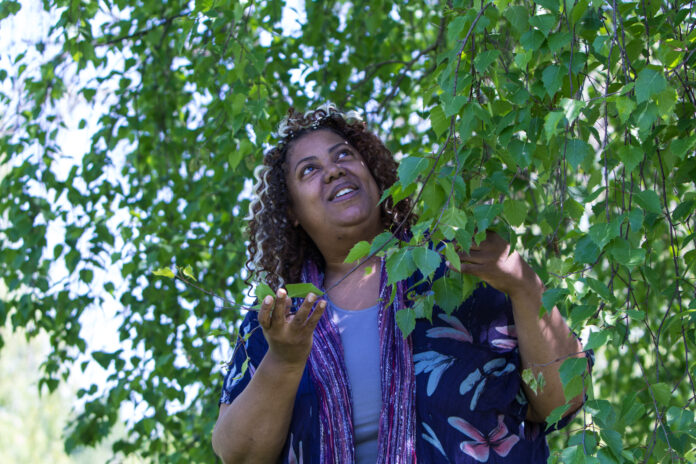
Siobhan Barker wearing a blue outfit, stands under a tree holding one of its branches full of green leaves gently, smiling upwards.
From Barker’s living room to mine, the cook-along felt like a night in with a friend. PHOTO: Siobhan Barker

By: Jocelyn Stevens, SFU Student

This year’s rEvolver Festival by Upintheair Theatre presented Harvesting Ancestral “Tea-Chings,by Siobhan Barker in a live screening Zoom event and Q&A on May 26. The event featured cooking and storytelling intertwined to share experiences about cultural roots, intersectionality, and the Black/African diaspora. Despite it being a virtual screening, Barker made us feel like we were all present with her: it was a stunning and approachable experience

What intrigued me about this performance was that it interactively focused on reconnecting to cultural roots through storytelling and traditional cooking. Barker opened the performance with a call to her ancestors, where she rattled a shekere and chanted to them

Barker called in two helpers, Jahmira and Athena, who prepared the dish as Barker guided them onto the next ingredient. Barker then introduced the dish they were going to create, pepperpot callaloo soup. As a vegan, I was delighted to hear them say they were going to make a gluten-free vegan version of the traditional soup.  

One of the stories  Barker shared was about how the women on her mother’s side have deep connections with the land that run generations back. These women know the importance of the “sights, sounds, smells, [and] tastes” of the land and how they can connect us to our past and present.

Growing up, my parents had always taught us the importance of the land and appreciating all that it has to offer. Hearing Barker say these words reminded me of these lessons. The connection that Indigenous communities have with the stolen ancestral lands we live on now are very similar to Barker’s story, and people tend to forget this fact. 

Another powerful story Barker shared was about living with and around disabilities. She explained she grew up with an understanding of disabilities because her father was someone with an amputation. Her father tended to try and bear the struggles around his disability on his own. Having grown up seeing this, Barker said she is now unlearning being silent while living with her own disabilities. 

The last unforgettable story Barker shared was about her longing to connect with family roots and ancestral knowledge in Jamaica. She shared a quote that resonated with me: “Family was named and claimed not by how you looked, but by blood, bone, breath and body.” I loved this, as members of my own chosen family are not based on conventional ideas and “looks” but rather who they are as a person and the deep connection that we share.

The different ways Barker would tell each story showed the care put into the performance. At one point, she sang a wonderful song from her culture called “Fanga Alaafia” to welcome us all into the space, and for another story, she had us close our eyes and just listen. 

At the end of the performance, I found myself wishing I had the ingredients to join in on the cooking. The whole performance was casual and comfortable despite the serious messages it conveyed. Barker’s vivid descriptions, vulnerability, and sense of humour kept me in anticipation of what she was going to say next. The tidbits of humour amplified the relaxed nature of the performance and made you feel like you were in the room with them. 


The pre-recorded performance will be available to view online for the entire duration of the rEvolver Festival. You can learn more about Harvesting Ancestral “Tea-Chings” here, along with more about the annually returning rEvolver Festival on the Upintheair Theatre website.

Need to Know, Need to Go: SFU edition

0
Blue and white calendar illustration with block text “Need to Know, Need to Go”
Arts & Culture events to catch around the city. Image courtesy of The Peak.

By: Yelin Gemma Lee, Arts and Culture Editor

There are a lot of events happening around the city, but sometimes you don’t want to go far from your usual route. If you want to enrich your campus life with some exciting artsy events, you’ve come to the right place! This June, don’t miss out on these events happening across all three SFU campuses.


Sacred Skin and Stories that Transform Us / Talking Stick Festival 2022

Full Circle presents its 21st Talking Stick Festival this year! With two weeks of incredible programming in various locations across Vancouver, this event is the perfect way to celebrate Indigenous History Month. SFU’s Woodward’s Cultural Programs is hosting Sacred Skin, a visual exhibition and Stories that Transform Us, a film screening. Sacred Skin is an exhibition that “explores the resurgence of Indigenous tattooing practices as they relate to cultural revitalization.” It documents the cultural practices, creative processes, and aesthetics of seven Indigenous tattoo artists and their works. This exhibition will be available for viewing all throughout the festival. Stories that Transform Us is a documentary created to celebrate its 20th anniversary of creative shorts and theatrical works under the program since it’s inception in 2001. The film is being screened in-person on June 12 at 7:00 p.m. and streamed online for the entire duration of the festival. 

Where: SFU Goldcorp Centre for the Arts (149 West Hastings Street)

When: June 12–July 3


Mindful Art Creation / Meet, Greet, and Eat 

So you’re stuck on SFU Burnaby campus on Tuesday for classes and have no one to eat lunch with because all your friends are out doing road trips or whatever? How about having lunch, making art, and chilling out with some new friends in the same boat as you? The Global Student Centre and Creative Collective have partnered up to present a free and inclusive series called “Meet, Greet, and Eat!” They have six events in their summer 2022 calendar, with one called “Mindful Art Creation” coming up. As the name implies, this event will help you de-stress through creativity. The crafts will use materials common to student living spaces, so if you have a great time, you can continue the practice at home. There is a graduate student version of this series as well, and you just need to fill in a quick web form to register for the event.

Where: Global Student Centre, AQ 2013 (SFU Burnaby) 

When: June 28, 12:00 p.m.–1:00 p.m. 


Nelly Queen: The Life and Times of Jose Sarria / Surrey Pride 

Surrey Pride 2022 has partnered with SFU Gender, Sexuality, and Women’s Studies Margaret Lowe Benston Lecture Series in Social Justice to present the Canadian premiere screening of this remarkable film! The film tells the story of Nelly Queen Jose Julio Sarria, a “WW2 veteran, a cabaret performer, a political activist, and the first out candidate for public office in 1961 all before Stonewall.” The event page writes that Nelly Queen is not only a history lesson, but “a triumphant story of the human spirit, a hero’s journey of a man fighting unjust laws and uniting a fractured community.” Come join me in celebrating pride this June by learning about the legacy of Jose Sarria through this momentous film screening. The event is free to attend, but make sure to reserve a ticket through their Eventbrite page.

Where: SFU Surrey, Room 2600 

When: June 23, 6:30 p.m.–9:00 p.m.

First Experiences: Batik

0
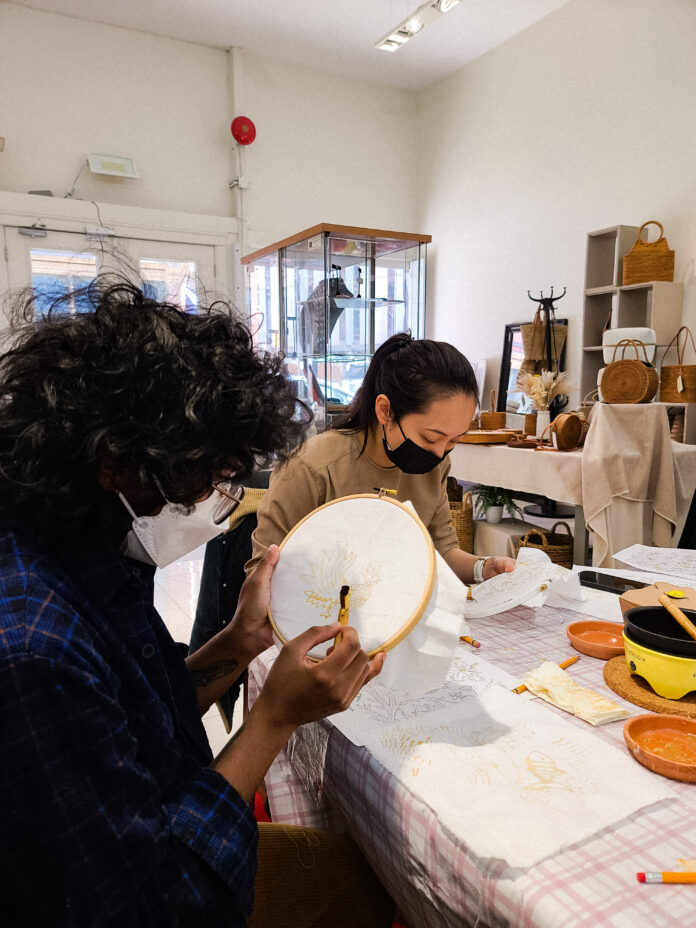
(1) Image of a person neck down wearing a moss green crewneck, holding up an embroidery hoop and using a Batik tool to draw on the fabric with wax. (2) first-person point of view, two pieces of cloth flatlaying on a table with designs drawn on them with wax. One is a symmetrical pattern that evolves into two small faces as it goes down, and one drawing is a larger side profile of a face. The person taking the photo has one hand in the photo holding up a Batik tool over the fabrics. (3) Person with dark curly shoulder-length hair, glasses, and a blue plaid shirt on has shoulders angled towards an embroidery hoop they are holding up and drawing on using a Batik tool. In the background, another person with a ponytail and moss green crewneck is seen at the table also hunched over their own Batik piece.
Practicing and learning about Batik for the first time. Yelin Gemma Lee and Gudrun Wai-Gunnarsson / The Peak

By: Yelin Gemma Lee, Arts & Culture Editor

As a part of explorASIAN 2022’s programming, The Batik Library hosted introductory batik workshops at the Indonesian Trade Promotion Centre (ITPC) in Vancouver. When I attended the opening session on the morning of May 20, I had no idea what to expect. I walked in with the faintest knowledge of what batik was and left with a deep appreciation for the ancient art form and the cultural history behind it.

Bernarda Antony from The Batik Library taught us that batik is a traditional Indonesian wax-resistant dyeing method used to make designs on fabric. This textile technique, she explained, is also practiced in other parts of Asia. However, artisans on the island of Java in Indonesia are considered to be experts in this practice, having developed a diversity of styles and techniques. Batik uses tools made of copper to apply a hot natural wax mixture (of beeswax, tree sap, etc.) to the fabric in a pattern. Cold-dyeing is used to colour the other parts of the fabric, and the dye-resistant wax is then removed by boiling the fabric in water, leaving a beautiful design behind. 

We worked around a small table in the centre of the room, surrounded by displays of Indonesian trade goods such as woodwork, food products, and of course, batik textiles. First, we practiced using a wooden stick with a copper application to hold a small amount of hot wax and drip it out of the pointed end. Depending on the angle of your wrist, the wax would flow out either in a controlled way or suddenly all at once causing big splotches. The cloth was so thin it was almost see-through, and Antony explained the thinner the fabric is, the easier it is to do batik on. This was because the wax had to seep through to the other side of the cloth in order to successfully imprint the design and resist the dyeing process. 

To make this practice easier and to prevent burns from the wax seeping through, we held up the cloth in an embroidery hoop while working. Antony explained that traditionally, Indonesian artisans would work balancing the fabric on their palms and that the heat transferring onto their skin was accepted as part of the practice. 

Whatever smidge of extra confidence I brought to this workshop as an artist immediately vanished while practicing. The experience I had with paintbrushes melted away. I moved onto a batik pattern I had traced in pencil on a cloth with a “fuck it” mindset and promptly annihilated the symmetry and detail. The wax in the little applicator of my drawing tool cooled down about every 30 seconds — a lot faster than I expected — and I had to keep pausing to rest the tool in the melting pot. After attempting the repeating motifs of my traced pattern multiple times, I went freehand on a new cloth and on a bigger scale with less detail.  

I learned a lot from Antony about the history and cultural significance of batik, but I learned even more from doingbatik was a teacher itself. It taught me a deep understanding and appreciation of batik artisans and their works. I looked at the batik pieces in the ITPC with new eyes and was flabbergasted at the skills honed with patience and grace. 

With the calming music playing in ITPC and the cozy smell of the natural wax mixture, I felt strangely connected to nature — the walls seemed to fall away into a peaceful, green utopia. Practicing batik meant being forced to slow down, take slow and deep breaths to steady my hand, and focus on the present moment with each careful stroke. As a person who vibrates to the fast-paced rhythm of the contemporary world, I felt soothed by the meditative ancient practice of batik

To learn more about The Batik Library and potential future workshops, check out their website and their Instagram. To learn more about ITPC Vancouver, check out their website or visit them in-person.

Horoscopes: June 6–12

0
An illustration of a girl with long flowing hair. Astrological signs and stars shine around her.
ILLUSTRATION: Marissa Ouyang / The Peak

By: Max Lorette, Peak Associate

Aries: 

The stars have informed me that it is a good idea for you to stay inside as much as possible this week. The cosmic forecast is calling for a killer sunburn on your horizon, and God knows you haven’t been keeping up with your SPF routine. Maybe try beating your Guitar Hero high score instead of suntanning. 


Taurus:

When was the last time you cleaned your bedside table, Taurus? The number of mugs, bowls, and spoons makes me very concerned. Is that mould growing in your half-empty teacup? Yuck! I promise you will feel much better after you take care of the mess. It might not declutter your overactive mind, but it also couldn’t hurt.


Gemini:

Do you feel as though you’ve been missing something from your life, my dearest Gemini? Do you feel an aching emptiness inside of you? When was the last time you saw your wallet? Or better yet, when was the last time you saw your appendix? I’m telling you, the government is totally harvesting that organ for some reason. I’m onto them. You should be, too.


Cancer: 

The stars are telling me that you have been looking for love in all the wrong places. Have you tried looking under the couch? In the dryer? Perhaps in the back of your closet? Oh wait, I think I got your soulmate mixed up with that pair of socks you lost three months ago. Good luck anyway!


Leo: 

Have you been looking for a new way to be the life of the party this summer? Leo, this season is all about you. Next time you get invited to hang out in a group, the stars advise you to learn how to do the worm. Trust me, it will bring your adoring crowd to their knees. 


Virgo: 

The stars have informed me that this upcoming week is the best time for you to change up your style! Why wait until the new year to be a whole new you? Go buy a cowboy hat! Get a pair of crocs! Go nuts! 


Libra: 

Nature has been calling you! You have been evading nature’s call! They’ve left, like, 10 voicemails now. You’re running out of storage! You should really call them back. Go touch some grass and hug a tree or something. Maybe go smell a flower or two. Change your phone background to some trees, maybe? I don’t know, dude, I’m just the messenger.


Scorpio: 

Next time you’re invited out to a bonfire, whatever you do, DO NOT play “Wonderwall.” The forest spirits have become restless, and the stars have informed me that they are NOT Oasis fans. Instead, try mixing your setlist up with some Taylor Swift. The spirits are totally Swifties. 


Sagittarius: 

When was the last time you did some self-reflection? Take a good, hard look in the mirror. Remember how far you’ve come. Remember to be proud of the person you’ve grown into. You’re doing amazing. Mwah! (Also, I think you might have something in your teeth).


Capricorn: 

The stars have informed me that they are incredibly disappointed that you haven’t been keeping up with your silent reading time! What, do you think because you’ve exited the public school system you can just quit silent reading? Go to a used bookstore, get the oldest looking tome you can and get back to it. The book probably isn’t cursed. 


Aquarius:

Have you been feeling stuck in your music taste lately? Have you tried discovery weekly? If that doesn’t help, maybe try listening to some classical music. I’m pretty sure that blasting “O Fortuna” at full volume while you strut your stuff this summer is the vibe that the stars have in mind.


Pisces: 

Take a deep breath, Pisces. Straighten up that spine, roll your shoulders back, and correct your posture. Your back literally looks like a lowercase “r” right now. Maybe it’s time to visit a chiropractor again. Crack my bones, Posture Daddy.

When homesickness feels a lot like grief

0
A girl with short black hair stands with her back turned. She is wearing a winter jacket and holding Mukmuk, a Vancouver 2010 winter plush mascot who resembles a beaver, in one hand and a Filipino flag in the other hand. In the distance is a scene of a busy street in Manila with people socializing and laughing.
ILLUSTRATION: Jiamin Bai / The Peak

By: Alyssa Victorino, SFU Student

I learned what it meant to be homesick when I was nine. 

My family and I packed up everything we owned, said heavy goodbyes to family and friends, and boarded a plane from Manila. Our destination was Vancouver where we became permanent residents, and later, Canadian citizens. I left behind my sari-sari store toys and replaced them with the Vancouver 2010 Winter Olympic mascot plushies (my favourite was Mukmuk). I traded in my tank tops and flip-flops for rain jackets and snow boots and got used to the deafening silence at home. There was no more playful banter among extended family members in the house. 

During the first couple of months, family friends kept asking me if I ever missed the Philippines. I think they expected whatever disorientation I felt to dissipate quickly as I adjusted. But even after 12 years, the sting of homesickness lingers. 

When you experience a deep longing for something you know you can’t get back, you start to lose yourself in fantasy and memory. Every few months, I get an itch to go through photo albums, old journals, playlists, and past school projects to immerse myself in the comfort of simpler times. They bring back memories of Sunday dinners at my grandparents’ house where the grandkids would fight over who got the last KFC fried chicken. I can still hear the never-ending bustle in the kitchen where family members would cook, clean, and gossip; they were excellent multitaskers.

In The Year of Magical Thinking, Joan Didion describes the grief she felt after her husband’s death: the fruitless waiting for the past to show up at your door and the subsequent realisation that there is only forward — things change whether or not we are ready. My life has been riddled with a similar yet different kind of grief for the last decade, lost in the memory of another version of myself that got to stay home. I struggle to reconcile the reality that I will never be able to find out who she would’ve turned out to be, and I fear I will always feel split between two lives. 

And it isn’t just about me. My family lost our village. My mom, who had loads of friends unafraid to let out full-belly laughs in quiet restaurants, had to learn how to navigate her first winter alone with three kids. My dad, who once played the guitar and sang Filipino folk music freely, was bogged down by work, travelling for months at a time. My sisters, too, had to navigate university and high school alone, learning for the first time what it’s like to have to search for a piece of home to hold onto. I grieve for them, the versions of my family members who remained proud and sure, whose senses of belonging remained intact. 

In elementary school, I used to count the number of Filipino students in each of my classes to anchor me and took every possible opportunity to make projects about Filipino culture. In grade four, I made a “Guide to the Philippines” handbook for my class, listing traditional Filipino clothing, games, and cuisine. Today, I flood my parents with questions at the dinner table about what their lives were like back home. I look up recipes for Filipino dishes — Filipino spaghetti for birthdays and arroz caldo for when it rains (needless to say, I have arroz caldo a lot). I make sure to watch cheesy Tagalog romcoms when they come out on Netflix like Isa Pa With Feelings and Love You to the Stars and Back

Most significantly, I decided to study social justice in universit and took every chance to centre my assignments on memory, colonialism, or immigration. At some point, the grief turned into a deep curiosity for everything that I had lost and everything that I was feeling; the whys and hows of my being here. 

But I soon found it’s difficult to study economic inequality, globalisation, and racism as an immigrant in a western institution. I see my childhood unfold in some of the case studies — the unemployment and low wages, the degrading process of the immigration point system. Learning about the structural forces behind my immigration story — the greed behind poverty and the centuries of colonialism behind the desire to be in proximity to whiteness — brought with it a transformation of grief for land and community. I grieve in classrooms, among my peers. I leave classes with an empty feeling wondering, “Now what?” 

My mom still asks me if I would move back to the Philippines out of fear that she and my dad made the wrong decision by moving us all here. It used to be an easy answer: of course not. There are better opportunities here, more choice and freedom, and easier access to nature. For a long time, I felt so much pressure to just be happy and grateful to live here. Of course, I am, and I acknowledge my privilege in this. But I can’t ignore the constant waves of sadness and struggle I feel in trying to reclaim my cultural identity. I hate not knowing the places that my parents talk about when they reminisce, having family members’ names feel foreign on my tongue, and asking what certain Tagalog words mean. I should know all of these things. I should have gotten the chance to know these things.

Home is something that I had to define for myself. It is not a place, but a feeling. I experience it now as fleeting moments that feel familiar: barbeques by the lake, loud Christmas parties with titos and titas you don’t know, and the warm and inviting smell of summer air. Losing the familiar to the unknown so suddenly 12 years ago taught me to cherish and live in these small, beautiful moments whenever they come along. 

And so, if someone were to ask me today if I’d move back to the Philippines, I’d want to say yes, if only to feel whole again.

The hybrid learning landscape at SFU

0
An image of a brown woman professor trying to command the attention of the in-person class in front of her and the zoom class behind her and looking calm but holding her hand out questioningly
The pandemic has highlighted existing accessibility concerns that were not widely considered until they affected the majority of the population, igniting questions of how to move forward. ILLUSTRATION: Angela Shen / The Peak

By: Olivia Visser, Staff Writer

What does the future of post-secondary teaching look like? Hybrid learning has been a hot topic since the transition towards temporary online learning due to COVID-19 and the subsequent return to in-person studies. Some have felt that pushing for permanent hybridization would be unreasonable or unfair to staff, while others believe in the practice yet critique its execution.


Pro-hybrid learning

Between January 11 and 22, the Simon Fraser Student Society collected survey responses about returning to campus in the midst of the pandemic. According to their results, nearly 80% of over 5,300 respondents desired some level of remote instruction. On top of that, 66% of respondents reported different degrees of discomfort regarding the return to in-person learning, and 94% reported they would benefit from having recorded lectures. 

The SFU Disability and Neurodiversity Alliance (SFU DNA) also released a statement criticizing the return to campus in Spring 2022. They said forcing all students to return to in-person instruction is “deeply ableist and ageist” as it puts vulnerable community members at risk. SFU DNA writes online learning increases accessibility because of captioning and lecture recordings. It also allows students to avoid “physically inaccessible campuses” while providing “more flexible lecture and assignment schedules.” This is particularly important for disabled students, but can benefit many other groups. 

Their statement pointed to a report from the Stronger Together Party which found hybrid learning was the most desirable course option for respondents. This opinion is also reflected in the multiple petitions created in favor of hybrid learning. SFU DNA created a list of demands to make the return to campus more accessible. Among the demands were calls to provide a mix of online, in-person, and hybrid classes, assist instructors in providing accessible content, and expand online course selection. 

Proponents of hybrid learning believe it provides the best of both worlds. Those who have long or complicated commutes, are immunocompromised, live with people who are immunocompromised, or have other responsibilities have the flexibility to attend from home. Students who have mental health concerns due to isolation, do not have proper access to the infrastructure necessary for at-home study, or don’t have a great study environment can attend in person. 


Against hybrid learning

While some students have been enthusiastic about incorporating hybridization, not everyone shares these feelings. In a Facebook comment responding to one of the pro-hybrid petitions, one student wrote hybrid would mean paying exorbitant tuition fees for a reduced quality of education. Others have shared concerns about divided attention from professors and the logistics of translating courses that require labs or hands-on learning to a hybrid model.

Additionally, SFU instructors have shared that hybrid learning would increase their workload without increasing pay or resources and make it difficult to organize classes and lesson plans. The mandatory recording the hybrid learning petitions advocate for may make it more difficult to address sensitive topics and add to concerns over intellectual property. Other professors like Orion Kidder echoed that sentiment. Kidder told Tri City News, “Remote learning has put an added burden on instructors and staff.” 

One instructor, posting on a Facebook undergraduate group, wrote that demands for hybrid learning without considering instructors “devalues teacher effort and reduces [them] to unseen, unpaid labour.” A student who had been enrolled in a hybrid class said of their experience: “The poor professor was sitting in front of a computer and trying to engage with students online and at the same time the students who were there in person.” They added they don’t feel hybrid is the “solution to this complex problem.” 


Hybrid learning in action

I spoke with Hannah McGregor, publishing professor at SFU who recently self-hybridized two of her courses, PUB371 and PUB448, to find out more about her experience. McGregor clarified hybrid status can be set by SFU but her classes did not have that official designation.

She made the decision to offer hybrid options to increase accessibility for students who might not be able to attend in-person. For her, this meant giving students the option to attend classes remotely. Her course used Discord for class communications, and took advantage of the microphones and video capabilities that SFU classrooms already have to livestream the class.

For the type of conversation-driven classes McGregor was teaching, a hybrid model “wasn’t ideal.” However, she stressed that lecture style courses can allow for less dependence on in-person attendance: “I don’t understand why anybody would deliver a lecture in person anymore.” 

While the hybrid approach may sound preferable for students, McGregor said this meant “teaching two courses simultaneously.” She added this approach also put stress on in-person students who had to participate in the Discord and in-person discussions at the same time. According to her, keeping the online students engaged felt “really unfair” because it involved more labour from the in-person students. Because of this conflict, McGregor gave up her hybrid group work approach over the Spring semester. She said this resulted in the online students being “a lot less engaged” because they didn’t feel like they were “in a community” with their other classmates. 


Potential solutions

According to McGregor, increasing resources is one of the ways hybrid learning can be expanded fairly into our institutions. Hybrid course delivery “requires some fairly significant redesign of your courses and creation of new materials,” which is a lot of work for instructors. An “ideal hybrid class,” McGregor said, would have two professors to engage the two groups of students. Moreover, before the pandemic, “there were resources in place to help instructors develop online courses, and that was considered to be work that one should be paid for,” she said. Due to the sudden transition to online, staff were expected to do a “significant amount of extra work for free,” she added. 

“We do it because we care about our students [ . . . ] but I would really like to see hybrid course development being recognized as work because it can be done really, really well. You just need time and resources to actually figure out how to create those courses,” she said. McGregor’s experience speaks to the need for resources to facilitate fair course hybridization, which is still in its early phases.


Blended learning: SFU’s alternative to hybrid

SFU’s solution to the hybrid learning debate has been to implement blended learning through the Centre for Educational Excellence (CEE). Project manager for online and blended learning, Brian Lorraine, had some helpful information about the program. 

Lorraine explained hybrid models usually involve the simultaneous delivery of a course to an in-person and remote audience. Alternatively, blended learning offers a set schedule alternating between asynchronous online classes and synchronous in-person classes. Simply put, blended learning reduces the “portion of the regular face-to-face class sessions in a given course,” Lorraine said.

This option offers greater flexibility for students with scheduling conflicts, disabilities, and other considerations. According to the CEE webpage, blended courses are “associated with higher student satisfaction” because they allow for flexibility and community.

As an alternative to full-scale hybridization, blended learning can be effective when thoughtfully designed, he said. Lorraine said the CEE “leads a 10-week blended learning design cohort of instructors every semester, with an offer to collaborate for an additional semester on building course components in Canvas.” 

SFU is “in the early stages of a 2-year pilot of blended learning,” having offered over 30 blended learning courses, Lorraine said. He anticipates “significant growth” the longer the program is in use.


Moving forward

Universities can create a more equitable learning environment by providing choice surrounding in-person attendance. For students with accessibility needs and scheduling conflicts, the flexibility of hybrid learning seemingly offers a viable solution. At the same time, hybrid learning is not a perfect system and adopting it without proper resources can be stressful for instructors. 

Blended learning may be an effective alternative that supports the needs of both students and professors through its intentionally mixed course design. However, it’s not perfect either as it still requires some in-person learning. 

Another solution may be increasing the number of remote courses available.

Online learning is a new and evolving field, and many of the practices we adopt will be through trial and error. While SFU students, administrators, and instructors have different perspectives on hybridity, a need for resources for students and professors should underline the continuing conversations about online learning.

Five exquisite ways to luxuriate in the dark academia aesthetic

0
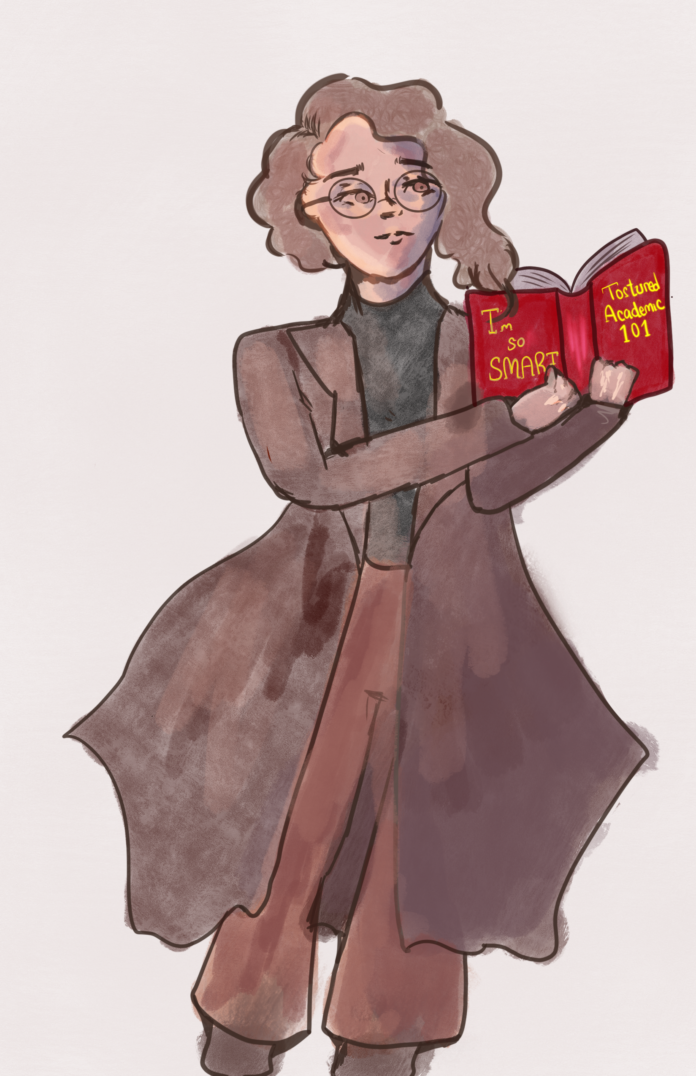
ILLUSTRATION: Kelly Chia / The Peak

By: Max Lorette, Peak Associate and Portrait Holder of Dorian Gray

Have you recently finished reading The Secret History by Donna Tartt? Has the slow ascension of summer made you yearn for the cool breeze of autumn? Do you revel in enforcing your superiority complex over your fellow scholars? Then you may be swept up in the warm embrace of the dark academic aesthetic. I implore you to ask yourself, “Is this the right aesthetic for me?”

Allow me to assist you in achieving such an esteemed lifestyle. I insist you forget that this movement is deeply rooted in classism, colonialism, and western-eurocentrism. There is little use in dwelling upon . . . unpleasantries. We do not believe in personal analysis here.

Embark with me upon a riveting journey in caffeine overload, tweed jackets, and academic burnout! You don’t need to attend a gothic university in order to achieve such a curated aesthetic. Read on and discover how best to live a prep school-esque lifestyle from the comfort of SFU! Who needs classical and gothic architecture when you have a style of architecture commonly compared to a prison?


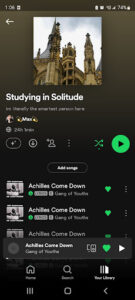
  1. I hope you feel honoured that I am divulging my greatest secret to you: my study spot. I urge you to study ONLY in the catacombs of the RCB. There is little as inspiring as the endless labyrinth of blood-red floors and melancholic concrete walls. Remember, if you have a cell phone signal, you aren’t deep enough. Though I, too, struggle with romanticizing such bland architecture, the perfect study playlist will surely assist you in immersing yourself in your studies. May I suggest my own curation of symphonies? Of course you would like to listen.
Spotify playlist screenshot. Playlist titled, "Studying in Solitude" and captioned, "im literally the smartest person here" by Max. All the songs in the playlist are "Achilles Come Down" by Gang of Youths.
SCREENSHOT: Max Lorette

Indulge your ears here on my highly curated Spotify playlist.

2. Upon submitting your written masterpieces to your professor, be certain to put some thought into its material presentation. Tea stains and coffee cup rings will make it appear as if they received a document from an academic straight out of the 40s! Better yet, type everything out through a vintage typewriter! Frankly, it is my firm belief that Microsoft Word is the single utmost inhibitor of creativity, and that analog is the best method forward. If your professor complains, you’re probably more intelligent than them anyhow. 

3. My dearest pupil, take it from me. The simplest way to assert your academic dominance over your peers is through constantly making unfounded and often irrelevant literary references! Don’t know any? Make them up! Attribute any and all quotations to the likes of Shakespeare, Gandhi, John Lennon, and Karl Marx. Want to appear well-read? Reference Greek mythology (naturally, the endallbeall of ancient civilizations)! Don’t know anything about the Hellenic period beyond what you read from Percy Jackson? Me neither!

4. Never be seen without a yellowed book in your clutches. It is essential that people never forget how well-read you are. As quoted from a little-known book, Norwegian Wood by the unsung literary genius Haruki Murakami, “If you only read the books that everyone else is reading, you can only think what everyone else is thinking.” Thus, I have made it my mission to provide you with my favourite underground novels to assert your intelligence over all those around you. No need to thank me!

The Illiad by Homer Simpson

Pride and Prejudice by Britney Spears

Animal Farm by Elon Musk

The Grapes of Wrath by Rihanna


And of course…

War and Peace by Meryl Streep


5. Finally, perhaps the most vital way to achieve the dark academia lifestyle is to have a thesaurus beside you at all times. Are you struggling to find the perfect word to fabricate the facade of intelligence? Choose a synonym. It doesn’t need to make sense. As long as it’s long, you will appear all the more intelligent. Make it sound as though you are trying to hit the word count in real-life conversations. No, I haven’t been doing this the whole time I’ve been writing this article and I am frankly insulted that you would insinuate so!

This is a way of life that is as beautiful as a rare volume, as intricate as a Baroque fresco, and as sustainable as a dual-ended candle burning into itself. And I sincerely hope to further indoctrinate you all, dearest readers, into my exclusive academic cult club.