Home Blog Page 246

The most popular Starbucks drink according to your major

0
Illustration of a a black coffee, accompanied with a student who has glasses, and a collared shirt beneath a green sweater.
ILLUSTRATIONS: Angela Shen / The Peak

By: Isabella Urbani, Staff Writer

From the people who brought you your name intentionally spelled incorrectly, comes an even more aggravating experience to your local campus Starbucks. If you haven’t picked your major, or better yet, you randomly settled on the same major half of your high school was choosing, Starbucks is here to help your indecisions stick around longer by dictating your beverage choice for life.

Business — Watered Down Iced Coffee

We’d like to make it clear that we didn’t purposely make you the worst cup of iced coffee you’ve ever tasted, although you do pop up behind the counter as soon as we open trying to convince us that you know just how to improve our business model. Sure, if you think drapes will improve our pyramid scheme, then go right ahead. You don’t even like coffee, you just want the notoriety that comes along with being a busy Beedie boy. That’s why you let your coffee sit there all day while you go on about how tired you are and how you practically live on caffeine, when we all know you’ve been a frappuccino drinker since the day you were born.


Communication — Vanilla Oat Latte

You’re the sole reason we run out of oat milk by the hour. You can see a communication student from a mile away. The way they hastily rack their eyes over the menu, even though they’ve literally never, and will never, venture beyond their usual latte. Swapping vanilla for hazelnut? Yeah right, psh, are you FOR REAL? Communication students just want to cozy up next to the fireplace with their hot coffee and their knit sweaters acting as drink sleeves while they read about capitalist realism. I swear there is a joke in there somewhere . . .

 Separate illustrations of a watered down iced coffee in a Starbucks coffee cup, accompanied with a shoulders-up portrait of a student in a suit, a Vanilla Oat Latte, accompanied with a shoulders-up portrait of a student in a cozy sweater, an iced fruity drink, accompanied with a shoulders-up portrait of a student with dyed hair and piercings,
ILLUSTRATIONS: Angela Shen / The Peak

Arts —The Fruitiest Refresher

You would think an art student would be the first to hop on some latte art, but you’re wrong. It’s all about the refreshers, rain or shine. Seriously, they even know about refreshers that aren’t written on the menu. It’s like they’re a part of a secret club. One student asked for The Fruit Basket. I thought they were joking right? Like the painting? No. I learned it was a drink. Try for yourself, only if you’re an arts student of course.


Education — Black Coffee

How can a major full of the most charismatic people drink the most unbearable coffee? I know you plan to become teachers one day, but life hasn’t been sucked from your soul yet. Stop subjecting your taste buds to this! No matter how many times you get it, it will NOT get better. “Starting ahead of time,” you joke wryly as you make a sour face swallowing the ink in your cup. But kudos to you for always bringing in your own god awful bedazzled thermos with your name on it. And your metal straw which somehow has that awful 2015 black and white checkered pattern on it.

Science — Chai Tea

Your palette is way too sophisticated for coffee, but your brain? Well, it’s screaming for you to drown yourself in six shots of espresso, pronto. Way to not let those impulsive thoughts win! You head to your little nook in the back and only get up once an hour for some more tea like it’s a reward. Someone probably would have caught you sneaking out of the store in the morning after you spent the night if it weren’t for that pesky business student who swings by each day.

 

SFUnexplained: The geese are out to get us!

0
Photo of a flock of geese with angry eyebrows doodled over their faces
PHOTO: Amirul Anirban / The Peak (doodles by Gudrun Wai-Gunnarsson)

By: Olivia Visser, Staff Writer

Have you noticed things just haven’t felt “right” lately? You’re not the only one. My pitch got no responses from the News or Opinions editors, but I promise you this isn’t some conspiracy theory! A publication is a publication, right? Yes, this is a journalistic approach into what’s really causing the downfall of society as we know it. Surprise, surprise: it’s geese.

Canada Geese, to be more specific. A national shame. Literally the worst part about visiting the lake or beach. Noisy, aggressive, pesterous little things. According to anecdotal evidence (the most credible type), geese have been secretly gathering to form what they refer to as One World Goose. Apparently, our famed Canada Geese have been plotting alongside various other species to form a Global Goose Alliance (GGA). Snow Geese, Barnacle Geese, and even Magpie Geese were among the many gathered last Tuesday at Trout Lake Park in a demonstration. I visited the scene to document what all the quack was about.

“There’s more than one type of goose, you know,” said one Canada Goose who wished to remain unnamed. Many attendees were peaceful demonstrators, but others shared more insidious motives. The geese admitted to intentionally disrupting our society by stealing food and causing noise disturbances. I saw a few nibbling on hotdog buns and potato chips. I really don’t think it ends there. I mean, does no one else see the danger of having an elite group of geese have so much power over us!?

Anyways, I heard some talk about mischief like intentionally contaminating lake water, and I think you know what that means. The geese are out there making sure we’ll always be in a pandemic. Don’t let me say I told you so. I remember doing a bit of research beforehand but couldn’t seem to find any articles to support this theory. To find out more, I asked around. This question triggered some aggressive responses.

“HONK!” shouted one goose. My question was so upsetting he didn’t want to speak to me in English. This is evidence enough. I’ve found what they don’t want me to know.

I came home that night confused yet motivated. Canada Geese are clearly part of a global movement to dismantle humanity. The lack of online information about this only speaks to the fact that our government is trying to hide it from us. Why? Could it be, the Geese have already infiltrated Parliament? Am I too late in uncovering what might be the biggest discovery of the 21st century?

Get the word out.

Signed,

Duncan Duck, Investigative Journalist

SFU suggests new system of decision-making for its Board of Governors

0
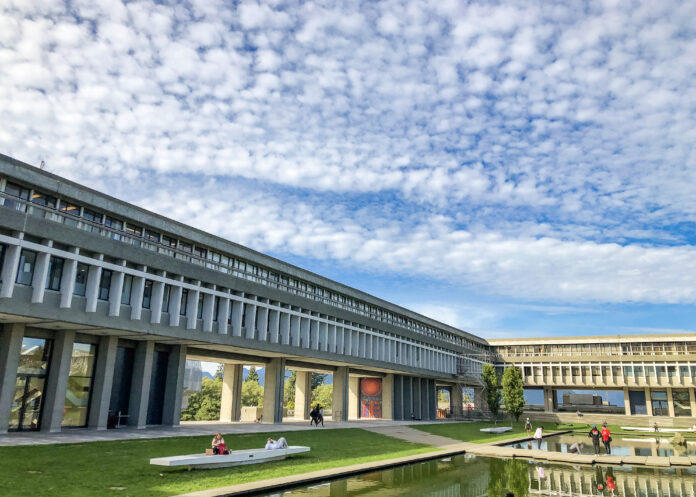
The photo is of the outside of SFU. The AQ, the pond, and the green space can be seen. The sky is clear and sunny.
The policy will consider community feedback before its decided on. Image courtesy of Allyson Klassen / The Peak

By: Chloë Arneson, News Writer

On May 10, SFU proposed new amendments to their policies on the Board of Governors (BoG)’ decision-making process. The general counsel and university secretary would be able to make amendments to university procedures without Board approval. The general counsel and university secretary would additionally have the power to approve and make changes to definitions applicable to university procedures and policies. These policy amendments have not been approved by the BoG. 

The BoG is the senior governing body of SFU. They are responsible for the “business of the university [regarding] property, revenue, and policies.” The Board consists of 15 members including SFU administration — chancellor of BoG Tamara Vrooman and president Joy Johnson — elected faculty, students and staff, as well as appointees chosen by the provincial government.

SFU claimed this proposal would provide “improved efficiency and expediency, and better use of resources. Policy B10.00 describes the processes to create and revise policies so the university community has increased transparency into the process.” 

In an interview with The Peak, SFU external communications assistant director Will Henderson said the Board will seek community input going forward. “Given the high degree of interest, the policy office will be reaching out to student, faculty and employee groups to offer to answer their questions about these proposed amendments.” Henderson remarked. Feedback will be considered in further amendments to this policy.

B10.00 is an existing policy that was created to provide guidance and support to members of the university community who are developing new university policies or revising existing policies.” He added, “The policy increases transparency on this process. It also helps reduce bureaucracy and increase efficiency for members of the university community who develop, oversee and implement policies.” 

Save SFU Democracy is an organization created as a result of this potential decision. In a press release, they stated that “giving unsupervised power to one individual at the university to make changes to the documents that guide SFU is a direct attack on the democratic structures that keep SFU running. 

“This proposal has far-reaching impacts,” writes the press release. “It can affect policies on student misconduct, freedom of expression, sexual violence and assault, whistleblowing, and human rights.” Save SFU Democracy produced several action items for staff and students to join them in speaking against the decision. They encouraged students to email the university or message them on Twitter, Facebook, and Instagram to voice their concerns before May 25. Their action toolkit outlines the issue in more detail and provides more instructions on how to influence this policy decision. 

The Peak reached out to Save SFU Democracy for more information, but did not receive a response by the publication deadline.  

You can follow Save SFU Democracy on Twitter for more information on their campaign. For further information regarding policy development, you can visit the FAQs on the policy development and revision website

NDP announces $3.75 million in graduate research scholarships

0
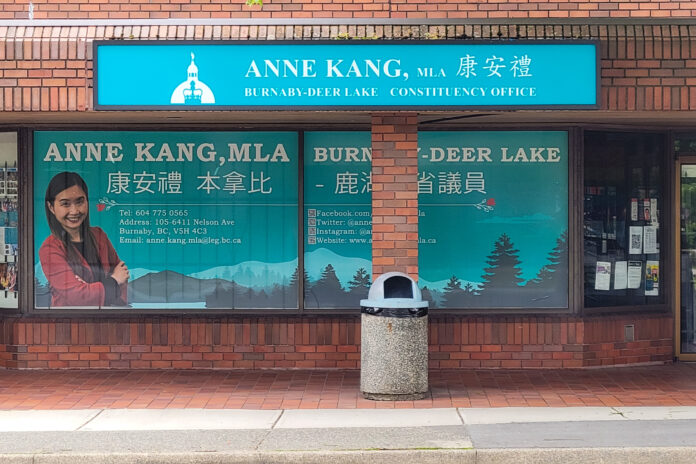
The photo is of the front of NDP MLA Anne Kang's office. The brick building's window has Kang's name and a photo of her face on it.
NDP MLA Anne Kang hopes the scholarships will help increase accessibility to education. PHOTO: Amirul Anirban / The Peak

By: Pranjali J Mann, News Writer

SFU is set to receive $630,000 in domestic graduate research scholarship funding. The provincial government’s press release notes the scholarships will be awarded based on merit. The focus will be research-based projects in science, technology, engineering, mathematics, and business disciplines.

The research funding comes as an effort of the BC government to close BC’s skills and talent gap, under the StrongerBC Economic Plan. This particular “investment will support 250 awards of a minimum of $15,000 each through March 2024.”

“One of the ways we can strengthen our communities is by investing in students so that they feel ready to take on whatever comes their way,” said Katrina Chen, MLA for Burnaby-Lougheed.

To find out more about the grant, The Peak contacted Anne Kang, minister of advanced education and skills training. Kang mentioned the BC graduate scholarship program was started by the government in 2018 with $20 million invested so far. 

She noted throughout 2022–23, the $3.75 million fund will provide domestic graduate scholarships across 10 post-secondary institutions. This includes British Columbia Institute of Technology, University of British Columbia, University of the Fraser Valley, University of Victoria, and SFU.

Kang underlined the funding is coming because the provincial government wants to “work hard to invest in affordable post-secondary education and break down barriers for people by investing in post-secondary institutions.” According to her, these scholarships can be used by graduate students to “cover their life expenses such as tuition, rent, food, childcare, and transportation. The purpose is so they can focus on their studies and be successful.”

For all domestic undergraduate and graduate students, the government offers these grants through the Student Aid BC program. Under this program, $50 million has been invested this year, covering financial assistance for about 4,000 graduate students in BC. 

On April 14, Tuition Freeze Now held a rally outside of Kang’s office in protest of the cost of tuition. International student fees and tuition has increased by 4% within the last year.

Kang added the issue of affordability is being worked on and several steps included a funding review looking into cost of living and tuition for all twenty five post secondary institutions in BC. She also stated, “I am very confident by 2028 that the government and post secondary institutions will have invested in 8,000 student housing. That means there will be more affordable housing and safe housing on campuses.”

Kang said education is being made more affordable in BC by “eliminating tuition fees for former youth in care” and allowing adults to receive free adult basic education.

Government pledges $2 million towards community-based food projects

0
The photo is a close-up picture on multiple piles of fresh vegetables. In the picture are onions, tomatoes, lettuce, carrots, cucumbers, and squash.
Bibeau toured the Greater Vancouver Food Bank, which has recently increased food storage capacity by 3,400 cubic feet. PHOTO: Mark Stebnicki / Pexels

By: Chloë Arneson, News Writer

On May 25, the federal minister of agriculture and agri-food Marie-Claude Bibeau announced up to $2 million from the local food infrastructure fund (LFIF) will be put towards 38 projects across the province. 

The fund offers grants to charitable organisations, Indigenous groups, not-for-profit cooperatives, and small municipalities. Over the course of five years, $60 million will be put towards sustainable and health-conscience food systems. 

The government of Canada released the news on their website, expressing the need for these community based projects. They stated, “All Canadians, regardless of where they live, deserve to have access to safe and nutritious food.” Pricing varies according to each region and the cost of food can be significantly higher in Northern and remote areas in Canada due to isolation and socioeconomic challenges. Northern areas are geographically disadvantaged because transport cost of food dramatically increases food prices. In Nunavut, where 86% of residents are Indigenous, the same bottle of juice that costs $6.79 in the Lower Mainland costs $34.99. The press release called for regionally tailored solutions. 

By providing the funding for communities to build their own food systems that meet their needs, the government stated they are “committed to working with community-based food security organisations to ensure they have access to the necessary tools that help them to meet the increasing and immediate needs of people experiencing food insecurity.”

The Greater Vancouver Food Bank is one of the organisations that received funding from the LFIF’s previous round of grants. They have recently installed a new walk-in fridge and freezer at their downtown Vancouver location. The Greater Vancouver Food Bank currently serves over 10,000 individuals and families in need of support every month. 

David Long, CEO of Greater Vancouver Food Bank Society, expressed the donation from the LFIF was urgently needed. “We are seeing a record-breaking number of new clients seeking our support each month,” said Long. “This infrastructure support from the federal government came at a time when we needed it the most.”

Because of COVID-19, many Vancouver residents faced food insecurity that continued throughout the course of the pandemic. In addition to limited delivery options, many of the city’s food services were shut down, which restricted access to affordable healthy food. Losing employment as well as inequities that disproportionately affect disabled people and BIPOC individuals contributed to the effects of this insecurity. According to The Cloverdale Reporter, the pandemic caused mostly low-wage workers to lose their jobs. These jobs are primarily held by women and people of colour. 

Applications for funding from the LFIF are being accepted until July 15, 2022. 

For more information about the Local Food Infrastructure Fund, you can visit their website or call 1-877-246-4682.

What Grinds Our Gears: We’re not in a state of perpetual panic over the tank farm

0
The Burnaby Mountain tank farm
“Look Ma! The poorly designed, dangerous energy tech of the past!” PHOTO: Amirul Anirban / The Peak

By: Luke Faulks, Opinions Editor

We complain, but SFU’s Burnaby campus is a uniquely beautiful spot for a school. Secluded at the top of a mountain, we’re as close as you can come to a literal ivory tower of education. But thanks to the Burnaby Mountain tank farm, our stunning locale becomes a death trap for SFU students and staff — and for some reason, we’re not up in arms about it. 

A simple scroll through the City’s 2015 report on the farm will send your blood pressure through the roof. Thanks to the installation, we’re all put at risk of massive fires and poisonous hydrogen sulfide emissions. And because the goons over at Kinder Morgan decided to plonk the farm on the side of a mountain, we’re doubly at risk of fire and fumes when an earthquake occurs.  

“But surely,” one thinks, “an institution that lined up to denounce the project in 2016 has prepared extensive evacuation and disaster relief protocols in the event of an explosion?” Wrong.

SFU did issue new policies for emergency responses, including amendments to the school’s mass evacuation and shelter in place plans. But neither set of plans addresses the fact that both points of egress (Gaglardi Way and University Drive East) intersect right above the tank farm! So, in the event of a fire, go closer to the start of it! In the event of toxic emissions, swing by and take a whiff! 

Every day, thousands of SFU students learn on a campus that’s straddling a ticking time bomb. Beyond the implications for climate change and beyond the implications for the sensitive environment of the Burnaby Mountain Conservation Area, we need to be losing our collective shit over the tank farm’s potential to burn or choke out our campus.

A talk on Palestinian leadership under the British Mandate

0
The photo shows the city of Palestine Israel. The buildings are condensed and in close proximity to each other. No people can be seen.
The talk was a part of the larger three day event — Palestinian Days at SFU. PHOTO: Amal Abdullah

By: Yasmin Vejs Simsek, Staff Writer

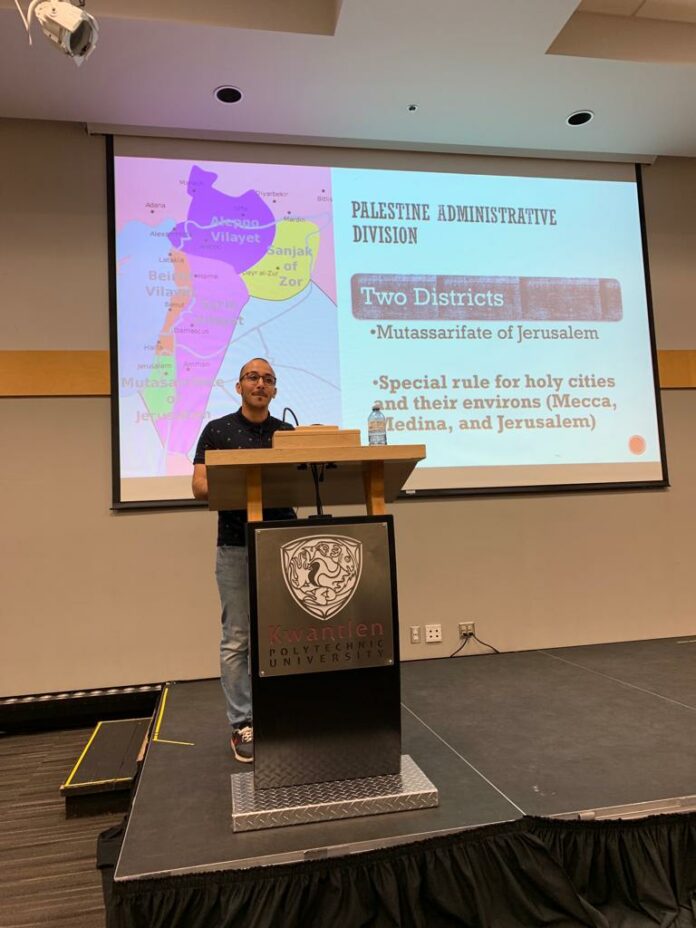
On June 1, SFU’s Centre for Comparative Muslim Studies (CCMS) held an event at Kwantlen Polytechnic University in collaboration with The Caucus. Educator and activist Bassam Abun-Nadi explored the absence of military academies in Palestine and its effect on the country’s anti-colonial struggle. 

The British Mandate for Palestine started after World War I and lasted until 1948. It saw British rule over Palestine after the fall of the Ottoman Empire. The British Mandate was “the establishment in Palestine of a national home for the Jewish people.” When talking about Palestine’s history, Abun-Nadi, explained, there are three antagonists — The British imperial project, the Zionist movement and the Palestinian leadership, being the urban notables.

Abun-Nadi explained the Mandate resulted in the notables (an urban and elite social class) of Palestine becoming parliamentarians — which could be thought of as government officials. This, however, came to an abrupt end with the Nakba — which refers to the displacement and ethnic cleansing of 750,000 Palestinians from their home country. Following the Nakba, the urban notables became the Palestinian leadership. Abun-Nadi explored the notables’ responsibility in losing Palestine and their anti-colonial struggle.

Being an educator himself, Abun-Nadi focuses on the impact of education on Palestine’s history. He observed the absence of military academies in Palestine, a free school to train men for the Ottoman army. This was important as several of the officers who came out of the academies in other parts of the Middle East went on to become anti-colonial figures and leaders of their home countries. Because Palestine lacked military graduates, the urban notables were forced to adopt leadership. 

There are several reasons there are no military academies in Palestine, according to Abun-Nadi. The first being “the Ottoman Empire did not design its institutions with the collapse of the empire in mind” and therefore did not plan for new borders. 

Secondly, military academies were only located in regional capitals. Holy cities and their surrounding areas were exempt from being drafted, leaving Jerusalem unable to have military academies. “What that meant is that Palestine barreled into the Mandate era without any institutionalized knowledge on how to resist an occupation,” said Abun-Nadi.  

This left the country with no one but the notables and peasants, who had no military training or no education at all, respectively, added Abun-Nadi.  

“In analyzing the anti-colonial struggle of the Palestinians, one would imagine had they had military officers it would have decisively changed the way that they were able to engage with the British empire,” said Abun-Nadi. The absence of military academies, and therefore officers, left the notables in charge. 

“The urban notables were not incompetent. They were not. The urban notables were supremely competent in all the wrong things.” The notables’ lack of leadership training may have enabled the occupation, but it was not a fault of their own. 

“The game had changed in such a way that the tools they had at their disposal just didn’t work anymore. They were playing chess while everyone else was playing rugby,” said Abun-Nadi.

Abun-Nadi ended with encouraging people to forgive each other and the urban notables for their share of the responsibility of Palestine’s past in the spirit of truth and reconciliation.  

Abun-Nadi is an SFU alumni and the founder and president of the grassroot organization RECLAIM, which works “to bridge the gap between Muslims and non-Muslims through education.” This talk marked the first of three Palestine Days at SFU, hosted by CCMS, MENA film festival, Institute for the Humanities, and other groups, at SFU. The Palestine Days lasted from June 1–3 and included film screenings, lectures, and workshops all surrounding Palestine and its peoples.

You can learn more from Abun-Nadi on his podcast “PreOccupation: A Not-So-Brief History of Palestine” and attend the next Palestine Days events. A Sky with no Stars will be available soon on CCMS’ Youtube channel.   

For more information on the Palestinian occupation, visit Amnesty International’s website or United Nations’ Human Rights Comission’s website.

Something for everyone: The online learning debate is way more convoluted than it needs to be

0
Cup of coffee in front of a zoom meeting
Everyone learns differently. PHOTO: Chris Montgomery / Unsplash

By Meera Eragoda, Features Editor

We’ve all got a take on hybrid learning. Too few options for it. Too much to ask of instructors. Not worth what we pay in tuition. We’re also blowing the problem out of proportion. A fully dual system, offering fully digital and fully in-person versions of the same class, helps us tackle the best and worst aspects of each system. 

In a recent piece about hybrid learning, assistant professor of publishing Hannah McGregor told The Peak, “an ideal hybrid class would have two professors to engage the two groups [in-person and online] of students.” McGregor implemented hybrid learning in her publishing seminar classes and is an overall supporter of the accessibility hybrid learning provides. If hybrid instruction has already been likened to teaching two classes, then why don’t we just offer two classes? One remote and one in-person. This seems like an easier way for students and instructors to get the best of both worlds without stressing out one group for the benefit of the other. 

Accessibility and flexibility seem to be the primary reasons why people support hybrid: it’s a format that allows students to choose what format they’re most comfortable with. However, given the critiques from instructors and students alike that a hybrid system leads to instructors being overextended and being unable to give students their full attention, why are we insisting on hybrid being the new gold standard for learning?

Instead, why not consider easier alternatives such as just increasing the number of remote classes available? It would mean SFU would have to increase its teaching staff but their constant tuition increases and the surplus profit they gained during the pandemic should make this feasible. What’s the purpose of our tuition if it can’t go towards improving options for students?  

Remote options are generally lacking so it makes sense why people see hybrid learning as the best of both worlds. However, not only has the pandemic shown that remote learning can be done more creatively than before, but it also offers the flexibility and accessibility that students are fighting for. 

Additionally, the pandemic forcing all instructors to teach remotely means that some may have discovered they prefer it and others might have discovered they absolutely loathe it. Just like students can learn in the way that best suits them, adding more remote options should theoretically also allow instructors to teach in a style that best fits them.

The blended learning style SFU started offering in 2021 as a compromise to hybrid learning, reduces but does not eliminate the number of in-person sessions students have in a course. Blended learning alternates between remote and in-person classes on a “set schedule”. However, if a class is remote, all students are expected to attend remotely and if a class is in-person, all students are expected to attend in person. While this is a helpful option, it is an imperfect one for immunocompromised students who may prefer not to come in, even at a reduced rate. Increasing remote options, when the pandemic has ensured the infrastructure is available, is the most obvious solution.

Political Corner: The thin blue line patch is a betrayal of public trust

0
A thin blue line patch
The “thin blue line” patch is a symbol of social division in policing. Photo Credit: Wikimedia Commons

By: Olivia Visser

Content warning: police brutality, racism, and anti-Indigenous violence

Amid calls for police accountability, the thin blue line patch has emerged as the subject of heated debate. Police, even those in Vancouver, argue the symbol represents innocent camaraderie among police officers, but a growing number recognize the badge for what it is: a symbol for a dynamic that pits officers against their communities. 

The thin blue line patch represents the role some officers feel they play in society. The line, representing the police, is intended to serve as a bulwark between order and chaos. It’s a manifestation of a problematic type of policing one in which cops view themselves as soldiers fighting a war, and where attempts at holding police accountable are seen as impediments to the “war” effort. 

The Vancouver Police Department (VPD) is, sadly, still mired in thin blue line-type narratives. In a recent Vancouver Police Board meeting, police chief Adam Palmer responded to a complaint about an on-duty officer wearing the thin blue line patch, saying the “patch has a deep-rooted meaning with police officers.” Palmer explained many officers view the patch as a way to connect with their community and respect coworkers who died in the line of duty. 

Except it’s not that. Others even other officers disagree with Palmer. In March, the Calgary Police Commission (CPC) issued a directive to discontinue the use of the thin blue line patch while on duty. Their statement acknowledged the symbol “has a contentious history with roots in division, colonialism, and racism.” The CPC is right. 

The Northwest Mounted Police was created to control Indigenous Peoples and establish colonial rule over Western Canada. This is a history we should be acknowledging, and policing is a a strain of law enforcement that should be actively held accountable. The CPC’s acknowledgment of policing’s colonial history is only a small starting point for adequately policing all Canadians, but it’s still ahead of Vancouver’s weak stance on the problematic patch. 

The thin blue line upholds an “us versus them” dichotomy between police and community members. It tells citizens that officers are serving their own interests when they should be acting within the best interests of those they work to protect. It’s a violation of an already volatile power dynamic. 

When the thin blue line appears as a response to activism supporting historically marginalized groups, it suggests that officers don’t view themselves on the same side as social justice. Case in point is the police response to Indigenous activists. Last June, RCMP officers were seen wearing the patch at old-growth logging protests despite official orders not to. In July, Saint John police officers were criticized for wearing it at a demonstration against residential schools. How are you supposed to trust someone with your life when they display on-duty support for an ideology that dismisses the violence committed by its subscribers?

It’s not just in response to marginalized communities standing up for themselves. Police abuse is an everyday issue. Adjusted for population, a CTV News analysis found that 1.5 out of every 100,000 Indigenous people had been killed by the police since 2017, compared to 0.13 out of every 100,000 white Canadians. Indigenous people are also grossly overrepresented in Canada’s prison population, which pokes a hole in the country’s peacekeeping façade

The thin blue line is not simply an ideological slogan it’s representative of real systemic corruption. With incredibly strong unions that often act against public interests, police officers have the freedom to abuse their power. One study from York University found that Canadian police unions are contradictory because they “contribute to entrenching police as a (relatively) privileged sector of the working class.” Because police already have elevated rights and responsibilities compared to other labourers, allowing them to unionize only upholds their inflated privilege by giving them a legal advantage over regular citizens. 

A CBC News investigation found that of 461 fatal police encounters over 18 years, only two ended with an officer being convicted. Attorney and past police officer James Lowry said that as an internal investigator, most officers were reluctant to disclose any information that would put a coworker at risk of criminal charges. This suggests a huge problem in the way officers are situated within the criminal justice system. It’s also emblematic of the way the “thin blue line” mentality manifests itself in concrete policy: police are protected because of the nature of their jobs; fighting a “domestic war.”

The thin blue line underlines a disconnect between community values and policing agendas. To visibly marginalized groups, the symbol is an affront to the historical and continued victimization that their communities live with. If the police want to improve public trust, they should begin by abandoning the thin blue line.

Food for Thought: Seaweed Soup

0
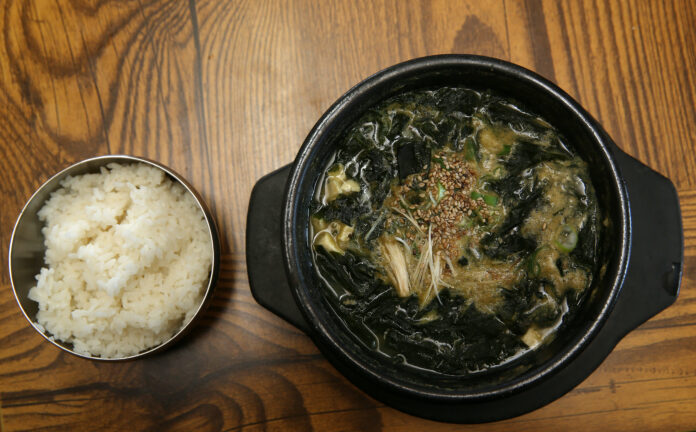
Bowl of seaweed soup served on a brown table with a bowl of rice
South Koreans honour our mothers on our birthdays with this ancient tradition. Photo Credit: Republic of Korea / Flickr

By: Yelin Gemma Lee, Arts & Culture Editor

On your birthday, your friends and family often celebrate you for coming into this world and continuing to age well. The older I grew, the less this made sense to me. I didn’t really do much to be born, whereas my mother went through being pregnant for nine months, giving birth to me, and raising me selflessly. In South Korea, there is a historical food practice we’ve integrated into our culture to recognize this and honour our mothers on our own birthdays. This is seaweed soup. You may have seen it being served in Korean dramas, during someone’s birthday. 

The origins of seaweed soup began in the Goryeo dynasty when people noticed that after giving birth, whales would eat lots of seaweed. Seaweed is rich in vitamins and minerals and has properties ideal for postnatal mothers. They began serving mothers seaweed soup after giving birth to strengthen both the mother and baby.

It became customary to put seaweed soup “next to a pregnant woman’s pillow on the week before birth.” This was an offering to Samsin Halmoni, “the three goddesses of childbirth and destiny in Korean mythology who assist in childbirth and blesses newborns.” 

In modern society, children often grow up with their mothers making seaweed soup for them on their birthdays as a token of thanks for being born safe and healthy. When the child grows up, this is done for them by their close friends, family members, or partners. 

When I became an adult, I began to make my mother the seaweed soup on my birthday to signify my thanks for her giving me life and raising me. In the west, it’s common to celebrate mothers on Mother’s Day but I feel that special connection to her most on my birthday. I treat it as such by setting a Korean breakfast for her featuring seaweed soup. The historical and cultural origins of the soup represent honour for the mother.

I’ve found it difficult to find seaweed soup being sold at Korean restaurants here in Vancouver, but luckily it is so simple to make at home. The more obscure ingredients like dried seaweed or bonito soup stock can be found at Korean supermarkets like Hannam, H-Mart, or Assi Market. I usually make a simple bachelor version of it with instant dried seaweed, the way my father taught me.