Home Blog Page 235

SFSS Council discusses donations to Indigenous Residential School Survivors Society

0
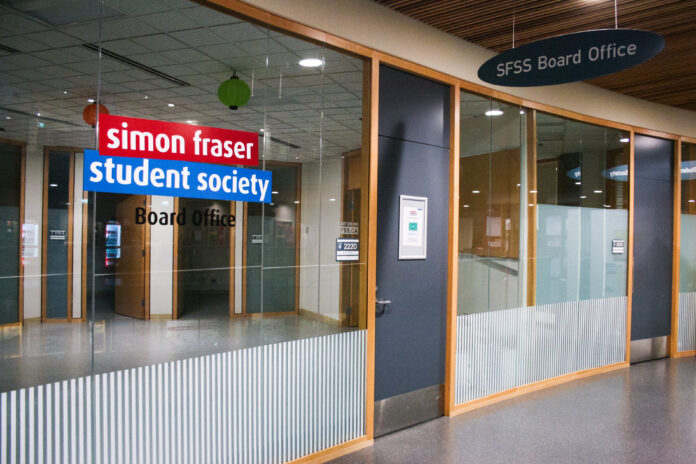
This is a photo of the door to the SFSS offices in the Student Union Building. The window has a large SFSS logo.
PHOTO: Gudrun Wai-Gunnarsson / The Peak

By: Pranjali J Mann, News Writer

In September, Simon Fraser Student Society (SFSS) vice-president external relations and community affairs, Eshana Baran, put forward a motion at a Council meeting to approve an annual SFSS donation of $10,000 to the Indian Residential School Survivors Society (IRSSS). The IRSSS is an organization based in BC that provides services to survivors of residential school such as counselling, physical health support, and cultural support.

The motion faced pushback from some Council members, resulting in discourse and subsequent amendments over the course of three Council meetings. During the initial discussion of the donation motion on September 28, Emiliyo Da Silva, acting global Asia studies councillor said, “At my old student union we donated $5,000 to an organization and later that year the Government of Canada removed their status for funding inappropriate things abroad.” Da Silva felt because the IRSSS also has no annual report on their website, it was an indication they do not conduct valid research. In the Zoom chat, councillor Mark Giles of psychology student union, said, “There is no reason why a charity would not have an annual report other than either fraudulent reasons or incompetent reasons.” 

At the beginning of the October 12 Council meeting, First Nations, Métis & Inuit Student Association (FNMISA) councillor Peter Hance said despite the lack of an annual reports section on the IRSSS’ website, there was enough information to make an informed decision. He noted in an interview with The Peak, “I feel there was no excuse; I mean, we’re paid councillors. I understand we are busy, but like, if we provided the information, you should at least open the link and not say we need a presentation.”

Regarding the discussion on September 28, Hance proposed a motion in the agenda to call for a collective public apology and increased efforts for education among Council members at the October 12 meeting.

Some councillors felt the responsibility of educating the Council about the motion should have fallen on the individual who presented the motion originally. Science undergraduate society councillor Ayooluwa Adigun, said, “Council should not be made to apologise [ . . . ] All the councillors here did was rightfully voice their worries.” 

According to Hance, a responsible answer to the councillors’ lack of information should have been, “I don’t have enough financial information,” instead of questioning the legitimacy of the IRSSS. 

Hance indicated the microaggressions and “anti-Indigeneity” reflected in the initial Council discussions were disrespectful. He addressed the concerns some councillors had regarding donating from SFSS’ deficit spending. This was brought up in October, where some Council members raised the question of the financial “burden” the donation would create on the SFSS budget. Hance responded that using deficit spendings is a viable option. “I think it’s a good way to show that we are backing what we’re saying,” in reference to their commitment to Indigenous reconciliation and territorial acknowledgements.

Nicole Kirigin, vice-president university and academic affairs, underwent consultation with SFU administration. She then proposed the alternative to make the donation in the form of a bursary instead at the October 26 meeting. On this, Hance noted Baran’s original motion to donate was brought up after consultation “with Indigenous individuals.” Citing the SFSS’ National Truth and Reconciliation statement, he was concerned the amendment to the motion demonstrated the SFSS “is not listening to us.” He explained replacing the original motion with a bursary would be a “Eurocentric” and “Western” way of focusing on individual needs. 

Hance said, funding a bursary “might help one or two students, but the whole point of a donation to each residential school survivor is that it amplifies their whole community, the generational trauma.” Through this, he advocated for a holistic approach and collective funding for the residential school survivors. He stated, “I think the viewpoint is a very limited, biased viewpoint [ . . . ] The whole point of truth or reconciliation is to listen to Indigenous voices. We are a community and we prefer this donation to the community.”

At the end of the interview, Hance called for greater education on the efforts of reconciliation for all SFSS councillors. “I do not like that they acknowledge and say, ‘it’s my international [background] or I’m not from here, I don’t know that much,’ Well, then you should have agreed to education and work towards education on these matters.” 

At the third Council meeting, on October 26, a donation of $6,400 was approved for this year. The motion that passed also included provisions for more education and workshops for SFSS councillors starting next year. 

The Peak reached out to SFSS president Helen Sofia Pahou for a statement, but did not hear back by the publication deadline. 

SFSS discusses expectations of executives

0
This photo is of the SFU stadium at the Burnaby Campus. The stadium is empty but it is a sunny day.
PHOTO: Krystal Chan / The Peak

By: Karissa Ketter, News Editor

Concerns about Executive Letter of Expectations 

A presentation was delivered to Council at their November 9 meeting. Vice-president internal and organizational development, Judit Nagy, and vice-chair of Council, Ben Tischler, discussed their concerns regarding the letter of expectations. SFSS president, Helen Sofia Pahou, required executive councillors to sign the letter.

The letter highlights the job duties and responsibilities of councillors — including their requirement of working a minimum of 60 hours biweekly. The letter also outlines that councillors are required to submit their course schedule to the SFSS president at the beginning of each semester. Additionally, councillors are expected to work in the Student Union Building offices, and if they choose to work remotely they must report this to the president. 

Nagy noted this section is problematic because it is “creating rules and requirements that have nothing to do with policy.” Nagy said where a councillor chooses to work from “is your private information that you should not be forced to disclose to anyone you work with if you don’t want to. This makes absolutely no sense.”

Another concern Tischler and Nagy highlighted was regarding the executive members’ work reports. According to the letter, executive members are required to fulfill a bi-weekly report which is then posted on the SFSS website for the student body to view. If the reports are not completed, the vice-president finance and services is able to issue a written warning, then a fine of $100, and then withhold the councillor’s pay entirely. Councillors will have the option to ask for an extension on their report which would be granted by the vice-president finance and services.

Ticshler noted that these measures create “a standard, not backed by policy or by-law, by which the vice-president finance and services is able to grant extensions on work reports.” 

He felt because the president’s letter outlined a process that “isn’t backed by policy, it’s problematic.” 

Pahou responded, “I know we had a bit of a rough start at the beginning of our tenure, and I will reinforce that, it wasn’t an easy transition. The intention of having this letter of expectations is to set a new precedent for when the new incoming executives come in, they’re given a simplified document to easily read into before they can expand their knowledge into the by-laws.”

“We do not need another agreement that has been done illegitimately through the SFSS,” said Nagy. Tichler and Nagy asked the Council to pass a motion that would terminate the letter until the president consults with their Governance Committee, Human Resources and Personnel Committee, and the Oversight Committee to redraft the letter. The motion was carried unanimously.

The Study quietly shut its doors permanently

0
This is a photo of the entrance to The Study pub. At the top of the staircase, the doors to The Study are closed.
PHOTO: Jonadan Cheun / The Peak

By: Hannah Kazemi, Staff Writer

The restaurant industry was hit hard by the COVID-19 pandemic. Public Health limited the amount of customers each restaurant could serve by up to 50% capacity. The Study, SFU’s former on-campus pub managed by the Joseph Richard Group (JRG), faced similar challenges throughout the pandemic.

In November 2021, SFU Ancillary Services published a statement announcing the closure of the pub, noting The Study would be closed temporarily but for an “undetermined amount of time.” The statement also included comments from Ryan Moreno, co-owner of the Joseph Richard Group, who said the temporary closure was due to “lower than anticipated customer volume this term.” 

Moreno had addressed the former staff of The Study, stating they had “enough positions available to transfer all current staff to other JRG locations at this time. We will continue to work with the team at SFU to monitor the situation and ensure we’re prepared to reopen as soon as possible.”

The Peak reached out to the Joseph Richard Group for comment after a photo of an eviction notice addressed to The Study began circulating in a popular subreddit. It was dated July 11, 2022. Comments on the post share the sentiment of disappointment over the closure of the pub, being one of only two options on campus. One person commented, “The vibe there was immaculate. It’s sad this has to go [ . . . ] I was looking forward to this place opening again.” 

Karen Renaud, director of marketing and communications for the Joseph Richard Group, told The Peak in an email statement, “The Study was not evicted from SFU. Rather, COVID-19 restaurant closures took a toll on the industry at large and given the reduced amount of traffic through campus during that time, we were unable to sustain the business and keep it operational.” In the “Notice of Termination” posted on Reddit, the reasons for The Study’s eviction cited failure to pay rent and other fees.

The Peak also reached out to SFU administration for comment on the pub’s closure. Mark McLaughlin, SFU’s chief commercial services officer, told The Peak in an email statement, “The Study pub was closed for business reasons during the COVID-19 pandemic, due to the reduced number of people on campus.”

Prior to the opening of The Study, the Highland Pub occupied that space and was partially owned and operated by the Simon Fraser Student Society (SFSS). However, for similar financial reasons as The Study’s closure, the Highland Pub was shut down by the SFSS in early 2017. In September of the same year SFU took complete ownership of the space and announced plans for opening The Study.

McLaughlin told The Peak that for the time being, the space is “currently vacant” but that it will become a multi-purpose space on campus. He said, “recognizing that our community misses this social space we plan to re-open the location as a bookable event space in early 2023.”

CEO campaigning for free speech gets mad people are making fun of him

0
A stock photo of Elon Musk looking confused.
PHOTO: Flickr

By: Olivia Visser, Opinions Editor

BREAKING NEWS — In an attempt to disavow misinformation, Elon Musk clarified in a recent tweet today that “free speech is not absolute.” 

The billionaire Tesla CEO, and now most recently, Twitter CEO, has entertained the internet this past week with what he described as “definitely a sound business decision.” Critics quickly jumped on the opportunity to mock Musk for acquiring a company losing $4 million in profit everyday. 

As a proposed solution to impending bankruptcy, Musk made user verification accessible via paywall, ending Twitter’s policy of restricting the feature to public figures. Thousands of now-verified Elon Musk parody accounts arrived in swarms. Tweets shot out with phrases like: “Tax evasion is now legal on Twitter!” and “Government handouts should be reserved for those with power and influence, like me. Look at my tech startups and what they became with government grants. Free money . . . for some!”

Much to the billionaire’s displeasure, Twitter quickly became a cesspool of verified parody accounts. Parody accounts of Peppa Pig spoke of her long-held violent fantasies, and gaming  companies instructed customers on how to fix their consoles by lighting them on fire. True blue anarchy. “Comedy is now legal on Twitter!” echoed the army of parody accounts. But Twitter being undesirable for advertisers was the least of Elon’s concerns. The CEO’s issue was with his own parody accounts.

“It’s become clear to me that free speech for all hurts my feelings,” Musk said in a surprisingly emotional official statement to The Peak. “People are saying I got all my money from my daddy, which is only partially true! I’ve been crying ever since I added that damn verification. Do you know how expensive these tears are!?” 

As a proposed solution, Musk adjusted Twitter’s policy to include the following: “All Elon Musk parody accounts must CLEARLY STATE in the description that they are a PARODY account of the MOST HILARIOUS and best businessman ever. Any rule-breakers will be permanently removed from the platform.” In fine print reads: “and anyone who makes fun of him in any way, shape, or form, is subject to punitive measures.” Also, if they parody Musk in a mean-spirited way, Musk reserves the right to retract this policy. “Why isn’t anyone praising me for owning the libs epically?” 

Unfortunately, Twitter’s future now lies in the hands of Elon Musk. As it stands, digital criticism seems to be the biggest hurdle affecting the free speech proponent. Only time will tell how he’ll handle his emotions over the upcoming weeks. Be sure to communicate your thoughts with doge memes, as it is rumoured that Musk only understands 2013 Reddit humour.

SFU Football Alumni Spotlight: Mark Bailey

0
headshot of SFU Football Alumni president, Mark Bailey.
PHOTO: SFU Athletics

By: Hannah Kazemi, Staff Writer

We often hear about SFU athletes who have stepped up or had a particularly impressive season, but what happens to those athletes when they graduate and leave SFU? For the final piece in this series, The Peak spoke with Mark Bailey, current president of the SFU Football Alumni Society, and former linebacker of the SFU football team from 2007–2009, to find out why he continues to support SFU’s young student athletes.

Bailey’s senior year with SFU was cut short when the athletics program began discussing a move from USPORTS to the National Collegiate Athletic Association (NCAA) in 2009. “There were a number of individuals, including myself, that were ineligible to play in the NCAA due to the eligibility [rules],” said Bailey. “We weren’t allowed to be grandfathered into the collegiate league in our senior years.” Bailey transferred to UBC to play his final year with the Thunderbirds, while many of his teammates found themselves at universities all over the country to play out their final year of university football.

Two years prior to Bailey’s arrival to SFU, the team was experiencing a significant losing streak. At one point during the linebacker’s first season, the team had went “25 games in a row without a win.” It wasn’t until SFU’s first victory against UBC to kickoff their 2008 sesaon that things started to turn around. “Myself, as well as our starting quarterback, [Bernd Dittrich] — who unfortunately passed away the following year due to an undetected heart condition — were both nominated as the national defensive and offensive players of the week across the country,” said Bailey. “As time had gone on, we ended up beating the number two ranked team in the country, which was, at that time, the University of Saskatchewan. We beat them at BC Place [ . . . ] which then made us a nationally ranked team.”

Bailey became president of the Football Society in 2016, but has been supporting SFU football athletes well before that. On Remembrance Day in 2011, Bailey established the Bernie Bowl to commemorate Dittrich’s passing two years earlier. In 2016, all the money raised through the event was used to create a scholarship for SFU football athletes in Dittrich’s name. 

Bailey attributes the support he received from alumni when he was a student athlete as the catalyst for his current involvement in SFU’s football program. “A lot of the alumni were quite involved with us as student athletes, and provided opportunities to find career paths,” said Bailey, who was one player to receive a job from an alumni. “Through that job, I was able to develop my skills [and] apply myself to another portion of that industry, [where] I found some career development and success.” Bailey referred to SFU’s football program as “more of a brotherhood,” and commended its ability to help navigate a good work-life balance: an especially necessary skill for student athletes.

“It’s important for them to know that there’s already been people before them that have gone through a lot of the same adversity that they have to balance.” 

Going forward, Bailey sees the Football Society broadening their impact by “providing more engagement and inclusion for the university campus and its students, alumni, staff and supporters as a whole. 

“It’s bigger than football. It’s bigger than each of us as individuals.”

The Rundown

0
photo of an SFU swimmer from their competition against UBC.
PHOTO: Wilson Wong / SFU Athletics

By: Isabella Urbani, Sports Editor

Cross Country

SFU was denied a back-to-back Great Northwest Athletic Conference (GNAC) Championship on November 5, after Western Washington captured both the men’s and women’s titles. SFU’s men’s team placed second with 52 points, while the women placed third with 86 points. Sophomore Charlie Dannatt finished first among the Red Leafs, placing second in the 8 km race with a time of 24:03.4 minutes. Seconds behind him was junior Sebestian Brinkman, earning All-GNAC honours alongside Dannatt for a top-10 finish. The fastest runner on the women’s side was junior Grace Chalk, who clocked in with a time of 21:45.4 minutes to place 10th. She was the only Red Leaf on the women’s side to earn All-GNAC honours. 

Swimming 

The men’s and women’s swim team had a good showing on November 5–6 at the UBC Odlum Brown Colleges Cup Pacific, placing seventh respectively. Senior Jordan Doner shone in both her relay and individual races. The swimmer recorded four personal-bests over the two-day period, finishing fast enough to swim in three A-final events. Two of her personal bests came in the 50m and 100m breaststrokes. With a time of 32.55 seconds in the 50m breaststroke, Donner became the third-fastest SFU swimmer in that category. Dylan Kormendy and Tori Meklensek also recorded personal bests, moving into third and fifth place at SFU for the 100m individual medley and 200m freestyle, respectively. 

Volleyball 

The women’s volleyball team has started November on a roll, winning both of their matches against Saint Martin’s and Western Oregon at home. SFU won their first two sets in front of 200 plus fans before surrendering one to Saint Martin’s in a close 25–23 decision. SFU won the next set to seal the victory, and won their first home game after a two-game road trip. After dropping their first set to Oregon on senior night, the Red Leafs rallied together to win the next two sets before Oregon forced a fifth and final set, which SFU won. Kalissa Beltran led SFU in digs in both games. Eva Person led both games in assists, and Kalyn Hartmann led the team in blocks in game one and aces in game two.

Wrestling 

The men walked away with first place on November 5 at the SFU open, while the women placed third among their competition. Across the board, seven SFU wrestlers placed first in their weight class. Aizayah Yacapin won the 57 kg category, Ryan Hicks won the 70 kg category, Patrik Leder won the 74 kg category, and Taniela Felicano-Takafua won the 125 kg category for the men. For the women, Victoria Seal won the 55 kg category, Paige Maher won the 72 kg category, and Katja Osteen captured the 90 kg category. 

Football                                                                                                    

The men’s football team played their final road game of the season on November 5 against Western Oregon. The Red Leafs fell short in that contest by a score of 32–7. After failing to score in the first quarter, SFU closed out the first half with an Ethan Beselt touchdown — his team-leading fifth touchdown of the season. Quarterback Justin Sieber finished with 11 out of 30 completions in the game, and defensive back Ryan Barthelson led the Red Leafs with 11 tackles. In December, SFU will suit up for their first  Shrum Bowl meeting with UBC since 2010. 

Soccer

The women’s season came to an end on November 3 after being shutout by the number one seed, Western Washington, in the semifinal of the GNAC Championship. The women previously lost to Washington at the 2018 GNAC semifinal, and have not been able to advance to the final since. New addition Isabella Muzzolini made history for the women’s team, being the first SFU women’s player to win the GNAC Newcomer of the Year award. Last year’s GNAC Newcomer winner Conrad Cheng and the men’s team have won four of their last five games. However, their 11–5–1 record was not enough to finish first in their conference and automatically send them to the Division II NCAA soccer championships. Both Mark Talisuna and Devin O’Hea, who finished top five in scoring on the team, earned first team GNAC honours. Talisuna was also named GNAC Player of the Year. 

Monday Music: Late night wine

0
“Monday Music” in orange block text on a yellow rectangular background with rounded corners and an orange border.
Monday Music: your weekly themed playlist. Image courtesy of The Peak.

By: Idara L. Udonya, SFU Student

Let me set the scene: you’re in a low-lit room, a vanilla musk candle is burning, and you’re enjoying your favourite vin doux, maybe a bottle of Jam Jar sweet shiraz or roscato. There’s one thing missing to complete the moment: the perfect playlist. Something about the sensual bliss of seductive sounds pairs perfectly with late night indulgences. Here are some songs to accompany your tipsy, mellow nights.

Listen to the full playlist on The Peak’s Spotify profile

Small Talk” by MALIA
Photo credit: MALIA, Pulse Publishing Administration

As sensual as silk sheets and long kisses, MALIA’s soothing tone and soft writing is smooth as wine. “Small Talk” is reminiscent of the first time seeing your crush; that instant attraction, yearning desire, and I-would-risk-it-all attitude. Her tender and healing alternative R&B sound is bound to set the mood for all types of fun.

Feelings For You” by Xavier Omär
Source: Xavier Omär

What’s a bottle of wine without the realization of the depth of your longing? There’s something about wine-enhanced thoughts that have you thinking “maybe I am in love.” “Feelings For You” is the embodiment of wine-inducing love life introspection. Omär’s ‘90s love-song-like melodious construction is electrified by a new age guitar solo. 

YouMe” by Safa Liron
Photo credit: Safa Liron

An ode to the likes of Floetry and Musiq Soulchild, “YouMe” is a whimsical blend of sultry vocals and old school soul instrumentals. Liron’s melodious writing and vocals brings an airy and sensual vibe to candle-lit late nights. “YouMe” sets the tone for your self-indulgent night in, centering you in self-love

You Are The Best Thing” by Sophie Faith
Photo credit: frtyfve

Picture this: the long day is over and you’re finally home, ready for some loving and relaxation. “You Are The Best Thing” is ideal for wine-in-hand slow dancing alone or with your lover. This song is the perfect soundtrack to colour your chilled-out nights of self-adoration. Faith’s serenading akin to an ‘80s love story brings depth and warmth. 

Driving high is a thrill you don’t want to chase

0
shot of a highway or a busy road
PHOTO: Amirul Anirban / The Peak

By: Nercya Kalino, Staff Writer

Content warning: mentions of car accidents

No parent, guardian, friend, partner, or sibling wants to receive a car accident phone call. People die horrifically from car accidents, and if not, there are typically still traumatic repercussions for everyone involved. Driving high might cost someone’s life — if not the driver, it could be the passenger, or another road user. I hate that this is even a conversation we’re having, but we need to address it. 

Driving is a privileged activity regardless of how many years of experience you have. Driving high is unjustifiable — there’s no reason why you should get behind the wheel and put others at risk for your own decisions. It’s an inconsiderate action towards your own safety and those that share the road with you. Some might justify their behaviour by arguing that driving high is “safer” than driving drunk, but drivers under the influence of marijuana are still almost twice as likely to be in a fatal crash as sober drivers.

UBC’s Faculty of Medicine conducted a study at four hospitals in BC that found blood THC levels above 2 nanograms/ml in twice as many injured drivers between 2013–2020. An article about the study stated that while low THC concentrations don’t always indicate impairment, there’s a big risk with higher THC levels. The number of injured drivers with blood THC levels above 5 nanograms/ml, which is considered enough for significant impairment, rose from 1.1 to 3.5 percent after legalization.

To contextualize this with federal law under Bill C-46, it’s the nanograms that matter when it comes to the legality of driving after using cannabis. Between 2–5 nanograms of THC per milliliter of blood within two hours of driving is a summary conviction. Having a blood alcohol concentration of over “50 milligrams (mg) of alcohol per 100 ml of blood, combined with a THC level greater than 2.5 ng per ml of blood” is a hybrid offense which leads to a $1,000 fine, and up to 10 years in prison for repeat offenders. 

This is something to think about when you decide to drive high. One brief moment of poor decision making isn’t worth the DUI, or the lives it could take. Many of us come from countries where cannabis is looked down upon, and in Canada it’s recognized for its legality. However, if you drive high, be aware that your life is not just your own — think about all those that would be hurt if something happened to you.  

That road accident phone call could be about you if you’re not cautious enough. Just because other people are driving high, doesn’t mean you need to parade along. Don’t get in the car if someone is driving high, because they might cost you your life. Driving high, or being present with someone driving high, could take something from you. Set safety boundaries for yourself, and your future self with thank you.

The ownership mess of AI-generated art

0
pixelated sketchy illustration of a face
ILLUSTRATION: Youngin Cho / The Peak

By: Daniel Salcedo Rubio, Features Editor

Artificial intelligence (AI) is slowly being adapted into our everyday lives. We see it used for relatively simple things, like the Netflix recommendation engine, digital assistants like Siri and Cortana, and image generators. These generators use programming called “deep learning” — the gist is that the software mimics a biological brain. Its developer gives the AI a set of images to learn patterns from, so if you give it a set of landscape photos, it will eventually recognize what sky and mountains are, and use this knowledge to create entirely new images. While this might sound groundbreaking, the current state of image generator AIs is controversial as it puts existing human artists at risk.

I like to consider myself an artist on the side, and I’m protective of the pieces I’ve created. I know this isn’t an isolated concern: look at what happened to artist Tuesday Bassen. Fashion retailer Zara allegedly stole her artwork for their merchandise and profited off her designs. Artwork theft and copyright infringement will likely only get worse with increasing use of AI. Artists have legal ownership over the work they create. Image generators like DALL-E-2 can’t violate this right, no matter how innovative they may be.

Since AIs need a data set to learn and recognize patterns, one major worry artists have is that their artwork is being used for AI learning, raising concerns of copyright infringement. Yes, artists use similar imitation strategies to learn and polish their skills. I myself have a Pinterest account full of reference material from other artists. However, there’s a huge difference between someone referencing other artists’ work to build their own skills, and an AI mixing-and-matching copyrighted material to create a “new” piece of art. Developers must ensure the data set they’re using for deep learning is free from copyright. 

How can we define the ownership of an AI-created piece? Is the person who gives the program its prompts the owner of this “new” creation? Should ownership go to the developer who built the AI? Or, should there be a type of communal ownership by the artists whose work was used for AI learning? There’s technically no right answer to any of these questions; each person involved is a key player in the creation of AI art. And it’s precisely because there’s no right answer that AI image generator users and developers should tread carefully in this new arena. 

Defining ownership is a required step before existing artwork can be used for financial gain. As it stands right now, image generators pose a significant threat to the livelihood of photographers, artists, and anyone involved in image generation. Businesses can use these open image generators to create free content for their own financial gain. In a world where you can create whatever image you can possibly imagine, what’s the financial justification to hire an artist? Not only that, but this also hurts the artists whose work was used to develop the AI. Their personal style which likely took years to create is now in the hands of corporate entities.

AI image generators are a fascinating new development. They’re an entire new tool for artists to work with, and will eventually open new opportunities for the artistic community. But, as is the case with many technological developments, image generators are moving at a faster pace than what society can regulate. We need a distinct  legal definition of ownership for AI generated artwork, and full transparency of the data sets used to develop the AI as soon as possible.

Gaining a new sense of self through therapy

0
Photo of a building with a painting on the side asking "How are you, really?"
Don’t wait for life to get bad to ask for help.

by Hannah Kazemi

In July 2019, I had the single worst emotional breakdown I have ever experienced, driving down the highway at 2:00 a.m. on the way back from the drive-in movie theatre. I was crying about the zoo.

Yes, you read that correctly. The Greater Vancouver Zoo led to my big breakdown moment. The one that happens to movie characters when they go through something really awful. Usually, this is followed by the character deciding to overhaul their life by going to yoga classes or something. Except, I didn’t choose yoga; I chose therapy and it was the best decision I’ve ever made.

I was always the “mature for my age” kid in elementary and high school. I’m also the oldest daughter in a family with divorced parents, which meant I took on a lot of responsibility from a young age. I learned to always put others before myself, even if it meant I suffered or lacked support in return. But I didn’t quite realize this until I reached a turning point.

All of the stress, anxiety, and weight that came with being the oldest daughter culminated in a loud, messy, uncontrollable release of emotion. All because I said I liked the zoo.

We were driving past it when I made a comment about how I loved going there when I was younger and looking at all of the different animals. My mom was surprised when I said that, despite being the one who had taken my sisters and me to the zoo when we were young. I never shared anything with her when I was a kid — she didn’t know when I was sad, when I was happy, or even when I was feeling sick because I kept it all inside. I didn’t want to be a burden, especially having two younger sisters that also required care and attention. I took on the role of mom #2. It was my mom’s shock and genuine confusion at my statement about loving the zoo as a kid that made me realize just how deeply I was hurting, and that I needed to do something about it. I had been keeping everything inside for years of my life, and eventually, all of that sadness and anger and frustration manifested as stress and anxiety.

So I started to go to therapy and it helped immensely. Talking to an unbiased third party whose job is to help you talk through your problems actually works, in case you were still doubtful.

I went to a few sessions over the summer before I started university and worked through some of the things that were bothering and affecting me the most. Summer came to an end and I started my first semester at SFU feeling like I was a new person, like I had a sense of control and an understanding of myself that I had never felt before. I felt like I was being heard: I had a safe space where I could speak freely and openly about my life and feelings without fear of judgement. I also finally realized why I had increasingly been experiencing anxiety as I got older. I figured out that the stomach aches I had been getting during moments of extreme stress, or times when I felt like I had to hide my feelings and emotions, were linked to that anxiety. I had been making myself physically sick.

I stopped booking sessions when I felt well-equipped to handle bouts of anxiety and insecurity on my own using the mental tools I gained from therapy. I was okay for a long time after that: I became more comfortable being vulnerable and expressing when something was wrong or making me feel a certain way. As a result, my relationships with my family strengthened, I became closer with my friends, and opened myself up to new relationships. The anxiety-induced stomach aches started to dissipate, and most importantly, I felt like I had finally started to heal the child inside of me who hadn’t felt heard, safe, or understood for so many years. I now pride myself on my ability to be open and honest about my feelings with others, and therapy is to thank for that.

Almost three years later, sometime during Spring 2022, I started to feel myself slip into old patterns that I thought I had broken. For a while, I couldn’t quite place what I was feeling, just that I was finding it harder to be myself again in certain spaces and to figure out what I needed emotionally. I started isolating myself from my family, shutting down emotionally, and dismissing comments about how I “seemed off” lately. I felt like I could truly be myself only when I was out of the house and around my friends or boyfriend. I was still feeling fulfilled in most of my relationships and I didn’t doubt my ability to eventually bounce back, but I quickly realized that I required a little bit of extra support to navigate the emotional changes. The tools and skills I learned three years ago became more difficult to put into action. I decided to go back to therapy.

I knew from the get–go that I wouldn’t need many sessions because I identified the problem before it got too difficult to manage, but the fact that I advocated for my own needs made me really proud. I don’t think I would have been able to come to this conclusion had I not gone to therapy three years before. Recognizing when you need help takes a lot of self-awareness and reflection, which can be difficult when your mind is consumed with other things.

I just started going again recently. I reached out to someone I felt comfortable sharing with, and let them know that I was feeling the need to go back. They pointed me in the direction of SFU’s Health and Counselling services and I started the intake process. I’ve only had one session since that initial ask for help, but it has been the single most beneficial session that I’ve had since I first went to therapy. I’m booked in for more sessions and am really excited to keep taking steps to better myself and feel more confident and secure in my relationships.

I think that everyone should go to therapy at some point, even if they don’t think they need it it’s changed the way I view myself, and it’s certainly changed my relationship with my family and other people around me. You don’t need something to be “bad” or “wrong” in your life to make the decision to talk to someone about it. Rather than feeling like you’ve lost yourself, try therapy — you might gain something from it.