February 28, 2010. It’s the 2010 Winter Olympics, hosted in Vancouver. Canada and the US are deadlocked at two in the gold medal game. Two hours earlier, this seemed impossible. Canada was sitting pretty with a two-goal lead halfway through the game. However, just minutes after Canada’s insurance marker, the UScuts the deficit in half.In true anti-hero fashion, Ryan Kesler, former Vancouver Canuck, gets the USback into the game in the same city he’ll try to win a cup for the next season.
As the game clock winds down, the US pulls their goalie, desperate to score the equalizer and push the game into sudden death overtime. Pressure mounting, six-year-old me went from checking in on the score each period to being pressed against the television. Nerves so shot, I couldn’t look anywhere but the clock, trading in my view of the game for listening to the commentators.
25 seconds. They had done it. The US had tied it up. They had erased a two-goal lead. Shock was written across everyone’s faces in my living room. The next goal would decide it all. I was barely a hockey fan at this time, and yet, I felt this pit in my stomach. I couldn’t fathom the US winning. I didn’t want to go to school the next day and hear about it. I didn’t want to watch them throw their gloves, and I certainly wasn’t prepared to hear a pin drop in a packed stadium of over 18,000 people.
Winning aside, the goal wasn’t very golden. It happened in a flash. One minute the puck was on Sidney Crosby’s stick, and the next, it was in between the legs of US goaltender Ryan Miller and in the net. You didn’t celebrate because you saw the puck in the net. You celebrated because you heard the eruptions. You saw the players throwing their equipment on the ice in front of a sea of screaming fans, and you couldn’t help but get goosebumps as the remaining players fled the bench to jump on one another.
Now, as a full-fledged hockey fan, the golden goal is sacred. But even for those who don’t follow the sport, if you ask them where they were during the golden goal, they may not know the name, but they’ll remember the moment.
Very calm, very cool. Nothing wrong here.
Illustration: Siloam Yeung / The Peak
By: Maya Beninteso, Peak Associate
1. Uncomfortable and deeply personal questions from extended family members casserole
I can imagine that if you’re a private person, you would invite extended family members and loved ones to dissect every aspect of your life. Coming in strong at number one is: “Do you have a partner yet?” Of course, because you haven’t freely shared that information, it practically means you’re begging someone to ask you about your love life. Other honourable mentions include: “And what exactly are you planning to do with that degree,” “What were your grades this semester,” and “Why are you crying?”
2. Disappointment pudding
Whether it be disappointment in others, yourself, or in your aunt’s lack of ability to cook without setting the kitchen on fire (sorry, Angie), disappointment embodies the true spirit of the holiday season. Although you could set your expectations low like me, an intellectual, so as to not experience disappointment, the holidays are truly not the same without this side dish.
3. The five-spice will to live
The most rare holiday side dish indeed. For those of you who managed to cook up this delicious dish, PLEASE! TELL ME HOW!* Please and thank you (don’t tell me to look at my notes from my psychology courses, because I don’t take any). *Note: this does not apply to my therapist.Keep your thoughts to yourself, Royce.
4. Coal
Yum, this holiday side dish will surely be accompanied with an overwhelming sense of nostalgia . . . right? Or was that just me? We all got coal as children, no? Oh cool, it was just me! Thanks mom. I’ll just cross this one out, then.
5. Delayed brown paper packages tied up with string
There’s nothing quite like the excitement that comes with not knowing whether your holiday presents will arrive in time for present exchanges. On that note, whoever gave me my first (fine, second) copy of Fifty Shades of Grey that they had lying around in their house, I know my real gift was delayed coming in the mail. You wanna know how I know it was your personal copy you decided to re-gift to me? It must be the fact that certain definitely appropriate phrases are underlined in pen (without a ruler, nonetheless, you animal.)
6. Just . . . just tears of children
Why, one of my favourite side dishes is the tears of children — especially after having defeated their sorry asses at Sorry. Taking it easy on the children only sets them up for failure. So, assert your dominance, but make sure to temper your bitterness. You don’t need to be Uncle Krampus. (Hmm, maybe I should be nicer to my cousins, if you children are reading this, which only one out of you three can, I sincerely apologize . . . Not. You should try to, I don’t know, actually win for once). One day I will be humbled, but not today, wee!!!
7. Holiday chee— Beer. Alcohol. Just alcohol.
‘Tis the season to enjoy one of the best holiday dishes, fa-la-la-la-liquor, to your heart’s content. Indulge in some ponche crema (hold the eggnog, of course) and validate your unreasonable overspending on holiday cocktails from your local restaurant or bar.
8. Cancelled flights to flavourtown
Nothing puts me in the holiday spirit quite like flight cancellations and heavy delays. But, I suppose this tracks — not only is your love life failing to take flight this holiday season, so is your actual flight. If only this happened like it did in the movie Home Alone, but then Kevin wouldn’t have learned that favourtism is real, kids.
9. Snow, a fuckton of snow
Oh my, you snowthis one’s my personal favorite — especially when I’m on my way to work and cars without snow tires plague the roads. Oh what fun it is to ride on the roads you might as well call a slip and slide, am I right? This side dish is such a fan favorite, you can almost say it’s to die for.
10. Hallmark movie hash
Ah, yes. A classic side dish is indeed Hallmark movies. Don’t you just love the lack of diversity and watching the same movie but in different fonts? Not to mention the completely natural dialogue and Oscar-worthy acting. Don’t mind me, I’m just about to cozy up with some hot chocolate and watch a Hallmark movie where the lead who is fed up with her mundane desk job decides to bring her rich — but not totally present — boyfriend/fiance back to her small hometown where the holidays are a big deal. Then, the hometown run-in with the ex-boyfriend/the one who got away/childhood best friend who got hot. He successfully sweeps her off her feet and they both decide to live happily ever after in her small hometown because she’s #DownToEarth.
On November 12, Grammy award winning Soweto Gospel Choir performed at the Queen Elizabeth theater as part of their North American tour. “HOPE: It’s Been a Long Time Coming” is their new concert with an uplifting message of resilience they aim to bring to the continent to overcome challenges.
Soweto Gospel Choir is a South African ensemble renowned worldwide for their breathtaking and spine-chilling energy that leaves a room full of joyful applause. Over the past two decades since their inception, they have performed for influential figures, including the late president Nelson Mandela and Archbishop Desmond Tutu. They have performed in the presence of former president Barack Obama and collaborated with artists such as Stevie Wonder, Beyonce, and John Legend. The choir is simply in a league of their own.
Their team consists of young musicians who are passionate about music and the impact they create through it. I was able to briefly speak to the choir master and founding member, Shimmy Jiyane, about what the Soweto Gospel Choir is excited for in the upcoming months and holiday season.
“It was a great performance with a beautiful audience and we felt moved by the turnout from the Canadian crowd,” said Jiyane. “The choir is very excited to be continuing our tour in this wonderful country and starting to bring some Christmas songs into the mix for the holiday season.”
As a choir, they hope that things will change for the better and wish their fans positivity. “We hope people leave our concerts smiling and filled with energy, joy, and encouragement.”
The performance reminds fans that despite the difficult circumstances of the pandemic and social struggle around the world, music can help bring a sense of hope and unity that transcends borders. Jiyane shared that the Soweto Gospel Choir hopes to perform in Vancouver again someday. Until then, you can experience the depth of their passion in their newest album, “Hope.”
By: Hannah Kazemi, Staff Writer, Mocker of Hallmark Movies
As a hater of all Hallmark movies, I am the perfect person to write a very bad Hallmark-esque screenplay that will cause even the most dedicated (read: people with poor taste) Christmas movie fans to cringe. You’re welcome.
UPPER EAST SIDE
MANHATTAN, NEW YORK CITY
It’s 8:00 p.m. on a Friday night, exactly one week before Christmas. New York City is blanketed in snow. CAMERA follows SARAH (23) and MARK (27) who are dressed in long wool coats, circle scarves, and leather gloves as they stroll hand-in-hand down the sidewalk lined with aged brick apartment buildings. SARAH looks self-consciously at her uggs, then at MARK.
SARAH
(to MARK)
I can’t believe it’s almost Christmas. Or that we’ve been together for almost two years! Time really does fly. When do you return from your business trip? I told my parents we’d be there for Christmas dinner. It’s tradition, after all.
MARK
(to SARAH)
I know, honey. I can’t believe it either. I leave tomorrow morning, and I have some business to tend to for a few days. I’ll be back the evening of the 24th. I have a feeling this Christmas will be one to remember. I wouldn’t miss it for the world.
SARAH looks down at their clasped hands and smiles. MARK is an important architect, but SARAH knew the most important thing he would build was their stellar relationship. SARAH suspects MARK is going to propose on Christmas day. SARAH suddenly becomes worried about what outfit to wear. She is concerned about her dress clashing with the ring. The photos would be awful!
CAMERA cuts to a montage of SARAH shopping by herself. SARAH looks for a new dress while MARK is away. She searches all over Manhattan, without much luck.
SARAH decides to look for the ring so that she can match it with one of the 40 dresses she already owns. CAMERA cuts to SARAH alone in their $4,000,000 apartment the morning before MARK is expected to come home. SARAH is hunched over a chest of drawers, their autumn selection of clothes strewn around the room. SARAH lets out an exasperated sigh.
SARAH
(voiceover)
Where on earth did he put that ring?! I’m sure he’s going to propose on Christmas. I just have a feeling. I better check all of his drawers. If my dress doesn’t match, what will people think? I need these photos to be perfect! You only get engaged twice, and at least once I need to have nice pictures.
MARK comes home from his business trip early. CAMERA is angled at SARAH rummaging through MARK’s clothing drawers. MARK is watching her from the doorway to the bedroom. CAMERA turns to focus on MARK. MARK is angry.
MARK
(to SARAH)
What’s going on here?! Why is the room a mess, and why are you going through my stuff?! You’ve tossed my pocket squares everywhere!
SARAH turns around at the sound of MARK’s voice. SARAH has a guilty expression on her face as she pushes her bleach blonde hair out of her face.
SARAH
(to MARK)
Mark! Oh, honey, I didn’t hear you come in! I thought—
MARK
(interrupts SARAH)
You thought you’d have more time to violate my privacy?? What the hell, Sarah! What are you even looking for?
SARAH and MARK stare at each other for a moment. SARAH begins to cry.
SARAH
(to MARK)
I’m so sorry. I was looking for a ring, I thought you might propose on Christmas, and I was worried about my dress not matching the ring, so I thought if I just saw the ring then I could—
MARK interrupts SARAH by walking up to her and holding her face in his hands.
MARK
(to SARAH)
Oh, honey. That’s what you were doing? I already sorted that out. I bought you a brand new dress last week. It matches the ring perfectly. I know how much coordinated photos mean to you.
SARAH looks lovingly at MARK. She is reminded of why she wants to marry him: he always makes sure she looks good in pictures.
MARK pulls SARAH in for a kiss. They’re gross and insufferable. CAMERA fades to black. TEXT appears on the screen reading, “The most picture perfect Christmas you can have . . . is with each other.” A DE BEERS ad cues.
This film is about the world-famous classical music composer and conductor Lydia Tar. She’s known to be the first ever woman to chief conduct a major German orchestra. Cate Blanchett delivers one of the best acting performances of the year, bringing strength, and passion to the role of Lydia Tar. In the recent rise of biopics, Tar is a one of a kind. With the two hours and thirty eight minutes runtime, its fast-pace makes it easy to get through. Tar is not your typical generic and bleak biopic. You’ll feel the emotional perspective of Lydia herself throughout the story.
McDonagh, known for his Oscars Best Picture winning film in 2018, Three Billboards Outside Ebbing, Missouri, has released another Oscar-contending film. This film is about two friends, Padraic (Colin Farrell) and Colm (Brendan Gleeson), who end up brutally ending their friendship. With McDonagh films, you appreciate the surrounding nature. The setting of the small-town Ireland setting elicits comforting simplicity and community, until a conflict between Padraic and Colm creates a feeling of brokenness in Inisherin. I didn’t expect myself to feel so emotionally attached to this story!
Ostlund won the Palme D’Or for the second time with this intelligent and satirical film. This film is about a group of wealthy people who ended up stranded on an island after a storm hit their yacht. Triangle of Sadness brings awareness to the dynamics of different social classes throughout different situations and locations, but in a subtle and lighthearted way. Dolly De Leon’s Abigail shines throughout the film with her witty and strong acting performance. It’s one of the most hilariously well-made films of the year. Make sure to catch it in the theatre if you can so you can experience uncontrollable laughter with the audience!
This film is about different couples going to an island where they are served luxurious and exclusive foods from a chef that serves surprises. Emmy-nominated and Golden Globe winner Anya Taylor Joy continues to serve a strong screen presence and shows her versatility as an actress. Meanwhile, Oscar-winning actor Ralph Fiennes also served a pressing and intimidating chef in the film. The film overall is anxiety-inducing with funny moments to clear the air. It doesn’t have a conventional storyline which is what makes this film so engaging. Not only are the line of dishes being served unexpected, but the way the story presents itself is not predictable in the slightest!
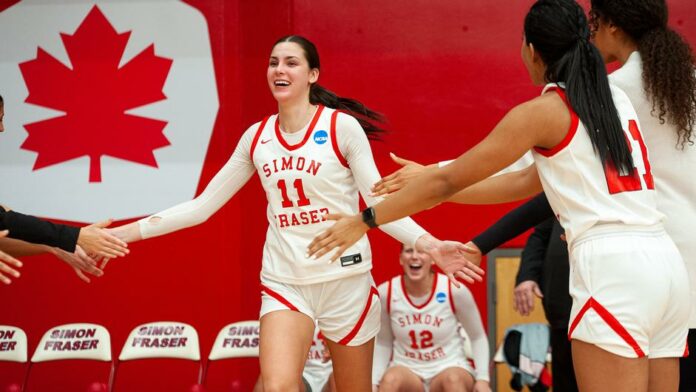
Being a student-athlete requires commitment to a grueling schedule of long days juggling practice, class, traveling, and competing. While most Red Leafs will have a break from competition during the academic school year, SFU’s cross country runners will get no such break. They stare down the indoor track season that is fast approaching with a meet at the University of Washington on January 15.
We spoke to Aiden Good, sophomore cross country and track athlete, and head coach of both the cross country and track and field program, Brit Townsend, to learn more about what it takes to transition from one intense season of competition to the next.
Good will be taking on the 800m, 1600m, and potentially the Distance Medley Relay (DMR) during the indoor season. In the spring outdoor season, he will switch to the 800m and 1500m.
While the women’s cross country team concluded their season at the NCAA Division II West Region championships, the men’s team received an at-large berth to the 2022 NCAA Division championships. The team’s qualification for nationals means their season is extended until December 2, after which they will join the women’s team in shifting gears for the indoor track season.
While both the men’s and women’s teams take a rest week after an intense season of distance-heavy racing, Good saysthe amount of running done during this week is very individualized.
“Some guys will take more time off than others. I don’t take as many days off — I have a hard time taking days off. I find I get antsy, which maybe isn’t the best. I’d probably be better off if I took off days and allowed myself to recover a bit more.”
Good says the transition from cross country season to competing on the track comes on its own. “That process, the switch and transition, will come pretty naturally once we start racing, and you’re having to taper a bit going into weekends where we race.”
Townsend, who has been coaching at SFU for more than 20 years, also shared some insight into what the transition from cross country to track looks like for her athletes.
“We start transitioning into more event-specific work, then specific intervals, that will prepare them better for the type of pacing they need to do on the track.”
She also shared her expectations for her athletes during the transition period, which naturally falls over the winter break, in between the fall and spring semesters.
“I think the biggest thing is it’s difficult with exams, Christmas, and everything to stay consistent,” said Townsend. But that isn’t any excuse for athletes to completely abandon training in her eyes. “It’s my expectation that they’re going to do that and complete the workouts. But the reality is, if they don’t, they won’t perform well.”
The most important part of moving forward into a new, but equally intense, season of competition right on the heels of a long cross country season? Both Good and Townsend were clear that the ultimate goal is to stay physically healthy and mentally strong, especially while juggling competition, academics, and a busy travel schedule.
Townsend emphasized how “getting a little bit of a break mentally from competing” is essential for dual sport athletes during the transition period. Those short breaks from competition, coupled with the continuous effort put in by her athletes across the two seasons, are just a part of Townsend’s everyday expectations for her team.
“The advice I give them is, you gotta try and make yourself better tomorrow than you were today. And that can be in lots of different ways. Whether it’s mentally, physically, or making sure you’re staying healthy and covering all the little things that you do.”
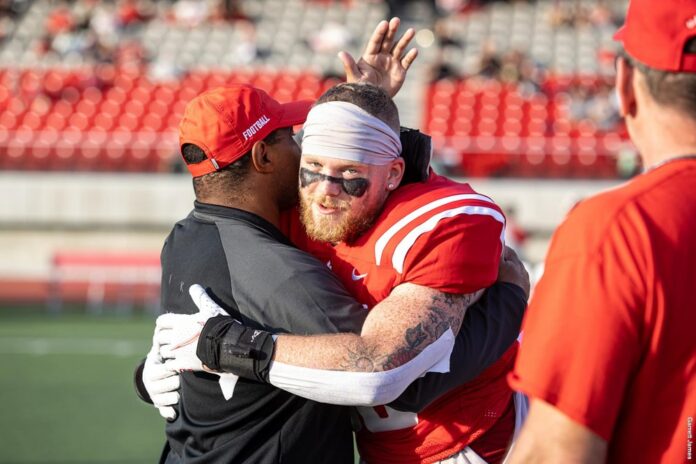
The SFU football team recently recorded their first win of the season in a blowout victory against visiting West Texas A&M. This was their first win asmembersof the Lone Star Conference — which theyjoined at the beginning of the 2022 season.
The victory is just the ninth win for the Red Leafs program since the 2013 season. Their 2012 runsaw SFU record an overall record of 5–6, which dropped to 3–7 by 2013. In 2014, the team won two out of their four conference games, but zero games against their out-of-conference opponents. Following that, the team went on a two-year stretch, from2015 until 2017, without a single victory. In 2018, SFU broke their two-year winless drought the same season that current head coach Mike Rigell joined the football program. The Peak reached out to Rigell for his perspective on the challenges SFU has faced in putting up wins over the last 10 years.
Rigell said one of his most memorable moments as head coach was the Red Leaf’s recent win on senior night atop Burnaby Mountain. Adding to what else he feels has highlighted his time as coach, he said, “Its been great to watch over and mentor our football student athletes, and help guide them to make great decisions on and off the field.”
In hoping to build momentum off the near-end-of-season victory, Rigell clearly expressed the team has no plans to slow down. “We build on this last win [by] having composure, and getting ready for the next opponent like we usually do every week.”
The seasoned head coach said that the Red Leafs “can’t get complacent and rest on our laurels.” This is especially true as SFU prepares to face the UBC Thunderbirds in the upcoming Shrum Bowl, set to take place on December 2 for the first time in 12 years.
As for what comes next for the football team, Coach Rigell laid out his expectations fordiligent offseason training after the 2022 season ends. “After the Shrum Bowl, I look forward to getting back to work hard for our winter season preparation and conditioning,” he said.
Throughout all the questions, Rigell expressed the team-first attitude that has characterized his time leading SFU. “As coaches, we love to prepare and see our kids [and] program grow as well. We are all trying to be consistent and be the best we can be everyday. We talk about ‘winning the day’ as a team everyday.”
Throughout it all, Rigell is ecstatic about the growth his players and the team have gone through since he joined the program. “In this profession, it’s not all about the wins and losses, but the journey. The comradery and relationships that have grown with not only myself, but with my staff [and] players as well.”
As a city with a leading film production industry, Vancouver often stands-in for famous real and fictional locales south of the border, from San Francisco in Planet of the Apes to New York in The Interview. Rarely, if ever, do we see Vancouver represented as itself on the screen.For this reason, Vancouver has long been known as Hollywood North. Then came Fakes, a comedy series that came out September 1. Available on CBC Gem and Netflix, both local and foreign audiences could finally see Vancouver play itself on the screen.
Fakesopens with a police raid on a lively apartment. If you’re keen enough, you’ll spot Canada Place in the background. During the melee, one of the protagonists, Rebecca, (Jennifer Tong), makes a short-lived escape. When we later meet Zoe (Emilija Baranac), the other protagonist, we find out that the two are from the affluent municipality of West Van. The show is centred around the duo’s venture into the world of white collar crime as they start a fake ID printing business.
Rebecca and Zoe quickly make a name for themselves. They go from printing fake Alaskan drivers’ licences at a self-serve printer in a tech shop, to a fully-fledged operation printing a sizable amount of BC drivers’ licences. They also have an awareness of their clients’ needs. The point is to fool a bouncer with a flashlight, but not law enforcement, ICBC, or a respective DMV.
As can be expected, this all starts with a misunderstanding, when the duo inadvertently advertise their expertise to series antagonist Tryst (Richard Harmon). When he puts word out that leaves them in a bind, trouble follows. Their benefactor, initially dealt with by Tryst and the owner of the swanky pad where they print the IDs, shoots someone right in front of his face during that encounter.
How two high school students get tangled up in such a situation is not so surprising once we look at their backgrounds. Both have cases of fractured families and absentee parents. The show, being set in one of Vancouver’s wealthiest neighborhoods, reminds us that even those behind the velvet rope can be prone to the same mishaps and experiences as those on the other side of it.
What’s most notable about Fakes is that it’s as Vancouverite as can be. The protagonists are local actors, and familiar sights as well as cultural cues make viewers in Canada feel at home. More importantly, this allows us to explore issues within our communities. The opportunity to do this through pop culture gets lost when our cities stand in for and prop up metropolises and locales south of the border. This inspires the questions: Can this be replicated or built upon? Will Surrey or Coquitlam finally be able to uniquely play themselves? Whether there are answers to these questions remains to be seen, but Hollywood North seems to have turned a new page.
By: C Icart, Staff Writer, Petra Chase, Arts & Culture Editor, Kelly Chia, Humour Editor, Daniel Salcedo Rubio, Features Editor, Olivia Visser, Opinions Editor, Michelle Young, Editor-in-chief
Dance Fever: Florence + The Machine takes you through a journey of self
Courtesy of Polydor Records, Universal Music Operations Limited
It’s no secret Florence + the Machine has a tendency to make music with religious imagery and soaring vocals. Dance Fever embraces its listeners with familiar references to angels and devils. There is a deep vulnerability to the exploration of singer Florence Welch’s own demons, and it’s breathtakingly honest.
A standout is “Cassandra,” which upon first listen has a reverent, and plainly, scary energy. The pause in the bridge, when Welch rasps her voice to horror-like croaking, “Take me back, oh, drunken gods of slaughter,” stunned me. But as a whole, it speaks to Welch’s own vulnerabilities processing the pandemic as a singer who had lost her means of creating music and the ability to perform. The meat of Dance Fever is exploring Welch’s relationship with performing, which feels so deeply personal for her. It’s what makes the confessional qualities of the ending track, “Morning Elvis,” so compelling. Welch gives an account on the struggles of sobriety, and a dedication to her audience, and you can feel every part of that gratitude in this song, especially with the audience cheering on the album’s closing track. — Kelly Chia
Caprisongs by FKA twigs: “Apple juice for when you’re thirsty”
Courtesy of Young Recordings Limited, Atlantic Records
FKA twigs knows how to package enigmatic worlds in albums. While different from her usual conceptual approach, twigs unlocks a new, more personal dimension. Caprisongsis an entrancing collage of avant-pop hooks, groovy afrobeats, schoolhouse chants, and harp-like vocals.
With unexpected twists and turns, each one just as instantly gratifying as the last, Caprisongsis an album to get lost in. On top of her superior production, it’s her most down-to-earth album yet, sprinkled with snippets of conversations with friends. “meta angel,” which features a heartwarming pep-talk about self-confidence, has been my go-to all year. Another stellar track is “which way feat dystopia,” which opens with the two of them casually pondering the song: “It’s like elevator music for when you’re going to the 50thfloor.” It’s no wonder twigs described the album as “apple juice for when you’re thirsty.” The only thing you can expect from twigs’ art is an extraordinary vision. — Petra Chase
Loud has been at the top of the rap québgame for some time now. His new album, Aucune Promesse, reminds us why. It’s his third full-length album, and it’s a straightforward rap album that goes back to basics. His hard-hitting lyrics navigate English and French in captivating ways. His song “#10,” honouring the passing of Guy Lafleur, includes the bar, “Hometown hero, j’parle en joual, mais j’compte en Euro” (I speak in joual, but I count in Euros). This references his success in Europe and usage of the French Canadian dialect, patois. Loud’s adept wordplay takes the listener through his journey as a rapper and acknowledges those who helped him get where he is. Loud is as confident as ever in his song “I Said What I Said.” If you were at the top of your game, you would be too. The three-year wait between albums was worth it. Loud is settling into his sound and leaving a mark with his commanding lyricism. — C Icart
As a long-standing BTS fan, I thought I knew what to expect with this album. Thinking it would be a cheerful and groovy follow-up to Hope World, I was blown away by the aggressive guitar on “MORE,” hard-hitting rap on “Arson,” and the gloomy piano riffs on “What If…” The album comes during a transitional period in BTS’ career and provides a vulnerable look into j-hope’s personal experience with fame and his creative journey. He skillfully juxtaposes doubt with ambition, passion with self-destruction, and fear with hope. Jack in the Box jumps through a variety of musical styles throughout the album, mixing old school hip-hop beats, rock, and smooth percussion. He is masterful in creating a cohesive album sound without having the tracks sound indistinctive to each other. j-hope flexes his versatility by jumping from raspy rap to bright, upbeat vocals. The album plays with j-hope’s public identity and image, deconstructs it, and puts it back together to truly provide the illusion of surprise, like a Jack in the Box. — Michelle Young
I’ve never been a Harry Styles fan. I liked “Watermelon Sugar” and like pretty much everyone, I was also obsessed with “Sign of the Times,” but that was it. In May, Harry’s Housewas released and . . . not a single flop. From the very first song, “Music For a Sushi Restaurant,” I knew this album was going to be amazing. The slow-groovy beats mix perfectly with his voice, with “Daylight” being the epitome of this “new” rhythm Styles found. Don’t even get me started with “As it Was.” While the song is fantastic, the music video goes above and beyond, including references to The Matrix, Charles and Ray Eames, and more. But the geniality of this album doesn’t end with groovy beats and catchy lyrics you want to sing and dance to; songs like “Matilda” and “Boyfriends” have the raw emotion needed to bring you to tears. — Daniel Salcedo Rubio
Mahal by Toro y Moi: Nothing but praise for the new studio album, as usual
Courtesy of Dead Oceans
Fans of Toro y Moi will agree with me when I say he never puts out a bad album. Frontman Chaz Bear is known for his experimental indie psychedelic music. He’s one of those artists that makes albums so enjoyable, you can listen without needing to skip a single song. Mahal is his seventh studio album, and it’s one of my favourites. According to an interview with NME, Chaz started thinking about this album five years ago, but didn’t find time to write until the COVID-19 pandemic hit. These songs experiment with so many different styles, and somehow still come together under Toro y Moi’s unique electro-funk sound. “Millennium” and “The Loop” are catchy upbeat electro-pop tunes, while “Déjà Vu” has classic psychedelic vibes reminiscent of The Beatles. My favourite song off the album, “Magazine,” is a melancholy song about relationships and climate change, featuring beautiful vocals from Salami Rose Joe Louis. Whether you’re looking for love songs, jazz, pop, or funk — trust me, this album has something for everyone. If you enjoy electronic music, you’ll almost certainly be drawn to Toro y Moi’s creative use of vintage sounds and dreamlike synth notes. — Olivia Visser