Home Blog Page 216

New Music: Only A Visitor’s ruminative singles build anticipation for upcoming art album, Decay

0
Group photo of Only a Visitor members surrounded by plants with flowers that are just about to bloom.
PHOTO: Yohei Shimomae

By: Petra Chase, Arts & Culture Editor

Only A Visitor is a Vancouver-based quintet with an idiosyncratic style that dips its toes in art pop, jazz, acapella, and avant-garde. They’re gearing up for the February 24 release of their first album under Mint Records, Decay. The album is full of peaceful melodies and harmonies that resonate as lasting meditative hums, drowning out negative thoughts throughout the day.

While akin to the conceptual songwriting of Mitski and ruminative outlook of Weyes Blood, Only A Visitor’s vocal composition casts them in a league of their own. After graduating from UBC with a bachelor’s degree in music, classically trained composer and pianist, Robyn Jacob, founded Only A Visitor in 2015. According to Stir, it started as “a project in which the voices were treated as one of the main instruments.”

This idea is mastered in Decay. From the simple humming that backs their acapella track, “Understanding Nothing,” to the call-and-response of their jazzy single, “What Does Waiting Mean,” vocal techniques are used not only to produce soothing rhythms, but to represent the nature of introspection. 

In addition to Jacob’s keyboard and vocals, the group consists of vocalists Emma Postl and Celina Kurz, drummer Kevin Romain, and bassist Jeff Gammon. Their collective talents come together cohesively. For instance, the jazzy instrumentals paired with theatrical songwriting in “All You’ve Held Since” produce a meandering, whimsical tone.

The album as a whole is a rhythmic meditation. Their single “I Am At Ease,” alternates between piano and vocals, gently building off each other to expand on singular optimistic thoughts like “everyday is a new day,” and “the future is a miracle.”

Fraud of Finery,” my personal favourite song, ponders “being close but yet so far, reaching over barriers of communication, and showing love and connection through the digital versus the tactile.” It was released with a music video October 2022, featuring interpretive dance by Justine Chambers. Chambers’ expressions perfectly match the melancholic mood of the song as she moves throughout her house and a forest. The lyrics, “It’s the season of darkness and midnight sleeps on the couch,” capture the song’s essence perfectly.

After listening to Decay, it’s no wonder CBC music named Only A Visitor “one of 10 Vancouver acts to watch.”

Stream Decay starting February 24 on Spotify and follow them on Instagram: @only.a.visitor.

Canada! We need to talk about our garbage

0
ILLUSTRATION: Raissa Sourabh / The Peak

By: Victor Tran, SFU Student

In 2019, Canadians produced more garbage per capita than any other country. What’s worse is that we’re sending that waste to developing countries. Between 2017–22, Canadians shipped more than 2,300 metric tons of garbage overseas. It’s high time Canada stopped dumping its trash on others and solved this problem domestically. 

Exporting waste to developing countries is appealing for many reasons, ranging from being cheaper, to helping meet recycling goals, to freeing up space in domestic landfills. Despite there being an international agreement that’s meant to prevent the exporting of plastic trash to developing countries, the non-profit Basel Action Network reported that multiple countries, including Canada, violated the treaty in 2021. The result of these violations is Canadian trash being found strewn across the Global South. 

Illegal trash dumping in developing countries with inadequate waste management infrastructure can harm people and the environment for a long time. The charity Tearfund estimated in 2019 that “between 400,000 and one million people die each year in developing countries because of diseases related to mismanaged waste.” Plastic that is not recycled is sometimes burnt in those countries, releasing toxic chemicals that contaminate communities and the food chain. Countries that receive exported garbage are at risk of that waste leaking out to the sea, resulting in contaminated water sources and impaired ecosystems. The influx of plastic waste in the Philippines, a major plastic importer, has sickened residents of Manila and clogged the island nation’s coastlines. We as a nation are creating horrible conditions for developing countries and their citizens. 

So, how do we solve the problem?

The easiest answer is to build more landfills in Canada. We produce more waste than we can store, so why not just build more storage? Because that doesn’t tackle the root cause of the problem.

Canadians produce a great deal more waste than peer nations. In 2019, Canada approximately produced 36.1 metric tons of waste. US, the world’s poster child for consumerism, produced 25.9 metric tons. We should be ashamed. 

We need to take that shame and direct it upwards toward producers. 

In Canada, only 9% of 3 million tonnes of annual plastic waste are recycled. This number is a far cry from Germany, which, in 2020, had a 67% recycling rate. Canada lacks what Germany has been focusing on for the last two decades; namely, strong government policies that motivate consumers and businesses to reduce and recycle.

The German government motivates recycling with two strategies: a deposit refund scheme and mandatory waste sorting policies. The deposit refund scheme charges consumers between $0.12 and $0.37 for purchased glass bottles — which is refunded if the bottles are returned to the retail stores. The program results in an outstanding 98.4% return rate, which not only accelerates the recycling process but also helps customers develop a more sustainable mindset. 

The mandatory waste sorting strategy consists of three major policies. The first is the 1991 Packaging Ordinance, which forces manufacturers to recycle and recover sales packaging. The next is The Green Dot System, a nearly EU-wide program that forces manufacturers to pay waste management companies a fee based on the number of packages on the market and the weight of the packaging. Lastly, there’s the Closed Substance Cycle and Waste Management Act, which hold businesses accountable for avoidance, reuse, recycling, and environmentally compatible disposal of waste that arises from manufacturing. Together, these programs incentivize businesses to rethink their production system and adopt recyclable materials in manufacturing.

Canada has a garbage problem. The solution can’t be to just build more landfills; we need to force producers to think about the ways they package their products and the degree to which they’re liable for disposal. 

An exploration of shinbyu and reincarnation in Myanmar

0
This is an aerial photograph of a temple in Myanmar. The roof is solid gold.
PHOTO: Yves Alarie / Unsplash

By: Olivia Sherman, SFU student

For Buddhist people in Myanmar, earning merit creates a better chance of a good life after rebirth. The pursuit of merit can be understood as “the Buddhist way to develop a wise sense of self” that is often based on selfless activities such as giving, virtue, and meditation. Earning merit can happen in many different ways, but the ideal way is to give things such as food or clothing to monks. The tradition that Dr. Keziah Wallis’ lecture focuses on is called a shinbyu, the practice of turning a boy into a monk. The symbolic action of “giving” the boy to the monks results in high merit for all. 

Wallis, an anthropologist and associate professor at the University of the Fraser Valley, discussed shinbyu ceremonies at a public lecture hosted by the SFU department of sociology and anthropology. She has spent many years studying the Bamar people in Myanmar, where reincarnation “is a total fact of life.”

Wallis has attended 17 of these rituals. The official ordination occurs when boys are around 20 years old. There is a primary ritual for younger boys, often aged between 1012. The shinbyu is, Wallis stated, “the most important ritual in Buddhist Southeast Asia,” and almost all Buddhist Bamars share this notion. 

The shinbyu is a vital ritual in a young boy’s life. It is meant to mimic the ordination of Buddha, who was once a prince who left his regal life to become a monk, where he reached Enlightenment. The boys undergoing the shinbyu are dressed in the finest clothes and makeup, given the best food, and carried in parades: the festivities can last weeks. Wallis explained the literal translation of the word shinbyu is “to make a lord,” as the boys are symbolically turned into princes. 

Though the ceremonies technically aren’t mandatory, most feel an obligation to partake, and those who don’t partake feel an immense loss. Some people will temporarily adopt poor or orphaned boys to sponsor their ordinations; this offers them an equal opportunity to take part in this ritual. Most of the boys stay for only a few weeks, while some stay for years studying Buddhist readings. A mere 1% stay with the monks for life. 

Women are considered “the dominant powerhouse” when it comes to decisions and economics because of their skills. Similarly, the women orchestrate the shinbyu from behind the scenes. While women are not able to earn merit by becoming a monk, they can earn merit by organizing these rituals. 

Shinbyu is also a ritual that highlights motherhood. “A man is not really a man until he has become part of the monkhood, and a woman is not truly a Buddhist until she has given a child to the sangha,” the community of monks, Wallis explained. While most merit-making events have women placed in the back, the shinbyu places them at the forefront. “Although it’s a symbolic sacrifice [ . . . ] that kind of idea of giving up a child is a big thing.” Women earn more merit than men do when they give their child to the sangha. 

The concept of community is a vital factor in a shinbyu as well, something that women largely orchestrate. “The village is constituted by karma, karma is made through merit-making, women are the ones who do merit-making. So if women weren’t doing merit-making, you would have no village.” A shinbyu is a ritual that provides the most merit for the entire community. People gain merit by being happy for others gaining merit, thus creating a “merit-go-round.”

“When you share merit with people, you create a bond of karma with them. You create yeseq.” Yeseq is the concept of sharing merit, therefore creating karma, with those closest to you. The more yeseq one shares with another, the more likely it is they’ll be reborn with each other in the next life.

“Yeseq means we’re not apart,” Wallis elaborated. “We have such strong yeseq that we will be brought back together again.” 

Knowing a shinbyu is the best way to make merit, “it makes sense, then, that the highest, strongest, deepest bonds of yeseq occur during the shinbyu,” Wallis noted. “Karma and community and connectedness — these are all what women do. Men don’t engage in that, women do it on behalf of the men.” 

Horoscopes January 30 – February 5

0
An illustration of a girl with long flowing hair. Astrological signs and stars shine around her.
ILLUSTRATION: Marissa Ouyang / The Peak

By: Hana Hoffman, Peak Associate

Aries

In this mysterious world full of unexpected coincidences, you are someday destined to end up in the same tutorial class as Ariel from The Little Mermaid. Aww, Aries and Ariel are going to be right next to each other on the alphabetical attendance list so when the instructor splits the list into groups for discussions, you two will always be in the same group! Please tell me about the interesting conversation when she tells you all about how she went from living in the big blue sea to enrolling at SFU as a human 🙂

Taurus

Honestly, you’re so strict when critiquing your own work. You always set your expectations so high! Soon you’ll discover that judging is your secret talent, and you’ll someday become a Canada’s Got Talent judge and meet your colleague, Simon Cowell. You’re gonna “no” the judging criteria so well.

Gemini

Are you still making edits on your new year’s resolution? New Year’s is so over — it’s time to just stick to the plan and start working towards your goals! It seems like you really need to start believing in yourself, which will lead you to meeting Justin Bieber after your counsellor schedules him to teach you how to become a “belieber” . . in yourself. That extra confidence boost goes a long way!

Cancer

The answer for you is actually up to you. On TikTok’s search bar, type the letter “c,” and the third account with a blue checkmark that pops up is who you’re destined to meet. Who is it gonna be? Central Cee, Charlie Puth, or even Cardi B? You tell me!

Leo

Looking straight into the future . . a time machine will be built by a group of SFU students, and they will offer anyone a free day trip to the past while they’re testing the machine. You will volunteer to enter the big futuristic time machine, and it will take you to Italy in the year 1503 to a painting studio. There, you will then meet the legendary Leonardo da Vinci. You could ask him if he ever thought his name would still be well known 510 years later!

Virgo

Once in a while you enter those social media giveaways, right? Well, some day, Virgo, good luck will come your way! You will see an Instagram notification saying you are the winner of a VIP meet-and-greet ticket to Harry Styles’ concert. That’s an exciting future, and it’s never too early to plan your hairstyle for that moment. It would put the good vibes in One Direction: a bright one.

Libra

Some day in the future, while life is good, you and your peers decide to travel to Toronto and go party at a local nightclub. Drake just happens to be the special guest that night, and during the show he accidentally drops his microphone right in front of you. He says, “Libra, can you do something for me?” and you’ll pick up the mic and give it back to him. So helpful! He thanks you dearly and wants to meet you after the show, wow. 

Scorpio

I’ll tell you why you’re so lucky to be a student in Burnaby, Scorpio. Some day after a long study sesh at SFU, you will go to the grocery store to buy a few cans of Bubly. You soon find out you’re not the only person craving Bubly when you look at the man also taking packs of Bubly into his shopping cart, and he turns out to be Michael Bublé! You get all excited and bubbly and start a conversation with this famous singer.

Sagittarius

As an SFU student you’re probably living in or near Vancouver. This means your chances of meeting Nardwuar the Human Serviette is extremely high! You’re a human Sagittarius, so I just have a feeling you two will cross paths some day! Whenever you hear about a famous artist touring to Vancouver, take some time to visit some local music stores and you might catch Nardwuar doing an interview in one of them. Meeting him is your destiny, I am certain of it.

Capricorn

Capricorn, I know from my omniscient Star-eyes that some of you are guilty of skipping a lecture or a tutorial at some point in your year(s) at SFU. But that’s also a cool thing, because it makes you have one thing in common with rapper Lil Baby: skipping. He was a headliner for Breakout Fest at the PNE venue last September but skipped his show . . . so if you two ever meet, you will have so much in common and become fast friends.

Aquarius

Aquarius, you’re full of fun, happiness, and sunshine, and a fun fact is that you love cats and you always enjoy sweets on Valentine’s. Well, that probably means that you’re destined to meet Cat Valentine on one of your future Valentine’s. You guys would be best friends, I can picture it already.

Pisces

Pisces, your ability to hide your stress and anxiety during exams and your laughter during lectures makes you an outstanding actor by heart. This will someday lead you to getting hired as an actor for a future TV series. Guess what? The cast also features the amazing actor, Ryan Reynolds. Therefore, you will become great friends with your fellow actor. Or great enemies. . .  who knows how it’ll go?

SFU workshop discusses sexual violence

0
This is a photo of two individuals sitting at a table. They appear to be confiding in each other.
PHOTO: Christina Morillo / Pexels

By: Natalie Cooke, News Writer

Content warning: mentions of sexual violence and harrassment.

SFU’s Sexual Violence Support & Prevention Office (SVSPO) recently hosted a workshop to address matters relating to sexual violence. Topics included the various forms of sexual violence, responding to sexual violence, and the services provided by SFU. 

People can be impacted by sexual violence in various ways — including indirect impact such as having received a disclosure or witnessing sexual violence. The Lunch ‘n’ Learn event spread awareness and answered questions about sexual violence for the SFU community. 

The event was discussed in an interview with Belinda Karrsen, an educational specialist for the SVSPO. Karrsen said as a facilitator, she noticed the Lunch ‘n’ Learn event was highly successful, and the conversations were enlightening and supportive. She explained the SVSPO has “created a space where people feel like they can engage.” 

The SFU sexual violence misconduct and education policy (GP 44) defines sexual violence as: “A sexual act or an act targeting a person’s sexuality, gender identity, or gender expression that is committed, threatened, or attempted against a person without the person’s consent.” This kind of behaviour may include “but is not limited to: sexual assault, sexual exploitation, sexual harassment, stalking, indecent exposure, voyeurism, stealthing, and the distribution of sexually explicit photographs or videos of a person without their consent.”

Sex & U defines consent as an agreement between parties that is “freely given. Consent cannot be given by someone who is intoxicated, unconscious, or otherwise considered incapable.” Consent can be withdrawn at any time. “No always means no, even if you or a partner initially agreed to sexual activity or sexual activity has already begun.”

Karrsen said it is important to be aware of sexual violence and prevention because “it is more widespread than some people think.” A 2019 report by Statistics Canada showed that 71% of post-secondary students attending Canadian schools have witnessed or experienced sexual violence. 

Karrsen said, “We can always deepen our awareness of the complexities and nuances of this topic.” She added the need to turn our awareness into action; when combating the systemic issue of sexual assault, “It is up to each person where they want to focus their efforts.” For example, you can get involved in advocacy and working with organizations such as the SFU Active Bystander Network or SFU Students for Consent Culture

Karrsen hopes people will continue to connect with the organization and other support networks after the workshop. According to Karrsen, the SVSPO emphasizes “the importance of offering a compassionate and non-judgemental response if someone does disclose an experience of sexual violence to us [ . . . ] and to respect their decisions.” She explained many people respond to a disclosure with advice and urgency to report an incident. However, it is important to allow the survivor to do what they want at that moment. 

Karrsen explained the importance of self care for anyone impacted by sexual violence. “Learning different ways to regulate your nervous system if you have experienced trauma is important because trauma can come to the surface unexpectedly in flashbacks.” She added, “When a person accesses support in some way, it can facilitate their healing and the process of healing.” Additionally, people need to find what works best for them. 

Karrsen told The Peak the SVSPO uses a “survivor centered approach,” where they “work with the assumption that the person that has been impacted by sexual violence knows what they need best.” Therefore, the SVSPO presents options for ways to move forward without judgement. 

The SVSPO offers “education and support services for people who have been impacted by sexual violence.” Such services include: access to health and counselling services, transportation to hospital or police, supporting someone who is reporting an incident, and connecting people to community-based services. 

To connect with the SVSPO, visit their website for more information. 

D. O. Gibson inspires youth through hip-hop

0
Headshot of D. O. Gibson. Gibson wears a blue hat that says “G.O.A.T.” and a blue plaid shirt against a black backdrop.
PHOTO: Khush

By: Anna Kazi, Peak Associate

World record-setting rapper, Duane “D.O” Gibson, kicked off the year with the Black Music 365 tour which teaches youth in BC about the musical contributions of Black Canadian talent. Gibson spent the second week of January speaking and performing his songs at schools in Chilliwack, Langley, Aldergrove, Maple Ridge, and Port Coquitlam. This past week, he delivered presentations in Burnaby at the Michael J. Fox Theatre. Before he heads to Toronto for the next leg of the tour, Gibson sat down with The Peak to talk about why he’s on a mission to empower youth and Black Canadian talent.

As a Black Canadian from Nova Scotia, Gibson has always been interested in learning about his family history. “What I noticed when I was living in Ontario is that a lot of people weren’t aware of Black history.” He added, “I think it’s really important, especially as a Canadian, to talk about our country.”

Gibson has visited over 1,000 schools since he started delivering presentations to youth back in 2001. “When I tell kids about how Black hockey players in the NHL was from Canada, and that there was the Coloured Hockey League in the 1800s — 22 years before the NHL — I think it makes people realize that there is a rich history of Black Canadians playing hockey,” said Gibson. “For people to say things like ‘Black people don’t play hockey’ is an ignorant thing. I hope that by giving kids that knowledge, they can come back and stand up to racism.”

In 2014, Gibson wrote a hip-hop curriculum for the Toronto District School Board. “Hip-hop music is a part of youth and popular culture. It’s a way to engage students,” he said. 

Gibson’s extensive discography boasts impressive wordplay, groovy rhythms, and inspirational hooks. His anti-bullying anthem, “I stand up,” features a music video filmed in an Ontario elementary school. Students were filmed dancing and mouthing the lyrics along with Gibson.

Gibson is also working towards raising the profiles of Black Canadian musicians. He will be attending the Grammys in LA, where he’ll be organizing his sixth annual Canadian artist and industry networking event, Northern Power Summit

“I love showcasing Canadian talent. One of the things that I noticed coming up as an artist was that there didn’t seem to be as many opportunities for hip-hop and racialized artists, and I realized for myself in my career, that I had to take charge of my career,” said Gibson. “I couldn’t wait for a label or manager to come along and help me. So I want to provide an opportunity that was never given to me to help that next generation of artists.”

Gibson also reminisced about his childhood influences. “I loved hip-hop music and I remember it being an outlet for me because when I was getting picked on in school and being bullied. I didn’t fight back with my fists, but I used hip-hop as my outlet,” said Gibson. “By writing raps and expressing myself, there was a way for me to get things off my chest. And that’s what I loved about hip-hop is that it’s so much of your personal story. It gave me a chance to express myself. Tell my own story.

“One of the things that I tell kids in every presentation, and I get them rapping along to this phrase as well, is ‘can’t nobody hold me down.’ I think that’s an important thing for young people to learn is that you can’t let anybody hold you down or hold you back.”

Canada should be focusing on domestic COVID-19 cases

0
PHOTO: Camila Perez, Unsplash

By: Michelle Young, Editor-in-Chief

As of January 5, “All air travellers two years of age and older, taking a flight originating from the People’s Republic of China, Hong Kong, or Macao that lands in Canada must provide proof of a negative COVID-19 test result, regardless of citizenship or vaccination status.” Not only does this make no sense for COVID-19 policy — it also, once again, fuels anti-Asian sentiment by suggesting COVID-19 is largely carried by people coming from these places. 

A statement from the BC government frames this new policy as a way to “protect Canadians from COVID-19.” They weren’t protecting us in the first place, though. There are already substantial levels of COVID-19 in BC, and hundreds of people were hospitalized from the virus at the start of January. Focusing on travel restrictions for a problem that is already here is nothing more than a smoke screen to look like the province cares. The US has incredibly high amounts of COVID-19 transmission, and yet, no additional restrictions announced for them to enter Canada. 

The CDC itself reported data from the WHO which found over 1,000,000 COVID-19 cases reported in the US in the last 30 days. In comparison, China had over 800,000 cases in the last 30 days. It’s also important to note that while China has been criticized for undercounting its COVID-19 data, the US is also undercounting. Even if we had an accurate picture across the globe, these travel restrictions would be ineffective, because COVID-19 is ever present in Canada anyways. 

It’s true there is a new COVID-19 variant, but this is not the way to combat it. You can still carry and transmit COVID-19 with a negative test result. The move has already been critiqued by multiple experts across Canada as being a political decision, rather than one based in science. Anti-Asian sentiment has been on the rise since 2020, and we obviously haven’t learned anything from the consequences of unfairly stigmatizing these groups. 

It is not difficult to curb COVID-19 transmission — we know how — it’s just that BC hasn’t been taking the steps to make that happen. Acting like there is no more pandemic, while simultaneously encouraging booster shots doesn’t work. Pointing fingers at other countries and arbitrary restrictions doesn’t work. What does work is mandating masks in public spaces, providing paid sick leave so people can stay home when they feel unwell, and improving ventilation, in addition to vaccination. All together, we could have a much nicer time waging this war against the pandemic: a world where the healthcare system isn’t collapsing and there aren’t as many mass reinfections, deaths, and disabilities. There is no perfect solution, but there are better ones than what’s being implemented now

COVID-19 is not a problem unique to China, Hong Kong, or Macao. If Canada was truly interested in COVID-19 management, we would be looking at the many “tools” we have at our disposal — most of which are not being used here. 

SFSS has mass resignations, new executives on staff

0
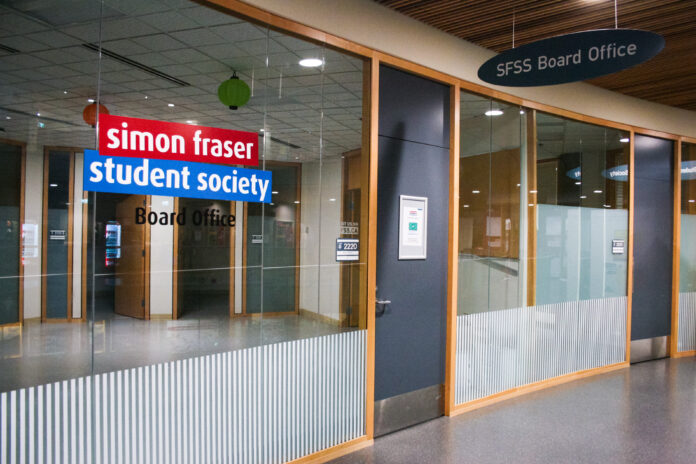
This is a photo of the SFSS office. On their window is the SFSS logo in big print.
PHOTO: Gudrun Wai-Gunnarsson / The Peak

By: Karissa Ketter, News Editor

Editor’s note: Chloë Arneson, who was interviewed for this piece, is a former Peak employee. The Peak acknowledges and has taken steps to prevent conflicts of interest or potential bias from influencing the article. 

Helen Sofia Pahou has resigned from her position as the Simon Fraser Student Society (SFSS) president. Former vice-president internal and organizational development, Judit Nagy, also submitted her resignation. Both executive members resigned on November 23. Recently, on January 11, Nicole Kirigin, former vice-president university and academic affairs, also resigned from the SFSS. The SFSS acting president released a statement announcing these resignations two months later, on January 18, 2023. 

The SFSS executive team is made up of the following changes: 

  • Acting president: Abhishek Parmar replaced Pahou
  • Acting vice-president finance and services: Rastko Koprivica replaced Parmar
  • Acting vice-president internal and organizational development: Peter Hance replaced Nagy
  • Acting vice-president university and academic affairs: Chloë Arneson replaced Kirigin

Parmar will serve as acting president until March 18. Koprivica and Hance will serve as acting vice-presidents until March 17, and Arneson will serve until April 30. The SFSS executive committee is made up of seven positions: the president and six vice-president positions. With the turnover of four roles, the acting president Parmar asked for “patience as newly appointed individuals and staff settle into their roles,” in the press release. 

The replacement process was based on nominations. Councillors nominated themselves or others and their appointment was voted on. In an interview with The Peak, Arneson noted their “election was a surprise.” They were nominated during the Council meeting on January 11. 

“As you can probably tell from the historically quick turnover rate, this job is far from easy,” said Arneson. Arneson noted “Abhishek and Rastko both had plenty of experience in Council” and took over the positions smoothly. 

In regards to Pahou’s and Nagy’s resignations, the executive committee is left to carry out the term with many new staff members. Koprivica told The Peak, “Burnout is huge in this position. Helen and Judit regularly put in long hours in their position and it wasn’t sustainable.” 

In an interview with The Peak, Hance said Pahou’s resignation made sense to him because “she was overwhelmed.” However, he was confused as to why Nagy resigned, because he felt “a lot of [Nagy’s] blame was towards Helen.” He believed Nagy’s challenges with Pahou were a “scapegoat” for another cause. “That’s what made both resignations leave a sour feeling in all of the councillor’s mouths because it felt like a lot of bullying,” said Hance. 

Others feel their resignations will be good for the community. Arneson noted, “I have followed both Helen and Judit’s journeys through Council closely and I believe Helen and Judit made the correct decision in stepping down. From what I understand of the information the student body has, their choices when handling Rea Chatterjee’s resignation left the executive in a difficult position and lost a student activist who has done incredible work in this school.” 

Chatterjee had resigned as vice-president equity and sustainability on August 17, 2022 citing harassment from councillors and being ignored in decision making processes. Sunghyun Choi was appointed acting vice-president equity and sustainability in their place. 

Nagy also spoke to The Peak on her resignation, “At the SFSS, rules don’t apply uniformly to everyone, so had I said half of what others did, I would have gotten into serious trouble — I expect I still will.”

Nagy noted her reasons for resigning “was being overworked, compensating for other executives’ shortcomings, with no relief in sight.” Nagy said she found most of the executive councillors “weren’t pulling their weight.” She added, “With the exception of a few, the organization had no interest in addressing this, so by November, I knew I could either stay and be complicit, or cut my losses; I chose the latter. 

“Given all that happened, the only thing I’d do differently is to be more assertive. I was too permissive when the SFSS needed a strong hand,” said Nagy. “The SFSS made it very difficult for me to do my job, and fought me for every inch of ground I gained — which wasn’t a deal-breaker, but its unwillingness to address its issues, will eventually lead to its extinction, and I refuse to play a part in it.”

Nagy is also concerned with Hance taking over her role. “Peter was only on Council for a month prior to his appointment, he’s unqualified and untrained.” She noted her concerns are with the job duties now assigned to Hance. “The internal portfolio oversees how this multimillion dollar society governs itself, so an untrained person could cause issues.” 

In an interview with Hance, he said the allegations of him being untrained “are pretty big attacks.” According to Hance, the previous vice-president internal has been refusing to contact him. 

“Usually during the on-boarding process, the previous vice-president helps you,” said Hance. However, when he replaced Nagy, this was not his experience. “The previous vice-president was very uncooperative with me. I tried multiple times to contact them in-person, they kind of walked away. Through online means they would not respond to me at all.” Hance noted this added complications to his role such as inability to access his email and important documents pertaining to his duties. 

In response to the allegations that he is underqualified for the role of vice-president, Hance referenced the progress he made during his time on Council as the First Nations, Métis & Inuit student association (FNMISA) councillor. He previously proposed a motion at the September 28 Council meeting calling on the SFSS to apologize for their behaviour during discussions about the Indian Residential School Survivors Society. Hance also noted he has worked to consult with student constituency groups in his current role. “I can say the previous vice-president internal didn’t do that. 

“I did put the effort through, even though I’m a relatively new student to the organization,” said Hance. “I’ve done my best to be very polite with the previous vice-president internal. I feel like I haven’t gotten that respect in turn.” 

In regards to the resignations, Hance extended understanding that “it’s a stressful position,” and a councillor may resign for a number of reasons — to focus on school, mental health, among other responsibilities. “We will all respect that, and hope you move on. We just don’t want any bad blood or animosity towards anything.

“These kinds of things hurt the entire student society and student body as a whole,” said Hance. 

The Peak contacted Helen Sofia Pahou, Nicole Kirigin, and Abhishek Parmar for interviews, but did not hear back by the publication deadline.


New Music: Kid Koala releases single and announces new album, Creatures of the Late Afternoon

0
Photo of Kid Koala making music with a turntable and a cardboard cut-out of a recording studio. Two bright-colored monsters with headphones sit outside the recording room, operating the recording settings.
PHOTO: Corinne Merrell

By: C Icart, staff writer

Nearly three decades after the beginning of his career, Vancouver turntable legend, Kid Koala is releasing his ninth album. The established artist is also “a respected performer, film composer, theatre producer and visual artist.” His upcoming album is called Creatures Of The Late Afternoon and is the soundtrack to an accompanying board game about creatures coming together and using music to protect their habitat. The board game is played on the vinyl case for the album. 

Kid Koala, also known as Eric San, has been honing in on his sound for years. He incorporates elements of hip-hop, blues, classical, ambient, and alternative. He is incredibly creative and the album is like  “the score to an action film-inspired love story.​​” The second single, “Once Upon A Time In The Northeast,” has been released on January 10 and it’s an instrumental electronic track.

I don’t typically listen to electronic music so I wasn’t sure what to expect. I let myself get transported by the beat. The song was reminiscent of a western film. It is described as “a pensive and patient turntable plod, the instrumental track slowly builds from scratched textures to arid Ennio Morricone-like guitar with great canyon reverb.” It’s the perfect background track for any chill evening. 

Kid Koala describes the album as “playful.” The first two singles are available to listen to now but the full album release is scheduled for April 14, 2023. The multi-talented artist also painted the art on the board game. I am looking forward to seeing how all the pieces of this album come together to tell one cohesive story through the visuals and the game. 

The double album and board game are available for pre-order. Those interested in seeing Kid Koala live can attend his show with Lealani at the Biltmore Cabaret on February 9, 2023. 

Hannah’s tips to survive SFU

0
PHOTO: Windows/Unsplash

By: Hannah Kazemi, Staff Writer

I’m in my last semester at SFU and looking back, there are many things I wish I had known when I started. There’s small stuff, like waiting to buy books or pay tuition until after the first week of classes, but there’s also big stuff that would have probably made the first year or two of my degree a bit more fulfilling.

Do: Try all the food!

This is one of the simplest ways to spice up those long days of back-to-back lectures. I made it my mission to do as much exploring as possible whenever I had a break, and the best way to do that is to go on a food tour. Become a campus food snob and you’ll find some kickass places to eat. I stumbled upon a great pho place called Pho 99 (which I realize is probably not a hidden gem but it is to me) at Cornerstone during my fourth year. Also, they give you ice cream at the end of your meal!

Don’t: Try to sit through a 3+ hour lecture without snacks!

Listen. You have to be prepared. Sometimes profs don’t give breaks to run and grab a snack from a vending machine or a café. I promise you that the day you start bringing snacks to class is the day your life will change. I stopped caring about munching on things and making noise with snack wrappers after I watched someone in my POL 100 class crush a family-sized bag of Cheetos. They crunched Cheeto after Cheeto during the whole two-hour class and then proceeded to lick the orange dust off their fingers. If that person was brave enough then you can be too. It’s better to be over-prepared than under-prepared. Just bring the snacks. Stop by the convenience store in the SUB or Nesters in Cornerstone or better yet, grab a snack at Renaissance and munch on something sweet during class.

Do: Go to office hours!

Ask for help! Do it! Immediately! Sooner than you think you need it!

The first time I ever went to office hours I was so nervous. I remember shaking like a leaf in the elevator up to the sixth floor of the AQ. I remember standing outside, about a door down the hall, and texting my mom, “omg I’m so scared what do I say????” But I did it and it was fine! Now, in my last semester, I waltz into my professors’ offices like I own the place. I address most of them by their first name (if they tell me it’s allowed) and ask questions about their dogs, their jobs, and if there’s anything they regret about their lives. I realized very quickly professors are human and not that different from me! They also get paid to pay attention to you, so make use of them! I remind myself of that when I feel like my questions are very simple. Repeat after me: Professors get paid to pay attention to you.

Along these lines, make good use of the resources SFU offers to students. I’ve personally had great experiences with Health & Counselling, and I encourage everyone to seek help when they need it. Some other resources include the Centre for Accessible Learning (CAL), financial aid, the Ombudsperson, and the Sexual Violence Support and Prevention Office (SVSPO). University is hard and students go through so much both within and outside of school. Remember, these resources and people are literally being paid to support you.

Don’t: Send panic emails! Verbalize the panic instead!

This is half-baked advice. I have typed up probably dozens of 2:00 a.m. panic emails to professors requesting extensions, trauma-dumping my anxiety onto the screen, only to delete them instead of hitting “send.” I find that I’m able to get all of my shit out and into the universe that way, and then I become so much more productive. I express myself best in writing, so writing out the most dramatic email on earth helps me get a handle on how exactly I’m feeling. 

This isn’t to say that asking for extensions is bad. Ask for help when you need it, and be honest with your professors (and yourself!) about a timeline that can be reasonable for you to get your work done. It’s been much better for me to verbalize or write out my feelings before acting on them.

Do: All the things!! Be open! But also stubborn sometimes?!

This sounds so cliché, but I don’t care because it’s true: you have to take ownership of your learning and yourself in university. Nobody cares if you show up or not unless participation is part of your grade. It’s up to you to decide how much effort you put into your classes. It’s also up to you to decide how diverse and fulfilling your university experience is. Go to puppy therapy! Take a random course about dinosaurs because you think they’re cool! Join a club! Quit that club and join a new one! Study abroad! Or don’t! It’s all about you, you’re the star. 

But also set boundaries; be social and pack your schedule if you want to, but take time for yourself as well. Self-care and alone time is important, so be stubborn when it comes to giving yourself enough you-time. You’re not too selfish by setting boundaries and saying no! If your schedule doesn’t allow for a day off from campus, change up your environment often. Walk the trails on Burnaby Mountain or find a quiet spot on the bottom floor of WMC to decompress and remove yourself from the busyness of school for a little while. Your brain and body will thank you for it.

Don’t: Waste your time comparing yourself to others!

This one is short and sweet because you’ve definitely absolutely certainly heard this one before: don’t do what other people do! Do what you want to do! Everyone is the star of their own show and if you compare yourself to other people you’ll never get to where you want to be. And that’s not a slay.

Do: Take time off!

I was able to get my degree done in four years — it’s been a great accomplishment and I know I sound like a privileged asshole saying this. Not a lot of people can graduate in four years and so many socio-economic factors impact the pace at which people can finish their degrees. But, if you can afford to, take time off. 

I took last summer off because I could feel the burnout seeping into my brain. It caused such an intense mental block that it was challenging to pay attention in class and absorb new information. My sister and I booked a trip together exploring four different countries. I had the best summer of my entire life seeing places I never thought I would see and I would do it again in a heartbeat. I just wish I had done it sooner.

Taking time off might look different for everybody, it could mean taking a summer off, or it could mean reducing the number of classes you take in a semester. However, make sure you listen and give yourself time to rest and recharge. It’s not a bad thing — it’s healthy, in fact — and you definitely need it.

Don’t: Put others first!

This is all connected to that “take a break and set boundaries” bit that I’ve talked about like three times now. You are the person taking care of you. You will be you for the rest of your life. So why wouldn’t you put yourself before anyone else? Do what makes you happy and enjoy the ride, it’ll be over before you know it. It still feels like I just graduated high school and started university, but in reality, I’m 22 and graduating with a university degree. Shit’s wild.

That’s all, folks.
Cheers,
Hannah xoxo