Home Blog Page 165

Bargaining team brushing up on their stalling tactic skills

0
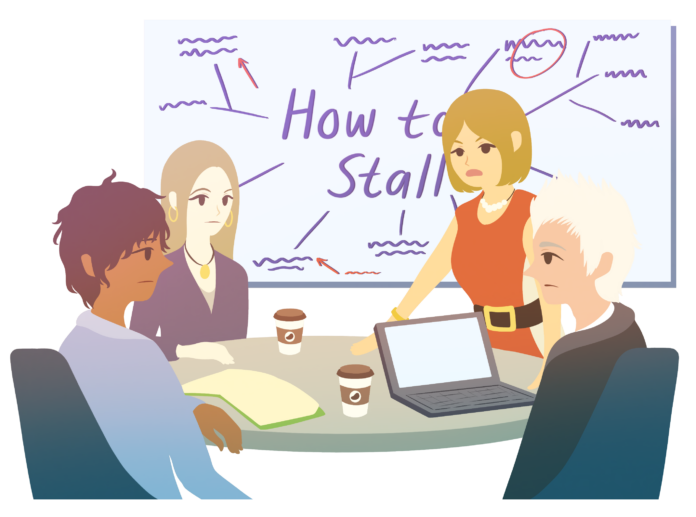
Four wealthy individuals sitting in a conference room in front of a white board that reads “how to stall.”
ILLUSTRATION: Alyssa Umbal / The Peak

By: Sude Guvendik, Staff Writer

Ah, the sweet symphony of bureaucracy. It’s like a finely tuned orchestra playing the most annoying melody you’ve ever heard. As the TSSU battles it out for a fair contract, the employer’s bargaining team has been brushing up on their stalling tactic skills with the dedication of a procrastinating student cramming for finals.

Picture this: a dimly lit room, the scent of lukewarm coffee, and burnt-out ideas hanging in the air. SFU’s bargaining team, dressed in their best “I’m here to negotiate . . . eventually” attire, huddle around a conference table littered with half-empty Timbit boxes and enough paperwork to shame a forest. Let’s eavesdrop on their brilliant brainstorming session.

Stalling Tactic #1: The Semantics Shuffle

SFU’s lead negotiator, Mr. Jargon Juggler, clears his throat. “Alright, team, our first stalling tactic is to delve into the riveting world of semantics. We’ll spend hours debating whether ‘office hours’ and ‘consultation’ are truly distinguishable concepts. It’s like arguing whether a tomato is a fruit or a vegetable, but way less fun.”

Stalling Tactic #2: The Equivalent Enigma

“Next up,” Mr. Juggler continues, “we’ll pretend that paying teaching assistants the same for different work is a perfectly reasonable idea. We’ll argue that ‘equivalent’ is subjective. Who’s to say what’s equivalent anyway? A panda and a penguin are both cute and fluffy, right?”

Assistant Negotiator B nods enthusiastically, “Exactly! We can use this tactic until they’re so baffled they’ll forget they wanted fair compensation in the first place.”

Stalling Tactic #3: The Historical Headache

“Now, team, we’ve got to stand our ground on the Truth and Reconciliation Commission’s recommendations,” Mr. Juggler declares. “We’ll tell them we need more time to reflect on history and its implications.”

Assistant Negotiator C pipes up, “And when they ask for specifics, we’ll start with the history of shoelaces and work our way up to the invention of the cheese grater. By the time we’re done, they won’t remember what they asked for in the first place.”

Stalling Tactic #4: The Procrastination Prodigies

“Lastly,” Mr. Juggler concludes, “we’ve got to master the art of procrastination. We’ll wait until they’re about to snap, then casually admit that not every improvement has to count against wage increases. It’s like giving them a nugget of hope after months of frustration.”

Assistant Negotiator D grins, “And we can toss in a few vague promises about ‘looking into it further’ and ‘exploring options.’ They’ll be so relieved they won’t notice we’ve actually said nothing.”

And so, dear readers, as TSSU continues to fight the good fight for a fair contract, SFU’s bargaining team hones their stalling tactics with the precision of a seasoned procrastinator. Will TSSU prevail, or will the employer’s baffling mastery of time-wasting semantics triumph? Only time, and possibly another 40 bargaining sessions, will tell. Until then, let the bureaucratic ballet continue!

Horoscopes October 9 – 15

0
An illustration of a girl, stars and astrological signs strewn in her hair.
ILLUSTRATION: Marissa Ouyang / The Peak

By: Hana Hoffman, Peak Associate

Aries
March 21–April 19

Change your phone wallpaper to something that will yell at you to do work. How about a photo of Nicki Minaj with the caption, “Barbs stay in school!” Or a picture of your favourite video game with the caption, “You wanna play? You have to earn it.” Bonus points if you also use that audio as your ringtone and alarm. Be creative!

Taurus
April 20–May 20

You pay for your SFU gym membership in your tuition. 99% of people who promise they’ll take advantage of their membership throughout the semester only end up working out twice, both in the first week of school. I want to be your witness when you’re working on your fitness!

Gemini
May 21–June 20

Make one trip to do all your groceries. Buy those 100-pack instant noodles, 50 pounds of minute rice, and 300 granola bars. If you want to have time to study this semester, you’ve got to be able to make meals in one minute. Who knows when you’ll have a chance to attend Guy Fieri’s Grocery Games?

Cancer
June 21–July 22

Get a pair of anti-slip, waterproof, ice-proof, grippy shoes with straps instead of laces. If you’ve lived here in the fall and winter, you know what the weather is like. And once the temperature gets low, your hands will be so frozen they won’t be able to untie your laces when you get home.

Leo
July 23–August 22

New school year means new sticker collection! Go to some random marketing stands or wander around the SUB until someone hands you free stickers. You could also buy those cute animal stickers at the dollar store. Make the back of your laptop unforgettable so your professors can always notice you in the lecture room and remember how awesome your computer was.

Virgo
August 23–September 22

Clear your entire drive, whether it’s Google Drive, OneDrive, or whatever you use today. It’s a true nightmare getting constant notifications saying, “your storage is 99% full.” Where will you keep all your videos from the Coldplay concert and hilarious videos of your dog and cat chasing each other??? Oof, just make a new email address and get the free storage plan again.

Libra
September 23–October 22

Invest in roller blades. As students, we don’t have a single minute to waste. Rolling down the hallways and across campus in Heelys instead of walking is estimated to save you 28.73 seconds per 100 metres (just an educated guess by me). And sometimes that’s the bit of extra time you need when you’re submitting an assignment on Canvas right before midnight.

Scorpio
October 23–November 21

Get your Halloween and Christmas shopping over with! Prove to yourself you’re not a pro procrastinator. You know you’ll be studying for your midterm the night before Halloween and staying up all night wrapping presents on Christmas Eve. Why not avoid all this stress for once?

Sagittarius
November 22–December 21

Take a nice long walk down a trail to mentally recover from the realization of midterms approaching. Go bananas and swing from branch to branch. Who knows when you’ll ever have time to inhale fresh air while you lock yourself indoors for months trying to catch up on weekly readings and assignments?

Capricorn
December 22–January 19

Hey Capricorn! I know you think you should be studying for midterms, but the stars actually want you to binge-watch all the seasons of your favourite show one last time before you start drowning in schoolwork. Just soak in all the good parts so you can replay them in your head when you’re bored in class.

Aquarius
January 20–February 18

Give your phone a leash like it’s your pet, and you can’t lose sight of it. How annoying is it to leave your phone somewhere and go through the whole process of tracking your recent footsteps, calling your phone number, and reporting your missing phone? And doing all that to eventually find out your phone was at the bottom of your backpack the entire time? The point is, just keep your phone in sight at all times to avoid unnecessary stress!

Pisces
February 19–March 20

Know where every bathroom is so you can avoid lineups during breaks. Whenever there’s a 10-minute break during lecture, everyone just goes to the same nearest bathroom and spends the whole time lining up. If you walk one minute to a more hidden bathroom, you’ll probably have the whole bathroom to yourself.

Monday Music: Commuter jams

0
Image courtesy of The Peak.

By: Omar Nsouli

Whether you commute to campus by car, bus, or . . . a helicopter, for all I know, Monday mornings can sometimes be a drag. A cure for this early inconvenience are songs calm enough to be played in the morning, but pack a little punch of energy to keep you going during the gruelling transition from home to classes.

KANTE (feat. Fave)” by Davido

The first time I heard this song was at a Drake concert and I could not resist Shazaming it — the melody was hypnotizing. The rhythmic Afrobeats track features a bouncy use of drums and blissful brass inclusions. Released earlier this year, “KANTE” is from Afrobeats star Davido’s newest album, Timeless. This song is perfect to add to your playlist because of its jazzy flair, which is sure to serenade you out of sleep. 

Dolerme” by ROSALÍA

From reggaetón to rock and everything in between, Spanish artist ROSALÍA can do it all. For her 2020 alt-rock song, “Dolerme” (‘hurt me’ in Spanish), ROSALÍA deals with heartbreak. Released near the beginning of quarantine, ROSALÍA shared how music is healing for her mental health in a vulnerable Notes app confession on Instagram. Through the novel use of an autotuned chorus and a soft guitar strum, this sentimental track packs an appropriate amount of angst to start your journey to school.  

Binz” by Solange

“I just wanna wake up to the suns in Saint Laurent” is a quote that will remain iconic in the Knowles literary canon among many other famed lyrics she shares with her sister, Beyoncé. The sumptuous song contains a relaxing use of funky keyboards and experimental guitar, coated by Solange’s honey-like voice. Solange sings about wishing to wake up one day “on a yacht” and just taking it easy with luxuries circling her. The mellow and summery dream acts as a small escape from your mundane Monday. 

Possibly Maybe” by Björk

Beginning with a telephonic and ethereal sound to initiate a sonic journey, “Possibly Maybe” is a great accompaniment to your commute. The trip-hop track is an aural jungle, blending an infinite mix of sounds and genres into one bite-sized song. Björk sprinkles in a telephone, a cartoonish crescendo, and soft brass notes as she sings about how anything could’ve happened when she was with then ex-boyfriend, Stéphane Sednaoui. Eclectic yet calm, the song is a perfect addition to your commuting playlist for its innovative experimental sound. 

The ABCs of Budgeting in Vancouver, Part 2

0
The word investment laid out in Scrabble tiles on a wooden background.
PHOTO: Precondo CA / Unsplash

By: Hailey Miller, Staff Writer

A few weeks ago, I wrote an article on the ABCs of Budgeting in Vancouver. It was so well received that I decided to write a part two. Without further ado, may I present to you some new and improved tips and tricks to help you keep on top of your financial A-game once again — or should I say, the HIJs of budgeting. Last time, I left off at growing your savings. Now, let’s do a deep dive into financial planning, investing, term deposits, escalators, funds, credits, and more oh my!

While investing gives you the opportunity to increase your wealth, it inherently carries risks, and it is essential to exercise caution and diligence when managing your finances. The information provided in this article is for general informational purposes only, and should not be considered as financial advice tailored to your specific circumstances. It is your responsibility to conduct thorough research, seek guidance from qualified financial advisors, and understand the implications of various financial tools before making any investment decisions. 

Handle your finances with care.

Your money is precious and finances are fragile. Be cautious with your spending and try to follow the 50/30/20 model. This model draws on the idea of putting 50% of your spending toward essentials and things you absolutely need (e.g. groceries, rent, bills), 30% of your spending toward things you want (e.g. non-essential shopping), and the remaining 20% goes toward either paying any debt that you may have, or, if you don’t have any debts, put this 20% into savings and investing.

Invest responsibly.

This brings me to my next point. What even is investing, and how do you invest responsibly? Investing involves putting money into allocated mediums such as savings plans, term deposits, funds, exchange-traded funds (ETFs), and the like to later increase your income and profits from the original invested amounts. For instance, if you invest in ETFs, you’re essentially buying a piece of a larger portfolio, mitigating your risk across multiple assets. For term deposits, if you invest x amount into one, the money that you contribute will increase a certain amount over a specified time. Depending on what type of investment you choose, the length of said investment, and the interest rate, your contributions will increase over time. These increases are particularly great for future savings, but, remember investing isn’t your only option. If your investing budget is relatively small, you might see little to no returns by the end of the investment period, and it might make more sense to save your money.

Jumpstart your savings with good interest rates.

Now, what is an interest rate, and how are you supposed to know your best option? An interest rate is a certain percentage that’s allocated for an investment amount. Let’s use a simplified term deposit example to explain how interest rates work. If you were to contribute $100 into a three-year escalating term deposit at a yearly constant 5% interest rate. After your first year you will have earned $5, giving you a total of $105. After your second year, you will have 5% of your new total, meaning you have $110.25. By the time the term deposit reaches its completion date, also known as “when it matures,” you will have $115.76, and by that time you can either take the money out and put it elsewhere (e.g. into different savings or chequing accounts), or you can renew it — hopefully, at a higher interest rate. Keep in mind that interest rates change as often as on a daily basis. 

Know your term deposits. 

Let’s use the above example of a three-year escalating term deposit (colloquially known as an “escalator”) again. Here’s the takeaway: the higher the interest rate, the more you’ll make. I consider anything under 4% terribly low and anything over 5% incredibly good these days. Banks are tricky when it comes to interest rates and investing, so doing your research on interest rates will make you more confident when it comes to getting the rate you want and need.

Interest rates don’t stay at the same rate for each year of an escalator or other investment medium. For example, although the total rate of a three-year escalator is advertised at 4.5%, you don’t receive 4.5% interest on your contributions each year. Rather, the total 4.5% is divided among those years (e.g. year one has an interest of 1.5%, year two has an interest of 0.5%, and year three comes in at 2%). Note that these rates may not be equally divided up for each year.

Learn more about savings plans.

It’s never too early to meet with a financial advisor, and you’re not too young to be investing for your future — including retirement. Whatever your plan may be, starting early is the smartest move. Doing so will give you a good sense of the importance of understanding your financial situation and investment options, alongside reducing financial stress for the future — whether that be six months from now, or 50 years down the line. There are many savings plans to take into consideration, including Registered Retirement Savings Plan (RRSPs), Registered Disability Savings Plan (RDSPs), Registered Education Savings Plan (RESPs), Tax-Free Savings Accounts (TFSAs), and more. Some savings plans are only applicable to you in certain instances. For example, you can only qualify for an RDSP if you have a verified disability and receive the disability tax credit. RESPs are only for post-secondary students whose parents, guardians, or other individuals invest money during your younger childhood years to later put toward their education. Important to note: TFSAs have a maximum amount that you’re allowed to contribute each year. The government sets a certain amount for you to shelter from being taxed based on your annual income. Find out more on your CRA account, and talk to a financial advisor. 

Make the most of your financial options.

Similar to the above point, in order to choose the right financial options for your needs, discuss this with your financial advisor. Do your research on which investments and savings options are best suited for you. Don’t invest a large amount of money for a long period of time if you know you’re going to need that amount for an expense in the near future. For instance, don’t put a big chunk of your money in a long-term or non-redeemable deposit if you know that you have to pay your tuition, or you’re saving up to buy a car, appliance, or even a laptop. It’s great to save, and it’s great to invest, but the two don’t always have — or need — to work in cohesion with one another. Likewise, don’t rack up large amounts of credit and debts that you can’t pay, if you can help it. For instance, avoid charging large amounts to your credit card if you can’t pay the bill on time. If you don’t pay your bills on time, you’ll be charged interest, which will make matters worse by having to pay more. If you’re struggling with debts (either student debt or otherwise), discuss your options with your advisor, plan accordingly, and do your best to stay on top of your financial plan and budget.

Never withdraw too hastily.

Long-term deposits typically last one to five years, while short term deposits can last anywhere from 30 days to just under one year. If you take money out of a long or short-term deposit before the term matures, you will likely be penalized a certain amount depending on when you take the money out. Typically, each bank or credit union has different rules regarding penalties, so check with your institution and advisor prior to any withdrawals. Another important point to be aware of is the difference between redeemable and non-redeemable term deposits and funds. Redeemable typically means you can redeem your money throughout the investment period before the term matures. This is applicable for most escalators, GICs, and long and short-term deposits. On the other hand, non-redeemable means you cannot redeem your money while the term is still in effect before it matures. This is typically applicable for RRSPs, TFSAs, RESPs, RDSPs, and RRIFs where your money is “locked-in” for a longer amount of time. Different rules apply to different financial institutions, too. 

Observe your finances and make necessary changes.

All this talk about chequing versus savings, term deposits versus escalators, redeemables versus non-redeemables, funds versus payments, and credit versus debit is probably making your head spin. Don’t worry, whether you’re new to investing and making the most out of your financial situation, or you’re a well-seasoned term deposit, interest rate chasing pro — financial planning can still be stressful and overwhelming. That’s why it’s important to plan ahead, be thorough with your options, utilize advice from advisors, and make adjustments when needed. If you’re not totally comfortable with investing or this is something new to you, a good rule to remember is to start safe and go slow. Before you know it, you, too, will be an investing pro!

Stop signs are for stopping

0
A stop sign
PHOTO: Max Burchill / Unsplash

By: Kaja Antic, SFU Student

As an experienced driver in Metro Vancouver, I’ve noticed an ongoing problem that threatens the safety of our roadways. It also threatens the well-being of other people. I constantly see drivers speed past the stop marker and inch into oncoming traffic at many stop signs, stop lines, and even red lights.

My issue isn’t even rolling stops. In fact, I rarely see them. It’s the unnecessarily aggressive approach to, and overshoot of, the actual stop location. Why do you need to stop a metre past the stop sign? Is the giant red octagon not enough notice of the location where you should stop? To me, and most law-abiding citizens, the instructions are clear. 

These dangerous drivers have no regard for pedestrians and cyclists, other cars, the generally accepted rules of the road, and their own front bumpers. I have seen these menaces everywhere, from my neighbourhood in Surrey, to downtown Vancouver, or when searching for the last parking spot in the East Lot. I witness encounters like these daily, no matter the time of day. Has the art of properly following traffic laws been lost on Vancouverites? 

If you are someone guilty of this sin, please change your ways, before karma and ICBC come your way. All drivers reading this, I implore you to be aware of this pressing issue, to save yourselves and your vehicles. These careless cars are out there, and there is no sign of them stopping. Properly. 

Academia needs a lesson in simplicity

0
A bookshelf filled with academic books
PHOTO: Iñaki del Olmo / Unsplash

By: Hailey Miller, Staff Writer

We’ve all tried to read a paragraph in a text, only to go back and reread it, with no greater success in absorbing the information. Why is academia so convoluted? It doesn’t need to be this way. It makes important information inaccessible to both the public and the students trying to learn this material. Some professors assign so many in-depth required readings each week that students can’t keep up and they fall behind trying to understand the material.

The margin between what’s conveyed in a paper versus what’s thoroughly comprehended is a vast one. Half the time students pretend to understand, when in reality, we do the minimum to grasp a surface understanding after toiling over it for hours. It seems professors and scholarly authors alike would rather students sift over every content-filled, obscure nuance with a fine-tooth comb, expecting us to become experts in each assigned reading. Most of us have other commitments outside of school, too, including work, appointments, and family to take care of. I don’t have time to dissect every reading assigned to me. If you’re an academic, you should be able to get your point across in a way that’s digestible.

There’s really no benefit to reading a detailed scholarly article when you’re spending more time with a dictionary than actually reading the piece. Most of the time, these ideas would benefit from less complex words, and more straightforward ideas. Sometimes highly-specific jargon is needed, but academia could also do with cutting down on these papers.

Sometimes we go to class just to have a quick, summarized discussion on the material in question, so why did we even bother reading such a content-heavy piece in the first place? Some things in these readings are never even mentioned again. It would be helpful for students if professors prioritized the important content they want us to learn, rather than stuffing every possible idea into a week. Instructors need to give more time to students for difficult readings, and ensure everyone truly understands the material at hand before moving on. 

While I’m used to the heavy depths of reading scholarly articles and literary journals, I’m also over it by now. Readings can be quite gruelling when you’re completely lost in the countless pages of a dense paper that becomes more monotonous the longer you read it. University instructors should have a responsibility to make their courses accessible, rather than relying on students to have perfect comprehension skills.

We’d all save so much time if we didn’t have to dissect every ambiguous meaning behind the words in academic writing. Professors need to set more manageable schedules and rethink some of their unrealistic expectations regarding course load and curricula, while effectively communicating with students. So, here’s a lesson to be learned: academia is long overdue a crash course in concision. 

Chornobyl and Kakhovka: a discussion of nuclear terror

0
This is a photo of Ukrainian soldiers. They are standing in front of a Ukrainian flag, as it is waving. The soldiers are dressed in military gear, and are holding weapons.
PHOTO: Minitry of Defense of Ukraine / Flickr

By: Izzy Cheung, Staff Writer

Content warning: mentions of war.

Dr. Svitlana Matviyenko is an assistant professor of critical media analysis at SFU’s School of Communication. On September 28, she held a lecture and Q&A discussion on nuclear terror and “radioactive colonialism.” The event was held in conjunction with SFU departments of communication, humanities, contemporary arts, and the SFU Vancity Office of Community Engagement. 

Matviyenko’s wide range of academic specializations include “media and environment, the political economy of information, and cyberwar.” Some of her most powerful works can be found on the Institute of Network Cultures’ website, which details her experiences living in Ukraine during the Russian invasion in 2022. 

To start her presentation, Matviyenko recalled how the Kakhovka Dam was destroyed on June 5, 2023. According to The New York Times, some suspect Russia is at fault for destroying the dam and causing it to overflow. The aftermath of this was the flooding of various Ukrainian cities and towns, which Matviyenko said could make it “the worst ecological disaster [in Ukraine] since the Chornobyl catastrophe.”

The destruction of the Kakhovka Dam “has been recognized as indicative of genocidal intent,” Matviyenko clarified. She noted how the environmental damage done to the area around the dam poses a “serious threat to the health and wellbeing of the Ukrainian nation and its future generations.” She described the attack as “ecocide,” which is defined as “the mass damage and destruction of the natural living world.”  

In December 2022, she visited the Ukrainian National Chornobyl Museum in Kyiv. The museum displayed photos and images of the recent Russian occupation of Ukrainian nuclear infrastructure. She described the exhibit as like being “from a crime movie” with photographs stuck to a board and tied together with red threads. 

“Let us take radiation itself as a medium, linking the present and the past,” Matviyenko said. 

She offered further context into her lecture by discussing the events of the Chornobyl disaster, which happened on April 26, 1986. The explosions carried radiation equivalent to “500 Hiroshima bombs.” The radiation was shown to have been travelling through the air 10 days later

Despite this event, Matviyenko argued that the full realization of nuclear power stations as a technological indicator of modern power didn’t occur after the Chornobyl disaster in 1968, as many scholars have claimed. Rather, this realization occurred in 2022, after the destruction of the Kakhovka Dam, which supplies Europe’s largest nuclear power plant. 

“[Being] immersed in the situation, I realized that everyone there, in Ukraine, does not have an option to ‘sign off,’” she recalled. “[They] don’t have an option not to see [the war].”  

A recorded version of this event will be available on SFU’s Vancity Office of Community Engagement’s website at www.sfu.ca/vancity-office-community-engagement.html. 

TSSU initiates full work stoppage

0
TSSU picket line at SFU Burnaby campus.
PHOTO: Olivia Sherman / The Peak

By: Olivia Sherman, News Writer

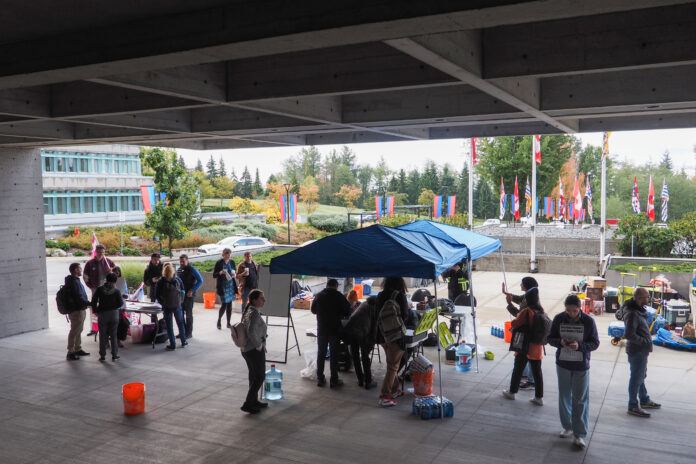
On September 28, the Teaching Support Staff Union (TSSU) engaged in a full work stoppage and began demonstrating in picket lines across all three SFU campuses. The stoppage of all work for teaching assistants (TAs) is an escalation of the current strike, which started in June. The Peak interviewed media spokesperson and bargaining committee member, Dalton Kamish, to learn more about the strike and ongoing actions. 

The TSSU has been campaigning for an adjustment in pay to keep up with the rising cost of living, end wage theft, and ensure a better future for instructors with a pension plan, Kamish said. They noted the SFU administration has been unprepared and inflexible with their terms. “The employer and their spokesperson just won’t bargain meaningfully,” they said, and it’s “not the employer’s intention” to do so. Kamish noted the SFU administration didn’t attend the arranged bargaining meeting on the evening of the work stoppage.

TAs are paid for how many courses and hours they teach. This compensation model doesn’t account for how many students are in each of the TA’s classes, therefore a TA is paid the same for a class of 10 students as a class of 100 students. This is also not reflective of office hours, assignment and test grading, or the number of emails and online communications sent, which the COVID-19 pandemic has exacerbated. Kamish said this is an example of wage theft, which is when an employer fails to accurately compensate a worker for their job. 

The university said the reason this compensation model cannot be changed is because of the mandate of the Public Sector Employers’ Council (PSEC). PSEC is meant to oversee BC’s labour relations and compensation planning. Kamish said PSEC sets a limit on the general wage increase a workforce can acquire, which isn’t what TSSU is asking for, but rather compensation for the work already completed. “It’s not a cost to the university to pay for the work that’s already being done. It’s not a general wage increase.”  

Kamish said “employers like SFU hide behind this mandate” and “use PSEC to shirk their own responsibilities to actually administer and manage the university. They act like they can’t decide to take some of this enormous surplus and spend it on the people who do the work.”

On the day of the work stoppage, all graduate and undergraduate students at SFU received an email on behalf of the administration from Yabome Gilpin-Jackson, the vice-president of people, equity, and inclusion. They also received an email from Dilson Rassier, provost and vice-president, academic. The notices made reference to the 41 bargaining meetings between November 2022 and September 2023. “In that time, the university tabled approximately 50 proposals while TSSU leadership tabled more than 500 proposals,” SFU said. “To date, there are still more than 200 TSSU proposals outstanding.” 

Kamish said TSSU is aware of the mass emails to students. “The irony of it is that, it reflects how much work we’ve put into our proposals, in contrast to how little they’ve put into theirs,” Kamish said. “I know for a fact that they’re counting changing typos as a proposal, because there’s no way that their math works.” TSSU members have expressed frustration with SFU spending much of their bargaining time in meetings discussing spelling errors, grammatical errors, and minute details. Kamish also noted many of the items TSSU proposed are recurring issues that have been brought up since 2012, “but every round they act like they’ve never seen them before. 

“Every single proposal we’ve made to improve our collective agreements, they’ve said, ‘that will reduce your wage increases.’ It’s only in the last three bargaining sessions they admitted ‘okay, maybe some things don’t need to count against your wage increases.’”

The mass email on September 28 also stated SFU’s bargaining team will continue to “look for solutions to present to TSSU to resolve collective bargaining” in order to strike a deal with the union, but said this will be accomplished “when the TSSU is prepared to return to the bargaining table.” 

Kamish said TSSU is “waiting to go back to bargaining [ . . . ] We’re out on picket lines, we’re on strike.” They added, “We don’t see a lot of sense in confirming a bargaining date when they’re going to waste our time, and we know that.” At the time of publication, TSSU had announced they would return to the bargaining tables on October 6, but no results from the meeting had been released. 

The work stoppage means TAs will stop teaching all tutorials and labs, and grading tests and assignments. Communication with TAs, such as through emails and Canvas messaging, will also cease during the strike. “While bargaining should follow logic and reason, it follows power, and our greatest power is our labour. The way that we show that is by withdrawing that labour,” Kamish said. “The normal, everyday function of this university relies on exploiting TSSU members’ work.” 

Kamish and the TSSU have hope of winning the strike. “We have a long and proud tradition of winning strikes.” 

This is an ongoing story The Peak will continue to cover. For more information on ongoing job action, visit https://www.tssu.ca/. The Peak reached out to SFU administration for a comment, but they declined to speak. 

Angela Sterritt discusses systemic violence against Indigenous women

0
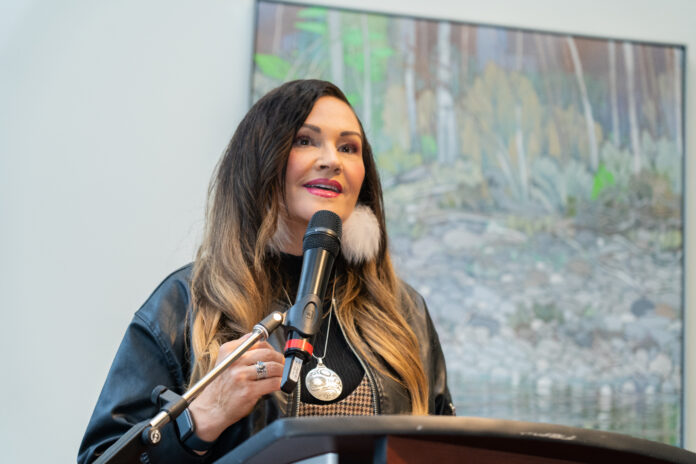
This is a photo of Angela Sterritt giving her lecture. She is standing at a podium, speaking to a large audience. The photo is close on her face. Behind her there is a painting of nature, forest, and animals.
PHOTO: Joelle Lee

By: Karissa Ketter, News Editor

Editor’s Note: This article was updated on October 13, to correct the title of the Haíłzaqv (Heiltsuk) Washing Ceremony. Also, to correct that Angela Sterritt investigated the cases of Ramona Wilson and Tina Fontaine in her book.

Content warning: mentions of missing and murdered Indigenous women and police brutality.

On September 25, Gitxsan author and investigative journalist, Angela Sterritt, spoke at SFU for the annual Andrew Mack Memorial Lecture series. Sterritt spoke on the systemic violence Indigenous communities and women face today, as highlighted in her newest book, Unbroken

“The reason why my book is called Unbroken is because when I grew up, I always heard Elders say, they took everything away from us, but we are unbroken,” explained Sterritt. “A lot of people think that colonization ripped everything away from us, which it temporarily did: our languages, our cultures, our children, our communities, our connections to our lands.” Sterritt said all the things colonization attempted to take away from Indigenous communities, they are powerfully reclaiming today. “I am proof that our cultures, our laws, and our land are still alive today.” 

Sterritt is a “bestselling author from the Wilp Wiik’aax of the Gitanmaax community within the Gitxsan Nation on her dad’s side and from Bell Island Newfoundland on her maternal side.” Her lecture, “How Indigenous women’s knowledge and power can transform our understanding of human security,” was hosted by SFU international studies. 

SFU international studies director, Dr. Megan MacKenzie, began the presentation by noting “the best way to solve global problems is to initiate solutions that draw from multiple fields of study.” MacKenzie said, “In this moment in the world’s history, the school’s ethos is perhaps more important than ever.”

Dr. Andrew Mack has been an adjunct professor for SFU international studies since 2007. According to MacKenzie, “Professor Mack’s work also helped legitimize and bring more attention to the concept of human security.” According to Mack, the concept of human security today goes beyond the original military terms of war and extends to considering “what it means to live without freedom from fear and want.”

In Sterritt’s lecture, she said, “I want to talk about what human security means for women, girls and two-spirit people in Canada.” To do this, Sterritt outlined three case studies of systemic violence that she investigated in her book. Two of these cases were those of missing and murdered Indigenous women, Ramona Wilson and Tina Fontaine. Both young Indigenous women inspired Sterritt to write her book, “and have also really illuminated the tragedy and the crisis of missing and murdered Indigenous women and girls in this country.”

Indigenous women in Canada make up only 4% of the female population. Despite this, they disproportionately make up “25% of all female homicides in Canada. Indigenous women are 12 times as likely to be murdered or go missing as any other woman in Canada and 16 times as likely to be murdered as white women,” said Sterritt.

The lack of government action to protect Indigenous women sends a strong message to Indigenous communities, according to Sterritt: “That we don’t matter.” Canada’s colonial policies “ushered in the idea that we were not human,” said Sterritt. 

Many Indigenous women have gone missing along a 700 km stretch of highway between Prince George and Prince Rupert in BC, including Ramona Wilson. This portion of Highway 16 has been named Highway of Tears, after the women who have gone missing there. Sterritt explained there are several Indigenous communities along that highway, some as far as 70 km away from the highway. “The reserves are far away, and the colonials set this up on purpose. It’s a system of apartheid that they created to make way for white settlers to come to thrive off the land.” 

Their communities being far from the main highway and urban centres made it increasingly difficult for Indigenous peoples to engage with the local economies. Additionally, the provincial government refused to set up a public transportation system along this highway until 2019. “Women have been forced to hitchhike on these lands.” 

One of the goals of Canadian colonialism was to dismantle Indigenous cultures and Indigenous sovereignty. Colonizers enforced that Indigenous communities “temporarily had the inability to enact [their] own laws [ . . . ] The colonials that came over understood deeply and intricately women here have power,” said Sterritt. She noted that Indigenous women were the “backbone of their communities.” Indigenous women were targetted in colonial society, to disenfranchise their humanity and power. 

“In order for Indigenous women and girls to have safety, we need Canadians to see Indigenous people as full dimensional beings,” said Sterritt.

Another priority for Sterritt is for Canadians to recognize Indigenous governance systems and sovereignty. The third case study she included was that of Maxwell Johnson, “a grandfather who was handcuffed while trying to open a bank account with his 12 year old granddaughter,” in Vancouver. 

After Sterritt covered the story in a CBC article, she found people “were shocked that anti-Indigenous systemic racism still happens. They were shocked that people of colour trying to open a bank account might be arrested.” In response, the BMO employee and Vancouver police officers were called on to attend a Washing Ceremony, which is part of the Haíłzaqv (Heiltsuk) justice system when wrongdoing has occurred. 

The two arresting officers from the Vancouver police department refused to attend. Sterritt noted that if the officers had attended, it would have been “such an amazing opportunity for these two officers to come and to bear witness to a different form of justice, a different court system. One that doesn’t handcuff people and put them in jail and forget about them. One that upholds people in all the things that they’ve done.”

When taking part in a Washing Ceremony, Sterritt said the person is symbolically saying, “I’m responsible, I’m accountable, and I’m honouring your system of governance and your system of law.”

Angela Sterritt concluded the lecture by sharing what white settlers on this land can do for Indigenous people. “I want to implore you to uphold Indigenous laws and governing structures, implore you to speak the truth. But I also want to implore you to dismantle the systems that our white ancestors have created.”

Angela Sterritt’s book, Unbroken, is available for purchase at Massey Books and on their website at www.storestock.massybooks.com/.

A chat with our favourite advice columnist

0
A woman standing beside a window. The blinds are slightly raised.
PHOTO: Min An / Pexels

By: Saije Rusimovici, Staff Writer and C Icart, Humour Editor

Dear Peakie, 

The other day, my friend asked me to close the blinds, revealing a very embarrassing truth about myself: I don’t know how blinds work. And can you blame me? Multiple cords are involved, and that stick thing that you twist, apparently??? Blinds are a medieval contraption I have yet to demystify. How do I hide my secret? 

Sincerely, 
Confused by Blinds

Dear Confused by Blinds,

This might signify that the time has come to pick up a tired but true skill necessary to spare you some embarrassment. You might be thinking, “Oh, Peakie, you’re so smart. Of course, you know how to close the blinds! It comes naturally to you!” And alas, reader, you are not wrong.

Nevertheless, my trials and tribulations are not important here. The next time you are home alone, you have to practice! Yank at the strings, pull at the blinds to manually open them if you must! See how they work by breaking down the mechanics one piece at a time. 

And if all else fails, it might be time to invest in some curtains. 

Warmly, 
Peakie 

Dear Peakie, 

My sister used MY fork. I spent years walking through the IKEAs, Bed Bath and Beyonds, and Costcos of the world, looking for my ideal fork. It needed to be pointy enough, provide excellent mouthfeel, and double as a comb. Needless to say, it is one of my most treasured possessions. So, why did I come home to my sister sloppily stabbing her gnocchi with it?! She’s saying I’m overreacting, but you’re on my side, right?

Sincerely,
Get the Fork Away From My Utensils

Dear Get the Fork Away From My Utensils,

Ah, this letter impacts me on a personal level. Okay, pull yourself together, Peakie. I hate to go on about my own experiences when giving advice, but this hits too close to home. Oh, what the heck. I’ll tell you my story.

When I was a child, my younger brother would use my favourite cereal spoon in EVERYTHING. A spoon meant for CEREAL does not belong in a bowl of Kraft Dinner (did I mention I loathe Kraft Dinner?). The point is, you’ve got to protect what belongs to you. When I finally moved out, I purchased a special set of monogrammed utensils. I keep them in a locked safe where my roommates will never find them. As much as it pains me to eat with regular cutlery, it needs to be done so no one will discover my secret set. 

Thinking of you,
Peakie

Dear Peakie, 

I don’t need your advice; I need your help. Yesterday, I got ghosted by not one but TWO buses. I watched patiently as the minutes to the scheduled arrival of my bus went by on Apple Maps. With one minute left, I carefully took my U-Pass out of my wallet so it would be ready for that tapping action. But the bus never came, and I had to resort to old-school transportation technology: my legs. Will you meet me at my secret lab where we can work on top-secret teleportation technology, so I’m never stranded again?

Sincerely, 
Teleporters Against TransLink 

Dear Teleporters Against TransLink,

Unfortunately, I cannot meet you. It would be a violation of both my privacy and yours. I’m sure you can understand. But let’s think about this logically. Of course, you can’t Uber around this city economically, and with rising gas prices, it’s no surprise that taking transit is your best option. Hmm. Yes, well, I never thought I would say this, but I am a little stumped. Fortunately, having my own driver, I don’t need to worry about these things . . . 

I hear those electric scooters are quite fashionable these days. It’s not quite a teleportation device, but you’ll be zooming down the mountain in no time! And, if you see the bus, you can scoot on right over to it! Gosh, I’m brilliant!

Don’t forget your helmet!

Best wishes,
Peakie