Home Blog Page 130

Warmer winters aren’t what we want

0
A sunny day on the coast of BC
PHOTO: Lauren Kan / Unsplash

By: Izzy Cheung, Staff Writer

This past fall semester, no classes or exams were interrupted by flurries of snow. Educationally speaking, this is a good thing, but when we look further into what this may mean for the future climate, it might have been better to endure a couple of snow days last semester. The warmer climates from this December may indicate a similar outcome for the upcoming summer months — hotter temperatures, resulting in more wildfires. As great as it was to not have to shovel our driveways so often or bundle up in layers of clothing, this doesn’t mean we should be hoping for warmer winters in the future. It means we’re already feeling the effects of climate change. 

The National Oceanic and Atmospheric Administration (NOAA) has attributed the warmer winter temperatures to a natural climate phenomenon known as El Niño. This phenomenon is indicated by “warmer-than-average sea surface temperatures” in the “Pacific Ocean near the equator,” though it affects more than just this area. While a milder winter was expected for 2023, some argue “it’s played a small part in 2023’s soaring temperatures.” This emergence of warmer weather makes for less precipitation and snow, consequently making wildfires in various regions of BC more probable. 

Drastic changes in our climate can lead to a plethora of problems that extend past the winter season. An increasingly dry climate, which can result in a greater number of wildfires across the country, will continue to displace even more individuals and devastate smaller communities. Moreover, people whose livelihoods depend on farming and agriculture are left with a feeling of instability, unsure if the next wildfire will take out their resources. The Okanagan Indian Nations traditional territory (also known as the Syeelhwh Nation or Okanagan Valley) is home to many crops of apples, peaches, and other fruits. The fact that wildfires are prevalent in this area spells trouble for these industries. If their fruit trees are impacted, the damage from the fires may force farmers to start anew, with the replanting and harvesting of fruits from new trees taking several years. Just last year, BC saw its largest wildfire, which impacted and displaced multiple Indigenous communities, destroyed their lands, and also brought cultural destruction to First Nations communities.  

NASA outlines a two-step approach we can take to reduce the effects of climate change. First, they emphasize the importance of “mitigation,” or the reduction of the flow of greenhouse gasses into the atmosphere. Provincial and federal governments have the most important role in this. For example, the carbon tax was “introduced by the Liberal government in 2019 and is designed as a financial incentive for people and businesses to change their behaviour to burn less fossil fuels and transition to greener forms of energy, thus helping Canada lower its emissions.” However, BC doesn’t follow this and has its “own carbon-pricing mechanisms.” Some advocates have argued we need to “apply a carbon tax to fossil fuel exports” and “scrap all fossil fuel subsidies.” 

More needs to be done in addition to a carbon tax. This includes “investment in low-carbon technologies” and increasing the tax to create revenue and “invest in research and development projects.” The United Nations (UN) defines net-zero as “cutting greenhouse gas emissions to as close to zero as possible.” Canada’s plan for achieving net-zero doesn’t include exports to other countries, and if we hope to have a meaningful plan for climate change, it should.

If anything, this season should be a wake-up call. Making the switch to more energy-efficient appliances can help use less energy around our households. Opting for a car-free transportation system such as walking, biking, taking transit, or carpooling, can reduce one’s carbon footprint by up to two tons of CO2 per year. Another small action is to incorporate more vegetables into your diet. According to the UN, producing plant-based foods “results in fewer greenhouse gas emissions and requires less energy, land, and water.” These are some small steps we can make as individuals, but it’s important to focus on calling for energy-efficient policies. On a larger-scale, committing to policies that continue to make buildings more energy efficient — such as implementing more LED light fixtures — can provide change without noticeable differences in lifestyle.

Warmer winter weather isn’t always a good thing. Sure, it might make our classroom commutes more convenient, but if anything, it indicates worse weather to come. The warmer our winters are, the warmer our summers will be, and this lack of cold air makes for a drier climate more prone to wildfires. With the climate’s rapid changes, we need to consider ways to reduce our impact on the environment while we’re still able to. 
GSU hosts inaugural RANGE conference

0
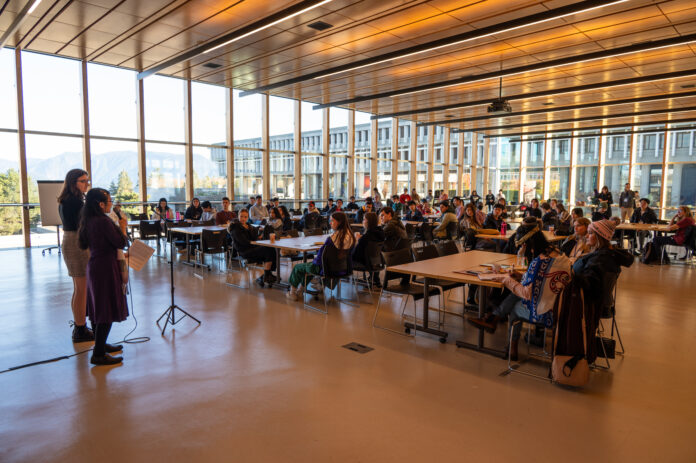
this is a photo of one of the conference presentations. There is a large crowd sitting at tables, looking at the speaker who is at the front of the room, speaking into a microphone
PHOTO: Zihao Zhang

By: Issra Syed, SFU Student

Editor’s note: The Peak would like to acknowledge that Issra Syed, one of the geography student union members, wrote this article. The Peak has taken steps to prevent conflicts of interest or potential bias from influencing the article. 

On November 25, SFU’s geography student union (GSU) hosted their inaugural RANGE geography conference at the Burnaby campus. The conference aimed to expose the broader community to the multiple facets of geography. RANGE highlighted 23 speakers, each sharing examples of their geography-focused studies through presentations. GSU members found RANGE successfully highlighted the community’s interest in geography, and gave them the opportunity to share their geographic knowledge with others. 

RANGE aimed to bring the broad disciplines of geography to the wider community, covering topics such as urban Indigenous geographies, human influences on ecosystems, seafloor mapping, and mapping planets in space. With attendees coming from over 15 different high schools and universities, the participants were exposed to topics in human and physical geography, sustainability, and the applications of geographic information systems (GIS). GIS are computer-based mapping programs used to display data and its relationship in physical space. 

The conference was spearheaded by physical geography major Isabel Nelson, and human geography major Gabrielle Wong. Nelson and Wong are the 2023 co-chairs of the GSU, along with human geography major Ajay Minhas. “Our goal with RANGE was to create a networking opportunity and a space for knowledge sharing for the youth of our community,” said Nelson. Since it was the first time the GSU hosted such a large event, members felt it was a great opportunity for the union to share the knowledge they’ve gained. “I was very pleased that all of our volunteers knew what they were doing,” she continued. 

A diverse collection of speakers were given the opportunity to present at the conference. Academics of all skill levels shared their work. This included undergraduates sharing their experiences participating in field work, graduates showing off their thesis projects combining lasers and off-terrain vehicles, and professors sharing their research about high-quality 3D scans of temples in Egypt and “The Big One” — a devastating earthquake expected along the Juan de Fuca plate in North America. “We had such a diverse speaker team,” said Wong. “The diversity of everyone’s presentations was super, super informative, all the different perspectives were amazing to see,” said human geography major and GSU marketing coordinator, Hailey Lougheed-Lagan. 

At the conference, the GSU members were reportedly excited to witness the fruits of their labour, and to listen to their professors’ passion projects. One presenter was Dr. Nick Hedley, an associate professor in the department of geography who shared his experiences using GIS to map the seafloor, visualize Mars, and develop the spatial interface research lab. “Nick’s talk was one of my favourite parts. It was a good talk to connect with both undergraduates and high school students along with other speakers. It was very engaging,” said human geography major and GSU member, Allie Bui. Hedley’s talk exemplified the interdisciplinary nature of geography along with highlighting the rapid evolution of technology used in research. 

“We had such a great range of people, such a diversity of speakers. It really gives you perspective on the breadth of geography,” said GSU events assistant and SFSS council representative Erik Makinen, who is majoring in global environmental systems (GES). 

GES student and GSU treasurer Akmal Aslam was impressed with the wide range of attendees and their background knowledge about geography coming into the conference. “I feel it is really cool that more students are being aware of geography and its importance,” Aslam said. “I didn’t know how much interest there was in geography from high school students, but after speaking with one student, I was like ‘woah!’ They know stuff that I didn’t even learn till my second year!” 

With the key idea of the conference being the sharing of geographical knowledge with future students and lifelong learners, the GSU felt that the first RANGE conference was a resounding success, with hopes to continue hosting the event for many years to come.

To learn more about upcoming GSU events, visit their linktree at linktr.ee/sfugsu.

Transit supervisors declare job action in Metro Vancouver

0
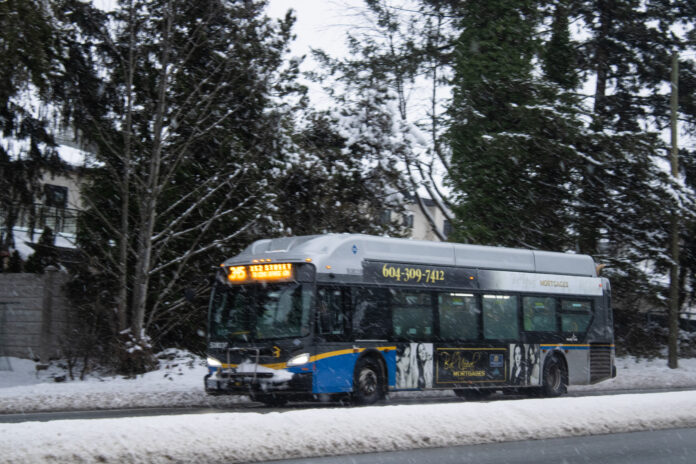
This is a photo of a bus driving down the road.
PHOTO: Prerita Garg / The Peak

By: Olivia Sherman, News Writer

The transit supervisors in Metro Vancouver have begun an overtime ban after the vote to strike gained 100% support on December 22, 2023. Transit supervisors have been without a contract since late 2022. 

The Canadian Union of Public Employees Local 4500 (CUPE 4500) represents 180 transit workers. The job action remains limited to these CUPE members. Other employees, such as operators and mechanics, are not on strike.

At this time, key demands of the Coast Mountain Bus Company (CMBC) include a wage increase, reduced workload, and increased staffing. The CMBC is contracted by TransLink to provide bus services in Vancouver. CMBC has stated the wage increases are “unreasonable” and “unrealistic,” citing the “25% wage increase over three years” is “almost double what all other unionized CMBC employees settled on just last year.”

In a news conference, CMBC spokesperson Mike Killeen said CMBC is strongly urging the union to return to the bargaining table with reasonable and realistic expectations, but raised concerns over the wage increase CUPE 4500 is demanding. 

In a statement to Global News, CMBC president Michael McDaniel said he does not expect the overtime ban to have “significant impacts to the delivery of transit services.”

The Peak contacted a transit supervisor, who is under a gag order — a judge ruling that a case may not be discussed publicly — due to the strike, and requested to remain anonymous. The source said “negotiations stopped as they could not negotiate a settlement between CUPE members and the employer,” and as the “discussion continues, the [overtime] ban remains in place with the legal right and possibility of escalation.” Overall, the source said their “official position is always to settle and minimize impact.” 

Transit supervisors “supervise, coordinate and schedule the activities” of public transportation operators, such as trains, the SeaBus, and buses. They are also responsible for problem solving duties, such as vehicle malfunctions, ordering materials and supplies, staff training, and route monitoring. 

While the collective agreement expired in October 2022, bargaining between the parties didn’t begin until December 2023, when the vote to take job action was cast and received 100% in favour of striking. 

Negotiations between CUPE 4500 and CMBC are ongoing. At the time of writing, CUPE 4500 has announced that they will “escalate to a full-blown strike” starting at 3:00 a.m. on Monday, January 22.

The Peak contacted TransLink and CMBC for an interview but did not receive a response by the publication deadline. For more information on service closures or delays, visit the TransLink website.

Undermining Palestinian solidarity does not help Jews on campus

0
A woman leading a protest for Palestinian liberation

Written by: Omri Haiven, SFU Student 

Content warning: mentions of war, genocide, and antisemitism. 

My name is Omri Haiven, and I’m a Jew who is a graduate student at SFU’s School of Communication. I’m also an active member of Independent Jewish Voices, which is an organization that works to advance the rights of Palestinians while combating antisemitism and expressing Jewish culture. Alongside many other Jews on campus, I’m sickened to see the ongoing bombing and decimation of Gaza by Israel in the name of a so-called “Jewish homeland.” Israel is not my homeland, and in fact, I believe Israel’s repression of Palestinians promotes more antisemitism and instability in the world. It is not antisemitic to oppose Israel’s decimation of Gaza, its apartheid regime within its own borders, nor its illegal occupation of the West Bank for more than 57 years. Opposing all this is a moral and humanitarian stance.

I’m deeply concerned by the motion from SFSS Council members to take away the vital policies that uphold human rights on a range of important humanitarian issues, including Palestine. The SFSS Palestinian Liberation policy supported “the liberation and self-determination of Palestinians in their quest for freedom, justice, right to return, and land back,” in addition to calling for Boycotting, Divesting, and Sanctioning (BDS) the state of Israel. While in the end the SFSS voted to call for a ceasefire and defended their own policy on Palestine, the fact that it was even at risk of being removed speaks to a troubling trend on campuses. More students are being pushed to silence when criticizing Israel, and being prevented from contributing to the global movement to halt Israel’s genocide of Palestinians.

As a Jew, and as a person of conscience, I know this work is an important testament to the humanity of our campus community as well as our respect for international law. I’m sad to see attempts to abandon a principled and moral stance toward Palestinian liberation in favour of remaining neutral or in agreement with Israel’s ongoing war crimes. We must stand up for those who are oppressed and hold true to the SFU community’s tradition of being a progressive voice for change.

Boycott, Divestment and Sanctions (BDS) is a necessary tool we must use to promote justice in Israel and Palestine and work toward peace in the region. This is a strategy that has been demonstrated as successful through the historic struggle against South African Apartheid championed by university communities throughout North America. It’s now time for our generation to boycott, divest and sanction companies and institutions complicit in the violation of Palestinian human rights. The SFSS already passed a motion in favour of BDS, and the recent genocide in Gaza underscores the need for our campus community to follow suit and uphold international law and the rights of Palestinian people.

Finally, it’s important to acknowledge the real threat of white supremacy to Jews and other minorities. White supremacy has only grown in recent years as a result of the candidacy of right-wing bigots in the US and Canada, and is evidenced by the uptick in hate crimes over the past years. Broad and multi-racial coalitions need to be formed on campus and in the Lower Mainland to combat this move toward hate that affects people from all backgrounds. 

We must not make the mistake of equating solidarity with the Palestinian people as antisemitic hatred. In fact, we must guard against this dangerously distracting false equivalency by employing rigorous standards when it comes to our definitions of antisemitism. The Jerusalem Declaration on antisemitism is the most robust and widely accepted definition today. It has the added benefit of taking into account other forms of discrimination without conflating legitimate criticism of Israel with actual forms of antisemitism. It explicitly states that “supporting the Palestinian demand for justice,” “criticizing or opposing Zionism as a form of nationalism,” and “evidence-based criticism of Israel as a state” are not antisemitic. 

If we are to be on the right side of history, we must stand with organizations like Amnesty International, Human Rights Watch, and the Israeli human rights organization B’Tselem in calling for an end to Israeli apartheid while we demand a ceasefire in Gaza for the sake of humanity.

Tips for teaching assistants – a student’s perspective

0
A woman placing sticky notes on a white wall while on a meeting.
PHOTO: Jason Goodman / Unsplash

By: Saije Rusimovici, Staff Writer

To be honest, attending a 50-minute tutorial on top of a two hour lecture can feel painful, and even useless. Whether or not you find tutorials useful, it’s frustrating to be stuffed into a miniature classroom with a bunch of students who refuse to participate. It’s no doubt frustrating for the TA, who wants to help their students but cannot figure out how to engage with them. They are just trying to do their job, but it can be difficult to do so when students are not always focused on class discussion. For this reason, I’ve come up with a list of tips for teaching assistants who want their students to gain the most out of their classes and feel like tutorials are valuable rather than a waste of their time. 

Be friendly and approachable 

This may seem like it goes without saying, but navigating a classroom of students requires that you are a pleasant person to be around. Go out of your way to get to know the students and address their needs. Each student should feel valued and comfortable in the classroom. With that being said, you are there to be their teacher, not their friend — any relationships you form with your students should be kept professional. However, this doesn’t mean you have to completely isolate yourself from your students and maintain a rigid, authoritarian style of teaching in the classroom; students want to feel like their TA actually wants to be there. Make a good first impression by appearing energetic and enthusiastic about not only the course material, but your students as well. 

Share your personal experiences 

Students want to hear about your academic journey! The TAs with whom I built the best connections were those who shared small tidbits from their personal lives and academic journeys. When I found out one of my TAs was interested in similar fields as myself in undergrad, it made me feel more motivated in class. Learning from someone who obtained a degree in the discipline I’m studying makes me aspire to delve deeper into my studies, and incites motivation. Beyond teaching course material, the role of a TA should also be about inspiring your students to make the most of their time in tutorial. This can be done through open conversation with students, structured time for assignment workblocks, and periods where students can freely ask questions beyond the course materials. We want to know how to be successful students, not just memorize course work.

Focus on materials that will be tested 

While it’s good to take a break and talk about topics other than course materials, we still have tests to study for, so emphasis should be placed on what will be on exams. There are so many ways of doing this beyond having a random in-class assignment that counts for a measly participation grade. In my communication courses, I’ve found that I benefitted the most from tutorials when activities included hands-on computer labs that allowed me to practice technical skills under guidance. In my criminology courses, low-stakes pop quizzes in the form of trivia games or mock debates have been a great way to get to know course concepts in a low-pressure environment. By focusing on the concepts that will likely be on midterms, finals, or assignments, students will feel as though they are gaining something out of attending tutorials and will be more likely to participate in class discussions.

Incorporate work periods for essay writing or group projects 

For those commuting to campus, it can be easy to zone out in class after a long drive or bus ride. During midterms and finals, your students may feel like they are being stretched super thin. They’re likely worrying about their assignments, plus they also need to study for their exams while still attending and participating in lectures and tutorials. Making tutorials a space where students can freely study or work on assignments is such a beneficial way for them to make the most of their time in your class. This way, you can be there for students to ask questions or explain difficult concepts. Being present and approachable during more “study block” structured classes is an essential component that will get students to use this time wisely. 

Ask your students how they want tutorials to be structured

Every group of students will be different, and not all students have the same needs or relate to the same methods of teaching. Personally, I find it helpful when my TA asks the class how they prefer tutorials to be structured and what style of teaching works best for them. It’s important that your students are getting the most out of being in your class. Start off the semester by surveying your students, asking what they’re studying, and trying to get a sense of their backgrounds so you can adjust accordingly. Understanding what they’ve liked or disliked about teaching styles of past TAs will not only make tutorials more enjoyable for them, but will also give you an idea about ways you could shift your teaching methods to accommodate this particular group of students. 

Don’t implement “mandatory” activities

Tutorials are all about practice, and giving your students the opportunity to do this without being penalized will provide them with a safe space to learn. Instead of introducing mandatory activities that students must submit by the end of class, place more emphasis on discussion and interactive learning “games” like trivia. Many students will try to rush through mandatory assignments just to get that mark towards their participation grade, but they may not actually be gaining anything valuable from that task. Certain aspects of in-class discussion may be more likely to stay rooted in their memory as opposed to an assignment they were required to submit and promptly forgot about.

The suburban housing dream comes with unwanted costs

0
A suburban neighborhood
PHOTO: Aiden Frazier / Unsplash

By: Izzy Cheung, staff writer

As populations rise and cities grow more condensed, the need for space around the world is only becoming greater. More and more post-secondary students are splitting large houses with many roommates or opting for smaller apartment units. However, the suburban housing dream is still prevalent — after all, who doesn’t want their own spacious, unobstructed plot of land? A study conducted showed that millennial and Gen Zs’ saving habits are geared towards home ownership. Unfortunately, it can be a little unrealistic to expect to live in your own massive house these days.   

I was taught the importance of owning a home relatively early on. Teachers in my career planning classes stressed the importance of saving up for a house rather than an apartment. Despite a house being evidently pricier, they emphasized that buying a house came with “ownership” over the land it resides on. Buying a house is essentially buying a space that can be altered to your liking. I remember being told that living in an apartment meant, despite owning your own unit, you would still be sharing spaces with others in your building. Because of this, owning a large house in the suburbs may feel ideal compared to living in a townhome or apartment. Being out in the suburbs also may feel like it’s better for the planet, as you’re farther away from all the pollution and congestion of the city. However, this isn’t necessarily the case. 

Our infrastructure doesn’t reflect and support our growing population anymore, making apartments a more reasonable option. The suburban housing dream may seem ideal, but it comes with its own share of unwanted price tags. A study determined that urban areas such as cities had smaller carbon footprints than more rural or suburban housing areas. They noted that those who live in cities have reduced emissions due to their “transportation, heating, and cooking” habits. With places such as restaurants, grocery stores, and general shops being more accessible in urbanized areas, there’s less of a need for cars and cooking. Individuals may choose to walk down the street to pick up takeout rather than fire up the stove to make their own meal. With everything somewhat within walking distance, urban cities provide more opportunities to reduce emissions produced by cars. 

The farther away from these urban hubs you are, the less likely you are to feel connected to the city. Looking at the Lower Mainland as an example, we can see that Skytrains only run as far as King George and Lafarge Lake. Moving away from these hubs results in longer wait times for buses, and longer bus rides into the city. Because of this, those who live farther away will resort to driving as their means of transportation which makes for higher emissions produced by those living in more rural areas. The farther you are, the cheaper the land becomes, which is why many may prefer heading east to settle down. However, when you find yourself driving back and forth to get to the hubs for school, work, or a night out, you may encounter added costs that aren’t monetary. “Home” should be something that makes us all comfortable, being a place we can de-stress. Just because it’s not what we were taught to aim for, doesn’t mean that any home we have is lesser — especially in this economy. 

Truth and reconciliation goes beyond Canada

0
A destroyed building in Gaza
PHOTO: Emad El Byed / Unsplash

By: Anonymous, SFU Student and Kelly Chia, Editor-in-Chief

Content warning: mentions of war and genocide. 

On December 13, Canada voted in a UN resolution calling for immediate ceasefire in Palestine after abstaining in October. Make no mistake, though: Canada continues to provide military support to Israel, and the nation’s silence in the face of weapons being used against civilians will continue to weigh on us. We must contend with Canada’s historical role in colonizing Palestine, and our continual support of its occupation.   

The Yellowhead Institute, an Indigenous-led research centre, published a piece detailing Canada’s involvement in the colonization of Palestine. It explains that Canada’s extensive efforts in international peacekeeping often disguise its stance on violence. A pivotal contribution was in the establishment of Israel, where Canada actively participated in United Nations-led committees in the partition of Palestine. Supreme Court of Canada Justice Ivan C. Rand and Senior Diplomat Lester Pearson played key roles in advocating for the partition. 

Kulthum writes that UN members like Count Folke Bernadotte, advocating for Palestinian refugees’ right to return to their land, were assassinated. The National Defence Canada’s website claims that hostilities immediately started against Israel in May 1948 by Palestine and neighbouring states. However, this narrative erases Canada’s role in endorsing a plan for the partition of state, making it complicit in ethnic cleansing. The country only takes the name of “peacekeeper” to deflect from its violence.

Canada’s complicity extends beyond history and continues through contemporary support for Israel. The close relationship between Canada’s Special Operations Forces and the Israel Defense Forces is unsettling. In 2023, Canada supplied “more than $20 million in military exports to Israel.” Looking further into Canada’s historical involvement in Palestine, Canada has consistently supported colonial occupation, despite its reputation as a “kinder” western nation. It’s important we confront our history to make changes in the present, as our silence is permission for genocide to continue. 

Canada appears to be ensnared in a cycle of selective morality, where its stance on human rights aligns with geopolitical interests rather than a moral commitment to justice. This pattern of selective morality is not confined to history but extends into the present, notably in Canada’s approach to reconciliation with Indigenous Peoples. Despite initiatives aimed at reconciliation, the fulfillment of the 94 Calls to Action, as outlined by the Truth and Reconciliation Commission, has been slow. This discrepancy raises questions about the sincerity of Canada’s commitment to rectifying historical injustices, as tangible progress lags behind rhetorical promises. 

The contrast between the promises made and their actual implementation shows a troubling lack of dedication to decolonization. Consequently, the majority of the calls to action remain unaddressed, leaving Indigenous communities awaiting long-overdue justice and reparation. It’s no wonder that many have been critical of Canada’s defense of settler-colonial attitudes, when Canada itself remains a settler-colonial state that violently neglects the needs of the Indigenous Peoples. Canada has always, historically, been supportive of settler-colonialism when it benefits western interests. Many have already pointed out that Canada issued an immediate response to the Russian invasion in Ukraine, and rightfully so. But now, people call for Canada to act on its so-called role as peacekeeper, and immediately intervene in the genocide of Palestinians.  

Outrage grows at the nation’s silence in the face of over 20,000 civilian deaths since Israel escalated attacks on Palestine, and Canada remains complicit. It’s time for Canadians to confront this uncomfortable truth and advocate for a humane approach to the plight of all Indigenous people who have been subjected to persecution and occupation, both within and beyond Canada’s borders. As citizens, we can participate in protests, write to our MPs and our Prime Minister, and provide educational resources for learning more about the country’s involvement in Palestine’s occupation. 

The Republic of South Africa has officially brought the State of Israel to the International Court of Justice, the UN’s highest court, under accusations of genocide. As of the time of writing, Canada is being called on by the South African High Commissioner and ambassador of Palestine to voice support for backing this case, and is also facing pressure from Israel to back its continued brutality. It is so crucial for Canadian citizens to call their MPs to voice support for South Africa’s application now, and meaningfully uphold our position on ceasefire as a nation. 

We must pressure our government to make direct intervention. The call for truth and reconciliation must extend globally, transcending national boundaries, as Canada strives to fix its tarnished moral compass on the world stage.

GPA boosters are a joke

0
Poster advertising the services of a Good Grade Genie for $19.99.
ILLUSTRATION: Kristin Lee / The Peak

By: Hailey Miller, Staff Writer

So you’re trying to boost your GPA, and you’ve come to the conclusion that the only way to save your grades is by taking some half-assed, easy-A course that will put you ahead of your dreaded full-time schedule? We’ve all been there. You assume that just one simple course will get the job done and miraculously give you a perfect 4.33 overnight, right? You scan the course calendar and inquire about easy courses in every social media group, desperately searching for some serious grade-booster that requires next to no work on your part. Are you living in a dream world comprised of miraculously flawless grades? Allow me to introduce you to Mr. Grade Genie!

If you think taking one of those easy-A GPA-boosters is going to do the trick, Mr. Grade Genie is here to burst your bubble and tell you: it will not. Fear not, though, he’s come to the rescue! A mere remnant of hope dwindles as you hold on tight to the remainder of your straight-A’s, honour roll status, B-average, or whatever grade floats your boat. If C’s get degrees, why waste your time with some useless easy-A in the first place? If half a point is what you’re striving for, then be my guest! Nothing like a GPA booster to waste your precious credits. With a little bit of scholarly pizzazz that says, “I still don’t know what I’m doing,” you’ll fail just as hard in some “easy” class as you did in that convoluted lecture that dropped your average by more points than you’d like to admit. You’ll be desperately calling up Mr. Grade Genie to grant you a wish on the Good Grade Hotline before it’s too late.

Are you considering some random art class that involves abstract Picasso paintings just because it looks like a simple pass? Make sure you check the prof’s rating on RateMyProfessors. Otherwise, the class isn’t necessarily going to summon the good grade gods and give your GPA a much-needed change in fate. Just because Sally the Sophisticated Smartie from your English class told you some random 100-level sociology elective will be the cure-all to your grades doesn’t mean it’s true. She may have had the class with some chill professor who always doles out A’s, but with your luck, you’ll score the worst-rated prof in town. If you think taking one easy-A will suffice in your fantasized dreamland of scholarly superpowers that have somehow gotten you this far in your degree, you better give poor Mr. Grade Genie a raise. 

Contrary to popular belief, you can’t just snap your fingers and have effortless A’s appear, with a perfect GPA at the top of your transcript, shining as the star of the show. Oh, wait! That’s right, Mr. Grade Genie will save the day. At this point, his overtime rate will cost more than your entire tuition combined. Why not just quit while you’re ahead and avoid those brutally boring  grade-boosters in the first place! 

If you’re desperate to boost your grades without the harrowing cost of Mr. Grade Genie, go ahead and take that supposed GPA-booster if it’s all your heart desires, but I can assure you it won’t be cause for the drastic change you hope for. Sorry that my half-baked scholarly opinion is that so-called easy-A’s and GPA boosters don’t exist . . . but genies do.

Don’t let your fantasized good grades escape! Call the Good Grade Hotline today and speak to Mr. Grade Genie before it’s too late! For the low, low cost of emptying your bank account and making the Student Loans Centre go bankrupt, you can have your own personalized Grade Genie whose fingers will snap right in front of you and straight-A’s will magically appear right away! Call today, before the cold, hard truth awaits! 

Artists to watch this year in Canada

0
A collage of images and album covers from eight Canadian artists, with a grainy sky blue backdrop.
Images courtesy of Ruby Waters, Nehemie, Karla Ximena, Fantasy Records, Pirate Blend Records, Lindsey Blane, Ishkode Records, and Babe Corner

By: Hailey Miller, Staff Writer and Petra Chase, Arts & Culture Editor

With the new year in full swing, there are tours, new music, and new artists conjuring up high expectations for Canadian artists. Here’s a list of some who are bound to make waves.

The eyes are on Hotel Mira with their new album and tour 
For fans of Said the Whale, Arkells, and Dear Rouge

Hailing from Vancouver, alternative rock band Hotel Mira is in for another big year. Fresh off the heels of their 2023 album, I Am Not Myself, the band is about to embark on their latest tour. Having formed in 2010, they’ve been resurging on Canadian alt-radio charts in recent years. With hit singles including “The Eyes On You” and “This Could Be It for Me” from Perfectionism (2020) followed by 2023 releases such as “Fever Pitch” and “Dancing With the Moonlight,” their electro-rock sound is full of catchy hooks and captivating lyrics. Hotel Mira has toured with bands including Billy Talent and The Beaches

Catch them play their hometown headliner at the Commodore Ballroom on Jan. 19.

Edgy rock floods in with Ruby Waters’ latest releases
For fans of Tash Sultana, Jessie Reyez, and Lights

Indie rock Métis singer-songwriter Ruby Waters is back with more soulful singles including 2023’s “Flash Flood,” which delivered to the expectations set with heavy guitar-picking tunes like “Supernatural” (2019) and “Open Arms” (2022). From Shelburne, Ontario, Waters recently opened for City and Colour’s 2023 fall European tour, which continues this February, including a Vancouver show. As a Juno-nominee with a knack for rhythm, her raspy sound is raw and refreshing. 

See her open for City and Colour on Feb. 8 at Rogers Arena.

Jayda G circles back to her roots with new album
For fans of Fred again . ., Disclosure, and Major Lazer

From Grand Forks, BC, Jayda G is a Grammy-nominated musician and DJ. Her electronic dance style elevates signature catchy pop rhythms. G’s 2023 album, Guy, takes on an introspective approach to songwriting ignited by techno beats. Singles such as “Circle Back Around” and “Scars” showcase G’s softer side while still keeping true to her up-beat style. Jayda also performed heartfelt live sessions of many of the album’s songs this year. No Canadian tour dates are currently set, but 2024 is shaping up to be a big year for G as she’s set to perform in Spain and Australia this summer. 

Allison Russell Returns with soulful tunes and powerhouse vocals
For fans of Rhiannon Giddens, Brandi Carlile, and Dominique Fils-Aimé​​

Montréal-born singer-songwriter and activist Allison Russell will be embarking on her headlining tour this month, in support of her 2023 album The Returner. The immense success of the album has led Russell to receive worldwide accolades and applause, including three Grammy nominations. Russell’s rhythmic pop is captivating and sure to get you up off your feet. With recent releases such as up-beat, disco-influenced “Stay Right Here” and “Demons,” with harmonies dripping in soul, it’s easy to see all the hype. 

See her live at the Commodore Ballroom on Feb. 23.

Aysanabee wastes no time with new EP
For fans of Digging Roots, Dan Mangan, and Bon Iver

Oji-Cree singer-songwriter Aysanabee’s 2023 EP Here and Now includes the title track smash-hit alongside songs such as “Alone” and “Waste My Time.” The EP has attained countless accolades and attests to his intimate acoustic style and introspective lyrics. The album dives into how love is impacted by colonialism, Aysanabee described, saying, “Through this record, I wanted to be honest by facing my own fallibilities when it comes to building and keeping relationships.” Aysanabee will be the opening act for Allison Russell on her The Returner tour this February. He’s also set to perform at other shows and festivals this January. 

See him alongside Allison Russell at the Commodore Ballroom on Feb. 23.

Hua Li 化力 will make cherry blossom season “Cherrier” with sophomore album
For fans of FKA twiggs, MARINA, and Rina Sawayama

A springy synth bassline plucks over lush poppy poetry in Hua Li 化力’s freshest single, “Cherrier,” planting a seed for her upcoming project, ripe fruit falls but not in your mouth. Thematic track titles like “Peonies” and “Feed Me Petals” make us hopeful for a spring release. The Montreal-based “half-Chinese, half-militant, half-rapper of your heart” describes the album as her “crying at the club record.” A fusion of dance, R&B, jazz, and hip-hop, ripe fruit is sure to be, well, fruitful.

Babe Corner is a home-grown supergroup of your dream (pop)
For fans of Wolf Alice, Alvvays, and The Runaways

Vancouver is home to the harmonizing alt-rock supergroup, Babe Corner. We hope they regroup after their 2023 album, CryBaby, and their North American summer tour. Made up of five members — indie pop icon Haley Blais, synthpop duo Doohickey Cubicle, and vocalist/guitarist Lindsay Sjoberg — there’s no telling what their enmeshed styles will bring. We hope to see more drifty dream pop like “Bianca” and screeching garage rock like “Summer Slaughter;” showpiece works in babecore, a genre coined by the band. If you want to pretend you’re living in an early 2000s indie movie this year, we suggest adding babecore to your lexicon.

Babe Corner will be performing alongside Doohickey Cubicle on Feb. 1 at The Pearl.

Néhémie brings laid-back, ‘90s nostalgia
For fans of Destiny’s Child, Tinashe, and Jhené Aiko

Montreal singer-songwriter Néhémie has been consistently delivering smooth R&B and hip-hop tinged with nostalgic lofi loops. Since “Over,” her 2020 debut single about closure from a breakup, singles like 2023’s “Green” and this year’s “Run” bask in prosperity and self-empowerment, with notable ‘90s r&b influences and some French lyrics sprinkled in. We’re excited for more of Néhémie’s golden voice and heartfelt songwriting.

Where the River meets the Salish Sea continues a legacy of Coast Salish art

0
A collage of five framed formline design prints, with curved lined patterns and gradient backgrounds in vibrant colours. The center piece features four frog faces stacked. The other pieces feature, a heron, a butterfly, and a whale tail.
PHOTOS: Amrit Kamaal / The Peak

By: Angela Shen, Peak Associate

Editor’s note: The author of this article, Angela Shen, is a program assistant at Shadbolt Arts Centre. The Peak acknowledges this and has taken steps to prevent conflict of interest.

As a student learning the art of Chinese brush painting, I always look forward to the exhibits at the Burnaby Shadbolt Centre for the Arts. In November, I saw Musqueam mixed media artist Kelly Cannell’s solo exhibition, ʔəyx̓ watəna:t | Where the River meets the Salish Sea, which featured her newest print designs. Hopping off the 144 SFU bus, I walked a path of autumn coloured foliage to the main centre, and was greeted by a poster describing Shadbolt’s honour in featuring Kelly’s work. Daughter of the prolific artist Susan Point, Kelly been immersed in Coast Salish art “from birth” and “lives it everyday.”

The first art pieces were in the Centre’s café, Encores Bistro. Over a mocha, I enjoyed two mesmerising butterfly patterned prints, “KALEIDOSCOPE STATE” I & II, under the café’s neon pink lights. Curved lines casted over highly saturated blues and yellows, creating an optical vibration, signature of the traditional formline design distinguishing this collection.

I took this time to read up about the Point/Cannell family and their legacy on xʷməθkʷəy̓əm (Musqueam), Sḵwx̱wú7mesh (Squamish), and səlilwətaɬ (Tsleil-Waututh) land. You might have seen Susan Point’s red cedar spindle whorl, “Flight,” beyond customs at the Vancouver International Airport, a sculpture of an “eagle and a man with raised arms, welcoming visitors and also gesturing flight.” Point has created countless art pieces in public spaces, translating “Coast Salish traditions into contemporary modes of expression.”

Her family line have carried on the pride of Coast Salish art. On the side of a Granville and 70th condo, you’ll find “Land & Sea,” a coloured glass panel perched in the sky that demonstrates the “way nature flows together.” Next time you catch the sea bus, look out for the signs welcoming visitors in hən̓q̓əmin̓əm̓ (Halkomelem) and Sḵwx̱wú7mesh (Squamish) languages, with a painting honouring Chinook salmon. Both of these are collaborative works from Kelly and her brother, Thomas Cannell. Thomas also designed the stunning glass frontier, “Sea to Sky,” on the Paramount building in Richmond. 

Thomas’ granddaughter, Summer Cannell, carries a love for art into the family’s third generation, with a handful of works already in the public domain at a young age. For instance, she designed the Musqueam–YVR Friendship agreement logo with her dad. These are just a handful of the works of art with which the Point/Cannell family have adorned the city.

Since youth, Kelly’s been an active artist and built a reputation with bold use of lines in her patterns. She frequently works with prints and public artwork, such as murals and sculptures. She also specializes in other mixed media, such as wood carvings, designs, and glass works, having studied glass in prestigious universities in Washington and Istanbul. 

Inspired by her mother, Kelly also draws her inspiration from a connection to nature and culture, which was evident in her latest collection. The landscape piece, “Reflection,” with a pattern of whale tails swimming to the rising sun hung above the James Cowan theatre entry.

At the main gallery hall, the Salish alphabet of Kelly’s name unfolded above the over 20 print pieces, and various colours fell in my view: a series of aquatic-themed gradient prints like “Symphony of the Sea” and a “Great Blue Heron” stood out for their gradient backgrounds. For the latter piece, placed in the left centre under a bright yellow sun and a deep navy to light blue gradient sky, a curving flow envelops the heron. 

The comfortable gallery hall has soft couch seats along the eggshell coloured walls further down the hall where I sat and looked at “Fusion.” The print features four bedding frogs, with light to dark green lined gradient, dark black outlines, and red lined mouths. The way they’re stacked on top of each other reminded me of mitosis, while the name suggested the opposite. 

Names helped me gain a better understanding of the prints, while not assigning any specific meaning to each piece. I found great fulfillment in simply standing and allowing my brain to observe and take in the mesmerising patterns. Kelly makes nature the focal point of her work, while the frontline design creates contemporary yet elegant portrayals of the subject matter.

Observing the framed pieces more closely, I noticed the number of prints for each design were marked in pencil. Take the piece “Reflection,” for example; two prints out of the 78 prints under that theme are shown in the gallery, a testament to her dedication to the subject. I also noticed the colours from the traditional ink print rather than digital print made pieces not as light-reflective, despite the glass frame protection, appearing radiant.

From murals to exhibits to family collaborations, Kelly’s work has undoubtedly always had an astounding and familiar presence in the community. While the exhibit has ended, the Shadbolt Centre always has exciting artists on display, and the atmosphere is perfect for meeting a friend or a crush you finally mustered the courage to go on a date with. 

In the meantime, I encourage you to pay close attention to Indigenous art spread around our city and support the artists who kindly share their traditions, history, and culture. Find out more about Kelly’s projects and browse her one-of-a-kind available paintings on her website.