Home Blog Page 1224

We must change our energy

0

WEB-oil refinery-Hourann Bosci-flickr copy

Although fossil fuels have brought us tremendous value in the last two centuries, burning oil, gas and coal has created a serious emergency. Here, at SFU, many faculty, staff and students are rightly focused on the climate crisis. Yet, by holding investments in fossil fuel companies that are wrecking the climate, the university itself is undermining and slowing society’s transition to a safer, low-carbon society. We should call on SFU to end its investment in fossil fuels.

The global warming crisis has major implications for your life after SFU and the future of your career, health and family. Scientists — including many from SFU — are growing ever more alarmed by the damage we are doing to the climate.

By burning oil, gas, and coal, we move eons of stored carbon from the ground to our oceans and atmosphere, where it stays and holds more energy. This creates the greenhouse gases that warm our planet, changing and intensifying weather patterns and contributing to more extreme droughts, heat waves, floods, and storms. Scientists also forecast water and food shortages and increasing poverty and inequality as a result of climate change.

There is still hope, though. If we hope to avoid this dangerous and irreversible global warming, the Intergovernmental Panel on Climate Change tells us we can’t burn more than 921 gigatonnes of carbon dioxide. Yet, scientists widely agree that fossil fuel companies can extract at least twice as much — more than enough to cook our planet. And each day, they look for even more reserves in places like the Arctic, shale formations, and deep oceans.

SFU’s fossil fuel investments jeopardize their academic mission and contradicts its research and education

Groups as diverse as the International Energy Agency, HSBC bank, and 350.org say the vast majority of proven and probable fossil fuel reserves should remain unburned if we hope to avoid runaway climate change. One report by HSBC found that these unburnable reserves could reduce the market value of fossil fuel companies by up to 60 per cent. Institutions like SFU that directly or indirectly hold investments in these companies should be alarmed by the “carbon bubble” they face.

This growing understanding, along with concern for climate justice and defence, is why SFU faculty overwhelmingly voted to create a fossil free pension fund this fall. It’s why 70 institutional investors with over $3 trillion in assets asked fossil fuel companies to examine and disclose their exposure to this carbon bubble in October this year. Over 400 other schools, churches, funds, and 16 US cities, including Seattle and Providence, have already moved to end their investments in the top fossil fuel companies in the near future.

Sustainable SFU has joined this global movement for divestment and is calling on students, alumni, staff and faculty to be a part of it. We call on SFU to immediately freeze new investment in fossil fuel companies, fully end ownership in those companies over the next five years, and disclose the potential greenhouse gas emissions in SFU’s endowment and other investments.

If SFU does not change course,  it will find itself with a portfolio of financially worthless fossil fuel assets. These investments jeopardize SFU’s academic mission and its research and education on climate change, clean energy, and public health.

Tell SFU we should be in the business of studying and slowing climate change, not funding the companies that cause it.

Album Reviews: One Direction, Death Grips, and a throwback to Interpol

0

Midnight Memories

One Direction – Midnight Memories

So, I listened to an entire One Direction album in a single sitting in the quietude of the Bennett Library. I obsessively monitored the volume of the music coming through my headphones so that no one would know what I was doing. Once I was finished, I was left with three distinct observations.


Observation One: Some of these songs are good.

That’s right, I said it. On Midnight Memories, the British quintet tries so many times to create the perfectly manufactured pop song that a couple of them were bound to turn out right. The infectious juvenilia of “Best Song Ever,” the mug of cocoa vocal harmonies of “Don’t Forget Where You Belong,” the puritanical bubblegum pop of “Happily” and the simple message of “Strong” are about as good as corporate assembly line boy band fodder gets — which, admittedly, is not very good, but certainly much better than this band has any right to be.


Observation Two Most of these songs are awful.

For every step forward, the impeccably coiffed teen heartthrobs of One Direction take three steps back. Many of the songs on this record are musical wallpaper — meaningless verse chorus verse nonentities that aren’t even worth mentioning. Others are so bad that they warrant further comment: the faux Freddie cock rock of the titular track, the paper thin sentimentality of “Diana,” the auto tuned aural assault of “Little White Lies,” the laundry list of lyrical clichés that is “Something Great.” Ultimately, listening to an entire One Direction album did little to dissuade my apathetic dislike of the group. Sorry, Tumblr.


Observation Three: This album is indistinguishable.

One Direction’s success story has become inescapable: their discovery on the British reality show The X Factor, the whirlwind success of their problematic “You Don’t Know You’re Beautiful” single, the chorus of yeasayers announcing the second coming of the British Invasion. After having finally listened to an album by these wide eyed ragamuffins, it’s become clear that the group’s success is distinctly a right place right time phenomenon. Nothing about One Direction differentiates them from any of the facsimile groups that have preceded, and will inevitably succeed, them.


Government Plates

Death Grips – Government Plates

Are we living in a post-Death Grips society? Whether you like their music or not, it’s hard to argue that the industrial hip-hop trio’s us against the world attitude to the music industry has turned more than a few heads. Just last year, the band was dropped unceremoniously from Epic Records for leaking their sophomore album, No Love Deep Web, onto the web weeks before its release date. Oh, and the cover art was a picture of drummer Zach Hill’s erect penis.

I’m serious. Look it up.

Though rumours of Death Grips’ triumphant return have been passed along through comment sections and internet forums ever since the group launched its own label, Thirdworlds, no one expected Government Plates to drop so soon. I learned about its spontaneous leakage through the band’s Facebook page, and quickly backtracked, thinking I must have missed an announcement, a blog post, a tweet, something.

But ultimately, this is exactly the kind of thing Death Grips is all about. Echoing the guerilla spirit of its release, Government Plates is a puzzling, schizophrenic record, full of choppy electro beats, deranged yelps and enough musical about-faces to make your head spin. Fans of the group will likely be unphased: after all, no one would choose to listen to these guys if they weren’t fully prepared for this sort of thing.

The album’s first track (who’s Bob Dylan-referencing title, at 26 words long, I refuse to type in full) opens with the sound of a glass shattering, followed by vocalist MC Ride yelling “It’s so fucking dark in here/Come come fuck apart in here,” and shrieking. In the post-Death Grips world, this is easy listening.

Despite the album’s unapologetic abrasiveness and complete lack of formal structure, it’s a remarkably easy LP to like. Maybe it’s because its frenetic pace and abstract expressionism feel purposeful, like they’re passages from some sort of radical manifesto on the state of our society that I haven’t quite decoded yet. Like Death Grips’ best material, Government Plates leaves its listeners frightened, confused, infuriated and clamouring for more.


Turn on the Bright Lights

Throwback: Interpol – Turn on the Bright Lights

Some records, you love because they’re classic. You love them because that’s what you’re supposed to do. They’ve crawled through the tunnel of critical appraisal and come out in one piece on the other side — your Revolvers, your Kind of Blues, your London Callings. These are the untouchable, the canonical crème de la crème of popular music that have reached the point where one might consider unironically referring to them as “legendary.”

Then there are those records you can’t help but love. They might be underappreciated indie label debuts or obscure back catalogue picks, but each one of us has that one record that we love in spite of ourselves, and in spite of their relative lack of mainstream approval. For me, Interpol’s Turn on the Bright Lights is that record.

To be honest, I expected the LP to have aged less gracefully when I picked it for this week’s throwback. My relationship with this album has faded from the passion of romance to the solemnity and security of companionship — listening to it, I feel as though I’m sitting in a carefully woven rocking chair on a sun soaked patio, sharing a mug of watered-down coffee with an old friend. I have a lot of feelings about this record, okay?

I could go on and on about the music on this thing — Carlos D’s self-consciously swaggering bass lines, Daniel Kessler’s far away guitar tones, Paul Banks’ arcane lyrics, Sam Fogarino’s spring wound drums — but I don’t want to bore you. The appeal of Turn on the Bright Lights goes beyond its music, anyway: from the album cover to the quartet’s perfectly pressed suits, Interpol’s debut LP was all about creating a mood.

That mood may include, but is not limited to: flickering street lamps, thick industrial fog, vintage neon signs, cheap foreign beer, abandoned train stations, molasses thick dollar store coffee, cigarette smoke, and hair gel. Not quite autumn, not quite winter, but certainly cold enough to button up your jacket.


Fukushima debris island myth proved false

0

WEB-Fukushima debris-Flickr-niXerKG

A graphic released by the National Oceanic and Atmospheric Administration (NOAA) depicting a Texas-sized island of debris (dubbed “Japan’s ‘toxic’ monster” by Fox News) heading towards North America sparked fear, controversy, and created catchy headlines over the past few weeks, even though this fear has been disproved by the NOAA itself.

In a tweet earlier this month, the NOAA stated: “Some talk is making the rounds that there’s an ‘island of debris’ from Japan coming this way. This is myth . . . there’s no evidence of a mass!” The graphic in question depicts 5 million tons of debris, which was released into the world’s oceans after the 2011 earthquake and tsunami that devastated Fukushima.

According to the NOAA’s Marine Debris Program website, after a year at sea, an estimated “70 per cent [of debris] sank off shore, leaving 1.5 million tons floating.” The graphic was created to show higher concentrations of the now far spread debris, the highest concentration being in an area roughly the size of Texas, off the coast of western United States.

While it has now been determined that this supposed “51st” US state is a myth, the highly dispersed radioactive trash now peppers an area roughly three times the size of the Continental US. The first pieces of detritus are now washing up on coastlines in Hawaii and along the west coast of North America, and are predicted to continue to appear for several more years.


Scientists have discovered over 165 native Japanese organisms hitching a ride on the arriving debris.


According to SALON, scientists have already discovered over 165 native Japanese organisms hitching a ride on the arriving debris.

“We’re finding that all kinds of Japanese organisms are growing on the debris,” John Chapman, a scientist at Oregon State University’ Marine Science Center told Huffington Post. “We’d never seen [some of these species] here, and we don’t particularly want [them] here.”

The Japanese government has also recently admitted that it is now clear that approximately 300 tons of nuclear contaminated water are pouring into the ocean each month from leaks within the devastated Fukushima Power Plant.

According the National Geographic, Shunichi Tanaka, head of Japan’s Nuclear Regulation Authority, has told reporters that leaks have likely been occurring since the earthquake and tsunami hit in March 2011. There is evidence to indicate that officials were aware of the leaks in June at the latest, but the announcement was made as late as July 22. 

The water is contaminated with several different chemicals, all of which affect the human body, and host organisms in different ways. Luckily for North America, the ocean currents the tainted water is riding are also diluting it to a point of safe consumption, equal to that of the background radiation we are already exposed to on an everyday basis.

Minoru Takata, director of the Radiation Biology Center at Kyoto University, told the Wall Street Journal that the radioactive water doesn’t pose an immediate health threat, though he is concerned that the leakage could cause higher rates of cancer in Japan.

Fish populations have also been under scrutiny since the leakage was affirmed, since high levels of cesium and strontium-90 have been found in fish local to the Fukushima plant. The concentration is so high that the Japanese government has banned the fishing and consumption of this local seafood, a decision which is costing local fishermen billions of dollars a year according to National Geographic.

It is currently believed that the radiation will not affect local North American seafood or those who eat it, as cesium is similar to salt in it’s ability to quickly enter and leave the body.

Teenager stuns guitar shop with flawless rendition of “Sweet Child O’ Mine”

0

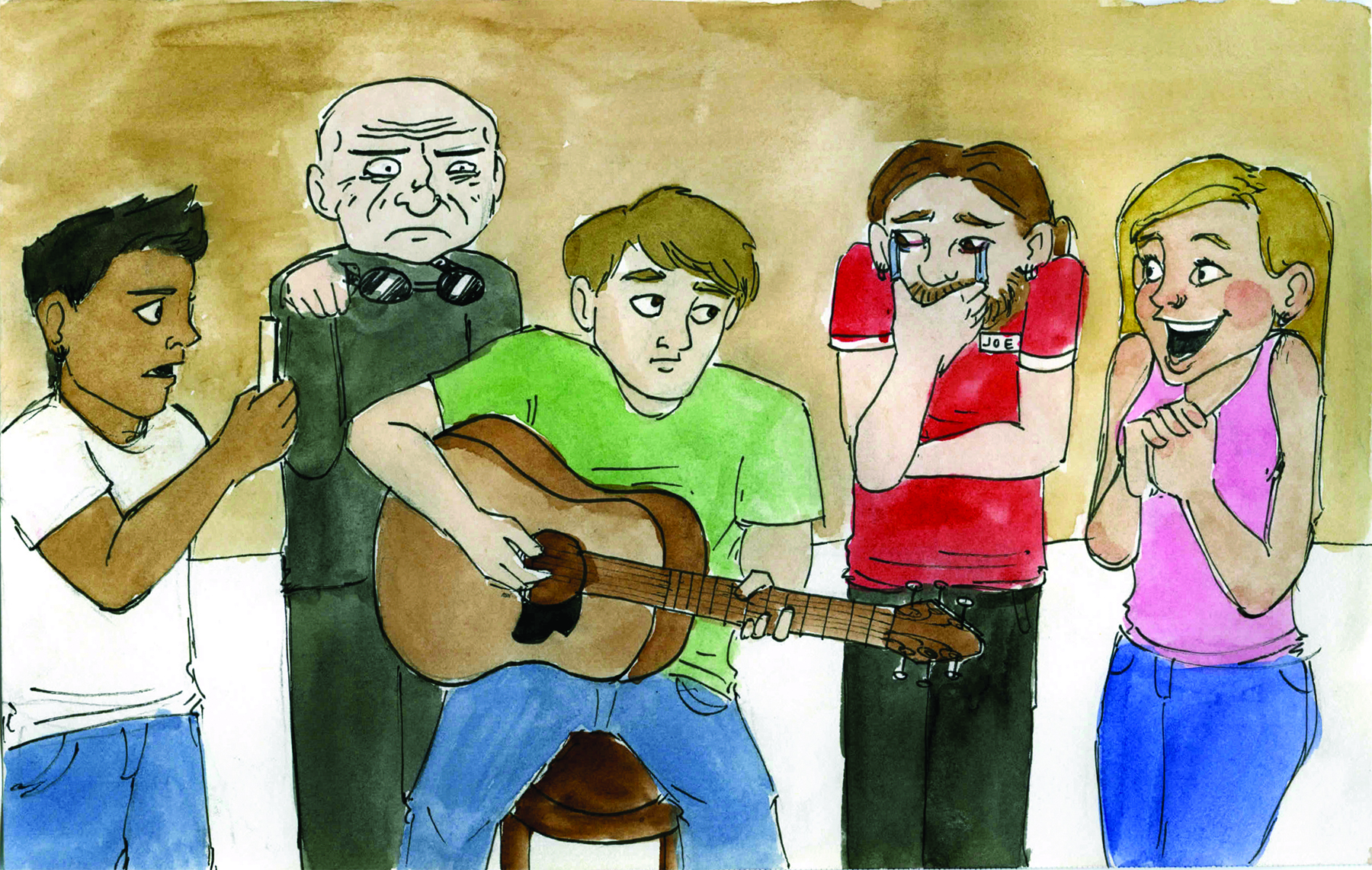
SEATTLE — Open mouths, gaping jaws and teary eyes were in abundance at the Bellingham Guitar Center yesterday afternoon when workers and patrons were treated to a stunning surprise performance of Guns-N-Roses “Sweet Child O’ Mine.”

Fifteen year-old Simon Flaherty said he was simply at the shop to try out a couple guitars and maybe buy a patch cord and that he had absolutely no idea he would receive this kind of ovation.

“It was crazy, I was just noodling around on this cool Martin accoustic when it just hit me to play ‘Sweet Child,’” Flaherty recalled thinking back to yesterday with starry eyes, “I noticed the woman across the room looked over at me and smiled as I played the first few notes and I just looked at her stunned like ‘you know this song?”

As Flaherty continued to play the opening riff he said that everyone there must have been real music experts because they were all whispering “it’s that song!” to each other before crowding around him in awe.

“It was a little nerve racking when even the store managers came out to watch but I still managed to hit every note, I don’t know how, I haven’t even done it perfect all the way through at home!” Flaherty said, with surprise still in his voice.

One of the shop’s salesman recalled the event as probably the most amazing performance he’s ever seen and according to friends he’s seen over three different GNR cover bands.

“It was so incredible, I almost couldn’t believe my eyes,” the salesman recalled shaking his head incredulously, “I mean I’ve seen a couple people who can get the first couple notes right but this kid did the ENTIRE opening without even looking down at his fingers more than once! I wouldn’t be surprised if this guy could even nail Stairway to Heaven if he set his mind to it!”

Resogun redefines addiction

0

resogun

It is, perhaps, a little alarming that the most notable launch title for the newly-released Playstation 4 is Resogun: an indie release from Housemarque, the studio that developed the PS3’s addictive asteroids-clone Super Stardust HD. Like Super Stardust HD, Resogun is extremely simplistic, yet also increasingly difficult. Its addictive qualities culminate in one of the few launch titles for the PS4 that will have players compulsively returning, over and over again.

In many ways, Resogun is an exemplary showcase of the power of the PS4. A plethora of voxels fill the environment when each enemy is destroyed by the ship, which players pilot, and an abundance of particle effects are displayed as massive amounts of numbers flood the screen. The goal is simple: maneuver through the barrage of bullets and debris, shooting anything that comes into sight until enough enemies have been decimated for the boss of each level to show up.

What makes Resogun slightly more engaging than its spiritual predecessor is that it adds the extra objective of trying to save all 10 humans in each mission. This is completely optional, and many will skip it because of how challenging the game can become later on, but saving a human will give the benefit of a weapon upgrade, extra bombs, more points, or even an extra life — all of which will come in handy on a very frequent basis.

The game also consists of online co-operative play, allowing users to play with each other to try and get through the unrelenting waves of enemies. The major complaint that Resogun warrants however, is that it does not have local co-op, which would have been great for those players who play together offline.

The game is also extremely short, with only five levels to enjoy, and the environments themselves are not extremely memorable. However, having had the game for a couple days now, it is the one title that I keep playing, despite having beaten it a couple of times already. Replaying it on different difficulties, with different ships, and also trying to save all the humans gives a longevity to the game that is welcoming and maybe a little destructive to one’s social life.

Resogun is so great that it actually makes the rest of the PS4’s line-up feel inferior in quality. While it may not be the graphic powerhouse of a game like Killzone: Shadow Fall or Battlefield 4, its gameplay is above and beyond those titles. After boosting through an onslaught of enemy ships and dealing incredulous amounts of damage with your overdrive — a fancy name for “laser” — addiction becomes an inevitable reality.

The Buck Stops Here

0

bitcoins

In the span of a single day, Bitcoin has gone from being seen as “fake online money” (as succinctly described to me by an Electric Owl bouncer), to being recognized by the US Senate as a force to be reckoned with. After recently concluding their two-day hearing on the digital, decentralized currency, government officials ultimately came forward with positive comments on Bitcoin, sending its value skyrocketing to a peak of $900 in fiat money — for a few moments, anyway.

At the same time, the Vancouver Bitcoin Co-op was signing their incorporation papers, a milestone that was filmed by NHK, Japan’s national broadcasting channel. Some enthusiasts are saying that Bitcoin has reached its first tipping point. Its every move is tracked in the headlines of mainstream press, while governments around the world are acknowledging its legitimacy as a means of exchange for goods and services.

The Canada Revenue Agency has elected to treat Bitcoin like legal tender in terms of how businesses and individuals file their taxes, though there has been no discussion around additional legislation yet. Germany recognizes it as legal tender, while the Hong Kong Monetary Authority said they would not regulate it.

However, Bitcoin companies and entrepreneurs are still regularly being denied bank accounts. The press headlines aren’t always favourable. Still in its infancy, Bitcoin’s infrastructure is plagued by security concerns. Investor mania and shadowy acquaintances alike are cause for scepticism from the average person.

Where “real” money has failed us, I say, let cryptocurrencies lead the way.

Bitcoin’s reputation for being the currency of choice in online black marketplaces, particularly the Silk Road, often precedes it, even as the value of the global illegal trading system stands at $400 billion. Advocates argue that buying illegal drugs on Silk Road, which make up 70 per cent of their inventory, is the harm-reduced alternative to buying ecstasy from a street dealer. Because buyers could rate and review products, it was easy to find high-quality drugs at competitive prices.

Think a whole market of Walter Whites circa the first season of Breaking Bad. Big-scale cartels and drug lords aren’t the ones flocking to this particular corner of the Internet.

Even the Secret Service said during the Senate hearing that high-level criminals have not moved towards using Bitcoin and other P2P (peer-to-peer) currencies. Centralized currencies continue to be the go-to choice during criminal activity, because every transaction conducted in Bitcoin is recorded in the system’s public ledger. It is a common misperception that digital currencies can be completely anonymous and private.

“Bitcoin is not anonymous and cannot offer the same level of privacy as cash. The use of Bitcoin leaves extensive public records,” the FAQ of Bitcoin.org states. Forbes staff writer Andy Greenberg has also documented the ease of connecting his “experimental” purchases of marijuana through three separate markets. “On Silk Road […] our online drug buys were visible to practically anyone who took the time to look,” he writes.

This is certainly true for the average user, though — like cash — there are more sophisticated ways to launder bitcoins.

Yet precisely because of its decentralized nature, Bitcoin can never be completely untraceable and anonymous, though it still retains a reasonable measure of privacy compared to credit cards. If someone hacked into the transaction records of a merchant, they would have access to enough information on your credit card to use it. But because your Bitcoin wallet’s private key — which is required to gain control of the wallet — does not get recorded in the same system, your currency remains relatively safe.

The largest threats to the legitimacy of Bitcoin are the security loopholes and inefficiency of trading the currency. At this point in time, the quickest, easiest, and safest way to buy and sell Bitcoins is in person; ironic for a currency that is prized as being the high-tech way of the future. In the last month, there has also been a rash of trading platforms around the world being compromised, as well as the China-based GBL shutting down and taking $4.1 million in user money with them.

To be fair, it’s more accurate to call this an outright scam than hack. Bitcoin advocates say that the users involved could have easily prevented this snafu by immediately transferring their currency to an online “wallet,” created by a service explicitly for the purposes of storing bitcoins, such as Blockchain, or to a wallet created on their personal computer. After all, Bitcoin exchangers — like banks — have the power to move currency around in whichever way they please, and are not necessarily a secure way of storing your money.

quotes1Bitcoin is designed to bring us back to a decentralized currency of the people.”

– Gavin Anderson, chief scientist at the Bitcoin Foundation

However, even large-scale, reputable exchanges like Mt. Gox and Canadian Virtual Exchange have been taking inordinately long times to process user verifications and cashouts, leaving money vulnerable for longer than necessary.

For now, Bitcoin is still largely a playground for those with disposable income, much like the stock market. It would be a poor move to invest any money in Bitcoin that you couldn’t afford to lose. While general consensus is that digital currencies are an inevitable part of our future economy, it’s not a guarantee that Bitcoin will be the choice cryptocurrency that becomes adopted in the mainstream.

Since its inception, rival currencies (or hopeless clones, depending on how you see it) have been established, such as Litecoin, Peercoin, and Namecoin. Though less popular than Bitcoin, each of these currencies have their own advantages. Litecoin, like its name implies, allows for shorter transaction times, making it more feasible for transferring microtransactions.

The difference between buying Bitcoin and buying shares on the stock market is that you don’t have to buy one entire Bitcoin. Like fiat money, it can be broken down into millions of parts, and you can convert any dollar amount you want into the cryptocurrency.

So, in the end, the Electric Owl bouncer was right. Bitcoin is fake online money. But after all, Canadian dollars are fake money, too — they just use paper instead of code. Both currencies only have as much value as the people who use them think they do. Both can be easily lost or stolen.

Government policy may never get to a point where you can pay your taxes in bitcoins, but the widespread adoption of a secondary currency in a country is not unheard of. Peru, Uruguay, Cambodia, Vietnam, and Afghanistan accept US dollars as easily as if it were legal tender, and it may well be a developing country that finds itself at the forefront of the worldwide Bitcoin revolution.

The more unstable the national currency and the less a people trusts its government, the more visible the benefits of Bitcoin become. For example, the Cypress government wouldn’t be able to confiscate the money from a citizen’s Bitcoin wallet, because there is no one central power to influence and exert power over. Citizens can rest easy knowing that their money is relatively safe inside their digital pocketbooks.

As Gavin Anderson, the chief scientist at the Bitcoin Foundation, told Forbes magazine: “Bitcoin is designed to bring us back to a decentralized currency of the people.” The greatest success of digital currencies will be to keep the powers that be in check and allow people a way to gain more control of their finances. So where “real” money has failed us, I say, let cryptocurrencies lead the way.

WEB-info bar

Neither ‘pro-ana’ nor ‘pro-mia’

0

WEB-anorexia-Jessica Wissel-flickr copy

People in North America are constantly bombarded with the ideology that they should be fitter, smaller, and sexier. There are many media sources that display idealized versions of what women and men should aspire to be, in regards to both their health and body shape. This is taken to the extreme in a section on the blogging site Tumblr.

The site utilizes tags, which are attached to photos, quotes, and other material, and allow the content to be categorized and filtered. While browsing through the main page of the website, I came across a disturbing set of tags on a photo of an extremely thin young woman: “pro-ana” and “pro-mia.”

“Ana” is a short and innocent-sounding version of anorexia nervosa; while “mia” is a shortened version of bulimia nervosa. Out of sheer curiosity, I clicked on one of the tags to see what would be displayed. Tumblr did warn, “If you or someone you know is dealing with an eating disorder, self harm issues, or suicidal thoughts, please visit our Counseling & Prevention Resources page for a list of services that may be able to help.” But this didn’t adequately prepare me for what I was about to see.

To my horror, a click on the tag took me to a section of the website plastered in photos of people with absolutely emaciated figures, and a frightening number of phrases such as “Keep Calm and Stop Eating,” and “I hate every inch of my body.”

I am still repulsed by what I saw. I’m not repulsed by the shapes of the people themselves, but by the fact that these people promote a mental illness, they idolize eating disorders.

I came across a video from a sufferer of anorexia nervosa under the “pro-ana” tag. In it, she detailed the true realities of the disease, and her most recent trip to the hospital at a mere 98 pounds. In it, she tries to reason with those posting glamorized photos of ribcages and thigh gaps, saying that these images are encouraging little girls to kill themselves, and that she wouldn’t wish this upon her worst enemy. She attacks the tags by saying, “I’m not ‘thinspo.’ I’m not ‘thinspiration,’ I’m ‘deathspo,’” hitting home the idiocy of these tags that romanticize diseases that claim lives.

It’s disgusting that the website allows for the existence of such a section, and yet, if they were to take it away, it’d potentially encroach upon the freedom of users to post whatever they wanted. This prompts the equally important, yet enormous question: where do we draw the line?

Our society must begin to tackle the tough issues of regulating speech like this, and deciding whether or not it has a place. Perhaps we won’t be able to reach a decision immediately, but the discussion is important.

Personally, I find it sickly ironic that this subculture of Tumblr seems to be thriving, while many suffering from these disorders certainly are not.

ADVICE COLUMN: Ask Dr Ygor Yvanovich

0

DEAR DR. YGOR: I have spent much of my adolescent years growing my reputation as a supreme dick and all around terrible person. My friends, or shall I say acquaintances, have learned that I am irritable, cynical, uncaring, and to just generally avoid me. Children in my neighbourhood have come to the conclusion that I must have serious mental issues in order to summon up this amount of dickishness, and they, too, generally avoid me. That’s the way I like it. I’ve worked 18 hard years to get to where I am.

Today, however, I may have thrown that all down the drain. While waiting for the one acquaintance, that can still stand to be around me, so I could tear down his hopes and dreams, a girl came up to me and asked me for a charitable donation for some cause. Now, normally, I’d come up with some less than witty but still hurtful retort. Today, however, I just froze. The only way I could think of getting out of the situation was giving her my spare change. It was only after running away (and not ruining my friend’s day) that I realized I committed a charitable act. Am I still a dick? Can I repair my reputation as an abomination against humanity?


DEAR DEDICATED COLUMN READER: You have come to the right doctor. In addition to having been Bulgaria’s No. 32nd Psychiatrist, I happened to be Bulgaria’s number one dick. In fact, I lost my license over my refusal to use positive psychiatry, instead belittling my patients, and encouraging their self-doubts and insecurities.

In my years of being a dick, I’ve learned how to exploit any situation as a showcase for my dickery. As such, where you see a failure of character, I see potential. Though most people agree that charity is good, one thing everyone hates is smugness, especially undeserved smugness, my favourite kind of smugness. Now assuming you’re not Bill Gates, your donation was probably no more than 75 cents. Assuming that, I’d say brag about your charitable contribution. Go on and on about how they don’t care about children and that they spend all their money on lattes instead of people in need, and how they get to go back to their comfy, cozy homes and watch their TVs.

Congratulations, you’re now not just an “irritable, cynical and uncaring” dick but an “irritable, cynical, uncaring and pompous dick”. And remember, when anyone asks how much you donated, stand up and proudly state, “75 CENTS!”

Make us dicks proud (or at least only mildly sarcastic)!

-DR. YGOR YVANOVIC

Minds of the Moment #3

0
Image credit: Kenneth Uzodinma.

A moment of silence

1

8452047975_bc76e331f2_b

In November 28, 1998, Rita Hester, a trans woman, was murdered in Allston, Massachusetts. Fifteen years later the crime remains unsolved, but her death — and the deaths of countless other transgender and non-conforming gender folks — continue to be commemorated on November 20: the Transgender Day of Remembrance.

Rita Hester’s murder prompted Gwendolyn Ann Smith to start the “Remembering Our Dead” web project, along with a San Francisco candlelight vigil in 1999. Since then, commemorative vigils and memorials have taken place across North American cities and around the world. The annual event not only serves to publicly mourn and honour the lives of all who have died because of anti-transgender hatred, but also to draw attention to an issue that the media rarely covers.

While there has been increased media pressure to prosecute hate crimes based on race and sexuality, there is comparably little education and awareness of trans issues. The individuals assaulted or murdered because of transphobia are often not provided the justice they deserve.

In fact, Rita Hester’s murder occurred just over a month after the murder of Matthew Shepard, whose much-publicized story led to such a large response from gay rights activists that it eventually brought about the The Matthew Shepard and James Byrd, Jr. Hate Crimes Prevention Act of 2009, a criminal justice legislation signed by President Obama which imposes harsher penalties for perpetrators of hate crimes. If this took 11 years to implement, what kind of timeline can we expect to bring justice for transgender and gender non-conforming folk?

In 2009, the brutal murder of Jorge Steven Lopez Mercado was reported as that of a “gay teen,”  and the reports used male pronouns. At the time, murder suspect Juan Antonio Martinez Matos’ statement outlined how he had thought Lopez Mercado was female but then “realized that the teenager was actually male.” The media for the most part has neglected to respect the fact that, at the time of her murder, Lopez Mercado self-identified as female.

These facts stand alone to show, first off, that many of these murders occur because the victim in some way does not conform to the perpetrator’s strict understanding of gender. They illustrate a trend wherein the hatred that led to the attack was sparked by an inability to understand identities or lifestyles that don’t conform to the strict rules of gender binary which many internalize.

Individuals assaulted or murdered because of transphobia are often not provided the justice they deserve.

The Trans Murder Monitoring project — in cooperation with Transgender Europe (TGEU), a network of trans rights NGOs across the continent — was initiated in April 2009 to collect, monitor and analyze reports of homicides of trans people worldwide. Today, the project functions in 36 countries. That same year, the update presented information about over 160 people killed because of other people’s violent reactions to their trans presentation or identity — but these numbers fail to tell the whole story.

The media often fails to accurately identify trans folks in their reporting. Chelsea Manning, formerly Bradley Manning, is a recent example. Despite publicly identifying as a woman following her incarceration, Manning has been referred to via male pronouns by many prominent media outlets, including The Washington Times, The New York Times, USA Today and NPR.

This leads to many trans folks feeling that their identities and lived experiences are not being recognized. Apart from the insult of using outdated names and pronouns to define trans people, refusing to identify a victim of a violent crime as transgender or gender non-conforming delegitimizes a case’s status as a hate crime and a trans issue — something that is essential in drawing the public’s attention to the severity and rampancy of violence against transgender and gender non-conforming folks.

TGEU recently published its newest findings, and they are shocking: between January 1 and April 30 of this year, 78 trans people were murdered in 13 countries. Since January 2008, there have been 1,233 reported murders of trans people in 59 countries worldwide.

The report also specifies that these murders tend to be particularly gruesome and violent, often including mutilation and other forms of torture. These were preliminary results, and will probably have grown by the time of this article’s publication. Furthermore, these numbers only include murders that are reported as victimizing trans and gender non-conforming folks. Often trans identities — and even murders themselves — go unreported.

Seventy-eight per cent of the globally reported murders of transgender folks (958 murders) were located in Central and South America, with Brazil alone reporting a whopping 468 murders. The highest numbers are reported in countries with strong trans and LGBTQ advocacy organizations, most of which keep careful track of numbers, meaning that the problem worldwide is surely much greater than these numbers express. In nations with less pronounced trans rights organizations, many murders go undocumented and undiscussed.

Based on the information thus reported, there have been clear patterns that show intersections of oppression that increase the likelihood of transgender individuals being targeted for violent crimes. There is a level of traditional sexism which plays into the murders: most of the reported names are people with a feminine gender presentation. Socioeconomic status, education levels, and race are all factors that further marginalize transgender and gender non-conforming folks.

A large risk factor is involvement in sex work. In Canada, sex workers have been fighting for legislation to bring about better safety and protection on the job; trans sex workers in particular are at a higher risk for violent victimization. Also, unsurprisingly, the lack of a solid support system for trans and gender-nonconforming people increases their marginalization in society. Many of the individuals in these reports having been rejected by friends, family and employers because of their gender identity and presentation.

However, these problems don’t lie exclusively in lack of public awareness and legislation. Law enforcement officers often display insensitivity or, at the very least, lack of education towards trans rights issues. For example, just over a year ago, 26-year-old January Marie Lapuz was fatally stabbed in her New Westminster home. In a press release, police first identified Lapuz by her male birth name, later noting her legal name change to January Marie.

Refusing to identify a victim of a violent crime as transgender delegitimizes a case’s status as a trans issue.

Many of these murders are not investigated properly or are not presented to the public and the media properly, leaving a large number of cases unsolved and leaving entire communities with no sense of justice or closure.

This year marks the 14th Transgender Day of Remembrance. There are more than 120 scheduled vigils and events around the world, in honour of the countless lives that have been lost as a result of transphobia. In an article for the Huffington Post, founder Gwendolyn Ann Smith argued that the Transgender Day of Remembrance “is not a quick and easy one-day way for organizations to get credit for their support of the transgender community. It’s not something to trot out on the 20th of November and forget about. We should be working every day for all of us, living and dead […] We remember for hundreds of others killed around the world in anti-transgender murders.”

By raising awareness that violence against transgender folk is not only present but very rampant, the Day of Remembrance also opens the floor for non-transgender allies to come forward with their support. At SFU, our opportunity comes this week: from November 18 to 20, Out on Campus will set up a display and vigil on campus. Students and faculty are encouraged to come and pay their respects for those trans people who have been murdered and harassed, and to open a forum on the possible actions the school can take in order to minimize the victimization of its trans community.

For Out on Campus, however, these issues are not limited to a single day: the organization is committed to promoting trans rights all year long, and have made efforts to make SFU a safe space for any and all gender identities and presentations. There are several exciting projects that are happening on our campus, in the hopes that education and awareness can contribute to an improvement in the quality of life and rights for folks of all gender identities.

The Trans* & Gender Diversity Project aims to create a resource guide for trans* and gender diverse folks at SFU by collecting personal accounts.

The SFU Queer History Project is working to archive and thus preserve over 40 years of queer organizing and activism at our very own campus. If you have any pertinent information, please contact Out on Campus at [email protected].

Positive Space Network aims to transform our campus into a safe space for all by reducing homophobia and transphobia through an educational program. It is also working to create a network of resource people and safe spaces on campus.

Despite increased legislation and awareness of trans issues since the death of Rita Hester 15 years ago, transphobic murders and assaults still occur with striking frequency in our society. We recognize the Transgender Day of Remembrance on November 20 in order to ensure that all of us at SFU are doing our part to ensure that our campus becomes a safe space for trans and gender-nonconforming students, staff and faculty. Take a moment to reflect on what you can do in order to make your school a positive force in the fight for trans rights.