Home Blog Page 1200

Moment of zen

0

Jon Stewart

At the SFSS Board meeting last week, President Humza brought to the Board’s attention that the SFU Outdoors Club encountered some troubles on their most recent excursion. While snowshoeing, the group allegedly discovered late in the night that two of their members were missing. The two were later found, safe and asleep.

However, there seems to have been a miscommunication between the club and Board, as seen in Humza’s comments.

“I don’t exactly know what the process of snowboarding is,” said Humza.”You’re supposed to be close to one another. There’s supposed to be teams and proper checks and balances.”

Humza admitted that he has never been a fan of the sport.

Woohoo, Boohoo

0

Woohoo: giving money to homeless shelters

I have fairly liberal opinions concerning the homeless. I know that the issue is much more complicated than homeless people being unwilling to secure jobs or preferring to be addicted to drugs -— as many of the most elegant conservative arguments boil down to. People may become homeless for these very reasons, no doubt, but I prefer to view these people as people before lazy drug addicts.

I don’t think it’s too much of a stretch to see anyone, including myself and (doubtlessly) our hundreds of loyal SFU student readers, as having the potential to be homeless. Even if my growing up as upper-middle-class stayed constant, a change in family, friends, love, or forgiveness could have led me down a path of addiction, or deep-set problems that emerge as financial irresponsibility.

Homeless people deserve support before judgement, which is why homeless organizations, like shelters, churches, and support groups, deserve the extra financial or physical support of whomever can give it.

Boohoo: handing out money on the street

Handing out money to people panhandling does not solve the issues surrounding homelessness. At first, it appears to be helping someone support themselves, at least in the short term. However, there is no guarantee that the money they receive will go somewhere worthy. Many of them suffer from mental-health issues, or do not know how to spend their money appropriately.

Of course this does not apply to every person begging on the street, but, doubtless, it applies to many. In the end, handing out money freely supports people living a lifestyle in which people exist in society without contributing.

The act may seem like one of the many small acts of kindness that make the world a better place. And perhaps it is. The problem, though, is that there are so many other kinder acts that require a similar sized contribution — for example, giving money to worthy homeless shelters.

So the next time you’re tempted to give money to a homeless person, write a reminder to give that same amount to a homeless shelter. Better yet, volunteer time or donate food. If you really want to help, it’s the best you can do.

Clan women continue successful season in Missouri

0

The SFU women’s wrestling team, already having found success this season, kept up the momentum with a strong showing at the Missouri Valley College Open on Nov. 16. Seniors Justina DiStasio and Jenna McLatchey both won their respective weight brackets, while two other Clan wrestlers, juniors Nikkie Brar and Darby Huckle, finished second in theirs.

DiSatsio went undefeated through four rounds to lay claim to the 170-lbs bracket title. Her first win came at the expense of Wayland Baptist University’s Brenda Mendoza, before beating Menlo College’s Solove Naufau in the second round by technical fall. She tossed aside Missouri Valley College’s Brittany Jones in the third round before besting Ruth Leger from Lindenwood College in the final round for a dominant title win.

McLatchey also won all four of her matches, but three of the four were won by decision. Her only non-decision victory came in the first round against Alana Jimniez, wrestling for New Jersey’s Bearcat Wrestling Club. She then topped Justina Luafaleman of Northwest Tech to move on to the third round, where she’d face — and defeat — another Wayland Baptist Wrestler, Angela Vyborny. In the final round, she beat Malexsis McAdoo of King University to claim the 191-lbs title.

Brar, meanwhile, won her first four matches to move onto the final of the 116-lbs bracket, but lost a close match by decision to Jessica Fresh from Waldorf College and was forced to settle for second.

Huckle, however, needed just two wins to move onto the final round of the 101-lbs bracket, but ultimately lost to Oklahoma City University’s Emily Website to fall just short.

Also wrestling for the Clan were senior Gina Carpenter and freshman Mallory Velte, who each finished fourth at 130-lbs and 136-lbs, respectively. Velte’s fellow freshman Laura Anderson finished seventh at 123-lbs, while Jilliane Vina and Minika Podgorski also hit the mat for SFU.

Already having had plenty of success so far this season, the Clan women will get a month to prepare for their next event, the Southwestern Oregon Duals on Dec. 16.

SFU Entrepreneur of the Year awarded to computing scientist

0

CMYK-maryam Sadeghi-Mark Burnham

This year’s SFU Entrepreneur of the Year award was presented on Nov. 16 to Dr. Maryam Sadeghi, an SFU alumna who recently received her PhD in computing sciences.

Sadeghi was recognized for her venture in health technology, called MetaOptima Technology Inc., and its development of the app, MoleScope, which will allow patients to detect skin cancer in its early stages at home.

Each year, the SFU Entrepreneur of the Year (SEY) program gives student innovators a chance to pitch their ideas to professionals and to compete for first place and the title of Student Entrepreneur of the year. Presented by Enactus SFU, SEY is a program that, as described on its website, “inspires business ideas and recognizes the future innovative leaders of tomorrow.”

“It’s a huge problem,” Sadeghi said of skin cancer, “70 per cent of patients identify it themselves or by family members who have never had access to any imaging device to look at moles closely and find cancer early.” In it’s early stages, skin cancer is highly treatable and catching it early on can mean a world of difference.


Above all, Sadeghi believes the product will bring its users peace of mind.


Sadeghi’s technology includes an advanced imaging device to capture potentially cancerous moles, to be used in conjunction with the smartphone app. The app will help patients keep track of their moles over time and learn how to spot the suspicious ones, as well as connecting patients with nearby specialists to whom they may send high quality images of their moles for consultation.

“It’s all about health solutions and having access to digital and mobile health,” said Sadeghi. MoleScope is just one of the tools MetaOptima hopes to develop that advances towards this ideal.

The MoleScope app will prove particularly useful for those patients that must travel lengthy distances to see a doctor about their suspicious moles. Sadeghi, mentioned that she’s observed patients coming to Vancouver from Victoria and even Kelowna, just to have their moles inspected.

“They could be doing this from their homes,” Sadeghi said she realized. “There’s not a lot of tests involved in the first visit, so it’s just looking at moles and saying, ‘oh, this is nothing,’ or ‘I need to biopsy this.’”

Above all, Sadeghi believes the product will bring its users peace of mind. For those who are already living with skin cancer, they are faced with the challenge of tracking all the numerous moles typically accompanying the illness, something Sadeghi describes at “a huge problem.”

The app should render this task less daunting as it will keep track of each individual mole and organize them to show their progression, and all from the comfort of patients’ own homes. After various stages of testing, Sadeghi is hoping to have the app on the market by summer of 2014.

SEY applicants were vetted through two preliminary rounds conducted online. The ten semi-finalists then presented their businesses to a panel of judges and the pool for the final round was reduced to four. The four finalists presented to a new panel and an audience in order to determine the ultimate winner for 2013.

On her experience as a contestant, Sadhegi commented “it was great!” She also remarked on how good it was to see the passion in all her fellow contestants and that she was happy to be a part of the competition.

Networking for cancer research

0

OLYMPUS DIGITAL CAMERA

This photo was taken at a previous 25toLife event, Pie Your Prof.

Last Tuesday, an SFU Beedie School of Business project management class held an event dubbed “Corporate Speed Networking,” which was designed as a fun and interactive way for business students to communicate with business professionals in a unique atmosphere.

The event was held at SFU Harbour Centre, and all proceeds were given to the Canadian Cancer Society (CCS).

Seven professionals from corporate giants Rogers Canada, World Financial Group, KPMG, and Affirmed Capital were stationed at tables, and approximately 20 students were individually rotated through each company for four-minute sessions.

“If only dating were this informative,” commented one SFU student participating in the event.

The event was the last of nine held by the project management class. This term, Beedie lecturer Kamal Masri, who taught the project management class, dedicated it to raising $25,000 for cancer research and to support individuals facing the disease. They dubbed the campaign 25toLife, a joint project between the class and the CCS.

“It’s an experiment,” said Masri, “It’s the first time I’ve run this kind of project, and the idea is to have 50 students working together rather than competing against each other, which is traditionally what we see in classes at university, including SFU.”

The challenge put before the students was to raise $25,000 dollars for the CCS, a goal that many students viewed as extremely difficult.

“Several of our teammates have already lost friends and grandfathers to this disease, while others have held the hand of aunts and mothers who courageously battled their way through,” stated the write up on the team’s website. “While each person’s story and relationship are different, we are all united by the same goal: to end cancer and celebrate the lives of all those it affects.

“It wasn’t the easy ‘A’ we were expecting.”

– Aliyah Ali, SFU Beedie student


In order to fulfill their goal, the class was split into nine groups, and each group had three months to plan a fundraising event. Previous events ranged from pub and club nights, to a pie-throwing contest involving SFU professors (aptly called “Pie Your Prof”), to a cancer-cut event where participants had their hair cut or shaved in the SFU Surrey Mezzanine.

“It wasn’t the easy ‘A’ we were expecting,” says Aliyah Ali, a student in the project management class. “It took us the entire semester to plan this.”

As it stands, the 25toLife campaign has raised $22,700 to date, and hopes to reach its anticipated goal of $25,000 by Nov. 26, just in time for the end of the semester.

“Right now they’re just working really hard to hit that target,” said Masri. As far as the success of the experimental class, Masri is pleased with the end result.

“In class, the semester was pretty much like a rollercoaster ride. Students were challenged, they were pushed, they pushed back, they lost motivation, then their motivation was back up again; in the end they picked it up.”

Board Shorts

0

WEB - Board Shorts - Enrique Lin
Build SFU update

A space program recommendation for the Student Union Building has been drafted by the architects. The board will finalize the draft on Dec. 2 and the site selection vote will take place on Dec. 4.

Members elected four Board representatives to a Working Group, where they will share their input on how the SUB space should be used. Elected members include Brandon Chapman, Clay J. Gray, Moe Kopahi and Gloria Mellesmoen.

The Board has also amended the Build SFU Bursary Terms of Reference introduced last week. The SFSS will now support the bursary through a portion of the Build SFU levy that will be transferred to Financial Aid and Awards via a remittance from the SFU Finance Office. The bursary will be available only to full-time undergraduate students who demonstrate financial need.


Men’s Centre Working Group

Board also appointed two Student-at-Large positions to the Men’s Centre Working Group. Out of the six candidates, Koju Kojwang and Karanvir Thiara were appointed. Thiara, a former at-large representative of the SFSS Board, put forward the Men’s Centre mandate during his elected term. In his application, Kojwang stated that, “gender issues are close to [his] heart” and he believes he can “bring a fresh, valuable energy to the discussion at hand.”


Office Holiday

Board passed a motion declaring Mon. Dec. 23 to be an Office Holiday. The Society will now close for the semester break on Fri. Dec. 20. President Humza Khan hopes staff will benefit from the extended break. “We recognize the fact that our staff has been working very hard for us,” said Humza. “[So that hopefully] when they’re back, they’re full of energy and ready to go.”

We must change our energy

0

WEB-oil refinery-Hourann Bosci-flickr copy

Although fossil fuels have brought us tremendous value in the last two centuries, burning oil, gas and coal has created a serious emergency. Here, at SFU, many faculty, staff and students are rightly focused on the climate crisis. Yet, by holding investments in fossil fuel companies that are wrecking the climate, the university itself is undermining and slowing society’s transition to a safer, low-carbon society. We should call on SFU to end its investment in fossil fuels.

The global warming crisis has major implications for your life after SFU and the future of your career, health and family. Scientists — including many from SFU — are growing ever more alarmed by the damage we are doing to the climate.

By burning oil, gas, and coal, we move eons of stored carbon from the ground to our oceans and atmosphere, where it stays and holds more energy. This creates the greenhouse gases that warm our planet, changing and intensifying weather patterns and contributing to more extreme droughts, heat waves, floods, and storms. Scientists also forecast water and food shortages and increasing poverty and inequality as a result of climate change.

There is still hope, though. If we hope to avoid this dangerous and irreversible global warming, the Intergovernmental Panel on Climate Change tells us we can’t burn more than 921 gigatonnes of carbon dioxide. Yet, scientists widely agree that fossil fuel companies can extract at least twice as much — more than enough to cook our planet. And each day, they look for even more reserves in places like the Arctic, shale formations, and deep oceans.

SFU’s fossil fuel investments jeopardize their academic mission and contradicts its research and education

Groups as diverse as the International Energy Agency, HSBC bank, and 350.org say the vast majority of proven and probable fossil fuel reserves should remain unburned if we hope to avoid runaway climate change. One report by HSBC found that these unburnable reserves could reduce the market value of fossil fuel companies by up to 60 per cent. Institutions like SFU that directly or indirectly hold investments in these companies should be alarmed by the “carbon bubble” they face.

This growing understanding, along with concern for climate justice and defence, is why SFU faculty overwhelmingly voted to create a fossil free pension fund this fall. It’s why 70 institutional investors with over $3 trillion in assets asked fossil fuel companies to examine and disclose their exposure to this carbon bubble in October this year. Over 400 other schools, churches, funds, and 16 US cities, including Seattle and Providence, have already moved to end their investments in the top fossil fuel companies in the near future.

Sustainable SFU has joined this global movement for divestment and is calling on students, alumni, staff and faculty to be a part of it. We call on SFU to immediately freeze new investment in fossil fuel companies, fully end ownership in those companies over the next five years, and disclose the potential greenhouse gas emissions in SFU’s endowment and other investments.

If SFU does not change course,  it will find itself with a portfolio of financially worthless fossil fuel assets. These investments jeopardize SFU’s academic mission and its research and education on climate change, clean energy, and public health.

Tell SFU we should be in the business of studying and slowing climate change, not funding the companies that cause it.

Album Reviews: One Direction, Death Grips, and a throwback to Interpol

0

Midnight Memories

One Direction – Midnight Memories

So, I listened to an entire One Direction album in a single sitting in the quietude of the Bennett Library. I obsessively monitored the volume of the music coming through my headphones so that no one would know what I was doing. Once I was finished, I was left with three distinct observations.


Observation One: Some of these songs are good.

That’s right, I said it. On Midnight Memories, the British quintet tries so many times to create the perfectly manufactured pop song that a couple of them were bound to turn out right. The infectious juvenilia of “Best Song Ever,” the mug of cocoa vocal harmonies of “Don’t Forget Where You Belong,” the puritanical bubblegum pop of “Happily” and the simple message of “Strong” are about as good as corporate assembly line boy band fodder gets — which, admittedly, is not very good, but certainly much better than this band has any right to be.


Observation Two Most of these songs are awful.

For every step forward, the impeccably coiffed teen heartthrobs of One Direction take three steps back. Many of the songs on this record are musical wallpaper — meaningless verse chorus verse nonentities that aren’t even worth mentioning. Others are so bad that they warrant further comment: the faux Freddie cock rock of the titular track, the paper thin sentimentality of “Diana,” the auto tuned aural assault of “Little White Lies,” the laundry list of lyrical clichés that is “Something Great.” Ultimately, listening to an entire One Direction album did little to dissuade my apathetic dislike of the group. Sorry, Tumblr.


Observation Three: This album is indistinguishable.

One Direction’s success story has become inescapable: their discovery on the British reality show The X Factor, the whirlwind success of their problematic “You Don’t Know You’re Beautiful” single, the chorus of yeasayers announcing the second coming of the British Invasion. After having finally listened to an album by these wide eyed ragamuffins, it’s become clear that the group’s success is distinctly a right place right time phenomenon. Nothing about One Direction differentiates them from any of the facsimile groups that have preceded, and will inevitably succeed, them.


Government Plates

Death Grips – Government Plates

Are we living in a post-Death Grips society? Whether you like their music or not, it’s hard to argue that the industrial hip-hop trio’s us against the world attitude to the music industry has turned more than a few heads. Just last year, the band was dropped unceremoniously from Epic Records for leaking their sophomore album, No Love Deep Web, onto the web weeks before its release date. Oh, and the cover art was a picture of drummer Zach Hill’s erect penis.

I’m serious. Look it up.

Though rumours of Death Grips’ triumphant return have been passed along through comment sections and internet forums ever since the group launched its own label, Thirdworlds, no one expected Government Plates to drop so soon. I learned about its spontaneous leakage through the band’s Facebook page, and quickly backtracked, thinking I must have missed an announcement, a blog post, a tweet, something.

But ultimately, this is exactly the kind of thing Death Grips is all about. Echoing the guerilla spirit of its release, Government Plates is a puzzling, schizophrenic record, full of choppy electro beats, deranged yelps and enough musical about-faces to make your head spin. Fans of the group will likely be unphased: after all, no one would choose to listen to these guys if they weren’t fully prepared for this sort of thing.

The album’s first track (who’s Bob Dylan-referencing title, at 26 words long, I refuse to type in full) opens with the sound of a glass shattering, followed by vocalist MC Ride yelling “It’s so fucking dark in here/Come come fuck apart in here,” and shrieking. In the post-Death Grips world, this is easy listening.

Despite the album’s unapologetic abrasiveness and complete lack of formal structure, it’s a remarkably easy LP to like. Maybe it’s because its frenetic pace and abstract expressionism feel purposeful, like they’re passages from some sort of radical manifesto on the state of our society that I haven’t quite decoded yet. Like Death Grips’ best material, Government Plates leaves its listeners frightened, confused, infuriated and clamouring for more.


Turn on the Bright Lights

Throwback: Interpol – Turn on the Bright Lights

Some records, you love because they’re classic. You love them because that’s what you’re supposed to do. They’ve crawled through the tunnel of critical appraisal and come out in one piece on the other side — your Revolvers, your Kind of Blues, your London Callings. These are the untouchable, the canonical crème de la crème of popular music that have reached the point where one might consider unironically referring to them as “legendary.”

Then there are those records you can’t help but love. They might be underappreciated indie label debuts or obscure back catalogue picks, but each one of us has that one record that we love in spite of ourselves, and in spite of their relative lack of mainstream approval. For me, Interpol’s Turn on the Bright Lights is that record.

To be honest, I expected the LP to have aged less gracefully when I picked it for this week’s throwback. My relationship with this album has faded from the passion of romance to the solemnity and security of companionship — listening to it, I feel as though I’m sitting in a carefully woven rocking chair on a sun soaked patio, sharing a mug of watered-down coffee with an old friend. I have a lot of feelings about this record, okay?

I could go on and on about the music on this thing — Carlos D’s self-consciously swaggering bass lines, Daniel Kessler’s far away guitar tones, Paul Banks’ arcane lyrics, Sam Fogarino’s spring wound drums — but I don’t want to bore you. The appeal of Turn on the Bright Lights goes beyond its music, anyway: from the album cover to the quartet’s perfectly pressed suits, Interpol’s debut LP was all about creating a mood.

That mood may include, but is not limited to: flickering street lamps, thick industrial fog, vintage neon signs, cheap foreign beer, abandoned train stations, molasses thick dollar store coffee, cigarette smoke, and hair gel. Not quite autumn, not quite winter, but certainly cold enough to button up your jacket.

 

Fukushima debris island myth proved false

0

WEB-Fukushima debris-Flickr-niXerKG

A graphic released by the National Oceanic and Atmospheric Administration (NOAA) depicting a Texas-sized island of debris (dubbed “Japan’s ‘toxic’ monster” by Fox News) heading towards North America sparked fear, controversy, and created catchy headlines over the past few weeks, even though this fear has been disproved by the NOAA itself.

In a tweet earlier this month, the NOAA stated: “Some talk is making the rounds that there’s an ‘island of debris’ from Japan coming this way. This is myth . . . there’s no evidence of a mass!” The graphic in question depicts 5 million tons of debris, which was released into the world’s oceans after the 2011 earthquake and tsunami that devastated Fukushima.

According to the NOAA’s Marine Debris Program website, after a year at sea, an estimated “70 per cent [of debris] sank off shore, leaving 1.5 million tons floating.” The graphic was created to show higher concentrations of the now far spread debris, the highest concentration being in an area roughly the size of Texas, off the coast of western United States.

While it has now been determined that this supposed “51st” US state is a myth, the highly dispersed radioactive trash now peppers an area roughly three times the size of the Continental US. The first pieces of detritus are now washing up on coastlines in Hawaii and along the west coast of North America, and are predicted to continue to appear for several more years.


Scientists have discovered over 165 native Japanese organisms hitching a ride on the arriving debris.


According to SALON, scientists have already discovered over 165 native Japanese organisms hitching a ride on the arriving debris.

“We’re finding that all kinds of Japanese organisms are growing on the debris,” John Chapman, a scientist at Oregon State University’ Marine Science Center told Huffington Post. “We’d never seen [some of these species] here, and we don’t particularly want [them] here.”

The Japanese government has also recently admitted that it is now clear that approximately 300 tons of nuclear contaminated water are pouring into the ocean each month from leaks within the devastated Fukushima Power Plant.

According the National Geographic, Shunichi Tanaka, head of Japan’s Nuclear Regulation Authority, has told reporters that leaks have likely been occurring since the earthquake and tsunami hit in March 2011. There is evidence to indicate that officials were aware of the leaks in June at the latest, but the announcement was made as late as July 22. 

The water is contaminated with several different chemicals, all of which affect the human body, and host organisms in different ways. Luckily for North America, the ocean currents the tainted water is riding are also diluting it to a point of safe consumption, equal to that of the background radiation we are already exposed to on an everyday basis.

Minoru Takata, director of the Radiation Biology Center at Kyoto University, told the Wall Street Journal that the radioactive water doesn’t pose an immediate health threat, though he is concerned that the leakage could cause higher rates of cancer in Japan.

Fish populations have also been under scrutiny since the leakage was affirmed, since high levels of cesium and strontium-90 have been found in fish local to the Fukushima plant. The concentration is so high that the Japanese government has banned the fishing and consumption of this local seafood, a decision which is costing local fishermen billions of dollars a year according to National Geographic.

It is currently believed that the radiation will not affect local North American seafood or those who eat it, as cesium is similar to salt in it’s ability to quickly enter and leave the body.

Teenager stuns guitar shop with flawless rendition of “Sweet Child O’ Mine”

0

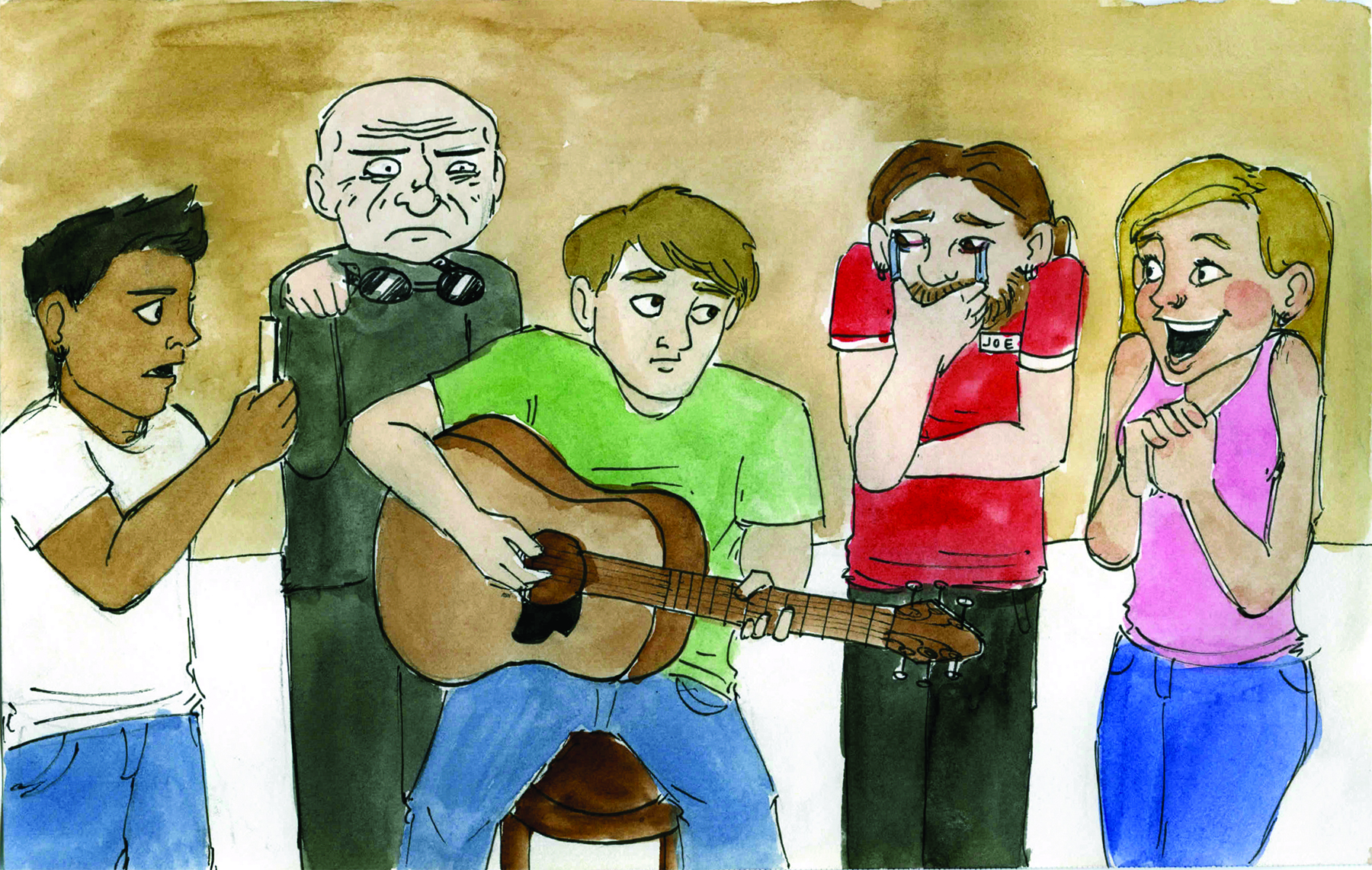
SEATTLE — Open mouths, gaping jaws and teary eyes were in abundance at the Bellingham Guitar Center yesterday afternoon when workers and patrons were treated to a stunning surprise performance of Guns-N-Roses “Sweet Child O’ Mine.”

Fifteen year-old Simon Flaherty said he was simply at the shop to try out a couple guitars and maybe buy a patch cord and that he had absolutely no idea he would receive this kind of ovation.

“It was crazy, I was just noodling around on this cool Martin accoustic when it just hit me to play ‘Sweet Child,’” Flaherty recalled thinking back to yesterday with starry eyes, “I noticed the woman across the room looked over at me and smiled as I played the first few notes and I just looked at her stunned like ‘you know this song?”

As Flaherty continued to play the opening riff he said that everyone there must have been real music experts because they were all whispering “it’s that song!” to each other before crowding around him in awe.

“It was a little nerve racking when even the store managers came out to watch but I still managed to hit every note, I don’t know how, I haven’t even done it perfect all the way through at home!” Flaherty said, with surprise still in his voice.

One of the shop’s salesman recalled the event as probably the most amazing performance he’s ever seen and according to friends he’s seen over three different GNR cover bands.

“It was so incredible, I almost couldn’t believe my eyes,” the salesman recalled shaking his head incredulously, “I mean I’ve seen a couple people who can get the first couple notes right but this kid did the ENTIRE opening without even looking down at his fingers more than once! I wouldn’t be surprised if this guy could even nail Stairway to Heaven if he set his mind to it!”