Home Blog Page 1190

Putting the Typo in typography

0

WEB-Frazer Adams and his art (1)

Vancouver’s Hot Art Wet City is known for its thought-provoking and insightful art exhibits which mesh pop culture with fine art. The opening reception for the gallery’s new display, Typo, took place Friday, Jan. 10 and proved to be an incredibly crowded affair. Running until Jan. 25, the exhibit provides an intriguing look at typography as an art form.

The exhibit features the work of three artists, each of whom has taken a distinctive approach to their work in an attempt to help viewers understand how typography can have substantial artistic meaning on its own terms.

The gallery is not a large room, but in the midst of a shoulder-to-shoulder crowd and an uproar of voices, I managed to snag an interview with artist Frazer Adams on the forms and meanings of his work. His exhibit pieces feature a detailed mingling of letters, geometric shapes, lighting, and outer space.

WEB-2 people viewing Slaters art (1)

“I want to spark people’s interest in the natural world,” said Adams. “Almost all of my work incorporates images of the cosmos and I hope to share a taste of the wonder I get from learning about it.”

Having first received an education in graphic design, Adams soon realized that he leaned more towards traditional typography and sign-painting: “I started out in graffiti and became interested in typography as its own art form, [which] is where a lot of my work comes from.”

“I want to spark people’s interest in the natural world.”

Frazer Adams, artist

When asked about the use of typography in his exhibit pieces, he said, “The fun part of typography is designing the letters and the hard part is coming up with the content. I really enjoy creating type by hand and I get a lot of satisfaction out of making crisp type that consistently follows its own rules.”

Typo also displays the works of artist Bennet Slater, who claims his goal is to “have the pop culture and the fine art world be one world that we all live under.” In catching snippets of attendees’ conversations, I could tell that viewers were particularly interested in his clean, refined technique. Slater’s work employs ambiguity through painted typography, which is interwoven with depictions of plants and other organic objects.

Artist Scott Sueme takes a different turn in his work, using an array of cut-outs, paint, and graphic design. Sueme’s interests involve more gritty, urban-looking typography, similar to that of street graffiti.

By the swarm of art critics I had to wade through to exit the building, it’s clear that more than just the artists themselves believe that typography is an art form worthy of note.

Putin’s Games

0

Putin-copy

It was -25 degrees Celsius on December 23, 2013 when Nadezhda Tolokonnikova, a member of the punk rock advocacy group Pussy Riot, was granted amnesty. She stepped out of the prison gate wearing a thin coat with no hat or scarf. In the bitter cold of the afternoon, Tolokonnikova walked proudly towards reporters, flashing the V sign at the cameras and smiling. “How do you like our Siberian weather here?” she asked. It was the first time she had walked free in 21 months.

3800 kilometres away in the town of Nizhny Novgorod, Maria Alyokhina — a fellow band member and political dissident — was far less pleased with her sudden freedom. “I don’t think it’s an amnesty, it’s a profanation,” she told reporters. “It’s a PR move.” Shoved into a car and quickly escorted from her cell to downtown Nizhny Novgorod, Alyokhina was given no time to say goodbye to her fellow inmates.

Before reuniting with her friends and family, Alyokhina met with local human rights activists. Having served almost all of her sentence, which was set to end in March, she was critical of the Russian government’s choice to grant her amnesty mere months away from the Olympic Games in Sochi. “If I had a chance to turn it down,” she said, “I would have done it.”

Both women have since publicly committed the rest of their lives to the fight for human rights in Russia. But for them and other political activists in Russia, there’s no easy road ahead.

Pussy Riot’s public demonstration on February 21, 2012 in Moscow’s Cathedral of Christ the Saviour only lasted two minutes, and began innocuously — the five members involved in the performance entered the church in modest clothing and bare faces, only to put on their trademark multicoloured balaclavas and strip off their clothing for an impromptu protest against the ties between the Russian Orthodox Church and, at that time, recently-elected President Vladimir Putin.

The Sochi Olympic Games carry a heavy burden for Putin’s presidential legacy.

Within hours, the show, which the group dubbed a “punk prayer,” was uploaded to YouTube. Three of the performers were arrested several days later on charges of “hooliganism motivated by religious hatred.” Six months later, Alyokhina, Tolokonnikova, and Yekaterina Samutsevich were sentenced to two years in a penal colony on the grounds that they had blasphemed and “crudely undermined social order” with their performance, as Russian women are not allowed at the altar of a church.

The women refused to ask President Putin for a pardon; Tolokonnikova called the verdict “a clear and unambiguous sign that freedom is being taken away from the entire country.”

Though she and many more political prisoners in Russia may be free today as a result of Putin’s amnesty, Tolokonnikova’s views on the Russian government have not softened. On December 27, she and Alyokhina announced on the Moscow news conference their plans to shed the Pussy Riot moniker, create a human rights organization and “keep the system in tune.”

Meanwhile, construction continues in preparation for the Sochi Olympics, devastating the local ecosystem and leaving those in the nearby town of Akhshtyr without a reliable source of water for the fifth year in a row.

***

Vladimir Putin’s decision to grant amnesty to over 20,000 Russian political prisoners is not without precedent. In fact, offering amnesty to mark important dates — in this case, the 20th anniversary of Russia’s 1993 constitution — is a time-honoured Russian tradition, dating all the way back to tsarist rule. However, Putin’s presidential pardon is hardly a harbinger for a change of heart in terms of dissidence or democracy. On the contrary, the move is a carefully calculated political strategy; an attempt to sweep Russia’s substandard human rights record under the rug.

To be clear, Putin’s amnesty avoided targeting any political prisoners directly; instead, pardons were given to those with young children or minor sentences, such as hooliganism. In an interview, Putin assured the media that the amnesty was “not a revision of the court’s decision” towards Pussy Riot, nor towards the group of Greenpeace activists arrested months before.

The pre-holiday amnesty was preceded by his decision to free Mikhail Khodorkovsky, arguably his most prominent political rival, on December 20.

Once the richest man in Russia, Khodorkovsky rose to prominence during Russia’s period of post-Soviet privatization. His company, Yukos Oil, quickly secured a monopoly on Russia’s oil reserves in Siberia. Openly critical of President Putin and what he viewed as the corruption of the Russian government, Khodorkovsky used his vast wealth to support social programs and fund political parties opposed to Putin’s regime.

In 2003, he was arrested on charges of fraud and tax evasion. His assets frozen by the government, Khodorkovsky was formally charged in May 2005. By this time, most of his fortune had evaporated, and Yukos Oil had capsized.

Khodorkovsky was set to be released in 2017, 12 years after his original sentencing. This elicited controversy from many international heavyweights, such as Barack Obama, German Chancellor Angela Merkel, and British Foreign Secretary William Hague. The European Court of Human Rights spoke out against Khodorkovsky’s arrest, arguing that his lawyers were pressured by the authorities and his witnesses were denied medical treatment.

Khodorkovsky walked free for the first time in almost a decade on December 20, 2013. Putin cited his mother’s declining health as reason for his release, and assured the Russian people that nine years in prison amounted to “a significant punishment.” At Berlin’s Checkpoint Charlie, a location rife with Soviet history, Khodorkovsky made his first public appearance since his arrest.

“I am happy about this decision,” he told reporters, a smile forming on his lips. “That would be the most precise.” When asked about Putin’s motivations, he replied, “I think it’s a sign that the Russian government, and Putin personally, are worried about the country’s image.”

Though Khodorkovsky, Pussy Riot, and 20,000 other political prisoners now walk free, their status as political dissidents in Russia is hardly a desirable one. One of Putin’s first actions in his third term was the application of a foreign agent law, which requires any advocacy group with international funding to register officially as a “foreign agent.”

In Russia, the term has connections to Soviet-era espionage, and its attempts to vilify and dehumanize Putin’s opposition are all but transparent.

NGOs who refuse to register as such are ordered to suspend their activities and provide confidential files and documents to the Russian authorities. Among the organizations targeted are Amnesty International, Transparency International, and Human Rights Watch. “The [law] violates Russia’s national and international obligations to safeguard the rights of association, assembly and expression,” an Amnesty International representative said. “It should be repealed immediately.”

***

It isn’t hard to see why the Sochi Olympics carry such weight for Putin and Russia; the games mark the nation’s second time as host, and its first for the Winter Games. The previous Russian games in 1980 were also host to controversy, as they were held during the Soviet Union’s occupation of Afghanistan — many nations, including Canada, Japan, China, Israel, Egypt, Argentina, and the United States, refused to take part due to Russia’s involvement in the conflict.

With Sochi, Putin has been given a chance to absolve Russia of its Olympic embarrassment, and to solidify Russia as the economic and political power it once was.

The Sochi Games also carry a heavy burden for Putin’s presidential legacy. The President is preoccupied with preserving his image as a strong-willed ruler of men, and an Olympic bungle might collapse his carefully constructed public persona. His tactful turn towards human rights advocacy is not only a move to soften relations with western powers, such as Germany and the United States; it’s an extension of his performance as Russia’s fearless leader, a man willing to swallow his pride on the international stage for the sake of the Motherland.

To be blunt, it’s also a chance for Russia to show off. The Games are already the most expensive ever, and they haven’t even begun; over $50 billion has gone into constructing the most elaborate showpiece in Olympic history, with business magnates such as Vladimir Potanin building metal skyscrapers and ski resorts from the ground up.

What was once an unadorned subtropical Sochi slope has become a carnivalesque display of excess, and one that Putin hopes will dispel misgivings about Russia’s finances and perceived political unrest.

President Putin’s strategy to transform Sochi into a thriving international hub has been plagued with controversy and turmoil since day one. Six lane highways have led to flooded houses and demolished roadways for the locals. Industrial waste litters the town’s forests and hills, leading to erosion and sinkage in Sochi homes.

In Akhshtyr, a small village which borders Sochi to the east, locals have had their water supply contaminated by the waste dumps of Sochi construction teams. According to the Human Rights Watch, the village has been denied access to clean water since 2008. Authorities deliver drinking water in trucks once per week — sometimes less.

Across the mountains on which snowboarders and skiers will compete, war rages on between Russia and the Caucasus Emirate, a militant Islamist group with connections to al-Qaeda and whose December 2013 suicide bombings in Volgograd killed 32 people in two days.

Plans set forth by the Kremlin to increase surveillance on athletes and spectators have done little to silence the skeptics: recently, the US bureau of diplomatic security released a statement warning Sochi travelers that “sensitive information may be taken and shared with . . . Russian regulatory and legal entities.”

quotes1I don’t think it’s amnesty, it’s a profanation . . . It’s a PR move.”

– Maria Alyokhina of Pussy Riot

Perhaps the most pressing question of safety, though, surrounds Russia’s puzzling June 2013 anti-gay legislation, which bans the distribution of “propaganda of non-traditional sexual relations” to minors. This includes any expression or support of non-heterosexual behaviour or relationships in public, in films, through conversation, or on the web — the latter of which will net you an increased fine and, unless you’re a local, an immediate deportation from Russia.

The passage of the law has resulted in a surge of homophobic violence, from public humiliation to private torture. Hundreds have been publicly beaten, insulted, harassed and, in some cases, murdered. Meanwhile, LGBT protests against the law have been met with violent reaction — often from Russian law enforcement.

The Pride House, a temporary location which accepts LGBT athletes, spectators, and organizers, will also be missing from Sochi’s Games. The tradition of the House began when Vancouver hosted the Games just four years ago, and has been carried on by London and during the UEFA Euro 2012 competition in Poland and Ukraine.

“Russia is trying very hard to make discrimination look respectable by calling it tradition,” Graeme Reid, LGBT Rights Program Director, told reporters. “It remains a discrimination, and a violation of the basic human rights of LGBT people.”

In a private meeting with opposition leaders on November 20, Putin denounced the homophobic behaviour his country had seen since the propaganda laws were enacted. “Xenophobia should not be fostered in society, no matter on what criterion it is based, including sexual orientation,” he said.

“I have heard a lot of criticism in my own address, but everything we did at the government and legislative level – all of this was connected to limitations on promotion among the underage.”

*** 

As of this article’s publication, world leaders from Canada, the United States, Germany, France, and Switzerland have refused to attend the Olympic Games as a result of the nation’s human rights record. Putin’s attempt to blanket his government’s problematic relationship with NGOs and advocates has done little to dissuade the tension and bitter controversy that has come to define the Sochi Games, which draw nearer every day.

In Putin’s eyes, Russia is the world power it is today because of his own iron fisted rule. It’s his gumption that revitalized the Russian economy, his commitment that has solidified Russia’s political stability and resolved its disputes with Chechnyan rebel forces. But it’s an illusion — one that Putin himself almost certainly believes, and one that the Sochi Olympics are meant to reflect on the world stage.

Whether the Games succeed or not, Putin’s legacy will ultimately be defined by their outcome. He has a lot to gain, and even more to lose.

For Russia’s LGBT community, its dissidents, opposition leaders, political prisoners, and for Tolokonnikova and Alyokhina, the Sochi Olympics are part of an unfortunately time honoured tradition of devaluing human rights in Russia. Long after the last foreign diplomat has caught the plane home from the Games, these struggles will continue — in Russia’s homes, streets, offices, churches, and prisons, activists will continue to fight for those less fortunate than them.

For their part, the former Pussy Rioters have vowed not to take part in the Games, and have urged the rest of the world to join them. “I’m calling for a boycott,” Tolokonnikova told reporters in the blistering Siberian cold. “For honesty.”

Anarchism is for gods, not humans

12

WEB-Anarchy-flickr-margaret Killjoy copyNo matter how anarchist advocates try to sugarcoat it, anarchism is definitely not a solution for humanity’s problems.

The biggest problem with anarchism is the assumption that all humans are born saints — morally perfect without one single glitch. These perfect humans always talk things out and find the best “solutions that meet the needs of everyone,” in the words of Joseph Levidal’s article “Finding Sense in Anarchy.” Unfortunately, that’s hardly the case, even in the most ideal situations.

The majority tends to bull-doze or even stampede over the minority rather than coming up with solutions that meet the needs of both. This happens even in the most democratic societies of humanity.

For example, in November 2009, the majority of Swiss citizens made a controversial decision through a constitutional amendment referendum that no more minarets — towers in mosques — could be built in Switzerland.

On the other hand, certain people from the minority would do anything just to make themselves heard, for example, Occupy Vancouver protesters would rudely interrupt any speaker or any discussion just to make themselves heard.

The objectives of anarchism are not only to eliminate all forms of governance, but also to eliminate all forms of laws and to replace them with morals. While morals certainly play a vital role in stopping bad actions before they happen, how much can they control a person without the existence of laws?

Do anarchists think that everyone has the skills and knowledge required to turn decisions into reality?

Do anarchists honestly believe that people can always keep their desires under control, taking only their fair share from society, without the consequences provided by laws and law enforcement? I’m not saying that anarchists are inherently violent, or that law enforcement is without its own problems, but there’s only one George Washington for every billion people.

Also, there are certain anarchists who equate anarchism and direct democracy. This is very misleading. Wherever there’s entrusting of power, there’s a de-facto government. While it’s great that these anarchists are advocating that everyone should have a say in decision-making processes, do they think that everyone has the skills and knowledge required to turn decisions into reality?

To make this idea concrete, let’s say the SFSS is now building a new student union building under anarchism. Do we have the knowledge to design such a building, the physical strength to carry and install the bricks, glass, etc., and the knowledge required to operate building machinery?

Didn’t think so. That’s why we appoint architects to help us design the student union building that integrates students’ opinions about the building, and why we hire a team of workers to do the construction work. When we can’t do everything on our own, we entrust some people to do the work for us.

I’m in no way satisfied with the status quo. Like many anarchists, I’ve been involved with direct actions trying to make this world a better place. However, the imperfectness of humanity has already determined that anarchism is simply not a solution for humanity’s problems.

Campus roads get a makeover

0

WEB-road repair-mark burnham


Update: Starting date for Roadway Improvement Project has been pushed to Feb. 10, during reading week, so as to minimize traffic disruption.


Say goodbye and good riddance to that bumpy ride up the hill; SFU’s Burnaby campus roads will be seeing various upgrades by the end of this calendar year.

The Burnaby Campus Roadway Improvement Project is set to start Feb. 3, 2014 and to be completed sometime in November; it will affect Gaglardi Way and University Drive West. The improvements will result in two-way traffic throughout campus as well as what the project’s webpage is calling “a multi-use pathway for cyclists and pedestrians”.

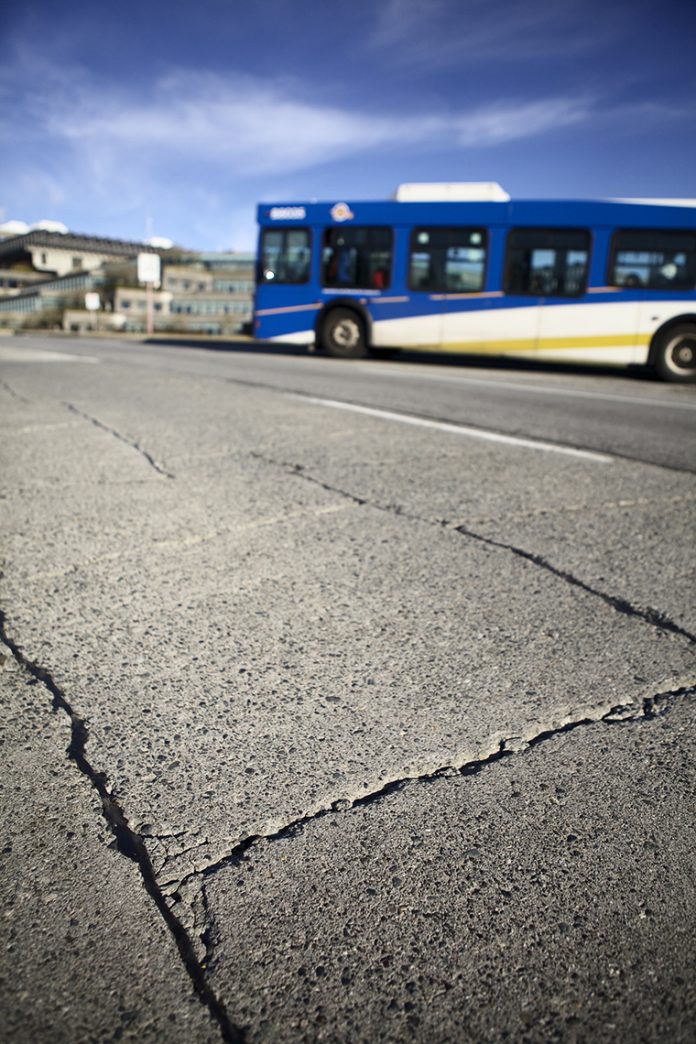
The poor conditions of roads on the west side of campus are a natural consequence of nearly 50 years of traffic – the roads are as old as the institution itself. Aside from the pavement’s sorry state, these routes are lacking in pedestrian and cyclist accessibility.

David Agosti, parking services director, cited first impressions of the university as another reason to improve the roadways: “People’s first interaction with campus is the drive up the road, either in a bus or [some other] vehicle.”

He continued, “When you ride the bus down the hill, if you have fillings in your teeth you probably don’t have them by the time you get to the bottom.”

While the roads undergo these improvements, staff and students will have to cope with a few minor transportation inconveniences. There will be road closures, some permanent – for the duration of the project – and some temporary. Vehicle traffic will be redirected and bus routes will be altered.

Though the roadwork will affect different parts of campus at different times, the adjusted transit route will remain in effect for the duration of the project. On arrival to the campus, all buses will proceed first to the bus loop at Cornerstone and will then pick up at the Transportation Centre on the way down the hill. The bus stop by residences on University Drive West will be out of service for the entire project.

New road construction will be split into three phases: the first phase, which should be completed in May or June, will close northbound Gaglardi Way up until South Campus Road, redirecting all traffic along University Drive East.

Agosti explains that since the incoming lanes into campus will be reduced from four to two, “Everybody, whether they’re taking transit or driving, can expect a little more congestion.”

Since most students arrive on campus via transit, Agosti stresses the importance of students’ awareness of travel delays, saying, “Students can expect it to take anywhere from five to thirty minutes longer for them to get to class.”

Buses leaving campus should not be as affected. Agosti uses the 145 bus route as an example, assuring that students are “looking at an extra five minutes at most” to reach Production skytrain station.

Drivers are asked to follow the detours outlined in the project’s online maps and to avoid University High Street as it is already busy with elementary school traffic. Parking services also affirmed that all parking areas will be accessible throughout the entire project.

The project aims to not only provide a smoother drive and a better walking or cycling experience, but the two-way streets should prove more navigationally friendly for visitors to the school. In addition, the project website mentions that these improvements will provide more opportunity for development on the west side of campus.

Clan athletes climb CFL rankings

0

WEB-Football-Adam Ovenell-carter copy

For all the disappointment the Clan football team’s 2013 season brought, two players are well on their way to an exceptional new year.

Offensive lineman Matthias Goossen and linebacker Casey Chin have both improved their CFL draft ranking, following outstanding individual seasons.

Goossen was ranked 15th in the first edition of the rankings, which came out in September. “It was exciting for sure to be recognized,” he said at the time. “I have put in a lot of hard work during my time here, but nothing is set in stone.”

His ranking certainly wasn’t. He’s climbed all the way to fifth in the newest edition of the prospects list. Goossen started all 10 games for the Clan in 2013, and was the anchor on a much-improved offensive line that gave up the second fewest sacks in the Great Northwest Athletic Conference (GNAC).

Chin, meanwhile, put together his best-ever season and one of the best statistical seasons the GNAC has seen. After being ranked 12th back in September, Chin racked up 119 total tackles, second in the conference (by one), while his 68 solo tackles were a GNAC record. He also finished with three interceptions on the year, good for third in the conference. His performance in 2013 pushed his ranking up to 11th.

“I work hard and try to do the right things on and off the field,” said Chin after the September ranking. Cliché as it may sound, his — and Goossen’s — hard work has paid off, and both find themselves just a few months away from hearing their names at the Canadian Football League draft in May.

Despite the team’s underwhelming performance this past season, the Clan football program continues to churn out quality football players. Four Clan athletes were drafted in the 2012 CFL draft, and now Goossen and Chin are ready to follow suit. With the two stars prepping for the pros, it’s a testament to the program and the fact that no matter who the new head coach is, there will be plenty of talent to work with.

New posters really going to spruce up never-visited dorm room

1

BURNABY —  With SFU’s semesterly Imaginus Poster Sale in full swing, a local first-year student believes that he has found the perfect selection of decorations to liven up the dorm room that only he has ever seen.

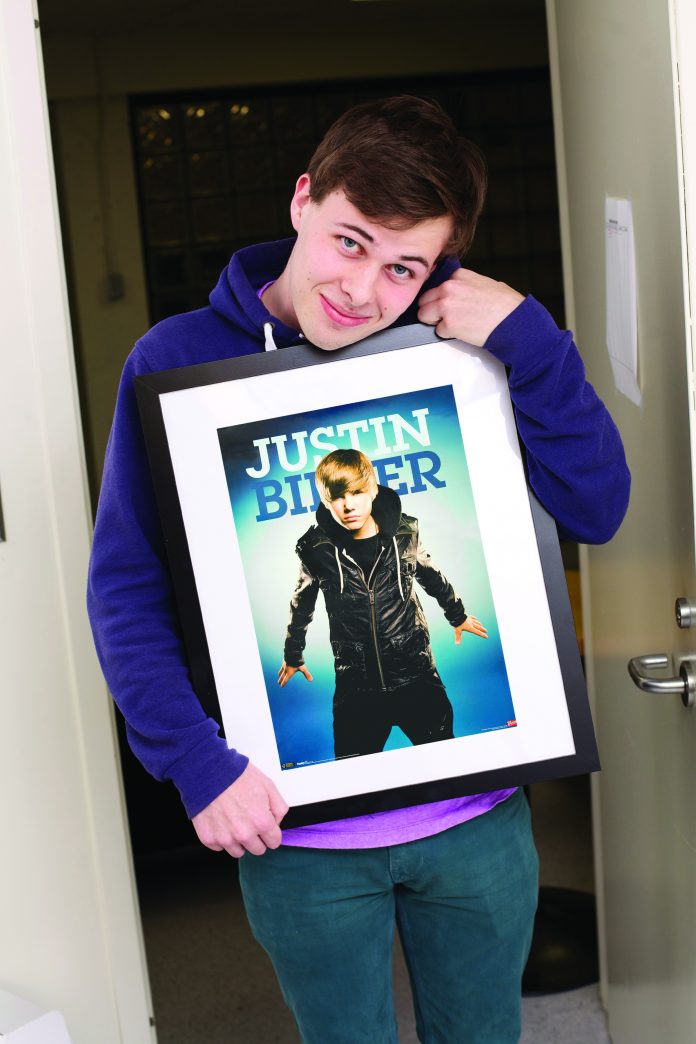
According to his own testimony, Harry Watson, who lives in a tiny, awful room in Towers purchased the “perfect collection” of posters that represent all his hobbies and interests, and can’t wait for them to be enjoyed by himself, the only one who ever spends any time there.

“I got a Dark Knight poster to show that I love films, a Bob Marley one because I’m a huge music-nerd, and this Che Guevara one because I’m a really into t-shirts,” Watson explained, going through his $89.99 receipt. “If anyone ever came to my dorm, I think they’d really have a good sense of who I am.”

While Watson still hasn’t finished mounting them all to the wall, he says the posters have really made his place look a lot nicer and believes they’ll inspire a fair number of conversation starters he imagines while lying there alone.

“I used to just stay in that room by myself all night, depressed, staring at the walls,” he told The Peak solemnly. “That’s all behind me now . . . now I can stare, depressed, at a life-sized image of Lebron James instead!”

While Watson is very impressed by the selection of posters he was able to acquire at the Imaginus sale, he doesn’t think that he is done decorating.

“Now that I see how it looks with a couple things up on the wall, I just want to keep adding stuff to really give it a cool vibe that will attract me to stay here at all times,” he said, flashing a huge grin. “Soon you won’t even be able to see the walls . . . well not you, but I won’t be able to see the walls.”

When asked at press time what accessories he was considering adding to the dorm, Watson didn’t know for sure but mentioned the possibility of either getting a cactus, a lava lamp or a decorative noose.

Saving face online

0

Want a job? Clean yourself up online.

Over the past few years, I’ve read through numerous articles on how employers must straighten up and stop internet-profiling their potential employees. Employers should draw solely from the information presented directly to them when determining who to hire. Those seeking jobs have the right to keep their private lives separate from their work lives! Right?

Not necessarily.

The Internet is ubiquitous. It’s much too easy to access, and employers feel that it’s an effective tool for discovering who you “truly” are. This ease of access only feeds the burning temptation employers have to find out more about their prospective employees. So, it’s time for us to face the truth: employers are not going to stop Face-creeping us any time soon, therefore it’s our job to comply with this notion and maintain positive images of ourselves online.

Facebook, Twitter, Instagram, and other social networking sites present to the world various glimpses of our lives outside of work. Selfies, careless Facebook statuses, accidental party photos, embarrassing videos and the like, are all shamelessly posted online without any regard for the people really viewing this information.

In a sense, any argument for our “right to privacy” is empty if we continually violate this right by publicly posting such unflattering, personal visuals.

For some reason, many employers correlate the things we do in our spare time with our time spent working, regardless of how they actually affect work performance. Put simply, I have yet to know an employer who is against profiling prospective workers online.

I once asked a previous employer, who was sorting through a small stack of resumés, whether or not the hiring process would stop at the cover-letter stage. The hasty reply was: “Are you kidding? We have to check them out online first.”

While we may disagree with employers’ reasoning, we cannot force them to stop screening online profiles.

This was unsurprising to me; his second comment, however, was: “I’ll make sure to get my daughters to Facebook them and tell me who they think is best.” This shows not only employers’ intent for undercover examination, but also the extent to which carelessness and unprofessionalism can play a role in doing so.

While we may disagree with employers’ reasoning, the fact of the matter is there is no way we can stop this from happening. We are confident individuals who are conscious of our rights, but cannot force employers to stop defacing proper hiring technique.

Some would say we are completely powerless to stopping them. But we are not. We do have power over ourselves in controlling how we look online. And this, I can safely state, is the only way to avoid the judgmental eyes of employers.

I understand that we want to make ourselves look popular, that party photos with all our friends are of utmost importance, that videos of us doing embarrassing things convey the cool “rebellion” that is so dear to our young adult society. But at what cost? Would you rather look good, or have an actual job?

While employers may be in the wrong, we can be as well. So if you want to find work, delete all of your unflattering photos, heavily monitor your privacy settings, and make yourself respectable to the eyes of the public. Save the videos and stories for somewhere else, as your income could seriously be at stake.

Security breach

0

Learn from the Harper security team: don’t underestimate busboys.

This was exactly what allowed for an alarmingly close encounter between two environmental protesters and Prime Minister Stephen Harper on Monday, January 6.

Harper was in town for a Q&A with the Vancouver Board of Trade at the Fairmont Pacific Rim hotel; as soon as he had gotten comfortable in his chair awaiting his introduction, two protesters, Sean Devlin and Shireen Soofi, calmly walked on the stage dressed as wait staff. They held up signs, one reading “Climate Justice Now,” and the other with the phrase “Conservatives Take Climate Change Seriously” crossed out with a thick black line.

The prime minister’s security acted quickly removing the two from the stage; Devlin fell down the short set of stairs and was briskly ushered to the kitchen. Witty Stephen Harper then chirped, “It wouldn’t be BC without it!” The two protesters were arrested, and have been released without charges.

In a CBC interview, Devlin said, “People are shocked that a citizen can access one of their leaders,” and brushed off any security concerns by adding, “I wasn’t there to hurt the prime minister.” Well, we know that now.

All of this has raised concerns about the adequacy of security around our country’s leader. The solution to this particular incident would not be hiring more security for Harper, but rather improving the work being done by his existing team.

The $20 million spent on Harper’s security is double what it was in 2006, yet a situation such as this can occur? The individual efforts at every smaller press conference and meeting need to be improved. In this case, the hotel wait staff were not screened, showing the security’s naively trusting assumption that outside visitors are the only threats.

Security was a little too relaxed for a situation in which the prime minister is in a crowded room -— screening everyone in the room is absolutely necessary. This close encounter with the PM could have been worse or even deadly because of such leniency.

If our prime minister simply hires excessive amounts of security, he is only a law-making figure rather than a representative that listens to the people, reflective of Delvin’s comment that “this government is really closing itself off.”

A happy middle ground needs to be found in the PM’s security, one in which he can interact with the public and be protected from sudden violence.

Yet, considering that Harper’s $20 million security still has some wrinkles, we as Canadians should be thankful for the predominantly safe country we live in that allows for security slips that don’t end in disaster.

Rejected Album Review

0

When I first came across Pet Sounds, it was quite a relieving moment. I used to think that I was the only one who loved to listen to sounds of dogs barking, cats meowing, roosters roosting and chimpanzees making whatever sounds monkeys make. But when I saw this album at my local record store, I thought not only was I not alone, but men — boys, actually — thought to make an entire album of them.

That’s what I thought, at least. I popped in the album and heard an instrument, not an animal, but a musical instrument. Well, I listened a few seconds further — perhaps it was an intro, and then I would hear a few oinks — but next I heard melody, beautiful melody.

Here I was expecting disorganized, dissonant pet sounds, and instead I’m hearing well crafted songs that are catchy and make you feel upbeat! I wanted music to rage to, music to make me wonder why I live in a barn (without actually living in a barn), not pleasant sixties surf-rock!

If the misleading title wasn’t enough, the cover shows these “beach boys” feeding animals. I assumed this was one of those behind the scenes shots of them preparing the animals for recording.

I mean, maybe I should have known better, because why would “beach boys” make an album with pet sounds? You would expect a name like . . . “The Pet Shop Boys” or something, but I thought that maybe they were just being ironic. Certainly, they aren’t going to the beach in those clothes and they clearly appear to be well above the age of boyhood.

Listening to the whole album, I did hear some pet sounds but was still disappointed that the pet noises were not at the forefront of the project. Unless you are a fan of well-done vocal harmonies and interesting arrangements, I cannot honestly recommend this album.

Verdict: I would pass on this one, and buy the upcoming Dog Barking Vol. 2: Six More Hours of Just Barking. Hopefully, that one will have actual pet sounds and not be just another ruse from a sycophant group of “beach boys”.

Time is key to successful online learning

0

clock_RachelleTjahyana

A recent study conducted by researchers from SFU’s faculty of education suggests that online courses may not be the easy A’s that students bank on.

SFU researcher Alyssa Weiss, whose work involves improving online collaborative learning, warns students against existing misconceptions about the online learning method. She explained that these can extend from the belief that online courses are easier and that they require less work, when in fact they demand the same types of work effort, deadlines, and exams as face-to-face courses.

Weiss feels that it is this type of misguided assumption that causes students to struggle and fail. “Student engagement in online discussions is hugely varied . . . there are important differences in how students pace and distribute their online learning time,” said Weiss.

According to the SFU Centre for Online and Distance Education (CODE) website, SFU is considered to have one of the largest programs in Canada for online learning. It offers university credit courses in undergraduate and graduate programs, as well as non-credit continuing studies.

Building on this new wealth of learning, Weiss’ research, published in Assessment and Evaluation of Time Factors in Online Teaching and Learning, examines how time management affects online learning. She and her team have demonstrated that during online discussions, both students and educators need to be aware of the amount of time students are putting into the course.

In her research, Weiss outlines four important factors that determine the value of the type of learning that is occurring: duration, salience, pace, and sequence. These involve students’ awareness of time spent, their rate of learning, and the order in which they are completing their tasks.

In spite of the challenges, Weiss feels that an enjoyable and successful online learning experience can be obtained. Since these courses provide all the resources and information from the start of the semester, students can plan out their work and know that there are no hidden surprises.

Weiss advises that students should set up an uninterrupted, scheduled time slot to work on an online course, thereby not falling behind. Weiss’ opinion is that starting these courses on time, staying consistent, investing energy and effort, and asking for help from online instructors and TA’s are key to successful online learning.