Home Blog Page 1156

Pooping towards a more sustainable environment

0

WEB-poop car-flickr-Ptpgrad

Hyundai is reportedly soon to give a whole new meaning to the term “gas tank.” It’s only a matter of weeks before the company introduces its new Tucson Fuel Cell car which is run on neither gasoline nor electricity, but poop.

Human fecal matter will be the sole fueler of this automobile, and while I envision a potentially disastrous marketing campaign, I also see, should this campaign work, the exponential benefits for our environment and for saving the dollars in our bank accounts.

How does poo translate to power? First we eat, then we digest, then we flush. Once our waste has been flushed it will be released into an airless tank called an anaerobic “digester” (yum). In this tank, our crap will then be broken down by microbes which release methane and carbon dioxide. These gasses will go to a public pump to be put into the fuel cell where the methane is converted to hydrogen to fuel the vehicle.

At first, this concept may seem a little less than appetizing; among the immediate drawbacks that come to mind is driving with a farm-smell reminiscent of the Chilliwack highway. But the concept of poo-fuel is brilliant. What more practical use can you think of for excrement, with the hydrocarbons from it now being used rather than wasted? Don’t answer that.

I do not smell poop, I smell success.

Poop-pump stations would allow for more businesses to emerge, hence contributing to more job opportunities, and would possibly provide this fuel at a much cheaper rate than gasoline or diesel.

The use of poop as fuel would also surpass the high environmentally-friendly standards that have recently caused a big hoopla with the introduction of electrically-powered hybrid vehicles. According to Hyundai, the Fuel Cell (which will produce zero gas emissions) will only take three minutes to fill, as opposed to the hours it may take to charge electric vehicles.

Furthermore, these cars can reportedly drive up to 483 kilometres (300 miles) before they need to be re-poo’ed; this is longer than your average electric vehicle.

Sure, some people may question whether we have enough hydrogen to allow most of our current vehicles to be replaced by poo-powered ones. But I say that with the leaps and bounds by which technology advances, and the fact that hydrogen is the most abundant element in the universe, I have no doubt that scientists will fit the pieces together and produce something that will allow all of our vehicles to be replaced with hydrogen-powered ones.

With this innovation comes a negative. With the probability of water being taxed in the near future as it becomes an extremely, if not the most, valuable resource, taxing poop is a possibility. But I’m okay with it. If there is any place I don’t mind my future tax dollars going, it would definitely be towards powering my car.

So now, if we want to drive longer distances, I guess we’ll just have to eat a little more. Or is this a bit of an overstatement? My point is that I do not smell poop, I smell success. Success that may, in the midst of roads with the fresh scent of livestock, bring about a more sustainable environment and help us to become more financially content.

Clan take two of three in Arizona

0

WEB - Lax week 12

It was a successful, but far from flawless road trip as the Clan braved the desert heat to play three out-of-conference games down in Arizona.

The trip started with a hard-fought, nighttime battle in Tucson against the #14 Arizona Wildcats. The Wildcats struck first, putting the Clan behind early for the third game in a row. But after the initial blow, the Clan came back and led for the rest of the game. The Wildcats nearly matched the Clan goal for goal, but were always one step behind.

Four Clan players scored multiple points led by Ward Spencer with four (two goals, two assists). Goaltender Darren Zwack stood tall between the pipes, stopping 15 of 22 shots in the Clan’s 8–7 win.

The Clan then made their way to Glendale to take on the #1 ranked Arizona State Sun Devils. SFU matched the Devils early but couldn’t stand the searing temperatures as the home team shut the door on the Clan, holding the high-scoring squad to just five goals on the day.

The Sun Devil’s own high-powered offence, led by junior Dan Davis (seven goals) and senior Logan Quinn (two goals, four assists), picked the Clan defence apart, out shooting them 53–32 over 60 minutes, routing the Clan 18-5.

After the thumping from the day before, the Clan came back to Glendale with a vengeance to take on the unranked Illinois Fighting Illini in a neutral site game. From the first whistle it was all Clan, all the time, with leading scorer Kirkby continuing his dominant season with four goals and two assists. Spencer (two goals, three assists) and Sam Clare (two goals, two assists) also had big nights.

The offence kept the Illini goaltender busy, ripping 30 shots on net. Backing up the high-powered offence was a stout Clan defence, a complete 180-degree flip from the day before, holding the Illini to just seven shots on the game, with both Zwack and Jeremy Lasher splitting time in net, allowing only two goals apiece to make the final score 11–4 in favour of the Clan.

With these results the Clan improve their record to 5-0 in the conference and 9-2 on the season, remaining at #10 in the rankings for another week. The Clan tone it down for the rest of the season with just one game a week until playoffs. Their next home game will be on April 5 against 0–8 Portland State on Terry Fox Field.

Vaccinate your kids, period

0

One of the most popular articles The Peak has ever published is a witty Opinions piece colourfully titled “I hate Jenny McCarthy.” The article, written by former editor Graham Templeton and published in 2009, took the eponymous talk show host and former model to task for her outspoken support of the anti-vaccination movement.

Five years later, it’s still garnering views on our website — and, despite overwhelming evidence refuting any and all claims that vaccines cause autism in children, this movement is still going strong.

Yes, seriously. Parents still think it’s a good idea not to give their children the MMR vaccine, which protects them against measles, mumps, and rubella, diseases that can and have killed hundreds of thousands of young people. Diseases that, thanks to modern medicine, shouldn’t be killing kids anymore.

But they are, and in greater numbers every year. Canada’s vaccination rates have dropped to 84 per cent — lower than necessary to ensure population immunity. Our rates are lower than those of countries like Eritrea and Tunisia, where vaccinations are both costly and difficult to acquire.

To not vaccinate is not only ignorant and selfish, it’s a willful endangerment of children.

So why aren’t we vaccinating our kids? For many, it’s because a man named Andrew Wakefield published a study in 1998 which claimed there is a direct causal connection between the MMR vaccine and autism.

There isn’t. Turns out that Mr. Wakefield had been given money by lawyers looking for evidence against vaccine manufacturers, and that his data was both carefully manipulated and just plain false. In fact, Wakefield was later removed from the British General Medical Registry, making him unable to practice medicine in the United Kingdom — and, hopefully, anywhere else.

Still, despite countless counter-arguments published by lawyers, scientists and medical professionals, the anti-vaccination movement marches on, stubborn and oblivious.

The debate has recently resurfaced in the form of a few offhand comments made by reality star Kristin Cavallari, who, like McCarthy, refuses to vaccinate her kids. “To each their own,” she told Fox News. “If you’re really concerned about your kid, get them vaccinated.”

Who can argue with that logic? If Cavallari wants to endanger her own kids, who are we to stop her? Except, of course, that just isn’t the case — the recent outbreaks of measles in Europe and North America are just one example of the dangerous effects of the anti-vaccination movement. It’s not an isolated decision: it’s one that affects everyone, especially young people.

Case in point: there have been 228 measles cases confirmed in British Columbia this year. We’re not talking about the black plague here; measles can be a dangerous disease, but it’s also one that’s easily treated in the Western world. Yet, on the premise of disproven evidence from a 25-year old article — not to mention the occasional staunch religious belief — parents are putting their children, and everyone else’s children, in danger.

There are plenty of studies out there that prove people aren’t swayed by the cold hard facts. So maybe a different approach is in order. Parents: vaccinate your fucking kids. To not do so is not only ignorant and selfish, it’s a willful endangerment of children. About 120,000 young people die of measles every year — and that’s nothing compared to the pre-vaccination days, when the number was closer to 2.6 million.

I still hate Jenny McCarthy, and in the immortal words of Graham Templeton, you should too. She and every other anti-vaccination airhead may desperately want to believe that vaccines which have the capacity to save hundreds of thousands of lives can cause autism, even though we know they don’t.

But you don’t have to listen to them. Vaccinate your kids, vaccinate yourself, and tell everyone you know to do the same.

SFU sweeps Crusaders for first wins

0

After 17 straight losses to open the season, the Clan softball team is finally back on track after sweeping the Northwest Nazarene Crusaders in Nampa, ID.

As with most things this season, the wins didn’t come easy for SFU. The first, a 3–2 triumph, took two extra innings to get the job done. After the Clan’s Danielle Raison scored in the top of the ninth, Jessica Goulet retired the Crusaders to give the Clan their first win of 2014.

“It was an outstanding performance from Goulet in the first game and [catcher Kaitlyn] Cameron called two great games today,” said head coach Mike Renney. “We got some timely hits and some clutch at bats. We got some runs when we needed to. We had some situations where the wheels could have come off but they didn’t. We bent but we didn’t break. We squandered some chances but we got ourselves out of some jams too.”

The second game, thankfully, came a lot easier. The Clan jumped out to an 8–1 lead in the top of the sixth, and though NNU would claw back, the lead this time was too big for the Clan to give up.

“It’s good to get the monkey off our backs and get a couple in the win column,” added Mike Renney. “We earned a hard fought win in extra innings in the first game and it was good to get some run support for our pitching in the second game coupled with a good pitching performance.”

Despite the sweep, the Clan’s record improves to just 2–10 in the Great Northwest Athletic Conference, and 2–17 overall, easily last in the conference.

Build SFU reveals preliminary SUB designs

0

PSD-SUB

Build SFU recently held an open session in the Think Tank where the architects of the SFSS project presented three possible designs for the new Student Union Building (SUB).

Not only will the new SUB be located at, “the heart of SFU,” between Maggie Benston Centre (MBC) and the AQ, but the building is meant to be “the heart of the student experience” and as such, student focused. Feedback has indicated a desire for community interaction, access to daylight, an opportunity to experience nature, as well as an outstanding design with a clear “wow factor.”

Students were asked which characteristics of each design worked to meet the above goals. The three schemes are not distinct options for the building, but rather a varied display of concepts from which the best elements will be chosen and incorporated into the final design for the SUB. Student commentary given at the Think Tank will be factored into the design process.

“Terrace”, “Pavilion”, and “Loft” are the three concepts that were presented, each with its own unique features. Marc Fontaine, Build SFU general manager, says that each design has its advantages and disadvantages: “Some pieces of [the models] could respond better to the campus architecture.”

One distinguishing feature of the “Terrace” design is that it has varying levels of outdoor space. Its storeys are also staggered, so the south side of the building aligns visually with MBC. The “Pavilion” model is unique in that its floors that are above Convocation Mall level have a distinguishable rounded shape.

Students seemed to like that the different shape made the building clearly identifiable, but it would mean pushing more student space to lower levels. The “Loft” design is different in that it reaches higher than the others, equalling the height of the 5000 and 6000 levels of the AQ.

One drawback of some of the designs was an overhang into Freedom Square, something that the university has particularly requested be avoided, so as not to block any light coming into that area. Another concern was having too much student space underground.

The double-height lounges, the opportunity for natural light, and the connections to Freedom Square, MBC, and the AQ that would result in new circulation patterns on campus are all factors that generated positive responses from attendees.


Students reacted positively to the concepts of double-height lounges and the opportunity for natural light.


A comment from one student was, as noted in the minutes, “It is nice to have different access levels to the AQ. [ . . . ] It makes travel across campus smoother.”

Fontaine commented on the feedback, “We can use that information to try to create a new concept that responds to student requests and responds to the university architecture as it stands.” Responses from the project’s upcoming sustainability workshop will also be taken into account.

The new schematic design report is set to be revealed mid-May. After its review, the design development phase will begin — a phase that will involve all of the interior and exterior design decisions that must be made before construction.

As for what will be inside the SUB, the space program developed by Build SFU allocates space to different purposes determined to be most important to students based on consultations done in 2013.

The most recent version of the program was updated in Feb. and has set aside more than a quarter of the building for lounge and study areas. There will also be ample space for meeting rooms — available to all students — and multi-use space. Another great portion of space will be reserved for student organizations, clubs, and services.

Other features of the SUB include a large multi-purpose room, unisex as well as gender segregated washrooms, additional dining space, and what is being called the “cabaret”; Fontaine likens this to, “the upper part of the pub, but without the age restriction.” It would be a comfortable place with audio/visual capabilities that could serve as a venue for events like open mic nights.

One of Build SFU’s main goals is for the SUB to be a distinctly student oriented building. In pursuit of this goal, workshops and open discussions will continue to be held to ensure that student opinion is kept in mind during the creation of this building. At this time, construction is scheduled to begin in the summer of 2015.

Satellite Signals

0

WEB-woodward

Woodward’s

The Walrus Magazine held an event on Tuesday, March 25 in the Djavad Mowafaghian Cinema during which seven different speakers were given seven minutes each to discuss an issue surrounding sustainable renewable energy. Topics included First Nations rights in relation to resource extraction, the political climate surrounding the Northern Gateway and Kinder Morgan pipelines, and the role for young people in mitigating climate change.


vancouver

Harbour Centre

Each year, a public lecture is held in honour of the late SFU professor of communication, Dallas Smythe. This year’s memorial lecture, titled “Pulling Punches: Media Power, People Power,” was given on Monday, March 24 by Natalie Fenton, a communications professor from the University of London. Fenton discussed whether or not the media affects the practice of democracy in our society, and if so, which forms of media might have the most influence.

surrey

Surrey

Angelika Neuwirth, one of the world’s leading scholars of the Qur’an, spoke at SFU Surrey on Thursday, March 27 about “Reading the Qur’an as a Text of Late Antiquity.” Opening with a quote by Johann Wolfgang von Goethe about the Qur’an being the “book of books,” Neuwirth unpacked a weighty thesis on how the Qur’an can be read as a literary text in its own context. In her lecture last Thursday, she argued that the Qur’an deserves to be recognized for it’s “epistemic shift” towards morality for the sake of humanity, rather than as a mere continuation of the preceding Abrahamic texts.

SFU walks the catwalk

0

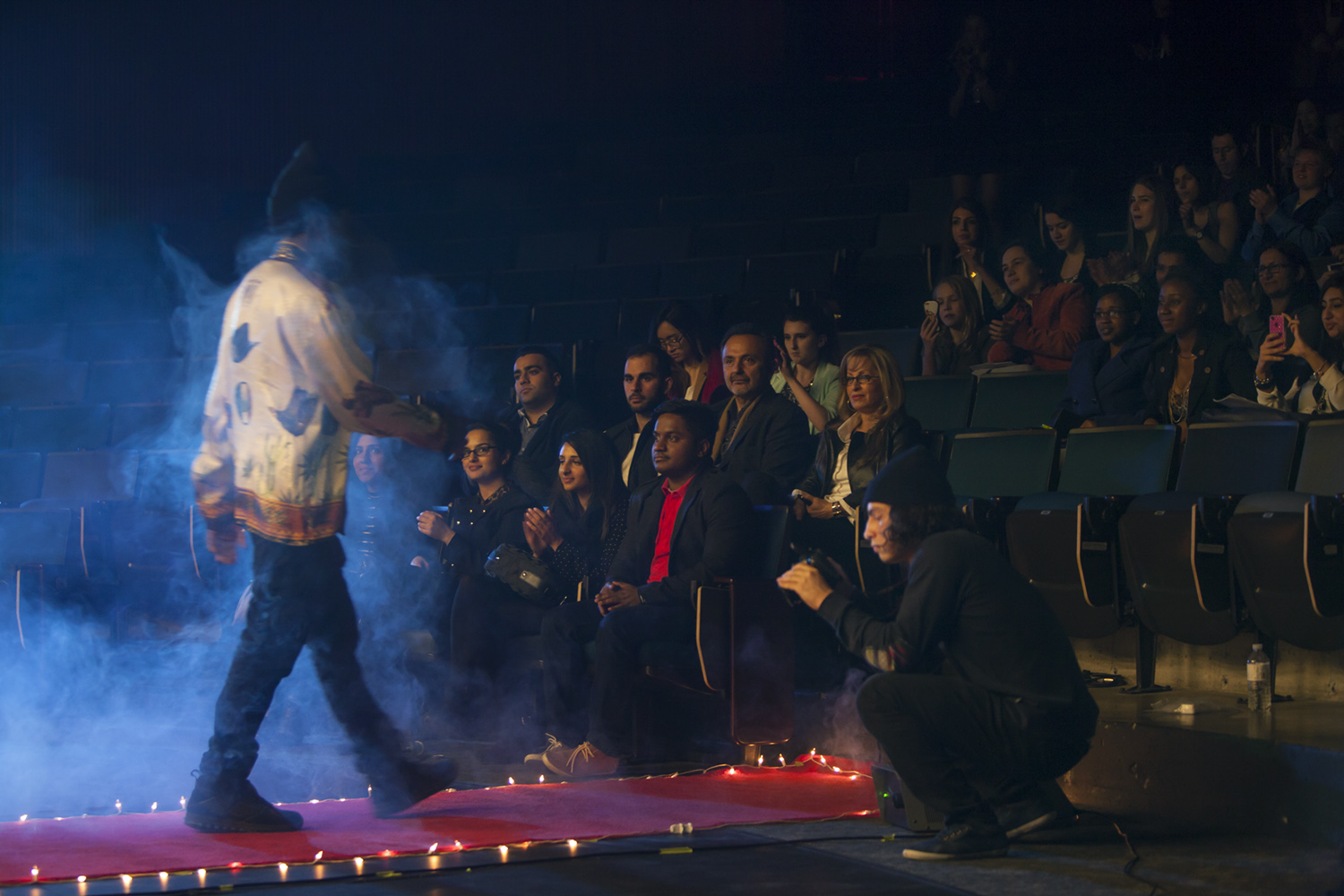
WEB-Fashion Show-Mark Burnham

When one thinks of fashion, SFU probably isn’t the first place that comes to mind. With NCAA sports teams, a world renowned co-op program, and notable academic achievements, fashion would seem to be the least of our concerns.

So it might’ve come as a surprise that SFU would be hosting its first ever Fashion Week, right here on Burnaby campus. As a school lacking in any sort of fashion design or marketing program, SFU seems like an odd locale for such an event.

According to SFU Fashion Week’s creative director Kayode Fatoba, this was exactly why the event was created: “The vision behind Fashion Week for us is to be able to represent a community that has more to offer than just academics.”

The SFU community has its own distinctive style, one that is, according to Viven Low, the event’s public relations and social media organizer, “based on the individuality of each person.” This individual style is what pushed organizers to bring SFU Fashion Week to life.

In order to exhibit SFU’s fashion community, organizers decided to set the stage for local designers to show off their collections. Showcasing brands such as Sleepless Nights, Dipt Vancity, Lavish Tee, Lily Rose, SFU Athletics, and the SFU bookstore, Fashion Week was able to bring forth this university’s hidden designing talent.

During the final show of the event, each brand displayed original designs on a runway; Sleepless Nights incorporated tribal prints with street wear through light-weight pants, eccentric hoodies, and loose shirts. The brand paired high-waisted slacks with simple t-shirts and beanies, with embellished bomber jackets paired with tribal-print harem pants.

“The vision behind Fashion Week for us is to be able to represent a community that has more to offer than just academics.”

Kayode Fatoba, creative director

Lavish Tee displayed everyday luxurious wear with an array of different prints, ranging from versatile t-shirts, tank tops, and sweaters, making the collection perfect for busy SFU students.

Lily Rose’s collection, on the other hand, used girly aspects to play up classic pieces, with floral-print dresses, bohemian bags, and blush-coloured skinny jeans, for an overarching feminine feel.

Dipt Vancity, a well-known brand throughout the city of Vancouver, displayed logo-clad hoodies, shirts, and snapbacks, representative of Vancouver’s ever-popular street style. Last of the independent designers, Chreetee displayed more exotic silhouettes with vibrant sequined maxi skirts paired with equally embellished crop tops.

It was inspiring to witness the artistic talent of the SFU and Vancouver communities, and to hear about the process behind getting into the fashion industry. At panel talks during Wednesday’s event, each designer spoke about breaking into the fashion world, showing how difficult yet rewarding the industry really is.

Along with networking and blogging, Sleepless Nights founder Jason Bempong says that it is important “to be brave enough to talk to people you don’t know and just put yourself out there.”

Though not necessarily a fashion capital, Vancouver’s fashion scene is increasingly making itself present on the global scale. If this fashion week proved anything, it is that fashion is present in this city and, as panelist Kevin Lalune stated, “Vancouver fashion is going to get big soon.”

I cannot wait to see SFU Fashion Week grow and expand in the future, and maybe even take on a more high-fashion and haute couture aspect. The fact that SFU hosted such an event just goes to show that there is a desire for fashion to be expressed in a more creative and impactful way on this campus.

Bringing together the community through the creative medium of fashion is not only inspirational, but it also presents a new platform for others to express their passions at future fashion weeks. As Fatoba put it, “While it is the first year of SFU Fashion Week, the journey of a thousand miles begins with one step.”

Distrikt Movement creates community

0

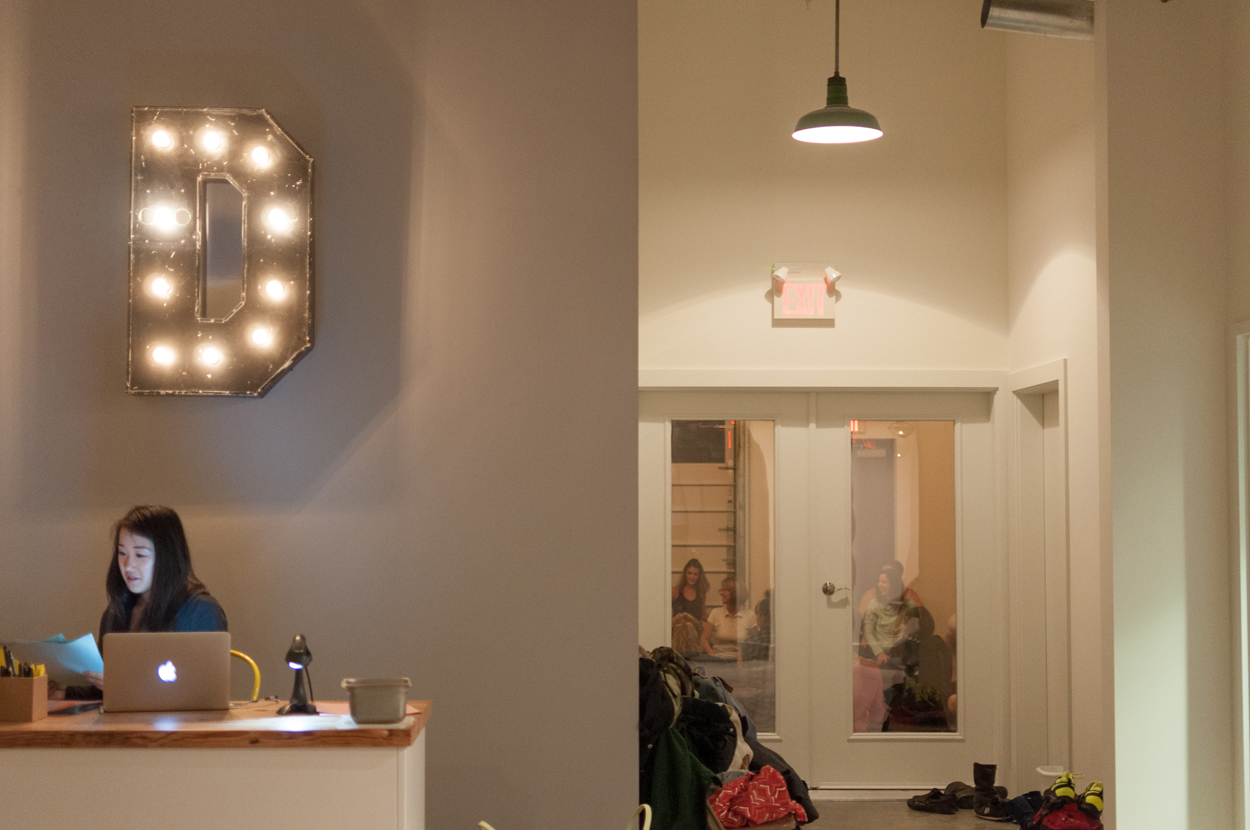
DSC_0393

If you live on the North Shore and have any interest in fitness, it’s likely you’ve heard of the new kid on the block, Distrikt Movement.

The studio, owned by established movement instructors and community leaders Alex Mazerolle and Jian Pablico, opened its doors the second week of January, bringing the ‘hood a new space to explore.

I first heard of Distrikt Movement through social media, and being an avid yogi and North Van lifer, I was immediately intrigued. I wondered, how would this one be different? In a city full of fitness centres and yoga studios, it was hard to imagine a newcomer offering up something truly original. Nonetheless, I decided to explore Distrikt Movement with an open mind and high hopes.

Before I even set foot in the studio, I was impressed by the variety of classes offered (yoga, dance, martial arts) and their refreshingly creative names (Core Mechanic, Ugly Sweaters). I chose a class entitled crush/hush for my first Distrikt adventure as it provided an appealing combination of fast-paced conditioning and plyometrics followed by a relaxing bout of yoga.

Since then I have taken a barre class, which combines pilates with ballet exercises — no experience necessary — as well as a classic vinyasa yoga class. Each of these selections offered an invigorating, unique workout led by energetic and knowledgeable instructors.

Chatting with Mazerolle about the studio, I learned that she and Pablico had first crossed paths through their collaborative work on various youth programs.

Both had founded successful youth initiatives (Girlvana and VARS/TY) independently, and soon realized a mutual vision of creating a fun and inclusive community hub that would provide a space for youth movement programs. From these beginnings Distrikt Movement was born: a multidisciplinary studio that welcomes all ages and abilities under one roof.

“[It’s] a fitness studio with heart. A place where you’re welcomed as you are and supported.”

Cassandra Van Dyck, SFU alumna

Community, creativity, and collaboration are the key values  at the heart of Distrikt Movement. Mazerolle discussed the importance of supporting local businesses and how this has shaped some of the studio’s offerings, including their partnership with Culver City Salads, a food truck that provides healthful lunches outside Distrikt every Friday.

Moving forward, Mazerolle and Pablico intend to build upon the foundation they have created by providing new leadership opportunities for youth and becoming more involved in the community.

When asked what it was like to start this business, Mazerolle confessed that it has been a tremendous amount of work. She recalled the long hours, learning curves, and continuous onslaught of obstacles that her and Pablico faced, both pre-and post-opening.

Yet even while discussing these challenges she conveyed a genuine sense of warmth and affection for all things Distrikt. In terms of advice for other young entrepreneurs Mazerolle remarked, without hesitation, “Just go for it.”

This week I asked other North Shore SFU students what their impressions of Distrikt Movement have been. One student described the space as having an unintimidating, relaxed atmosphere, while another characterized it as fun, friendly, and welcoming.

SFU alumna Cassandra Van Dyck said of Distrikt, “[It’s] a fitness studio with heart. A place where you’re welcomed as you are and supported. [ . . . ] You feel like you’re part of a community of people who care about being healthy, having fun, and feeling good about who you are.”

Distrikt Movement is not just a studio where people come to exercise; it is a community that offers a healthy dose of camaraderie — a space that strips away some of the seriousness of life in an honest and accessible way. To quote Mazerolle, when it comes down to it, it’s all about “people sweating and moving together.”

Distrikt Movement is located at 105-197 Forester Street in North Vancouver.

The return of Veronica Mars

0

veronica-mars-movie-2

Veronica Mars is an addict.

At least that’s the metaphor the new film plays with, poking fun at television’s favourite teen-girl detective and her inability to stay out of trouble. After years of retirement from the private-eye lifestyle, Veronica is drawn back to her hometown of Neptune, CA, where her old flame Logan has become the lead suspect in a very public murder.

Though she tries to keep out of the action, she is pulled headfirst into what she’s best at: wrangling her way into dangerous situations and solving crime, all served with her signature biting wit.

But our heroine isn’t the only one addicted — it would be foolish to review the Veronica Mars movie without acknowledging the events which allowed it to come together in the first place. Mars was one of many too-quickly cancelled television shows, beloved by dedicated fans who spent years creatively campaigning for its comeback in television or film.

This is the same group of fans who mailed thousands of Mars Bars and over 500 pounds of marshmallows to studio executives in protest of the cancellation.

Veronica Mars stood out for its clever lead female character, a teenage private eye who involves herself in the film noir dealings of a rich beach town constantly on the verge of class war and scandal. Campy it was not — the show was grounded in gritty crime and character driven plot.

This is the same group of fans who mailed thousands of Mars Bars and over 500 pounds of marshmallows to studio executives in protest of the cancellation.

When director Rob Thomas proposed his Kickstarter campaign to crowdsource the film through fans it, was met with a record-breaking response. It was fully funded in mere hours, and was sealed with a promise to make the best possible film for the deserving fans. So the question is: did it fulfill that promise?

The film opens with a snappy overview of the basic premise of the show for any of the uninitiated watching for the first time. Moving swiftly along, Mars retains its film noir tone and traditional use of snarky voice-over narration. Using the premise of a 10 year high school reunion in Mars’ hometown, the film easily draws together its core group of characters — and then some.

The film could drag through introductions but doesn’t, making the gathering of characters seem natural and allowing the plot to move on to the main mystery and action. The central crime results in tense conflict and a satisfying conclusion.

But does this work for both the hardcore fan and the casual viewer?

I would guess that first-time Veronica Mars viewers will enjoy the overall film, but miss many of the fan-heavy references that make the reunion of the characters so special. The film is balanced enough to be exciting for the general public but, true to intention, the most thrilled audience members will be the most dedicated backers.

After all, this film was made by the fans and it’s set up in a way to keep them coming back for more.

Retired SFU professor rakes in literary award nods

0

David Stouck_credit Wayne Wiens

After 40 years of teaching in SFU’s English department and penning over a dozen books on Canadian literary authors, it seems an odd departure for David Stouck to write a book about an architect. But in fact, a book about Arthur Erickson is a serendipitous fit for a retired SFU professor, as Erickson designed the Burnaby campus.

Stouck actually wasn’t the one who came up with the idea for the book; it was Ethel Wilson’s niece, Mary Buckerfield White, whom he had interviewed during his research of Ethel Wilson. Mary contacted Stouck in 2004 and said no one was writing about her long-time friend, Arthur Erickson. Despite knowing next to nothing about architecture, and very little about Erikson, Stouck decided to take on the project.

“I thought it would make an interesting retirement project,” Stouck comments lightheartedly, “[but] I was skeptical, because I did not know the technical language of architecture.”

What he didn’t realize was the sheer amount of background research he would need to conduct — educating himself in everything from painting and philosophy to Japanese and Indonesian culture.

“It was a huge job,” states Stouck, “[Erickson] had a huge life.”

Stouck began research in 2005 and conducted nearly weekly interviews with Erikson, bringing archival material to Erickson’s house on the weekends to help jog his memory. He was surprised to learn about Erickson’s personal life, which became rather flamboyant when he moved to LA.

Stouck finished writing in 2011, two years after Erickson passed away. Then, after a small snag with the publisher, the book Arthur Erickson: An Architect’s Life was published in September 2013. The research process took Stouck and his wife traveling, as Erickson told him that to understand his influences, he would have to visit Florence in Italy, Kyoto in Japan, and the island of Bali in Indonesia.

Stouck began research in 2005 and conducted nearly weekly interviews with Erikson, bringing archival material to Erickson’s house on the weekends to help jog his memory.

“SFU is a good example of how Bali influenced him,” explains Stouck. “The landscaping of a mountain top in Bali, the buildings hug the landscape, and are very low.” All the other architects who put in proposals for SFU’s Burnaby campus had huge high rises as a central focus.

When Stouck and his wife visited Bali they saw terracing of the rice fields up and down the mountainside; those who are familiar with SFU Burnaby will understand how Erickson applied this concept.

“Japanese influence was really important too, both in landscaping and design. The idea that the building doesn’t rise up, but should be an intimate part of the landscape.”

Erickson also studied philosophy and believed in the creation of open, common areas for gathering and interdisciplinary mingling — which is reflected clearly in Convocation Mall and the AQ.

Arthur Erickson: An Architect’s Life has since been nominated for several awards, including the RBC Taylor Prize and two categories of the BC Book Prizes, for which the shortlist was announced on March 13.

Also on the BC Book Prize shortlist is Renée Sarojini Saklikar, graduate of the SFU Writer’s Studio and founder of Lunch Poems at SFU. Saklikar is nominated for her debut collection children of air india: un/authorized exhibits and interjections, reflecting on the Air India Flight 182 bombing in 1985.

The Dorothy Livesay Poetry Prize includes two other poets with SFU connections: Jordan Abel, shortlisted for his title The Place of Scraps, is an instructor in the Continuing Studies department. Russell Thornton’s book of poetry, Birds, Metals, Stones and Rain, was also shortlisted for the Governor General’s Award for Poetry in 2013; Thornton completed his MA at SFU.

On Thursday, April 3, there is a free soirée to celebrate the shortlisted authors at Joe’s Apartment at 6:00 p.m. The winner of the Lieutenant Governor’s Award for Literary Excellence, a lifetime achievement award, will also be announced at the event.

In mid-April, the BC Book Prizes On Tour will kick off, touring select authors (to be announced) around the province to visit schools, bookstores, and libraries in various communities. The winners of the BC Book Prizes will be announced May 3 at the Lieutenant Governor’s BC Book Prize Gala, an award celebration to be held this year at the Renaissance Vancouver Harbourside Hotel.