

Shuttle to take SFU students to Clan games for free

Now for all Clan home football games, SFU students can take a free shuttle from the Burnaby campus to Swangard stadium, a stadium near Metrotown, where SFU will play in order to make way for BuildSFU’s construction plans.
The Pepsi student shuttle leaves the upper bus loop by the Cornerstone building 90 minutes before the start of every home game. The shuttle will then return the students half an hour after the game has ended.
“With the move to Swangard this year, we recognized that it would be tough for students to get there and we wanted to solve that issue for them,” said Ben Hodge, SFU Athletic’s manager of communications and marketing.
In addition to a free shuttle, the games themselves remain free for SFU students, while tickets for youth (18 and under), seniors, and SFU staff are $2. Otherwise, tickets cost $8 for benches, while seats are $10.
Students can also participate in the Fraser Nations Rewards Program in which they are rewarded points for each game they attend, regardless of the sport. If a student attends 25 games, they will be entered into a raffle for a grand prize trip to Hawaii.
“Come to a game, it’s free admission to a game. If it’s football you get a free shuttle to the game and you can win prizes if you come,” explained Hodge. “It’s a good offer for students who are looking for things to do.”
The next shuttle leaves for Swangard stadium at 11:30 a.m. when the Clan face the Western Oregon Wolves on Saturday, September 13.
Vancouver deserves another hockey team

It’s that time of the year when hockey will soon be upon us, and it just wouldn’t be right if we didn’t start off with some good ol’ fashioned rumours.
The latest rumour is that by 2017, the NHL will have added four more franchises to the league, and even though the league has officially denied it, sports commentators are already busy talking about where these four teams may appear. According to the experts, the next expansion will feature the return of hockey to Quebec City and a second team in the Greater Toronto Area, along with new teams in Seattle and Las Vegas.
First of all, I don’t understand why Las Vegas needs a hockey team. Putting a team in the middle of the desert so far has not gone well: The newly rebranded Arizona Coyotes, for instance, are still struggling financially and are currently relying on a taxpayer subsidy to stay afloat, all amidst continued relocation rumours.
On the other hand, the nostalgic fan in me loves the idea of Quebec returning to the NHL — after all, my first NHL game was the Canucks hosting Guy LaFleur and the Nordiques at the Coliseum. As for Seattle, the addition of another team that’s actually in the Pacific Northwest might provide the Canucks with a true rival. (The Flames and the Oilers already have the battle of Alberta to worry about.)
But if we really want to provide the Canucks with a decent rivalry, why not go one step further? If Toronto can supposedly support a second NHL franchise, why not Vancouver? Both teams are known for their capacity crowds but it should be noted that the Canucks currently hold the longest active consecutive sellout streak in the NHL. Though Toronto’s Air Canada Centre can hold an extra thousand people, this is still an impressive feat.
Financially, the Canucks are also holding steady, with the fourth most valuable team in the NHL, currently valued at around $700 million. Though, normally, fourth place is nothing to write home about, it’s worth noting that the three teams leading the pack are all members of the Original Six, and that Vancouver is only $150 million out of second place. This goes to show how profitable a team in Vancouver is, and would continue to be in the future. Despite only being in the NHL since 1970, the Canucks have managed to produce one of the highest revenues, and they’ve done it without winning a championship.
Another reason why Vancouver would make an excellent destination for an expansion team is the infrastructure. With apologies to Giants fans, the Pacific Coliseum could easily be upgraded in order for NHL hockey to return. While smaller than the Canucks home across town, the Coliseum still has the capacity to seat just over 16,000 hockey fans, which is something the Giants only managed to approach a handful of times last year, with their average capacity being 38.5 per cent. For those of you who think that 16,000 is too small a number, consider that the Winnipeg Jets’ MLS Centre seats a thousand less than that.
A second franchise in Vancouver would come with a ready-made set of fans, consisting of those who feel betrayed by the Canucks’ high ticket prices, those who have been on the waiting list for seemingly ever, or those who are just tired of having a team that has not yet been able to deliver a single championship.
Who knows? Maybe we could even name the new team the Millionaires and see if they could pull off a repeat of 1915 and finally deliver Lord Stanley’s Cup to the city.
Alternatively, we could just be like Toronto who brag about their glory days even though they haven’t won anything since there were more than six teams in the league.
The Clan kick off on the right foot
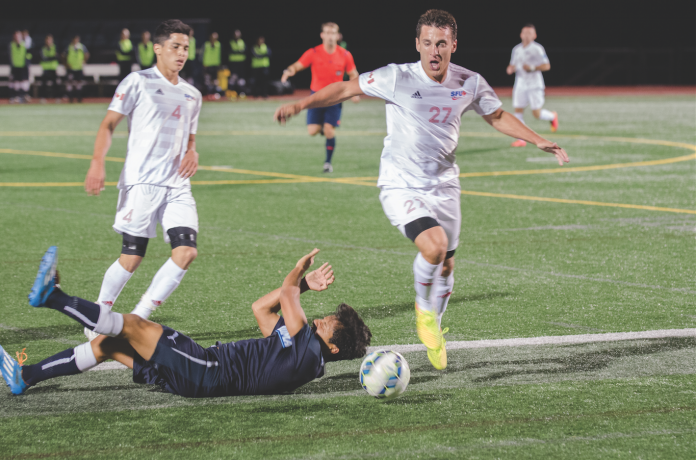
On a clear Thursday evening at Terry Fox Field, the SFU men’s soccer team opened their season with a 3-0 victory over the Sonoma State University Seawolves. The Clan were dominant in the first of three non-conference matchups in their schedule.
Much like in their three pre-season wins, the Clan put their feet on the gas straight away with blistering pace, dangerous set pieces, and high pressure on and off the ball.
With less than 20 minutes gone in the first half, the ball first found the back of the net after Alex Rowley’s dangerous corner kick was mishandled by the Seawolves goalkeeper Sean Taufer and Clan defender Alexander Kleefeldt pounced inside the box, seizing the opportunity.
This ignited the squad’s momentum instantly, as just moments later the men added another goal from a string of plays by some experienced squad members. Sonoma State’s set piece cross was confidently punched out by Clan keeper Brandon Watson before captain Jovan Blagojevic surged down the left wing to lay off a pass for Ryan Dhillon who had his first attempt saved by Seawolves keeper, but made no mistake on his rebound, taking the score to 2-0.
Additional pressure from Blagojevic was key to the third goal, after the attacker began cutting in from the wing with step-overs before being fouled outside the 18-yard box. The ensuing free kick attempt from the captain was tipped by freshman Niko Schroettle into the back of the net and would be SFU’s final goal.
Brandon Watson provided a fitting end to the first half highlights when the shot-stopper came out big and robbed a Seawolves penalty kick to preserve his clean sheet. Second half proceedings included more goalkeeping heroics, but this time from the Seawolves’ Taufer, who denied a penalty kick struck from Blagojevic at the restart.
In the end, the Clan achieved their victory amidst many rough tackles and yellow cards, much to the excitement of the home crowd.
“I think we’ve come a long way since we started the beginning of pre-season,” said head coach Alan Koch. “I love the character of the group, and the willingness to win, and tonight wasn’t really our best game but I spoke to the guys at half-time and said it’s going to take a mature second half to go out there and get the result.
Clan de-claw the Bearcats

Thursday night, the women’s volleyball team played a one-sided game against their non-conference opponents, the Columbia Bible College Bearcats, sweeping them in three sets, and improving over their 3-1 victory against them last year.
Although the Clan opened up scoring, the first set started off close, as at the first time-out the score was only 10-7 SFU; it looked as though the game truly could go either way.
After that, however, the Clan kicked into gear, winning the first set comfortably 25-17, with 14 kills.
The second set wasn’t any closer, with SFU getting out to a quick 12-5 lead. At one point they had a 13 point lead, before the Bearcats attempted to rally back before losing the set by 11. Kelley Robinson had a critical dig to secure the 24th point of the set.
In the third and ultimately final set, the Bearcats opened the scoring. It was a tight beginning, but as in the first set, the Clan pulled away and, after a while, it became apparent that the Clan’s skills were too much for the Bearcats to handle.
The Bearcats fought back hard, resulting in an incredible back and forth rally near the end of the game, but ultimately, the back and forth ended with the 22nd point for the Clan. They took the set 25-17, completing the sweep.
 Statistically, the Clan were lead by Devon May and Brooklynn Gould-Bradbury. May was the focal point of their attack, with 12 kills and many chances to add to that total, while Gould-Bradbury provided the perfect set-up throughout the night, with 30 of the team’s 41 assists.
Despite her team’s relative ease in handling the Columbia Bible College Bearcats, May still sees room for improvement.
“There’s always a thousand things to improve on,” she said, after the game. “We’ll look at the stats from our coach and she’ll tell us what our passing percentage and hitting percentage was, but I think mainly it’s limiting errors when it’s still early in the season. It’s easy to make those mistakes but I think that [change] will come later in the season.”
In all, it was a good start for the Clan. Fans will most certainly hope that this is a preview of what they will see night in and night out against their GNAC rivals.
It’s the most wonderful time of the year

It’s one of the most exciting times of the year. No, not because school starts (although there is certainly excitement to be had, I’d rather be on a beach), but because it’s hockey season.
Perhaps I should clarify: it’s not just because it’s hockey season, but more specifically, it’s before hockey season. It’s the time before the season begins, before any colossal meltdown, before any hard-nosed coach who produces interesting sound bites turns out to be probably the wrong choice.
All we have now is an abundance of new prospects, completely new management who seems to take action, a promising new coach, and a bunch of interesting signings. At this point, there is none of the drama that develops throughout the season, nor has any free agent turned out to be overpaid and ineffective, and there’s still the chance that some prospects could make the team this year.
As of this moment, we can still believe that the team could be a playoff contender; whether it stays that way throughout the season is hard to say, but right now everything looks good. For now, we can just bask in the glory of optimism.
With that being said, perhaps you’re reading this as a cynical column suggesting that the pre-season is the only time for optimism. But that’s far from the truth, as I am legitimately excited for the Canucks’ season.
At this point in the season, it feels like the Canucks could do anything, and truthfully they could. It’s certainly possible that last year was a minor blip, perhaps brought on by the wrong coach for the job.
And the truth is, they have certainly made enough moves to radically change the team, for good or bad. I think they certainly could be a contender this year, and it seems that a retool rather than a rebuild may be possible.
Also, the truth could be the other way around. Perhaps they are a team on the eve of a rebuild. But really, that’s the fun, you just don’t know. I’ll be watching, that’s for sure.
(A)side Jab: It’s rather humorous that the Maple Leafs are going after all the Canucks’ old pieces having signed Mike Santorelli, David Booth, and last year signing Mason Raymond. I don’t want to diss on these guys because I like them as players, but I’ll just say it’s an interesting strategy.
The Clan aim for a national championship

Both the men’s and women’s cross country teams had successful seasons last year. The women’s team made the national championships, and ended up in seventh place “out of probably 350 teams total,” according to coach Brit Townsend. The men’s team just missed the national championships, however, they “were very strong in the west regional championship,” said Townsend.
Now entering their third year in the NCAA, both teams are championship contenders, with a pre-season poll ranking the women’s team as first in the GNAC and the men’s as third.
To get there, though, both teams will have to work hard. “We have to qualify for the West regional championship in Billings, Montana in November and they will take six teams from our region to qualify for the national championship [. . .] in the beginning of December,” observed Townsend.
The men’s team is likely to feature last year’s GNAC freshman of the year Oliver Jorgensen as their lead runner, a position he served last season. It should be noted that the Abbotsford native narrowly missed making the cut for the national championships as an individual by just five seconds.
The team will also be bolstered by two freshman from Sherbrooke, Quebec: Phillipe Gravel and Marc-Antoine Rouleau. Townsend stated that the duo “for sure, will be a huge factor” and “will make an immediate impact on [the] program.”
Travis Vugteveen, who was redshirted last year, will run this year. Townsend described him as one of the “top cross country guys.”
Junior Cameron Proceviat, who was one of the “strongest track runners last year,” rounds out the team along with freshman Max Drummer, sophomore Ephraime Tadresse, and senior Austin Trapp. “I would say those would be our key men for this upcoming cross country season,” said Townsend.
The coach explained the drive behind the men’s team: “Their goal is to make the national championships, because they didn’t make it last year.”
On the other hand, the women’s team did make the national championships last year, and thus their goal is to beat, or at least match their placing last year.
“Our goal would be definitely to be in the top 10 again, as we were last year, and hopefully [we can do] even better if everyone’s healthy,” said Townsend.
The team will, however, have to contend with a changing roster, losing last year’s lead runner Lindsey Butterworth, whose NCAA eligibility for cross-country ended last season. As a result, the team is young, with no seniors whatsoever.
“We have lost two seniors that were key people, my top two seniors,” Townsend told The Peak. “It’s a very young team; we actually have no seniors at all other than Jennifer Johnson who is a grad student. The rest are freshmen, sophomores, or juniors.”
However, she is confident that with the new additions (including Johnson, Paige Nock, Miryam Bassett and Julia Howley) that the team will still be a force to contend with. Returners include Rebecca Bassett, Emma Chadsey (“one of our top runners last year”), Kansas Mackenzie and Peggy Noel.
Townsend maintained that both teams need to focus on closing the gap behind their front-runners. As points are awarded to the top five runners of the team, it would be advantageous to have the runners behind first place closer together.
“The thing we have to work on most is to have as many people close together in competition, so as close as they can be to our top runner. That way, our gap from first place to fifth place, or even seventh place, is not very big. That’s our best chance of beating other teams.”
For now, though, Townsend likes what she sees, saying, “The next couple of years for us look really good on both sides; we’ve got some really good new people.”
Both teams open up their season at the Ash Creek Invitational in Monmouth, OR on Friday, September 12.
Meet the Clan: Miryam Bassett
 Entering your first year of university can be quite a challenge. From the size of lecture halls, to the fact that you have to buy all of your textbooks, it’s an intimidating step up from high school.
To top it all off, it’s probably the very first time you move out on your own, or are at least much more removed from home than you’re used to.
In the first few weeks, it’s common to just want to retreat into a shell. Although, certainly, it’s a time of excitement, it’s also a pretty stressful time before the big jump up becomes just another routine (and then come finals).
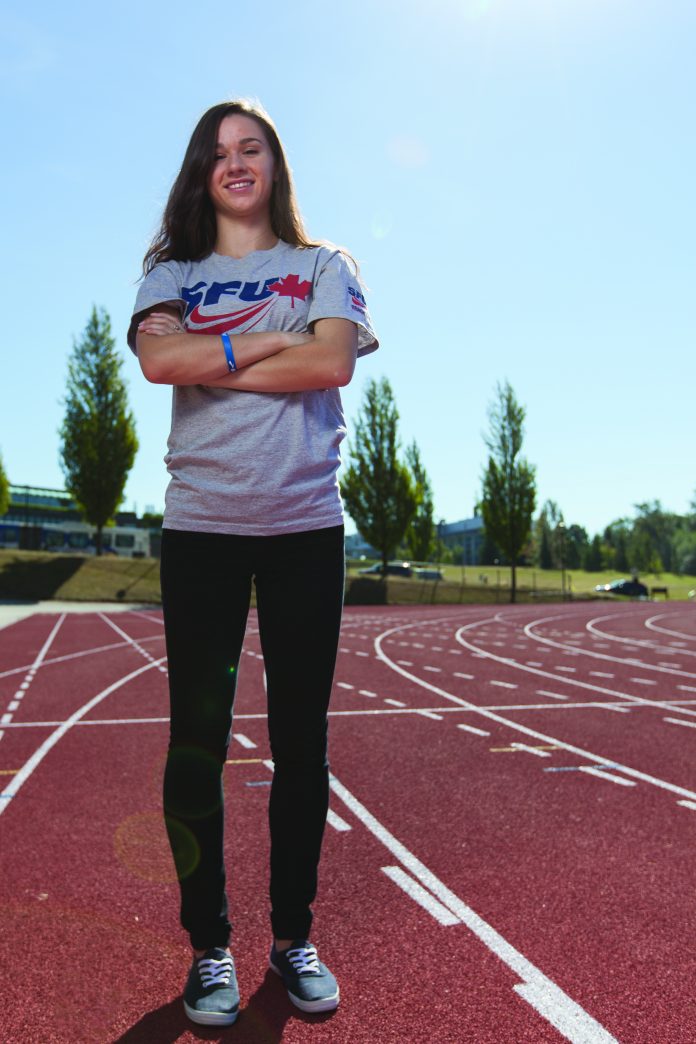
Enter Miryam Bassett, a freshman cross country runner from Nanaimo, who during her high school career, won various cross country and track and field championships. Now, she resides in residence where she is making the tough transition from high schooler to university student.
However, for the most part, she is excited by the experience rather than scared: “First of all, it was really intimidating but it’s also kind of exciting. I’ve only been here for two days but it’s gotten really exciting pretty fast and I’ve already gotten kind of used to it, [for example] living here.”
Discussing her first classes, Bassett explains, “The [class] size is intimidating. The first class was a bit more intimidating than the second one, but I found it interesting. It’s cool in university because you get to choose what you want to do whereas in high school, other than choosing math or sciences, there is a lot more specific things you can choose.
“I got to choose what I was more interested in than in high school, so I feel I’ll like university, academically, a lot more.”
Although the prospect of moving away from home is intimidating to some, Bassett enjoys the freedom. “So far it’s definitely been exciting and it’s cool having your own little space that you can be in charge of. It was a little stressful to begin, but I look at it now and it’s a fun sort of atmosphere. You get used to it quickly.”
Perhaps it helps that her sister, Rebecca, who is a year older and headed into her sophomore year, is also an athlete and around to help her through the trials of university life. “My sister’s on my team, so I’ve been introduced to a lot of her friends [. . . and] I’ve had someone telling me positive things about the university, someone, like a family member I can always go to if I need any help or have any questions who I know will always be there to help me out.
“It’s definitely nice having a sister here,” she added.
She did, however, allude to the stressful application process, pinpointing the Scholastic Aptitude Test (SAT). SFU, as an NCAA school in Canada, has to play by NCAA or American rules, which require the use of an SAT to decide if a student merits admission to university. For Canadian universities, this is usually unnecessary but SFU’s NCAA status adds this challenge.
“It was sort of stressful with the whole NCAA thing, making me do a SAT and stuff like that,” Bassett explained. “The SAT is very different from school in Canada; you can tell it’s very American. The test was very hard, [though] it wasn’t difficult as in hard to write [but] it was hard because it was long. Personally, I didn’t think it was the best.”
Bassett mentioned that she chose SFU over some American schools for a better education: “I had a few other universities come talk to me, the ones that I was considering the most were in the States. I chose SFU because first off, the academics are a lot better — for me, they had what I wanted.
“It wasn’t all academic,” she added, praising SFU’s cross country program. “The athletics were more like what I wanted; they have a really good program, especially on the girls’ side for 850m.”
With the school year starting, Bassett has to focus on her academics in addition to athletics, as she works toward a kinesiology degree in hopes of becoming a physiotherapist. She observed, “They say a lot that you’re student athletes, and student comes first so what I really want to do is keep on top of school while also keeping up my athletics. The thing is if you don’t do well in school, you can’t compete.”
As for the transition from from high school to university athletics, Bassett noted the faster, more intense pace of the NCAA, a feeling most students can relate to when they first come to university, with greater workloads and more trying schedules.
However, just as the athlete adjusts to higher pace, so does the student adapt to their new surroundings.
TA-dating article unfairly persecuted

From the printing press to Twitter, the modernization of media technology has made information more easily accessible to the distant masses. While this has been largely to society’s benefit, it’s not without drawbacks. Among these is the ability of journalists to create narratives of outrage that can bully small figures without proper nuance.
One of the latest victims of these rhetorical rampages is Robert Nanni, a writer for The Gazette, a school newspaper for a not-terribly-significant Ontario University. In his article entitled “So You Want to Date a Teaching Assistant?” Nanni lays out a disjointed series of flirting mechanisms for undergraduates to gain the romantic attention of TAs. Since its publication, accusations of sexism, harassment promotion, and a host of other things have made Nanni’s article into a nation-wide discovery.
But is Nanni really deserving of such a witch-hunt?
First of all, this article was placed in the humour section of the paper. Humour, by its very nature, pushes boundaries and relies on the alphabet of stereotypes. If deliberately sought, one can easily find things to be offended by in nearly any corpus of humour.
If we were to expect the same level of political correctness to regulate comedians as other public figures, it would strangle their raison d’etre. Therefore, as a society we give more leeway to people operating in the arena of humour, letting people like Colbert, Leno, and Mercer say things that we would never allow Couric, Obama, or Harper to get away with. This is a leeway we need to afford to Mr. Nanni as well.
Both the author and the newspaper displayed courage in defending themselves from national outrage.
Secondly, we need to realize that, while Nanni seems to be encouraging people to develop inappropriate relationships, his intended audience are the undergraduates, not the TAs themselves. When we develop rules to prevent romantic relationships from developing in circumstances of a power imbalance, we need to understand the primary onus is on the person with greater authority, not the one with less. If Nanni was suggesting predatory behaviour on the part of the TAs, even with the cloak of humour, he would be well deserving of angry censure. But this is not what he did.
Perhaps the most serious charge people have leveled against Nanni is that he has promoted sexual harassment. But if one actually reads the text of the article itself, rather than merely relying on the sound bites picked up by the national media, one sees a picture that is far more nuanced. The Canadian Labour Code defines sexual harassment as “any conduct, comment, gesture or contact of a sexual nature that is likely to cause offense or humiliation to any employee.”
The actions Nanni actually suggests in his article — glancing at a TA’s public Facebook profile, asking smart questions during class, or wearing moderately revealing clothing — hardly qualify for this designation. Unless his critics are suggesting that TAs should insist their students only ask dumb questions or have the authority to control their tutorials’ dress code?
Both the author and the newspaper displayed tremendous courage in defending themselves from the onslaught of national outrage, and while they have stated that “[their] priorities concerning such topics remain the same,” they have understandably removed the article from the internet. Here, as in so many other places, ire seems to have triumphed over nuance.
SFU graduate says study what you love

Speaking from personal experience, choosing a degree is hard. It’s perhaps one of the most stressful things you will ever do after high school. Honestly, even if it took longer than I planned, I don’t regret switching from a science-based health program to an arts-based one in order to find the right fit for my strengths. It’s important to choose a subject that genuinely interests you, instead of how employable it makes you.
During university, you are encouraged to make your own decisions and find your own path instead of following the opinions of your parents and teachers. Studying what interests you is perhaps the best way to not only open more opportunities, but achieve success in life.
The value of a degree should not be based solely on the merits of how employable it makes you. I find that this mindset tends to lead to over-fixation on a single goal. This is a shame, as the first year of university is the best time to experiment and find your calling. Oftentimes you will find that you are playing to your strengths when you stumble upon a subject you are passionate about.
The university programs at SFU are structured in a way that allows you to take courses outside of your major. However, I find my peers too often squander this opportunity and take only the bare minimum. If your sole goal is to get a job right after graduation, there are cheaper alternatives, such as technical schools. When you come to university, you come to learn, and finding a successful job afterwards is a side benefit to this.
If you have a passion for something, you will certainly find a way to make it work for you.
On the other hand, I agree that getting a university education is a hefty investment, one which many hope will net them substantial returns. But as a university student you are trained to think critically and problem solve; you can take what you’ve learned from your degree and apply it to other career paths. Someone with a genuine interest in what they are studying should research all possible paths available to them. If you have a passion for something, you will certainly find a way to make it work for you.
Aside from the personal benefits to your well being in enjoying what you do, having a genuine interest in a topic means that you are more likely to understand it, instead of just memorizing and regurgitating course material until the end of the semester.
To be poetic, when you study something you enjoy, you take the information you find and make it part of yourself. As a result, you are more likely to do well in classes because of your interest, as opposed to obligation.
Another benefit is that you are able to share a common interest with your professors, which can help build connections later in your career. Success in academics opens up other opportunities in the long run, such as internship possibilities and financial awards. These can help ease your financial burden in university and prepare you in your future career.
In the end, you must make whatever you feel is the right decision. However, there are few reasons not to study what you want. Even if you do choose to focus on a more job-oriented approach, taking a minor to further supplement your current program can benefit you in the long run. Studying what you love will ultimately lead you to a happier life.


