Home Blog Page 1103

Lack of finish hurts the Whitecaps

0
The Whitecaps have run into serious scoring problems as of late disappointing fans.

It’s become a broken record for all those who follow the Vancouver Whitecaps: they can’t score. Until Wednesday’s game, they were held off the score sheet since August 16 — just under a month. It was so bad, it was cringe inducing.

The one silver lining in all of this is that they aren’t out of the playoff race just yet; as a matter of fact they’re actually two points up on the Portland Timbers (as of Wednesday, September 10). But they have to start making up ground, and fast. Scoreless draws like the one we were treated to against the DC United on Saturday, September 6 will not help them.

It’s not as if the Whitecaps have no idea what to do once they get the ball. They’ve been creating quality chances, just not converting.

A perfect example of what has been ailing the Whitecaps came in the 11th minute against the United. Mauro Rosales started a beautiful counter-attack after some DC United pressure, which led to Darren Mattocks having a wide open net from six yards out, but he ballooned the ball over the net.

Kendall Watson had another glorious chance in the 31st from a set piece — a header from six yards out — but put it wide. Mattocks had yet another chance near the end of the first half, getting sent in nearly all alone after being kept onside by centerback Steve Birnbaum.

That’s three glorious chances in the first half alone. If even one of them goes in, the ‘Caps get the three points and are in solid playoff position.

One idea for the ‘Caps going forward would be to create more shots on goal, especially on target. They had a decent total in the United game, with 15 shots directed at the goal, but of those 15, only three were credited with hitting the target. More shots on target will mean more rebounds, which the ‘Caps could try to turn into goals.

However, no new help is expected for the stretch run. President Bob Lenarduzzi stated that he’s not willing to sacrifice the team’s future to bring in an established veteran, so scoring will have to come from within.

Despite all of this, manager Carl Robinson is still preaching patience with his squad. “Just got to keep doing what we’re continuing to do,” he said at the post match press conference on Saturday. “Hopefully we’ll get a break or we’ll take a number of chances we’ve missed tonight.”

Luckily, the fate of the Whitecaps post season aspirations is still in his players’ feet. For all of us who support the ‘Caps, we surely hope that this goalless streak had more to do with luck rather than a worrying trend for the near future, and that Wednesday was a sign of things to come.

Putting golf back on the map

0
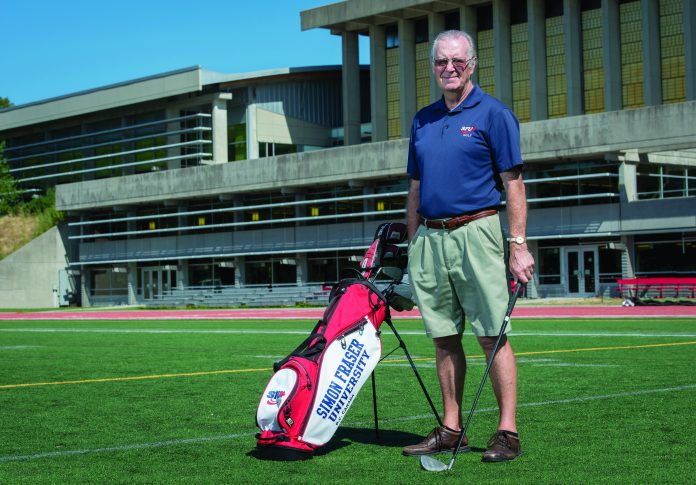
Head coach John Buchanan led the men’s golf team to place 17th at last year’s national championship in Allendale, MI.

Last year, the men’s golf team placed 17th in the national championship, and according to head coach John Buchanan, they achieved that “without playing that well” in the tournament.

That’s quite an accomplishment for a team that had to be rebuilt from the ground up five years ago; after being cut in 2006 due to financial problems, the team was once again granted varsity status.

The team’s climb was rocky, as they not only had to restart a golf program but also work to become NCAA calibre. However, as time went on, the team grew and so did their reputation, attracting higher class talent.

“Eventually, the dust started to settle and some of the local kids who might have gone south, but for whatever reason didn’t, came to SFU,” explained Buchanan.

He also noted that SFU’s academic reputation probably played a helping hand in that growth, drawing players such as Brayden Brown, an NCAA Division I transfer from Arkansas State University. “[SFU] is a really good school; that attracts people,” said the coach.

This year, the men’s team looks to improve on last year’s placing, and Buchanan believes that they can. However, he says that it’s all mental, a game of confidence, rather than a question of skill.

“We’ve got the capability of winning a national championship, it’s as simple as that. It’s the matter of whether they believe they can win a national championship,” Buchanan elaborated. “They’re as good as the Americans.”

He went on to explain that without confidence, they are giving the other teams a “head start.”

There is, however, a hole left by the absence of Mike Belle, SFU’s premiere player and last year’s GNAC player of the year, who graduated from NCAA eligibility. Last season, he held the best average score in the GNAC with 74 strokes.

Coach Buchanan states, though, that the team will make up for the loss with increased depth and more experienced returners: “Although we’ve lost our number one man, the three that are returning have matured.”

The returners include sophomore Kevin Vigna, who was last season’s GNAC freshman of the year and first Clan winner of the GNAC Championship, and junior Brett Thomson, who in the offseason placed eighth in the Canadian Amateur Championship, held in his hometown of Winnipeg. Both were selected to the all-conference team along with Belle and senior John Mlikotic.

Despite the fact that the men’s team are becoming a model of success, the women’s team has not reached the same pedigree, yet. “[The women’s team is] probably a year to two years from that, [but] we’ve already started to trend towards it,” Buchanan commented.

This season, he has already seen a portion of that upward trend, saying, “For the first time, we’ve actually got depth in our women’s team.” They currently have nine players listed on the roster including freshman additions Michelle Waters, Breanna Croxen, and Kyllie Jack.

This year, the men hope to continue their ascension to one of the top teams in the GNAC, while the women’s team work to carve out their own future success.

The Clan men open their season at the St. Martin’s Invitational in Olympia, WA on September 19 to 20, while the women’s team start at the SMU Invitational in Lacey, WA on October 6 to 7.

Seahawks look to repeat

0

Anyone living around here who follows the NFL should remember last year’s glorious Super Bowl, when the Seattle Seahawks crushed the Denver Broncos 43-8. It was rather hilarious hearing viewers (or should I say reading their online comments) complain about how it was the most boring Super Bowl ever. Sports-wise, it was one of the best things I have ever seen, with the Seahawks not only winning, but clearly, and utterly, dominating the Broncos.

However, now the question is whether the Seahawks can win two years in a row.

I don’t think there is too much of a question about whether they will dominate the regular season. It’s pretty clear that they are currently the best team in the league, and if not the best, then at least one of the leaders of the pack. Their season opener against the Green Bay Packers, in which the Seahawks won 36-16, showed that they are still a dominant force even when not playing the best football.

However, defending the Vince Lombardi trophy two times in a row is a lot more difficult than it sounds, with a repeat win not having happened since the New England Patriots won it back-to-back in 2004 and 2005.

The last team to pose a real threat for two consecutive Super Bowls was the Green Bay Packers, who went 15-1 in the regular season, only to fall in the divisional playoffs (after receiving a first round bye).

That’s about as dominant a season as you can have, other than 16-0 which the Patriots had in 2008 when they blew it against the New York Giants, after making it to the Super Bowl.

The point being, these elite teams are still fallible; no matter how unstoppable they look, it still only takes one game to lose and you’re out. One bad game and the lesser team can advance.

Also, at any moment, untimely injuries can occur, slumps can happen at just the wrong time, and truthfully, the competition is still pretty darn good. The San Francisco 49ers are probably as dominant as the Seahawks, and really, the Super Bowl could have been theirs last year.

With that being said, the Seahawks look awesome. They have not lost too many key guys (with the exception of Golden Tate) and perhaps with a bit of luck, they could have an almost ‘new’ elite player in Percy Harvin (as he missed most of last season).

They look scary good, and if there’s a team that could win back to back Super Bowls, it is surely them.

Don’t shop at Ikea

0

As autumn rolls into Metro Vancouver, I am sure that many of you, like myself, will invest in new home furnishings for your dorm, apartment, bedroom, the list goes on. This semester however, I encourage you to shop Ikea-free.

Don’t get me wrong, I too love the look and design of Ikea furniture — plus who can resist the hotdogs, meatballs and frozen yogurt? Simply put, I refuse to buy from a company that violates Canadian labour laws and tries to force its employees to work for less.

According to Teamsters Local 213, the union representing the Richmond Ikea workers, an issue began when Ikea imposed wage cuts, axed benefits, and reduced the hours of its full time staff. When staff refused the proposed changes, the corporate giant locked out over 300 of its workers. Ikea then attempted some hardball tactics, such as reducing workers’ pay for  every day they stayed off the job. But sadly, that isn’t the end of the unfair labour practices.

The corporate giant then ignored labour laws by trying to negotiate with the employees directly on an online job website instead of going through the union. According to a Labour Relations Board (LRB) ruling, Ikea must now pay damages to the union for unfair negotiation tactics.

Profit should not be made off workers’ backs, but rather through product sales.

Last year Ikea had record sales, reporting an annual increase of 3.1 per cent. However, in countries such as the United States, Turkey, Russia and France, Ikea is being accused of poor labour relations. Profit should not be made off workers’ backs, but rather through product sales.

It’s easy to pretend that this problem isn’t real, or at the very least doesn’t affect you. But that is the exact mentality big business hopes that you will maintain. These workers are our neighbours; they are members of our community and are being bullied by this corporation.

Despite the LRB ruling, employees are still not back at work, as Ikea does not feel pressured by the 300 ‘little guys’ who are taking a stance. The company is asking its Richmond workers to accept less without due cause. We should not admire nor give our business to a corporation that shows blatant disrespect for labour law and workers’ rights. Therefore, I say it’s time to boycott this brand.

If Ikea won’t listen to its employees, it will have to listen to us, the consumers. Take a stance against the corporate bullying by furnishing your home or dorm with the products of a company that is committed to protecting its workers. Ikea’s workers were asked to accept less than what their previous contract promised — they are not asking for anything more than what they once had.

This semester, I hope you join me in the Ikea boycott, and put pressure on the corporation to resolve this labour dispute.

Clan victorious in six goal thriller

0
Niko Schroettle weaves the ball around the Vulcans.

On Tuesday evening, the SFU men’s soccer team grabbed their second win of the season in exciting fashion over the University of Hawaii-Hilo Vulcans with a 4-2 result.

The Clan have shown themselves to be deadly from their set-pieces in recent matches, and just 10 minutes into play they were ahead thanks to Joel Malouf’s headed goal from Alex Rowley’s corner-kick. With momentum in their favour, the men struck again when Magnus Kristensen’s lobbed ball was brought down by Ryan Dhillon outside the opponent’s box, who then laid a simple ball for Jovan Blagojevic to slot home.

Goalkeeper Ivan Hutsulyak made the most of his Clan debut and confidently swept away the rare chances made by the Vulcans in the first half. The Clan kept immense pressure going from all angles and finished the half with 13 shots.

The second half provided more intense resistance from Hawaii-Hilo, but not before the Clan would take their lead to three when Niko Schroettle won a penalty kick that Blagojevic converted from the spot. Immediately after, the Vulcans created clear goal scoring chances, but efforts from Mike Reckmeyer and Jamie Sporcic were shot wide of the Clan goal. Reckmeyer would come back to haunt the Clan with a stunning bicycle kick goal in the 71st minute. With the tide turning, the Vulcan offence were able to build more pressure into the Clan’s 18-yard box and won a penalty kick, scored by Reckmeyer again.

Screen Shot 2014-11-26 at 5.51.56 PMOnly two minutes later, the Clan found their fourth goal from a counter attack of blistering pace when Dhillon picked out substitute Callum Powell, who calmly rolled the through ball past the UHH keeper. The Vulcans went out guns blazing until the last minute with their free kick smacking the crossbar to the delight of the home crowd.

“It was more exciting than it should’ve been, we took our foot off the pedal,” said head coach Alan Koch. “They gave us a good run for our money, but thank goodness we weathered the storm and showed maturity.”

The coach added his excitement for freshman Callum Powell: “He’s been chomping at the bit for more playing time and he came in tonight and proved himself. He’s explosive, dynamic, and I hope he can build on that.”

The Clan lose series to the Vulcans

0

In their opening matches of non-conference play, SFU’s women’s soccer team suffered double-header defeats against the University of Hawaii-Hilo. Early stages of both matches saw stout defending and resistance to the Vulcans’ pressure thanks to the defensive leadership of Clan senior Kelsey Atherley. Freshman goalkeeper Priya Sandhu showed great confidence between the woodwork in the opening stages and was quick off her line.

While their first match was limited to just one goal from an unlucky rebound, the return leg provided far more struggle for SFU.

Despite keeping their first match scoreless for the first 45-minutes, the Vulcans were able to break the deadlock early in the second game. A handful of fearless and aggressive slide tackles in the opening minutes led the Clan to concede a penalty kick in the 23rd minute. Kristine Pasek’s ensuing penalty kick was unstoppable for Sandhu. With 10 minutes left in the half, Clan sophomore Kate Pearsall showed great composure to chest down Devon Kollmyer’s corner and volley home the equalizer.

The Vulcans were quick to snatch the lead again just minutes later, after an unmarked Taylor Wright side-volleyed a corner kick from Amanda Dominguez just two minutes later. Second half proceedings continued much like the first, with the Clan soaking in some strong pressure from the Vulcans with more defensive prowess.

Screen Shot 2014-11-26 at 5.53.15 PMPearsall continued to alter the game with her surging run to the opponents box in the 58th minute and thru ball to Sierra Leung, but the move was quickly cut out by Hawaii’s defence. Ten minutes later, the Clan were given their best chance to equalize after the Vulcan keeper spilled across into the box, but Andrea Di Lorenzo was pressured out of scoring.

Defending from set-pieces was, again, a weak point for the Clan after Caroline Stromick gave the Vulcans their two-goal lead with a stunning volley from another corner kick with just 10 minutes left. Unfortunately the Clan were unable to recover from the deficit and finished with a tough loss.

“We’ve introduced a different style of soccer to the girls, it’s a process, so once that develops then we hope the results will go our way,” said assistant coach Anna Picarelli.

Assistant coach Chris Sargeant added, “We could do better with defensive shape, and then introduce ways to play through opposing teams and hopefully we will get more chances that way.”

Auld alliance for a new era

0

Barely three days after you read this, the map of Europe could once again change. On September 18, a referendum will take place in Scotland asking a single question, “Should Scotland be an independent country?” If a successful ‘yes’ vote is passed, the nation that currently forms an integral part of the United Kingdom will become its own country for the first time in over 300 years.

Despite the fact that this vote appears to be unimportant to Canadians, an independent Scotland could become the catalyst for drastic changes in our own nation.

Most of us are too young to remember the fervour of nationalism in Quebec and their demands for independence. In the past 40 years, there have been two referendums regarding the creation of an independent Quebec.

The first, held in 1980, produced a lopsided result, with 59 per cent of voters opting to remain part of Canada. The second vote, held almost 20 years ago, was much closer, with Quebec remaining a Canadian province by a mere 1.16 per cent of the vote.

In recent years, support for sovereignty has faded in the province, as evidenced by recent elections on both the federal and provincial levels. A side effect of the NDP’s “Orange Wave” in the 2011 election was the Bloc Québécois’ complete decimation as a federal party, when they lost 44 of their seats to the NDP, and gained only one.

At least one group in [Canada] will watch and hope for an independent Scotland.

This left them eight seats shy of official party status, and they have been reduced to two since that election.

On the provincial level, the Parti Québécois has not fared much better. Despite winning a minority government in 2012, their most recent campaign this past April resulted in their worst result for the popular vote since 1970.

Despite these defeats, the sovereigntist movement in Quebec has not disappeared, even though many argue that the provincial government has achieved ‘de facto’ independence due to its control over so many of its education, immigration, taxation, and cultural policies.

They even call their provincial legislature the National Assembly of Québec. Some Canadian political experts refer to this protracted struggle as the “neverendum referendum.” It seems no matter how much de facto independence Quebec achieves — even to the point of being recognized as a nation within Canada by Prime Minister Harper and the Canadian government in 2006 — they will not be happy until they achieve true independence.

What worries me is that a successful bid for independence by Scotland could result in a new surge of Québécois separatist feelings. If nothing else, it would set a legal precedent for a process by which portions of a country could legally vote to separate from the whole.

Historically, this separation has only been accomplished by force of arms, and is often subject to military resistance on the part of the nation that would end up being divided. This was the case in the US Civil War and, more recently, the dissolution of Yugoslavia.

I will be watching for the results of Thursday’s vote with great interest. Though many are hoping for the bid’s defeat, there is at least one group in our country who will watch and hope for an independent Scotland. The Québécois sovereigntists are the heirs of the Auld Alliance.

The Clan open the season with a loss

0
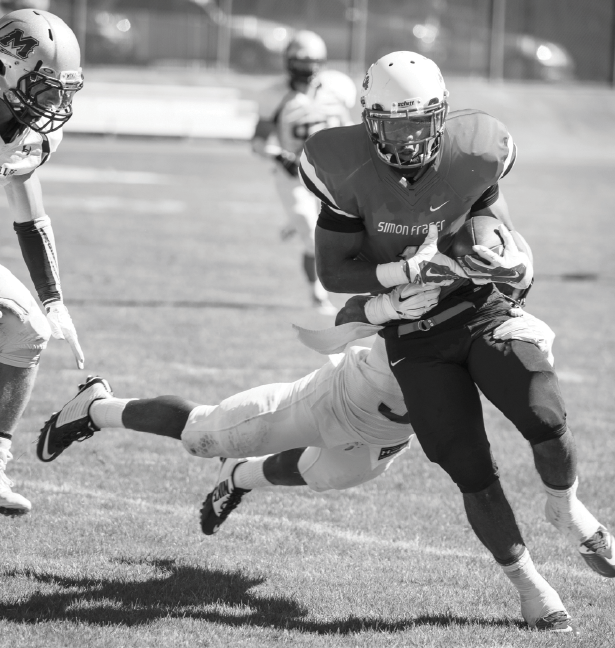
SFU played an inconsistant game resulting in multiple turnovers on both sides.

SFU started their season with a loss against the Menlo College Oaks, a non-conference rival of the National Association of Intercollegiate Athletics (NAIA), on September 6.

The game started promisingly for the Clan, as 2:27 into the first quarter, linebacker Eric Murphy intercepted a pass from Menlo College quarterback Wade Hawkins, who later left the game in the first half due to injury to be replaced by backup Nate Dodson.

SFU pounced on this opportunity: Kyle Kawamoto caught a 29-yard pass from quarterback Ryan Stanford, who eventually threw 260 yards, to open up the scoring with a touchdown.

This fast-paced offence seemed as though it could be the story of the game for the Clan, as Mitchell Barnett intercepted the ball for them once again. During this drive, however, flaws started to appear in their game plan, as they were unable convert for a touchdown, and missed a 33-yard field goal attempt.

In the entire first quarter, SFU had just one first down, and their opponents held onto the ball for 42 seconds longer than they did. The only other scoring in the first quarter was a Menlo College field goal, which, to be fair, was miraculous considering the yards given up by SFU’s defence, to bring the score to 7-3.

It was during the second quarter that the Oaks started to take advantage of the Clan’s sloppy play. They scored two touchdowns building a sizable lead, including one scored off of a 72-yard pass received by running back DJ Jones, who lit up the Clan on more than a few plays, highlighting the holes in SFU’s defensive game.

However, the Clan would enter halftime only down by three as they scored a touchdown with just 24 seconds left in the quarter.

SFU appeared to turn a new page in the second half and seemed recharged, with a more confident looking team. Matt Isherwood intercepted the ball with 12:16 left in the quarter, which led to a touchdown pass to Lemar Durant, bringing the score to 21-17.

The SFU defence also started strong, not allowing the Oaks to advance, and sacking the quarterback when they went for it on a desperate fourth down play.

Sloppy play would return once again, however, with SFU allowing Menlo College to make a 78-yard pass for a touchdown, reclaiming the lead 24-21.

Following this, the Clan fumbled the ball at kickoff, only to have Isherwood recover it the very next play, making back-to-back interceptions for him.

SFU would score a field goal 3:45 into the fourth quarter, tying up the game, although only after many missed opportunities.

The rest of the quarter would remain silent until Jones scored another touchdown for Menlo College claiming the lead for the last time, making the score 31-24.

SFU did not go down without a fight, however, as they tried to take advantage of an unsportsmanlike conduct penalty on Jones’ touchdown celebration, giving them them 15 yards on the kickoff. On a fourth down attempt with 27.1 seconds left, it briefly looked as though the Clan had completed a pass for a first down at the goal line. However, they were just out of bounds, and thus lost the game.

The running theme of the game was inconsistency, with players such as Isherwood putting up excellent performances with back-to-back interceptions, while other players such as Chris Tolbert gave up back-to-back fumbles.

“We need to learn to finish things. Our players need to understand that we need to protect the football a little bit better,” said head coach Jacques Chapdelaine. “Offensively we can’t turn the ball over.

“If we shoot ourselves in the foot a little, we’re going to struggle uphill, whereas if we can eliminate those mistakes we’ll put ourselves in a better position.”

Meet the Clan: Alison McKay

0
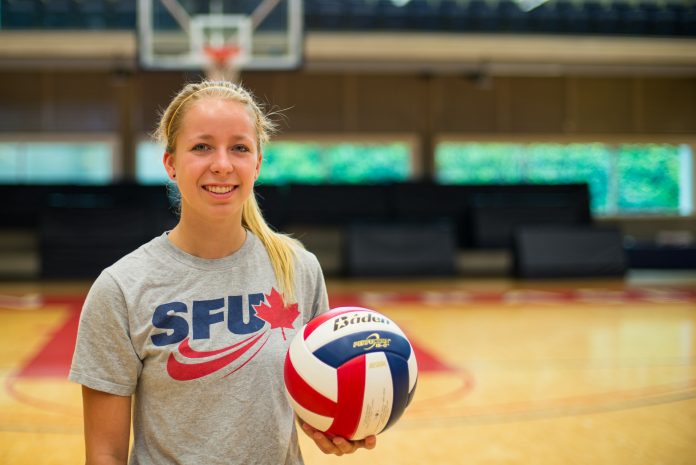
This is Alison McKay’s second year on the volleyball team, but her first in the libero position.

Screen Shot 2014-11-26 at 5.37.18 PMIn volleyball, the libero is a unique position. She stays at the back line and is only responsible for defence, not being allowed to attack the ball if it is above net height. For a libero, the concentration is on digs, or how to keep the ball in play, not necessarily on winning the rally with the next kill.

To add to these differences, the libero wears a different coloured jersey than the rest of the team, making her stand out. Players in this position rarely sub out, and often play nearly the whole game; they must have leadership abilities and good communication. For many, in light of the extra attention and added responsibilities, this would be a daunting position.

Alison McKay, however, revels in this position, including the fact that she does not have to sit on the bench all that much: “I was itching to get on the court anyways last year.”

She describes her position and some of its necessary skills, saying, “You have to have a lot of ball control, you have to be able to pass the ball really well [. . .] I’m kind of the captain of the back row, setting all the plays and controlling where everyone moves.”

McKay made the jump to libero from defensive specialist this year after previous libero Alanna Chan left the team, and despite the added responsibilities, McKay found the transition easy. “I think it flowed because [they’re] very similar positions, it’s just that it’s a bigger role, you’re on the court more and wearing different coloured jerseys, you stand out a lot.”

The move was unexpected, as Chan left the team for a job, but it was welcomed by the Port Moody native: “It was like all of a sudden, boom, taking on that position but I’m really glad it all happened. I was ready to step up.”

Now entering her second year, she comments on finding herself in more of a leadership position after experiencing a full season in the NCAA: “I really like the role I’ve been taking on. It’s nice to be the one helping others instead of others helping me.”

McKay is able to draw upon her experiences from last year, watching the leaders on the team. She explains, “I learned so much. It was a lot of leading by example and that’s what I find I can do for the players coming in. I can show them how things work around here by just playing, [for example] going for every volleyball, the basic stuff the coach expects from us [. . .] I’m just taking that on now.”

As for her own game, McKay is a huge fan of tennis, both watching and playing, and draws upon tennis technique to help in volleyball. “[Tennis] kind of translates to volleyball, [because it shares] the quick side to side movements, back to back, hand-eye coordination.

“I also play beach volleyball which helps with my indoor [volleyball] skills. [It only has] two people in the court, while indoor has six, so you definitely have to be a bigger presence so it helps me back to indoor because I can take up a lot more of the court and feel more comfortable with that,” added the sophomore. “Beach volleyball is also a lot of running so I find it’s a really great workout that keeps you in shape all summer.”

A love of sport and athletics is a persistent theme, as she explains that being the daughter of Canadian Olympic wrestler Dave McKay may have put her on the path to being a successful athlete, though she stresses that it was always her choice. “I was always around the gym. Actually from the ages of five to 10, I was always up [at SFU] doing his wrestling classes with him and so I have been exposed to the gym and being on the track. Gym was my favourite subject at school, it was what I found most comforting and I probably get my competitive drive from him.

Screen Shot 2014-11-26 at 5.37.53 PM“That helps with falling in love with a sport,” she concluded.

With the season starting up again, McKay looks to play a vital part in helping the volleyball team take that next step, becoming a full blown contender, advancing on the considerable successes of last season.

Having already won four of their first five games of non-conference competition, the Clan look well on their way.

The great Canadian punishment culture

0

I hope I’m not the only person who finds it odd that Skytrain security officers rarely check for proof of transit fare at the gate. The lack of security presently displayed at Skytrain stations is so abysmal that it undoubtedly entices many transit-goers to attempt to hitch a ride for free. Yet, you never know when a security guard could spring through those sliding skytrain doors, catching you off-guard with a fare inspection. Such prospects shroud me with unease, and convince me to keep my UPass safely tucked inside my wallet at all times.

I then realize, in frustration, that the company has established these strict rules about transit fare, yet makes them far too easy to break. These regulatory ideologies work to entrap the public, rather than to promote upholding the law in a positive manner. The Skytrain’s harsh regulations are merely a fragment in a Canadian society that seems obsessed with strict rules and easy punishment.

Am I wrong in claiming that Canada is a nation that favours public penalty? It seems like such an ironic statement given that our country boasts a progressive nature. However, the reality seems to be that Canada is a nation in love with rules — rules that permeate every crevice of Canadian life, yet ultimately try to set Canadians up for failure.

When it comes to municipal law, our nation is still very much chained to tradition.

If you still don’t understand what I mean, consider the fact that police officers will arrest people for urinating on public streets, yet there are very few public restrooms available outside of shops and restaurants. How about the idea that it is legal to sell sex to people, but illegal to purchase it? And we mustn’t forget the helmet situation — if I’m riding my bike as fast as I walk, shouldn’t I also be wearing a helmet when I walk? What if I fall and hit my head while on foot?

The unfortunate reality is that, while it’s oftentimes easy to break these laws, Canadians are subject to heavy penalties when caught doing so. Our harsh rules starkly contrast with many European countries, such as Germany and Sweden, where it is legal to drink alcohol wherever one chooses, and to take a leak in one of many public restrooms.

Apart from being open-minded and progressive with their laws, these countries provide a plethora of opportunities to avoid breaking them — an approach that I feel contributes immensely to a society’s well-being.

Currently, crime is a big issue on our government’s political agenda. I’d be able to instantly pay off my student loans if I had a dollar for every time I heard that “Harper is cracking down on corruption.” Rules and punishment are hot topics in this country, however archaic and unfair these notions may be.

It may be a stretch to proclaim that Canadian laws and cultural norms should be changed immediately, but we should start to think about the ways our culture seems to value punishment over prosperity.

Is Canada progressive? In a multitude of respects, yes. But when it comes to law, especially municipal, our nation is still very much chained to tradition, and this is a notion that is seriously worth public consideration.