Home Blog Page 1102

Why road trip stories are so captivating

0

I have yet to encounter anyone who doesn’t like a good old-fashioned road trip. That’s the truly amazing thing about them: there are so many different kinds of vacations and people tend to differ in opinion about all of them — whether it’s better to go to the beach or the forest or the mountains — but one thing we can always seem to agree on is that the best way to get anywhere is to load up a car with your favourite people, some good music and junk food and just hit the road.

It’s amazing that people still chose to drive places when they could just as easily fly, but there is something so much more interesting about driving through the Rocky Mountains for six hours than just flying over them in one. There is something alluring about forging your own path and enjoying the ride. Road trips make every vacation so much more worthwhile because the journey is just as important as the destination, if not more.

English poetry classes teach about the pastoral ideal, about the idea of getting away from it all and returning to the outdoors, and I think that the artistic obsession with road trips is an extension of this. Books such as Kerouac’s On The Road romanticize the idea of just getting up and going, allowing the open road to take you away from everyday life. Kerouac’s characters are driven to escape from their mundane lives in search of something more exciting and fulfilling, and the journey to get to this imagined destination is an integral part of the story.

Movies like Into the Wild and The Secret Life of Walter Mitty are able to capture our attention with characters who strive to find that serenity that comes with forging amazing paths for themselves. On top of it all, there is always such a huge focus on the scenery, the amazing breathtaking views that you can find if you just drive an hour or two out of town.

We all want an escape from the everyday parts of our lives, and not everyone can afford to hop on a plane and go away for months at a time, or just move and start all over. Road trips are accessible: you can make a trip down the coast for only a weekend, and it can be something exciting if you make it about the trip itself versus the arrival at your destination.

Always make time for stops at the side of the road for goat farms and pie shops, lakes and deer herds; for every eccentric thing that catches your interest, you should pull over for. Road trips are a lot like art, we search out meaning from them, we use them as an escape or as a way to find a story, be it our own or imagined.

Of course, every great story needs a great soundtrack. One of the best parts about road trips is choosing your musical accompaniment. It’s key to pick the best music and to sing along as loudly as you like, and be sure to add in embarrassing dance moves that you know those passing cars will see.

There is something so fitting about the acoustic sounds of easy-to-sing-along-to music that makes kilometres of highway between stops melt away. I have some of my own personal favourite go-to road trip sounds, and I’m sure you do to, but if you are looking to expand your playlist, give John Welsh’s new EP, On the Road, a listen.

He’s a BC local who wrote all his songs while travelling the world, from New Zealand to Newfoundland, and all the way back home again. His music is upbeat, catchy, and super easy to sing along to while cruising down the highway on your next adventure.

If you’re ever looking for a break — maybe classes are getting a bit overwhelming or your job just kind of sucks — try just taking a day or two to go somewhere different. Maybe you don’t even have a specific destination, but just get up and drive somewhere. If you don’t have a car, I’m sure a friend who does would be up for an adventure, and worst comes to worst you can rent a car. There’s nothing stopping you but yourself, so get out there, get on the road, and don’t forget your iPod.
 

Fringe Festival highlights

0

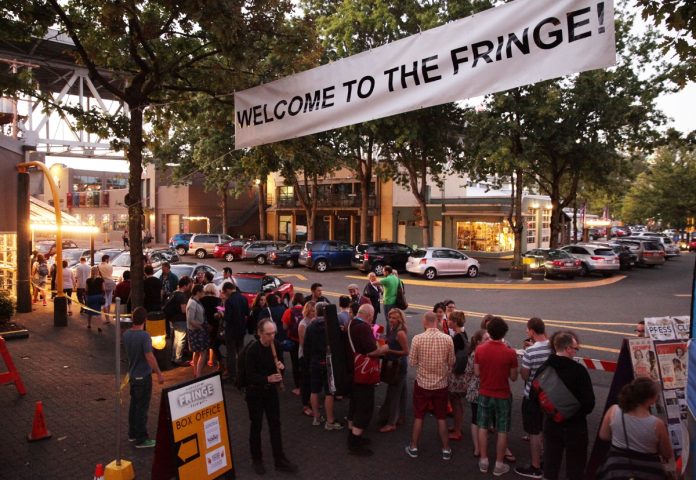
The Fringe Festival is on its 30th run this year, but I only discovered its majesty in 2013. Its small-sized venues provide just the right amount of intimacy at a show, offering both the prestigiousness and closeness that allows the performers to speak to the audience, and vice versa, a technique used extensively in the Fringe For All preview event.

Fringe For All is the event used to promote Fringe shows. It packed 40 show previews into a roughly two-hour time span, and each show was allowed two minutes to show off what makes it special.

The shows that immediately stood out to me were those that took a different look at storytelling and acting, or that had a unique quirk that set them apart. Of course, at Fringe, these qualities are pervasive. Take the terrifying, charming, Tim Burton-esque Aiden Flynn Lost His Brother So He Makes Another, for instance. This silent preview had Aiden Flynn (Morgan Murray) teaching his apparently zombied brother (Danielle Spilchen) how to walk one step at a time, leaving an air of mystique from the mix of childish love and logic that could make such a horrifying situation come to being.

The Greatest Monkey Show on Earth has a similar quirky effect. The name in itself suggests the cliched nature of such a show, but the preview wasn’t simply based around a tired monkey costume act. Ross Travis showed his strength of comedic timing, as he simply flipped between goofy acrobatics and screams to blank stares, yet had the crowd laughing harder than in any other preview.

Dr. Frightfeld presents “Dead Air” features a radio host (Grahame Kent) giving a radio performance while assuming the audience can’t see him. This gave room for the silent sound-effects creator (Robert Grier) to show the extent of his lackluster sound effects through the use of his voice and plastic keyboard, and the speaker to tell the audience to “turn off their radios right now!” and smoke like no one was watching.

Roller Derby Saved my Soul featured Amy (Nancy Kenny) explaining how to pick the perfect name for roller derby, with “the perfect mix of violence and sexuality,” like “human menstrual crisis,” or “Justin Cider,” the latter of which she made sure to explain explicitly, as she couldn’t understand it without “saying it really fast” a few times. The show promises to play with the audience’s comfort levels to get at its main themes of finding oneself and one’s sexuality, all through the eyes of the excited, charming Amy.

Of course, many traditional storytellers were there, whose shows are surely as captivating as their more quirky counterparts. The Dark Fantastic is dramatically reminiscent of, and at least as captivating as, Welcome to Nightvale. Paleoncology features the charming Kira Hall avoiding her family problems by obsessing over dinosaurs, and dressing up as one.

Also, I was surprised by how intriguing I found Verbal Diarrhea, Actual Diarrhea, Heartbreak, Disorder, considering the preview featured Gerard Harris telling the passionate, expressive dramatic monologue of Cher’s “Life After Love,” before he promised that it had nothing to do with the show.

Of course, not every play is going to conform to my personal tastes, but that’s one beauty of Fringe. There were many shows, for instance, whose frankness and honesty promise to tackle important issues tastefully. Meatfloaf Jesus, for instance, offers a mix of music by artist Meatloaf set against the backdrop of Christianity, passion, and finding one’s sexuality. Eating Pasta off the Floor featured one moment of Maria Affinito being embarrassed by her loud, insulting mother, that promises an intriguing narrative.

Want to be amazed? See Junk, a musical with instruments made from junk, or the juggling in Eye Candy. Want to be moved? See The Human Body Project, an unscripted show featuring Tasha Diamant talking about nudity and vulnerability, while being nude and vulnerable.

All the creativity and talent that is going into this year’s Fringe certainly can’t be summed-up quickly. Read the descriptions, see what stands out to you, and you’re certain to come away from a show with something more than what you went in with.

For more information,visit www.vancouverfringe.com.


In theory: no budget, no crew, no script

0

Schrodinger’s cat, dinner party antics, and experimental filmmaking collide in James Ward Byrkit’s directorial feature-length debut, Coherence. This is one head trip of a movie that begins slowly as a dull and pointless visitation to one of the most tiresome branches of indie filmmaking, mumblecore, but gains momentum as it begins to fully explore its trippy sci-fi story. Eventually it goes into territory you don’t see coming and ends with a cliffhanger even Hitchcock would have been proud of. The less you know the better.

Byrkit made this film with no budget, no crew and no script. His actors were as clueless as the audience; the actors tried to piece together the mystery of how so many weird events could be taking place at once.

A comet is passing close to earth which is apparently interfering with cell phone reception and causing power outages. The guests of the party drink, take drugs, and discuss their mundane lives. None of it is particularly interesting until things go bonkers.

The director sacrifices technical polish in order to utilize his methodology. The visuals are often weak and not pleasing to the eye as their improvised nature becomes apparent through the editing, which cuts between characters without establishing the surrounding setting. We almost never get a wide shot to show where everyone is sitting at the table so that we can mentally place everyone in the space within the frame.

The director filmed improvised material not knowing where his actors would move or what exactly they would say. Perhaps there was no time for perfection. Unfortunately, the same can be said for some of the audio. Sometimes when multiple characters are bantering at once some of the sound descends into incomprehensible sludge.

However, I suppose this is the sacrifice he is willing to make in order to get naturalistic performances out of his actors, who all do remarkable work. Their dialogue is authentic and does not seem rushed like most films that sacrifice realism for efficiency.

James Ward Byrkit lets his actors talk and talk and talk. At times this is a commendable aspect of the film and at other times it is one of the most boring; it all depends on what the characters are chatting about. If it’s themselves it is probably the latter aspect but if it’s the mystery, it’s the former.

Don’t be confused by the quantum theory and that stupid cat; this is pure genre fare, not profound cinema. Any attempt to make a statement about the characters or explore any significant themes is neglected in favour of figuring out the mystery. It’s in these scenes that the naturalistic performances from the actors pay their dividends. The screams are real screams; the inquisitive stares are real confusion. James Ward Byrkit’s talent is the real deal.

In theory, anyone could have made Coherence, but in practice it takes someone creative and inventive. In practice this is an amateurish effort, but in theory its story is too different and far out to ignore. Coherence is a film all about theory.

Dramatic Fringe

0

For Body and Light – 3 stars

Slow and pensive, this show was poetry in motion. The poetry and music of Ian Ferrier and choreography of Stéphanie Morin-Robert, Linnea Gwiazda, and Allison Burn, combined to create a vivid atmosphere full of maritime imagery. Like the ocean tides, these dancers moved fluidly below one large light hanging above centre stage, representing the moon.

The mesmerizing poetry came alive, yet left room for imagination and interpretation. The large light, maneuvered by a pulley, changed the tone of the space as it was moved to different heights and pulled to the side of the stage. Opening the show were a young musician and spoken word duo who were extremely talented and set the tone for the show. The show ended in a puddle of water as one of the dancers stood in rubber wellingtons filled to the brim. As she moved, the water spilled out around her.

Definition of Time – 4 stars

Iris Lau’s new work in a series exploring complexities of time further delves into the theme as her company incorporates elements of theatre into their work, addressing each other in gibberish and using props to illustrate various scenes.

I found this study of time fascinating as they question what defines time for each of us. Memories, emotions, and thoughts all punctuate time, and the way it manifests itself for each of us. My favourite scene was near the end of the performance as the dancers walked across stage one at a time in all kinds of shoes and left them scattered around the stage.

The Zoo Story – 5 stars

Part of the Dramatic Works Series at The Cultch, Edward Albee’s 1958 play is still extremely relevant today. A bench and a conversation between two strangers is all it takes to captivate the audience of this powerful piece of theatre. It’s a commentary on social alienation, class disparities, and the universal desire for human connection — all of which resonate very well in the 21st century.

Scott Button was wonderfully subtle as Peter, a wealthy man who likes to sit on a bench in Central Park and read a book. Along comes Tom Stevens as Jerry, a working class guy who inquires which direction is north. Jerry sticks around and gradually their conversation grows as they move on to more personal matters and we learn about each of their lives. Stevens impressed me with his portrayal of this character who seems on the edge of insanity, yet is so sympathetic.

Macbeth – 4 stars

Set in the Dunsinane Institute for the Criminally Insane, this adaptation is also part of The Cultch’s Dramatic Works Series. Macbeth is already full of dark themes, but this production takes them even further. The murderous tendencies of Macbeth (Nicolas Taggart) and his wife are paralleled with their lust and the three witches seem to be part human, part animal. The sparse stage and black costuming adds to the grim atmosphere of the piece. Lady Macbeth (Hannah Rose Brearley) in her blood red dress and matching hair is the embodiment of their murderous rage, and although Macbeth attempts to sway her mind, he is drawn into her evil plan.

To create a feeling of being in an institute for the insane, whispered voices would sometimes play, even while actors were speaking. I found this to be quite distracting at times, and I would have liked less of it. I enjoyed this new version of such a familiar story, and I think that after a few more performances it will be even more polished and striking.

Versus – 3 stars

What if you were trying to write a play and then it all of a sudden started writing itself? Writer Andrea Yu toys with this idea in Versus as Andrea (Evelyn Chew) touches a forbidden Chinese figurine that begins to work its black magic and her writing begins to take place in real life.

Andrea’s friend, Pandora (Pandora Morgan) is caught up in this creative writing exercise and ends up being turned into a zombie and things get very strange. The first few scenes of this play were intriguing, but I had the impression that the story was going to take a very different direction. When Pandora became a zombie, it felt like there was some genre mixing going on, and while she was a very convincing zombie, I don’t know if it was the most effective direction for the plot.

That being said the actors in the show were able to bring this story to life without taking themselves too seriously and Chew was able to let out a few cathartic screams at family members as it seemed the black magic was affecting her too.

Junk – 4 stars

Who knew that junkyard scraps could be turned into such beautiful, creative instruments. Paul Snider’s labour of love is a musical about trash, but it’s also a musical about treasures. With themes of sustainability and looking out for future generations running through the songs, I loved the message he is trying to spread with this show.

The music was also impressive with instruments like the recycolin (violin made from a baseball bat and papier mache), xyladder (xylophone built from wood scraps into the shape of a ladder), and trash set (a drum set made from all kinds of trash). The oil drum tampini and various PVC tubing organ reminded me of Blue Man Group’s innovative use of sound.

I enjoyed the extremely creative instruments and there were great songs like “Pieces of Somebody’s Life” that had strong lyrics and an important message, but I felt that the show was missing a narrative and developed characters to guide us through. As a series of songs played on these very cool instruments, it was an entertaining evening, but I think it could be developed further.

Comedic Fringe

0

Anatolia Speaks – 3 stars

Anatolia is a Bosnian refugee who gives a presentation to her Canadian ESL class. It begins with the basics of her new life in Canada: where she works (Superstore), where she lives (a small apartment with no fridge), and why she loves Canada (freedom to shop at Superstore). As Anatolia answers her classmates’ questions, the story of her past and all the hardships she endured to come to Canada are revealed as the presentation takes a darker turn.

This one woman show was an emotional journey into Anatolia’s past as we pieced the bits of information together to learn about her struggles. Anatolia was captivating for the most part, but there were sections that felt a bit dry and I thought it could have used something more than a bland powerpoint presentation.

No Tweed Too Tight – 4 stars

This cheesy genre spoof of insurance investigator Grant Canyon was over the top in a good way. Acting like an exaggerated, drunken cross between Philip Marlowe and James Bond, Grant Canyon is on the trail of a huge insurance fraud case. If only he can remember what happened to him, he might be able to solve the mystery and escape death.

Actor Ryan Gladstone staggers around the stage downing liquor and creating vivid scenes with only a chair and a wooden box that serves as a bar, a bed, and a bathtub, among other things. Cutting to scenes where he awakens from a blackout, he finds himself in many unexplainable situations including being stuck inside a snake, in outer space, and buried underground. Of course, Grant Canyon always knows how to get out of a sticky situation.

Gladstone delivered cheesy one liners and mixed metaphors with just the right tone and switched back and forth between multiple characters with intoxicating speed.

Chase and Stacey’s Joyride – 3 stars

Having seen Chase Padgett in two extremely impressive one-man shows, 6 Guitars and Nashville Hurricane, I was a bit disappointed in this show. I think the problem is that this show is a completely different format, so it requires different expectations. With his partner in theatre and life, Stacey Hallal, he created an improv show performed in a randomized, audience-driven order.

Some of the sketches include a ribbon dance performance by two commentators who fall in love, a rutabaga farmer who is trying to film a commercial but failing in various hilarious ways, and a gender reversal where Padgett is a controlling girlfriend and Hallal is her boyfriend who takes a stand. I found the finale of the show when they read out audience responses to “when was a time you felt joy” the most interesting.

Peter n’ Chris and the OK Corral – 4.5 stars

It’s easy to see why Peter Carlone and Chris Wilson are award-winning comedians. Their ability to transport audiences on a wild west tale of betrayal, friendship, and slow motion bar brawls was impressive. With no props, simple costumes, and plenty of sound effects, Peter n’ Chris had the whole audience in fits of laughter.

Their style of physical sketch comedy involved Wilson mooing his heart out as Winifred the cow and Peter have a long conversation with his “talking gun.” While there were some groan-worthy one liners, they were within the corny realm of the whole premise of the show, so they didn’t feel out of place. Their attention to detail down to the sounds of the swinging bar doors is what made this such a vivid story. In case you were wondering, the guys also perform a pretty good line dance that received a few whoops from the crowd.

High Tea – 3 stars

Advertised as being inspired by Mr. Bean and Monty Python-style comedy, I had different expectations than I should have going into this show. I was not expecting an imaginary tale on the high tea seas, but I soon realized that Aaron Malkin (James) and

Alastair Knowles (Jamesy) are skilled physical comedians who excel at playing with their imaginations and involving the audience in their imagined worlds. James comes over for his weekly cup of tea at Jamesy’s house where Jamesy is already in full swing pretending the teapot if a phone, a ship, and various other things.

I am not generally a fan of coercive audience participation when I go to the theatre, so I think that put me off a bit, and I also felt at times that the show came across as a bit childish. I did appreciate the moments of clever humour such as Jamesy getting his head stuck in the fourth wall as he tried to see the audience on the other side. I’m not sure if I just wasn’t in the right mood for this show, but I think these two are great representatives of the importance of playing and imagination — something we’re never too old for.

The Hatter – 4.5 stars

Fans of Alice in Wonderland will love this show, and fans of great theatre will also be pleased as Andrew Wade takes the audience on a wonderful journey into the mind of The Hatter as he tries to find his way back to Wonderland. The March Hare, the Cheshire Cat, the Dormouse, and even some talking flowers all have appearances in the show, as well as the dreaded Jabberwocky played by two willing audience members.

Getting ourselves a cup of tea on the way in, we were all part of the tea party and even joined The Hatter in a rousing rendition of “The Unbirthday Song.” As The Hatter tries to find his way back to Wonderland and comes to terms with his past, we learn about this complex character’s many layers; he is endearing and sympathetic in his desire to block out reality and return to a place where he can have an “empty mind and a full cup.” Who knew The Hatter was such a profound character?

Cannibal: The Musical – 4 stars

Trey Parker’s tale of Alferd Packer, the first American ever convicted of cannibalism, is a hilarious, South-Park-reference-filled joyride of carnage and the crude humour Parker is known for. Alferd is on trial for cannibalism after he is the sole survivor of a badly planned gold mining expedition in the Colorado Rockies. His only hope of escaping execution is with Denver Post reporter Polly Pry, who may just be on his side.

The young cast put on an impressive performance with songs like “Shpadoinkle” (in the tune of Oklahoma!’s “Oh, What a Beautiful Morning”), “When I Was on Top of You” (Alferd singing about his beloved horse Liane), and “Let’s Build a Snowman” (which gets one miner shot), and “Hang the Bastard” (self-explanatory).

If the sound of “Hideho!” or “Umkay” will make you laugh, then this is the show for you.

This week in comics

0

bobo
“BoBo” the French Bulldog (Rachelle Sean)

peersmovie
Peers (Leslie Lu)

8-10 servings #1
8-10 Servings (Jacey Gibb)
Donkey Parking Lot 1Donkey Parking Lot (Alison Roach & Leah Bjornson)

Cops: The Musical hits sour note in Ferguson

0

Fifteen people have been hospitalized with varying injuries after the debut performance of Cops: The Musical in Ferguson, Missouri resulted in violent rioting.

Eyewitnesses from the event say protesters trampled people and mobbed the stage immediately following the second half — which is reportedly the weaker of the two acts, lacking serious character development and dance numbers. Following the incident, performers told The Peak that they were unaware of any controversy surrounding police in the city.

“We thought everybody would love Cops,” said Aaron Shipmann, who plays the role of Officer McTaser. “The show has been on-air for 25 years now, so there’s clearly an audience for it.”

While the injuries ranged from minor scrapes to broken bones, it is reported that all of the victims are in stable condition.

The musical, which featured original songs like “White-Collar Crime Don’t Pay No Dime” and “Interrogation Station,” was reportedly unpopular with Ferguson residents.

“This is some kind of joke, right?” Derrick Rivera, a resident of Ferguson, told reporters after the show’s debut. “I mean, this sounds like something published in The Onion. Un-fucking-believable.”

According to Rivera, people “started goin’ apeshit” immediately following the musical number, “To Serve and Protect,” an upbeat, catchy tune about arresting tax evaders.

“We wanted to show a different side of police officers,” explained Shipmann. “In hindsight, what we went with may have been an insensitive choice.”

While general response has been that Cops: The Musical is hopelessly offensive and something that “only a person completely devoid of any trace of a soul” would come up with, the play has some critics singing on a high note, with many praising the show’s direction, integration of actor movement, and the decision to use actual rubber bullets instead of prop guns.

Burning down the house

0
Mr. November, a former waiter, has come out as a strong supporter of the new hiring process

A fire department in the Lower Mainland has recently come under fire for reportedly hiring only attractive, strapping young individuals instead of older, more experienced firefighters.

With recent financial cutbacks and the rising cost of inflation, the fire department has been forced to look for alternative sources of revenue. The annual firefighter calendar — a favourite amongst locals —  has become increasingly popular over the years and is being cited as the main reason behind the shift in hiring methods.

“By hiring individuals that photograph well,” fire chief Ignatius Blandus told reporters, “we’re able to improve our yearly calendar and make up the difference for recent cutbacks. This is largely about finding a way to balance the books and avoid running a deficit.”

Instead of submitting traditional cover letters and resumes, applicants are being asked to send photo portfolios and recent headshots for consideration. Standard fitness examinations have also been replaced by auditions that measure a person’s ability to stand beside a burning building and smoulder for the camera.

However, some critics of the new hiring strategy are claiming it could ultimately put countless lives at risk.

“These men and women are being hired based solely on their killer bods and perfect facial bone structure,” local MP Bob Turpis explained in an email to The Peak. “The only fire-related experience many of them have is from burning up the club dancefloor on a Friday or Saturday night, so I have to call into question their ability to pull someone from a burning building.”

Blandus has been quick to defend his department’s decision though, saying the hiring process does take into account a person’s physique and toned, toned muscles. “We are basing our hires on a physical examination of a different type. Musculature can tell a lot about an individual; it both exemplifies attractiveness and strength. By using the portfolios to screen applicants, we are essentially getting the best of both worlds.

“If someone was rescuing you from a burning building, wouldn’t you rather be carried out by someone with the arms of a greek god or goddess? I know I would.”

Revenue from the department’s calendars is reportedly up 315 per cent from last year’s and the money is already being used to improve the firehouse’s facilities — which include a state-of-the-art photography studio space and a year’s supply of coverup and foundation.

“With results like these, it wouldn’t be surprising if this hiring strategy is taken up across the country,” explained SFU economics professor Dr. Diana Locke. “This could completely change the way in which essential services conduct fundraising. Police departments, paramedics, within the next few years, it’s possible they’ll all start publishing annual calendars and reevaluating their hiring processes.”

Regardless of the long-term effects this might have, Blandus is focussing on the immediate benefits his firehouse is seeing — all because of support from the community.

“We hope that each time you check to see what day of the week it is and you look at your firefighter calendar, you’ll be reminded of the contribution you made to help better your community: better facilities, quality services, and more abs.”

The five stages of grief (of having gone to the bathroom without your phone)

0

1) Denial and Isolation: Hmmm, your phone’s usually in the left pocket. Maybe it’s in the right one? Nope, not there either. You might’ve accidentally put it in your back pocket before rushing to the bathroom. Not in that one either? Better check the front ones again, just to be safe.

2) Anger: Good lord, how did people shit before they had cell phones? What are you supposed to do without Candy Crush? The bathroom’s also where you get most of your texting done. Literally anything could be going on in the outside world and you would have no idea. What if a high-profile celebrity just died? Twitter’s probably exploding with tweets about Cher dying and you’ll get back from the bathroom and someone will ask, “Hey, did you hear Cher died?” And you’ll lie and say, “Of course I knew!” But you didn’t. All because you were stupid enough to not bring your goddamn phone with you to the bathroom.

3) Bargaining: Okay, this isn’t so bad. This must be what that Jezebel article was talking about, getting away from technology and just being left with your thoughts. Maybe this might be the best thing that ever happened to you. Just pass the time reading some bathroom graffiti and it’ll be over before you know it . . . Geez, people love drawing dicks on bathroom stalls. I’ll just count the floor tiles instead.

4) Depression: You’re going to die here. You’re going to die in this stall, with your pants around your ankles, insufferably bored out of your mind. What’s the point of even going to the bathroom if you don’t have something to do while you’re there? At least in heaven, every bathroom stall will probably come with its own iPad or Wii or something.

5) Acceptance: It’s over. It is done. Your morning bowl of Raisin Bran or afternoon roasted butternut squash has been successfully purged from your body and you’re ready to take on the rest of the day. It was kind of nice being away from your phone for a little bit. Maybe you should start leaving it at home sometimes, just to take a break from it all. You’d probably save a bunch of data. Maybe you’ll even be a bit more social . . . Ah, fuck it. Better see what Snoop Dogg’s up to on Instagram right now.

Approaching suicide prevention from a different angle

0

Last month, the world was shocked by actor and comedian Robin Williams’ suicide. Soon after his death, a public discussion on ways to prevent suicide was opened, and it is certainly no coincidence that the World Health Organization (WHO) issued its first global report on suicide prevention last week.

The WHO’s report suggests that suicide can be prevented by improving the social conditions of the poor and middle class, by removing exaggerated coverage of suicide from the media, and by identifying and managing those with mental illness and addiction.

Unfortunately, the report focuses heavily on improving standards of living for lower income people, rather than on the importance of treating people with mental illness. In addition, it merely skims over the importance of the media’s role in suicide prevention through creating awareness of aid resources.

These two preventative measures most definitely take priority over global living conditions, as they offer direct solutions that work on both local and international scales.

Firstly, the correlation between mental illness and suicide is an important factor which should be considered as more of a priority in preventing self-murder. A study in the Oxford Journal of Medicine concluded that 90 per cent of United States suicide victims were diagnosed with a psychiatric disorder, and that the best preventive method against suicide is to effectively treat those with mental illness.

The WHO’s report suggests that suicide can be prevented by improving the social conditions of the poor and middle class.

Furthermore, the media’s representations of suicide are important to consider, as studies show the issue can be directly linked with technology. We are bombarded by suicide sensationalized on social media, in news outlets, and in television shows.

Some social media innovators, however, have begun to take advantage of media to combat this issue. The WHO should recognize these preventive attempts, and seriously take into consideration a further expansion of these technological efforts.

In 2011, Facebook partnered with the National Suicide Prevention Lifeline and the Substance Abuse and Mental Health Services Administration (SAMHSA), to allow status updates that express thoughts of suicide. Facebook could then send these users a message, providing them with a Lifeline number and a direct link to an online crisis counsellor.

Furthermore, the popular iPhone feature Siri can also be used to seek help for those with thoughts of suicide. Siri is programmed to call the National Suicide Prevention Lifeline when a user says something that indicates thoughts of suicide.

All in all, while improving the standards of living for low income families may help prevent suicide, it is not a priority because it is a large-scale measure; one that would take lots of time and resources to carry out. Instead, the WHO should look at more accessible solutiowwns that involve the improvement of mental health care, and the media’s projections of suicide to the public. This will ensure that people get the help they need right away.