Home Blog Page 11

The rivalry between The Ubyssey and The Peak

0
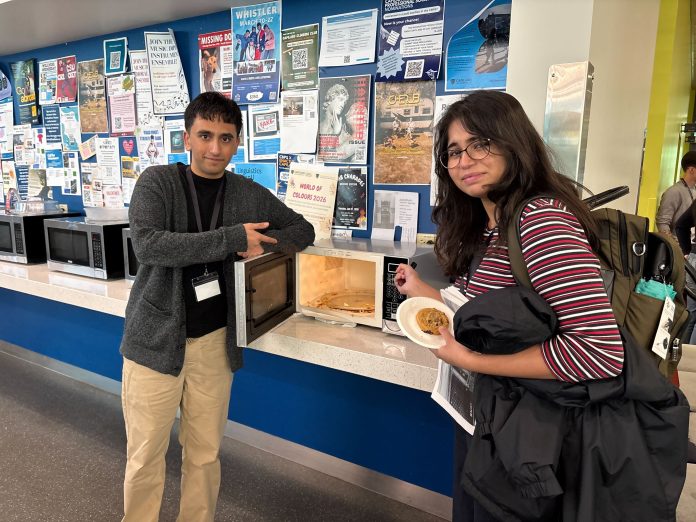
Two humour editors stand next to a microwave with spaghetti spilled all over the inside.
PHOTO: Zainab Salam / The Peak

By: Mason Mattu, Humour Editor

A few weeks ago, The Peak’s staff attended NASH, Canada’s National Student Journalism Conference. While my colleagues went into this weekend with professional development in mind — I had one goal and one goal only. To rid The Ubyssey of their humour editor.

Let me back up and tell you where this beef began. For three weeks leading up to NASH, I had been receiving mysterious messages on my cell phone from a random number with a Vancouver area code. All I was receiving were memes of Shrek and John Pork. One message was a video of someone kicking dirt all over a copy of The Peak flipped to the Humour section. I gasped. What kind of monster would do something like that? I gasped again. I had done the same thing to a copy of The Ubyssey a week before . . . Only a fellow humour editor could have done that. It was time for revenge. A quick email to the previous humour editor from The Ubyssey gave me an unlikely ally (apparently there’s some unresolved shit between them) — someone who hated the enshittification (literally) of the section. 

I looked around on the first day to see my fellow student journalists from across the country equipped with notebooks and copies of their papers to exchange. What losers. Me? I was wearing a bulletproof vest, a clown nose, and a microwave popcorn bag on my left arm. In my ears rang the tune of “Roar” by Katy Perry. No . . . I’m not weird. It was all part of the plan. 

“How many of you are journalists?” Andrew Mrozowski, president of Canadian University Press, posed during the opening ceremony. Everyone’s hands shot into the air except for two people. Me and this one person with googly eyes on her nose. She and I locked eyes. I had secured my target. 

Over the next few days, I pretended to take notes during workshops on topics such as “investigative journalism” and “how to kick your student union in the ass with it.” Yawn . . . until the moment I had been waiting for had come. The humour editor roundtable. I had a plan to eliminate the editor there and then, but we instead ended up joining forces against an anti-humour dude who was moderating the panel. In the most dire circumstances, sometimes our enemies become friends. We answered questions together, rebutted against the slander this guy was spewing, and even shared a few laughs. I had to remember my task. There was no room for distractions.  

As my counterpart and I walked the halls of Capilano, I realized that I had caught her in a moment of weakness. She had been taunting me with those videos, but perhaps she was a changed woman. I shook my head and blasted “Roar.” It was time to get revenge for my people. To establish dominance over the clearly inferior humour section. 

The previous humour editor was stationed by a roughly used microwave in a building. It was now or never. I ran over and opened the microwave, hoping that the soul of the humour editor would be sucked into the microwave. And so it did. The Ubyssey’s humour editor was pulled towards the stench and began laughing like she saw one of my totally funny humour pieces. She got sucked into the microwave portal and transformed into the remnants of spaghetti left in an old microwave. 

I watched in horror as the spaghetti exited the microwave, forming the blob of a human. “You fool. You can’t kill humour,” my Ubyssey colleague spat at me. It was just then that another Shrek meme arrived to my phone. Her and I both looked at each other confused. If she was standing right in front of me . . . who was sending the Shrek meme?

“How many of you are journalists?” Mrozowski asked the students. None of the crowd raised their hands. They were instead generating memes . . . I started receiving a million texts from the same number I thought was from The Ubyssey. It was then that my enemy and I realized that a rivalry had emerged. We will have to work together to defeat them. 
Blackness is not a monolith

0
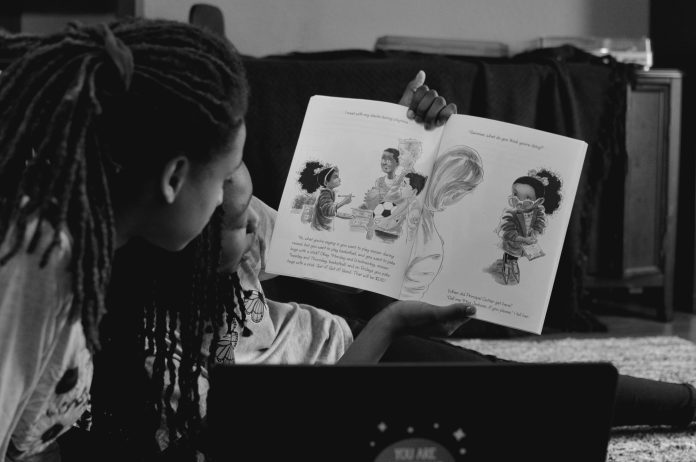
A photo of a kid showing the pages of a kids book to another kid.
PHOTO: IIONA VIRGIN / Unsplash

By: Noeka Nimmervoll, Staff Writer

In Canadian media, when Black individuals are celebrated, their cultural identity is simplified under this single social label, seemingly for the convenience and comfort of other Canadians. The author Esi Edugyan explained to The Tyee that “ideas of what it meant to be a Black person were these kinds of easily digested, maybe monotone depictions of Black characters on downgrade TV shows.”   

It’s time to get more specific about the unique backgrounds that make the Black community so diverse. For true celebration of Black excellence, the unique experiences and identities of Black individuals must be recognized and understood. 

Black is a term used in countries with Black diaspora communities, which often comprise many identities. In many families, the term Black is not used until Western influence and racial differentiation set in; before, they identify with terms such as Ethiopian, Algerian, and Nigerian. This westernization of Blackness seems to operate from the false concept of “white superiority,” both past and present. Historically, Black people in America have experienced heavy stereotyping and profiling that come from a lack of respect within a Eurocentric society, felt both individually and systemically. Creating the idea of a singular Black culture, and with it, a singular idea of a Black person, allows for prejudice and fearmongering to grow in a society. This is not to invalidate the experience and identity of those who are most aligned with being Black. 

Yet, the idea for a singular culture seems to be used for the comfort and simplicity of the rest of the population at the expense of a true acknowledgement of Black histories and experiences. Of course, it reflects the limited Black histories that are taught in BC about a multicultural community that comprises only 1% of BC. Often, because of this lack of Black population and historical education, Black children unfairly become the only representation of Black culture in their school settings, and face unique challenges in representing a falsely monolithic identity alone. It’s not their responsibility to be an emblem of Black culture — they should be allowed to just be kids. 

Identities like Black Canadian, Black Indigenous, and Caribbean Canadian are just a few of the identities that exist in Canada under the umbrella term of Blackness, displaying the many existing intersectional identities.

Intersectionality is a sociopolitical framework that points to the interconnected nature of social categories, wherein the experience of a Black Indigenous woman is not simply the addition of these separate experiences of being Black, Indigenous, and a woman. It provides language to talk about the unique experiences and oppressions that someone who exists at the intersection of these identities experiences. 

Instead of assuming a person is one thing or another, acknowledge their history. Your colleague could identify as Kenyan, Black, or both. Most importantly, the agency of divulging one’s identity should belong to the speaker. The norm should be a Black person sharing their unique story, if they feel like they want to. When you meet someone, no matter their race, have them tell you what their identity is and what they prefer to be called. 

This overarching diversity should be precisely what is celebrated during Black History Month and beyond, and should be a key part of the story when celebrating Black identities in BC.

Black spaces that feel like home

0
An illustration collage: a Black church congregation sitting and standing between wooden pews. A bowl of soup joumou, a brown broth with chunks of vegetables. A package green of hair beads. A package of box braid extensions.
ILLUSTRATIONS: Angela Shen / The Peak

By: C Icart, Co-Editor-in-Chief

Last December, I went home to see my family for the holidays, as I do every year. It was a great time, and after months away, the warmth of being in majority-Black spaces envelopes me. So let me let you in on what these spaces are and their historical significance in Black communities. 

The beauty supply store

When I go back to Ontario, my mom always asks if I want to take advantage and get my hair done. With a smaller Black population, there are fewer options and higher prices out here in BC. In the past couple of years, I’ve been choosing to rock the faux loc* look, but I was feeling box braids* this time. I needed to go to the beauty supply store to execute my vision. I didn’t realize not everyone knew about these stores until non-Black people started asking me where I got the hair for my box braids when I flew back to Vancouver.

Beauty supply stores are magical. Some even refer to them as “sacred spaces” for Black women.

While drugstore selection has improved, the beauty supply store is one of the only places that has a wide selection of products for Black hair. I walk past the relaxers* and beads my mom used to put in my hair as a kid, towards the seemingly never-ending wall of braiding hair. It comes in all colours and lengths. I called my mom over to help me decide on the shade of red and the number of packs I need (nothing is more annoying than returning to the beauty supply shop with your hair half done because you didn’t buy enough hair). Oh, and can’t forget the bonnet*! 


The braider’s house

Black hair salons and barber shops are some of my favourite places on earth (extra points for the ones with TVs playing Afrobeats music videos), but this time we were heading to my mom’s friend’s house. Many Black women take on braiding as a side hustle. On top of making money, they are keeping alive a cultural practice that has existed in Black communities for thousands of years. Different braiding styles differentiated African cultures, and then, the people taken and enslaved during the transatlantic slave trade adapted their hairstyles to their new conditions. This is the origin story of cornrows*, for example. Unlike the times when I’ve fallen asleep while my aunt braided my hair (the process takes hours), visiting this at-home braider was slightly more professional. I showed her the hair and explained the braids I wanted and her expert hands started moving at the speed of light. Lively conversation and cultural exchange (my mom and I are Haitian and the braider is Cameroonian) animated the space as family members walked in and out. Multiple people worked on my hair at once because they had a packed day (it was New Year’s Eve). Both my mom and I walked out looking absolutely fabulous. 


The Black church

As a Haitian Canadian queer and trans person, my relationship with Christianity has been . . . complicated. I was raised Christian, went to Catholic school, and went to church with my mom every Sunday. As I got older and learned more about history, social justice, and myself, I started asking the hard questions. What does it mean to adopt a religion that has been both used to justify the oppression of my people and support the Haitian Revolution? Can I pray next to people who use religion to justify homophobic views? But I also knew that this small local Haitian church was one of the only majority-Black spaces I had growing up. Monday–Friday, I was one of 2–3 Black kids in class feeling like an outcast. But on Sunday, I put on my nicest clothes to go to Sunday school with a bunch of kids that look like me.

We sang songs in French and Haitian Creole and socialized after the service. It was a great place for community and returning as an adult for Christmas and catching up with everyone filled my heart. My Sunday school teacher asked me if I still read the Bible I used to annotate as a kid. I answered with a non-committal smile. 


The kitchen

Home is where the bannann peze* is. My mom always makes this Haitian side dish for me when I come home because it’s my favourite, and I don’t like deep-frying in my poorly ventilated basement unit. Otherwise, cooking is one of my favourite hobbies. So, considering that I’ve learned how to make pad thai, scallion pancakes, and mushroom risotto from scratch, how is it that I barely know any Haitian recipes? The recipes can’t die with me. I’m sure my mom was thinking the same thing because she was very clear that this New Year, I was going to make and drink soup joumou. So I asked for her recipe, went online and read how other people make it and headed to the grocery store to gather the ingredients for my attempt at veganizing the iconic dish. On January 1, 1804, the Haitian Revolution culminated in independence from the French.

Soup joumou* used to be reserved for slave owners, so drinking the soup every year on January 1 is a powerful act. Prior to European colonization, the land now known as Haiti was inhabited by the Taíno people. When they became independent, Haitians got rid of the colonial name given by the French (Saint-Domingue) and replaced it with Ayiti, the Indigenous Taíno name. My parents say I put too many hot peppers in the soup, but I think it turned out just right! 

In past years, I think I approached Black History Month as an opportunity to learn and educate other people about Black Canadian history, because it tends to be overshadowed by African American history. After all, I’m a Black Canadian. But I’m also a second-generation immigrant so, for me, learning about Black history is learning more about Haitian history and celebrating my culture. So from me to you, Bon Mwa Istwa Nwa! Happy Black History Month! 


Glossary 

Bannann peze: This Haitian creole word directly translating to “pressed plantains” refers to fried plantains. Typically, Haitians will soak unripened plantain slices in salted water before frying them twice.

Bonnet: Typically made of satin or silk, bonnets are used to protect hair from the elements. Many people wear them to avoid the friction between their hair and their cotton pillow cases that would lead to hair breakage. 

Box braids: This is a hairstyle where hair extensions are braided with one’s hair. The term box refers to the square shape of the parting for each braid. 

Cornrows: This braided hairstyle can be traced back to 3000 BC “in the Horn and West coasts of Africa.” They were often used to communicate information like marital status or religion. During the slave trade, they were sometimes used strategically to illustrate escape routes. In some cases, they were used as a place to hide seeds that could be used to plant food to survive after they escaped. Today, they function as a common protective style with a rich history in Black communities. 

Faux locs: This is a hairstyle that imitates the look of locs with hair extensions. Locs (sometimes known as dreadlocks) are a hairstyle where sections of hair are matted together to “create a rope-like appearance.” The word locs tends to be preferred over dreadlocks because the term is believed to originate from slave owners calling the hair of enslaved people “dreadful” when it matted after months on ships. 

Relaxer: This is a chemical treatment that permanently straightens curly hair. Relaxers have been fluctuating in and out of style in Black communities since the 1940s. There has been research coming out about the health risks related to wearing relaxers. 

Soup joumou: Blended calabaza squash and Haitian epis (a blended seasoning paste made with garlic, scallions, thyme, and parsley) serve as a base for this iconic soup. It is then customary to add ingredients like potatoes, cabbage, beef, pasta, and leeks.

My musings on Guess Who’s Coming to Dinner at the Vancouver Public Library

0
IMAGE: Courtesy of Columbia Pictures

By: Jonah Lazar, Staff Writer

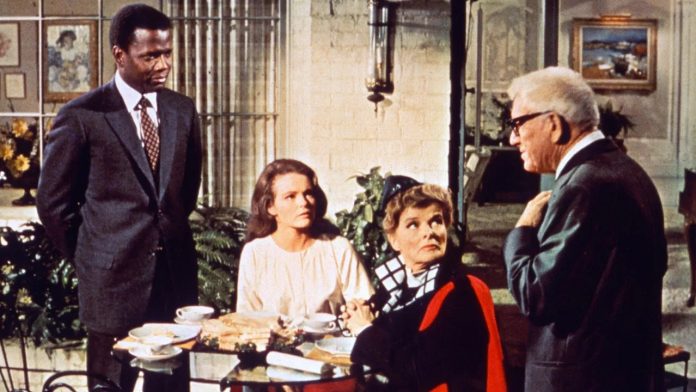
Throughout Black History Month, the Vancouver Public Library is running “Black Brilliance on Screen,” a film series taking place on Friday afternoons to explore prejudice, discrimination, and Black identity. 

February 13’s programme was the star-studded, 1967 rom-com Guess Who’s Coming to Dinner, featuring Sidney Poitier, Katharine Hepburn, Katharine Houghton, and Spencer Tracy. This film is a snapshot of an afternoon when a rich, young, white woman brings home her Black fiancé to meet her parents, and to seek out their blessing for them to get married. The film details how her parents, particularly her father, come to terms with their daughter loving a Black man. Throughout the film, the father, played by Tracy, battles with what he thought were his liberal values and his deep-seated racism. 

This film definitely shows its age when grappling with certain themes; the acceptance of the Black fiancé is largely hinged on the fact that he is a doctor and a professor, among other laudable achievements.

In a way, it seems that this character was turned into an exemplary figure, as this was the only way in which audiences would sympathize with him. The film also leaves much to be desired in the way that the men speak to, and treat, women. 

For me, the most impactful scene of the film is the closing sequence without a doubt. Tracy delivers one last speech in which his character finally comes to terms with the situation, and chooses to support his daughter and fiancé on their journey. While the speech within the film is very touching, the events happening behind the scenes add a layer of gravity, which bleeds through quite visibly. Tracy had been dealing with severe health problems for years leading up to the film, and this scene was his last before he passed away just 17 days later. This final scene continually pans to a heartbroken Hepburn, who plays his wife in the film, but had also been his long-time lover and friend for 26 years. The love and the pain in their eyes as they try to hold it together to finish the scene are truly palpable, and add a depth to this film, which cannot be manufactured. I had been far more critical of this film up until this scene, as prior to the ending it felt like something of a run-of-the-mill vintage movie. However this ending sequence was emotionally captivating and made me feel as though I was watching my grandparents dance together for the last time. Despite certain themes such as sexism and elitism in this movie, I think the end sequence depicting the bittersweet tragedy and loss of these two people who had loved each other for such a long time certainly makes it worth watching.

Personal retrospectives from the As You Are: Celebrating Asian Artists

0
PHOTO: Maya Barillas Mohan / The Peak

By: Maya Barillas Mohan, Staff Writer

Nestled in a repurposed motel painted in bright colours right on Main Street, 15 minutes from the train, One More Life gallery calls quiet attention to itself. Open until February 28, As You Are: Celebrating Asian Artists features more than 30 local Asian artists. I went on behalf of The Peak on Valentine’s Day and met the co-founders of the gallery, Flavia Chan, and Daniel Yang

Enclosed in a small space converted from a reception lobby, the gallery has a small footprint. There are 33 pieces, each by a different artist, and the only restriction was size. Chan says that “this is a show for them to create and express with full freedom however they want.”

I also reached out to Kathy Mak, a featured artist and accomplished SFU alum. Having contributed to The Peak as a student new to creating work, Mak has published, performed, tabled, and judged artwork in the nine years since. She urged viewers to think about their “own roots and journey,” while contemplating her work, teaching me the Chinese saying “勿忘初心,” (wù wàng chūxīn), which roughly translates to “don’t forget your initial heart.”  

The gallery featured an abundance of artists, styles, and interpretations Mak described as “inspiring.

” Art aggregates one into the community, forging a connection to “our respective cultures, other artists, and passersby.”  

 — Kathy Mak, featured artist

Peering at each piece, many in experimental mediums, I thought about my own Southeast Asian heritage. Being mixed, I experienced a variety of cultural traditions cobbled together as I grew up. As an adult I’ve lost touch with some of them. So many of the paintings evoked something nostalgic and sentimental as I gazed at each one.

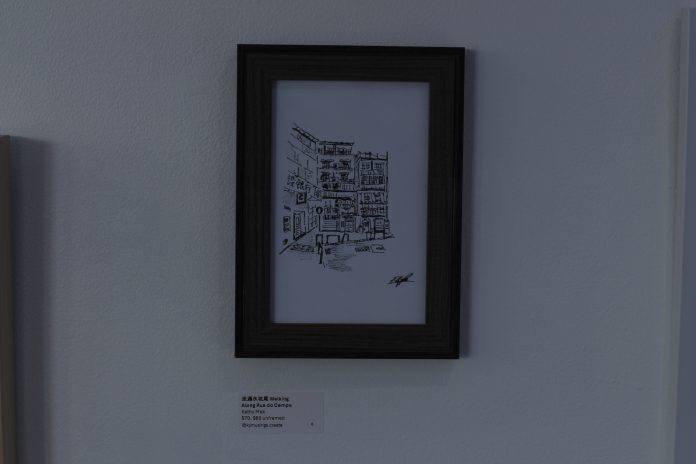
Mak confided that this was her first gallery experience, cherishing the opportunity to share her input on “what it means to be Asian.” Brought to life in the work displayed, Mak incorporated memories of her recent trip to Macao. She characterized the local architecture as “tight-knit and rustic, but [with] a sense of realness to it.” The process of artistic creation allows Mak to “observe, appreciate, and connect with [her] roots deeper.” 

Prominent against a pristine white wall, much is communicated through the colour or a lack thereof in each work. Mak says colour can “transcend a piece to a different level,” but is adamant that there is beauty and charm in black-and-white when a viewer lingers. Mak’s architectural sketches are monochrome, allowing Mak to capture “memorable, happy” moments — her contribution to As You Are is neatly inked on stark white paper. The piece provides clean outlines, and the viewer can wonder where the light fell as the artist gazed upon the reference.

The As You Are exhibition was an immersive experience. Attractions like this are crucial for creating community through production and viewership of the art itself. Interactive workshops make arts and crafts more accessible. Within the narrow display space, I felt completely immersed in something collaborative and expressive. While only open on Saturdays, the exhibition is a must see.

As You Are: Celebrating Asian Artists will be on display at One More Life gallery until February 28.

Beware of evil chipmunk pop stars when raising your child

0
ILLUSTRATION: Cliff Ebora / The Peak

By: Maya Barillas Mohan, Staff Writer

When raising a child, you must follow three golden abstinences. A satisfying life is often defined through experiences gained and pursued, but boundaries are evergreen. Without limiting certain practices, chaos ensues.

  1. Don’t give them an iPad
  2. Don’t allow them to talk back
  3. DON’T LET THEM ANYWHERE NEAR ALVIN AND THE CHIPMUNKS

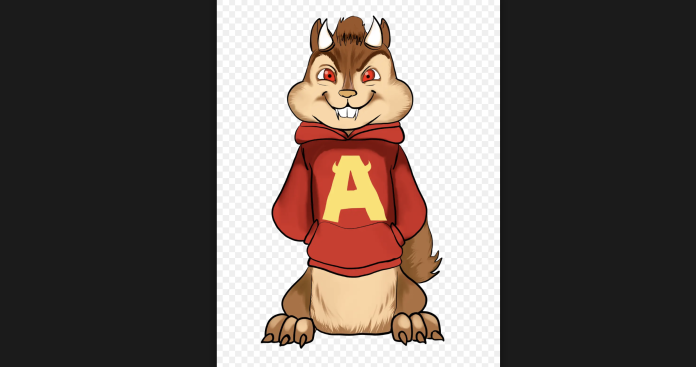
They’re adorable, fuzzy, vivacious little creatures. But they are GROSSLY INACCURATE PORTRAYALS OF RODENTS and possess unnaturally high and squeaky voices. While the appeal of Alvin is gravitational, despite his tiny size, his pathetic, anthropomorphized body must be barred from any and all screens in your home. If you allow your child to engage with Alvin and the Chipmunks in any capacity, you open your life to several dangers. For one, your child may be disappointed that the mice your landlord won’t evict can’t sing or play guitar. They might even attempt to catch one and domesticate it to bring out its hidden talents. Another issue that arises is they may request a CD version (or Bandcamp) of the Alvin and the Chipmunks soundtrack. You will be forced to relive your glory days of youth at the club with covers massacred by a CGI rodent’s abrasive croon. 

The bizarre rodent brothers are managed by their human father. This freak display rejects all genetic logic and is never explained. Imagine trying to explain the birds and the . . . chipmunks to your kid, who already looks nothing like you post-rhinoplasty. If these little scrappy critters are elevated to the dignity of a human child, there is no limit to what your child will believe is possible. You’re going to feel massively intolerant, trying to explain that families have to be composed of people. 

Alvin and his chipmunk brothers are grossly over-decorated, having EIGHT Grammy nominations. This represents the death of art and respect for music as a legitimate enterprise. Alvin and the Chipmunksmusic is pitched up, weakly inspired by the sound of an elementary school choir, without any of the soul behind music production. Their prolific catalogue is evidence that they are not making music for any reason besides the mass market. In Chipwrecked, the chipmunks get stranded on a deserted island en route to a music awards show. You will pray they remain there at the hand of their own hubris, but these squeaky, wretched creatures are infallible.

If you and your child follow this expansive chipmunk franchise, you are participating in the deterioration of art. Alvin doesn’t want to promote friendship or the virtue of learning an instrument — he wants to slap around his gentler and smarter brothers for cheap laughs on the TV. He wants to sell CDs and stuffed animals filled with microplastics. The gullible mom in you might even be persuaded to purchase tiny outfits to dress up these lifeless chipmunk dolls, accessories shrunken leagues beyond use.  

Beyond this, an unrealistic expectation is created about the lifespans of what are essentially glorified pets. The personification of these chipmunks has these three demons stuck at the same age throughout the show, despite a chipmunk only living until three years of age! True parents must order for the public execution of Alvin, Simon, and Theodore! 

Alvin and the Chipmunks does not promote good values, let alone good art. While chipmunks are low on the food chain, they will become a parasite in your home. Ban it.

Students raise concerns over alleged AI-use at the SFU bookstore

0
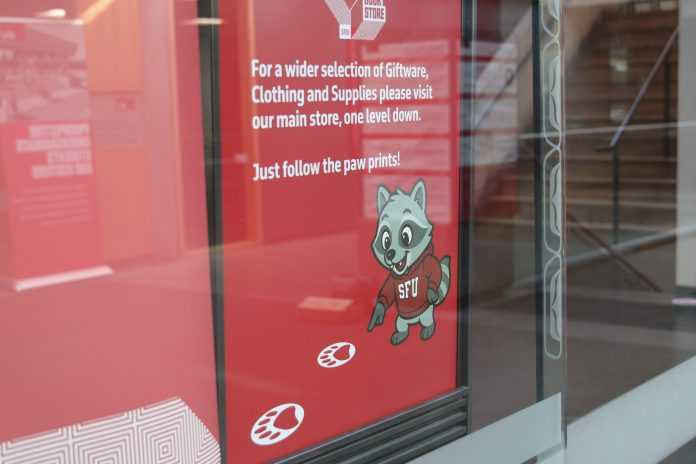
An SFU promotion poster for the bookstore features the raccoon, who is wearing a red SFU hoodie.
PHOTO: Juliana Manalo / The Peak

By: Mason Mattu, Section Editor

Recently, the SFU bookstore began sporting a raccoon graphic on stickers, magnets, keychains, buttons, and t-shirts. This became a topic of discussion on the r/simonfraser subreddit, where users questioned whether the graphics were generated by artificial intelligence (AI). Some pointed to minor variations in the raccoon’s appearance across different items, such as different paw, teeth, and tail styles. One person claiming to work with AI also noted grainy textures, which they believe are synonymous with AI usage. According to Capitol Technology University, AI usage signs in art involve small inconsistencies such as extra fingers or distortions. 

“If they commissioned an alum or current student, the artist would be pretty consistent in their character design. Artists don’t usually change up their character designs for the same project or series of merch,” one Redditor commented. “Sure, it can evolve over time, but these raccoons are used on the same few pieces of merch and posters.”

In a statement to The Peak, the bookstore’s products team lead wrote that AI was only used “at the very beginning of the mascot’s creation,” and not further. 

“I saw there were some comments around the raccoons and bears having slightly different designs or are too pixelated,” the representative said. “The graphic designer made a couple dozen designs of the mascots, so there were some variations between them. As for the pixelation, it’s just the type of medium used.” 

The SFU bookstore told The Peak that their “in-house graphics designer from Document Solutions at SFU” was happy to provide copyright information and drafts for all illustrations. The Peak contacted Document Solutions on four occasions over several weeks but did not receive a response. 

“What has been disappointing is these accusations are made directly for public condemnation; we were never contacted before the post was made on Reddit, presenting speculation as facts and allowing misinformation to spread,” the bookstore representative said. 

“Our reputation was damaged and our designer’s work was disrespected. In an academic environment at SFU and age of AI, exercising critical thinking, research, and source verifications has become more important than ever.” 

Eugene Lee, a design student at Capilano University, told The Peak that if this had been a use of AI, it could have been unintentional. 

“In-house designers also borrow [and buy the rights to a graphic] from clip art websites,” she said. Graphic designers “will be on a clip art website and looking for a graphic that they want, and choose one without knowing it’s AI. The person who made it knows that it’s AI, but the person choosing it might not be good with technology or at spotting AI art.”

The Peak also contacted SFU’s Interactive Arts and Technology Student Union for more input on the designs, but did not receive a response by publication time. 

Mapping bicycle infrastructure across Canada

0
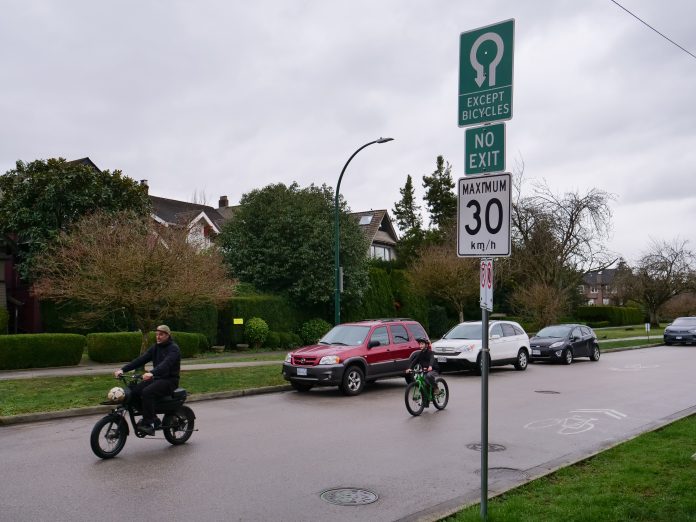
A man and boy bike along a bike road in the suburbs.
PHOTO: Elliott Marquis / The Peak

By: Lucaiah Smith-Miodownik, News Writer

How far can two wheels take you? For SFU health sciences professor Dr. Meghan Winters, this is a question worth exploring. 

Winters works in the cities, health & active transportation research lab, which focuses on “the intersection of population health, urban environments, transportation, and safety to produce evidence to support practice, policy, and programs.” Recently, she headed a study chronicling the changes in bicycle infrastructure, or the various roads and paths intended for cycling, in Canada from 2022 to 2024. The Peak spoke with her for more information. 

Without a trail to follow, Winters and her team had to build their criteria before assembling a map of cycling networks across Canada in 2022. Doing so meant finding a way to measure the different types of bikeable areas throughout the country. “Not all bike lanes feel equal [ . . . ] there’s different levels of both comfort and objectively measured safety on different kinds of cycling infrastructure,” she said.

After researching engineering design guidelines and public health evidence, the team created the “Canadian bikeway comfort and safety” classification system. Bike infrastructure was rated as high, medium, or low comfort. High comfort meant “bike-only paths, cycle tracks, and local street bikeways,” while medium comfort was “paved multi-use paths,” and low comfort was “painted bike lanes.” From there, the team took their newly founded rating system and applied it to OpenStreetMap to form their own map.

According to the study, plotting cycling network data is a key step in “supporting healthy transportation options in cities of all sizes,” especially when some cities are removing bike lanes. 

The 2024 map indicates that the total distance of bike paths and lanes increased from 23,502 kilometres in 2022 to 27,089 two years later, with most additions being classified as medium comfort. Additionally, more growth was charted in small and medium cities (populations of 50,000 to 499,999) as opposed to large ones. “Areas with greater populations of recent immigrants, racialized people, and people with low incomes,” as well as “areas with lower proportions of populations of children and older adults” also saw more expansion.

Winters clarified that while these areas may see more bike infrastructure, it is not necessarily built with these populations in mind. In reality, busier streets with bike lanes may be home to more newcomers or lower-income populations, while children and families may live in more residential areas.

“When cities are planning their infrastructure, they have different criteria in mind, and the criteria may not be ‘are we building infrastructure near kids and the places kids need to go.

— Dr. Meghan Winters, SFU health sciences professor and lead author of the study

In regard to Vancouver, the city “showed little change over the time period” in terms of bike networks. “There is high-density cycling infrastructure in some areas, in the business district, around the Seawall [ . . . ] and yet there are a lot of areas of Vancouver that are very underserved,” Winters explained. Such a layout agrees with the study’s findings that “a common pattern in many cities’ cycling infrastructure is a focus on connecting to business districts, but often fewer connections between neighbourhoods.” 

“All through South and East Vancouver, it’s very hard to ride your bicycle. The connections aren’t there, the protection isn’t there, and it makes it hard for the people living in those neighbourhoods to be able to get across town to the places they need to go.”

These findings could inform future work, such as “offering the potential to explore linkages between cycling infrastructure and health and social outcomes.” They also support “evaluat[ing] the existing cycling network and prioritiz[ing] investments for populations who have been underserved or are underrepresented in the cycling community” when looking to expand bike networks in the future.

We can’t keep borrowing America’s story

0
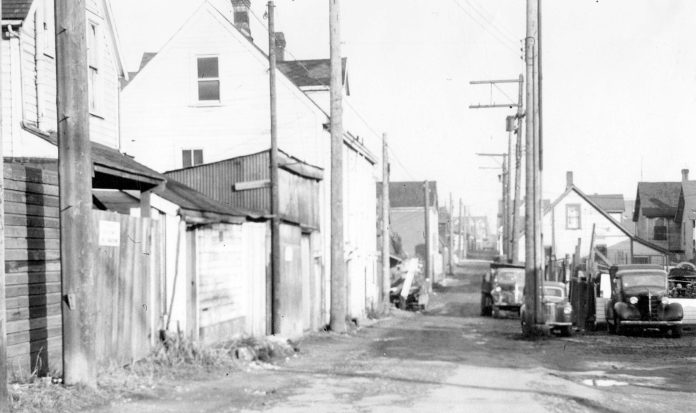
a black and white photo of Hogan's Alley.
PHOTO: Courtesy of A.L. Yates / City of Vancouver Archives

By: Jonah Lazar, Staff Writer

In 2018, Canada made a historic decision to feature Viola Desmond on the $10 bill. In 1946, Desmond refused to leave the implicitly whites-only section of a movie theatre, leading to her being fined and jailed. Her case is often credited with having helped kickstart the Canadian civil rights movement. She is the first Black person, and first the Canadian woman, to stand alone on one of Canada’s banknotes. 

This was a watershed moment in the public perception and recognition of Black Canadian history. Unfortunately, there are still instances when Viola Desmond is referred to as “Canada’s Rosa Parks.” This is a common theme in Canada. Our proximity to a country with a sociopolitical influence like the US has often meant we adopt aspects of their history at the expense of learning about our own. During Black History Month, many of us will be exposed to stories of Martin Luther King Jr., Malcolm X, and the aforementioned Rosa Parks, due to their prominence in American media, which has a tendency to seep into our country. In Canada, these figures often take centre stage at the expense of championing the Black civil rights activists who fought for equality domestically. Viola Desmond, as well as many other Canadian civil rights activists, such as Charles Daniels and Lulu Anderson, who were both denied entry to theatres in Alberta, have for too long remained in the shadows of civil rights activists south of the border. 

This isn’t to say that the US’ civil rights movement shouldn’t be taught — the stories of freedom fighters in the US should be acknowledged — but it definitely shouldn’t be the focal narratives in Canada. Centring US stories erases the champions of Canada’s civil rights movement and creates a situation where accountability for the oppression of Black people in Canada goes unaddressed. This gives Canadians a false sense of their state’s innocence, as it allows them to focus on the injustices abroad in which they did not explicitly participate. This serves to erase the long, uncomfortable history of systemic oppression of Black people in Canada. Centring American history comes at the expense of acknowledging that segregation in some Canadian public schools continued until the 1980s.

We talk about Harlem at the expense of Africville.  

Centring Black Canadian history during Black History Month is crucial to rightfully celebrate Black Canadian civil rights activists whose contributions have not been recognized as much as the work by their American counterparts. In doing so, we situate Black Canadians who fought for civil rights in our country as being a visible part of our cultural fabric, rather than a mere spillover of the movement in the US. Finally, confronting these elements of Canada’s past creates important and necessary dialogue about the realities of discrimination still felt by Black people in Canada.

Student advocacy is a frontline defence against the war on Ukraine

0
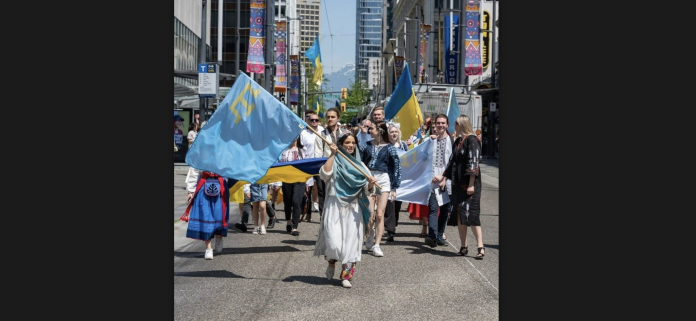
a photo of a student protest in solidarity with Ukraine, by the Ukrainian Student Society of SFU.
PHOTO: Courtesy of @sfu_uss / Instagram

By: Iryna Shyshkina, SFU Student

Student advocacy has, historically, played a significant role in creating social change. For some, student advocacy is a necessary outlet to share one’s voice. This has become especially necessary for Ukrainian students. Some talk about Russia’s invasion of Ukraine, as if it began suddenly in February 2022. For Ukrainians, especially those in the diaspora, this framing is not just inaccurate; it is exhausting. Russia’s invasion of Ukraine is not a new crisis, but a long and escalating aggressive campaign that has shaped Ukrainian lives. For this reason, student advocacy becomes something larger than spreading awareness; it is a form of survival, resistance, and a fight to preserve cultural identity. 

After Ukraine regained independence in 1991, Russia continued attempting to maintain control through various tactics. Through acts of political pressure, economic coercion, information warfare, and efforts to undermine Ukrainian sovereignty. Russia’s aggression escalated in 2014 with the illegal annexation of the Crimean Peninsula and the creation of the so-called Donetsk and Luhansk “People’s Republics,” which were never recognized by Ukraine or by the international community. When the war is framed as something that just began in 2022, it pushes unaffected people to treat it as a single shocking event rather than a long struggle, perhaps making it easier to detach and grow numb over time. For Ukrainians, there has been an attack on our sovereignty, identity, and safety that is felt in all brutality on a daily basis. 

For those living outside of Ukraine, this creates a different but deeply personal loss. Many Ukrainian Canadian diaspora members worry about the physical safety of their loved ones, while also being emotionally attached to daily violence and horrors that are happening there.

Many in my community, including myself, have family members in Ukraine — waking up with news that our cities have been bombed, and not having the ability to contact our relatives immediately due to power outages.

This is a hard reality that many Ukrainians face. Advocacy becomes a sociopolitical necessity.

This is why student advocacy matters. All over Canada, students have rallied in support of Ukraine through student-led organizations. From McGill, to the University of Toronto, to the University of Victoria. The student body at SFU is no exception: the Ukrainian Student Society (USS) exists not only to raise awareness, but to actively counter discrimination, preserve historical context, and transform care into action (such as fundraising). In a media environment, where the situation is depicted as “complicated,” this student-led space provides verifiable information, education, and human support. Through events, lectures, cultural programming, and organizing, it allows us to keep Ukraine present, as a lived and ongoing reality. 

Advocacy helps counter feelings of helplessness. Seeing others speak up, post, organize, and become a voice for the Ukrainian people restores a sense of hope, reminding us we are not alone. 

Student-led advocacy is practical solidarity. The USS collaborates with organizations like All-Ukrainian Association “Patriot,” which supports adults and children affected by the war and assists Ukraine’s defence efforts through humanitarian initiatives. It also works with the Ukrainian Canadian Congress, which represents Canada’s Ukrainian community, advocates for their interests before the government, and strengthens cultural and political linkages with Ukraine. Advocacy can produce positive, tangible impacts. Cultural preservation happens not only through memory, also through active support and community mobilization. 

Russia’s war on Ukraine is about more than territory. It is a matter of whose history survives, whose culture continues, and whose future is allowed to exist. By organizing, educating, and sustaining Ukrainian culture overseas, the community resists erasure in real and meaningful ways. Student advocacy is not just a symbolic support; it is a real defence of identity, culture, and justice.