Home Blog Page 1099

University Briefs

0
Canadian university fees are projected to increase by 13 per cent over the next four years.

Costs of Canadian universities to rise over the next four years

School fees at Canadian universities are projected to increase by a university average of 13 per cent from $6,886 this fall to $7,755 over the next four years, according to a report released earlier this month by Canadian Centre for Police Alternatives.

Provincial funding for universities is insufficient, the report said. The resulting funding gap drives universities to push more costs onto students by charging additional compulsory fees on top of tuition.

“What we are seeing are some institutions actually implementing new fees entirely: fees to graduate, for example, or facilities fees,” said Erika Shaker, director of the education project at Canadian Centre for Policy Alternatives.

With files from The Canadian Press

U of T tops Canadian universities on World Rankings list

In this year’s new QS World University Rankings, released on September 16, U of T rose above all other Canadian universities to place 20th. It was closely followed by McGill in the 21st spot.

Overall, 18 out of 20 of Canada’s top-ranking universities — including SFU, which placed 222 — showed strong improvement in their standings; SFU moved up 22 spots from the 2013 rankings.

QS noted that “the strongest indicator for the improvement of Canadian institutions in the past year was that of academic reputation.”

With files from The Montreal Gazette

McGill-led projects awarded Brain Canada grants

Thirty-two projects at McGill University received major grants under the Canada Brain Research Fund. Four projects, led by researchers in the neurological field, were aimed at understanding the functions and dysfunctions of the nervous system and their impact on health.

This research will help to better our understanding of the nervous system and lead to new methods of diagnosis for all types of neurological and mental illnesses.

“The team grants and platforms we are announcing today showcase Canada’s important contributions to the global effort to understand the brain and brain diseases,” said Inez Jabalpurwala, president and CEO of Brain Canada.

With files from McGill University News and Events

UniverCity celebrates 10th anniversary

0
The celebration's events spanned the whole week

This fall, SFU’s UniverCity community celebrated the 10 year anniversary of its development on the east side of Burnaby campus.

Events were held all last week to commemorate the occasion, culminating in a community block party on Saturday, September 20. These included a market, a wine and beer tasting at Club Ilia, and an outdoor family movie night.

The block party featured musical performances by local buskers and children’s entertainers Bobs n’ Lolo, a birthday cake, as well as activities such as a bouncy castle and rock climbing.

Director of development for the SFU Community Trust Dale Mikkelsen told The Peak that the event was, “largely family focused, [including] a big BBQ put on by Nesters,” all free of charge.

When first considering the area that is now UniverCity, developers had the opportunity to build up to 4,500 homes and also had the option to expand into SFU’s 700 acres of land down the side of Burnaby Mountain.

Mikkelsen explained that through a design process in the late ‘90s, “it was decided that it would create a more vibrant and sustainable community if all those homes were built in a higher density — all on the mountaintop, adjacent to the university.”

He continued, “What we could have had was the typical sort of development of single-family homes and townhouses. Instead, we decided to go for a high density community on a small portion of the land. The big move was converting that almost 700 acres of land into a conservation area.”

Over the past 10 years, UniverCity has grown into a community of about 3,800 residents and several businesses. It boasts its own elementary school — University Highlands Elementary — and an award-winning childcare centre.

Mikkelsen spoke to the significance of these further developments: “One of the biggest successes we’ve had so far is going from just building buildings, to building a community.”

There are plans to develop the next building along University High Street, across from Nesters Market. This new building will provide 30,000 square feet of community space and, like other High Street developments, will have commercial space with residences above.

The next goal of the SFU Community Trust is to develop another residential “phase four” neighbourhood on what is being called the “South Slopes,” located on the east side of Tower Road, south of University High Street — an area that is currently home to only a few closed parking lots.

“That will be a great area because it’s south-facing,” said Mikkelsen. “It will really suit young families. [. . .] We’ll also be establishing a second neighbourhood park down there as well.”

Once these new developments are in place, the SFU Community Trust expects the number of UniverCity residents to increase to just under 10,000 people.

To conclude, Mikkelsen commented on the impact UniverCity has had on SFU as a whole. “You can certainly see how it has changed SFU from feeling like a commuter campus — where it’s just students arriving in the morning and leaving at night — to sort of a more vibrant community,” he said.

“I’ve noticed over the past couple years how SFU and UniverCity are becoming the same place. [. . .] It is really starting to become this cohesive place,” he concluded.

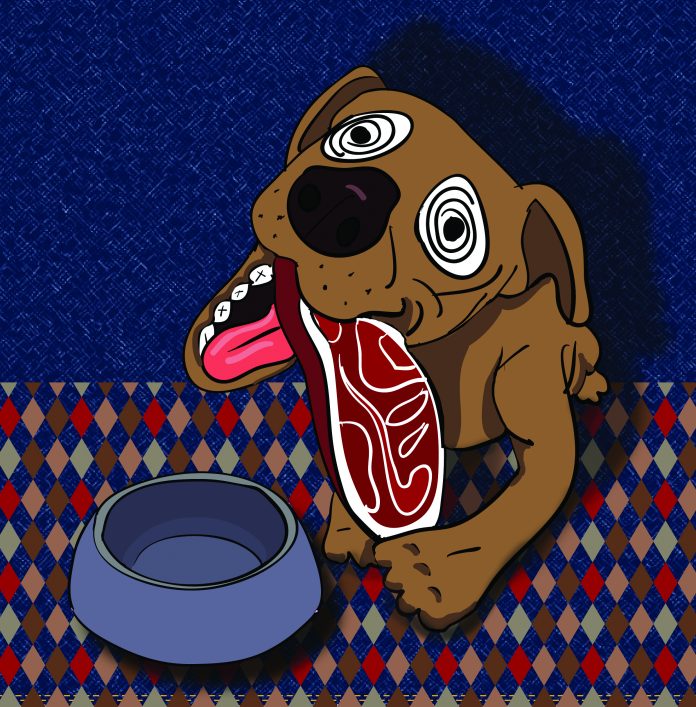
Pet owners should consider the raw food diet

1

Dog and cat owners want what is best for their pets. From exercise to toys and collars, we will do anything to keep our pets healthy and happy. The most important factor for a healthy pet is their diet. In this vein, a new trend is on the rise surrounding what food is best to feed your dog or cat. While many stand by the traditional kibble and wet food, raw pet food diets are steadily gaining popularity due to their healthy nature.

I first came to learn of the raw pet food trend earlier this year when a friend told me that he regularly feeds his Doberman puppy raw meat — within weeks, he noticed that the dog had gained increased jaw strength and bone structure, and was more energetic.

My friend credits these positives to the dog’s diet. Raw food diets are full of vitamins, proteins, and essential fats that can help dogs and cats maintain a healthy lifestyle, reminiscent of their undomesticated ancestors. Wild dogs and cats would seek food for themselves, taking nutrition from small animals and plants, whereas the dry and wet food that we feed pets now is a completely man-made product.

The problem with wet and dry pet food is that we, as consumers, can never be entirely sure of what it contains. However, feeding your pet raw food, which you can be sure has the nutritional benefits that your pet needs, nullifies this doubt.

Raw organ meat contains essential fatty acids that animal’s bodies cannot produce.

For example, raw organ meat contains essential fatty acids which the body cannot produce. Raw meat is also very low in carbohydrates, which are not ideal for pet health but are nevertheless plentiful in both dry kibble and wet food.

Feeding your pet a raw diet does have certain drawbacks, such as the risk that your pet could catch a food-borne illness. Perhaps your pet has the tendency to swallow its food whole, which is especially dangerous if given a raw meat bone. However, a little more care on behalf of the pet owner is all that is needed. Make sure you take care in handling and preparing their meals, and that you really know your pet before beginning them on the raw food diet.

Cost is another possible issue with the raw food diet. While a large bag of dry kibble can feed your dog for a dollar per day, some companies charge about seven times that for two of their raw patties. For a cheaper food source, I would suggest you visit your local grocery store.

Most stores sell raw organ meat for only a few dollars, and you can always discuss the possibility of finding raw meat bones, with your butcher. If time and cost are currently restrictive factors for you, a good option would be to gradually ease your pet into the diet.

As a new pet owner, I have been researching the raw food topic on and off for the past several weeks, and with anecdotal encouragement from friends and from the Internet, I can’t wait to start my Wheaten on this healthy diet.

Feeding your pet raw food is more time consuming and requires a little more owner involvement and supervision. However, when executed well, the benefits outweigh the drawbacks, leaving you with a healthier and happier feline or canine.

Fall Kickoff largest concert yet

0
The stage featured projectors, smoke machines, and a light show

With over 1,750 attendees, the Fall Kickoff concert last Friday was one of the biggest events the Simon Fraser Student Society (SFSS) has ever organized.

The concert was the third event of this kind that the SFSS has put on within the last year. Acts included electronic artists, LuvLyf, DJ Lazy Rich and Paris & Simo, alongside local bands BESTiE and The Faceplants.

The event had been in the works since June, when the SFSS announced that the fall concert would feature both bands and DJs, unlike the previous Fall Kickoff and Spring Sendoff.

As the venue opened up to concert-goers, Shirin Escarcha, SFSS faculty of communications and technology representative, told The Peak, “Set up went really well, prep went really well, and the show is underway.”

At 5:00p.m., the first band, BESTiE, took the stage in front of a small crowd. Following their performance, SFU (and Peak) alumnus Colin Sharp entertained the crowd with moustache jokes and joviality.

“I’m honored to host, and it’s fun to come back and be part of something cool, because when I started the SFSS didn’t throw a lot of big events,” Sharp said. “I’m honestly proud of how far the SFSS has come, so it’s really cool to see this.”

When asked about what he thought of the event so far, Sharp replied, “I’ve been spending a lot of time sitting in the pub drinking whiskey, and so my impressions have been very positive.”

The Faceplants took the stage at 5:45p.m. as more people filed in. Dan Botsch, lead vocalist of the band, spoke with The Peak before performing; “It’s our first time playing [at] any university ever, so this is going to be nuts. We’re so happy to be here.”

Botsch continued. “I think [SFU] is awesome. This is one of our first outdoor shows as well. This is the perfect setting for us.”

The tone of the show shifted when The Faceplants concluded their set and LuvLyf took over. A Vancouverite herself, LuvLyf brought her unique blend of live vocals and electronic music to the stage, transitioning the event from rock show to an electronic dance music (EDM) concert.

Following Luvlyf, Lazy Rich took over for the latter half of the show. A last-minute replacement to the lineup, Lazy Rich was added after Thomas Newson canceled his appearance.

Zied Masmoudi, project lead, assured The Peak that the circumstances were out of the SFSS’ or the artist’s control: “Thomas Newson did send a letter of apology. He [was] really sorry that he [was] not going to be able to play tonight in front of SFU students and he promises he is going to make it up.”

The event concluded with a performance by headliners Paris & Simo, after which concert-goers headed to the Highland Pub’s official after party. DJ competition winner GlideForm kept the party going late into the night alongside DJ Sajjid and Lazy Rich.

Regarding the night as a whole, Masmoudi seemed pleased. “Convo Mall is packed, a lot of people out there are having a lot of fun, sets are going really good so far,” he said. “I have personally seen a lot of talent, which is something that we promised at the beginning of the summer.”

Letter to the Editor

0

Dear editor,

In Adam Bielka’s op-ed “TA-dating article unfairly persecuted,” the author unfairly persecuted what was, in my opinion, a fair and justified response to a senseless article. I believe that Mr. Bielka repeats some of the naïve assumptions made by the writer he is defending, Robert Nanni.

I also graduated from the “not terribly significant” University of Western Ontario and was a TA there. I am familiar with the controversy and take offence that Mr. Bielka accuses those who responded to the original ‘TA dating’ article of not reading it. It seems he didn’t read their responses very closely either.

Social media did not drive the so-called Nanni ‘witch hunt.’ As someone who read the original article and knows people who responded to the article early on, I witnessed the very sound and informed commentary the article received from parties with a vested interest in TA-student relationships, and are concerned about an already pervasive problem with sexual harassment and assault on university campuses.

However, I am more astounded by Mr. Bielka’s minimization of the issue taken with this article regarding sexual harassment. I will cite the Human Rights Policy this university uses in determining whether certain behaviours can be considered instances of sexual harassment.

Sexual harassment is considered to be behaviour of a sexual nature by a person who, firstly, knows or ought reasonably to know that the behaviour is unwanted or unwelcome,  and secondly, interferes with another person’s participation in a university-related activity, or thirdly, leads to or implies job or academically-related consequences for the person harassed.

One of the naïve assumptions I ascribe to Mr. Bielka relates to his belief that power-relations go only one way between a TA and a student, conflating the issue of the TA objectification and delegitimation with an inability by the ‘all-powerful’ TA to assert control over a situation where a student shows sexual interest towards him or her.

First of all, TAs are not all of the same age, with the same level of experience, cultural background, or personal histories. I have worked alongside many graduate students fresh out of their undergraduate degrees, who are no more than 21 or 22 years old.

Because of the nature of labour exploitation in universities, TAs may be entering the position with little or no teaching experience, let alone training on how to navigate situations which Nanni encourages in the article. Younger TAs may very well be struggling with self-esteem in their new position of authority, and be unsure of what actions to take in scenarios involving students.

To the UWO community, it came as a surprise that an article written in The Gazette would so blatantly undermine this relationship and make a mockery of education in the university. If the union had its way, every student reasonably ought to know that sexual advances by their TA are unwelcome because it’s universally understood that TAs play an integral role in their education.

Furthermore, there are people pursuing academic careers for whom TA-ships represent crucial teaching experience, and who can be affected adversely psychologically, should the behaviour Nanni encourages have triggering effects for a sexual violence survivor. To call these concerns exaggerations, I’m sorry to say, is another example of ignorance relating to silence around issues of sexual assault and harassment.

Overall, Mr. Bielka’s article reflected uneducated and ignorant opinions surrounding TA-student relationships at universities, and brushed off the contradictions this article has with etiquette in the graduate community.

Sincerely,

Siobhan Waters, SFU Student

Community members advocate for preferred names on student IDs

0

Two SFU community members, in collaboration with members from SFPIRG and Out on Campus, have started a campaign to create a university policy which would allow students to have their preferred names on their student ID cards.

Lucas Crawford, Ruth Wynn Woodward lecturer in the Department of Gender, Sexuality, and Women’s Studies (GSWS) and a transgender individual himself, is embarking on a campaign with GSWS student Nathan Lyndsay to make self-identification more comfortable for transgender students at the university.

The issue concerns the university’s current policy which does not allow students to use their preferred names on their IDs. According to Crawford, this is not feasible or even always safe for transgender students.

“The problem with the current lack of policy I would say is it is one of safety, and one of access, and one of choice. And by that I mean that it should be up to a transgender student when and if they want to disclose their transgender status to other people,” Crawford said.

Beyond formal activities, such as registering for classes or paying tuition, students at SFU use their ID cards in places such as the library, the bookstore, and the cafe. These are all situations in which a transgender student might have to disclose “a really intimate piece of [their] past, [their] old name,” said Crawford.

In addition to transgender individuals, the ID issue also concerns international students who may prefer to be called by a different name, as well as students who go by names other than those on their birth certificates.

Lyndsay told The Peak that the only place he has ever seen his preferred name appear is on the online Student Centre and on his email.

“I looked into it, emailed some people in the department, and they told me that the university requires that you use your legal name on your student ID because it can be used as a secondary piece of legal ID,” he said. “I can understand that, but I think there should still be a trans policy.”

Although legally changing one’s name might seem to be a solution to the problem, Lyndsay explained that many students can’t afford to undergo the process.

He echoed Crawford’s concerns that the current situation carries a risk factor for trans individuals: “It makes it unsafe. It puts someone at risk of being outed, [facing] violence, feeling uncomfortable, having to explain your identity to people. You don’t always want to be on the defensive all the time.”

To cast a spotlight on the issue, the two threw an ID Modification Party with Out On Campus on September 17. At the event, students were encouraged to laminate over their current student ID cards, replacing their “wrong” names with their preferred names. “I think [the event was] a first step to a long-term solution that needs to happen,” Lyndsay said.

Next week, Crawford and Lyndsay are meeting with Tim Rahilly, associate vice president, students, and Mark Walker, SFU’s registrar, to propose changes to the university’s policy.

Crawford said he believes the university could have an effective policy in place for students arriving at SFU in fall 2015.

Regarding the meeting next week with administration, he said, “I’m hoping that we can show them just how exciting for SFU it would be to take the lead on this issue, and I hope that we can [work towards] figuring out how to move forward with the new initiative.”

Protesters rally against pipeline proposal

0
Protesters rallied at the site where Kinder Morgan intends to build a helicopter pad for equipment transportation.

Protesters flocked to Burnaby Mountain on Saturday, September 13 to oppose Kinder Morgan’s survey, which is investigating how they can triple their pipeline operation in Burnaby.

Kinder Morgan is conducting the survey despite the city’s opposition to the project — demonstrated recently in an injunction filed by the city. The injunction was rejected last Wednesday by a BC Supreme Court judge.

Event speakers included SFU professor of English, Stephen Collis, Burnaby Mayor Derek Corrigan, President of the Union of BC Indian Chiefs Grand Chief Stewart Phillip and Carlene Thomas with the Tsleil-Waututh First Nation Sacred Trust, among several others. During the event, several protesters chained themselves to Kinder Morgan’s Westridge Marine Terminal.

The speakers expressed their concerns for both the local and global climate. Many noted that the protest on Burnaby Mountain reflected the need to stand up against climate change altogether.

Collis set the mood for the event, describing the proposed pipeline expansion as “three times the amount of diluted bitumen and crude oil [. . .] loaded into three times as many tankers here in our harbour, [dumping] three times as much carbon into our atmosphere,” saying, “That is not acceptable.”

Collis told The Peak that SFU students need to interrogate the meaning of “living exactly where climate change is happening.”

In response to questions about society’s increasing need for oil, Collis said, “We need energy, but oil is not the only way to get energy.”

He continued, “There is a way of carefully transitioning [. . .] from fossil fuels to a replacement, but [Canadians are] not starting that transition. In fact, we’re going the other way.”

Mayor Corrigan then spoke about the support he feels from the city in his decision to oppose this project. According to polling, Corrigan said, “70 per cent of the people in Burnaby are supporting us in the efforts that we are making, and more are being added each and every day.” For him, the protest represents a stand “against the kind of corporate interests that are tending now to control so much of our culture.”

Corrigan believes the opposition also marks a desire to preserve the park. The city bought the conservation area from SFU years ago, which was done “to ensure that we were [. . .] the guardians of this conservation area.”

Of Kinder Morgan specifically, Corrigan cited concerns that the corporate “Goliath” would deem the mountain unsuitable to house the pipeline expansion, resulting instead in a push for it to be routed through the conservation area.

He said that the destruction to the people, the city, and the wildlife of Burnaby caused by a tanker spill in the inlet would mean that “no one would want to come to British Columbia to see what was one of the most beautiful cities in the world.”

He continued, “We’ve just increased [oil spill] odds by seven times as a result of this project.”

Grand Chief Stewart Phillip similarly showed distrust of the corporation and concerns for the environment. “A spill is a spill is a spill,” he said. “We know the absolute devastation that that will wreak on this beautiful land, and how devastating and destructive it will be to so many tens of thousands of lives. And yet KM and their cronies in government could [not] care less.”

He called on “the power of the people,” to hold government and companies accountable.

A final environmental assessment report by Kinder Morgan is due to cabinet on January 25, 2016.

Men need to get on board with male contraceptives

0

In a publicly issued release, the Parsemus Foundation declared that male birth control will be widely available by 2017.

Parsemus is an organization that currently possesses US property rights for Vasalgel, the trade name for “reversible inhibition of sperm under guidanc” (RISUG). RISUG is a procedure involving the injection of a synthetic polymer into the male vas deferens. This polymer prevents sperm from penetrating the female ovum, thus nullifying the opportunity for pregnancy. It is cited as quick, painless, and reversible.

Although no major media outlets have followed up with Parsemus — with the public release mostly circulating among smaller online news outlets — the simple mention of male birth control forces us to re-examine a number of questions, most notably whether men will be obligated or even willing to undergo the procedure.

Because the most effective options for contraceptives, beyond surgical procedures, were products exclusive to women, men have been able to discard much of the birth control burden. Even if a man wanted to assume a larger responsibility, options were relatively limited, with the most effective procedure (vasectomies) being quite invasive.

But assuming Vasalgel or an alternative does become readily accessible in the near future, promising all the effectiveness of a vasectomy without its invasiveness, the contraceptive unavailability argument will become moot. Should a couple wish to have intercourse without the intent to conceive, there will be a means for the male to take responsibility for pregnancy prevention.

Because most contraceptives are women-exclusive products, men can discard the birth control burden.

Supposing that the effectiveness of the contraceptive and its inconvenience to the user is equal for men and women — who is then responsible for assuming the contraceptive burden? 

In examining the impact of an unplanned pregnancy, it is rational to suppose that this would disrupt the woman’s life more than the man’s. Even ignoring the physical inconvenience of carrying a child to term, a pregnancy can threaten the health of the mother herself. Also, women often find themselves in the financially disadvantageous position of being removed from, or unable to enter, the workforce. Men are able to avoid these consequences.

There is also the risk that a woman’s partner might leave her before she carries a child to term. Despite laws requiring that absent partners pay child support, there are many scenarios where the pregnant woman cannot determine who the father is, or is unable to contact him, leaving her financially despondent.

The logical conclusion is that responsibility should fall on the man. If a man wants to be participatory and, quite frankly, considerate, he should be willing to accept male birth control should his partner reject female birth control. Men should take proactive measures to avoid putting women at risk.

As facts about the health implications of Vasalgel-like procedures become more publicly known, the idea that they might not be as dangerous or disruptive as female hormonal contraceptives would place even more responsibility on men. If men wish to engage in a responsible relationship, they must be willing to accept the true responsibilities of a male role and avoid putting their partners at risk as much as possible.

Community members advocate for preferred names on student IDs

0

Two SFU community members, in collaboration with individuals from SFPIRG and Out on Campus, have started a campaign to create a university policy which would allow students to have their preferred names on their student ID cards.

Lucas Crawford, Ruth Wynn Woodward lecturer in the Department of Gender, Sexuality, and Women’s Studies (GSWS) and a transgender individual himself, is embarking on a campaign with GSWS student Nathan Lindsey to make self-identification more comfortable for transgender students at the university.

The issue concerns the university’s current policy which does not allow students to use their preferred names on their IDs. According to Crawford, this is not feasible or even always safe for transgender students.

“The problem with the current lack of policy I would say is it is one of safety, and one of access, and one of choice. And by that I mean that it should be up to a transgender student when and if they want to disclose their transgender status to other people,” he said.

Beyond formal activities, such as registering for classes or paying tuition, students at SFU use their ID cards in places such as the library, the bookstore, and the cafe. These are all situations in which a transgender student might have to disclose “a really intimate piece of [their] past, [their] old name,” said Crawford.

In addition to transgender individuals, the ID issue also concerns international students who may prefer to be called by a different name, as well as students who go by names other than those on their birth certificates.

Lyndsay told The Peak that the only place he has ever seen his preferred name appear is on the online Student Centre and on his email.

“I looked into it, emailed some people in the department, and they told me that the university requires that you use your legal name on your student ID because it can be used as a secondary piece of legal ID,” he said. “I can understand that, but I think there should still be a trans policy.”

Although legally changing one’s name might seem to be a solution to the problem, Lyndsay explained that many students can’t afford to undergo the process.

He echoed Crawford’s concerns that the current situation carries a risk factor for trans individuals: “It makes it unsafe. It puts someone at risk of being outed, [facing] violence, feeling uncomfortable, having to explain your identity to people. You don’t always want to be on the defensive all the time.”

To cast a spotlight on the issue, the two threw an ID Modification Party with Out On Campus on September 17. At the event, students were encouraged to laminate over their current student ID cards, replacing their “wrong” names with their preferred names. “I think [the event was] a first step to a long-term solution that needs to happen,” Nathan said.

Next week, Crawford and Lyndsay are meeting with Tim Rahilly, associate vice president, students, and Mark Walker, SFU’s registrar, to propose changes to the university’s policy.

Although the university has yet to discuss the initiative, Rahilly told The Peak, “I look forward to speaking about this and SFU will do its best to respond to concerns while balancing our role of protecting the authenticity of student identity and credentials we issue.”

Crawford said he believes that the university could have an effective policy in place for students arriving at SFU in fall 2015.

Regarding the meeting next week with administration, he said, “I’m hoping that we can show them just how exciting for SFU it would be to take the lead on this issue, and I hope that we can [work towards] figuring out how to move forward with the new initiative.”

Raccoon Prank Scares Students!

0

SFU is known for its raccoon problem, but usually they aren’t this scary.