Home Blog Page 1093

Forum fosters dialogue around “Education Behind Bars”

0
Because prison programs prioritize high school diplomas, inmates receive few options for post-secondary education.

While students often joke about SFU looking like a prison, many real inmates desire access to post-secondary education.

SFPIRG’s forum “Breaking the Cycle: Education Behind Bars” on October 1 sought to address this issue; students, teachers, and former inmates came together to engage in a dialogue about the lack of, and need for, educational resources within prisons.

“We really need to think seriously about the tools we give people in prison.”

According to SFU criminology professor Brenda Morrison, educational resources in prisons are seriously lacking. Correctional Services Canada (CSC) prioritizes high school diplomas, leaving inmates few options for post-secondary education.

Morrison stressed the positive impact that higher education could have on both inmates and society: “If we want people to be coming out of prison making good decisions [and] keeping themselves and others safe and productive, then we really need to think seriously about the tools that we give people in prison.”

Morrison credited university-based programs, rather than the CSC, with driving post-secondary education in prisons. One such program, Inside-Out, offers university-credit classes to groups of university students or ‘outsiders’ and incarcerated people or ‘insiders’ within prisons across Canada and the US.

Shoshana Pollack, Inside-Out coordinator and professor of social work at Wilfrid Laurier, was one of three speakers at the event.

Pollack described Inside-Out’s unique approach to education as offering multi-disciplinary classes that focus on the knowledge and experience that both groups of students — insiders and outsiders — as well as instructors bring to the table.

The event also featured Liz Fulton Lyne of the Greater Edmonton Library Association (GELA), and Kim Williams, career development coordinator in the criminology department at the University of the Fraser Valley.

Fulton Lyne highlighted GELA’s Prison Library and Reintegration Project, which includes book lending programs, book clubs, author visits, and a storybook reading program for incarcerated mothers.

Williams talked about the importance of fostering strong relationships between inmates and staff when working in prisons. Pollack agreed, saying, “Normally as a society [. . .] these two groups of people don’t often have the opportunity to talk with one another as equals, as peers, in a classroom.”

Pollack’s recent study of Inside-Out participants, however, suggests that reservations exist on both sides of the prison walls.

When it came to implementing education systems in prisons, Pollack found that insiders were typically afraid that they would be studied or scrutinized, and that outsiders would treat them as unintelligent or dangerous. Outsiders felt open to the experience but, Pollack said, many had assumptions about the degree of difference between themselves and inmates.

What these outsiders soon realised, Pollack explained, was that, “had it not been for a couple of factors in their lives, they themselves could quite easily end up within a prison or jail.”

Carla Stewart, the forum’s coordinator, said she hoped that the event’s participants left with a new awareness of the issues surrounding education behind bars.

Stewart stressed, “It’s important that the information gained goes beyond questions of ‘What can I do to help?’ or ‘What can I do with my criminology degree?’ and enters a deeper consider-ation of why prisons are such broken systems to begin with.”

Morrison concluded, “The only right that prisoners lose when they’re charged with a crime [. . .] is the right to freedom. All other rights remain in place.” As “Education Behind Bars” hoped to address, the right to an education is not a right that should be taken for granted.

The importance of following world news

1
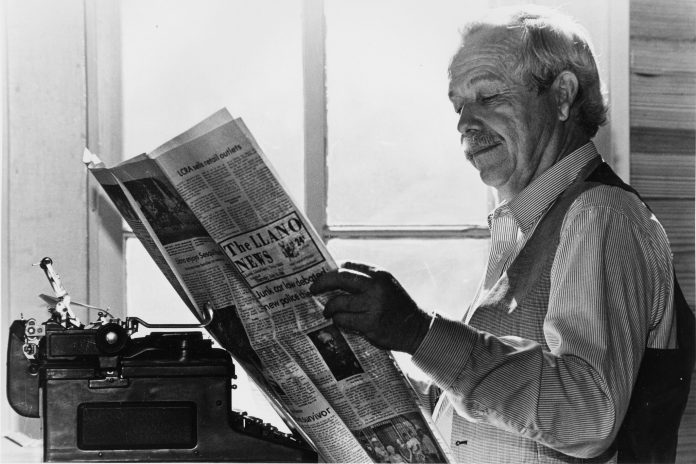
World news stitches us together in a tapestry depicting not only struggle and turmoil, but happiness and prosperity.

As grotesque photographs of the devastating Ebola outbreak in Liberia filter through my newsfeed, I find it difficult to transcribe my reactions. My feelings are a sadness-stricken medley confused with a dash of relief and a hint of anxiety. Why do I feel these strange emotions toward something that is occurring thousands of kilometres away? And why am I further astonished to understand that many people don’t seem to care about these events?

A couple weeks back, I listened to a TA suggest to the class that foreign news coverage is pointless for Canadian news-watchers, and that headlines of significant relevance to readers are the only items that should concern them. After all, it doesn’t apply to me. I shouldn’t be interested in Hong Kong’s umbrella-battle for democratic liberties, when I’m safe at home with a smile on my face and a Charter of Rights and Freedoms to soothe me to sleep.

Growing up, the idea that I would someday be interested in global current events was unfathomable. My father’s six o’clock ‘click’ to Global News only supported the fact that Middle Eastern struggles or violent European protests bored the hell out of me. Thankfully, a solid education, curiosity, and a little procrastination now have me skimming sections of Al Jazeera and The Guardian, and realizing the true importance of reading up on world news.

Through global events, I understand we all fight for survival in a precarious world of uncertainty.

Foreign news gives me a sense of my place in the world as an individual, a citizen, and a human. Yes, it seems selfish and ironic to suggest that I read up on global events to understand myself a little more, but this is the fundamental reason that our access to world news exists. In learning of the ongoing battle against the Islamic State of Iraq and Syria, I begin to understand my own position as a citizen in my own country.

I am able to reflect on current situations surrounding me, and relate them to foreign situations. I analyze a snapshot of myself to discover my own fortunes or misfortunes, as compared with those of other individuals or states.

The Ebola outbreak saddens me because I envision myself in that Liberian world; I empathize with those coping with loss. Though, I’m relieved to not live in that position, but I’m also anxious that I could some day be struck with such a deadly virus. Through these emotions I come to comprehend that we are all people fighting for survival in a precarious world of uncertainty.

As Canadians, we relate with national events more directly, but global awareness is the gateway through which we come to see our broader situation. World news stitches us together in a tapestry depicting not only collective struggle and turmoil, but happiness and prosperity. This is something we can’t afford to bypass or ignore.

Pragmatically speaking, yes, Ukrainian civil unrest does not affect us Canadians directly, but it allows our nation to learn from others’ mistakes and to reflect these learned lessons back to the world as responsibly as we can. So think twice about your lack of interest in the world news section — through it you may find a sense of balance.

The Age of Anonymous

0
This Guy Fawkes mask makes me feel so unique!
Behind the veil of anonymity, Internet trolls encourage hate speech and bigotry.

The far reaching abilities of the internet have opened many doors for all of us, but they have also exposed us to a new racist, classist, homophobic, and (especially) misogynistic rhetoric that endangers the progressive ideals we’ve spent decades working towards.

Now, don’t get me wrong; I think the internet has been a great tool for spreading equality, and it has certainly been an excellent platform for women and other underrepresented groups around the world to make their voices heard. But increasingly, those who share their opinions and beliefs about injustice online are often met with a series of comments meant to shame them for speaking up.

Consider the efforts made by feminists to open discussion about gender equality. After Emma Watson’s stunning speech at the United Nations promoting the ongoing He for She campaign, she was immediately met with sexual threats and told by anonymous users that naked photos of her would soon hit the net. Despite the revelation that the supposed leak was a hoax, this is still an instance of misogynistic bullying, and a threat we should take seriously.

Watson is still being used as an object to make a point. Every day, women are being abused and harassed online — using Watson as a bargaining chip isn’t going to change that.

Just because these comments are made online doesn’t make them any less hateful or destructive.

We all live two lives: our physical one in the ‘real world,’ and our digital one online. Those with a prejudice against women or others tend to use the latter to express their hateful views. Operating from behind a veil of secrecy, people are allowed to openly propagate ideas which would be met with harsh criticism in the real world.

Social justice requires accountability, but the nature of the internet makes it difficult to know from where and from whom regressive comments are coming. Because of this, we tend to shift the blame for online attacks onto the victims, which is a serious step backwards.

The relationship between the web and society is not as simple as we like to think. The internet has become a sort of modern Wild West — lawless and often dangerous. From behind their screens, trolls attack others with vulgar comments and threats of assault.

But these attacks are only part of the problem. Perhaps an even bigger issue is how our society has normalized these attacks, often writing them off as minor annoyances or simply an unavoidable part of the web. As the real world continues to progress in favour of equality, the digital one is becoming exceedingly weighed down by the regressive forces of online harassment.

As Laurie Penny, British journalist and feminist, put it: “An opinion, it seems, is the short skirt of the internet. Having one and flaunting it is somehow asking an amorphous mass of almost-entirely male keyboard-bashers to tell you how they’d like to rape, kill and urinate on you.”

Society continues to put the blame the women who experience online invasions of their privacy, instead of focusing on the aggressors. After the recent nude photo leaks, many countered that, if a woman doesn’t want naked pictures of herself on the internet, she shouldn’t have taken any to begin with.

This is classic victim-blaming, plain and simple. It’s no mistake that the leaked photos were of some of the most powerful and prominent women in our society — this invasion of privacy was an attempt to reaffirm patriarchal ideas of gendered power dynamics.

The anonymity of the internet makes it hard to identify where threats are coming from, and because of this, we put responsibility on women to protect themselves. This often translates to dissuading women from participating in online discourse, rather than looking to change the problem.

Allowing anonymity on the internet, however, comes with plenty of potential benefits, and threats to remove anonymous outlets on the web have met with backlash. We know that being able to browse and post anonymously protects an individual’s right to privacy. In an effort to track the few who are responsible for hate speech, we would likely punish the large majority of web users who don’t engage in these sorts of exchanges.

Ultimately, we will change people’s attitudes about online threats and hate speech by recognizing and condemning them when they appear, anonymously or not. Instead of focusing on the victim, we need to call out these attackers and make sure they know that their comments are damaging and unacceptable.

Mob mentality and the feeling that anonymity allows one to get away with anything is what fuels many to keep posting offensive remarks — if we are watching and calling them out, they may think twice.

Blaming victims and dismissing hate speech as ‘trolling’ ignores the strides made by modern feminism, civil rights, gay rights, and other movements; and protects those who are making the internet a less safe place to be. We need to take these comments and threats seriously, just because they’re online doesn’t make them any less harmful or destructive.

I encourage all of you to think hard about the recent online shaming of women — if it had happened anywhere but on the web, would we be talking about it the same way? We need to focus on the real problem here; if we don’t, the internet will never become the safe and constructive environment that it’s meant to be.

Vancouver citizens must vote “yes” on transportation funding referendum

1

Within the next year, Metro Vancouver citizens will have the chance to vote on a new funding source to support the Mayors’ Council’s $7.5 billion vision for transportation in the region.  This plan includes upgrades to services and frequency of transit, an extension of the Millennium Line to Arbutus street, two light rail lines in Surrey, 11 new B-Lines, 2,700 km of bike-ways, and a replacement of the aging Pattullo bridge between Surrey and New Westminster.  A “no” vote on the referendum would be devastating for the region as a whole.

In order to build new transportation projects and improve the existing network, our governments and Translink need capital. Under current circumstances, there is just not enough money for new projects. With all other funding sources considered, the Mayors’ Council’s vision will require an additional $110 to $390 million per year.

It gets worse; according to Translink’s 2014 operating and capital budget report, this year Translink will not be able to expand bus, Seabus or West Coast Express services, nor move ahead on a number of pressing projects on the regional priority list due to limited revenue.

If we stick to the status quo, the situation will be dire. According to Vancouver’s Metro 2040 population projections, in the next 30 or so years, the population of Metro Vancouver is expected to rise by more than one million people. With current levels of transit service and funding, it would be impossible to move that many people and goods around the region. 

A “no” vote on the referendum would be devastating for the region as a whole.

Maybe you drive or don’t care about transit, so why should you have to pay for someone else’s transportation? The vision is not just about transit. Next time you’re stuck in traffic on Broadway or King George Boulevard, think about how much easier your commute would be if there were 10, 20 or even 50 per cent less traffic on the road.

When the Canada Line was built, many critics assumed that the ridership projections were false, and that the Canada Line would have no effect on congestion. The critics were proven wrong by the more than 120,000 people per day who use the Canada Line to get to work, school, and other activities. The Mayors’ Council’s vision estimates that drivers could save 20 to 30 minutes per day on some of the most congested corridors if the plan is implemented. A positive vote for new transportation funding means “yes” to less congestion.

The good news keeps on rolling. With the new transportation funding source, there would be major infrastructure projects and upgrades all over the Vancouver region. Those projects mean more jobs in engineering, construction, planning, manufacturing, energy, and all the secondary services that go along with those jobs.

As the dutiful citizens of Metro Vancouver, we have been given a great responsibility and opportunity to voice our opinions. Whether you are a student or professional, blue or white collar, millennial or senior citizen, transit-user or car driver, it doesn’t matter. If you live in Vancouver, this referendum affects you. Give your support to the new source of funding, and give support to less congestion, better transit, more jobs, and a prosperous region.

Prisoners should have access to adequate education

0

As students, we strive to complete our post-secondary degrees because we believe education can lead us to a prosperous future. In theory, prisons employ the same ideology. Currently, however, prison inmates do not have access to adequate education — an ironic fact considering that jail institutions say they value education as the most beneficial correctional method.

While volunteering at the Simon Fraser Public Interest Research Group (SFPIRG), I came to learn about the current situation for prison inmates in regards to education. Since Correctional Services Canada discontinued accredited university programs in the early 1990s, there are inadequate resources in prison libraries, as access to books and other forms of information has been limited.

Interestingly, many prison inmates inquire about possible post-secondary educational opportunities and whether or not they will have access to them, which further suggests that prisoners are interested in using education to redirect their lives.

Moreover, many experts believe that adequate informational resources will specifically benefit those inmates who are still young, immature, and uneducated. Knowledge is not just for inmates’ well-being but is also beneficial for the whole of society, as it can reduce recidivism and future criminality, thus creating a safer community. Adequate access to education will also allow inmates to better their chances at finding employment, which will make their transition to the outside much easier.

Adequate education can reduce recidivism and create a safer community.

A Forbes article from last year provides a real life example of how education can help inmates. The article discussed New York’s Cornell College, which works jointly with four maximum-security jails to provide a program that offers inmates a chance to earn an associate degree. It suggested that, upon graduation from the program, inmates were able to read, write, and communicate more effectively, analyze complex problems, and had a greater chance of finding full-time employment once they were released.

In addition, the article suggests that completion of these degree programs shows that inmates are able to “do good,[. . .]exercise discipline and increase [their] adaptability.” Evidently, access to knowledge has proven to be beneficial for prisoners both inter and intrapersonally.

Education does not guarantee a successful future for inmates, but it is certainly a major determinant. Without education, inmates will have difficulty transitioning to the outside, as they are more likely to become involved in the illegal activities in which they were previously involved.

This is why Correctional Services Canada should reintroduce accredited university programs in prisons, and prison libraries should be re-stocked with a diverse range of informational resources. An inmate with access to education would be in all of our best interests.

University briefs

0

UBC food services to adopt cashless system

The University of British Columbia’s Alma Mater Society (AMS) catering service will soon implement a cashless payment system through app developer nTrust.

   The app will allow students to transfer funds from an nTrust account in order to pay for items at AMS businesses such as The Pit Pub, Burger Bar, The Gallery, Bernoulli’s Bagels, and Blue Chip Cookies.

   The new system aims to reduce time spent waiting in line and could also help students to avoid fees associated with some credit cards.

With files from The Ubyssey

UFV students launch new art magazine

A new student-founded publication has been introduced to the University of Fraser Valley.

PIPE journal provides a space for students to showcase their artwork. Any art submitted must be accompanied by a 500 word statement from the artist.

The journal is geared toward visual arts students, but all UFV students are welcome to enter submissions.

With files from The Cascade

Puppies make people happy

McMaster University’s faculty of social sciences has welcomed a year-old border collie, Scout, into its midst.

Scout is currently undergoing assessment by the SPCA to become a therapy dog. He will be on campus full-time in the next school year when he has completed his training.

The SPCA dog program will be implemented at the university with the aim to de-stress social sciences students as well as bridge the divide between students and faculty.

With files from The Silhouette

Council commentary

0

Behavioural neuroscience DSU established

Lukas Grajauskas brought a proposal to council to establish the behavioural neuroscience student society (BNSS) as a departmental student union (DSU). He explained that, currently, behavioural neuroscience is represented by the psychology and biomedical physiology and kinesiology DSUs, but this is problematic because it does not foster a sense of community between behavioural neuroscience students. “I think it’s time for us, as a growing program, to have something more dedicated to students, to give ourselves a voice in the community,” Grajauskas said.

Council voted unanimously in favour of recognizing the BNSS as a DSU and granted it a voting seat on council.

Open textbook campaign update

Arts and social sciences representative Brady Wallace and president Chardaye Bueckert spoke to the open textbook project at council on Wednesday night.

Many DSUs have appointed a departmental curriculum committee representative, and Bueckert and Wallace requested they bring the open textbook issue to the respective curriculum committees and push for the usage of free textbooks. This collaboration was offered as an opportunity to enhance the student experience collaboratively with the board of directors, DSU/FSUs, and the university.

SFU drives on its brand new roads

0
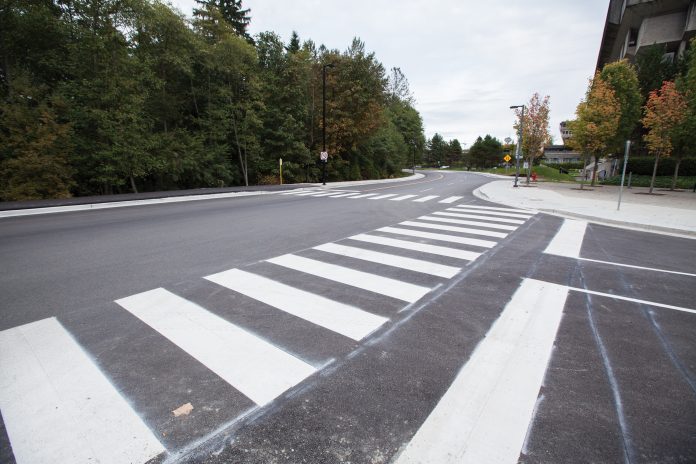
Life is a hiiiiiiighwaaaay
The roads were officially finished on October 1.

SFU Burnaby will now have full use of its new campus roads as construction comes to a close.

On Monday, October 6, transit routes will return to what they were last year, before the beginning of the roadway improvement project.

Parking Services director David Agosti said, “That will be a big change and I think a welcome change to students.”

This means that transit users will be able to exit the bus at the Transportation Centre first, before it heads to the bus loop. Buses will also leave the mountain via University Drive West, putting the residence bus stop back in circulation.

Parking Services told The Peak that there have been positive reactions to the road openings. “We’re not driving on the concrete roads of a year ago, but we’re also not driving on the unpaved gravel roads of two months ago,” said Agosti.

Though all the roadways are open and the multi-use pathway (MUP) along Gaglardi Way and University Drive West is in service, the eight month-long project is not quite complete as there is some landscaping yet to be done.

Agosti explained, “There may be some minor impediments, say if they’re putting in a tree beside the pathway or they’re putting in some shrubbery or what have you.”

He warned MUP users that workers are still in the process of fertilizing the gardens along the path. “It may be pungent for another week or two,” he said.

In regards to the West Mall parkade, SFU is considering an alteration to the original entrance and exit off of University Drive West. That section will be closed for potentially a week or two while Parking Services and Safety and Risk Services assess the area. People parking on the 8000 level of that parkade will still need to use the altered exit and entrance.

Agosti also encouraged drivers to try out new routes: “If you are [driving and] going to the west side of campus — to residence, childcare, recreation and athletics, West Mall Complex — it’s probably worth your while to try going up the new way now. See if that’s faster [or] more enjoyable.”

Homeless seniors rely most heavily on Victoria shelters

0
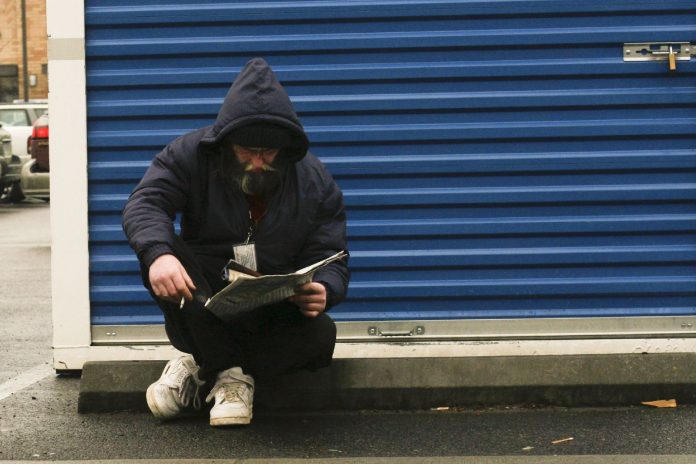
Seniors stayed at the shelters for an average length of six months per visit.

A recent study on patterns of homelessness in greater Victoria, led by SFU master’s student in public policy, Hannah Rabinovitch, reported that there are a disproportionate number of seniors utilizing emergency shelters as compared to all other demographics.

Rabinovitch, in partnership with the Centre for Addictions Research of BC (CARBC) at the University of Victoria, conducted a longitudinal study focused on patterns of emergency shelter use in greater Victoria.

Rabinovitch, who began collecting data for the study in April 2010 and ceased collection in May 2014, followed 4,332 individuals and examined approximately 46,000 shelter records.

“I was stunned by the amount of seniors [. . .] regularly seeking refuge.”

Over 85 per cent of shelter users accessed the shelters only once or twice. However, 13.6 per cent of users accessed the shelters as many as five times during the four-year period, with an average stay length of 30 days.

The remaining 1.5 per cent — mostly seniors — stayed four to five times over the four years for an average length of six months.

Despite the large sample of individuals followed, Rabinovitch conceded that the results were not fully representative of the population who use homeless shelters. “For example, it’s widely known in research that homeless women avoid emergency shelters for fear they’re unsafe and that their children will be apprehended, and because they lack women’s beds,” Rabinovitch said.

Rabinovitch, who has worked with five out of the seven emergency shelters in Victoria, is worried about the large number of seniors utilizing shelters. “I was stunned by the number of seniors with complex physical and mental health problems regularly seeking refuge in emergency shelters,” she said.

Rabinovitch also stated, “It really points to the fact that [. . .] there’s a housing gap and that they are finding serious challenges for homelessness.”

Seniors often experience more health problems than other segments of the population, and being homeless further contributes to these issues. “In general, older people experience more health challenges, and the longer people stay homeless, the worse their health outcomes get,” said Rabinovitch.

The homeless pattern reported in Victoria is similar to those in Ottawa, Toronto, and Guelph. The Greater Victoria Coalition to End Homelessness has partnered with the government, non-profit organizations, and local service providers to work towards eliminating the problem of homelessness in Victoria by 2018.

Bernie Pauly, Rabinovitch’s supervisor and a researcher for the University of Victoria’s Centre for Addictions Research, said that the team is investigating strategies that may contribute to finding a solution: “Those experiencing temporary homelessness would benefit from rapid re-housing, more emergency cash assistance and rental subsidies to prevent or quickly address homelessness.”

FIPA ratification is an insult to Canadian values

3

Despite widespread controversy, the Harper government ratified the Foreign Investment Promotion and Protection Agreement (FIPA) with China on September 12. The agreement took effect on October 1 and, from here on out, the welfare of Canadian citizens will be disregarded in favour of the prosperity of Chinese investors.

This is not to say that foreign investors do not already influence Canadian industries; Canada has a number of other FIPA agreements, but none are comparable to this lopsided, non-reciprocal agreement made with China. By signing this contract, the Harper government has devalued our country for short-sighted economic benefit. What’s worse is that these highly controversial decisions were made without public consent. 

The first problem with the agreement is that it locks Canada into a 31-year contact. Either party can withdraw only after the first 15 years, as long as one year’s notice is provided. However, any existing investments are preserved for another 15 years. Keep in mind that Canada’s participation in NAFTA can be terminated with six months notice.

Another horrific reality is that the contract’s parameters allow Chinese investors to challenge our provincial and municipal governments’ decisions. For example, if BC rejects or alters decisions regarding the Northern Gateway pipeline, and Chinese investors perceive these changes to have a negative impact on their investments, they could sue Canada.

Harper, the next time you completely screw us over, have the decency to send out a press release.

This means that Canada will have to choose between a hefty fine or the welfare of its citizens — a position the federal government has inflicted upon itself.

Canada has willingly given the reins to China in an exchange that is not mutual. Specifics of the agreement provide carve-outs, or exceptions, that each country has outlined to protect itself. Canadian carve-outs are specific and limited to existing entities, while China’s are extremely vague. This means that Chinese foreign investors could block Canadian influence more easily at even a municipal level, which makes the agreement exceptionally beneficial to China.

The situation becomes worse. Not only has the Harper government put foreign investors first by placing their needs above those of Canadian citizens, but the decision was made with very little debate. The treaty was quietly tabled by the House of Commons in October 2012, where it was signed by Stephen Harper without so much as a press release.

Unfortunately, the agreement was only subjected to a one-hour review before the trade committee. The opinions of Parliament were completely disregarded and the vote was contained within the Cabinet. Despite widespread opposition from the public, the NDP, the Greens, and even members of his own cabinet, the Harper government decided that nobody else’s opinion had any merit or value to the decision-making process.

We get it Stephen Harper — your horrible negotiation skills, along with your complete disregard for public opinion, clearly indicate how much you care about the citizens of your own country. Next time you completely screw us over, at least have the decency to send out a press release.