Home Blog Page 1049

SFU researchers investigate deadly liver cancer

0

A group of SFU researchers have collaborated with colleagues internationally to provide insight into the “mutational landscape” of a rare type of fatal liver cancer, which may allow them to identify its cause and improve its diagnosis and treatment.

Intrahepatic cholangiocarcinoma (ICC) or intrahepatic bile duct cancer, while only observed in five to 10 per cent of those with primary liver cancer, is very dangerous for those affected. This is because it is based in the bile duct, where it is unlikely to be detected.

A lack of diagnostic tools make it difficult to form a conclusive diagnosis in the early stages of the ailment. Therefore, it is usually detected at advanced stages when it is too late to be successfully treated.

Jack Chen, SFU associate professor in the department of molecular biology and biochemistry, worked closely with a research group at SFU, including postdoctoral fellow Jiarui Li, doctoral graduate Christian Frech, and master’s student Xinyin Zhao.

By understanding the nature of the mutations that are associated with ICC, Chen suggested that one can potentially learn more about the cancer’s cause. That way, “information could be imprinted in the mutation profile,” creating what is known as the “mutational landscape.”

As a group, they collaborated with researchers from Shanghai. The clinical and molecular biology components of the study took place there, while the sequencing technology and computational power were provided at SFU.

ICC is most commonly diagnosed in individuals who live in Southeast Asia. Chen explained that this is ”likely due to environments and the type of mutagens they are exposed to.” For example, ICC is diagnosed at an incidence 100 times higher in Thailand than the worldwide average.

Further research into this type of cancer is becoming increasingly important, as the incidence rates have risen globally from 0.32 to 0.85 per 100,000 people — a 165 per cent increase.

The study involved 103 ICC patients who underwent surgical removal of the tumour. Chen explained, “We sequenced the tumour genome and we also sequenced the normal genome from the same person, so that we can compare the genomes to identify differences — in other words, mutations that are specific to the tumour sample.”

With these findings, Chen and his colleagues will be able to understand more about the sorts of mutagens that are causing these harmful mutations, the types of mutations in the genes themselves, and finally, the types of cellular pathways that will be affected as an end result.

In the future, this information could be used to develop the tools necessary to increase diagnostic accuracy and hopefully improve ICC patient prognoses, giving patients more time to receive potentially life-saving treatments.


Why I am not Charlie

0
Photo courtesy of Anne-Christine Poujoulat (NBC NEWS)

Since the tragic shootings in Paris revolving around comics published by the French satire magazine Charlie Hebdo, many people on the Internet have tried to show solidarity with the victims and their families by prominently making posts with the hashtag “#jesuischarlie” — in English, “I am Charlie.”

While I sympathise with the sentiments expressed by these people and I feel terrible for the victims and their families, I’m afraid I cannot, in good conscience, use this hashtag. The fact is that I, Benjamin Buckley, am not Charlie. I have verified this by a brief glance at my birth certificate: my name is “Benjamin Nicholas Roland Buckley.” It is the name my parents gave me, and I have become rather attached to it.

In theory, it might be possible to legally change my name to “Charlie.” However, in British Columbia, this requires filling out a long form and paying a $137 fee, plus $25 for a criminal record check and fingerprinting. It would be unreasonable to expect me, let alone every member of our society, to go through such an inconvenient expense just to make a point about freedom of speech.

Even more troubling are the broad social consequences of a society in which every person is named “Charlie.” On the surface, living in such a society might seem more convenient. For one thing, it would be easier to remember everyone’s name. But it’s easy to forget that the reason we have names is so that we can tell each other apart. If, as these activists propose, we all call ourselves “Charlie,” then we will be left without a quick, simple way to identify ourselves. Even if we use variants like “Chuck,” “Charles,” and “C-Dawg,” it will be of little help.

I want to emphasize that I hold no ill will against people who are named Charlie. If you are named Charlie, that’s perfectly fine. Just keep it to yourself and don’t force your name down the rest of our throats. A tragedy, even one so symbolic of the fight for freedom of speech as the Paris shootings, is no reason to rob the world of all the diverse names it has to offer.

A person can believe in freedom without having to change their name to Charlie. It’s time for these online activists to wake up and realize that.

Petty, puritanical, and obtuse, Canada’s foreign policy is morally wrong

0

In 2010, Stephen Harper took the stage at the Inter-parliamentary Coalition for Combating Antisemitism conference in Ottawa and pledged, in no uncertain terms, Canada’s unshakable support for Israel: “the easy thing to do is simply to just  go along [. . .] with this anti-Israel rhetoric. [. . .] There are, after all, a lot more votes [. . .] in being anti-Israeli than taking a stand. But, as long as I am Prime Minister, [. . .] Canada will take that stand, whatever the cost.”

Consistent with the self-aggrandizing nature of his comments, Harper’s foreign and domestic policies have been rooted in a political and moral certainty that he has never bothered to substantiate. While opacity from this government is nothing new, it is dangerous when used to prop up an increasingly inflexible backbone that reduces incredible complexities to a series of black and white puppet shows. Exercising pragmatism has been abandoned by the Tories in favour of a frankly fundamentalist approach to government.

Harper’s policy in the Middle East is threatening to completely erode decades of Canada’s carefully cultivated persona in global politics as a humanitarian, independent, and neutral arbiter of political and moral crises. John Baird’s comments in Jerusalem reiterated this stance, claiming that the Palestinian Authority (PA) had made a “huge mistake” by attempting to bring allegations of Israeli war crimes to the International Criminal Court, an organization Canada played a key role in founding. 

Israel’s history has been scoured by acts of Arab aggression, which have fuelled its hawkish foreign policies. So while we criticize Israel, it is impossible to divorce the country’s collective trauma from its current-day politics.

At the same time, Baird’s assertion that “the great struggle of our generation is terrorism — one that Israel faces on the front lines” isn’t so simple. The greatest threat Israel faces today is from a crippled Hamas, Iran, and Hezbollah, all of whom are currently preoccupied with combating ISIS forces. However, a large part of the enduring regional hatred towards Israel has much to do with its apartheid policies directed towards the Palestinian people.

Harper’s foreign and domestic policies have been without an affirmed political and moral certainty.

It would be exhausting to list the ways in which Israel actively persecutes Palestinians on a daily basis, but it is stunning, and only serves to stoke the fires of regional discord. Benjamin Netanyahu’s latest ploy has been to, once again, freeze the delivery of taxes collected on behalf of the PA, an act that the PA ambassador to the UN labeled “blatant theft.” The action was further denounced by the Israeli president and US State Department. Yet Canada remains unmoved.

Our stated international agenda is in support of Israel’s right to live in peace with its neighbours within “secure boundaries,” while recognizing Israel’s right to assure its own security by way of “necessary measures.” Within this position, the Conservative government officially acknowledges the Palestinian right to self-determination within a territorially contiguous state.

However, Israel continues to rapidly build settlements on disputed territory, diminishing Palestinian attempts at creating a state — a war crime, according to the Rome Statute that Canada signed in 2000. According to Baird, such actions are not unilateral or detrimental to peace. Instead, attempts by the PA to bring such actions to the world’s attention, while opening up Hamas to prosecution over war crimes (who are, as noted, an enemy of Israel) cross a “red line.”

It is utterly embarrassing that Canada is represented by asinine claims to absolute morality while sporting an abhorrent human rights record. We cannot pretend to be independent arbiters, nor can we play any meaningful role in the Middle East if we take two steps back for every step history takes forward. Who would trust that record?

SLAPP suits misunderstand the nature of public protest

1

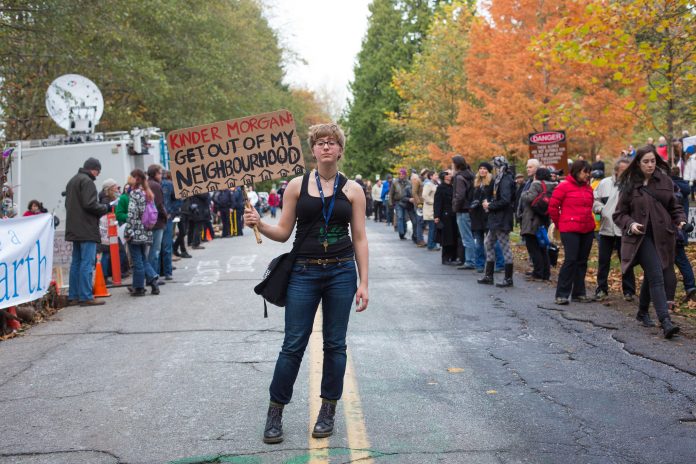
Alan Dutton, an organizer for Burnaby Residents Opposed to Kinder Morgan Expansion (BROKE), will not settle in the $5.6 million lawsuit brought against him by Kinder Morgan. The lawsuit targets five protesters for conspiring to intimidate the survey crews on Burnaby Mountain. While four of the defendants have settled, Dutton refuses to do so, on the basis that the lawsuit is meant to suppress the right to protest.

The BC Supreme Court has ruled that the suit is a justifiable exercise of Kinder Morgan’s legal rights (by suing ordinary people for $5.6 million). However, the consequences of the actions of Kinder Morgan and the Supreme Court are clear. Not only do they suppress the right to protest, but they also completely misunderstand the nature of civil disobedience.

This lawsuit is an archetypal example of what is commonly referred to as a SLAPP suit, or Strategic Lawsuit against Public Participation. This is when the threat of a lawsuit is used to intimidate those who wish to protest. SLAPPs abuse a supposedly egalitarian legal system. Corporations with deep pockets can launch malicious but legally acceptable suits against protesters and demand conditions for a settlement, which essentially silence these individuals.

These actions are coercive and exploitative because very few grassroots protest movements have the resources to effectively combat such lawsuits. Quebec and the majority of US states have legislation against SLAPPs. British Columbia once had such a law in the books, which was promptly removed by the Liberal government when they took power in 2001.

SLAPP suits water down our constitutionally enshrined freedoms of expression and assembly to very narrow interpretations. We are encouraged to protest only when it is convenient and comfortable for the entities we protest against; if Kinder Morgan begins to feel “threatened” or “unsafe,” it becomes the burden of protestors to tone it down and speak softer.

SLAPP suits water down our freedoms of expression and assembly to very narrow interpretations.

Moreover, such legal actions essentially reframe the narrative of the entire protest movement as one in which large corporations has the moral high ground. It becomes a matter of protesters encroaching on Kinder Morgan’s legal right to survey the land, whereas back on planet Earth, Kinder Morgan is in fact violating numerous city bylaws and moving forward with a project that local and First Nations communities are vehemently opposed to.

Kinder Morgan charges the defendants in this lawsuit with intimidation, but protest is by its very nature intimidating and challenging. When African-American civil rights activists marched from Selma to Montgomery in 1965, no doubt they were intimidating the majority white populations who stood to lose from African-Americans gaining political and civil liberties.

Seldom does non-violent civil disobedience originate from an uncontroversial movement. Protest should aim to challenge the status quo, and if it intimidates those in power or those who commit injustices then congratulations, we’re doing it right.

Such legal actions can have chilling effects across all spheres of public activity. SLAPPs can lead individuals to resist exercising their civil liberties. After all, the fear of having a multi-million dollar lawsuit launched against for carrying a picket sign is a serious deterrent against public protest.

Examples like the Kinder Morgan lawsuit demonstrate that SLAPP suits can only be justified under the shakiest of factual foundations, and it quickly becomes unclear whether any form of protest is truly within one’s “rights.” So long as the provincial government and court system remains complacent about SLAPPs and complicit in the suppression of civil liberties, silence in the face injustices may soon become the norm.

SFU wastes no time joining food waste ban

0

Following Metro Vancouver’s recent ban on organic waste in landfills, SFU is gearing up to push for better recycling habits within the university community.

The ban went into effect on Jan. 1, 2015, imposing a new year’s resolution on the region’s 21 municipalities.

The goal is to have everyone sort out all of their organic waste from their trash. In order to aid the transition, Metro Vancouver has allotted the next six months as an “education period,” and will not be administering fines until July.

Carrie Hightower, Metro Vancouver’s technical advisor for Zero Waste implementation, noted the harm that comes from leaving organic waste in landfills. “When this goes into a landfill it produces methane gas, which is a greenhouse gas.”

“Every time we throw something away, we’re throwing away everything that went into producing that food,” she continued.

The SFU Sustainability Office and Facilities Services have taken a leadership role in reducing waste at the university, launching a Zero Waste campaign at SFU just last year. Zero Waste coordinator Rachel Telling explained that, with this new policy in place, the Sustainability Office will be increasing their education efforts — a full-time job, as Telling pointed out that SFU has “a constantly changing population, with new students all the time.”

Part of this effort will include streamlined signage and clarification on how to sort waste on the front end — when waste is transferred from the consumer to the bin — as well as how recycling is handled behind the scenes. The Sustainability Office will offer training to food waste handlers on campus to help them adjust.

Telling also emphasized that she hopes that students take the message with them off-campus as well. “It’s our role to educate beyond what just happens here [at SFU],” she said.

Individual households will not feel the effects of the ban immediately, though Metro Vancouver encourages citizens to begin sorting out organic waste more thoroughly. Larger institutions, like SFU, and food service providers are expected to clean up their recycling process during the education period.

“Every time we throw something away, we’re throwing away everything that went into producing that food.”

Carrie Hightower, Metro Vancouver, technical advisor, Zero Waste implementation

Seeing as Metro Vancouver only takes care of the “end of life” handling for solid waste, the fines can only be placed on waste collectors who bring in organics, who will then pass these on to their clients who have generated the waste.

Waste will be inspected as it is brought in, and checked for a composition limit of 25 per cent or less organics. This limit will be reduced to 10 per cent in 2016, and five per cent in 2017.

SFU Dining Services has also been working to support the Zero Waste movement. General manager Mebs Lalani stated, “We’ve been separating our compost from our regular waste for over a year.”

He went on to say that all packaging used in SFU Dining Services establishments is eco-friendly, from their fettuccine pasta stir sticks to utensils made from sugar cane.

Lalani also mentioned that introducing clear bins “turned the program around,” since it made it easy for staff to see whether or not recycling procedures were being followed.

He echoed the sentiment of others that, even if things improve systemically, it ultimately comes down to individuals sorting their waste properly. “Always, the greatest challenge is breaking habits.”

SFU graduates enter Super Bowl commercial contest

0
Nelson and Graham Talbot have been working as “struggling filmmakers” since graduating in 2011.

SFU graduates and twin brothers Nelson and Graham Talbot have been chosen as finalists in the Doritos Crash the Super Bowl Competition, for which the grand prize is $1 million and a year-long employment contract with Universal Pictures.

If successful, the twins will also have their TV spot aired to an audience of well over 100 million people during this year’s Super Bowl on February 1.

This is the Talbot twins’ second time participating in the competition; in fact, they were semi-finalists last year. Their previous commercial was decidedly “darker” than their current entry; the 30-second spot showed a mermaid seemingly seducing two fisherman until the camera cuts to a shot of her on the wall, hung like a trophy catch.

The twins have learned from last years’ experience. Graham acknowledged that they “just came up with a funny idea, and didn’t think much about the branding of Doritos and their history and the rest of their commercials.”

“In football, they throw around the pigskin, and we’ve got a flying pig.”

Graham Talbot,

SFU alumnus

The new approach, explained Nelson, “plays it a little safer with clean, all-American humour that has a pretty wide audience.” The new ad features an adorable little boy on a farm who is told he can have a Dorito “when pigs fly.” The boy sets his mind to creating rockets, which he uses to launch a pig into the sky. He then triumphantly eats his Doritos.

Nelson told The Peak, “We knew what we wanted. We wanted a kid and an animal. Then it was just sitting down together and brainstorming and pounding out a couple hundred ideas until we found one we really grabbed a hold of.”

The twins feel that their advertisement has a competitive edge over the other entries. “Ours has a super bold atmosphere to it,” said Graham, “It’s got a kid that is on a mission to accomplish something.”

In keeping with the lessons learned from the previous year, the twins wanted the commercial to have wide appeal. “The people that will enjoy it [is] anyone from a small child to full grown adults, both women and men.”

The two acknowledge that considering the diverse audience of the Super Bowl, they aimed for a down to earth look, right down to the farm setting. Graham laughed about how “in football, they throw around the pigskin, and we’ve got a flying pig.”

The budget for their ad was $1200 — money out of their own pockets, as well as contributed by their parents. “Even if you don’t win, hopefully it’s a good enough investment in your career,” explained Nelson.

“It’s worth spending that little bit of money for the risk and reward.” When speaking about the budget, Graham noted, “Super Bowl commercials tend to have a high production value and ours looks a hell of a lot more expensive than 1200 bucks.”

The twins who both graduated from the Contemporary Arts Program at SFU in 2011 and describe themselves as “struggling filmmakers” ever since. They said they hope that winning the prize will solidify the career path they’ve chosen and hopefully get them more work in the future.

Nelson noted that they intend to pay those who helped with the video, such as the actors, visual effects supervisor, and co-producer, but admitted that the cash prize is “going to be a big help no matter what.”

The winner will be announced at the end of January.

Meet the Clan: Josh Kim

0
Despite being born into wrestling, it was the self-control and self reliance that drew Josh Kim into the sport.

Screen Shot 2015-01-23 at 10.17.02 PMWhich sport do you follow? Is it hockey, soccer, or basketball? Most likely, you like whichever sport is your favourite because of the environment in which you were raised. Considering you spend most of your formative years with your family, there’s a good chance they have something to do with your sport of choice.

For Josh Kim, the family sport wasn’t soccer, or hockey, or even baseball. It was wrestling. With a father who is a certified national wrestling coach, the choice seems obvious — but was it?

“I got started in wrestling when I was nine years old because my dad was a national level coach,” says Josh. “[But] I really only started taking it seriously after grade nine.”

Initially, he was more interested in other sports like hockey rather than his household’s penchant for wrestling. So what drew Josh further into the family passion?

“The feeling of having full control over the situation and having just yourself to rely on,” explains Josh. “And the feeling of [having] your hand raised at the end of the match [is] an addition.”

For Josh, wrestling is full of highs and lows. “[It’s] a sport full of hard moments. You’re constantly pushing yourself to your mental and physical breaking point, whether it is in practice or competition, and it can be difficult to pushing past the mental aspect of the sport can be more difficult than the physical side. But, wrestling also provides you with lasting memories.”

His favourite memory, he says, “has to be winning the Junior National Championships last year and making my first Canadian national team.”

Even after becoming a national team member in 2014, Josh is not content to sit around and boast about his accomplishments — he recognizes that the sport of wrestling is about growth and continuously setting goals, both for the current season and the future.

“My goal for this season is to qualify for the NCAA national tournament, and become an All-American,” he proclaims. “For the future, I want to take the sport as far as I can, becoming an NCAA Champion, and making more [Canadian] national teams.”

With these goals in mind, Josh find inspiration from two wrestlers who have competed in weight-classes similar to the one he wrestles in. It doesn’t hurt that he knows these role-models personally. One is his friend, Russian-born Canadian Olympian Khetag Pliev; and the other his varsity coach, Justin Abdou, who not only represented Canada at the 2000 Olympics but was also an SFU athlete himself — two strong and determined forces on the mat. 

Josh also doesn’t have to look too far out of the household for inspiration. His father, Kimin Kim, coached Josh throughout his high school career, and continues to do so during his summer training at home in Toronto.

“Having my father as a coach is great. He knows me better than anyone,” Josh says. “There is no way I would be where I am today without him.”

Although the sport of wrestling is very important to Josh, he finds it just as important to achieve a high quality post-secondary education. For him the choice to come to SFU instead of a school closer to his hometown of Toronto was an easy one.

“I knew [in high school] that I wanted to study criminology, and SFU has an extremely strong criminology program and department,” he explains. “Having known this about SFU and knowing how strong the wrestling program was — the best in Canada — deciding to come here became an easy decision.”

Screen Shot 2015-01-23 at 10.18.08 PMWhile he works towards his eventual degree, Josh still has two more seasons to wrestle for the Clan. And as his final season wearing SFU’s red and blue approaches, Josh shows no signs of slowing down. Bringing SFU to victory at the Boxer Open in Forest Grove, OR, just last week, he remains a force (in the ring) to be reckoned with.

An ode to the glass (of milk)

0

Each week, one of The Peak’s editors must write an Editor’s Voice — a column where we say something profound, or muse about the world around us in a way not often encouraged in our own sections.

These articles usually give advice on how you should live your life, with the help of our many years of great experience. Well, I don’t have much of that stuff. I’m sure I could spin you a yarn about joining some clubs, writing for the sports section — you know, one about getting out and doing things. But that would be boring, with a capital B.

Instead, I will expound my philosophies on milk, as it’s a great drink. But milk doesn’t get the respect that it deserves. Sure, most of us drink milk with dinner, we have milk in our cereals, but do we ever appreciate how good it actually tastes?

Firstly, milk just tastes awesome. Milk is a superb drink just to consume on its own, like pop or other tasty, sugary beverages. I think milk often gets lumped in with boring drinks like water, but really, that’s unfair. Water is tasteless, and unless I’m going to bed or I’m in the hot sun, it’s not something I really want to drink. There’s just something to milk that’s not there in water.

Who first went up to a cow, grabbed its udder, and said, ‘hey, we should drink this?’

Milk enhances the flavours of every meal; it seems to add so much to food — just like how wine apparently brings out all the flavours in some foods (or something like that, I don’t spend all day hanging with wine connoisseurs).

Some meals, such as spaghetti, or pizza seem incomplete without a glass of milk or two, or three, or more. Without milk, one of my favourite dishes becomes just another silly ol’ meal.

And who decided to start drinking milk, anyway? Who went up to a cow and grabbed its udder, and said, ‘hey, we should drink this?’ Good on them, but can you imagine? Just going up to a cow, grabbing its teets, and drinking the nefarious result. Probably some cave-dude too. Thank you, you wonderful cow pervert.

(I sure hope I did not subconsciously take this riff from some stand up comedian. If I did, I’m udderly sorry.)

You’re now probably wondering, ‘what should I get out of this most informative column?’ Appreciate your milk! Gulp it down with pride. Stuff yourself until you’re the kind of full that only milk can make you. And remember, milk is better than water — all the cool kids drink it.


Web Editor’s Note: We decided since he loved milk so much, Austin should “eat his words” – check out the video of what went down here: Mr. Milk Monster Gets It

Track teams looking for individual championships

0

Last year, only one SFU athlete qualified for the indoor track and field national championship — senior Sarah Sawatzky, who is not eligible this year.

So when head coach Brit Townsend stated after one event that the team should have an even better result, it came as a surprise. “We’re off to a good start,” she told The Peak. “We had only one person qualify for the NCAA indoors last year, and I’m convinced we have two after [our first event].”

The Clan put on a dominant performance at their first indoor event — the University of Washington Preview held on January 17. Senior Lindsey Butterworth led the team, and the NCAA, with a time of 4:44.80. This feat earned her both the Great Northwest Athletic Conference (GNAC) and the U.S. Track & Field and Cross Country Coaches Association athlete of the week awards.

The team’s performance was good enough to earn nine athletes provisional standards — the minimum time for a runner to be ranked. Many Clan athletes put up GNAC top five performances. “We had lots of personal best performances,” explained Townsend.

Most notably, the teams that the Clan faced consisted of both NCAA Division I and II talent.

The relatively short indoor track season will continue until February 21, when the indoor national championship wraps up. Then the outdoor season begins, with the UBC Open held March 28, and continues until late May.

The Clan’s goals for the outdoor track season are the same as indoors: to get more athletes to qualify for the national championship. Last season, two runners made the cut — Sawatzky, and then-freshman Oliver Jorgensen.

“I’m looking to improve on both of those stats this year,” Townsend noted. “We have to progress slowly and keep improving, and I’m confident we’ll have more than that — in both categories.”

The focus of the Clan will be more on the aforementioned individual titles. The nature of track and field allows teams to send an unlimited amount of qualified athletes into competition, meaning that teams with a higher quantity of national championship-qualifying team members will win. As relatively new members of the NCAA, having sent only one athlete indoors and two outdoors, the Clan could not compete as a team last year.

“My goal is that we will have a national champion indoors — an individual championship,” she said.

Thank you, but no thanx

0
Image courtesy of Avard Woolaver (Flickr)

I thank you. Thank you for reading this.

There! Wasn’t that simple and, most importantly, sensible? Thanking each other for every little small act has been the norm for years. But now, these have become two of the most forgotten words in our communities.

In the past, this was once considered the only decent way of expressing gratitude to someone: “I thank you.” But somewhere along the way, we decided to throw away the first part, because we are lazy verbal sloths. Now, there is literally no “I” in “I thank you.”

So then we were left with “thank you,” which really wasn’t all that bad. Multi-talented musicians like Led Zeppelin, Boyz II Men, and Jay-Z used their blessed voices to bring us songs titled “Thank You,” while some decided to use homonyms, like Alanis Morissette and Ayumi Hamasaki. These two decided to substitute the phonetically taxing “you” with “U,” resulting in songs both called “Thank U.”

Who do these Canadians and Japanese think they are? Too cool for two extra letters?

And then we lost it. We decided to completely throw away the subject of our already degenerating gratitude “U,” and we were left with “thank.”

I don’t know what a “thank” is. Someone struggling to learn English might assume is the equivalent of thanks; I don’t blame them for it, since English is the silliest language on the planet. Thank you, British colonialism!

And now, as a society, we are heading towards oblivion. We are left trying to make sense of the word “thank.” We’ve tried being clever and adding “s” at the end, but Shakespeare beat us to it.

So, in an attempt to surpass this method of appreciation, we have tried to become pseudo-futuristic about it by combining “k” and “s” and replacing the amalgam with “x.” But “thanx” is not actually a polite way to show gratitude. It is lazy and a slippery slope to — and I can’t believe I am saying this — “ty.”

Apparently, in this texting-saturated world, we have tried to bring back the “you” after the “thank,” resulting in “ty,” a short-form for “thank you.” This is not the same. Rather, saying “ty” is inconsiderate verbal insensitivity for not even taking the time to send a proper expression of gratitude.

If you do use “ty,” please stop. You are a beautiful human being and you’re not in junior high anymore, so who are you trying to impress with your cool new slang? This is an abomination of the simple, old-fashioned decency of thanking another human being. Not some autocorrect, curated, nitrate-rich fertilizer you thought of while standing in line to buy your Uggs.

Heck, not even the rudest panhandler is gonna tell you “táy” — which is how “ty” is pronounced — after accepting your reluctant quarters and safety pins.

And since you have read this far, I want to bring you up to date with the thanking trends: “T” is the new short-form for thanks. I just made it up and I will use it from this moment onwards. Until next time, T for reading this.