
SFU Kendo Club gears up for national championships in August
By: Niveja Assalaarachchi, News Writer
Editor’s note: The Peak’s Arts & Culture editor Phone Min Thant is a member of the SFU Kendo Club, but was not involved in the writing of this piece.
From August 7 to 9, the BCIT Burnaby Campus will host the 23rd annual Canadian National Kendo Championships. The tournament will see about 190 kendo practitioners gather, with competition split into three main competing categories: an individual bracket, a club bracket, and a provincial club bracket.
10 clubs from BC will compete in the tournament, including the SFU Kendo Club. The Peak reached out to PJ Arce, the president of the club, to learn more about SFU Kendo’s goals for the championship and beyond.
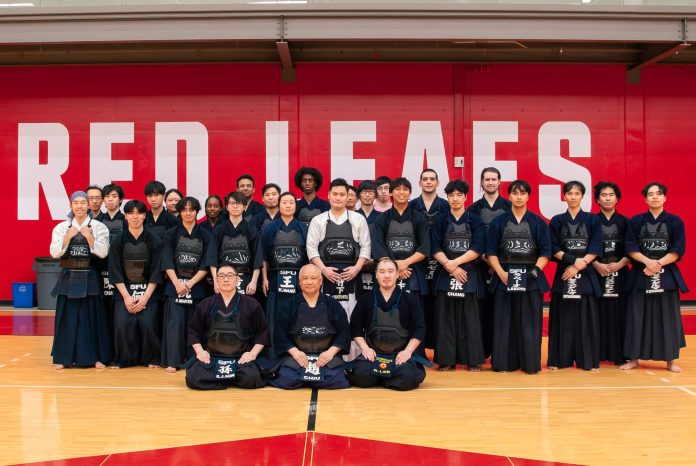
The SFU Kendo Club was founded in 2001 with seven members, and has grown to more than 35 active members across different skill groups, according to Arce. He said that five students and three alumni will compete on behalf of SFU, with a group of five students “selected to represent us in the team bracket.” Arce highlighted qualification to the tournament “use an open-entry format rather than requiring athletes to qualify through a conventional regional pathway” thus differing from other sports. He noted he saw the championship as an “opportunity to test the quality of our training against experienced kendoka from across Canada. I think it represents both our development as competitors and the character we have built through the hardships of practising this martial art.”
Kendo is a Japanese martial art sport which features players wearing protective armour and fighting with bamboo swords. The aim of the sport, according to Arce, is for competitors to try and “score valid strikes to designated target areas while demonstrating proper technique, spirit, and control.”
With the first Canadian dojo for the sport being established in Steveston in 1914, the kendo scene in the Lower Mainland has an extensive history. In a statement to The Peak, the vice president and general manager of the the Canadian Kendo Federation Makiko Ara said, “Kendo has a well-established and growing community throughout BC,” with her noting that clubs operated in cities like Coquitlam, Surrey, Burnaby, Victoria, and Kelowna. She noted university clubs like SFU Kendo were important as “they introduce kendo to students from a wide range of backgrounds and help make the sport accessible to adults trying the sport for the first time,” thus playing “an important role in the future growth of Canadian kendo.”
“We want to continue fostering an environment where kendo can be at the center of a welcoming, kind, disciplined, and character-driven community. Kendo gives people a reason to challenge themselves, but it also brings people together.”
— PJ Arce, president of the SFU Kendo Club
Arce said that SFU Kendo was aiming to grow the club and win an upcoming college-level kendo tournament. Beyond results, he said, “We want to continue fostering an environment where kendo can be at the centre of a welcoming, kind, disciplined, and character-driven community. Kendo gives people a reason to challenge themselves, but it also brings people together.”
Less is more for future FIFA World Cup and the environment

By: Tomos Land, Staff Writer
It has barely been a week since the 2026 FIFA World Cup final, yet the focus has already shifted to future iterations of the tournament. After enjoying a bountiful event, which is forecast to bring in record levels of revenue, FIFA — the sport’s world governing body — is reported to be considering plans to expand the number of nations taking part. More teams at future world cups means more matches, fans, and host cities. Each of these factors come with a higher cost to the environment. Governments need to step up and require FIFA to host the competition in a country that has better green infrastructure. By reverting to a single host nation, the governing body can meaningfully reduce the amount of travel required between matches.
During his tenure, the organization’s president, Gianni Infantino, has overseen a major pivot away from fans and fairplay to the total commercialization of soccer. His pursuit of money has already alienated his counterparts in the Union of European Football Association (UEFA) and La Liga, Spain’s top soccer association, with the union stating that “the soul and governance of football are not assets to trade.” This comes at a time when the tournament’s environmental footprint is being felt more acutely than ever before. Just days before the final, concerns were raised about the projected air quality at the Metlife Stadium in New Jersey on game day, triggered by the smoke from wildfires in northern Turtle Island (Canada). Fortunately for everyone, a storm front the day before the final helped clear up the air.
During the latest edition, Infantino made headlines for his own carbon footprint during the event, having “attended 24 matches in just over two weeks” during the group stage. Leading by example, the FIFA president is overseeing a tournament which is estimated to end up producing “almost double the average for the last four World Cup finals,” topping 9 million tonnes of CO2 equivalent (CO2e). Having previously pledged to reduce its emissions 50% by 2030, FIFA now appears to have abandoned its climate goals in the pursuit of commercial revenue.
However, as the recent deadly wildfires in Spain and devastating storms in Morocco have shown, the degradation of the environment will continue to exact a much, much higher cost.
To celebrate a century since the first edition of the tournament in 1930, the 2030 FIFA World Cup will take place across three continents. Three initial centennial games will be played in Argentina, Uruguay, and Paraguay, followed by the remaining fixtures in Spain, Portugal, and Morocco. Undoubtedly, the event, even without the proposed expansion, will rake in enormous sums of money, as evidenced by this year’s World Cup. However, as the recent deadly wildfires in Spain and devastating storms in Morocco in February have shown, the degradation of the environment will continue to exact a much higher cost.
FIFA should be serious about sustainability, and must mitigate its tournament’s impact on the climate. The tournament’s economic impact, which FIFA uses as a key selling point to potential hosts, should revolve around producing generational upgrades in infrastructure, such as investing in modes of mass transit and green energy.
Transvestigation hurts everyone
By: Sasha Rubick, Fact Checker
Content warning: transphobic language, misogyny.
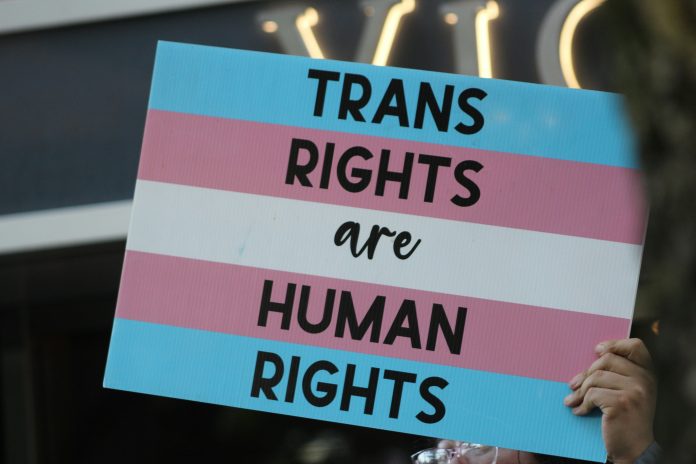
Transvestigation, the process of “investigating” whether someone is transgender, has affected an untold number of public figures. From Michelle Obama to Serena Williams to Beyoncé: online conspiracists have utilized pseudoscientific anatomy diagrams, and demanded invasive testing to falsely “determine” someone’s sex. These investigations label appearances and behaviours according to traditional notions of gender roles, target gender nonconformity, and reinvigorate misogyny. The most notable way transvestigation occurs is by targeting successful cisgender women. It implies that trans women are seeking to take advantage of so-called “biological” women, and that a cis woman’s successes only happened because she was “secretly trans.” It also reinforces misogynistic norms, by threatening women’s privacy and reputations if they defy traditional gender roles — for example, if a woman has “masculine” features, like extra body hair, or participates in “manly” activities, she may be the victim of transvestigation and face harassment, cyberbullying, or worse. Transvestigation is treacherous: it harms both transgender people and cis women.
Since transvestigation leans on gendered expectations, it also disproportionately affects racialized women, who have long faced sexual scrutiny. It’s no coincidence that every example in the introduction was a Black woman. Since transvestigators push a standard of “femininity” based in whiteness, racialized women will often be punished for any perceived nonconformity. Thus, any woman who is successful and doesn’t conform to racist standards of femininity is at risk.
This issue goes far beyond celebrities. Calls for women to prove their sex while participating in athletics have resounded internationally, including the new Olympics policy, which mandated gene-screening for people competing in women’s category events this March. Trans sports bans such as these have become increasingly enforced as a way to apparently “protect women and girls’ sports,” at the cost of trans inclusion and acceptance. These bans are supposedly made to allow cisgender women to win against “stronger” opponents. However, according to Dr. Joshua D. Safer, speaking to the ACLU, “a person’s genetic make-up and internal and external reproductive anatomy are not useful indications of athletic performance.” Additionally, trans women athletes may even have physical disadvantages against cis women in sports. But trans sports bans lead to even more hurdles for women to participate in sports.
Just look at Imane Khelif, an Algerian Olympic gold medalist boxer. Khelif is a cisgender woman, but failed a “murky eligibility test for women’s competition” in 2023 from an association that was banned from the Olympics the following year. Afterwards, rumours of her being secretly male spread far and wide, especially when she was competing in 2024. Khelif faced a wave of harassment and calls for her to be removed from competition (even though she was fully eligible) by people like JK Rowling, Elon Musk, and JD Vance. Khelif’s race and physical strength absolutely affected how she’s been treated. Khelif notably played a match with Italian boxer Angela Carini, who withdrew and burst into tears after a punch to the nose. All ordinary, this was a boxing match between two professional fighters at the Olympics. But seeing a “victimized” white woman being defeated by a strong woman with North African features was apparently too much for the internet, and Khelif received droves of scrutiny, speculation, and hatred — yet another example of a woman being unfairly targeted due to gender nonconformity and racism.
This form of institutionalized transvestigation is all over the place. Last year, the Fairness and Safety in Sport Act was enacted in Alberta. The system is managed via complaint. If someone questions a teenager’s sex, they will have to prove their eligibility to play on a girls’ sports team via birth registration document if they’re 12 or older. People wanting to participate on boys’ teams don’t have to do a thing. According to the Edmonton Journal, the bill has led to girls’ teams being cut or turned co-ed because there aren’t enough participants. Considering that trans people are estimated to make up about 0.5% of the youth population in Canada, how is this legislation “protecting women and girls?” To me, it seems like it’s holding them back. Protecting women and girls means letting them participate in sports, and allowing them dignity and privacy.
A similar bill was raised in BC (and thankfully didn’t pass). If you think transvestigation is isolated to conservative areas or public figures, think again. A nine-year-old girl’s gender was questioned at a track meet in Kelowna just because she had a pixie cut.
That’s the reality of transvestigation: it goes far beyond defaming and harassing public figures. Beyond transphobia, transvestigation is inherently misogynistic. Gay & Lesbian Alliance Against Defamation has termed it a “hate-driven conspiracy theory.” Its proponents are promoting a theory called “Elite Gender Inversion,” which holds that a shadowy cabal of elites are all secretly trans. It’s one step further on the alt-right radicalization pipeline.
“I reject the framing of issues like sports as some mythic battle between trans rights and women’s rights.”
Transvestigation is presented by the right as a way to protect and empower cisgender women. Women’s rights are often pitted against trans ones in this way. This is a trans-exclusionary radical feminist (more commonly known as TERF) idea, that “gender ideology” is incompatible and dangerous to women and feminism. This viewpoint has majorly informed recent pathways to transphobic legal discrimination. To me, though, the idea that trans rights and women’s rights can’t both exist freely at once is ridiculous. Enforcing a delineation between transgender and cisgender people is defended under the guise of “protecting women,” but does the opposite. I reject the framing of issues, such as in sports, as some mythic battle between trans rights and women’s rights. Our liberations are intertwined: they can, will, and do coexist.
SFU to retain contract worker model for cleaning, despite calls for in-house employment

By: Lucaiah Smith-Miodownik, News Writer
Content warning: mention of death.
For the last 15 years, SFU has outsourced its janitorial services through BEST Service Pros, meaning cleaning staff are not directly employed by the university.
This decision to outsource labour has been met with notable and continued pushback. The SFU coalition, Contract Worker Justice (CWJ), organized a rally in late 2024 to advocate for in-house contracting of janitorial and food service work. SFU food service workers, employed by Compass Group Canada, led bargaining efforts in 2025 for livable wages by their employer. These organized protests call for the university to in-source and directly employ these staff.
Advocacy for this shift was amplified in July 2025, when Kulbir Kaila died during a cleaning shift at SFU. Coworkers later came forward and described the conditions under which she and many others worked: “up to 40,000 steps each shift,” “a lack of job security,” and “a culture of fear.” BEST previously denied these allegations. With SFU’s BEST contract set to expire in April 2027, organizations like Contract Worker Justice (CWJ) are calling upon the university to transition to in-house employment.
SFU’s recent press release suggests a different path. On July 10, the university announced that it “is issuing a Request for Proposals [ . . . ] for our next janitorial services contract.” A Request for Proposals is a competitive submission process, wherein potential vendors submit their interest and apply to fill a role outlined by a contracting business. The Peak corresponded with SFU and CUPE 3338, the union that represents the janitorial staff, for more information on the decision.
“Bringing these services in-house would allow SFU to take greater responsibility for staffing levels, working conditions, accountability and the respectful treatment of the workers who clean its campus.”
— CUPE 3338
“We are disappointed that SFU is moving forward with another contracting process for cleaning services rather than seriously considering bringing this essential work back in-house,” the union noted. “Bringing these services in-house would allow SFU to take greater responsibility for staffing levels, working conditions, accountability and the respectful treatment of the workers who clean its campus.”
In a July 13 Instagram post, CWJ echoed these sentiments, adding that “the university continues to refuse to do the right thing and take these workers into direct employment — even after documented workplace safety cases, managerial bullying, and harassment, and the horrific tragedy of Kulbir Kaila’s death on the job.”
CWJ also expressed alarm over the proposed timeline for new contract proposals. “The deadline for companies to declare their intent to bid is July 17 — an exceptionally tight timeline — and interested bidders must also attend three mandatory site visits this summer,” the organization wrote. “Our reading is that these requirements give the current contractor, BEST, a significant inside track in the bidding process.”
The group noted additional concerns regarding how “the posting makes no mention of SFU’s living wage commitment,” a certification that SFU has been seeking since 2022. CWJ also shared that the Request for Proposals states that “the successful proponent shall perform quality work according to the specified performance level of service and to the ‘best practice’ of the janitorial industry,” though they characterized the statement as “a remarkably low bar.”
The university commented in a statement to The Peak, “Public institutions in BC are required to run competitive procurement processes [like Request for Proposals] once contracts reach certain dollar thresholds or time limits to ensure fairness, transparency, and value for public funds.” Additionally, “regularly re-competing contracts also ensures the institution continues to receive best value, up-to-date services, and innovative solutions, while meeting provincial trade agreement and procurement policy requirements.”
The school “completed a review of the feasibility of bringing janitorial services in-house in 2021/22 and it was determined that an insourced model is not financially viable,” added SFU.
The Peak contacted CWJ but did not hear back by the publication’s deadline.
2SLGBTQIA+ campus groups celebrate $50,000 coverage for gender-affirming healthcare
By: Niveja Assalaarachchi, News Writer
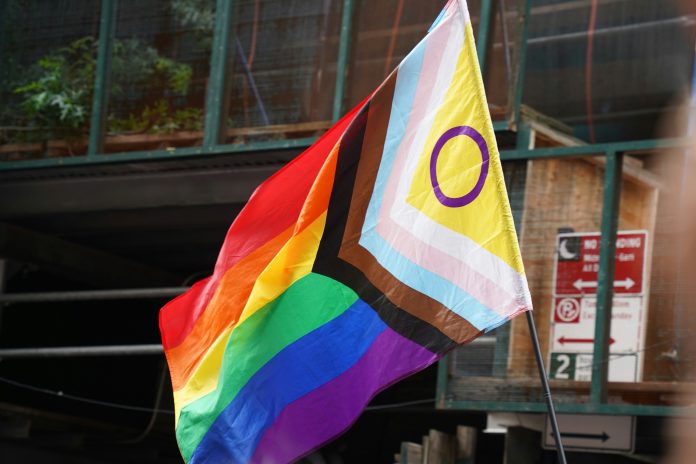
On July 16, the Graduate Student Society (GSS), in a joint Instagram post with the SFU Queer Collective, announced that per-procedure caps were being removed from gender-affirming healthcare benefits. These caps previously set a $5,000 limit on how much coverage students can receive from their health plan for a single procedure. Additionally, the GSS noted that the lifetime maximum has increased from $10,000 to $50,000, and has “expanded eligibility” to not only to those diagnosed with gender dysphoria, but also those with gender incongruence. Gender incongruence describes wherein someone’s gender is different from their assigned sex, while gender dysphoria describes the unease people may feel when they have gender incongruence. These changes will impact not only graduates at SFU but also any student enrolled in a Canadian university that has a student health plan through GreenShield.
“The changes [in coverage] are the direct result of organizing led by trans and queer students who have been advocating for the removal of the per-procedure caps for a while now,” said the GSS Executive Committee in a statement to The Peak. They highlighted the importance of open letters, but said that it only provides the public a “snapshot of a broader picture of organizing and advocacy.” The GSS shared, “We want to honour and emphasize the significant amount of emotional, physical, and intellectual work that the trans community put into making a positive change in our healthcare benefit plan.”
On June 16, the SFU Queer Collective, SFU Faculty Association, SFU Trans Equity Pod, Administrative and Professional Staff Association, and union CUPE 3338, released an open letter calling for more comprehensive gender-affirming healthcare coverage.
“This kind of advocacy shows how important it is to centre the material, basic needs for Two-Spirit, trans, and non-binary people to have health, welfare, and dignity, and safety, and be included in their communities”
— Clio Lake, outgoing chair of the SFU Queer Collective
The Peak reached out to Clio Lake, the outgoing advocacy chair of the SFU Queer Collective with a masters in public health. They said that the letter was “community-driven” which showed “the significant allyship from the bargaining units, from the employee groups, and from community leaders.” Lake noted, “This kind of advocacy shows how important it is to centre the material, basic needs for Two-Spirit, trans, and non-binary people to have health, welfare, and dignity, and safety, and be included in their communities.”
Lake said the groups have thus far received no response from the Simon Fraser Student Society (SFSS), however noted that the aforementioned changes would be relevant for undergraduate students as their health insurance was being carried under the Pacific Blue Cross and GreenShield medical programs.
The open letter from the advocating groups called upon the university to “create a comprehensive funding mechanism for all staff and faculty health benefit plans across bargaining units, to ensure lifesaving gender-affirming healthcare is never out of reach for our community members.”
The open letter had called upon the SFSS and GSS to create a “comprehensive funding mechanism for gender-affirming procedures to be covered by the Alumo plan and reserve funds without exclusions, removing coverage-stigmatizing per procedure caps.”
The groups said that the SFSS and GSS had signed a student healthcare agreement last year which included procedure caps on funding, which they shared were “despondently below what’s needed to cover acutely needed and difficult to access interventions.” These interventions refer to gender-affirming medical procedures or treatments.
GreenShield, the gender affirmation healthcare provider for SFSS and GSS, covers foundation procedures, such as eligible “chest/breast surgeries,” and focused procedures, such as “hair transplants/implants.” The cost of many of these interventions are high. For example, full body laser hair removal can cost upwards of $1,300. Body contouring ranges from $4,000 to $10,000 depending on the size of the area. Hormone treatment can cost as little as $9–30 per month for injections, but some individuals may opt for more expensive options that range from $150–170 per month, due to preference or side effects.
The groups stated that university employees “remain dangerously underinsured by employee benefit plans, which exclude the amount of coverage necessary to fund these critical interventions.” They called on SFU to match the rate of coverage offered at alternative institutions such as UBC, which offers $50,000 lifetime maximum levels of coverage.
The open letter highlighted the importance of proper coverage to “keep trans people safe from gender-based violence, sexualized violence, and suicidality, reduce impacts of anti-trans discrimination in education, housing, and jobs, and support the well-being and mental health of trans people.”
Lake said the change was a “big win” and the amount of coverage trans individuals could receive was “groundbreaking, life-changing,” and “life-saving.” Noting the reaction in the community, they said, “There’s been a lot of celebration and a lot of gratitude for the folks who’ve been involved in advocating, the folks who’ve been carrying that advocacy through to the insurer.”
They also noted the change was relevant for alumni who had recently graduated from their respective programs, with individuals having access to benefits until August 31. Lake shared, “There’s yet to be a formal announcement from either Greenshield or Studentcare/Alumo about this benefit change, but we expect that the membership will be informed widely,” come September.
Lake shared, however, that staff were only covered under the Pacific Blue Cross program for extended health and dental and “now have worse gender affirming benefits than students at the university.” They said, “From what we’re aware of, staff and faculty have access to $10,000 of [lifetime] coverage, which is really insufficient to provide coverage for some of the really costly, inaccessible, and medically necessary procedures that are excluded by public health insurance.” Lake encouraged staff and faculty impacted by the coverage to get “engaged in this process” of advocating for more comprehensive benefits.
Content moderation unfairly silences queer expression

By: Jonah Lazar, Staff Writer
Content warning: mention of rape, incest, and child sex abuse.
Last year, anti-porn organization Collective Shout successfully lobbied to prevent transactions from users buying video games containing “adult content” on game purchasing sites Steam and Itch.io. In an open letter addressed to payment processors like VISA, MasterCard, and PayPal, Collective Shout condemned the sale of video games containing rape simulation, incest, and child sex abuse. They called on these companies to cease their relationship with these gaming platforms so long as they host games and content of this nature. Limitations on content involving rape, incest, and child sex abuse are undoubtedly a good thing. However, since then, there are claims that over 20,000 not safe for work (NSFW) games across platforms are deindexed, removed, or no longer purchasable.
The content ban has largely followed a non-transparent approach that prevents the purchasing of any content tagged as NSFW, which is much broader than Collective Shout’s stated issues. This has had a disproportionate impact on queer media, which is often labeled NSFW due to lingering stigmas around queer sexualities and relationships, even when the content itself is no more explicit than its heterosexual equivalents.
Websites removing NSFW content to appease payment processors or app stores is not a new phenomenon. In 2018, Tumblr was removed from the Apple App Store for having abuse images circulating. In response, Tumblr purged all explicit content, erasing vast swathes of the 2SLGBTQIA+ communities’ content on the platform. The reason is 2SLGBTQIA+ content gets flagged as NSFW even when dealing with non-sexual themes. This happened on Tumblr after they used an algorithm to detect explicit content, but flagged regular art. For Steam, any user can add tags to a game, even if the developer disagrees with it. Content dealing with sensitive topics like queer expression and existence gets flagged simply for its queerness; even a two-dimensional, non-sexual game was banned due to having a transgender main character. Heteronormative content is able to get away with a lot more, and gets to exist in a grey area of appropriateness that is not afforded to queer content. It’s not that the content is explicit, it’s that content with queer characters gets flagged for just existing.
The queer community consistently has had to fight for the right to exist in public, without their experiences and expressions being reduced to stories about sex.
The queer community consistently has had to fight for the right to exist in public, without their experiences and expressions being reduced to stories about sex. This latest wave of content moderation is yet another example of queer voices being silenced. Until queer content begins to be held to a similar standard to straight content when labels such as NSFW are assigned, queerness will continue to be abruptly filtered out without warning or care.
We need an Indigenous approach to wildfire control
By: Jonah Lazar, Staff Writer
For many people in the north of Turtle Island (Canada), the summer has become synonymous with the fire season. Forest fires wipe out entire towns and have displaced thousands across the country, leaving many communities wondering when it will be their turn. Over the past five decades, there’s been twice as much land victim to wildfire in northern Turtle Island, and it has been commonplace for these fires to cross over into towns and people’s homes. Three years ago, nearly 50,000 people were evacuated from their homes in a record-breaking fire season in BC. On July 7, the Namaygoosisagagun (Collins) First Nation, were forced to evacuate with only minutes of notice. They did not receive any warnings from the provincial or federal government. Indigenous communities have been disproportionately affected by these fires and are “33% more likely to evacuate from a wildfire.” Many of these communities have not been equipped to fight these fires effectively. Various First Nations groups have called for additional equipment, like fire trucks, upgrades such as water systems, and increased funding.
The climate is changing, and one of the more drastic, direct impacts that this change has had on northern Turtle Island is the increase in forest fires. In the record fire season of 2023, 93% of the area set ablaze in northern Turtle Island came from lightning strikes. This wasn’t an anomalous year — in fact, this is a taste for what is to come. Increased lightning activity is directly related to climate change; higher average summertime temperatures caused by increased CO2 in the atmosphere mean that the updrafts are far stronger, and hotter air retains more moisture. This leads to fewer but more intense summer storms, with an estimated 12% increase in lightning strikes per 1 degree celsius of temperature increase.
What makes matters worse is the government’s approach to forest fires. It has predominantly been to fight them head on, with a priority on containment and fire suppression, an approach where minimizing fires is the biggest concern. In previous decades when we consistently had more temperate summers and less intense forest fires, this approach worked to some extent. However, there is now a dangerous collection of dead wood in our forests, which are pure jet fuel for any potential fires. With the increased lightning frequency brought on from climate change, and the copious amounts of fuel left dry on the forest floors, fires have become an inevitability.
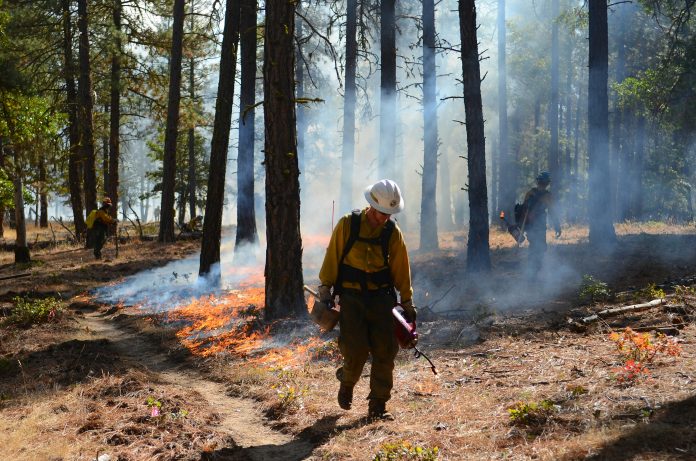
Indigenous communities across Turtle Island (North America) and South America, as well as Australia, have traditional fire management practices; controlled burns. These burns are carefully started to preempt an uncontrolled fire. These controlled burns are planned when the weather would help in ensuring that the fire wouldn’t grow out of control. These tactics are not just effective in reducing out of control fires, but also beneficial for the environment as it regenerates the soil with nutrient rich ash, promoting ecological growth.
Vast bodies of knowledge of the practice has been lost due to generations not being permitted to practice controlled burning.
Controlled burns, however, were banned by the BC government in 1874 through the implementation of the Bush Fire Act — the colonial government incorrectly viewed these burns as damaging to timber. While some burning is now allowed, albeit heavily restricted, the current controlled burning falls far short from what experts view as needed in BC’s fight against wildfires. Since then, vast bodies of knowledge of the practice has been lost due to generations not being permitted to practice controlled burning.
Continuing down the colonial approach of firefighting will not work in the modern reality of climate change. Intense storms caused by warmer temperatures and prolonged droughts through the summer months will only lead to more of a fire risk, and the current approach of fire suppression is not keeping up. It’s time to begin crafting alternative ways of fire control, and utilizing Indigenous fire management systems is a great place to start.
Exploring queer spaces in the city
By: Kelly Chia, Peak Associate and Maya Barillas Mohan, Staff Writer
As we approach Pride here in “Vancouver,” members of diverse queer communities in Davie Village and Chinatown are still advocating for one another. Many queer walking tours are made to platform queer people’s struggles and joys. To learn more, I read an article from Xtra Magazine where author Robin Perelle and her interviewees reflect on queer spaces. Today, Davie Village is “the heart of gay Vancouver,” but before the ‘80s, queer businesses were scattered throughout Vancouver. Archivist Ron Dutton said, “Gay people could get away with being gay” in places like Chinatown and Gastown.
More visibility meant more harassment. Perelle wrote that in 1974, police “raided at least a dozen more gay bars.” It also meant the community was invigorated to hold one another. Another interviewee, Don Hann, said, “We were asserting our sexuality and claiming space that had never before been available to us.”
I would also like to acknowledge Glenn Tkach’s Really Gay History Tour, which runs once a week. Tkach told The Tyee he wanted to create a tour that was “inclusive of all queer history” that goes beyond the dominance of gay, white men. It shows sites like the Quadra, Vancouver’s first lesbian bar, where some of the city’s first acts to call themselves drag kings performed, and other histories of transgender and Two-Spirit communities.
With so much history before me to reference, I wanted to highlight the community that exists today. I started in Chinatown. Historically a place where Black, Chinese, and Indigenous people experienced rampant discrimination, Chinatown is also built on treasuring community among immigrants and other marginalized groups. Kimberley Wong, program manager at Hua Foundation, embraced their Chinese queer identity while “heaving crying” watching local drag queen, Maiden China, in Chinatown.
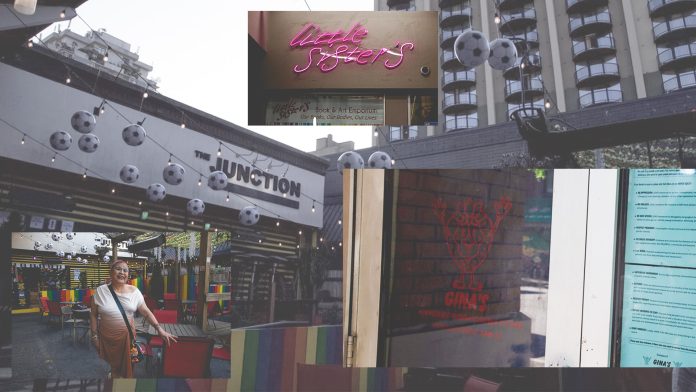
Gina’s
My first stop was Gina’s, a sapphic “for queers, by queers” event space which holds karaoke nights. It is only open on Sundays from 6:00 p.m.–11:00 p.m., but as I drew up to the glass, I saw Gina’s was closed.
“No oppression, No violence, No hate speech,” the sign instructs patrons. “Allies are welcome but should be mindful of the fact that they are in a queer establishment meant to centre and be safe for queer people of marginalized genders.”
When I contacted owner Valeria Velazquez to ask her about Gina’s, she told me she opened the spot because “there needed to be a space that was a little bit more chill than the alternative,” something with less of a “party scene.” It’s a space designed with talking in mind; Gina’s is a close-knit community knit together by Velasquez and her girlfriend.
In 2025, Velazquez told Daily Hive, “From my immigration process, to burnout, to this city’s red tape, capacity limits, event restrictions, and the expectations and pressures that come with holding a space like this, it’s been hard to sustain the dream we had for this place.”
“Queer spaces aren’t just about walls or locations; they go beyond that. Even if physical spaces close, our queerness and our community persist.”
— Valeria Velazquez, owner of Gina’s
Gina’s operating hours had slimmed, and now the doors have shuttered. On July 22, Velazquez announced that Gina’s would be closing. In face of this, Velazquez says, “Queer spaces aren’t just about walls or locations; they go beyond that. Even if physical spaces close, our queerness and our community persist.”
After a short bus out of Chinatown, I arrived on Davie Street. The whole area is decked out in pride flags. Hardware stores and drug stores stock prosaic merchandise like screws and nails, but the windows boast a vibrant display. Rainbows drip from white paint cans, with pride flag crêpe paper curling down from the ceiling to graze nylon plastic flowers bloomed across the scene.
Little Sisters
Little Sister’s bookstore is the first queer bookstore in Western Canada. It was where 2SLGBTQIA+ community members “discussed the happenings during the AIDS epidemic.” In 1987, it was bombed in a hate crime that thankfully didn’t kill anyone. Little Sister’s was also at the helm of an important landmark case. The late original storeowners Jim Deva and Bruce Smythe noticed their shipments from the US would sometimes arrive damaged or missing. They challenged the Canada Border Services Agency for violating their freedom of expression and won in 2000. The Supreme Court of Canada agreed Little Sister’s had been discriminated against.
Still, through legal and physical threats, the bookstore has survived as an important space for the 2SLGBTQIA+ community. “I think it will be here long term,” current owner and longtime friend of Deva and Smythe Don Wilson told CBC.
When I visited the store I was amazed by the bright displays of colourful packaging. I spoke with cashier Aurora Jones, who explained that as e-commerce took centre stage, many bookstores were forced to pivot their business models.
Compared to the primarily literature-based stock in the past, they now “have clothing, adult novelty, sex toys,” Jones said. “We still have a pretty diverse collection of fiction, non-fiction, and used books.” Looking through the magazines and used books from different time periods, the store has an archive suffused into its contemporary collection. “People bring collections from back when they were shopping in the ‘80s, so more generations can enjoy stuff from that time.”
“Little Sister’s has been able to survive this long because of the community and because people just keep coming back to support this smaller business.”
— Aurora Jones, cashier, Little Sisters
Aware of the space’s legacy and how it serves the community, Jones focuses on the current responsibilities of the shop. “Little Sister’s has been able to survive this long because of the community and because people just keep coming back to support this smaller business.” This includes “parents looking for information about their kids who have come out to them,” he added. Davie is “definitely a community that’s not ashamed to be who they are,” but many other places “could stand to be a little more open and honest with themselves.”
The Junction
The Junction is a bar with a dance floor that runs a variety of events. A drag show was happening that night (they happen every night!), but the patio by the host stand was open to non-ticketholders. It was my first visit. We sipped our drinks there as we watched attendees filter in, many wearing extravagant outfits themed around video game characters.
I spoke to Imelda Mae Santos, a performer about to go on stage that night, over the roar of the crowd audible from inside. “I’ve been here for a long time.” She gestured at me: with a chuckle and said I was “not even born.” I asked her what her favourite part about performing is, and she enthusiastically responded, “It’s just a rush. I love being a performer, I really do!”
I asked for a photo of Santos before she went off to perform. “My hair’s not done!” she said, but I thought her blue iridescent makeup was immaculate.
I also spoke to a bartender, name tag reading Mikheel, wondering what it’s like to work somewhere so alive. He recounted a broad audience, too; young people, seniors, families with babies visit in the daytime. “Everyone’s here, everyone’s welcome.”
But around 10:00 p.m., it becomes an adult-only space. “Nightclub mode,” Mikheel said. “We have drag shows every night. This is like the drag show central.” The Junction also has other events: queer improv, bingo, trivia shows, and more. Mikheel told me with a smile that “most of the community events happen here.” The Junction has been renamed over the years, but the space has been a hub for queer people for a long time.
Numbers
Numbers has a cool multi-story build because it was once a residential building. You can still see traces of this, like the stained glass windows on the walls, details the about page explains were “from the late 1800s and early 1990s.” My visit was brief but enjoyable. I suspect it teems later into the night. According to their website, Numbers hosts frequent themed drag shows and nostalgia nights, “welcoming generations of guests who come to dance, connect, and celebrate freely.”
Walking along Davie, I was pleased to see the assortment of queer businesses old and new. I learned a lot about how important pride is for resistance. Everyone I spoke to or interacted with was deeply enthusiastic about their work and role in building a welcoming community, proud of the scene that exists today.
How art supports healthy aging
By: Marie Jen Galilo, Staff Writer
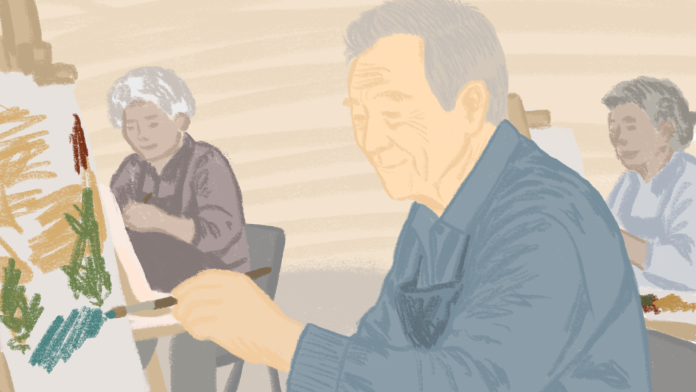
Many people are afraid of growing old because they fear its features, including changes in physical appearance and cognitive abilities as well as social isolation. Art can help us reframe our perspective on aging and learn to view it as a gift. The Arts & Health: Healthy Aging Through the Arts project creates collaborative spaces where seniors and Indigenous Elders work with artists to explore different art media. To learn more about this initiative, The Peak corresponded with its coordinator, Caroline Liffmann.
Arts & Health is a Vancouver Board of Parks and Recreation project, in partnership with Vancouver Coastal Health, and local organizations. The project was founded 20 years ago and was influenced by Dr. Gene Cohen’s research on creative aging, the use of art-based learning and community-building to promote healthy aging in seniors. His research showed that seniors who participated in art programs exhibited “reduced chronic pain, reduced stress and anxiety, increased brain connections.” In the project’s first three years, the UBC School of Nursing conducted a study on its impacts on senior health, and found that seniors in arts programs had “increased social connections.”
“One participant this year shared how grateful she was for the project and the group, because she usually leaves her apartment just twice a week — once to get groceries, and once to come to her weekly Arts and Health group,” Liffmann shared.
There are currently five active Arts & Health programs in which artists and participants work together on a variety of projects, including “digital storytelling, memoir, beading, improv theatre, screen printing, and contemporary dance practices.” Even after the program ends, participants stay connected and continue making meaningful art. This year, a group of such participants who worked on a project 20 years ago called “Queer Imaging and Riting Kollective for Elders” received an award from SFU’s Gerontology Research Centre. Achievements like this show the lifelong impacts of practicing creative aging through arts, both for individual empowerment and to society at large.
Arts & Health aims to empower seniors by letting them lead the creation of their own art through which they “explore issues and ideas that are important to them.” In a Strathcona Community Centre puppetry project, for instance, the participants “didn’t think of themselves as artists initially,” but they “became more confident and vocal about their interests, beginning to take on more leadership roles,” and used puppetry to share their “experiences of war as children.” Liffmann shared a testimonial from one of the participants: “Arts & Health brings out our happiness and sadness. It helps us recollect our memories, life experiences and individual stories, with laughter and tears. We forget our age, health limits, and pain . . . we support each other.”
As I watch time turn the hairs on my parents’ and loved ones’ grey, knowing there are community-based support networks that will help them navigate this stage of their life gives us the reassurance we need to enjoy the present and remain hopeful for what the future will bring.
After seeing the positive impact that art has on the health and well-being of seniors and Elders, Liffmann views arts as “a way to process the information of our life experiences, and to express and imagine ideas, memories, futures, heartbreaks, complexities, fragments, joys, and new possibilities, large and small.” As I watch time turn the hairs on my parents and loved ones grey, I worry about how to support them as they age. Knowing there are community-based support networks that will help them navigate this stage of their life gives us the reassurance we need to enjoy the present and remain hopeful for what the future will bring.
Exploring Canadian women printmaking trailblazers at The Gibson
By: Jonah Lazar, Staff Writer
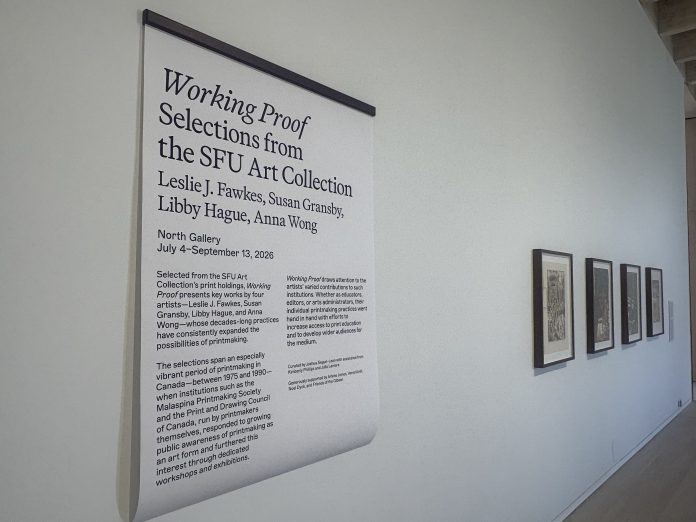
Working Proof is an art collection displayed in the North Gallery of SFU’s Gibson Art Museum to celebrate four artists who played an integral role in promoting printmaking in Canada. Curated by SFU MA graduate Joshua Segun-Lean, the exhibit brings together pieces from SFU’s art archive, spotlighting printmakers, Leslie J. Fawkes, Susan Gransby, Libby Hague, and Anna Wong. The works displayed were created roughly between the years 1975–2000, a period when artist-run institutions like Granville Island’s Malaspina Printmakers were pushing printmaking back on the pedestal of artistic practice in Canada.
Walking into the exhibit, the first thing I noticed were the prints created by Wong: carefully constructed pieces containing a mixture of Chinese embroidered patterns, Chinese script, and fragments of traditional paintings. Wong trained in Chinese brush painting in Hong Kong before coming to Vancouver to pursue printmaking as an academic and professional endeavour, and that dual inheritance is everywhere in her work. The piece that most captured my attention in the whole exhibit came from her section; the surreal collage of the Great Wall of China spread across two frames, and was a slight departure from the aforementioned themes. With stunningly delicate shadowing accentuated the rolling, gentle green hills and the winding wall, this piece felt like a still frame from an Akira Kurosawa film.
Further along the exhibit came some pieces by Hague, which primarily involved stencilled cutouts of murky black and white figures moving around in day-to-day activities. The figures in her works often display a flattened, poster-like quality, almost as if they were the shadows. None more telling of this than “The Women Walking By” (1978), where three silhouetted women clad in black, carrying purses seem to be convened at a bus stop, collectively going through the motions of everyday life.
Moving clockwise through the room, I arrived at Fawkes’ explorations of the nude body. Monotone black figures with thin white engravings that demarcate different body parts, these pieces balance a kind superficial strikingness with an underlying tenderness, inviting the observer to engage with the humanity of the two-dimensional figures.
Finally I arrived at Gransby’s works, which are displayed next to newspaper clippings, brochures, and memorabilia of the Malaspina Printmakers where Gransby once plied her trade. Gransby’s works on display are distinguished from others by their striking focus on architectural styles, most of them often leaning towards colourful, abstract depictions of buildings, houses, and rooms, with chaos and nostalgia abound in her artworks.
This exhibit served as a quaint, yet powerful, tribute to these four trailblazing artists, as well as a great source of artistic inspiration and accessible public education on Canadian print making.
Overall, Working Proof provided a very accessible point of introduction to the print making world, an art form that deserves its flowers. This exhibit served as a quaint, yet powerful, tribute to these four trailblazing artists, as well as a great source of artistic inspiration and accessible public education on Canadian print making.
Working Proof will be on display at The Gibson Art Museum until September 13, 2026.

