Home Blog Page 935

World at odds over arms in space

0
Experts say space warfare could compromise structures like the International Space Station. - Photo courtesy of Wikimedia Commons

Weapons in space are almost globally understood to be dangerous. They could, for instance, damage the International Space Station or another structure if they fell into orbit with them.

However, the United States has refused to sign a binding deal that would prevent them from ever sending weapons into space.

Russia, China, Canada, and several other countries have agreed to proposals for a treaty prohibiting any country from putting weapons in space, but the United States has refused to join.

SFU adjunct professor of International Studies and fellow in International Security Paul Meyer weighed in on the conversation taking a critical view of US policies: “In the Obama Administration’s June 2010 National Space Policy, it has said it would consider any arms control proposals ‘if they are equitable, effectively verifiable, and enhance the national security of the United States and its allies.’

“The US has, however, not proposed any such measures of its own and has criticized those put forward by Russia and China.”

He added, “The US has expressed a preference for political arrangements, such as confidence-building measures (CBMs), but has not been active on behalf of these either. The impression is left that the US does not want to accept any new constraint on its freedom of action in outer space.”

Some people are concerned because while countries rely on space technology for scientific research, communication, and space technology, it is possible that a failure to prevent space weaponry could have serious consequences.

Meyer says that space warfare not only poses a threat to spatial structures, but could also result in a massive amount of debris that would be obtrusive to prime satellite orbits. According to data from the Union of Concerned Scientists, there are approximately 1,300 operational satellites in orbit, including 120 American satellites used for military operations.

He commented, “As [the US is] the leading spacefaring nation, US opposition to a space weapons ban would make it difficult to achieve such a treaty. Understandably, other space powers would not want to accept constraints on their conduct that would not also bind the US.

“There is always the risk that as long as the door to weaponization of space is not firmly closed, some irresponsible actor will introduce weapons into this fragile operating environment to the detriment of all users of space,” Meyer added.

The United States has supported the EU Code of Conduct for Outer Space Activities, a set of political measures that has run into opposition since being proposed seven years ago. Meyer says that this is mainly from BRICS (Brazil, Russia, India, China, and South Africa) arguing that this type of code should be negotiated under UN auspices with a clear mandate.

“With the EU’s Code proposal stalled and continued US opposition to international legal instruments for prohibiting space weapons, the prospects for obtaining new agreed measures of restraint are dim,” Meyer concluded.

Advocates are hopeful that when the UN meets on October 22, the debate over space arms will be considered to be the most prevalent issue of the year.
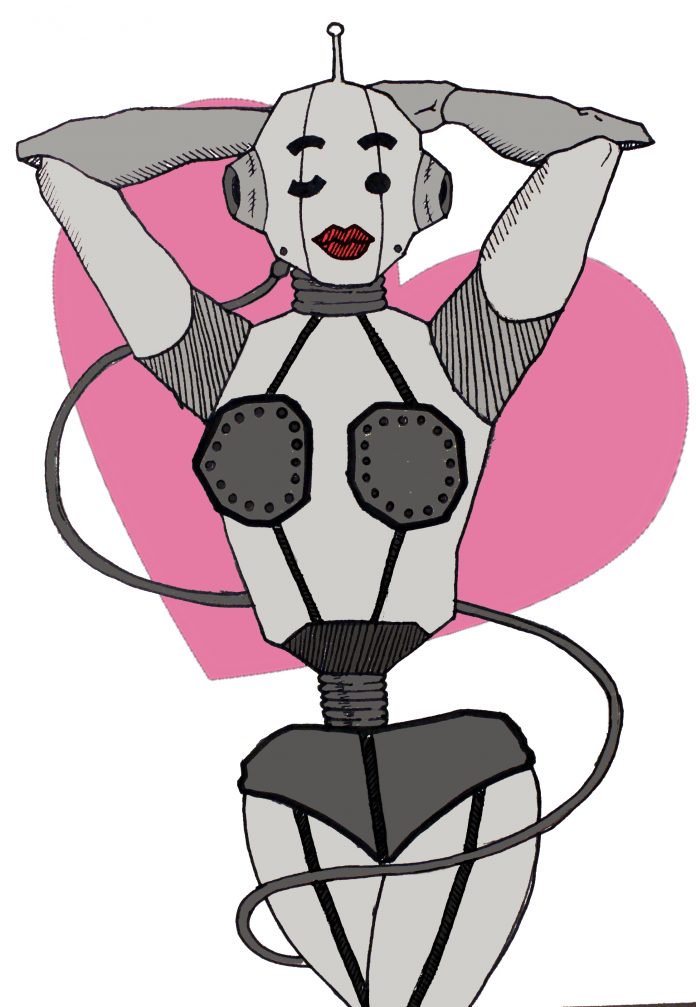

Sex robots: hot or not?

0

Yes, they are perfect for sexual exploration and discovery!

By Bernice Puzon

Sex is often thought of as a physical act between two people. However, a huge part of that act is actually composed of what each self desires.

Artificial intelligence engineer Douglas Hines has developed the first human-sized, interactive sex robot, named Roxxxy. Roxxxy will be able to “carry on a discussion and [express] her love to you. She can talk to you, listen to you and feel your touch,” according to the company’s website.

Dr. Kathleen Richardson, a robot anthropologist at England’s De Montfort University,  recently released a paper arguing that sex robots would be “detrimental” to society, as they could replace physical human relationships.

I don’t believe that robots could replace human relationships at all — in fact, sex robots could be a great tool for personal exploration of one’s sexual preferences.

We are all attracted to and turned on by different people or things. Some people like to be touched or kissed in specific places. Some enjoy BDSM or role play. Others may prefer oral or anal sex. There are so many ways that having sex can play out, and even more ways to personally feel pleasure. This is why we masturbate. Sex toys such as dildos exist for enhancing this personal experience.

However, so many people have trouble communicating with their partner about their sexual preferences. Often, many people don’t even know what they like or don’t like, simply because they haven’t bothered to find out for themselves!

We live in a culture where an idealistic version of sex is portrayed by the media as exciting and passionate, where two people are in sync and reach orgasm at precisely the same time. But in reality, sex doesn’t usually work that way. It takes time, effort, and communication to have a mutually gratifying sexual experience between partners.

Sex robots like Roxxxy can provide a means of self exploration on a human body. It would allow people to discover how pleasuring others can give themselves a sense of pleasure. And since Roxxy is designed to be a communicative and sympathetic partner, it could also be a positive model of open communication with partners as well.

Hines states, “We are not supplanting the wife or trying to replace a girlfriend, [. . .] the physical act of sex will only be a small part of the time you spend with a sex robot — the majority of time will be spent socialising and interacting.” At the end of the day, a robot is still a robot. It’s a piece of technology that is supposed to enhance an aspect of real life, and there is nothing detrimental about that.

No, They’re nothing but glorified sex slaves!

By Zach Siddiqui

It’s one of the most critical times during your relationship: the one-year anniversary. You’ve meticulously blueprinted the evening — the scrumptious home-cooked dinner, scintillating conversation, and scented candles illuminating your bedroom’s subdued lighting. The night progresses smoothly, and soon, wrapped in blazing passion, your accelerating heartbeat synchronizes with the internal cooling system for your partner’s unfeeling metal insides.

365 days ago, you paid thousands of dollars for your very own sex robot.

Companies like TrueCompanion have been developing humanoid machines designed to ‘scratch the itch,’ complete with personalities and customizable appearances. While these marionettes’ makers are pleased with their seductive Frankenstein’s monsters, robotics experts and cognitive scientists raise serious ethical concerns. As important as sexual gratification is, I’m going to have to join those experts with a bucket of ice and serious misgivings about this ‘technological advancement.’

“Robots are a product of human consciousness and creativity and human power relationships are reflected in [their. . .] design,” writes robot anthropologist Dr. Kathleen Richardson, from the Campaign Against Sex Robots. I’m honestly scared of what’s reflected in the demand for sexual partners with zero capacity to deny consent or act against the customer’s wishes.

Mass-producing these dolls risks reinforcing and normalizing sexual relationships where only one participant’s desires matter. You might argue that defending robot rights is ridiculous, but this isn’t about robots; it’s about what they say about us as people.

Companies have defended the product by proposing uses beyond the sexual, claiming that robots would mainly be used for socialising.

That’s very nice, but it should go without saying that to ‘Netflix and chill’ with the equivalent of iOS 5 is hardly a healthy way to deal with loneliness, heartbreak, or grief. If anything, it draws people into unhealthy dependencies, distracting them from actual recovery strategies, and damaging their ability to experience empathetic connections.

The robots are even being suggested as a crime reduction method. “Child-like robots could be used for paedophiles the way methadone is used to treat drug addicts,” speculates Ron Arkin, director of Georgia Tech’s Mobile Robot Lab.

This justification rankles on multiple levels. Sex crimes are not something a person can just get out of their system, and to treat them as such is to grossly trivialize some of the most heinous human acts.

“It’s just another sex toy,” some might say. But most sex toys don’t embody the forms of glorified sex slaves. They don’t endanger our ability to reach out to real people in times of emotional need. They don’t dismiss sexual abuse as something comparable to anger released by screaming into a pillow.

These robots are a menace, and we need to stop marveling at the novelty and treat them as such.

Come at me, bros!

0
Say 'adios' to your manhood, boys!

A man’s ballsack is the perfect encapsulation of the incredibly sad irony that is conventional masculinity — it’s painfully sensitive, weak, and very easily crushed.

Today, there are some fascinating characteristics ingrained in the typical male psyche. Along with a genetically inherent conversation-list comprising of how many women we can bang, and who’s wrestling on TV tonight, masculinity includes a ‘confident’ male strut comprised of a straight back, stiff neck, rigid arms, and a slight bounce in step. For men, it’s simple. It’s inherent that all of us defy the way our bodies naturally move so that we can show how tough we are by walking as if we have large sticks up our rear-ends.

Now, here’s a shocker: we’re creative beings, we have emotions, we construct fiction. And that’s simply what being a bro is — a sadly constructed visage of sensitivity disguised as a 12-inch dick.

Thankfully, I consciously don’t subscribe to conventional masculinity, other than maybe in some of the clothes I wear. I wouldn’t classify myself as feminine either. I’m not a ‘hipster.’ Maybe I’m a little geeky. But I prefer to label my culture as ‘Adam;’ in other words, I don’t really fit anywhere, and I’m pretty satisfied with this.

However, because I don’t act in every usual sense a ‘bro,’ people react incredibly sensitively. Other men seem helplessly confused by me, especially those who adamantly classify themselves as your typical ‘dude,’ or who are otherwise simply struggling to understand the meaning of masculinity in general, much less their own.

He even adjusts his physical posture to uphold the self-assurance that he’s ‘not gay.’

Sadly, bros often label my masculinity as ‘not quite right,’ a phrase which they usually equate to ‘not manly enough,’ ‘just weird,’ or ‘he’s not like me so he must be gay!’ Ironically, while they judge, they’re the ones who frantically sweat bullets to maintain their own appearances. Don’t get me wrong, I wouldn’t say I’m holier than thou, as in the past I’ve sadly judged other men in the same manner (and felt horrible about it afterwards).

Though I’m ashamed to relay it, during a ‘bro’ conversation, I’m typically given a borderline objectification about a “hot chick” within the first five minutes. If I actively agree with these lovely pleasantries, then both us dudes can breathe a sigh of relief and the conversation can continue comfortably (with frequent comments on how hot we find lesbian porn of course).

However, if I don’t readily engage, then I’ve simply crossed a line that no proper man dares to cross. Eye-contact is immediately averted, feet shift uncomfortably, the topic is desperately changed to something more ‘masculine’ so the uncomfortable party can feel better about himself. He even adjusts his physical posture to uphold the self-assurance that he’s ‘not gay’ — because for some reason sexuality is brought into the picture.

This is when I realize that men are so easily infringed upon; masculinity is incredibly fragile, and so horribly grounded in homophobia that it’s laughable.

Men, I’m sorry you exhaust yourselves being terrified of societal pressure, but I’m tired of how you all mindlessly act the same; how most of you don’t even realize how ridiculous this is, or maybe you’re simply afraid to. Drop the prosthetics and grow a real pair of balls; be open-minded, accepting, treat women with respect, treat people with respect, try to embrace your intelligence and emotions, talk to a man who doesn’t fit your stereotype, and do so without feeling as if your brittle masculine shell will shatter to bits if someone sees you.

But of course you don’t want to read any of this, so I’ll conclude this article in your favour. Remember: to express your masculinity in any unconventional way is unequivocally wrong. You won’t be successful, you won’t find a relationship. Don’t leave your house without flipping your cap backwards, securing your jeans below your ass, and making plans with the boys tonight to drink so much Pabst that you give yourself and the next guy alcohol poisoning. After all, that’s obviously what men do!

Me? As the confident man I am, I’ll be gladly marathoning Orange is the New Black, while chugging back a double long-island ice tea with an extra slice of lemon. Thanks!

SFU mathematicians crack the mysteries of the maple tree

1
Currently there is no concensus on how trees ooze maple syrup. - Illustration by Phoebe Lim

An SFU study has unlocked some new evidence regarding how maple trees produce such a large quantity of sap — and the implications of these findings could mean big things for the maple syrup industry.

The study, led by SFU mathematician John Stockie with colleagues Isabell Graf and Maurizio Ceseri, looks into the subject of tree sap exudation (excretion) in sugar maples.

The research was developed to find a more concrete answer to why these particular trees continued to produce a lucrative amount of sap even in a leafless state during the winter months.

The prevalent theory of the secretion of tree sap attributes exudation to the physical processes of osmosis and freeze-thaw cycles, which involve the buildup of gas in sap cells during freezing and results in the release of gas and expansion of the sap as it thaws. However, these models have led to their fair share of unanswered questions and head-scratching over the years.

Hoping to close the gap of uncertainty, Stockie and his team designed the first mathematical model of sap exudation as means of resolving the bewilderment linked to the strange case of maple exudation.

Stockie justified the need for a mathematical model: “Typically what happens with problems like this — with many different physical mechanisms coupled together and interacting — people have ideas for what could be going on, but the physics is so complex that it’s very difficult to fasten on the correct solution unless you get into the math.”

SFU mathematicians worked first on modelling the mechanics of sap exudation on a cellular level, to understand all the processes that were going on. They then scaled up the cellular processes to arrive at a simpler string of equations, which the computer could then go on to solve.

A year later, Stockie and his team discovered three new physical mechanisms that were essential components in tree sap secretion. Additionally, they discovered a connection between exudation and freeze-induced embolism, which causes blockages in sap flow and further damage to the tree itself.

Stockie argued that the model could be greatly helpful to the maple syrup industry. It would, he said, aid in the optimization of sap harvests for syrup producers, and help foresee the potential impacts of climate change on sap yields.

For Stockie, though, these findings are only the beginning to unlocking more unanswered questions in the study of sap harvest. He hopes to further pursue this topic over the next two years and continue to unlock more secrets into our beloved national treasure, maple syrup.

Student newspapers are underrated

0

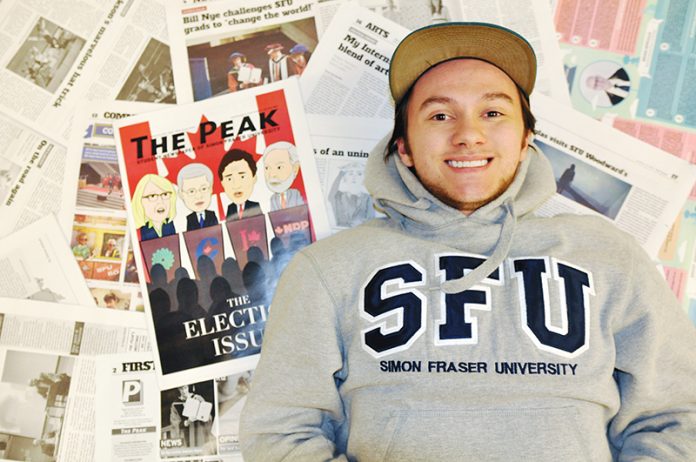
While student press has suffered the same shrinking industry that larger newspapers have been plagued by over the last decade, I’d argue that now is the most important time for student news to be in circulation — not for the students and faculty (and mostly parents and interviewees) to read, but for the writers and editors themselves.

For all the hype that SFU gives its co-op program, The Peak (and similar student papers across the country) doesn’t get the credit it deserves. It allows writers to foster their journalistic skills by conducting real interviews, write their own articles that aren’t for a grade but for people to actually read, and ultimately get a sense of what it feels like to have their writing commit to news forever.

We can be lauded, or we can be ripped apart in a comments section. Our work can be nominated for awards, or get us sued. We can see our work help push for real change, and, as in my experience with my prior newspaper, we can get it banned from restaurant chains because they “can’t publish stuff like this in a family-friendly establishment!” (In their defense, publishing an article with the phrase “toy-filled fuck-hole” wasn’t family-friendly in the slightest.)

The bottom line is that everything that you end up reading from a student newspaper comes directly from people who are not only struggling to go to their early morning classes, but who are getting a sense of what it is like to work in the fabled real world, where there isn’t a safety net to stop you from doing a bad job. 

I’ve been lucky enough to work for a student paper the last five years now, first as an editor with The Reflector, at Mount Royal University, and now with The Peak as a contributor. I can say confidently that the skills you learn aren’t just valuable for someone in the communication field, but anyone who could benefit from improved writing skills, critical thinking, and working on a short deadline.

These are the attributes you would want to walk away from your classes with, but ultimately don’t have to pay hundreds of dollars for. They aren’t dependent on if your prof or TA knows what they are doing, and they aren’t something you get to put on for four months just to try and get through with a better mark. It also looks way better on your resume because you’re getting involved in campus life.

On top of that, though, it’s maybe one of the best ways to feel associated with campus. SFU has a reputation of having no culture, but it seems to me that this university is a place where you are rewarded for what you put in. What better way to feel like you belong than to report on the successes and struggles of the place you’re calling home?

It can be intimidating to think of beginning work at a campus newspaper, but at a time where trying to get any advantage is a premium for students, there’s no question where to start. It’s time to stop reading this article, and start writing your own.

SFU graduate develops technology to reduce head injury

0
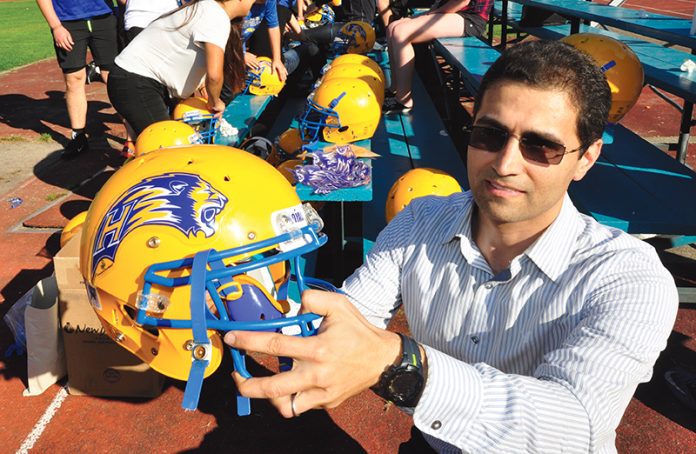
Daniel Abram holds up a helmet with a BrainShield protective decal on it. - Photo courtesy of SFU University Communications

The journey for BrainShield began six years ago with a simple question: “How can we improve helmet performance?”

By asking this, BrainShield creators SFU post-doctoral fellow Daniel Abram and SFU professors Gary Wang and Farid Golnaraghi of the School of Mechatronic Systems Engineering discovered that the majority of available helmet designs were made and tested only to protect the brain against direct collisions. However, most blows to the head are delivered at an angle, rather than head-on.

BrainShield is a decal that can adhere to the outside of a helmet. It was designed to reduce the risk of Traumatic Brain Injury (TBI) that can result from shocks suffered during high-collision sports.

TBI is a high risk for serious injury or death, especially among players of sports such as boxing, football, and hockey. The technology has been in development for five years at SFU’s Head Injury Prevention Lab. Now, Abram’s company, Shield-X Technology Inc., prepares to sell the technology on a wider scale.

Abram explained in a statement that BrainShield is unique because with trauma to the head there can be a “compression” and “rotation” due to the angle of collision and the decal protects against both of those.

Said Abram, “While research studies show that the brain tissues are considerably more sensitive to rotation than compression, the majority of helmets are only designed to protect the head against compression of the brain.”

In addition to its safety features, BrainShield has several other functions. For instance, it glows in the dark for cyclists, and can be customized with a logo for sports teams. Shield-X hopes to soon usecrowdsourcing to fund efforts to produce a higher quantity of the decal for mass distribution.

Jacques Chapdelaine, head coach of the SFU Football team, explained how the team began using BrainShield last year. Said Chapdelaine, “the number of these injuries was reduced from 14 in 2013 to only 4 [sic] recorded injuries in 2014.”

He continued, “I sincerely believe that using BrainShield was an instrumental element in dramatically reducing the number of head trauma injuries and thus can play an incredible role in a holistic approach aimed at significantly reducing the risk of traumatic brain injuries.”

When hairy met Sally

0

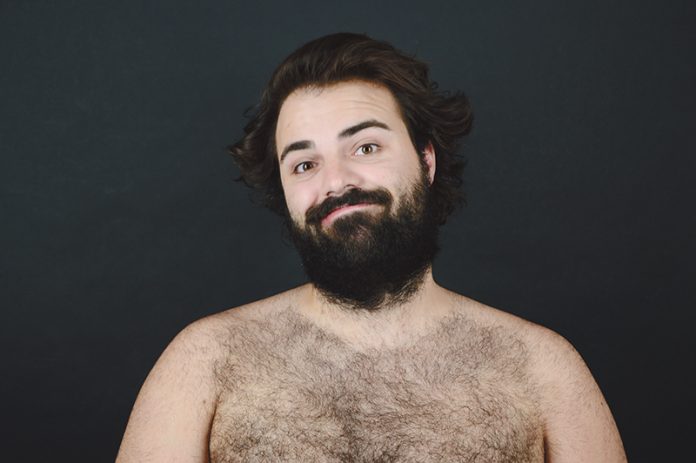
Remember back in high school when everyone’s bodies were a whirlpool of change, and every week brought something new to feel insecure about? I’d always been a heavier guy, so that didn’t bother me as much; and fortunately I’d — for the most part — dodged the acne and bad skin bullet. No, the thing that worried me the most during those anxious years starts with ‘body’ and ends with ‘hair.’

Hair. What was developed as an evolutionary trait to protect/warm certain parts of our body became a burden to me. People in my grade were busy expecting theirs to shoot up and I was busy trying to hide any trace that it already existed on me.

I changed in washroom stalls during gym class, wore a shirt while at the beach, and always wore a crew neck undershirt even under regular shirts to hide any trace of the Sasquatch bod I was boasting. I even slept in shirts, summer months included, afraid roommates over the years would spot my body in an unkempt state.

If it sounds ridiculous or like I’m being overdramatic, it’s because it was and I was. Recalling the absurd lengths I went to hide something as normal as body hair is painful, not because of some repressed memories but from how badly I facepalm myself thinking about it.

Just as there was no single moment that constructed my shame over body hair, I can’t pinpoint a single moment where I began to be comfortable with it. When it came to changing rooms, I started changing out in the open. Somehow V-necks made their way into my wardrobe, and the world continued to turn for hairy and non-hairy guys alike.

I hate to use other people’s opinions as a reason for my acceptance, but unfortunately this was a huge part of it. Once I figured out that no one cared that my back and shoulders looked like a bathmat, I realized I didn’t have to care, either.

A big moment came when I realized that members of the opposite sex weren’t immediately disgusted by my densely-follicled body. In fact, the opposite was true in most cases. While I know some girls who dig the skeletal prepubescent look, where a guy has more hair on his head than the rest of his body combined, others want a guy that doesn’t remind them of a hairless cat. I won’t get into some bullshit about hyper-masculinity, but I’ve had girls tell me they like being reminded of when guys were less concerned with manscaping and had traditionally hairy bodies.

I’m trying to find a moral to pass onto you readers; something that goes beyond the cliched, ‘just be comfortable in your own skin.’ Only hair isn’t part of your skin, and cliches about accepting your body have become next-level cliches.

Your body is yours, so rock it. There’s nothing wrong with the occasional grooming session to keep things in check, but don’t let feelings about body hair impede your daily activities and even your life. My body hair is mine; it’s a built-in sweater that itches in the summer and shields me in the winter, and I couldn’t be happier.

Woohoo, Boohoo

0

Woohoo: Apple Cider

Nothing screams autumn more than apples; the perfect fall fruit that can be baked into pies, eaten right from the tree, turned into crumbles, or accompanied with pork. But the perfect thing that versatile and humble apples can be turned into is cider.

Cider is the nectar of the gods. It fills your heart with warmth, comfort, and a sudden urge to wear flannel with a toque, then jump into a massive pile of leaves. In all its family-friendly glory, this one drink can capture fall in a mug.

On the other hand, these feelings could also come from hard cider, in all its alcohol-filled wonder. The only difference is that you might skip the flannel and toque and just jump right into the leaves. Either way, whether your drink is family-friendly or adults-only, you win.

Boohoo: Pumpkin Spice latte

So what if it is made with real pumpkin? Have you ever eaten plain pumpkin? Spoiler alert, it’s kind of gross. But put some cinnamon, clove, allspice, and nutmeg, then place it all in a pie shell, and boom! You end up with the most perfect of pies.

Pumpkin pie pairs perfectly with coffee. In other words, pie on a plate, coffee in a cup. When someone got lazy and decided to put the two together in one cup, his was a terrible idea. Mixed together, you wind up with something that tastes like regret and the slow death of all the plants heralding the coming of winter.

The pumpkin spice latte doesn’t celebrate everything that is good about fall; it emphasizes the sadness of the season. It also encourages you to stay indoors, in a climate-controlled, leaf-free cafe, ‘liking’ Instagrams of fall weather without actually experiencing it.

Professors awarded for climate change activism

1
Collis and Quarmby recieved their awards at a ceremony at the Morris J. Wosk Centre for Dialogue. - Photo courtesy of Lynne Quarmby

SFU professors Lynne Quarmby and Stephen Collis have received the Nora and Ted Sterling Prize in Support of Controversy for their involvement in the protesting the Kinder Morgan Trans Mountain Pipeline expansion.

The prize, established in 1993, is awarded to individuals that provoke or contribute to the understanding of controversy. Among previous recipients are biologists that studied the origins of HIV, restorative justice advocates, and others from a wide range of disciplines.

In 1994, the first recipient of the Sterling Prize was Parzival Copes, an economist who, in 1961, predicted accurately and unpopularly that Newfoundland’s economy wouldn’t be able to support its population if fisheries declined.

In October 2014, Quarmby and Collis, along with several other protesters, were sued for $5.6 million in damages due to their obstruction of surveying work being conducted on Burnaby Mountain. In his trial, some of Collis’ poetry was read in court. Collis joked to the audience that, “It was a good day for poetry, even if it was a bad day for this one poet.”

Professor Quarmby has long been a vocal opponent of the pipeline expansion. - Photo courtesy of The Vancouver Sun
Professor Quarmby has long been a vocal opponent of the pipeline expansion. – Photo courtesy of The Vancouver Sun

The conflict over the pipeline received major media attention when an injunction was granted to Kinder Morgan, which resulted in the eventual arrest of over 100 protesters, including Quarmby. By then, Quarmby already had a history of climate change activism. In 2012, the biochemist was arrested while blocking coal trains on the railway in front of the White Rock Pier.

The surveying work for the expansion concluded in December of that year, and resulted in 15 trees being cut down along with other damage to the forest.

After receiving the awards, Quarmby and Collis each spoke, detailing the ways that climate change and corporate influence on democracy are related.

Professor Collis at the Kinder Morgan protests on Burnaby Mountain. - Photo courtesy of The Vancouver Observer
Professor Collis at the Kinder Morgan protests on Burnaby Mountain. – Photo courtesy of the Vancouver Observer

Collis explained, “If what Lynne and I have done constitutes anything controversial, it is so only because of the problematic state of our current democracy.”

Quarmby elaborated, saying,  “we have slowly signed away our sovereignty,” speaking to the degree that trade agreements have taken away the government’s ability to act on climate change. She continued that democratic reform is paramount to address these challenges: “We need to change the culture of parliament.”

Speaking about her decision to run in the current federal election as MP for the Green Party of Canada, Quarmby said that when Elizabeth May called to recruit her, “I knew immediately: ‘Oh no, I don’t have any choice.’”

She continued to say that her options to oppose the pipeline as a citizen had been exhausted. Even so, Quarmby recognized that she had been criticized by some of her former allies, saying that “somehow, I went over to the dark side by becoming a part of the system.”

However, the solutions to the tangled problems of corporate influence and climate change are not simple or clear. Collis explained that we should encourage all forms of engagement, because “there is no single solution” to the problems Canada is facing.

Spotlight on Camara

0
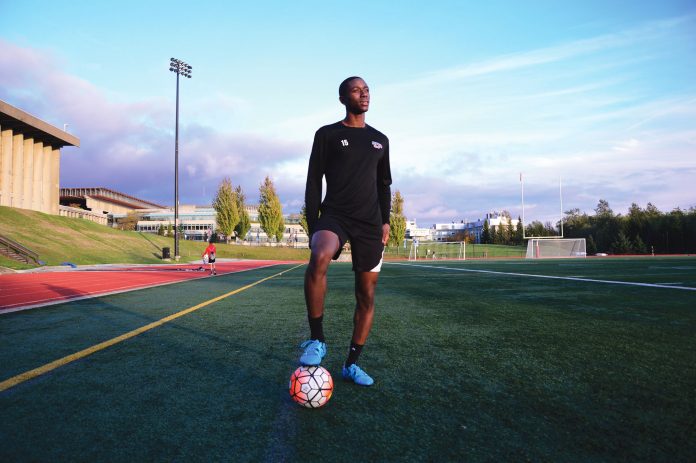
Camara is one of the rising stars of SFU Athletics.

One of the biggest storylines this year for the men’s soccer team is how they will replace the void Jovan Blagojevic left. He scored 18 goals in 18 games last year, and was named GNAC player of the year before being drafted by the Vancouver Whitecaps. He was the undisputed star of the team. But now, SFU looks like they have another up and coming talent on their hands: Mamadi Camara.

“I was six years old [when I started playing soccer],” explains Camara, who grew up in Quebec. “I played for a local team in Montreal [. . .] I played there for two or three years, then I transferred to a team in Southshore, who had coaches, and better insulations.

“[As a kid] we use to play in the park right next to our house with kids from different ages. We would just play with the ball, no real net. It was just fun.”

A few years later, he was heading on to play soccer at the postsecondary level, but Mamadi almost ended up not going to Simon Fraser.

“I was supposed to go to Southern New Hampshire last year. However, it didn’t work out, for various reasons. So this past summer, I emailed Clint [Schneider . . .] I told him, ‘I’m still looking for a school, and if you have room for a scholarship, I would be interested.’ I had been in contact with him earlier in the year, so he replied to me right away and said we still have some scholarship money, because one of the players that was suppose to join the team didn’t get into the school. . . So I sent my transcript really quickly, and he responded in two days, saying that I was accepted into the school of communication.

“[What attracted me to SFU] is the fact that it’s the only Canadian School in the NCAA,” Camara says. “It’s kind of cool when you go down to the United States and you represent one whole country. . . I also really like the environment here. I came to Vancouver once when I was 14 years old for Nationals, and I really liked it. You’re surrounded by mountains and trees.”

“Pressure is what drives me [. . .] when I have more pressure, I think I perform better.”

So, does representing an entire country give extra motivation? “Definitely,” he says. “It’s something that comes up really often in the speech from the coach. He always reminds us that we are representing Canada, and we must be good when we go down there. And we have a really good program. . . we’re one of the most respected programs in Division II. It’s cool that this program is from Canada.”

Some freshmen struggle for playing time on a new team, but not Camara. He has quickly become an integral part of the team, starting nearly every game, which is rare for a freshman.

“I think the coaches are really looking forward to put the best 11 out there. So if you don’t give them a choice, they’re going to put you on the field. That’s my mentality. If you want to be a starter, you just need to work hard enough so you can prove to the coach and to everyone else that you deserve your place on the field.”

He also has a strong support network around him that has helped him get integrated quickly. “I’m fortunate to live with three other guys that have a lot of experience. Robert Hyams, who is in third year, Shane Sharma, who’s a senior, and Calvin Opperman, who’s a junior. These guys really helped me to really sort out my classes, get the best schedule I could, and give me some advice.

“We have help from our teammates in this team. It’s really good.”

Being so early on in his Simon Fraser career, this support has paid dividends for Camara, who won GNAC offensive player of the week for October 8. He scored three goals in two matches, both of which were game-winners.

“It felt good to see that your efforts are rewarded when you work for it,” says Camara. “However, that’s only one little title. I would be more pleased to win the NCAA title with my team than to win any other individual title.”

That NCAA title didn’t seem very likely at the beginning of the season, but the team is now firmly back in the race for the GNAC title and a potential postseason run. “The way we started this season is not the way we expected,” says Camara. “It was a tough start at Sonoma, losing 3–1 [. . .] I think we are just starting to get more confident, and building towards our goal, which is to win the NCAA title.”

As a freshman, Camara has already established himself as a key component of the team, and perhaps the future star player of the team. For his part, he himself seems up to the added pressure of being a more integral part of the team, and filling the void left from the departed Jovan.

“Pressure is what drives me [. . .]  when I have more pressure, I think I perform better. It may be a bit more pressure, but I like it.”