Home Blog Page 932

When done right, Halloween costumes can be empowering

0

A quick disclaimer: This is not another article about how your costume is culturally appropriative or sexist or racist or ableist — although, let’s be honest, it might be. As much as I do believe it’s important not to use Halloween as a chance to belittle cultural iconography and engage in hurtful, lazy stereotypes, I’m also acutely aware that you have already heard that argument before, probably more times than you can count.

You should already know why you shouldn’t wear a headdress or put on blackface this year, and if you don’t, it’s your own responsibility to figure that shit out.

Instead of writing that article, though, I’d like to look at the other side of the spectrum: namely, to celebrate the potential for Halloween to be empowering, and to allow us to show a side of ourselves that might not be considered “appropriate” the other 364 days of the year.

Think about it. Halloween is the only day of the year where it’s not only sanctioned but actually encouraged that you dress up as something radical, flamboyant, and over-the-top. If you’re into horror films, you can dress up as Freddy Krueger or Nosferatu; if you’re a comic book nerd, there are hundreds of different superheroes to choose from. Columbia may not be willing to sign off on a black Spider-Man, but you’re likely to see at least one roaming the streets come next Saturday night.

The idea that dressing however one wants can be acceptable [and] awesome is pretty underrated.

Better yet, All Hallow’s Eve doesn’t just allow superfans and weirdos to fly their freak flag — it gives the more reserved and awkward folks among us the chance to express ourselves in a situation where everyone else is equally dolled up and in no position to judge us. Want to show off your sexy gams or your totally ballin’ chest hair? Halloween’s your day. Eager to boast your sewing skills with a homemade costume that tops anything you’re likely to find at Value Village? Mark your calendars.

Especially in the increasingly button-down, niqab-ophobic Great White North, the idea that dressing however one wants can not only be acceptable but awesome is an idea that is, as far as I see it, pretty underrated. The other days of the year have a lot to learn from October 31.

This may seem obvious to many of you, but to me it’s an important part of Halloween — one that the annual shame-fest aimed at the latest idiot with an ill-advised costume tends to distract from. It’s important to hold racists and other assholes using Halloween as an excuse to show off their horribleness accountable, but it’s a mistake to let that take away from how empowering this holiday can be for everyone else. After all, few other occasions give us a chance to spend hours working on a costume to show off to our friends and to hand out free candy to trusting (!) children.

It’s easy to look at Halloween as the time of year where our culture’s most misogynistic and racially clueless aspects are brought to the forefront, and to an extent, that’s true. But Halloween also gives us a chance to take off our real costumes — our suits and ties, our fancy socks, our combed hair — and to dress the way we truly see ourselves.

We all have a superhero, a creepy ghoulie, and a Disney princess inside us, and we only get one day to show it off. So own it.
More trick and less treat this Halloween

0

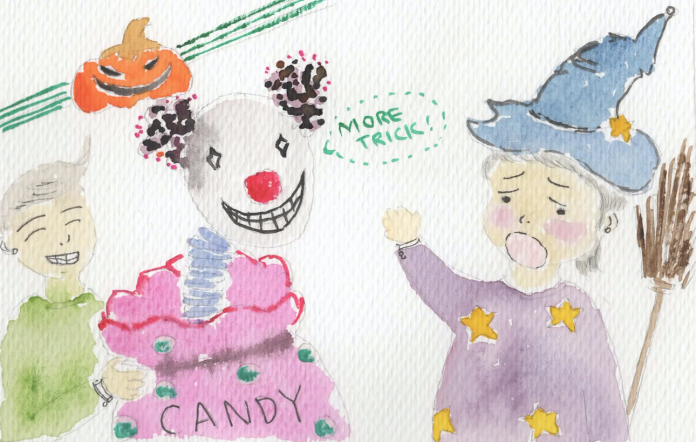
A special October night is upon us. No other occasion is as peculiar as it is intriguing. As we embrace the horror, adults play dress-up while children are encouraged to speak to strangers. “Trick or treat!” is Halloween’s catchphrase. In costume, one is asked to choose between doling out either a trick or a treat. Strangely, the norm is to choose the latter, even though the former is more entertaining.

It seems that the ‘trick’ element of this ritual is not even considered. In the unhealthy amount of time I’ve thought about this subject, the scarcity of tricks compared to treats is a downright tragedy. There sits a well filled with untapped possibility. The concept of ‘more trick, less treat’ could potentially make Halloween even more intriguing than it already is.

During the customary tradition of collecting candy, the trick is usually an idle threat in that it assumedly involves some kind of mischief. Though if the ‘more trick, less treat’ concept was adopted, senses would be heightened. Those opening their doors to kids will be as tense and curious as they are generous. What sort of pranks do they have in store?

That tension would contribute to the atmosphere that already defines Halloween; that is, excitement with a bit of fear in the mix. Tricks also shouldn’t be limited to little children. If every person collecting candy on horror’s anniversary participated in the mischief, Halloween would become even more exciting.

Apart from buying costumes and candy, to think of ideas for tricks creates a whole new space for creativity.

Interactivity is vastly underestimated on October 31. To put more emphasis on creating and performing tricks increases the opportunity for socialization. Apart from buying costumes and candy, to think of ideas for tricks creates a whole new space for creativity. One has the chance to brainstorm tricks that are unique in order to impress both friends and candy-givers.

As individuals don their costumes for the night, the ‘more trick, less treat’ concept means that strangers have the opportunity to break the ice with each other and show off their respective ‘tricks.’ A moment could be created between strangers in the attempt to trick one another.

Apart from the fun and mischief, there is a moral importance of placing a higher value on tricks over treats during Halloween. Children would not be handed candy just because they ask for it, and therefore a sense of entitlement would be removed. Halloween does not strictly become about the rewards of candy.

In the end, there would be an appreciation for the entire process of creation and execution. In a world where celebration is vast and diverse, Halloween is unique. The idea of ‘more trick, less treat’ maintains the major element that makes Halloween stand out: horror. While candy tastes great, let us all embrace our inner tricksters and produce a night of fear and fun.

Dickson twins are double trouble

0
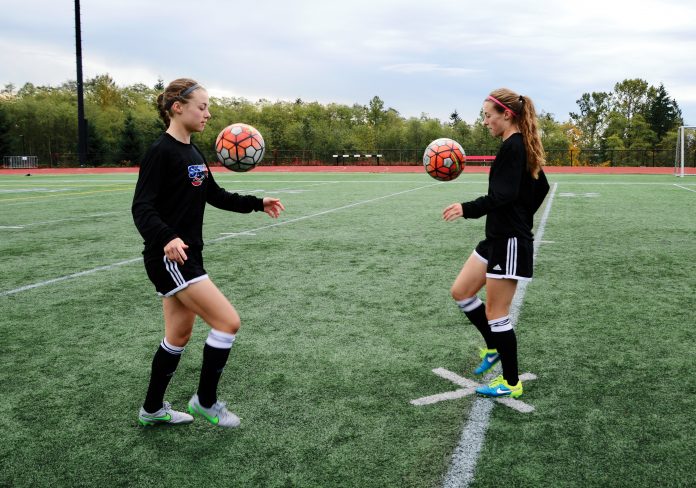
Christina and Allyson have been playing soccer together from an early age.

After a tough season last year — the Clan only won two games — the women’s soccer program needed something, anything, to lift their spirits. They seem to have found that in freshman twins Christina and Allyson Dickson. The two have been instrumental in helping the team climb from the bottom last year to, at publication time, fourth in the GNAC standings.

I immediately started the interview by embarrassing myself and confusing Allyson for her sister Christina. They weren’t surprised — people confuse the two all the time. “You kind of get use to it,” says Allyson.

Also unsurprising was their claim that the two have played together for almost their entire lives. “We’ve been playing soccer since we were five,” Allyson says. “We’ve always been on the same team.”

“I think it started [a] good chemistry when we were younger,” adds Christina. “We’ve always been on the same teams, so we’ve had similar experiences as well. And we usually play similar positions, so we’re always near each other on the pitch.”

Christina is currently ranked second in the GNAC in goals, an even more impressive feat considering she just recently started playing as a striker. “I used to play as a centre back during my youth career,” she reflects. “And then two years ago, I kind of switched, just because of the numbers at the time. We had a lot of defenders and we needed more forwards. Our coach put us both as forwards one game and we scored, so he said we could stay there.”

Allyson switched from defence to midfield around the same time. “I broke my collarbone when I was playing defence, so [Christina] got switched in for me. That’s why she started playing defence. And then we both got moved forward.”

It’s not always easy for freshman to integrate themselves into a new team, but both Christina and Allyson seem to have done just that, both starting nearly every game for the Clan this season. “It’s been pretty easy,” Allyson says. “All the girls on the team were super welcoming.”

“The atmosphere they create is really welcoming as well,” adds Christina.

“We’ve always been on the same teams, so we’ve had similar experiences.”

So what’s it been like to be a freshman on a relatively inexperienced team? “We’re not lacking experience, but we don’t have as much experience, just because of the young team,” explains Allyson.

“The experience is not going to come [during] first year,” notes Christina. “You’ve got to work towards that, so that’s what we’ll build later on.”

The duo have quickly become key members of the squad — perhaps the perfect example of this being Dickson’s recent hat trick against St. Martin’s University. She scored three goals in nine minutes, which is an unofficial school record.

“I don’t know, I think the thought process hit me afterwards,” reflects Christina. “During the game, it was kind of like, you’re in the moment [. . .] Afterwards, you kind of look back and reflect on it.”

“I thought the first one was supposed to be a cross,” Allyson remarks on her sister’s achievement. “Because I was on the bench at the time, and everyone was asking me. ‘Did she actually mean to shoot that?’” The answer to that question, it turns out, was no.

“It worked, though,” Christina laughs.

The twins had offers from other schools, but chose to come to SFU because of the school’s inclusion in the NCAA. “We had offers from UBC and Trinity Western, but what attracted us to the program was the NCAA,” explains Allyson. “That was a big selling point — as well as the great academic stuff.”

Both Allyson and Christina were very active growing up, playing multiple sports. “All through high school we played basketball,” remembers Christina. “We also did baseball and gymnastics when we were younger.”

“Probably around 10 years old is when we started concentrating on soccer,” Allyson remarks. “We started taking it more seriously, so more training sessions every week. We had to let go of gymnastics and baseball and just focus on soccer.”

The goal for the Dicksons, as well as for the entire women’s soccer program, is to eventually emulate the success that the men’s soccer program has had since moving over to the NCAA. “A goal for this year that me and some of the other girls had was to make the GNAC top four,” Allyson says, adding: “It’s totally reachable.”

It remains to be seen if the women’s soccer team will reach the goals it has set for itself, but one thing is for certain: both Christina and Allyson Dickson will be key components of the team for years to come.

SFU explores open educational resources

0
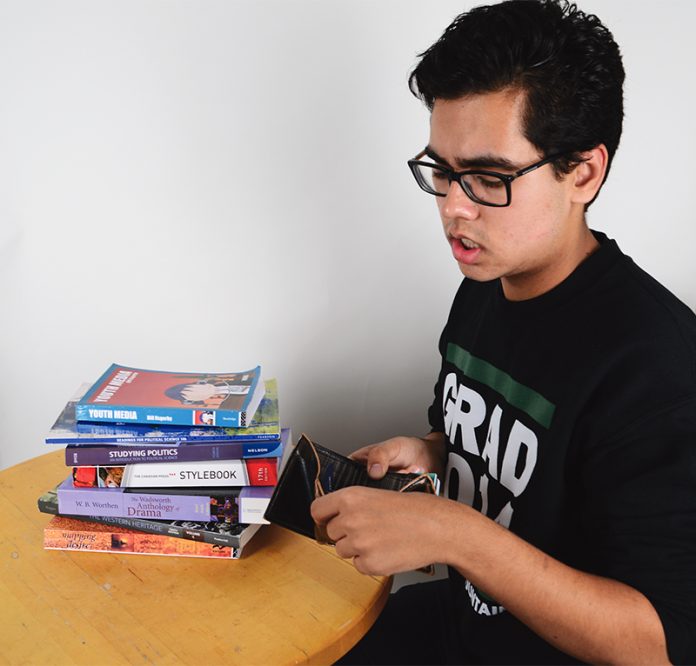
Students shell out major dollars for books. - Lisa Dimyadi

This Fall, SFU students returned to crowded morning buses, late nights of studying, and increasingly inflated textbook prices.

According to an estimation by the Simon Fraser Student Society (SFSS), students, especially science students, on average drop about $500 per semester for their lower-level courseware.

This figure comes out of the campaign work the society did at the beginning of the semester, where they asked students coming out of the SFU Bookstore to share how much they spent on their course materials through a social media campaign, using the hashtag #textbookbrokeBC.

The push for more open educational resources has been going strong since the post-secondary education innovation company BCcampus launched the BC Open Textbook Project in October 2012 with funding from the BC Ministry of Advanced Education. The project aims to make resources more widely available and to reduce costs for students with resources in the public domain on the Internet.

SFSS VP University Relations Brady Yano commented that the university has been very receptive to the idea of open textbooks. “SFU, as an institution right now, is definitely in support of greater adoption of open educational resources,” he said.

SFU has also announced plans for three $5,000 grants per semester that would allow professors to adapt current open educational resources from the BC Campus library to fit their courses.

The Harbour Centre campus recently hosted an event as a part of International Open Access Week 2015. The panel, “Open for Collaboration: Is it Time for Canada to Implement A Unified Open Strategy for Higher Education?,” was put on by the SFU and UBC libraries in conjunction with BCcampus.

Juan Pablo Alperin, an assistant professor in SFU’s publishing program, spoke at the event about how he encourages his students to publish their academic work online after submitting it. He even explored the idea of students submitting work by publishing it directly to the web, as opposed to uploading files to platforms like Canvas.

Although open educational resources have been gaining popularity, few professors have actually decided to adopt any open textbooks for their courses. Yano shared, “While administration has been vocal in their support, that hasn’t necessarily trickled down to the faculty, who are still relatively apprehensive about adopting the existing materials.”

He speculated a few reasons for this hesitation, suggesting that it could be hard for professors to adapt existing syllabi to make use of an open textbook and that big textbook publishing companies make it very easy and appealing for instructors to purchase and use their materials.

Yano specified that this applies largely to lower-level science and applied science courses, for which textbook costs can range in the hundreds. “A lot of first-year students are not aware that the high costs of textbooks are an issue,” he said.

Considering how many students enroll in these larger introductory courses, it adds up to a lot of student money being put towards courseware. Recently, a UBC professor adopted an open textbook for PHYS 100, saving students approximately $90,000 combined for just one year.

SFU advises prospective students to budget $1,000 per semester for textbooks and other educational resources. “SFU is already educating students to expect to pay, so when they do arrive at school they’re not surprised to be receiving bills that are around $600,” said Yano.

He went on to say that although it is good to be prepared for those prices, “it’s quite problematic, because it’s people are [. . .] accepting the norm of paying high costs [for] learning materials.”

Appreciating our distinct cultural cuisine

0
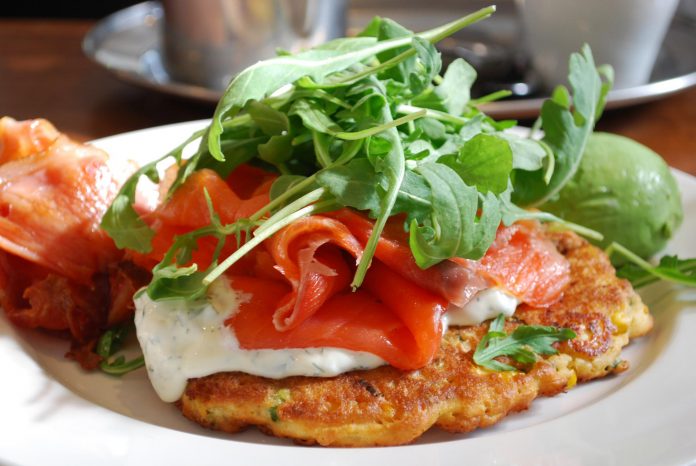
Nothing like great Canadian salmon!

Have you ever heard of tarte au sucre? Or fish n’ brewis? Have you ever tried them? Unfortunately, dishes like these are forgotten by most Canadians.

I’m no ‘foodie.’ I don’t blog about everything I eat or stand on chairs at restaurants to capture a bird’s eye view of some overpriced plate of spaghetti. But I can speak to how undervalued Canadian cuisine is. I’ve been told many times that Canada has no culinary identity, but our country has developed a cuisine around its unique history and land, which deserves recognition and appreciation.

We are lucky to live in a place where the land has provided us so many unique flavors to play with — BC is home to the world’s finest salmon, Nova Scotia brought us lobster, Saskatchewan gave us Saskatoon berry pies, and Quebec gave us rich dishes such as Tourtière. It’s crazy to argue that Canada has no cuisine to call its own.

We certainly have a lot more to offer than just deep-fried beaver tails. From the Atlantic to the Pacific, we have truly unique flavors that have led to some remarkable home-cooked dishes and tasty treats. Take a step back and look at what’s around you; think about how lucky we are to have these foods at our fingertips. All too often we forget that Ontario grows us purple garlic, PEI provides some of the world’s best Russet potatoes, and B.C is famous for juicy blueberries — our culinary identity has grown around foods such as these, all of which grow here naturally.

This being said, Canadian cuisine undoubtedly includes a lot of ‘foreign’ food. After all, we are a country built off of a diverse collection of families who have come here from all over the globe. Personally, I can’t imagine my life without sushi or nachos.

Nevertheless, the presence of their foods hasn’t hurt the growth of Canadian cuisine. If anything, it has helped our culinary identity establish itself as one entirely different than other nations. Have you ever had butter chicken poutine? Or maple curry? Foods such as these create a cultural hybrid — a blending flavors from here at home and from abroad.

This should be considered the apogee of Canadian cuisine, as it plays off of traditional Canadian flavors and incorporates international zest. And this, if you ask me, is Canada in its essence. Simply put, the argument that ethnic food dominates our local foods is cop-out that fails to see the larger picture.

We need to appreciate the food our land and history gives us, and how those foods have fused with foreign flavors over the years. We are the home of the Nanaimo bar and the Montreal smoke meat sandwich. These foods are not inaccessible; they are all around us. I implore all of you to try a Canadian dish you haven’t before — you may just learn something about Canada’s history in the process.

Ways to improve your club’s Halloween mixer, based on science

0

Recent findings by the world’s top social scientists have concluded that the best way to have a “spooktacular” and “creeperific” Halloween party is to carefully engineer a series of absurd experiences and pair them with an unsettling, traumatizing environment. You can’t argue with science.

The first scientific step towards creating a spooky atmosphere is to defy attendees’ expectations. Instead of greeting people and informing them of the night’s activities, you want information available prior to be minimal and slightly confusing. This will help establish a dark and mysterious setting for the mixer, where no one knows anyone else or what’s going to happen next! You’ll know you’ve done a good job when your participants look mystified and agitated!

Mentally distress your participants by having your Halloween party completely different than your club’s theme/mandate! If you’re a Korean club, serve Eastern European food, play Japanese pop music, and watch Bollywood horror movies! If you’re a club that focuses on making relaxing environments that help de-stress students, make your event extremely traumatic and stressful! This shift in familiar stimuli will guarantee everyone is on their toes and mentally on-guard for a fun evening.

Your next step should be to create a sense of danger at the mixer because, scientifically, humans are more likely to remember situations that involve a lot of physiological arousal. We recommend a fun game of handshake murder — except with a real knife! (You won’t actually be stabbing people, because that’s sort of illegal; use prepared fake blood, and diffuse panic with a yelled, “It’s just a prank!” Everyone will then thank you for the fun experience and prepare themselves for the next activity.)

Now we want to create true fear. It’s time to exploit the psyche of the average SFU student. Instead of plastic spiders, scatter spooky Post-it notes about the room. Some examples of what to write are: “The promise of free food is a lie!”; “Andrew Petter is actually a spy from UBC, sent to ruin SFU by giving us a non-KKK-related team name!”; “The SFSS really stands for Spooky Friday Student Squad!”; “Completion of Calculus IV will become a mandatory requirement graduation requirement for all SFU programs!” Channel your inner Shyamalan and write!

Lastly, SFU students have been conditioned to feel pleasure when they’re being punished, thanks to the crowded busses, the fog and rain, the professors with incomprehensible accents, and the fight to enroll in their preferred classes. Recreate these conditions in your party’s environment: crowd the room; splash water on people’s faces; turn a fog machine on; and narrate everything in the thick and incomprehensible accent of their calculus professor.

Join us next time on “. . . based on science” where we breakdown the formula for awkward family gatherings at Christmas.

Satellite Signals

0

Woodward’sWEB-woodward

SFU is hosting a talk that will look into whether or not the cinematic experience tends to raise awareness of world suffering. This event explores the power of films to inspire people to take action on global issues.

Anil Narine will discuss this issue and related topics in eco-cinema in this free lecture, entitled “Can Movies Move Us to Take Action?,” at SFU Woodward’s on Oct 29, from 7 to 9 p.m.

All Campuses

From 9 a.m. to 7 p.m. on October 31, explore all three SFU campuses and learn how universities encourage vibrant, livable, and sustainable cities. Campus to City will look at the role of universities within city-building.

A tour bus will take participants from campus to campus and will have the opportunity to discuss sustainability, design for inclusivity, social finance, and First Nations perspectives. Registration for this event is free on Eventbrite.

Vancouver Whitecaps Playoff Preview

0
The ‘Caps are poised to make some noise this coming playoffs

This is the third time the Caps have advanced into the postseason in five years, and they’ll be hoping that this time around they can improve on the first round exits they had the previous two outings.  With a mixture of speedy young wingers, creative centres, and an experienced back line, it looks like this might finally be their year.

Heading into the playoffs, the Vancouver Whitecaps are in a bit of a lull, with only one win in the past two months. However, the season on the whole can definitely be considered a success, considering what the expectations were at the beginning of the year. The Whitecaps were able to win their first major trophy, the Amway Canadian Championship, against the Montreal Impact. This not only gave BC Place an extra piece of silverware for its trophy cabinet, but also the guarantee of hosting matches in next year’s CONCACAF Champions League.

However, all the highs and lows of the previous 34 matches are thrown out the window when the playoffs begin. The teams are only given 90 minutes to serve up a spectacular performance, or else face the prospect of a dark, cold winter filled with ‘what-ifs.’ The Whitecaps will be looking to a core set of players to help them deliver in these tense matches.

Starting from the back, the Caps will be happy to have one of the best goalkeepers in the league, David Ousted, protecting their net. Ever since coming over from Danish side Randers FC, Ousted has helped Vancouver reach new heights with a mixture of superb saves and quick distribution, which plays right into the Caps counter-attacking style. Helping him protect the net is a powerful defense anchored by Kendall Waston. This towering Costa Rican, together with Steven Beitashour, Pa-Modou Kah, and Jordan Harvey, has helped the Whitecaps achieve many a shutout.

The architect steering Vancouver’s midfield is Pedro Morales. For the past couple of seasons, he has done a stellar job of distributing the ball to the many speedsters on the squad, such as Kekuta Manneh and Darren Mattocks. Potentially joining him in the midfield are two Canadians, Russell Teibert and Marco Bustos. Both are hardworking, creative players who can definitely influence the game in the Caps’ favour.

Up top, the Whitecaps will be looking at Designated Player Octavio Rivero to add some goals. Though he has been rather inconsistent throughout the season, he’ll only need one moment of brilliance to become a hero in Vancouver.

At this time, the exact playoff matchups have yet to be finalized. However, if the Whitecaps wish to win their first MLS Cup, they’ll have to go through some tough opposition. The best team in the West is FC Dallas, a team that Vancouver has a 1–1–1 record against, so they know that any game against Dallas is bound to be close. They also lost last year in the playoffs to them, a game which featured a more-than-questionable penalty call.

Two potential matches the fans would love to see would be against either the Portland Timbers or the Seattle Sounders, the Whitecaps’ Cascadia rivals. Out east, both Toronto FC and the Montreal Impact made the playoffs, which gives the Whitecaps a chance to play in an all Canadian final, something all fans north of the 49th would love.

Regardless of who Vancouver play in the postseason, they know that the whole squad needs to play the games of their lives. But with a solid backline, creative midfield, and quick forwards, the sky’s the limit for the Whitecaps.  

The Peak Publications Society board meeting agenda

0

Peak Publications Society Board of Directors Meeting Agenda

October 22, 2015

The Peak offices

Chair: Max Hill


In Attendance:

Maia Odegaard (Board Secretary, non-voting)

Max Hill (Editor in Chief)

Tamara Connor (Collective Rep)

Melissa Roach (Collective Rep)

MuhammadQasim Dewji (Employee Rep)

Thadoe Wai (At-large Rep)

Cecile Favron (Guest)


  • Call to Order
  • Approval of Agenda
  • Approval of past minutes from September 17, 2015
  • Financial update

Maia to present the state of the Society’s finances through September 2015 (see appendix A)

  • Bookkeeper for bank reconciliation

Our accountant, Andrea Knorr, suggested we bring in a bookkeeper every quarter to do bank reconciliation. 

BIRT we hire Nadine Simcoe to perform bank reconciliation every quarter, at $30/hour for roughly three (3) hours each fiscal quarter,  to assist with CGA Andrea Knorr’s year end workload.

  • Implementation of liability form for photo contributors

Melissa will present a motion put forward by photo editor Lisa Dimyadi suggesting the introduction of a liability form for those borrowing the Society’s cameras and photo equipment.

  • Website Hosting

Maia to discuss increasing in web hosting budget.

  • CUP NASH

Maia and Melissa to present proposal for CUP NASH conference in January, 2016.

  • 50th Anniversary

Some concerns regarding Peak events and possible addition to Promotions Coordinator job description.

  • Disciplinary action

The board will discuss a matter in-camera.

  • Adjournment


Why volunteering as a student is better than a job

0

It sounds outrageous that a position that doesn’t pay anything would be considered better experience than one that does. Employers, especially ones looking to hire new graduates, tend to weigh volunteer and work experience similarly, which is antithetical to how most students regard these experiences.

Implicitly, many students feel that a paid position will build a stronger resume, but that is not always the case. Paid positions are necessities for many university students, but my experience with volunteering has only helped me grow personally and professionally.

As I navigated my way through high school, volunteering was a mandatory activity in my family. Thirty mandatory hours of work or volunteering has become a graduation standard in BC since I graduated. I feel that many students coming out of high school who were forced to volunteer may have consequently developed a negative association.  

Volunteering, when forced, loses its effectiveness as both a provided service for the organization and rewarding experience for the individual. I spent a few hours a week at a local community centre on their youth council, not really gaining useful skills, and frankly, not giving my best effort.

But to volunteer, especially with the same organization for a length of time, can give an employer a better idea of your personality. I spent most of my university career volunteering for SFU Recreation. This was a huge boon after university, as employers have since been intrigued by my love for sports while noting my long-term commitment. Volunteering shows that you evidently care about a community, and will help employers envision your transition into the workplace.

Nearer the end of my degree at SFU, I began my job search. With two unrelated degrees in English and Business in my pocket, I still had no idea what my future job would be. Searching SFU’s job board, I found a volunteer posting for Writer’s Exchange, a program to help develop literacy in at-risk youth.

The experience rewarded me as I quickly saw how my time and hard work influenced in helping at-risk children to develop their reading and writing skills. I struggle to see how the opportunity to make such a huge impact would be presented if I substituted volunteering for another part-time job.

For many students entering the workforce after graduation, there is a low expectation for work experience, and its value is diminished, as most of a student’s experiences will be irrelevant to their actual job. Soft skills and personality traits are more convincing when coming from a volunteer experience, because employers know that you commit your time out of desire to improve.

Everybody recognises people who only work for a paycheck, and while this is important for many students, it doesn’t always set you up for success in the future. I would suggest you not pass up a volunteer opportunity just because of the lack of pay, but look to the personal and interpersonal rewards these opportunities can bring you; ones that are far superior to a full wallet.