Home Blog Page 922

From Christian to godless

2
After moving to Canada from Kenya, I evolved away from God.

Atheism is a word often made synonymous with evil and godlessness. However, only the godless half of that statement is true. It’s not godless in the sense that atheists are wicked and morally defunct, but godless in that atheism is a lack of belief in the existence of a deity.

My journey of negotiating religion and faith is by no means unique. But by sharing it, I hope to help demystify what being an atheist is, based on my personal experience. Hopefully it will encourage others to not be afraid of their doubts as I was.

Many religious people tend to think that atheists are inherently immoral people, which is a common misconception. Indeed, bad people who are atheists do exist, just as there are bad people who believe in God. But the lack of belief in God is hardly ever the cause of immorality.

Like most people from my home country Kenya, I was raised a Christian — Protestant, to be exact. However, soon after moving away from home in 2012, I began confronting my beliefs and values as an individual. I began to see the problematic nature of my attachment to Christianity, especially coming from a former British colony.

My rejection of God is about my way of living, and still allows me to maintain my ethics.

The last straw for me came when I attended a church service in downtown Vancouver. A preacher rejoiced in an ailing man’s conversion to Christianity from Islam, which the preacher then claimed led to the man’s healing. The congregation then followed with an enthusiastic “Amen!”

Apparently God is a picky healer when it comes to non-Christians.

From this point, I began to question the implications of believing solely in a Christian God. If born into a family of different faith, wouldn’t that determine what kind of God I believe in? And if one faith is right, is everyone else wrong?

This led me to research and increasingly question my faith over the course of two years, along with deep reflection about my values. What I realised was that God and religion were ideas I only accepted based on fear and pure indoctrination. That’s when I decided that I would hold on to them no longer.

The concept of God is an unnecessary burden that does little for my personal development. This, however, does not mean that I am automatically motivated to be ‘bad;’ instead I focus on different things for personal fulfillment and to seek answers.

Evidently, my process did not come from premature rebellion. It was the result of careful consideration leading me to eventually outgrow religion and subsequently God.

Yes, ladies and gents, I outgrew God. I don’t mean that in an arrogant or dismissive way, though. I simply left behind bad ideas. My rejection of God is about my way of living, and still allows me to maintain my ethics.

I’m still learning to cope with accepting my lack of belief. It is by no means an easy transition. However, our insecurities can be easily dealt with if we are open about them. Hiding underneath the guise of social acceptance does little to promote our well-being.
Goodnight, my sweet Peak

0
I'll miss you, my love.

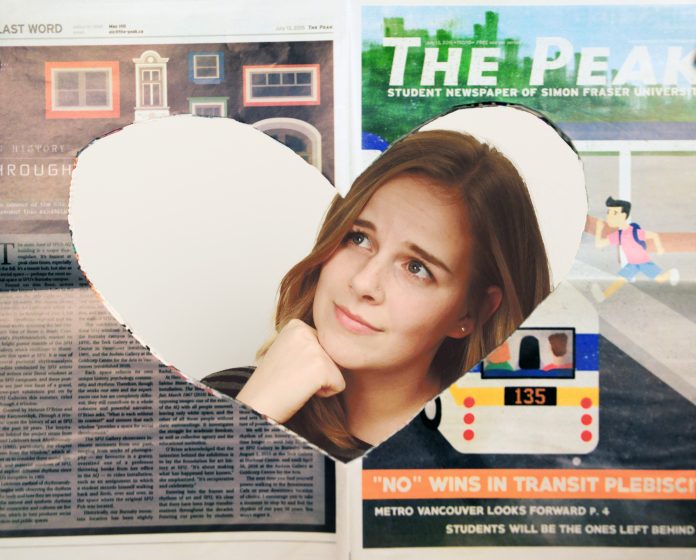
Oh God, how do I start this? I love you, Peak, and I will always love you.

It’s not you, it’s the SFSS elections. I can’t live tweet my way through another set of six hour-long debates. It’s the beautiful nightmares about writing formulaic articles on SFU’s community engagement. At the heart of it, it’s about how I’ve changed.

I gave you the best years of my undergraduate degree, and you gave me prematurely grey eyebrow hairs and an addiction to lukewarm Folgers coffee. Really, you’re the habit I have to kick.

I’ve been carrying a voice recorder in my bag and a chip on my shoulder for too long.

We’ve made some beautiful memories together — late nights in the office drinking too much vanilla Coke, Sting-a-longs to acoustic renditions of “Message in a Bottle,” and travelling to exotic places like downtown Edmonton, or making the trek down to the SFU Security office in Discovery 1.

Like Cathy and Heathcliff, the two of us are inextricable. From the bowels of Burnaby Mountain I cry out, “I am The Peak!”

I worry that I will lose all of my friends to you when I leave. After all, you are the biggest thing we have in common. I do concede that you can have them on Fridays. Just try not to keep the poor dears out too late, slaving away to fill your pages.

“I’ll still write,” I say. “I’ll stay on as collective rep on the board of directors,” I said. I think we both know that might not be entirely realistic.

“Make it a clean break,” said noted advice-giver, and my mother, Joanne. I know I should probably listen to her, but I don’t know if I can really quit you.

No, there’s no one else. Not yet. But I’ll have to pay the bills somehow. I’m just looking for something different — something that won’t swallow me whole. I can’t forever be at the beck and call of campus news.

Is there a life for me after student journalism? Nothing is for certain, but I have to find out.

SFU professor explores sound in CBC documentary

1
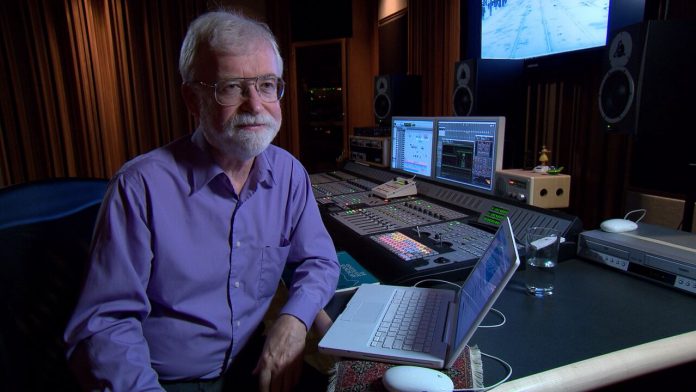
Barry Truax has been in SFU’s Department of Communications since 1973. - Photo courtesy of CBC

SFU Communications professor and renowned composer Barry Truax is one of the many experts featured in the upcoming documentary, Sonic Magic: The Wonder and Science of Sound, produced by CBC’s The Nature of Things, which will air on November 12.

The documentary was shot around the world and explores the effects sound can have on people’s well-being, the use of sound in medical treatment for cancer and Alzheimer’s, as well as how sound affects how public spaces are experienced. Currently working in Berlin, Truax sat down for a Skype interview with The Peak to talk about his involvement with the the documentary.

The Peak: Could you tell our readers about your research that was featured in the documentary?

Barry Truax: Well, this is definitely what we would call soundscape research or soundscape analysis, which we have been doing in the School of Communication at SFU for the entire time I’ve been there, which is over 40 years.

Basically, it’s about the science of sound. And of course they are popularizing it with what they call “Sonic Magic” [. . .] but it really has a lot serious science in it. [. . .] Sound as an environmental aspect is included here and we’ve drawn on the World Soundscape Project’s heritage.

In particular, one of the main sequences that they based in Vancouver focused on the Holy Rosary Cathedral bells downtown because it’s just a focal point. [. . .] It was documented by our project back in 1973 with what was called the Vancouver soundscape as a significant ‘sound mark’ of Vancouver.

P: For our readers who don’t know, can you explain what exactly a soundscape is and why it’s important?

BT: Well, it’s the acoustic environment that we live in all the time, and we’ve always put the emphasis in the School of Communication — on the way it’s perceived and understood by people as opposed to for instance how an acoustic engineer would simply just measure it as an objective fact.

It’s important because it affects the quality of life that everyone has 24/7. People use sound, or ignore sound, or are exploited by sound, or rely on sound as part of their daily life and it’s important as a quality of life issue.

P: Referring to quality of life: a lot of the research in this documentary is about how sound can be used for medical purposes. Could you talk about the other ways sound improves quality of life?

BT: We [at the School of Communications] started by simply emphasizing listening and so instead of telling people what’s good and bad, we try to make them more aware of it [themselves] by just basically starting to listen and pay attention, and evaluate and make choices in their lives.

Instead of just saying, ‘Oh this noise is bad for you,’ which it is, and, ‘it’s a stressor on you’. . . And particularly for students, I can argue that it is actually affecting your grades.

If you live in a cheap apartment next to a highway and you can’t sleep at night and you’re subjected to noise through most of your waking hours, this is going to have an effect on your academic life. [. . .] There [are] just so many ways in which sound affects us 24/7, both positively and negatively, and we want to emphasize the positive and have people become aware and make choices for themselves.

Senate Report

0

Government Financing

SFU President Andrew Petter announced to the Senate that he made an appearance in front of the Select Standing Committee on Finance and Government Services in regards to the cuts made by the Provincial Government to post-secondary education and the 2016 budget.

“I spoke in support of the Research Universities Council BC presentation, which called for a major reinvestment of the $50 million that has been cut by the province over the last three years,” he shared.

Petter also made a case for needs specific to SFU, offering deferred maintenance on Burnaby Campus and plans for Surrey expansion as examples where the university could use some financial support from the government.

He continued, “I want to congratulate both the student groups. Both the Graduate Student Society and the SFSS also made presentations which were very well put together and very powerful in speaking from a student perspective to many of the same needs.”

Renaming School for the Contemporary Arts

SFU’s School for the Contemporary Arts is being renamed the Dena Wosk School for the Contemporary Arts in tribute to the first dean of the school.

Vancouver has an inequality problem

1
The panel discussion was held at SFU Woodward's. - Photo by Samaah Jaffer

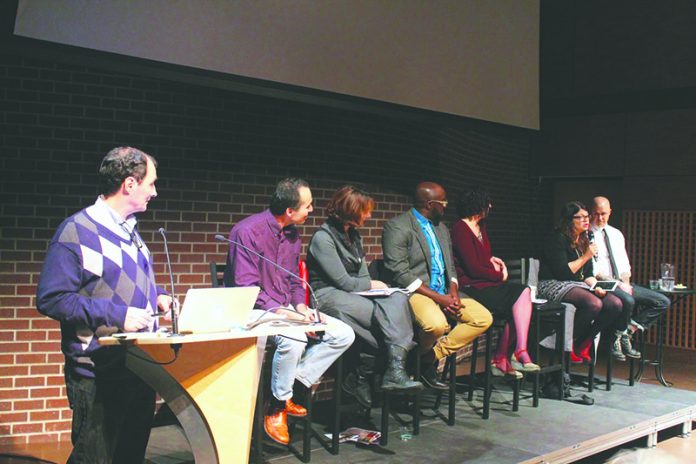
SFU’s Vancity Office of Community Engagement and the Vancouver City Planning Commission hosted a panel discussion on the issue of “Social Inequality in the City.”

The conversation covered issues ranging from health, education, hunger, mental illness, justice, accessibility, and social mobility.

Mary Clare Zak, Managing Director of the City of Vancouver’s Social Policy and Project Division, presented a number of statistics on housing, population growth, diversity, education, income, and homelessness, and spoke to the city’s approach to foster continual improvement in health and wellbeing in Vancouver.

Zak commented on a city’s ability to make an impact at the municipal level: “Local governments are actually uniquely placed to provide leadership around health and well-being, because many of the social determinants of health are played out in your day-to-day life.”

Margot Young, a constitutional and social justice law professor from UBC, broke down the meanings of the terms ‘inequality’ and ‘city.’

In terms of inequality in the context of Vancouver, Young said, “We need to look at inequality with a very specific, absolute focus; a focus on the problem that inequality signals for us in Vancouver in particular, and that’s the problem, the distress of poverty [. . .] and the exclusion and marginalization that poverty puts and cements in place.”

The Aboriginal Front Door Society’s Community Coordinator, Bill Beauregarde, presented on the vital issue of the land Vancouver is located on, its significance to indigenous people, and its relationship to the housing crisis and poor living conditions on the reserves.

“In our culture, we share the land, we don’t own the land,” said Beauregarde. “That’s basically [it] — the sharing aspect of the land is not equal. Right now, Aboriginals do not have the share that they should have.”

Paul Taylor, Executive Director of Gordon Neighborhood House in the downtown West End, spoke about his personal experience growing up with a single mother on welfare, and commented on the unequal way food is accessed and experienced by those with lower incomes.

“When I see people in long lineups, accessing food — and in Vancouver it’s often cold and rainy — it’s dehumanizing and I see people missing out on the celebration of food.”

Viveca Ellis of Single Mothers’ Alliance BC spoke to the core issues faced by single mothers living in poverty, including the issue of access to civic engagement of all sorts.

“We advocate for a shift in focusing on the affordability of transit,” said Ellis. “We envision transit as a tool to mobilize people out of poverty — to access that job, that school, that affordable food three miles away, that social life in the greater community.”

Matt Hern, professor in SFU’s Urban Studies program, echoed Beauregarde’s sentiment of the inextricability of this issue of inequality and land and property in the context of Vancouver, identifying the root of the problem being that we are situated on indigenous land.

“Any concern with settler disparities or inequities, with the home crisis, with who gets to stay and who gets to leave, under what basis — all of that has to be historicized within the context of very recent and ongoing colonial rationalities.”

Director of Community Engagement, Am Johal, commented regarding the significance of a holding discourse on social inequality at SFU: “Since SFU’s Vancity Office of Community Engagement started almost five years ago, we’ve committed to engaging in social questions through both dialogue and disruption on important public questions. [. . .] Being based in the Downtown Eastside neighborhood, we have a public responsibility to engage in these questions.”

SFU is still number one

0
Maclean’s names the Archaeology and Envfiornment programs as standouts for SFU. - Photo by Mark Burnham

SFU, you’ve done it again! MacLean’s has released its university rankings for 2016 and SFU has — for the seventh time in eight years — clinched the top comprehensive university spot.

The university lost the title in 2014, when the University of Victoria temporarily dethroned SFU, bumping it down to second place.

SFU President Andrew Petter was pleased to announce the rankings in this month’s Senate meeting. He reminded the room that rankings are not everything, but nonetheless, this was a cause for celebration.

“We usually take rankings with a grain of salt, but in this case it comes with a lot of sugar,” he joked.

MacLean’s defines comprehensive universities as those with significant research activity, strong undergraduate and graduate programs, as well as professional schools — or, as Petter puts it, “research-intensive universities unburdened by medical schools.”

The president spoke to what he sees as the key factors that went into this high ranking: “Certainly the success we’ve had with faculty and student awards and our research performance clearly figured very strongly in the reasons why we did as well as we did.”

Although MacLean’s put SFU in the top spot, they also asked students themselves to rank Canadian universities for the first time in a decade. According to the surveys, Guelph is the top favourite comprehensive university among students, while SFU ranks much lower at 12th place.

The survey included various subcategories for students to rate their school, such as administrative staff, instructors, and the amount of red tape in its bureaucracy. In these subcategories, students rated SFU the highest among comprehensive universities for its mental health services, making it students’ ninth favourite overall in the country.

Despite the positives of the top ranking, Petter acknowledged that there are other things to consider when evaluating SFU as a whole. “We understand that the strengths of the university are not fully measured by these rankings,” he said, “but it’s nonetheless nice to get that kind of recognition.”

Bad sex has nothing to do with feminism

0

There are many different factors that cause bad sex. But apart from the lack of consent, there is no one particular element that makes sex bad all the time. This is why I completely disagree with Margaret Wente’s recent criticism of casual sex in The Globe and Mail. The idea that sexual desire or satisfaction corresponds strictly with commitment, when it comes to women, is simply false. Any attempt to control sexuality, much like the misguided attempts to control sexual orientation, is a losing battle.

People are as diverse as they are unpredictable. I do not claim greater understanding over why sexual relationships are good or bad. That should be the point. Instead of forcing everybody to be the same and act in the same way, people should be encouraged to make sexual decisions based on what is best for their mental, physical, and emotional well-being. This does not necessarily mean having casual sex, nor does it mean pursuing a committed relationship.

Communication is very important as it involves conveying consent. In terms of having good sex, being able to communicate effectively to your partner allows you to confidently state what you like or don’t like. Associating guilt with sex is what makes communication difficult, as young women often have trouble asking for what they want. This is why feminism in the modern era is important.

The casual approach some young women have towards sex allows them to explore what works best for them and how to effectively communicate that.

People should make sexual decisions to uphold their mental, physical, and emotional well being.

‘Young feminists being clueless about sex’ could be a result of being young, rather than being feminist. It could be that young women have not yet discovered what circumstances work best for them in sexual situations. In the process of finding who they are sexually, there will be bad sexual experiences.

I oppose the idea in Wente’s article that women having good sex and women being casual about sex are mutually exclusive. There are many women in relationships that are dissatisfied with their sex lives. There are also many women that enjoy one night stands. There are many types of women with many different personalities.

Human beings are complicated creatures with complex layers. What works for one woman may not work for another, and this is why all experiences should be embraced. It should also be stated that bad sex in not necessarily a bad thing, but a way for us to learn about ourselves and our sexual partners. It is possible that a lack of emotional connection is why young women have bad sex; inadequate sexual chemistry with a partner or limited sexual experience are also potential reasons young women have bad sex.

Sex is something to be enjoyed by both genders, and associating bad sex and feminism is simply misguided. I would instead argue that in embracing casual intercourse, feminists encourage young women to embrace their own different sexual preferences. Women, men, and all those in between benefit from this, because all parties involved are given the freedom and space to have good sex.

SFU lights up the night with Diwali festival

0
The event featured Bhangra dancers who later performed with Scottish Highland dancers. - Photo courtesy of University Communications

SFU experienced a slice of Hindu culture last week at its eighth annual Diwali event at Surrey’s Aria Banquet Hall on Tuesday, November 3.

The annual celebration of “the festival of lights” is a part of SFU’s aim to engage its South Asian students and the greater community.

Diwali, widely celebrated in India and around the world, signifies light over dark, knowledge over ignorance, prosperity over poverty, and good over evil. It marks the beginning of a new year for Hindu peoples, and is considered to be a time to embark on new beginnings and ventures. Elaborate decorations, lights, fireworks, and food preparations are all key to this festival.

SFU took the initiative eight years ago to begin an annual event that encompassed all these factors and to further deepen cultural ties with its South Asian community members.

Over 300 government, community, and business leaders, along with SFU students, alumni, staff, and faculty members attended the event. The celebration kicked off at 6 p.m., with a reception, followed by the evening program and dinner. The opening act was a lively Bhangra performance by members of the Vancouver International Bhangra Celebration Society.

The event concluded with a fusion performance of Scottish and Punjabi dance, followed by a door prize draw with SFU goodies and gift cards.

The funds raised through ticket sales for the event are to be used for the SFU India Student Mobility program, which aids students who want to study, volunteer, and work in different cities and villages in India.

The community support for this event had an impact on SFU student Dara Hill, who was one of the student speakers at the event. Hill is a fourth-year Communications student, traveller, and photographer who interned for six months last year at the Deshpande Foundation, a global non-profit organization that promotes social innovation and sustainable entrepreneurship.

“It really is an honour to be the student speaker at this year’s SFU Diwali Gala,” Hill told The Peak.

“There is a diverse group of individuals in this room, but one common thread they hold is the way they value experiential learning, creative problem solving and discovery in just as high of a regard as I do.”

She continued, “It is this community that made this experience in India a reality for me, and I’m so excited to share with them a taste of what they supported.”

SFU chancellor Anne Giardini mentioned in her speech how diversity and community engagement lie at the heart of SFU’s mission and ensure continued success. SFU President Andrew Petter spoke to the many milestones that SFU has accomplished as a university.

“We’re proud of the fact that we do things differently than traditional universities,” said Petter.

“In particular, I think the thing we do different and do best is our commitment to engaging the student community. It is truly the value that defines us and has led to some of our biggest achievements.”

The Peak is hiring for the spring semester!

0

I know when that hotline bling, and this could only mean one thing: The Peak is hiring for the spring semester. Applicants should send in a resume as well as a brief cover letter. Sample work relevant to the position(s) applied for is highly encouraged.

The Peak‘s hiring board is looking for the best and brightest SFU students to help report on stories that are of interest to the student body. If you are passionate about campus politics, student advocacy, arts and culture, local and regional sports, satire, leadership and management, graphic design, and stale pizza, this is the job for you.

Working for The Peak is an excellent way to gain hands-on experience in the field of journalism as well as skills in communications, public relations, design, critical thinking, leadership, photography, and more. You will meet like minds who work hard and play hard in a high-energy environment.

Applicants must be registered SFU students for the duration of the semester for which they are applying. Previous experience with our newspaper is preferred, but not required. Please address your applications to The Peak hiring board at [email protected], or drop them off at our offices in MBC 2900.

Applications close on Sunday, November 22 at 11:59 p.m. Job descriptions for available positions can be found below:

Production and Design Editor

Copy Editor

News Editor

Opinions Editor

Features Editor

Arts Editor

Sports Editor

Humour Editor

Photo Editor

Multimedia Editor

Associate News Editor

Proofreader

Layout Assistant (2)

Multimedia Assistant

Letter grades won’t give us a competitive edge

0

“What the hell am I paying this institution for if I am not getting my grades?” This is what I wondered after writing a midterm conceived in the fiery depths of hell. With the TSSU still struggling to reach an agreement with the university last week, I was becoming seriously concerned with where I stood on the teeter-totter of academic success.

Just as I was about to go rogue and start my application process to UBC, I had an epiphany.

What if we don’t need grades to be successful students?

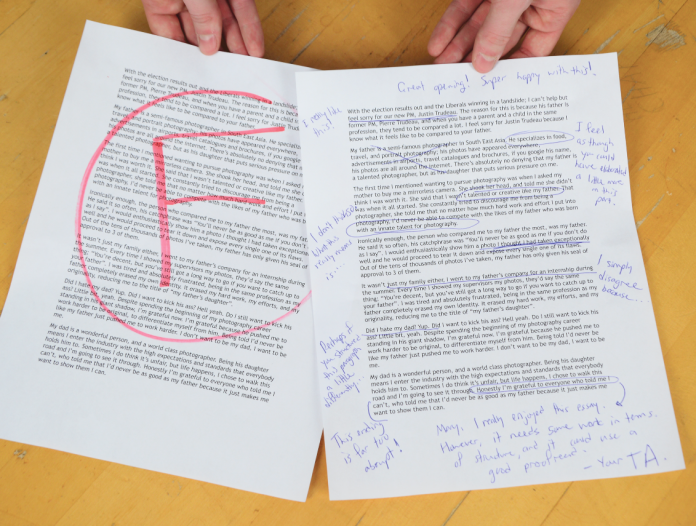
Adam Van der Zwan made it clear in a previous Peak article titled “Stop throwing shade on the grade” that maintaining our current grading system is imperative to fostering good students. He says, “You think a system of letters creates undesired competition? Welcome to the life we must face outside SFU’s walls.”

If competition through grades is what we are after, then the bell curve should be used in all of our classes because, according to my friend and graduate of the Beedie School of Business Michael Costley, that is the model that most closely resembles competition in the job market.

But the bell curve model is far from what I am talking about.

What I advocate is a change to a completely outdated system. Many SFU students temporarily learned to live without their grades because of the TSSU strike. Instead, many of us were given in-depth feedback for our work. We ought to explore this idea further, and perhaps bring universities into an new era of scholarly feedback. We are young, adaptable, and think differently than past generations, something that should be embraced — or, should I say, ‘engaged.’

An article from The Guardian in 2012 showed 23 per cent of responders in a survey regarding the graduate job market “singled out lack of jobs and opportunities” as their biggest challenge; others regarded unpaid internships and being regarded as inexperienced “a big hurdle.” It seems that committing years to grueling courses and having the piece of paper to prove you graduated just isn’t enough anymore. The GPA has lost translation.

We are even accepted into programs with virtually no market available when we graduate. Those hoping to become teachers are a prime example, as a tragic amount of Canadian graduates are unable to find work in the country.

Students pay astronomical amounts to be graded, rather than be challenged and reinforced intellectually. If we are to truly remain competitive as students, we should place more emphasis on actually preparing for competition in the real world.

It’s time to ask ourselves not what will be lost if we abolish the grading system, but what will be gained. Without grades, SFU’s grading system was replaced with direct feedback from our teaching assistants and professors, which is far more conducive to learning. This has the potential to create students more prepared to be successful and to have a competitive edge where it counts.

Our world has changed drastically over the last 20 years, and our education system should, too. We do not live in the time that our parents grew up in, and the present is only going to move further away from that period. We should be defining our futures and how we get there, not our outdated institutions.