
 Seagull Square (Jill Mandrake)
 The Crapside (Ryan Stella & Darien Lechner)
 Three Piece (Rosemarie Perkin)
 Pun 2 3 (Sarah Walker)
 During/after the TSSU strike (Destiny Hsu & Justin Stevens)
 Creator’s Pet (Destiny Hsu)
Seagull Square (Jill Mandrake)
The Crapside (Ryan Stella & Darien Lechner)
Three Piece (Rosemarie Perkin)
Pun 2 3 (Sarah Walker)
During/after the TSSU strike (Destiny Hsu & Justin Stevens)
Creator’s Pet (Destiny Hsu)
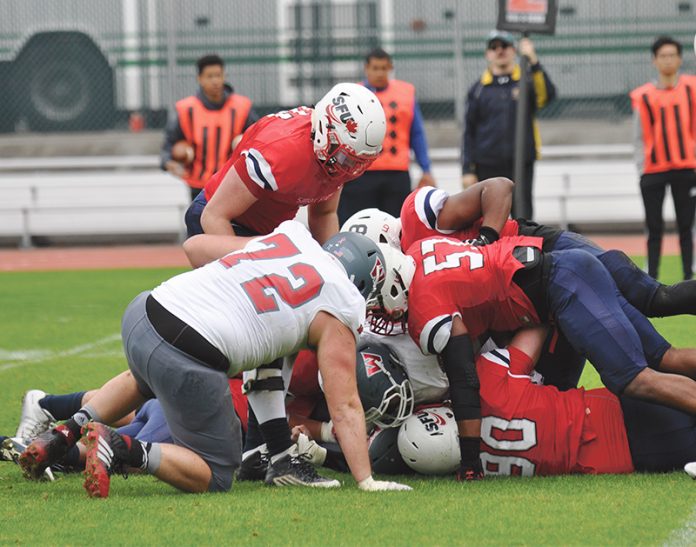
After flying down to California earlier in the week, the SFU football program hoped to get their first win of the year against the Lumberjacks of Humboldt State University (HSU), who are currently sitting in first place atop the GNAC with an undefeated record.
The sound of 5,000-plus screaming fans in costumes with the buzzing of the mascot’s chainsaw on the sidelines sure made for a ghostly atmosphere in Arcata, California on October 31 as the Clan prepared to take on this year’s GNAC contenders.
SFU opened the game on offense and rallied down the field with the help of a 26-yard completion from quarterback Ryan Stanford to receiver Christian Berger. They settled for a field goal a few plays later, but it sailed to left of the uprights, leaving the score 0–0. Humboldt state responded the following drive with a field goal attempt, but this too missed wide.
A stout Lumberjack defense began to hone in on the Clan offense, as SFU was only able to amass three first downs in the first quarter. These short offensive drives for the Clan gave HSU great field position, which they quickly took advantage of by putting together back to back drives that ended with rushing touchdowns from running backs Ja’Quan Gardner and Jabar Byrd.
Coach Bates described the outcome of limited offensive production by stating, “[when we’re] not able to stay on the field on offense, really our defense gets to a point where they’re just tired and they get worked over. Part of that is a product of the size of our roster size at this point in time.”
Jordan and Justin Herdman led the SFU defense to a couple of promising stops to open up the second quarter, including a big play on third down where SFU defensive back Cairo Messer-Barrow broke up a possible first down catch for HSU.
“They are dedicated to their craft, they work hard and their students of the game,” coach Bates said of the Herdmans. “They are human and they make mistakes, but they are leaders on this defense and I don’t know where we would be without them.”
However, things began to turn sour for the Clan as the Lumberjack defense forced an interception and back-to-back three and out drives for the SFU offense. The Lumberjack offense would simultaneously rally together to put an additional 21 points on the scoreboard before heading into the locker room for halftime.
“We can’t afford to make mistakes when we play [HSU], but each play we had one or two guys make mental errors, and that caused issues that [they] weren’t able to overcome as a team,” said coach Bates.
Lumberjack quarterback Robert Weber opened up the second half of the game by leading his team down the field to add to an already staggering lead by throwing his second touchdown pass of the day to make the score 42–0.
An early deficit in the second half forced the Clan to abandon the run game that had been so efficient in recent weeks thanks to the recent emergence of converted running back Ante Milanovic-Litre. Ante finished the game with only 14 rushing attempts for a total of 28 yards.
The rest of the second half continued to play out in favour of HSU, as they tacked on an additional pair of touchdowns before closing out the game. Stanford finished the game completing 17 of 36 passes for 140 yards and two interceptions. Justin Burren again came out as the Clan’s leading receiver, with four catches for 52 yards, while Jordan and Justin Herdman led SFU in tackles with 26 and 12 total tackles respectively.

Aries (March 21 to April 19): You’ve been working hard all week, so take some time to chillax. Do something fun, preferably leisureful — and no, studying to get ahead in your course reading isn’t considered “fun” by normal people. Calm down with some Netflix, a nice nap, and maybe get wrecked at the Highland Pub tonight.
Taurus (April 20 to May 20): Feeling nostalgic, Taurus? The alignment of Pluto this week means it’s an optimal time to call up an old friend. . . unless the old friend you’re thinking of is a total ass-wipe, which is why you let them go in the first place. If so, it’s okay to ignore Pluto just this one time and not call them; they’re an old friend, Taurus.
Gemini (May 21 to June 20): Lucky for you, Venus has decided that you’re going to get laid this week. So use SFU’s Party Calendar to raise the roof at a super hip uni party and find yourself a good-looking human!
Cancer (June 21 to July 22): I suggest you start living your life to the fullest, because your astrology sign says it all, man. It says it all.
Leo (July 23 to August 22): Whenever I hear “Leo” I think of how there was totally room for two people on that floating door wood for Jack Dawson. I’m talking to you, Rose! So I guess I’m trying to say. . . sharing is good. #titanic
Virgo (August 23 to September 22): If you looked into the mirror this morning and said, “Why am I so uuugly?,” let me tell you something: today, you are not ugly. If you were a bird, you’d be a swan. Fluff your fluffy feathers and prepare those mating calls.
Libra (September 23 to October 22): This is the part where I give financial advice by recommending ways for you to save your money. But hey, you guys aren’t the only students with money troubles. All of us uni students have money troubles. You can barely afford your textbooks, let alone tuition. You have no money with which I can advise you about.
Scorpio (October 23 to November 21): Sometimes when you wanna travel, the plane crashes and you get stuck on, like, Mars or something. And despite your resourcefulness and your loyal character, I’d rather not be stuck in a desert with a venomous predator.
Sagittarius (November 22 to December 21): You’re a freaking centaur. You don’t need advice. Nobody tells you what to do. You do your own thing, horse-human. You’re the bomb, and that will never change.
Capricorn (December 22 to January 19): Because the stars of our solar system won’t always align in your favour, try to avoid saying “when I graduate” and stick to more open-ended terminology, like “if I graduate.” Life is more fun when it’s not so strictly defined.
Aquarius (January 20 to February 18): Uranus has been feeling a bit off these days. Perhaps it’s all the macchiatos and Red Bulls you’ve been chugging down to keep you bright-eyed and awake for your exams. Stay near a toilet.
Pisces (February 19 to March 20): Hey, little fishy. I know you’re feeling lonely these days because of that stormy breakup, but Neptune and its moons have come together to move Earth’s seven oceans, mixing things up a bit. Swim, little fishy, for there are other cute and charming chordates in the sea.
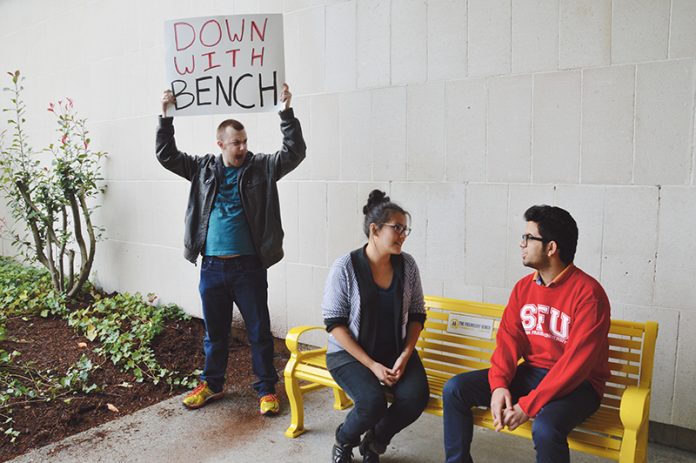
The unveiling of a new mental health initiative is driving one group at Simon Fraser University out of their mind: the MaleMen, a men’s rights activist group on campus, is protesting the new Friendship Bench, saying that it is too close to a physical entity of one of their group’s most combatted institutions — the “Friend Zone.”
“The Friend Zone is definitely a real issue for men and men-allies,” said Chad Anderson, president of the MaleMen. “With this new bench on campus, it encourages complete strangers to be friendly to each other, and then just walk away — unaware they’re supposed to continue the encounter with sex or at least a sloppy make out sesh.
“What’s the point of constantly being kind to people if they can just get off the bench and walk away from you? It’s a burden on real men trying to make a beneficial connection, with heavy emphasis on the benefits.”
Putting one in the “Friend Zone” is described by MaleMen’s website as mentally registering another person as only ever just being friends, often very good or best friends. MaleMen warns folks not to be enticed by how nice it can be to actually be friends with other people, as it doesn’t take into account the lack of tangible benefits having friends in your life has.
The MaleMen protested the opening of the Friendship Bench on October 28, handing out pamphlets with facts about meninism and chanting anti-bench sayings, some about what the bench stood for and others just denouncing benches entirely.
According to a press release from SFU, the yellow bench is meant to serve as a permanent symbol of mental health awareness and of SFU’s vision for a vibrant stigma-free community.
Peter Phillips, one of the protestors, is taking it one step farther; he has initiated a standing strike, in which he refuses to sit down again until the bench is removed from campus.
“I feel like my boys really need something they can rally behind, so I’m taking this bullet for the team,” said Phillips. “It’s kind of difficult and awkward to go from standing to lying down without anything in the middle, but I feel as though I can inspire others to do the same until SFU responds.
“Imagine sliding into a dry Slip ‘N Slide, except it isn’t very fun at all and it hurts most of the time. I and other MaleMen will subject ourselves to that constantly until our demands are heard and the bench is scrapped.”
An official from SFU was asked to comment on the actions of the MaleMen. However, upon hearing about the objections to a bench built around friendship, they threw their arms up in the air and exclaimed, “This is why we can’t have nice things!” before storming off.

As a university student, you’re no stranger to financial struggle. The loonie you found on the ground last Monday was the highlight of your week, and the first question you ask when you’re invited to literally any event ever is: Will there be free food? Luckily for you, The Peak has some money-saving tips to get you through the rest of the term.
Bedding: No classic grandmotherly figure who knits blankets like everyone else seems to have? No problem. Just head to your building’s laundry room. Most university students don’t get rid of the lint in the dryers after using them, meaning you can take what everyone else left behind and forge makeshift pillows and blankets to get you through the cold, Canadian winter nights.
Your cellphone bill: Instead of spending $50+ a month on a cellphone plan for texting, calling, and data, learn the ancient art of smoke signals. Not only will the fire help keep you warm, but you’ll never have to worry about poor cell reception or dropped calls again; smoke signals work whether you’re in the middle of a metropolis or the middle of nowhere. Of course, you won’t be able to gossip anymore, you can’t really be discrete about giant plumes of smoke in the sky, but assumedly there aren’t too many people who could intercept and successfully interpret your messages.
Fresh breath: Instead of spending a few bucks on a pack of gum, save money by picking already-chewed pieces off the bottom of desks and chairs. Sure, maybe the flavor isn’t what it used to be, but the lackluster taste is made up for by the extra money in your bank account at the end of the month! Even better, there’s the bonus of the element of surprise, never knowing what flavor of gum you’ll get. Before, you would’ve had to spend extra on a variety pack of gum. But this way, you get to sample them all for free.
Bad hair day?: The cost of hair accessories like curling irons, flat irons, and combs can really add up, so take the financially-efficient route: just gather up the hair that’s been strung up on the shower stall wall. Not only will your floormates love you for taking care of the mess that once repulsed them, but you get a free wig out of it. Some assembly required.
Netflix: Just because you’re poor, doesn’t mean you have to suffer by missing out on How to Get Away With Murder. Simply set up a lawnchair outside of your neighbor’s house — we all have one that seems to never close their curtains — and voila! What used to be a gross, tragic trait of your neighbour is now your ticket to free Netflix. It’s gross, but every Thursday night they’re your new best friend. You’ll just have to get really good at reading lips.
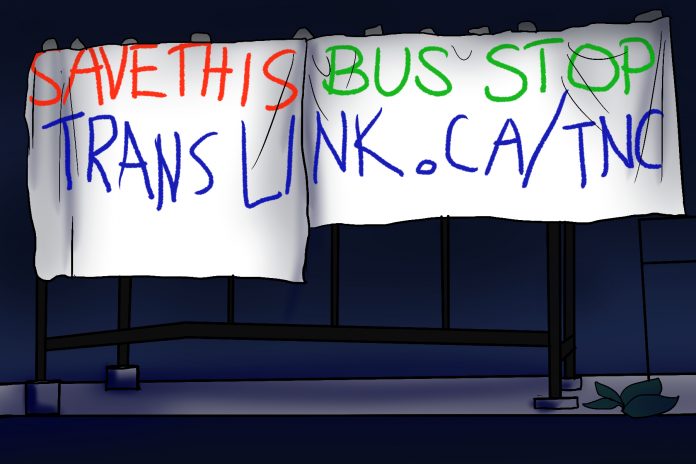
“Save this bus stop.” That was the message engulfing SFU’s residence bus stop late Thursday night before being taken down. But reduced service to that particular stop is not the only proposed change to transit that would affect SFU students.
TransLink conducted a consultation survey regarding the proposed 85 changes to existing routes, some of which would affect all three SFU campuses. The changes are meant to increase efficiency and decrease travel time for riders across all of Metro Vancouver.
Among the changes are plans to convert the 135 to a B-line, eliminate several stops in Burnaby, reduce the number of stops on Burnaby campus to allow for two-way flow for transit, and other proposed changes to a significant number of routes that may be utilized by SFU students studying at the Burnaby, Vancouver, or Surrey campuses.
Caitlin Maxwell, a first-year communications student living in residence who relies on TransLink to get on and off Burnaby Mountain, will be affected by the diminished service to the residence bus stop, which will only be serviced by the 144 and N35.
Despite the Simon Fraser Student Society’s (SFSS) attempts to raise awareness amongst students through leaflets and posters on campus, Maxwell told The Peak that she had no idea of the proposed changes.
“I was not aware of the specific changes that TransLink proposed, only that it was making some changes that students should know about,” said Maxwell. “Really, how many students are going to do full research online after infrequently seeing a poster on campus?”
One of the largest proposed changes to an SFU bus is the possible expansion of the 135 into a B-line. This means the route would lose stops in favour of decreasing the travel time between SFU and Burrard Station, a change TransLink says would save travellers 10 minutes.
“I don’t see how 10 minutes would benefit anyone in a full work day,” said Maxwell.
The survey, which has more than 8,000 responses at time of publication, is just another step in making sure that TransLink is able to implement changes that they feel will best benefit everyone riding, according to spokesperson Jennifer Morland. She said that the procedure they were following wasn’t any different to how it is usually done.
“We have shared publicly the dates for the survey, and we hope that people have taken the opportunity to take the survey so far,” Morland told The Peak days before it officially closed.
Kathleen Yang, SFSS VP External Relations, expressed her own worry that there was not enough time to reach out to all the students before the survey deadline to make sure they had their say.
“Do I think they gave us enough time? No, I don’t think so,” said Yang in regards to the opportunity the SFSS has been given to raise awareness. “They’ve said that they’ve been in consultation for a number of months now with the city, with other stakeholders, with regional planners, but what about the people who are literally going to be affected by these changes?”
She acknowledged that the proposed changes are very complex and that students may not realise how it will affect them.
“I think [students] need to know that there are a huge number of bus route changes,” she said. “I’d really encourage students to take a look to see what buses are going to be changed [. . .] and whether or not that is going to be good for them.”
Morland emphasized that the changes are still in their developmental stage, and should not be inciting the kind of worry that some students might feel. She hoped that students would fill out the survey to make their concerns heard.
“The important thing to stress here is that these are proposed changes, so there have been no final decisions made,” she said.
Proposed Route Changes:
All routes redesigned to allow for two-way traffic instead of functioning as a one-way loop, fewer stops on the hill, reduced routes servicing residence bus stop
135 Burrard Station/SFU
Turned into a B-line, number of stops reduced to decrease travel time by ten minutes from Burrard Station to SFU
143 Coquitlam Station/SFU and 144 Metrotown/SFU
Redesigned to act as one-way loops respectively
SFU Surrey
Reroute the 509 to Lougheed Station and reroute the 501 onto Highway 1 via 156th Street
5 Robson/Downtown
Adjusted to provide year-round service on the route
6 Davie/Downtown
Extended to include Yaletown-Roundhouse Station and Cambie Street
C23 Yaletown/Davie/Main St. Station and C21 Yaletown/Beach
The two routes have been consolidated
Route 394 White Rock/King George Station
Changed into a B-Line, with fewer stops to decrease travel time
Other routes with proposed changes in the surrounding area:
Burnaby
145, N35, 49, 26, 106, 116, 129, 130, 430, C3, C4, C8, C9
Vancouver
41, 43, 480, N8, N20, N6, N16, N22, 4, 7, 16, C18, C19, C20, 44, 250, 258
Surrey
595, 502, 531, 590, C63, 320, 341, 509, 351, 352, 354, C50, C51, C52, C53

If I were to be completely practical, I’d say that all airlines are pretty much crap. But instead of wallowing in my first-world problems, I thought I’d take a moment to snapshot the fleeting happy moments in life, to sift through the negativity and pull out those golden nuggets, to pluck the ripe from the rotten.
In this case, I’m talking about that sweet contract Air Canada has with Cineplex Odeon, which allows passengers to play ‘still in cinema’ films from touch screens on the back of the passenger’s seat in front of them. Let’s be honest: this personal in-flight entertainment has pretty much revolutionized the commercial airplane experience, and has left the Canadian corporation flipping the smug bird at most of the other travel options out there.
Personally, I view this free in-flight entertainment as a reward for all the stress a passenger encounters while going through customs and baggage checks. Sure, Air Canada just might lose track of that huge suitcase with all of your personal belongings for an indefinite period of time, but as long as your 14-hour flight has films that you don’t have to spend $25 at the cinema to see, then it’s not as much of a big deal, right?
United States airlines have a lot of catching up to do. Either that or they’re simply extorting passengers’ pocket-cash for all its worth. I took a flight to Texas last week and was surprised to find that there are no touch-screens emblazoned on the seats of United Airlines airplanes. I’m sorry to say this, but I’m now going to bitch about my first-world problems.
In place of a touch screen was a simple blue sticker that flashed a wifi symbol and asked me to pay $8 to connect to their Web service in order to access in-flight entertainment on my personal digital device. Other United flights I took during the trip had no wifi access altogether. I’m sorry, United Airlines, but Canada has set the bar pretty darn high. As your valued passenger I expect free, easily accessible in-flight entertainment, and to deprive me of this is to hang your head in shame while crushing your skull under the corporate weight of your “friendly hat,” Canada.
United Airlines, call me a pretentious ass, but if you’re also going to lose all my luggage and then smack me in the face with a boring flight, then you’ve lost all my respect. I guess I could pull out a novel, but really — who reads books these days?
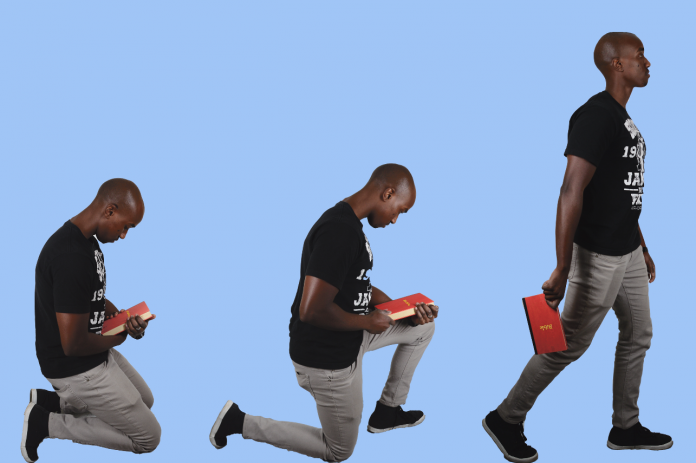
Atheism is a word often made synonymous with evil and godlessness. However, only the godless half of that statement is true. It’s not godless in the sense that atheists are wicked and morally defunct, but godless in that atheism is a lack of belief in the existence of a deity.
My journey of negotiating religion and faith is by no means unique. But by sharing it, I hope to help demystify what being an atheist is, based on my personal experience. Hopefully it will encourage others to not be afraid of their doubts as I was.
Many religious people tend to think that atheists are inherently immoral people, which is a common misconception. Indeed, bad people who are atheists do exist, just as there are bad people who believe in God. But the lack of belief in God is hardly ever the cause of immorality.
Like most people from my home country Kenya, I was raised a Christian — Protestant, to be exact. However, soon after moving away from home in 2012, I began confronting my beliefs and values as an individual. I began to see the problematic nature of my attachment to Christianity, especially coming from a former British colony.
My rejection of God is about my way of living, and still allows me to maintain my ethics.
The last straw for me came when I attended a church service in downtown Vancouver. A preacher rejoiced in an ailing man’s conversion to Christianity from Islam, which the preacher then claimed led to the man’s healing. The congregation then followed with an enthusiastic “Amen!”
Apparently God is a picky healer when it comes to non-Christians.
From this point, I began to question the implications of believing solely in a Christian God. If born into a family of different faith, wouldn’t that determine what kind of God I believe in? And if one faith is right, is everyone else wrong?
This led me to research and increasingly question my faith over the course of two years, along with deep reflection about my values. What I realised was that God and religion were ideas I only accepted based on fear and pure indoctrination. That’s when I decided that I would hold on to them no longer.
The concept of God is an unnecessary burden that does little for my personal development. This, however, does not mean that I am automatically motivated to be ‘bad;’ instead I focus on different things for personal fulfillment and to seek answers.
Evidently, my process did not come from premature rebellion. It was the result of careful consideration leading me to eventually outgrow religion and subsequently God.
Yes, ladies and gents, I outgrew God. I don’t mean that in an arrogant or dismissive way, though. I simply left behind bad ideas. My rejection of God is about my way of living, and still allows me to maintain my ethics.
I’m still learning to cope with accepting my lack of belief. It is by no means an easy transition. However, our insecurities can be easily dealt with if we are open about them. Hiding underneath the guise of social acceptance does little to promote our well-being.

Oh God, how do I start this? I love you, Peak, and I will always love you.
It’s not you, it’s the SFSS elections. I can’t live tweet my way through another set of six hour-long debates. It’s the beautiful nightmares about writing formulaic articles on SFU’s community engagement. At the heart of it, it’s about how I’ve changed.
I gave you the best years of my undergraduate degree, and you gave me prematurely grey eyebrow hairs and an addiction to lukewarm Folgers coffee. Really, you’re the habit I have to kick.
I’ve been carrying a voice recorder in my bag and a chip on my shoulder for too long.
We’ve made some beautiful memories together — late nights in the office drinking too much vanilla Coke, Sting-a-longs to acoustic renditions of “Message in a Bottle,” and travelling to exotic places like downtown Edmonton, or making the trek down to the SFU Security office in Discovery 1.
Like Cathy and Heathcliff, the two of us are inextricable. From the bowels of Burnaby Mountain I cry out, “I am The Peak!”
I worry that I will lose all of my friends to you when I leave. After all, you are the biggest thing we have in common. I do concede that you can have them on Fridays. Just try not to keep the poor dears out too late, slaving away to fill your pages.
“I’ll still write,” I say. “I’ll stay on as collective rep on the board of directors,” I said. I think we both know that might not be entirely realistic.
“Make it a clean break,” said noted advice-giver, and my mother, Joanne. I know I should probably listen to her, but I don’t know if I can really quit you.
No, there’s no one else. Not yet. But I’ll have to pay the bills somehow. I’m just looking for something different — something that won’t swallow me whole. I can’t forever be at the beck and call of campus news.
Is there a life for me after student journalism? Nothing is for certain, but I have to find out.
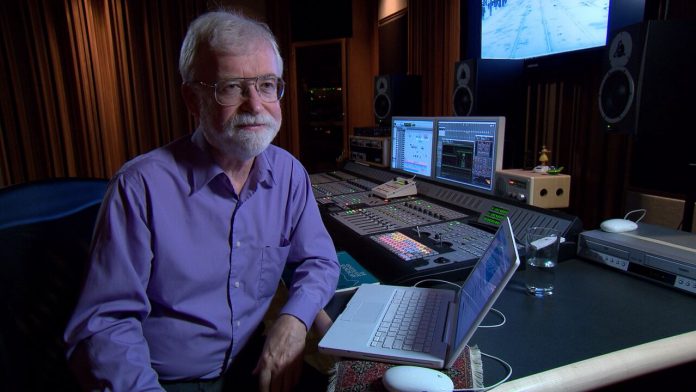
SFU Communications professor and renowned composer Barry Truax is one of the many experts featured in the upcoming documentary, Sonic Magic: The Wonder and Science of Sound, produced by CBC’s The Nature of Things, which will air on November 12.
The documentary was shot around the world and explores the effects sound can have on people’s well-being, the use of sound in medical treatment for cancer and Alzheimer’s, as well as how sound affects how public spaces are experienced. Currently working in Berlin, Truax sat down for a Skype interview with The Peak to talk about his involvement with the the documentary.
The Peak: Could you tell our readers about your research that was featured in the documentary?
Barry Truax: Well, this is definitely what we would call soundscape research or soundscape analysis, which we have been doing in the School of Communication at SFU for the entire time I’ve been there, which is over 40 years.
Basically, it’s about the science of sound. And of course they are popularizing it with what they call “Sonic Magic” [. . .] but it really has a lot serious science in it. [. . .] Sound as an environmental aspect is included here and we’ve drawn on the World Soundscape Project’s heritage.
In particular, one of the main sequences that they based in Vancouver focused on the Holy Rosary Cathedral bells downtown because it’s just a focal point. [. . .] It was documented by our project back in 1973 with what was called the Vancouver soundscape as a significant ‘sound mark’ of Vancouver.
P: For our readers who don’t know, can you explain what exactly a soundscape is and why it’s important?
BT: Well, it’s the acoustic environment that we live in all the time, and we’ve always put the emphasis in the School of Communication — on the way it’s perceived and understood by people as opposed to for instance how an acoustic engineer would simply just measure it as an objective fact.
It’s important because it affects the quality of life that everyone has 24/7. People use sound, or ignore sound, or are exploited by sound, or rely on sound as part of their daily life and it’s important as a quality of life issue.
P: Referring to quality of life: a lot of the research in this documentary is about how sound can be used for medical purposes. Could you talk about the other ways sound improves quality of life?
BT: We [at the School of Communications] started by simply emphasizing listening and so instead of telling people what’s good and bad, we try to make them more aware of it [themselves] by just basically starting to listen and pay attention, and evaluate and make choices in their lives.
Instead of just saying, ‘Oh this noise is bad for you,’ which it is, and, ‘it’s a stressor on you’. . . And particularly for students, I can argue that it is actually affecting your grades.
If you live in a cheap apartment next to a highway and you can’t sleep at night and you’re subjected to noise through most of your waking hours, this is going to have an effect on your academic life. [. . .] There [are] just so many ways in which sound affects us 24/7, both positively and negatively, and we want to emphasize the positive and have people become aware and make choices for themselves.
 Mystic Man (Reuben Newton)

