Home Blog Page 905

New illustrations capture the magic of Harry Potter

0
Jim Kay brings the world and magic of Harry Potter to life.

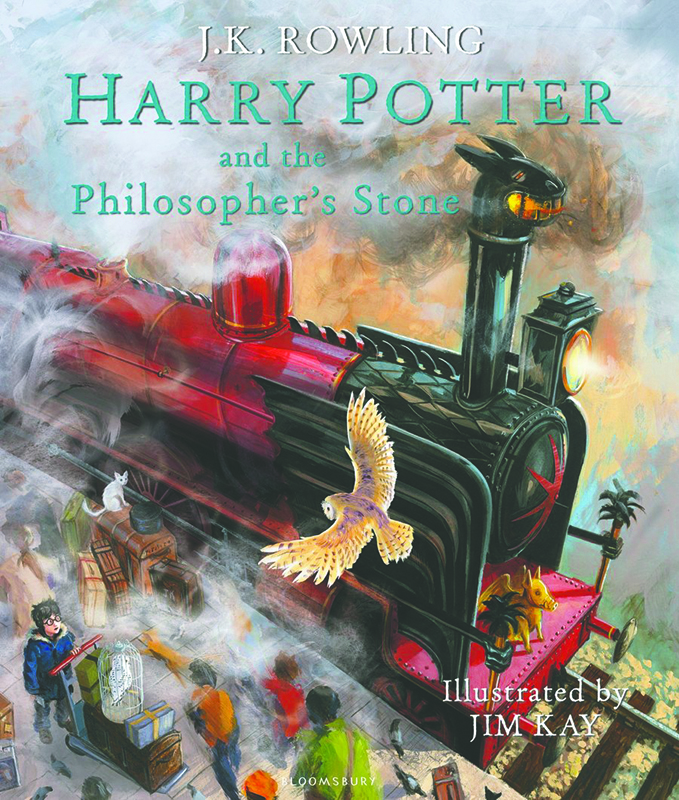
Just when you think that the print versions of J.K. Rowling’s beloved series Harry Potter couldn’t possibly be improved, the fully illustrated edition of Harry Potter and the Philosopher’s Stone was released.

It may be because I am a massive Harry Potter fan, but when I first picked up the book I was taken back to discovering Harry Potter and the magical world for the first time. I would hesitate to call this a surge of nostalgia, but I am not afraid to admit that I did get goosebumps when I opened to the first chapter to see the Dursleys illustrated to perfectly coincide with Rowling’s description.

Throughout the book, illustrations complement and accentuate the story and Rowling’s prose. This is not like a picture book for small children — Rowling and Kay still leave space for your imagination to fill in missing images in the story, and the ones that are present on the pages serve to centre your imagination in a way the movie adaptations never could.

The detail put into the creation of this book is astounding. Whereas most illustrated editions of novels do black and white images on a few pages and a few colour plates in its centre, this edition features some form of colour or illustration on every page. Each one appears as though printed on well-aged parchment paper — the preferred paper of both witches and wizards alike.

While the font of the book does not go to the same lengths as the illustrations of the novel, this is understandable. It would be incredibly exciting to a Harry Potter nerd like me to see the story told through fonts that resemble the writing of all the main characters in the series, but the readability of the novel would suffer. This may sound nitpicky, but it works with the feel of the book and the thought that was put into its creation. They chose to not go overboard on the creativity and this allows the masterful illustrations to star.

This is not like a picture book for small children — Rowling and Kay still leave space for your imagination to fill in missing images in the story.

One of the main complaints surrounding the Harry Potter series and its various incarnations has been the lack of diversity, an issue which is addressed through some of Kay’s illustrations. Two noteworthy examples of this are the illustrations of the suits of armour in “The Midnight Duel” chapter: they are of varying heights, shapes, and body types. The other example comes from the “Quidditch” chapter, in which students of varying ethnicities are shown. While the main characters are all still white, it is refreshing to see that Hogwarts and the wizarding world isn’t necessarily as monoracial as previously thought.

While the movie versions of Harry Potter seemed to depict Hogwarts as a serious place, Jim Kay took some creative license with some of the less well described parts of the castle. Where there was once just a hall filled with suits of armour that I had always envisioned in a manner similar to that of the suits of armour in Beauty and the Beast, Kay gave each suit he illustrated a personality of its own. The same goes for the magical chess pieces, which are described as being somewhat sentient in the novel; Kay again gives each one its own personality. 

Having been excited for the release of the illustrated versions of Harry Potter since they were announced, I had a lot of potential to be let down by the final product. I am pleased to say that it doesn’t just meet, but exceeds my expectations. I couldn’t be  more excited to see what Jim Kay will do with the remaining six books.
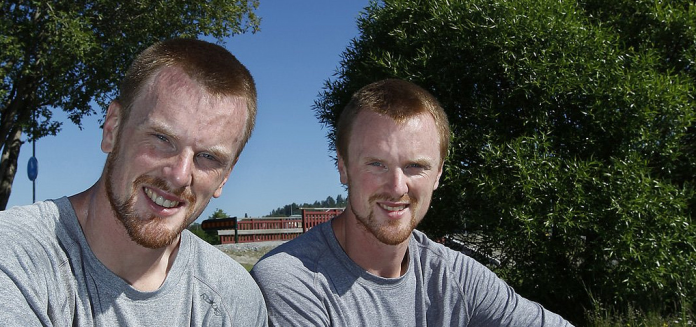
Canucks need to think about the future

0
The Canucks haven’t picked in the top five since they’ve picked these two Swedes in 1999.

We’re close to halfway point of the NHL season, and the Vancouver Canucks are in a playoff spot. Not because they are playing particularly well, but because the Pacific Division this season has been terrible. Six of the seven teams in the division are at .500 or worse, including Vancouver, who have 14 wins and 23 losses in regulation in overtime combined, good enough for third place and 37 points. In comparison, the Canucks would place sixth and seventh in the Central and Metropolitan divisions, respectively.

While the playoff home dates will be welcomed by the owners (read: more money), playoffs would mean yet another year of putting off the inevitable. Approaching the stretch run of the NHL season, the Vancouver Canucks need to seriously consider starting the dreaded “T” word: tanking. Tanking is purposely losing to get a high draft pick by putting a subpar product on the ice, and it would be the best course of action for the long-term competitiveness of the franchise.

Although Jared McCann, Bo Horvat, Jake Virtanen, and Ben Hutton have shown brief flashes of brilliance, they are not the top-end talent needed to win the Stanley Cup. The only way to get that talent in a salary cap system is to draft them high. Gone are the days before the salary cap where teams like Detroit, Colorado, and Dallas could sign and trade for all the talent they could afford to get. With the salary cap, the free agent market has dried up, resulting in less high end talent getting there and gross overpayments for the players that do.

Recent history has proven that tanking ultimately achieves its desired result.

Trading has become a balancing act, with equal salary having to go out and come back. The only way to get high-end players is to draft them, and more often than not they’re picked in the top five.

Recent history has proven that tanking ultimately achieves its desired result. Chicago drafted Jonathan Toews third overall in 2006 and Patrick Kane first overall in 2007, and went on to win three Stanley Cups in five seasons. LA drafted Drew Doughty second overall in 2008, and he ended up being a major player in their two Stanley Cup wins. Pittsburgh of course drafted Sidney Crosby and Evgeni Malkin first and second overall in their respective draft classes, and have been perennial contenders ever since, even winning the Stanley Cup in 2009. Edmonton is still trying to become competitive, but there are always exceptions to the rule.

The worst place to be is where the Canucks are right now: a middle-of-the-road team. Not only do you not have any chance of competing for the Stanley Cup, you also won’t get a high enough draft place where your odds of picking an high-end, impactful player are good.

The Vancouver Canucks are at a crossroads. Do they make a push for the playoffs that will most likely result in another first round exit? Or do you bite the bullet for the next few seasons, acquire high draft picks, and try and eventually win the Cup? I believe the best course of action is obvious.

My journey into the wild

0
The first day of the hike, I was able to see an amazing expanse of untouched trees.

In 2012, I attempted my third backcountry hiking trip with an ambitious goal. I intended to do the unmarked Donjek route in Yukon’s Kluane National Park.

Upon arrival at the park office, the ranger told me that she would not issue me a park pass because I was unprepared for the Donjek. The reasons were that I had no GPS, emergency beacon, or route plan, and that no one had done that trek alone all year. She then delightfully told me that there was an alternative trail that I could do that would meet all my expectations for wilderness hiking and more in the fabled Yukon.

My possession of bear spray and a bear canister made me eligible for the 85 km Cottonwood Trail, a marked route with no human improvements such as toilets, campsites or bridges.

The first day was spectacular. I hiked up switchbacks alongside a deep blue inlet of the Pacific Ocean flanked by a beautiful mountain which reflected majestically across the water. At its crest, I was treated to an endless expanse of virgin forest untouched by the hand of humankind. My first night was spent watching loons play in the sea on a gravelly beach under the stars. The next day I did my first of several creek crossings. These “creeks” were rushing torrents of water, ice cold and often waist high. I had to strategically and carefully move across them with my poles and plant foot fighting the current.

Day two saw me set up camp at midday in a beautiful river estuary surrounded by mountains and a sheltered bay.  As there was no sign of anybody since I began the hike, I decided to roam around the rest of the afternoon in the nude. It was the first time I had ever been naked out in the world and it was exhilarating! After a beautiful fire and spectacular mountain sunset I awoke in the middle of the night to see a beautiful white arc in the night sky.

Day three’s highlight was a grizzly bear sitting on the trail. I had seen evidence of their footprints and scat throughout the trip. Fortunately, it ran away as soon as it saw me. I then descended into a beautiful meadow adorned with moose antlers before another spectacular sunset.

Day four was the most incredible part of the trip.After a tough uphill climb on a hot August Day I reached the ridge and saw three large wolves at extremely close range. I yelled and they immediately bolted.

I spent that night in a beautiful alpine meadow before an easy hike out to the highway the next day, having seen no other people the entirety of the trip. The Cottonwood Trail is the most beautiful place I have ever visited in Canada, and I hope you get the chance to visit it in your lifetime.

Catchin’ up with the Clan

0
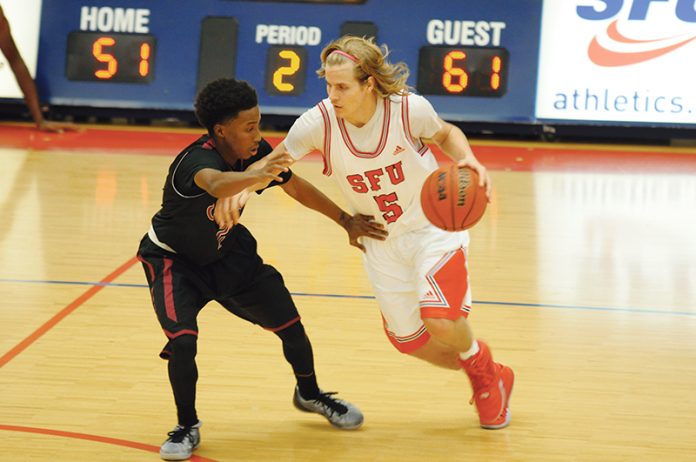
Max Barkeley has been a standout so far this season.

The Peak may take December off, but that doesn’t mean the world of SFU sports stopped. Here’s a guide to what happened in December and the last bit of November:

Cross Country

On November 21, the men’s cross country team broke new ground with a 12th place finish at the NCAA Division II National Championship in Joplin, Missouri, marking their best performance at the national championship.

This marks only the second time that that the men’s team have qualified for the national championship, having placed 20th in 2014.

“The hardest thing to do is to qualify for nationals, and we did that, and we improved on our previous performance,” Head Coach Brit Townsend told SFU Athletics. “Our young guys did better than expected and will be real leaders in the future for us now that they have had this experience.”

Junior Oliver Jorgensen led the pack, placing 48th with a time of 30:41.2 on the 10 km track. Senior Marc-Antoine Rouleau placed 56th, freshman Sean Miller 103rd, freshman Rowan Doherty 121st, redshirt senior Cameron Proceviat 125th, senior Brendan Wong 139th, and sophomore Phillipe Gravel finished 189th.

The men’s team finished with an average time of 31:16, which gave them 372 points, while first-placed Colorado School of Mines finished with an average time of 30:22, and 100 points.

The race included 32 teams and 246 runners.

For the first time since 2012, the women’s team did not qualify for the national championship, having placed seventh in both 2013 and 2014. However, junior Rebecca Bassett earned an individual invitation to the nationals after placing ninth in the West Region championship.

“Our women have battled injuries all season long but we will be back,” Townsend told SFU Athletics. “We just need to get our confidence back because we have the people to get us right back where we need to be.”

Despite the disappointment of the team missing the cut, Bassett made up for it with her performance, finishing 21:05.9 on the six kilometre track, placing 24th out of 247 runners, and making the top 40 cut for All-American status.

Men’s Basketball

The men’s basketball team has struggled out of the gate, having only achieved one win in their first nine games.

Having lost key players from last year like Sango Niang, Justin Cole, and Patrick Simon, the team has only managed a win against Douglas College — a member of the Pacific Western Athletic Association (consisting of local colleges and universities in BC), and is certainly a step below Division II play — and none against Great Northwest Athletic Conference rivals or any American team.

And it’s not likely to get any easier.

In previous years, January was kryptonite to the men’s basketball team. In the 2013–14 season, after going 7–3 before the New Year, the men’s basketball team only put up one win in eight games in January. Last season, after putting up a respectable 6–3 record before the Christmas break and gaining media attention for their high-paced offence that scored 100+ points nearly every night, the team went 2–7 in January, and ending the season with a 11–15 record.

Whether this drop in play is due to the long break forced by the NCAA in which teams aren’t allowed to practice, or simply due to the fact that much of November and December is spent playing non-conference rivals, the fact is Januaries aren’t kind to the Clan.

However, this is par for the course. In an interview with The Peak before the start of the season, first year Head Coach Virgil Hill emphasized the focus was on the future, and on building a culture.

“Right now, it’s just about culture,” he said. “It’s about developing culture and having some of the young guys being able to compete every night. If we can compete for 40 minutes, whatever the result is, it is.”

And there are certainly bright spots. Junior transfer Max Barkeley has looked impressive, leading the team in points-per-game with 17 and playing with an in-your-face attitude. Freshman Oshea Gairey has also shown potential, and returners from last year like JJ Pankratz, Michael Harper and Hidde Vos have stepped into key roles on the team.

Men’s Hockey

The men’s hockey team went into the Christmas break on a two-game winning streak after wrapping up the 2015 calendar year with a dominant 8–2 win over Selkirk College — who had swept SFU in last year’s BCIHL Finals to win a third straight championship — on December 5.

The victory also avenged a 5–0 loss to Selkirk on the road at Halloween.

SFU opened the scoring with second-year forward Adam Callegari notching his first of the year just minutes into play. However, Selkirk would tie it up with 6:11 left in the first, then would take the lead on a power play goal with 42.5 seconds left in the period.

SFU would have the last laugh (of the period), when Callegari beat the buzzer tying up the game with only nine seconds left in the first.

From then on, it was all SFU. With two goals in the second period and four in the third, SFU had seven different and goalscorers and 14 players credited with a point.

In addition to Callegari, Brendan Lamont, Saylor Preston, Darnel St Pierre, Jesse Mysiorek, Brandon Tidy, and Michael Sandor added goals.

“It’s awesome to see guys who don’t necessarily get powerplay time and first line minutes step up and score a goal,” said Coletta. “Our guys, [if] you give them a chance, they’ll score.”

With the victory, the Clan sit in third place in the BCIHL with a 7–4–0 record, behind Selkirk College and Trinity Western.

Woohoo, Boohoo: A Redneck Holiday

0

Woohoo: Beer-butt chicken

I’m barrelin’ home to small town B.C. fer the holidays, and as dat dere Greyhound hauls itself into the mountains, them good ol’ memories come rushin’ back. I’m chuggin’ back beers with my buds in overalls – I’ve worn ‘em last two weeks. I’m smackin’ ol’ Bessie on the rear to giddyup through the drive-thru to get me my nuggets. I’m leakin’ out my name in the snow, only the “d” came out lookin’ like a “b.” I’m hollerin’ at that dumbass truck driver who’s drivin’ like granny on the roundabout. But my fondest memories would hafta be fillin’ my belly with good ol’ beer-butt chicken.

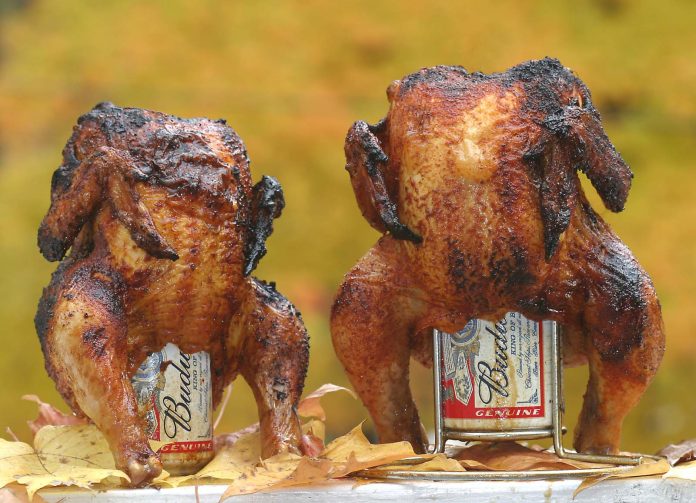
Each Christmas, Dad snaps the head off a fresh clucker (last year it was Crazy Sheila!) and plucks ‘er right naked. Mom fires up the oven to 375. She whips some garlic, paprika, coriander, and oil in a tin, and massages that chicken the way she hollers Dad never could. Then she opens a piss-warm can o’ Budweiser, stretches open that clucker, and shoves it up the badonk!

An hour later Crazy Sheila comes sizzling out o’ the oven, right as rain, golden brown, tender ‘n juicy, birthin’ a can o’ the best drink this here side o’ the mountains. As we stuff ourselves on chicken, we says, “holy moly Crazy Sheila, yer makin’ me all drowsy like! That Bud did you somethin’ special!” The supper table nods and belches, and we grin and toast to stuffin’ next year’s chicken with Molson instead.

Boohoo: Bare-butt chicken

Christmas comes ‘n goes, and then we’re gearin and beerin’ up fer the biggest celebration this here side o’ the darn border! And each New Year’s eve, me and the boys chug back a few cold ones to soften us up, then we play the new year’s game o’ “Snow Tushie.” Yup, ya heard that right, sorry ma.

Snow Tushie’s a chance to show that we’re ready fer the new year, a chance to toughen us up like. S’pretty simple — we pull down our johnnies and sit down bare-ass in the snow fer two whole minutes! Not that tough; I do it every year no sweat. Though there’s always that little wimp who ain’t got the nards to stick his crack in a snowpile fer long, before he yelps and leaps with eyes bulgin’, cheeks clenchin’ tight, then whimperin’ like.

Last year it was Jimmy; the year before it was Fred. This year, while we whooped and hollered, Pat was squattin’ and squealin’ like little Daisy down the street! He only made it to one minute n’ 45.

Jeezus, Pat! If you can’t wiggle that bony patootie in the darn snow for just two minutes, then you better grow a pair o’ low-hangers an’ prove yerself next year cause I ain’t got no time fer this horse pucky!

What a bare-butt chicken. Here’s to a better 2016!

GUESS AGAIN, GRANDPA: Why marriage isn’t high on my priority list

0

[dropcap]B[/dropcap]ack in the days of flower children and easy living, the ‘in’ thing was to get married at age 20. And yet, despite the incredibly early marriage date, many of our grandparents are still happily bound 40, 50, even 60 years later.

Marriage has changed dramatically over the past half-century. The 1960s saw childbearing as part of what The Atlantic’s Peter Berkowitz calls “the core of marriage’s social meaning.” But fast-forward 50 years and twenty-somethings aren’t focussed on getting married. In fact, the notion of walking down the aisle usually sits at the very back of the millennial brain.

Of course, to relay to your grandparents every Christmas that you got a bigger office isn’t nearly as exciting as bringing home that special someone. Our grandparents would sigh and remind us that they aren’t getting any younger. Grandpa would say: “Back in the day, before all this Instabook and tweet-tagging, true love existed. Your Grandma would always walk by the farm at quarter past eight, and I would smile at her while I tended Father’s fields. . .”

They would get married at 21 and would still be together some 40 years later. At this point, Grandpa would turn to you and say, “See, it’s not so hard!”

Well, Grandpa, it is.

For one thing, marriage is nothing like The Notebook. We don’t live in black and white while working the fields. It’s obvious that our millennial priorities have shifted. Despite the advent of apps that make ‘dating’ as easy as swiping right, we have a serious case of cold feet.

Since we’re all a little bit selfish, marriage gets set back while we figure out what we want.

There are those in the older generation who said “I do” as early as 18 and still find themselves very much in love. After growing a successful family, these sixtysomethings are now jet-setting to different vacation spots to relive a honeymoon forgone for their early families.

Meanwhile, 18-year-olds of today are just receiving freedom from asking to go to the washroom, are driving the highways for the first time, and are choosing the life paths they want, instead of the ones the government demands of them. In addition to upholding a steady job and reputation, we have no time to start a family. The hunt for ‘the one’ is placed on the backburner until our mid-twenties — but a degree, a few jobs, and a couple dates later, we’re already 30.

It’s a classic chicken and egg argument: our grandparents put the family first before their teenage dreams of success, while millennials are focussed on discovering our passions and fulfilling our dreams to pay off the crippling student debt that will accumulate during of our soul-search.

Further, our generation is arguably afraid of the word “commitment.” Getting married and living with someone is asking a lot from both parties, and since we’re all a little bit selfish, marriage gets set back while we figure out what we want. No one gets into relationships thinking of divorce five years down the road, so we push it aside. Fear and pride in tow, we’re on a neverending search for ‘soulmates.’

Somehow, the world has shifted our focus from love of each other to love of things. What may have been easy for our grandparents is definitely not the case anymore. Back then, there was little debt, fewer career options and less distractions — all things that prominently plague us today.

________________________

Guess Again, Grandpa! is a new weekly column in The Peak, in which Rachel offers her millennial rebuttals to her grandpa’s perspectives. Check back next week for new content!

WEB EXCLUSIVE: TIM’S BIT — Tirades on our stupidest things

0
Stop whining about how the holidays are too commercial, and spend a little more family time!

Tim’s Bit is a brand new web-exclusive column, featuring Tim Mottishaw’s comedic tirades on some of humanity’s dumbest problems, with regards to culture, society and politics. Check back frequently for new content!

____________________________

[dropcap]H[/dropcap]ave you ever had one of those friends who bitch about Christmas being ‘too Commercial,’  complains about all the presents they have to buy, or whines about corporate involvement, yet is not a devout Christian, so when they talk about getting back into a ‘traditional’ Christmas, you know they’re not talking about the three wisemen? These people drive me a little crazy. If you’re missing some spirit from your Christmas, then reclaim it. Don’t just complain that it doesn’t exist any more.

If you were a North American kid in a family that celebrated Christmas, chances are you grew up with a distinct awe towards the magic of the holidays. An awe towards those flying antlered quadrupeds, led by a glowing red nose, dragging behind a sleigh filled with toys. A big man in a brilliant red suit who can squeeze down any chimney — even when there is no fireplace — and who leaves toys under the tree you were delighted to help decorate. The Christmas spirit was all about the sheer joy of the impossibilities of it all.

As you became older you began to learn the truth, often from friends at school, (thanks alot, Todd!) that beloved Santa is really your parents. If you were the eldest sibling, like I was, you kept it a secret because your parents asked you not to ruin it for the others. While you may have privately scoffed at the idea, you enjoyed the attachment to the magic that was sadly now starting to fade.

I can justify the experiences spent in the company of friends who bring back the nostalgic holiday magic for me.

As you continued to grow, you began to learn the commercial side of the season: buying and giving gifts, you couldn’t just make gifts at school any more. You learned that the image we use for Santa was created by Coke, Rudolph was created by a department store advertising copywriter, and most of the jingle-style songs were written by people who often didn’t celebrate the season but we’re producing content to fill their pockets. Yet, you retained that little bit of magic in your memory. Every time you heard a kid talk excitedly about Santa, experienced a night of perfect snowfall, or witnessed joy in someone’s face as they opened a gift, you would feel that Spirit of Christmas.

And that’s my point. Yes, It drives me crazy to see Christmas products on sale before Remembrance Day. So, now I don’t shop at those businesses in November. Luckily for me, grocery stores seem to hold off a bit better. I also have all but stopped buying gifts for my friends and most my family. I’m a student, I simply can’t justify spending money on stuff, though I can justify the experiences spent in the company of friends who bring back that nostalgic magic for me.

This season is my favourite. I love the lights, I love bringing my Christmas tunes out, I love my Santa hat that I wear specifically from December 6 to Jan 6. I love, love, love that my friends and family get chances to come together, share stories of the year, and be merry.

Over the years I’ve learned that making your own traditions is one of the cool things about being an adult. I chose to celebrate Christmas as a season, a chance to spend time with people I love, be a little sillier, be a little more merry, and let the magic of my inner childhood take over. If you brooded over how this past Christmas had become too corporate, maybe next holiday you should put down the credit card and take everyone out for a walk in the park, or a board game night, or make dinner even if it’s just Kraft Dinner. Just believe in magic a bit.


Why your New Year’s resolutions keep failing

1

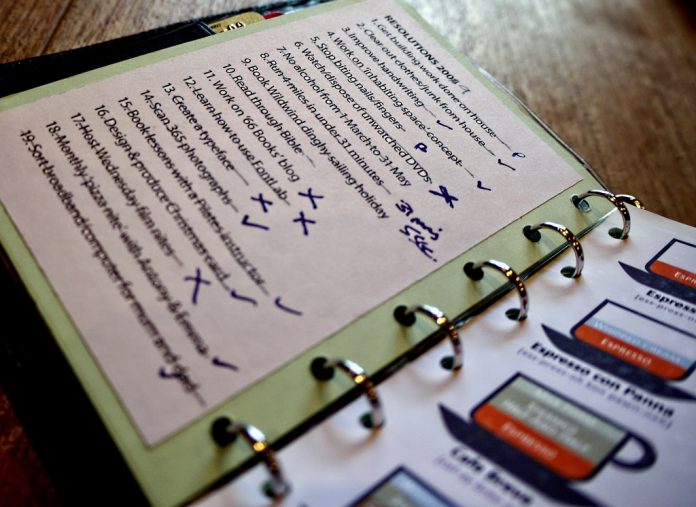
[dropcap]S[/dropcap]o, we’re a few days into 2016. Have you been keeping up with your new year’s resolutions?

You might be doing well so far, but chances are you have a feeling that this success won’t last long. Don’t worry, you’re not alone. If you belong to the approximately 50 percent of the population who make resolutions, you may have committed to losing weight, exercising more, quitting smoking, or saving more money; but out of that 50 percent, only eight percent will actually achieve their resolution.

Making a change to your habits is never easy — it involves rewiring your brain to change your behaviours. It takes time, commitment, and persistence; and you can’t just give up when things don’t change right away. Often, people become discouraged if they don’t see results right away, and this can lead to backsliding into old habits.

On New Year’s Eve, we often make declarations of things we wish would happen or things we think we should be doing; we say things that sound good to us and get us into the spirit of the season, but we aren’t making realistic goals that we can actually see ourselves achieving. New Year’s resolutions fail because they remain hopes and dreams that we have no intention of acting upon.

Deciding to do things differently in January is also not great timing to set yourself up for success. It’s still bitterly cold and wet outside, it still gets dark before dinner, and you’re recovering from the excitement and financial burden of the holidays. Going back to the routine of school or work, while also trying to change your life, only adds an unnecessary level of stress and complexity to your resolutions.

Another reason resolutions so often fail is that they tend to be huge aspirations instead of concrete, achievable goals; with multiple resolutions and unrealistic expectations, we only get stress and pressure that are extremely demotivating. When planning to change any habit, it’s important to commit to small, manageable steps that can be achieved quickly — they’ll offer you the confidence you need to continue working towards the final goal.

Further, there is nothing inherently revolutionary about January 1. It’s just another day, and there are another 364 that could serve as your day to make a change.

It’s not that resolutions can’t be motivational — a new year can bring with it the feeling of renewal, which can seem like the perfect chance to turn over a new leaf and begin fresh. But perhaps we should stick to cleaning out the closets and preparing for the year ahead rather than trying to changing our lives wholesale.

One of my favourite quotes, care of Andy Warhol, states: “They always say time changes things, but you actually have to change them yourself.” In other words, don’t wait for change to happen or for what you may think is the right timing — just seize the day and make it happen already.

POINT / COUNTERPOINT: Should spanking children be illegal?

0

Yes, spanking should be illegal!

By Theresa-Anne Clark Harter

[dropcap]I[/dropcap]n wake of the Liberal party promising to fully uphold the recommendations of the Truth and Reconciliation Commission (TRC), spanking one’s child will become illegal, and rightfully so.

In a society which claims to value peace, we must recognize the ramifications of using violence to solve problems in our homes. If peaceful existence with our fellow humans is the goal, then violence, in all its forms, is something we should discourage our children from partaking in, and parents must lead by example. The idea that hitting a child to discipline them doesn’t promote using violence is naïve.

Parents most often spank when they’re angry, effectively teaching their children that hitting when you’re mad is acceptable behaviour. Contrary to the popular rhetoric among corporeal punishment supporters, ‘spanking’ is just socially acceptable ‘hitting.’ To lump spanking and hitting together makes supporters of spanking uncomfortable. Most prefer to see spanking as something other than hitting, exempt from that label.

Beyond the semantics, spanking is not effective and may have consequences exactly the opposite of what is intended. Many reputable organizations have spoken out against spanking, including the American Academy of Pediatrics, stating “corporal punishment is of limited effectiveness and has potentially deleterious side effects.” In fact, more and more modern studies show that the use of corporal punishment on children can result in the slowing of mental development, as well as creating more violent behaviour in the child.

Currently, section 43 of the Canadian criminal code states that spanking cannot manifest as a reaction to feelings of frustration, loss of temper, or abusive personality. In a perfect world, this would be a fair and just rule. However, in reality, most parents are just as unwittingly flawed as the rest of us humans, and wouldn’t hit unless provoked by very commonplace, understandable emotions like ‘frustration’ or ‘loss of temper.’

Nobody hits when they’re happy. Many households have realized this already, and spanking has become less popular. As the Truth and Reconciliation Commission states, “corporal punishment is a relic of a discredited past.”

Though many religious groups and other supporters of physical discipline believe that the government has no place telling parents how to discipline their children, the line between discipline and abuse is gray. To avoid abuse and the negative ramifications that spanking influences on children, the government is right to act.

With the increase in credible evidence towards the detrimental effects of spanking, it is a government’s duty to rectify the situation. With education and promotion, alternative methods of discipline that do no harm to the child, could become more widely practiced. When it comes to children’s safety and development, government intervention is undoubtedly warranted. Spanking should be illegal. There is no time or place to hit a child.

No, it shouldn’t be!

By Yemi Ajayi

[dropcap]A[/dropcap]ccording to recommendations made by the Truth and Reconciliation Commission, the federal Liberals have agreed to “repeal Section 43 of the Criminal Code that permits parents and teachers to use reasonable force to correct the behaviour of youngsters in their care.” While any attempt to reduce violence is commendable, this particular issue is not black and white.

Corporal punishment is a polarizing subject. On one hand, there are people who cannot imagine a world where spanking children is okay, and on the other, there are those who understand the benefits. I fall into the latter category. We have to understand that there is no mathematical equation for raising children successfully; human beings are too diverse for that.

If you take into account the cultural diversity within Canada alone, it is somewhat arrogant to assume that all children will respond to the same disciplinary tactics in the same way.

I was raised in a country where corporal punishment was praised. Although my parents used it sparingly and with tact, I did experience corporal punishment in school as the default strategy for discipline. Therefore, I instinctively understood the difference between being disciplined and being abused.

There is a fine line between the two. In my household, I was always aware of why I was being spanked. My parents made it clear that corporal punishment was reserved for extreme misconduct. I believe that the current spanking laws accommodate those grey areas between discipline and abuse. For example, present spanking laws prohibit straps, paddles, and other implements, blows to the head, and any corporal punishment of children under the age of two. Parents that disregard these limits should be held accountable for their actions.

Discipline should be subjective because different children have different personalities. They will respond differently to the same things. There are children that do not need to be spanked in order to understand that an action is wrong, and there are also children that do need to be spanked in order to understand the message.

It may be seen as politically incorrect to claim that spanking is good for certain children, but I think it’s true. Applying the same disciplinary tactics to all children across the board is misguided, and it should be up to the parent to know what works for their child and what doesn’t The government should only interfere if the well being of a child is threatened.

Abuse and violence are very important issues. However, associating all forms of corporal punishment with abuse and violence is an overreaction. If the goal of discipline is to mould children into well adjusted human beings, why restrict the methods by which parents can achieve it?

The One Who Stops: an interview with SFU’s nicest bus driver

1

[dropcap]S[/dropcap]FU students who take the 135 bus up to campus every morning see a lot of different bus drivers — some nice, some not so nice. Most of them tend not to make much of an impact. But Bill Laird is an exception: known for his friendly demeanor and insistence on wishing every single passenger a nice day, he’s become an honorary member of the SFU community.

Oh. And did I forget to mention that he totally looks like Walter White from Breaking Bad?

A post featuring a photo of Bill, along with the words “I am the one who stops,” exploded with popularity on the SFU Confessions page this past October, garnering over 600 Facebook likes. Then Reddit got a hold of the image, resulting in over 4,000 upvotes, 500 comments, and a brief stint on the site’s front page. “Someone has the easiest Halloween costume in the world,” one commenter quipped. “Dude, you have to post a pic of your bus driver for comparison,” joked another.

Bill’s photo has since been the subject of many Photoshop gags, including several replacing his face for Bryan Cranston’s. Sometimes, it’s hard to tell whether the images are Photoshopped at all.

By now, most SFU students have heard of Bill — they know him as Heisenbus, Braking Bad, the one who works for Bus Fring. But he’s also known, and beloved, for a lot more than his celebrity doppelganger. The Peak sat down with SFU’s nicest bus driver to ask him about his love for the series, his sudden Internet fame, and what inspires him to be so friendly to his passengers.

“You know, I try and treat people the way I would like them to treat me. It’s simple.” – Bill the bus driver

The Peak: So, to begin: have you ever seen Breaking Bad?

Bill: You bet. I love it. I’ve been watching it for a long time.

P: Who was the first to point out the resemblance between you and Walter White?

B: That would have been . . . damn, I don’t remember the gentleman’s name. But he came on the bus and asked if he could take my picture, and he said “you look like the guy from Breaking Bad,” and I went “oh, okay!” And my son made a comment about it, and he showed me something on the Internet — and the first gentleman, he had put it on, what the heck is it, I think he put something on SFU. . .

P: SFU Confessions.

B: Yeah! Yeah, so he put the picture on there. And actually, I ran into him just a while ago, and we sort of just looked at each other and we just smirked about it, right? Because nobody thought it would be so popular.

P: Do people point it out more often, now?

B: Yes, definitely. It’s great, I absolutely love it.

P: You’ve become something of a minor campus celebrity, in part because of that post. Do you find that a lot of students recognise you not as Walter White but as Bill the bus driver?

B: Yep. I have no problem with telling people who I am — you know, I’ve been doing this a long time. Some guys, they sort of keep stuff inside, and they try to stay a little bit distant, but I’ve never had an issue with that. That’s just not who I am. [laughs]

P: You say you’ve been doing this a long time. When did you start working as a bus driver?

B: Oh God, I’ve got 25 years in now. So it would have been, I guess, September 1990.

P: And how long have you been doing the 135 route?

B: Oh, I don’t know. How long has the university been around? [laughs] Yeah, basically on and off for about 25 years. And I absolutely love it. It’s a lot of fun — you know, it’s students, faculty, and businesspeople, and I’ve never, ever had an issue with anybody. I’ve done other routes with the company where I’ve had nothing but problems, but nothing with the 135.

P: What would you say is your favourite thing about that route?

B: SFU. Definitely SFU. The least favourite is driving through the rest of it, the downtown part of it. [laughs]

P: It’s funny, because you seem like the polar opposite of Walter White — you’re always so friendly and accommodating to everyone on the bus. What compels you to give that extra effort when most bus drivers don’t?

B: Well, that’s just me. I can’t really think of anything else. You know, I try and treat people the way I would like them to treat me. It’s simple — I wish I had something more exciting to tell you, but it is what it is, right?

P: What’s something that most SFU students probably wouldn’t guess about you?

B: Well, I’ve got a family. You know, I’ve got numerous hobbies. I ride motorcycles, I get my tail kicked on Xbox on a regular basis — probably by some 12-year-old in another country who thankfully can’t see who he’s playing against. But you know, I’m a family guy. My wife and I have been married 40 years. I’ve got two wonderful kids, and they’re all grown up and have their own families. Life’s moving along nicely.

P: Is there anything you want to share with the SFU community?

B: I just want to say thank you very much. I really appreciate the way everybody has treated me, and I’ve had a lot of fun with this. You know, I go online and look at the comments and stuff, and I absolutely love the Photoshop stuff that’s been done. My favourite one is the one with me and Walt sitting there having a beer. And apparently somebody the other day put [Vladimir Putin’s] face onto my body, and I’m looking at it and I’m going, ‘that was well done!’

Stuff like that I absolutely love. And I’m just very happy that there’s a lot of good people who are having a lot of fun with it.