Home Blog Page 9

In Boots, portrayals of being gay are nuanced — the way it should be

0
IMAGE: Courtesy of Sony Pictures Television and Act III Productions

By: Mason Mattu, Section Editor 

Boots, Netflix’s recently-released gay military dramedy, stars a very talented Miles Heizer (Parenthood) as Cameron Cope, a closeted gay teenager who enlists in the Marines in 1990s South Carolina. The story is based on Greg Cope White’s memoir, The Pink Marine

A central question to this series is whether Cameron should stay or go. Cameron enlists in the military rather impulsively, not realizing that it was illegal to be gay as a Marine. “Living a lie is too high a price,” Cameron’s repressed and fully-out alter ego says to him in the final episode. “The longer that you stay here, the more you’ll betray who you really are — until, one day, you won’t remember who that is . . . and I’ll be gone. What happens to me?” 

Throughout the series, Cameron struggles with whether he should leave bootcamp because of the brotherhood and growth he sees while training alongside others who, despite their buff appearances, are just as lost as he is. One example out of the ensemble cast is the charming Max Parker (Vampire Academy) as Drill Sergeant Sullivan, who carries the weight of his own sexuality while putting on a macho façade and barking orders to his trainees. Meanwhile, Captain Fajardo, played by the talented Ana Ayora (The Big Wedding), struggles with her identity in her own way, being a woman in a very sexist and male-dominated military.  

What I liked about Boots was the fact that it is a departure from stereotypical representation of the gay community on television. The series has only one sex scene, which feels more like a view into Sullivan’s struggle with his own identity than just sex — despite its very photogenic cast. There’s no dramatic “coming out” moment for our main character. His struggle with his identity is not resolved at the end of the show — it remains repressed, messy, and in Cameron’s context, illegal. 

The question of whether Cameron should stay or leave the Corps is not entirely based on his sexuality. If he stays, he loses a chunk of himself. If he leaves, he loses his courage, willpower, and brotherhood with fellow soldiers. This complicated duality is intentional. It is carefully constructed by the show-runners, who evidently would like the audience to view Cameron as a nuanced, gay character. While focusing on Cameron’s experience as a closeted gay soldier, the series also places it within several other broader problems that he faces, including living with a narcissistic mother, coping with death, and the contradictions of masculinity itself. 

Beyond its narrative complexity, Boots is visually stunning. Cinematographers Bruce Francis Cole and Pedro Gómez Millán portray the landscape by drawing attention to the gruelling nature of the bootcamp while also creating a dreamlike green hue. Alongside this, the camera is often focused on the eyes of characters in the centre frame. This helps establish a sense of emotional connection to the deep-rooted thoughts and fears of all the men in the squad. 

Boots perfectly captures one of many potential experiences of being gay, while allowing Cameron to be a multi-dimensional character with something for everyone to relate to. Yes, his alter ego does (very iconically) break into “Fernando” by ABBA. However, the genius of the series shows itself in how it is different from queer representations I’ve seen on television growing up.

Boots presents us with a nuanced picture of being queer and its life dilemmas for those who are balancing their identities and achieving their own aspirations in inherently oppressive settings. 

The Peak’s rating: 5/5 raccoons. It’s a must watch!
 

50 years of unique idealism: UNIT/PITT’s story

0
IMAGE: Courtesy of Shafira Rezkita Vidyamaharani

By: Ashima Shukla, Staff Writer 

What does it mean for an artist-run centre to survive 50 years? For UNIT/PITT, the answer is a commitment to remaining porous, responsive, and unpretentious. The Peak interviewed their team to learn more. 

Founded in 1975, UNIT/PITT is a non-profit organization that has served as an incubator for arts advocacy in Vancouver. Often willing to subvert what counts as art, executive director Catherine de Montreuil explained UNIT/PITT’s work as lending “institutional and organizational framework” to local and international, emerging and renowned artists. Its associate director Ali Bosley believes it has remained a space for “the weirdos and the misfits,” where those who challenge Vancouver experiment and grow. “There’s been this willingness to adapt, even if it looked like a failure,” Bosley continued. This insistence on imperfect growth, while staying close to the ground, has been key to its survival. 

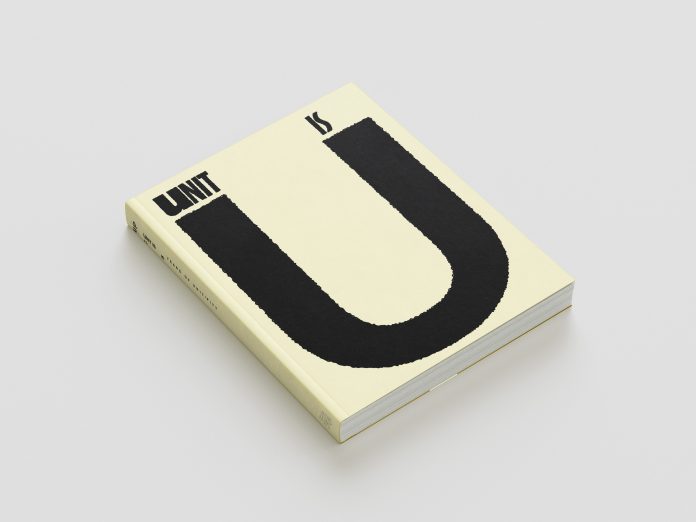
On November 7, it celebrated that legacy of creative resistance with 50: Half a Century of UNIT/PITT and UNIT is U publication launch. This featured “live audio and visual interventions by Kaila Bhullar and Jefferson Alade, reimagining artist david-george extensive audio and video archive of the Pitt of the Past.” Meanwhile, the exhibition, running until February 2026, invites viewers to step back in time and explore their extensive archive, reigniting hope for overcoming today’s crises.

The accompanying 183-page publication, designed by SFU student and graphic designer Shafira Vidyamaharani, complements this unruly history, as a tactile testament of endurance. Lovingly edited by de Montreuil, Bosley, and archives project coordinator Kira Saragih, it asks, what does it mean to archive from the margins? 

Understanding the “importance of leftist organizations carrying leftist archives,” Bosley sees this undertaking with “a sense of responsibility to archive what hasn’t been documented.” As Saragih emphasized, “Archival practices, in their roots, can be quite colonial.” Instead, Unit is U reframes memory as a collective act. The process of unpacking the archives was not limited to sorting through papers, as Saragih elaborated: “Early in the project, I met with a lot of the folks that were involved with UNIT/PITT,” seeing them as “living archives” of the organization’s work and impact. 

The resulting publication is a vibrant collage of essays, timelines, and archival fragments that capture this sprawling and eclectic history. In various forms, the pieces explore Chris Wong’s reflections from HIV/AIDS activism in the 1990s, Dana Claxton’s First Ladies exhibition featuring Indigenous women artists, Jamie Ward’s stories curating music from mariachi bands to the Wrong Wave festivals, Brit Bachmann’s honest reflections on burnout, and more. 

In the next 50 years, Bosley wants to carry forward the unique idealism she sees at the heart of UNIT/PITT’s work. The goal is not simply to preserve history but forge new solidarities. As Saragih claimed, “real art isn’t what is displayed in the room, but the conversations that stem from it.” Bosley echoed this sentiment, calling on young artists to see themselves as part of a lineage. 

As art becomes essential to the collective’s survival, support UNIT/PITT by becoming a member. Visit the exhibit at their new space in Kitsilano, and absorb its rich history of resistance and solidarity.


Need to know, need to go: What’s on in November

0
IMAGE: Ramakanth Chilekampalli / Pexels

By: Rachael Quak, SFU student

The Eastside Culture Crawl

Various locations, Vancouver

Thursday, November 20–Sunday, November 23

Thursday, November 20, and Friday, November 21, 5:00–10:00 p.m.

Saturday, November 22, and Sunday, November 23, 11:00 a.m.–6:00 p.m.

Cost: Most events free

The Crawl returns to Vancouver’s Eastside for its 29th year, boasting over 500 artists. Arts and crafts lovers of all kinds will enjoy getting to visit artists at home in their studios, working in mediums ranging from charcoal to silver, acrylic to film, and so much more. Roam between the studios on the crawl map for an immersive and inspiring experience with local artists!


Birds of a Feather: Winter Wings

Nature House at Stanley Park, Vancouver

Sunday, November 23, 9:30–11:00 a.m.

Cost: Standard $18, reduced price $12 for those with financial barriers

Even in the November cold and gloom, there is still plenty to look forward to this month for birdwatchers and outdoor enthusiasts. In fact, many cold season birds flock to the Greater Vancouver area at this time of year, as part of their migratory patterns, heading south from Alaska. This guided walk around Lost Lagoon in Stanley Park is a great opportunity to unwind, connect with nature, and learn more about these unique seasonal birds “filling our waters, forests, and skies with vibrant feathers and fun calls and quacks.”


Got Craft Holiday Market

Croatian Cultural Centre, Vancouver

Saturday, November 22, and Sunday, November 23, 10:00 a.m.–5:00 p.m.

Cost: $5 entry plus $0.71 in fees

Want to get gifts for your loved ones outside of the inescapable sales season by big retailers? ‘Tis the season to shop local and soak up some festive vibes at Got Craft’s holiday markets this weekend! Featuring 100 vendors, you’ll discover a huge variety of handmade goods, including clothes, skincare, accessories, and sweet treats. Check the market out and be sure to chat with the makers themselves too!


Sam Carter Applied Art + Design Polygon First Nations Art Exhibition

Roundhouse Arts & Recreation Centre, Vancouver

Tuesday, November 18–Tuesday, November 25

Monday to Friday 9:00 a.m.–9:00 p.m., Saturday and Sunday 9:00 a.m.–4:45 p.m.

Wednesday, November 19 and Tuesday, November 25 9:00 a.m.–1:00 p.m. 

Cost: Free

For one week only, this exhibition celebrates the awardees of the Polygon Award in First Nations Art: artists Rebecca Baker-Grenier, Gordon Dick, Kari Morgan, and Lawrence Paul Yuxweluptun Lets’lo:tseltun. They were selected for “their role in preserving traditional practices while embracing contemporary art.” Also being featured are the works of the Sam Carter Award in Art + Design awardees: Tyler James Goin, Russell Hackney, Bettina Mueller Reichl, and Mario Pao. Their works embrace both creativity and functionality in a striking combination, inventing fresh perspectives on how art can fit into our daily routines.

Hey kid, how do I get to the Lorne Davies Complex?

0
ILLUSTRATION: Yan Ting Leung / The Peak

By: Sasha Rubick, SFU Student

It’s 9 o’clock on a Saturday, cloudy, and campus is deserted. The commuter students fled home yesterday, and the Burnaby campus residents are hunkered down in their concrete boxes. I’m headed home to my dorm, veering left on the walkway. As I look up, I realize that every overhead light fixture has a spider on it. Yikes. Out of the shadows, a wild Gen Xer appears. He’s wearing a windbreaker and has the self-assured vibe of someone who bought a house when the cost of living was cheaper.

“Hey kid,” he says. He sounds like the median voter that politicians always talk about. “How do I get to the Lorne Davies complex?” 

I go into fight-or-flight immediately . . . and freeze. 

I’ve been at SFU for three years. I downloaded SFU Snap. I know this campus like the back of my hand. Directions, though — yeah, no. The only way to navigate SFU Burnaby is to get lost 30 times during your first semester. 

But this poor 50-year-old retiree is asking for help, so I’ll have to do my best. 

“You’re going to want to write this down,” I warn.

“Here’s the deal. SFU is renting out space to the ‘Kill Everyone With Fire and Death and Knives’ conference tonight because we’re a little too short on funds to be discerning. Instead of going through the AQ, you’re going to go through Saywell. The second that you go up the stairs to Saywell, you’ll be hit with a wave of disappointment so intense that you’ll question if you’ve just received an F on a midterm. Yes, you. Yes, I understand you’re not a student — UGH, just follow along, will ‘ya? Then you’re going to turn . . .”

It takes me half a minute to remember left from right, even when I make L’s with my thumbs and index fingers. 

“Turn right, out of the first door you see, and then make another right. You’re going to keep going straight until you see two things. On your right, there will be a pack of first years in knockoff Stüssy hoodies. They’ll be drinking beers on the roof of the RCB. On your left, there are three hooded members of the Revolutionary Communist Party (RCP) wheatpasting posters onto the wall. Right, RCB; left, RCP. Got it?

“That’s where you’ll turn left. On the fifth step or so, a trapdoor will kick out under your feet, and you’ll fall into a glowing portal. You’ll rematerialize in the depths of the Shrum Science Center, which is like a liminal space. Ignore the shelf of taxidermied birds. Once you reach the standee for The Peak with newspapers from 2015, you’ll know you’re in the right place.

“If you wait there for a couple minutes, one of the only security guards on campus should be patrolling the Shrum Science Center at about that time. He’ll bring you to Lorne Davies from there — you might even be able to make it to your daughter’s volleyball game. Did you catch all that?”

The man shakes his head, looking healthily traumatized and slightly impressed that I knew about his daughter. (Of course I know her. We got lost in the underground tunnels on the way to BPK 110 in first year. It took twelve packs of Hubba Bubba and a rubber chicken to escape).

“Shoot,” I say. “It might be faster for me to walk you there.”

Horoscopes are back

0

By: Katie Walkley, Peak Associate

Aries (March 21April 19)

Go lay in grandma’s lap, tough guy. You deserve it. If you don’t have a grandma, any scruffy-looking dog will do. It’s gotta be scruffy, though. 

Taurus (April 20May 20)

Stars are aligning in a way that hasn’t happened in 2 million years. With this new luck on your side, try a backflip . . . you may end up in the hospital, but . . . wait a second . . . is that a vision of Pedro Pascal doing your X-rays?

Gemini (May 21June 21)

Your sign makes you a strong, powerful person. However, this week, you have to ignore all that. Hone in on all your twisted subconscious thoughts and make a salad. 

Cancer (June 22July 22)

Don’t leave the house. I hate to be the one to break it to you, but it doesn’t look good for you. Sorry, babes. 

Leo (July 23August 22)

The cancers in your life may be avoiding you by staying inside their homes. What a bunch of weirdos, right? Take this as an opportunity to confess your undying love for them that will last whether they are perpetually inside OR outside. 

Virgo (August 23September 22)

As you take on new projects this week, you must learn that you cannot control everything. Start teaching jazz. And if you don’t know how to play the trumpet, just blow, baby.

Libra (September 23October 23)

You are the master of looking at all sides, but your disarrayed spirit is unbalancing the stock market. Get your money out of the stock now and open a penny arcade.

Scorpio (October 24November 21)

This week, if your bangs naturally drift to the side, don’t straighten them out. The shortening days are awakening your emo vampire powers and only your flawless side bangs can make the time we must wait for the sun more bearable.

Sagittarius (November 22December 21)

When’s the last time you thought of your feet? Got you! It’s time to show your feet some TLC, girlypop. 

Capricorn (December 22January 19)

A moment’s rest is on its way to you. When you feel it, shake that powerful finger of yours and bellow from the bottom of your gut, “Not yet!”

Aquarius (January 20February 18)

Get out the red thread. It’s time to look into the conspiracies you’ve been avoiding investigating. First order of business: don’t trust the moon; it might just be a round cloud.

Pisces (February 19March 20)

This Monday, you may be feeling a calling to put things off until the end of the week . . . wait ‘till Friday to see if that’s a good idea.

Reimagining Shakespeare: The campus is but a stage

0
EDIT: Gudrun Wai-Gunnarsson / The Peak

By: Zainab Salam, Opinions Editor

Jess: a fourth-year student, burdened by ambition and Wi-Fi issues.

Advisor: a keeper of bureaucratic riddles, and a destroyer of hopes and dreams.

Professor: philosopher, lecturer, and a veteran of many, endless faculty meetings. 

Barista: servant to the gods of caffeine and despair.

Student 1: group project hero in theory, ghost in practice. 

Student 2: master of excuses, chronic vanisher when deadlines draw near.

Weather: omnipresent, dramatic, and really a main character in its own right.


ACT 378

Scene I  

Fog blankets the concrete halls. Students wander, pale and sleepless. The wind whispers bad omens. Midterms approach. Enter Jess, dressed in a super puff, hunched beneath a broken umbrella, clutching a binder swollen with rain and regret. Jess heads towards the academic advising office. She takes a seat in the waiting room. 

JESS (raising her phone to the heavens): I have awoken at dawn, taken the R5, walked through the foggy pathways, only to find that my Wi-Fi doth vanish at the very moment of the dreaded submission of mine own cursed assignment. The portal hath betrayed me! Nay, it mocks me, spinning its cursed wheel of eternal loading! 

Enter the advisor into the small room. 

ADVISOR: Good morrow, pupil. Dost thou seek guidance, or merely to lament thy fate aloud more?

JESS: Kind oracle, I wish to drop ECON 302. The graphs taunteth me. The numbers sneer. My calculations mocketh me. 

ADVISOR: Alas, the deadline hath passed. You may appeal to the Board of Academic Sorrows, but they require three signatures, two tears, and a doctor’s note declaring existential fatigue. 

JESS: Then I am undone. 

The advisor exits, weighed down by policy and despair. 

Scene II

Renaissance Cafe. The line stretches into eternity. The air smells of espresso mingles with wafts of hopeless ambition. Students swarm by, clutching loyalty cards as if they were talismans. 

BARISTA: Step forth, good patron! What manner of brew shall please thee this day?

PROFESSOR: (enters, muttering lowly) I seek caffeine strong enough to revive the will to grade. Make it a double — nay, a triple.

BARISTA: One doth remortgage their nonexistent house for that. 

PROFESSOR: Aye, that would not be the first of such misfortunes; for in these latter days, the economy doth wither like a neglected houseplant. 

At a nearby table, students discuss their group project. No one has read the rubric. The tension could fuel a small reactor. 

STUDENT 1: Methought it was thine honour to present, good friend. 

STUDENT 2: Nay, I did believe the burden rested upon thy shoulders, fair friend. 

A silence heavier than the Burnaby Mountain’s fog descends. Outside, the rain intensifies, drumming against the windows with the persistence of unpaid tuition.

WEATHER (from beyond): Behold! I am the true protagonist of this tale! 

JESS (sipping her latte): Indeed thou art, sky. For even the sun feareth to climb Burnaby Mountain.

She glances at her phone — Canvas notification: “Grade posted.”

JESS: (Whispers) I shalln’t open it. Mighty flesh of mine, in the darkest night! Thy seductive flair shalln’t — I . . .  

ADVISOR enters the room. 

ADVISOR (chuckling menacingly): Jess, oh jess, where art thou chest? Have thy no guts? Or have thy no flames? I received word that you’ve received an F, so you shall stay in damnation at SFU for ten thousand more days.

JESS (crying to the ceiling): I begeth of thou, prithee! Spare my soul! Allow me to leaveth this cage — locked I am among the birds who die in this here glass. I am merely a student with a wandering past, and wander I shall ‘till the end of time, alone with my thoughts and Canvas notifications to keep me composed as twine! 

ADVISOR pulls out a staff and bangs it against the floor, opening it up. As asbestos surrounds Jess, she looks panicked. Weather watches anxiously. When the asbestos cloud arises, Jess is in a trance-like state and proceeds back to class. ADVISOR exits on stage left, holding a sign reading:“WELCOME TO SFU: WE WANT YOU TO STAY FOREVER.” 

FIN

Freshet News flows through community

0
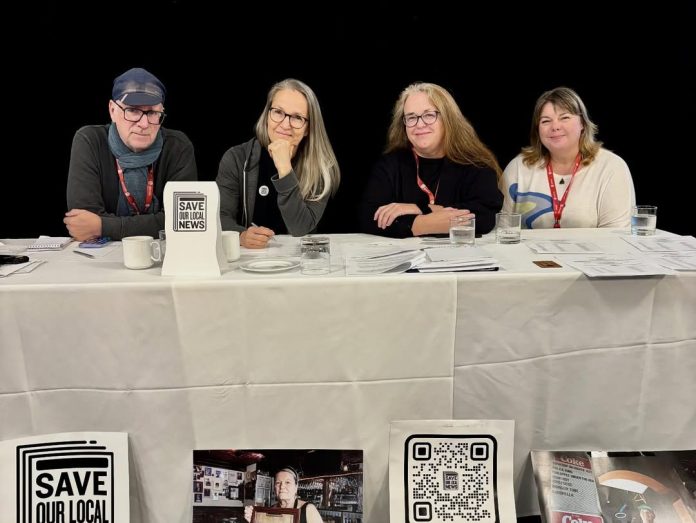
Four of Freshet’s founders sit at a long white table and smile for the camera. Their table has a small sign saying, “Save Our Local News.”
Courtesy of @saveourlocalnews / Instagram

By: Lucaiah Smith-Miodownik, News Writer

When snow begins to melt and gives way to spring, rivers in BC rise and rush in response. This high water phenomenon is known as a freshet. Now, in the Tri-Cities and surrounding areas, a new paper bears the same name. Similar to the turbulent nature of the river’s flow, Freshet News sees itself “as a disruptive force in the corporate media landscape, where quality local news has been all but abandoned.” The Peak spoke with Janis Cleugh, one of the publication’s founding members, to learn more about the local paper. 

Freshet News is the product of the Save Our Local News campaign, which launched on June 4 in response to parent company Glacier Media shuttering three local papers — Burnaby Now, New Westminster Record, and Tri-City News. From the campaign’s inception to Freshet News’ website launch, the founders have had “quite a journey,” Cleugh explained. “We’re learning about how to build a non-profit,” she added. “We’ve been fundraising and getting out into the community during the summer, and meeting people and hearing what they want, and largely it was they’re very much welcome to have the local news back.”

As a non-profit and worker-owned co-op, Freshet News draws funding through sponsors, advertisements, donations, and government grants. With this business model, “you don’t have to chase the numbers and satisfy the shareholders like we did in our previous employer,” Cleugh explained.

“We are responding to the community,” she added. “We’re writing stories that are meaningful, we’re spending time talking to people.”

 — Janis Cleugh, co-founder of Freshet News

Without pressure to chase “the high clicks,” Freshet News can focus on stories that the publication believes will mean the most to readers.

“We’re covering a lot of city hall, and arts, and sports,” Cleugh told The Peak. “We’re going big on events. People want to know what to do on the weekends and during the day [ . . . ] we have a pretty comprehensive directory that drops every day of things you can do in your community, Westminster, Burnaby, the Tri-Cities.”

In addition to her work as a reporter and editor, Cleugh serves as board treasurer. Alongside her are her three co-founders, Mario Bartel, Cornelia Naylor, and Theresa McManus. The four currently make up the Board of Directors and will look to onboard more community members soon. All four worked under Glacier Media at their respective publications until their sudden closures. “It was incredibly disappointing when our employer shut down [ . . . ] our news outlets, in April, in the middle of the federal election,” Cleugh said. “We hope to do better.

“We’re really honoured to be back working in the same communities as we were before, and we’re incredibly happy to reconnect with people after being laid off.”

Freshet News is currently working to bring their publication into print. Those interested in reading more can find the publication at freshetnews.ca.


Vancouver to require exempt staff in-office five days a week

0
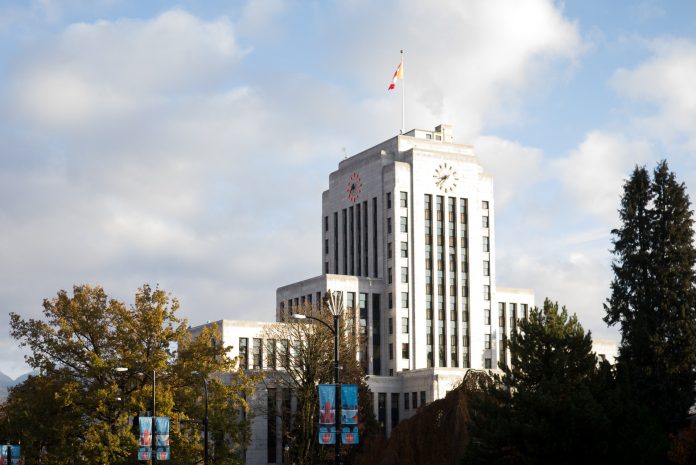
The outside of Vancouver City Hall is pictured on a bright day, with trees around it.
PHOTO: Thomas Roessler / Wikimedia Commons

By: Lucaiah Smith-Miodownik, News Writer

For Vancouver city employees, pyjama bottoms at work may no longer be feasible. 

CTV News reported that on October 21, workers received an email from city manager Donny van Dyk informing them that “effective January 1, 2026, all exempt staff will return to a city office site five days a week.” The same applies to non-unionized city workers. Exempt staff are not covered under the Employment Standards Act and are generally paid a salary rather than an hourly wage. 

Additionally, unionized city employees will be required to work “a minimum of three days in-office each week” come the new year. This announcement originally came in May, but delayed the change until next year due to a grievance filed by CUPE 15 “in connection with the notice and transition period,” reported the Vancouver Sun. CUPE 15 represents indoor Vancouver city workers. 

This order is a stark contrast to the onset of the COVID-19 pandemic, when Vancouver implemented the flexible work program, allowing employees “to work remotely between one to four days per week, depending on their department and position.”

Mayor Ken Sim “believes this approach will lead to greater efficiency and productive outcomes — particularly over the busy year ahead,” reported Daily Hive. A city spokesperson told Postmedia News that “the city has not observed a decline in productivity with hybrid work.” 

In an open letter to the City and Parks members, CUPE 15 highlighted “the toll this takes on families and work-life balance; challenges securing appropriate childcare and its cost; health concerns for many who will now have to crowd onto transit and into tight office spaces; climate impacts; as well as several other personal and practical implications, such as impacts to recruitment and retention.”

Some believe, however, that these consequences are by design. 

“The general feeling is that this is being done as a strategy to get rid of people,” 

 — Vancouver city employee

With the city “in cost-cutting mode ahead of the 2026 budget,” some see the in-office mandates as a “backdoor method” to “reduce the workforce.” One study reviewed such requirements in technology and finance firms and found this approach leads to “abnormally high employee turnover.” 

The City responded to concerns by stating, “We understand this is a significant change for some and that life requires flexibility. While the model may not suit everyone, we’re facing important challenges that require us to work together. ”

Regardless of whether Vancouver aims to make workers quit, some believe budget cuts are a near guarantee. The 2026 city budget includes a 0% property tax increase, a motion called for by Sim heading into a mayoral election year. Sim’s move comes despite reports from city staff “that maintaining existing service levels would require a roughly 7% property tax for next year, factoring in wage increase, inflation, and other factors,” reported the Vancouver Sun. Without money from a property tax increase, the budget will require “huge cuts to Vancouver’s public services,” said the Coalition of Progressive Electors through Instagram. In October, the Vancouver Sun reported that “some non-union employees have already been laid off in recent months, and potentially hundreds of additional job cuts could be ahead.” 

In a virtual all-staff meeting on October 16, van Dyk also explained that the City plans to seek out “incentives for departure from the organization,” and “would look at offering early retirement” as well. 


Bangladesh Students’ Alliance’s Shoroter Mela celebrates the fall spirit

0
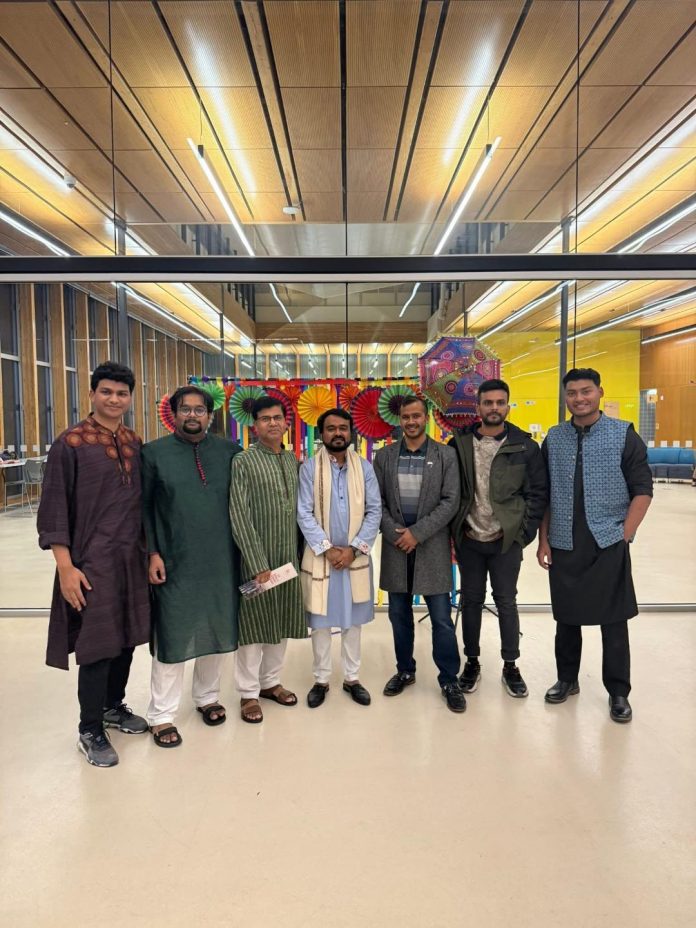
Seven men stand together and smile for the camera in traditional Bangladeshi attire in a brightly lit room with big windows.
PHOTO: Bangladesh Students' Alliance

By: Heidi Kwok, Staff Writer

On October 25, the SFU Bangladesh Students’ Alliance (BSA) celebrated the fall season with a Shoroter Mela event in the Student Union Building ballroom. In Bengali, Shoroter Mela translates to “autumn fair.” The cultural event featured traditional Bangladeshi street food, fair games, vendor stalls, live music, and performances. Attendees also came dressed in traditional attire.

In Bangladesh, both rural villages and cities alike host over 5,000 festive fairs or “melas” throughout the year. A Shoroter Mela, in particular, is a seasonal fair that’s held during Sharat, the autumn period that lasts between Bhadra and Ashvin (mid-August to mid-October). The Peak was unable to attend the event, but spoke with BSA vice-president Md Rownak Abtahee Diganta to learn more.

Diganta shared that during a meeting to plan future events, BSA members reflected on what they missed most from back home and decided on the mela. “We never had melas in Canada that much or that often, none of the [SFU] cultural student associations ever did that. So, we thought, you know what, let’s organize our own mela.”

The mela featured traditional Bangladeshi fair games like darts, Ludo (a popular board game), pen fight, Panch Guti, and other classics. “I thought, let’s remind all our people about their childhood so they can be a little nostalgic,” Diganta said. Attendees also had the opportunity to purchase a variety of traditional handmade arts and crafts created by vendors. A free Mehndi station was also on-site, decorating attendees with intricate pattern designs.

Diganta and BSA president Abrar Shahriar reached out to small, local food businesses to bring the event catering to life. To emulate the atmosphere of an outdoor mela, food vendors, including Gulshan’s Cuisine, Nimontron Bari, and Sharmin’s Kitchen, were recruited to serve popular traditional Bengali street foods. The mela featured delicious treats like Chop, Fuchka, Jhal Muri, Samucha, Biryani, and Pitha, a cake-like delicacy that’s both sweet and savoury, as well as Chotpoti, a spicy dish made with chickpea and potato.

The latter half of the evening featured a live music and singing segment. The night ended with an original BSA stage drama written and directed by Diganta that drew inspiration from Meena, a cartoon character from a UNICEF film series. Diganta told The Peak that Meena is beloved by children across South Asia, “so it’s really close to our heart.” He decided to bring Meena to Canada, dramatizing her life as a newcomer and a student at SFU. The drama was well-received by the audience.

Diganta said the BSA organized the event to cure homesickness, as attendees “can commemorate what they used to do back in the country.” He said these events are a “good way of gathering a lot of people,” so the event turns into a reunion, and bonds “become stronger because these events give us some good memories to share together.”

He also said he hopes that by attending a mela far from home, attendees will realize that

“Home is not made of bricks. Home is the people around you — home is the small moments or experiences to enjoy.”

— Md Rownak Abtahee Diganta, vice-president of the Bangladesh Students’ Alliance

“[I hope] they felt, for a little bit of a moment, they feel like they’re at home, enjoying with their loved ones.”


SFU’s contracted food service workers stage demonstration

0
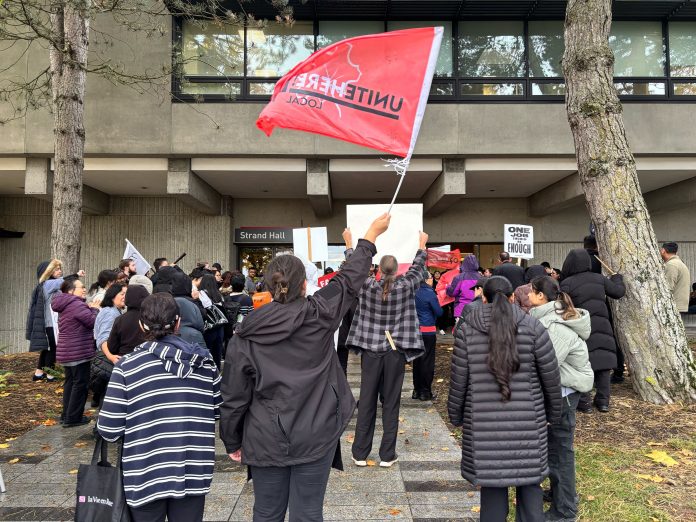
A crowd of people in jackets surrounds the entrance to a building, with the building’s sign being displayed near the entrance (“Strand Hall”). The person closest to the camera is waving a large red flag that says “UNITE HERE Local 40,” while others hold a few signs here and there as well. Another sign says, “ONE JOB SHOULD BE ENOUGH.”
PHOTO: Mason Mattu / The Peak

By: Mason Mattu, Section Editor 

On November 5, SFU’s contracted food service employees took their lunch break collectively to stage a demonstration, demanding a living wage and improved working conditions. Employees from Tim Hortons, Starbucks, Mackenzie Café, the Dining Commons, and catering participated, holding signs and banging drums as they walked around the perimeter of strand hall, SFU’s administrative building.

Workers delivered a letter asking SFU president Joy Johnson to meet with them on November 10 at 6:00 p.m. to hear their concerns. The workers’ union, UNITE HERE Local 40, said they are open to arranging another time with Johnson, for now just wanting to hear from her by Monday. 

They added that if they don’t hear back from Johnson or SFU by Monday at 6:00 p.m., they would initiate a full strike. “Today was just a strike action. An actual strike is pending,” said Preet Sangha, Local 40 union representative. 

On Friday, November 7, SFU stated that “the university has responded to their letter and declined their offer to meet. Terms and conditions of their employment, including rate of pay, are matters between employees and their employers.” They added, “It would not be appropriate for SFU leadership to discuss those matters, or to comment on ongoing collective bargaining between an SFU-contracted vendor and their employees.”  

In terms of the living wage, SFU stated “the university negotiates contracts with its service providers to ensure contract workers earn a living wage, based on living wages for Families BC’s rate at the time of negotiation. ”

SFU does not directly employ food service staff — they are employed by a third-party contractor, Chartwells (a sector of Compass). However, union representatives and community members have argued that the university has a responsibility as a living wage employer to either uphold their values and pay a living wage, or bring the food service employees in-house. Living Wage BC sets the living wage for Metro Vancouver at $27.05. At SFU Burnaby, the highest wage listed in Chartwells’ food service job postings at the time of publication is $23.58

Mitch Hoganson, a senior supervisor in the dining services and catering department who was present at the rally, told The Peak that although the contractor had offered to go to mediation with the workers, none of the proposals were in good faith.” 

“Our real fight is with SFU.” He added, “UVic, UBC, and even the government of BC have brought food service workers in-house.”

“SFU has the opportunity to do the right, ethical thing. They can showcase to the world that they are the university they claim to be, instead of being a university of hypocrisy.”

 — Mitch Hoganson, senior supervisor of dining services and catering 

“We want a living wage,” one striking worker said. “Some summers, we get laid off. December, we get laid off. The benefits are not good.” 

“When inflation continues to rise, people’s wages are standing at a standstill. How do people survive? How do people [take care of their] kids and families? How do people pay their bills? The majority of workers here probably have two to three jobs and barely sleep,” Felisha Perry, an individual in attendance, told The Peak. “So, yeah, I think [food service employees] frickin’ deserve a liveable wage! 100%.”  

In the case of a food services strike, SFU stated Chartwells “has contingency plans in place to ensure essential services can operate, such as reduced service for meal plan holders in Dining Commons.”