Home Blog Page 898

SFU alumni teach finance to millennials

0
Pictured: Irvin Ho (Left), Justin Lee (Centre), and Shun Lee (Right). - Photo courtesy of Business in Vancouver

Justin Lee, Irvin Ho, and Shun Lee, three SFU graduates, have made waves with Young Guys Finance, a website that educates young people through videos and workshops about personal finance. Back in 2014, the trio realized that most young people didn’t know how to manage their finances to maximize returns and thus took it as an opportunity to begin their venture.

In an interview with The Peak, the three spoke about their inspiration and approaches to teaching, and also gave some tips to students.

The Peak: What was the inspiration for your venture?

Shun: We noticed that there really weren’t any resources that were tailored to young Canadians like us. This was when we saw the opportunity to create something that could benefit people similar to us.

Irvin: We started to experiment with budgeting, apps to manage money, and investing. We also started to ask our peers about their knowledge on personal finance and the common answer was that they had no idea what they were doing.

P: What is the reaction that you have received so far?

Justin: It’s been really exciting. We’ve gotten positive messages from students and professionals from all backgrounds complementing our new approach to financial literacy.

Shun: One of my favorite quotes from one of our readers was “I love that your content is informative in a simple and concise way, and I appreciate the humor you smuggle in here and there.”

P: How has it been working with one another and how important is teamwork to you?

Shun: All of us have a slightly different background in terms of our own studies and profession. I enjoy my responsibility within the team because in the areas where I lack in-depth knowledge, Justin and Irvin are able to help fill the gap with their expertise.

Irvin: We have spent countless hours working on projects together, we are almost family at this point.

P: What approaches do you favor to educate millennials financially?

Shun: [Being] concise, yet informative. Very few millennials are willing to sit down and read through dozens of financial books to learn how to start saving or investing.

Irvin: We aim to cut the crap and focus on what millennials need to learn.

P: What financial advice would you give to students?

Justin: Always ask for student discounts. Worst case, they say ‘no’, best case, you get a small discount for something. I would suggest paying off student debts before investing. Debt will cripple your net worth.

Shun: It’s time in the market, not timing the market. Make sure you start investing money early to give it time to grow.

Irvin: All your monthly expenses can and should go through a credit card. If you’re spending on these expenses, why not consolidate your spending, why not earn some cash-back or rewards on the side, and why not start building your credit score now?

P: What would you say are the top 3 skills behind successfully managing finances?

Justin, Shun, & Irvin:

1. Being persistent and sticking to your investing plan, rather than chase the highs and lows of the stock market.

2. Being honest with yourself and spending within your means.

3. Investing in a portfolio where you can set it and forget it.

Why I only buy public liquor

0

[dropcap]E[/dropcap]verything we do is political. The books we read, the news we watch, the food we eat, and yes, where we buy our cheap six-packs.

Recently, I have had this conversation a lot. And every time I do, I’m always taken aback when people tell me they’ve never really put too much thought into where they buy their drinks, food, and the like. I’m surprised by this because of how important it is to be conscious of the politics behind how we spend our money.

I buy my alcohol only from BC public liquor stores for three main reasons.

The first is right there in the store’s name: it’s public. This means the money I spend there will be returned to me via stronger public services, like healthcare and education. For me, this is a huge deal. A government can, and should, have extensive and stable public services — but they need funding to do that, and this is one way the state can collect that money.

The second is due to the kind of workplace that public stores create, that private stores don’t. Employees work better hours, and for better wages. They are all unionized and receive much better benefits than the minimum-wage employees at private stores. Frankly, I don’t care if I pay an extra $1 each time I buy some Growers, so long as the workers are being treated well and are making a fair wage.

The third is largely tied to deregulation. It’s no secret that if you privatize a service or a commodity, you risk facilitating a more lax approach to regulation of said service. To keep liquor in the hands of the state keeps regulation strong and transparent.

So there they are: my reasons for purchasing only public liquor. Like them or not, they are an extension of my values. These values are a part of me, and I believe that it’s important to uphold them. That’s why I try to be politically conscious of where and how I spend my money.

Similarly, we send a message every time we buy local. All too often we try to hide from politics, claiming that it doesn’t really affect us. But we are lying to ourselves every time we say that, and frankly, we aren’t doing ourselves any favors by denying the importance of political consciousness.

Where you buy your liquor is just the tip of the iceberg. Life is political, and we should strive to be more aware of how our actions, or purchases, ripple out. There is no shame in acknowledging the deep political roots in our society, and making changes in your life to better reflect your values.

New incentive to recruit Aboriginal professors sees first hire

1
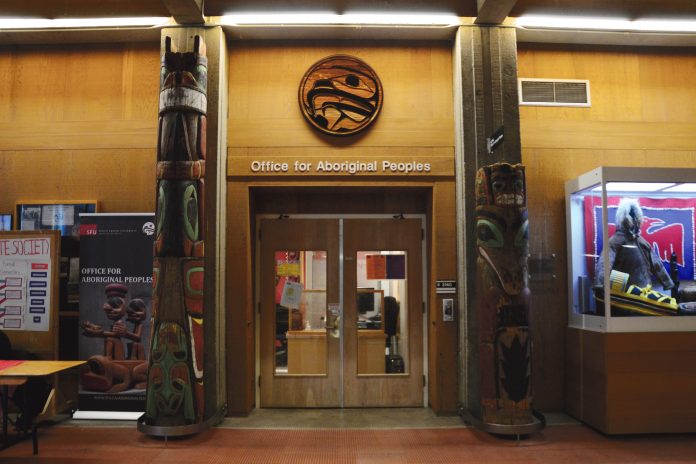
The initiative is affiliated with the Office for Aboriginal Peoples, pictured above.

The first indigenous professor to be recruited under SFU’s Aboriginal Faculty Recruitment Plan was hired in the Department of Education last month.

The plan, unrolled by the VP Academic office two years ago, will fund the creation of up to two new Aboriginal faculty positions each year. When a position is filled, the office then pays for three years of salary and benefits, after which the faculty is required to continue to support the professor.

“This is a way of trying to increase the number of Aboriginal faculty in the university, but it’s not the only way we recruit Aboriginal people,” explained VP Academic Jon Driver.

However, the new assistant professor hired in education has chosen to remain anonymous in the wake of their appointment.

“[They’re] sensitive about being identified [as] having been recruited in that particular way,” confirmed Driver.

“Even though this is not the intention, whenever you have a program [where] you’re trying to incentivize people to bring in underrepresented groups there’s always the concern that someone could get a job not because they are the most qualified person but because of some aspect of who they are.

Driver stressed, however, that the same commonplace standards of rigour are upheld when faculty are hired under the recruitment program.

“I’m confident that when we do the hiring that we get very good people,” he said.

The program has also sparked the creation of four other positions since 2014 for Aboriginal hires in business, health sciences, communications, and environment. Unlike in the Education department, searches to fill these new positions have to date turned up empty handed.

According to Director of the Office for Aboriginal Peoples William Lindsay, these failures are in part due to the limited number of Aboriginal academics available at SFU.

“We do have some areas that are strong in Aboriginal faculty; those are Education, First Nation Studies, and Health Sciences,” said Lindsay. “But in the other faculties there is little to no Aboriginal faculty representation.”

The initiative is also coupled with a scholarship program for indigenous graduate students to help them complete their degrees and go on to obtain their doctorate.

The monetary support for the recruitment plan is derived from the VP Academic’s strategic initiative fund allocated for such projects. Driver says that the program costs the university between $90,000–$100,000 per Aboriginal faculty member each year, as most new hires are brought on board as assistant professors.

Lindsay emphasised that it is important to increase the number of aboriginal academics at SFU in order to indigenize curriculums, attract Aboriginal grad students, and encourage Aboriginal research and community partnerships.

“It could make a substantive difference for SFU in the eyes of the Aboriginal community,” he noted. “[SFU’s] getting known for being one of the major universities that is welcoming Aboriginal people and initiatives, so this can be one of SFU’s reputation projects.”

Despite the limited success since the program was enacted in 2014, Driver insists that the long-term project will be successful.

“I think we need to continue the program until we see an increase in the number of Aboriginal faculty members at SFU,” he said.

Driver and Lindsay both acknowledge that some aspects of the program are ambiguous; namely, identifying a potential recruit as being an indigenous person. Thus far they agree that the candidates recently hired were clearly identifiable as Aboriginal, but they also noted the need to rely on a person’s self-declaration and their relations with Aboriginal communities in order to approve a person’s suitability for the positions.

“It’s not a completely clear cut definition, and I think if we were to see somebody who had very close ties to an Aboriginal community [including through research], we would be interested in recruiting them,” Driver explained. “I could imagine, for example, recruiting indigenous people from outside of this country for these positions for a more global perspective.”

However, the need to bring more Canadian Aboriginal people into the university is still a top priority.

“The intention [of the program] is to recruit people who would be clearly identified as Aboriginal in Canada,” he said.

Letter to the Editor

1

Dear editor,

Re: “SFU’s men’s rights activists protest new ‘friend zone’ bench unveiling”

The Hi-F.I.V.E Movement for Mental Health Executive Committee was disheartened by your “humour” article, dated November 9, 2015, regarding The Friendship Bench (the Bench).

We acknowledge that it is supposed to be entertaining, but we are nonetheless concerned that it damages our efforts to eliminate a stigma that has been so pervasive and unyielding. We believe your article actually perpetuates the stigma surrounding mental illness as early as the first sentence through the author’s tone and language, and by comparing the Bench to the undesirable “friend zone” (perhaps that undesirability is a not-so-subtle parallel?).

When the National College Health Assessment surveyed SFU students’ mental health in 2010 (the most recent data available), 83.6 per cent of students felt overwhelmed by all they had to do; 43.9 per cent felt things were hopeless; up to 11 per cent had seriously considered suicide; and almost two per cent had attempted to take their own lives. This is no laughing matter.

In fact, the Bench was donated to SFU by a man who lost his son to depression, and ultimately suicide. He generously donated the $5,000 Bench and a year’s worth of mental health resources to help raise awareness and prevent future tragedies. The idea of him and his invaluable work becoming associated with the article in question is, frankly, mortifying, which is why we decided to exclude his name.

This piece was published a mere two weeks after the Bench was permanently installed and recognized as a permanent symbol of mental health, as well as SFU’s commitment to a stigma-free community. Considering how new the Bench was at the time of your article it is more than likely that many of your readers did not have an opportunity to appreciate the significance of the Bench, instead forming an impression based on your satire, or dismissing it altogether. This is a tragedy in itself and hard to undo.

Since The Peak is unwilling to remove the content from its archives, we can only hope that its availability does not discourage students in distress from seeking help or make them feel that this is in any way representative of SFU’s stance on mental health and illness.

The media are one of the most frequently identified sources of mental health information and journalists have the power to shape coverage of it — let’s work together to better understand and de-stigmatize it.

Sincerely,

Hi-F.I.V.E Movement for Mental Health,

2015-16 Executive  Committee

[The Peak could not confirm all the percentages in this letter]

Beedie lecturer opens vegetarian café

0
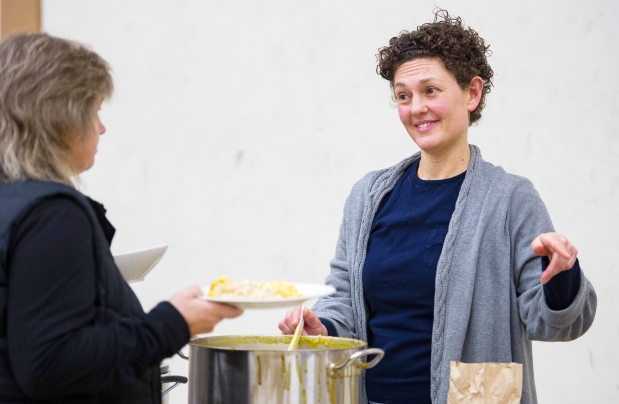
Lisa Papania (pictured) tries to to serve the greater community at her cafe. - Photo courtesy of The Vancouver Sun

An SFU Beedie School of Business lecturer is putting her money where her mouth is. Lisa Papania has opened a new vegetarian restaurant as the culmination of the courses she has been teaching for the past decade.

Papania is the founder of Lupii Café, which focuses on serving up sustainable, vegetarian options, with a menu that revolves around ingredients gathered daily. Overloaded stock or spare food from local farms and markets are sourced to make the dishes at Lupii, without waste becoming an issue.

Lupii Café is also a home for many community activities such as monthly community dinners, drop-ins for parents, a homework help club, and movie nights, all of which facilitate a fun atmosphere that anyone can enjoy.

Dr. Papania said that her background was essential in the creation of the café. “All of the courses I have taught for the last 10 years have been around social and environmental responsibility,” she said. “All of the courses I taught have been around understanding what happens to food waste.”

She noted that a major reason she created the café was to offer a space where people could meet each other and where new ideas could be adapted into actions that would benefit the community.

To that end, a lot of the projects going on under the café’s roof are focused around the people it serves.

“We have [a] community dinner which happens once per month. People can meet each other and form social networks. We get involved in community projects, like charity,” said Dr. Papania.

The café has also started a new initiative called “The Lupii Box,” a weekly delivery service. Fruits, vegetables, soups, and preserves can all be delivered to your door, helping to minimize the café’s waste.

According to Dr. Papania, 40 per cent of all food produced and distributed along the chain is wasted. While dumpster diving — the act of reclaiming food from the trash — has become a popular trend lately, The Lupii Box aims to eliminate that middle step and ensure that good food is reaching people who want to eat it.

Now that Lupii Café is up and running, it is going to focus on existing projects — like the Lupii Box and the community dinners — as well as remain open to the possibility of new, upcoming events.

Said Papania, “If people start getting connected, they will take more responsibility for what happens beyond themselves.”

Woohoo, Boohoo

0

Woohoo: Hershey’s Kisses

First sold in 1907 by North America’s biggest chocolate company, I present to all of you the most deliciously infectious confection ever put on the chocolate conveyor belt: the Hershey’s Kiss. Wrapped in an eye-catching array of multicolored tin foils, these pint-size goodies are nothing short of a gift from the universe; a true testament that most beautiful things can indeed be found in the smallest of places.

These delectable and voluptuous flat-bottom treats are what dreams and desire are made of. With over 60 different flavours to choose from, it truly is a treat suited for everyone’s palate. Poignantly simple and less calorically intimidating than a deep-fried stick of butter, its teardrop-shaped body is something truly worth crying about.

Boohoo: Actual kisses

Admit it: the kiss is probably the most confusing if not utterly befuddling method of showing affection next to being forced to make a Build-A-Bear for your ex. Whose idea was it to stick their tongue down the throat of their significant other and play a period of tonsil hockey? At least a hug makes sense! With a hug you can steal warmth or feel the invigorating contours of your lover’s chesticular cavity and areolas.

A smooch is just well-choreographed slobbering given the Hollywood makeover. It’s an utterly ridiculous display of affection that is probably the reason we need flu shots and therapy. If you want my opinion, we should just scrap this archaic spectacle of sucking face for something more proficient and germ-free: handjobs.

I am committed to not committing

0

[dropcap]W[/dropcap]e’ve got Jeremih cranked as loud as our petty laptop speakers will go, and we shout, “commit to not committing!” and high-five each other a little too hard.

We’re half-kidding. After all, it has a ring to it and we’re fueled up on angst and desire. But there is a point to it — a truth value that isn’t as bad as it may sound.

When I say commit to not committing, I’m not advocating for hook-up culture. I’m not saying skip all your classes, quit your job because you don’t like getting up early, and hang out in your bedroom avoiding responsibility. I’m not suggesting you shouldn’t enter a relationship, or that the commitment of a relationship is anything that should be toyed with.

Rather, I mean that you have every right to stop answering people when they ask you where you’ll be in two years. You have every right to stay single despite the questions regarding your relationship status at every family gathering. You can transfer universities, you can switch jobs, you can move out of your parent’s house, and you can move to a different country.

And more importantly, when you do, you are under no obligation to put your life under a time-frame for the benefit of other people’s knowledge. Essentially, we’re upwards of 20 years old, and there is no requirement stating we have to commit to some kind of life plan right now — if anything, we can commit to the impermanence of our situations, and embrace our ever-changing lives.

There is no requirement stating we have to commit to some kind of life plan right now.

‘Not committing’ has nothing to do with avoiding responsibility, and everything to do with embracing flexibility. We in our twenties are living out some of the most flexible times of our lives, and it’s important to accept the possibility that there are things in our lives that hold us back, and despite our commitment to them, it may be time to walk away.

Young adults are terrified of commitment. We avoid it like the plague, and often try to cover it up with a half-hearted joke. In one of the several communications courses I took, we learned about methods of persuasion — that people feel uneasy about backing out of a purchase if there was some level of commitment involved. School life and career choices are no different.

There is a time and place for commitment. But I think we need to be careful with what we choose to commit to in our twenties, and more than that, I think there needs to be an understanding of the importance of walking away. I don’t want to end up pursuing a career because I felt obligated by a commitment I made to my parents or friends. I don’t want to end up maintaining an unhealthy relationship because I’m too afraid to walk away.

We can be flexible right now. Completely. I don’t think it’s something to be wasted. That’s what I mean when I refer to not committing, but it’s a whole lot easier to just high-five your roommate and toast your wine glasses to being “committed to not committing” than it is to try and explain it. And a lot more fun.

Satellite Signals

0

WEB-woodwardWoodwards & Surrey (prepare for trouble, make it double)

Have you been thinking about becoming a NOW student (Nights or Weekends) at SFU? These courses are ideal for those who are looking to be students while working a steady job during the week, and info sessions are taking place at both Vancouver and Surrey campuses next week.

On January 19, a session will take place at the Harbour Centre. Two days later, a similar session will take place at Surrey. Both events start at 6 p.m.

Surrey surrey

If you’re looking to make your time at SFU Surrey a little more exciting — or if you missed your chance up on Burnaby Mountain — Club Days are happening this week down at the Surrey Mezzanine on both January 18 and 19!

Pop on by from 10 a.m. to 4 p.m. on either day to see if you can’t find a new fit for you for the upcoming year.


vancouverHarbour Centre

On January 23, there will be a free public forum discussing the vanishing cultural heritage of Iraq and Syria. On top of learning about the countries and their current situations, there will be a brief history of the Middle East as well as a couple of visual presentations about Iraq and Syria.

This event will begin at 1:30 p.m. in the 1900 room at Harbour Centre. It is free and open to all adults, but participants are encouraged to register online ahead of time.

Seeing colour isn’t the problem. Racism is.

2

[dropcap]W[/dropcap]hen I was in the eighth grade, I read The Giver. The novel was centred around a 12-year-old boy who lived in a society that could only see black and white, devoid of all emotion, passion, and colour. I remember thinking that the world he lived in seemed so cold. They eliminated the concept of colour in the name of equality. ​

At the time, I thought that kind of ‘colour blind’ mentality only existed in the world of fiction. But shortly after I immigrated to Canada, I discovered that racism in this country is often met with the same oversimplified, cold approach to eliminating systemic discrimination. Unfortunately, race issues are often plagued by ignorance and oppression. Claiming that you don’t see colour or that society shouldn’t see colour only hurts those who have experienced racism firsthand.

‘Colour blindness’ in itself denies those who have faced discrimination the ability to share their stories. When I realized this, that novel I read in high school suddenly seemed much more real than it did before.

Sentiments such as “I don’t see colour” or better yet,  “all people are the same to me” are the foundations of this approach. This viewpoint may seem to be about equality on the surface — it is, after all, principled on the idea that we should all be treated the same. However, being colour blind as a response to racism actually negates the diversity of experiences among individuals, and only perpetuates racist ideas.

To put it simply, seeing colour isn’t racist, but seeing one colour as being superior or preferable to another is racist.

Disguised under the premise of fairness, colour blindness only sweeps the issue of racism under the rug.

The colour blindness argument, in a way, distorts the definition of racism. This idea has been elaborated by many, but E.J.R. David, an American journalist and professor at the University of Alaska, sums it up the most eloquently, “pretending or choosing to not see color [sic] will not solve racism; colorblindness will just ignore racism and maintain it.”

Disguised under the premise of fairness, colour blindness only sweeps the issue of racism under the rug, leaving those who are affected by it more frustrated, angry, and oppressed than ever.

At the age of 15, I immigrated to Canada with my family. I was born in the Philippines but spent my entire childhood growing up in Hong Kong. When I first registered for high school here, I was told that I would have to take an English test, since I had moved to Canada from another country. Even though I told the secretary that English was my first language, as I had gone to an international school with a Canadian curriculum in Hong Kong, she still insisted that I had to take the test in compliance with school procedure.

The test had one question that had to be answered in paragraph form. I quickly filled up two pages with my answer and shocked the teacher when I asked her for more paper. And her shock at what I was capable of stuck with me.

As my time spent living in Canada has gone by, I have had many conversations centred around where I lived before Canada, and over the years I have received many comments like, “oh, you moved from Hong Kong? But your English is so good. I thought you had grown up here!” or “you have no accent whatsoever — I had no idea you had moved here from another country!” Making comments about one’s accent, and the lack thereof, is discriminatory.

I watched my parents struggle to find employment. My dad, who had over 30 years of accounting experience, did not have his credentials recognized here because they were obtained in the Philippines. I remember him looking through a catalogue of classes offered by the Burnaby School District for Continuing Studies, and considering whether he should take an “Accent Reduction” course to increase his chances of employment.

We were judged, often incorrectly, based on our immigrant status.

These were a few of the experiences my family lived through. We were judged, often incorrectly, based on our immigrant status. While Canadian society had guidelines in place for newcomers to Canada, these guidelines certainly don’t apply for every immigrant. The disparities in this system were evident even within the experiences of different members of my own family.

Even though Canada prides itself on being an accepting and diverse country, these subtle nudges to assimilate into Western society are very much still there.

My family’s story is only one of many examples of how race is only one aspect of a multitude of life experiences. Even if a group of people come from the same country, they live through different events, have a variety of backgrounds, and have many components to their identity — and while their culture is certainly part of that, it doesn’t tell their whole story. 

Instead of being colour blind, we should act as allies to marginalized groups, and give them the opportunity to tell their stories. The issue of race is complex — comprised of the intersections of culture, background, and lived experiences. Colour blindness is nothing but an oversimplified, unproductive approach to racism in Canada. No one is colour blind — we should acknowledge colour and appreciate the diversity it creates.


Classroom cussing reflects reality, plain and simple

0

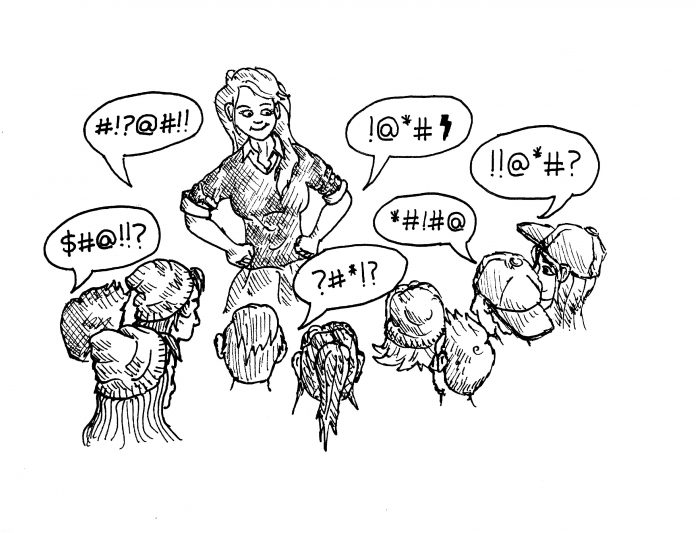
[dropcap]S[/dropcap]hould professors be allowed to drop F-bombs in lecture? For years, Dr. Michael Persinger’s first-year psychology course at Laurentian University has included a disclaimer form on the first day of class that warns students of the use of foul language. To me, this is ideal.

However, the school recently removed Persinger from his teaching position for administering these “Statement of Understanding” forms. The document informed students of a list of nearly 30 potentially offensive words that they would encounter in the course, including homophobic and sexual slurs as well as vulgar and obscene language. The document suggests that if a student feels uncomfortable, they can feel free to transfer to a different section.

Following complaints from students, university administration decided to remove Persinger, not because of his use of obscene language, but on the grounds that faculty may not have students sign a waiver form as a component of the class. Persinger stated that he began distributing these forms over 10 years ago after the dean at the time suggested it due to the student complaints.

What a catch-22. It’s difficult to see what the decision to remove Persinger achieves. The student union says that the form is not a contract, and according to CBC News, Persinger would not have forced any student to leave the class if they did not sign it. It is merely an engaging way to ensure students are aware of what follows in the class.

This decision seems to echo a common trend throughout Canadian universities as of late — that students are being needlessly sheltered.

Our universities are not building the minds of our students by restricting content that may shock them.

Why does this waiver suddenly justify the removal of a popular professor? It suggests that Persinger would have been better off if he simply conducted the course with no prior warning to students of the potentially offensive course content.

Honestly, if a student doesn’t agree with the waiver or the proposed course content, then they can switch to another section. That was the original purpose behind having a waiver.

Students should attend university to have their beliefs challenged and to be exposed to real-world content such as offensive language. Our universities are not building the minds of our students by restricting content that may shock them.

In the real world, there are no options to stifle offensive content. When we inevitably find ourselves confronting bigots and foul-mouthed individuals, how then will we react?

Persinger intended to make students think about why certain language makes us feel the way we do. By introducing them to this content early, students would be better equipped to think rationally when faced with offensive material.

This was undoubtedly a poor decision by the university administration. Sure, they may have enforced a redundant rule regarding students signing non-legally binding and unnecessary contracts, but at what cost? Now, they find themselves in the spotlight of criticism regarding speech and academic freedoms. The students who wished to take this class with Persinger now find themselves without an informative course that introduced them to real-world language.

Ultimately, it is the student’s decision to take whichever courses they’re interested in, and I’d be ashamed of SFU if it were to take similar actions toward its professors.