[dropcap]T[/dropcap]hree waves of feminism later, women are still fighting for equality in today’s society. “Unpaid emotional labour is being hailed as the next feminist frontier,” writes Leah McLaren for The Globe and Mail. She, herself, has been downtrodden with extra tasks that no one has specifically asked her to do, but must be completed nonetheless in order to maintain a functioning household.
What is emotional labour, you ask? It includes all the extra hours of buying birthday gifts, soothing fussy toddlers, preparing for social engagements and, overall, maintaining the emotional well-being of the entire family. These tasks are leaving many women feeling resentful and overburdened, arguing that because this work is unpaid and essentially unrecognized in capitalist society, it renders women as dependent on men, thus facilitating an unequal division of labour.
Although it isn’t always the case that women exclusively provide these foundations, they’re seen as inherently feminine, and are devalued as real work in our society, which ultimately suppresses these ‘labourers.’
Once regarded as working the double shift, women have been caught in this struggle for generations, as they are expected to work full-time — cooking, cleaning, and raising the children. Unequal distribution of housework was a hot topic in the ‘60s, spurring ideas to adopt a Marxist view: one solution, for instance, was to compare housework to paid jobs such as a nanny, gardener, chef, and domestic servant, and to provide similar compensation.
This idea did not catch on then and I don’t think it’s going to catch on even today. So what’s a feminist to do?
Here’s a novel idea: why don’t we stop devaluing the feminine? This probably isn’t as easy as dropping a hot potato in our current society that has a predisposed paradigm that worships the masculine. However, if we start to respect feminine values, perhaps men would be less afraid of participating in them? How do we bring about this paradigm shift? I propose looking to Sweden, one of the most gender-equal countries in the world, for inspiration and influence.
Sweden’s official website states that “gender equality implies not only equal distribution between men and women in all domains of society. It is also about the qualitative aspects, ensuring that the knowledge and experience of both men and women are used to promote progress in all aspects of society.”
Since we elected a sympathetic prime minister who’s progressive with regards to women’s rights and is not scared of the ‘F’ word, why can’t we make a tangible change in our constitutional government? We could emulate Sweden and seek guidance from their functioning policies that are actively and concretely encouraging equality amongst genders.
With a change in politics comes a change in acceptance and ideals. Social media has already helped pave the way for feminism and other pressing social matters to progress. Policy will solidify and support these ideals that the public sphere has begun to identify with.
If men and women are both given ample opportunity in terms of education, paternity leave, in the workplace, politically, and economically, I believe emotional labour will no longer be devalued and will no longer be primarily the woman’s role.
Guess Again, Grandpa!is a brand new column by Rachel Wong. Each week Rachel argues against her grandfather’s perspectives, presenting insights into the differences between generations. Check back every week for new content!
[dropcap]O[/dropcap]ur grandparents have led extraordinary lives, and they always have amazing stories to tell to prove it. But sometimes, those ‘I remember when I was your age’ beginnings can push us to direct our attention elsewhere.
Our grandparents had attention spans much longer than we do today. In fact, the attention spans of millennials are now shorter than that of a goldfish, according to a 2015 study by Microsoft. For our grandparents, hard work has always been a driving factor behind anything they do, even if it’s not the most interesting. My grandpa hated cleaning the house, but when my grandma was busy, he would roll up his sleeves and begrudgingly do his part.
Despite his deep-rooted hate for dusting and window wiping, he did it out of love, and he got it done fast. Even with things he did love, like building model boats, he would start the job and keep at it. There were no such things as distractions; he took his time and put 110 percent in. Our grandparents didn’t chase after instant gratification, just completion and perfection.
But fast forward to now and it seems like we can’t get anything done. Our less-than-a-goldfish’s attention span is eight seconds. We only have the capacity to pay attention for eight seconds before we get distra — I wonder what my crush is up to?
My grandpa always shakes his head and wonders how I get anything done. How do you hand your homework in on time? How do you meet your deadlines?
Well Grandpa, sometimes I get by. I guess this ‘all about me’ culture isn’t really working out for us. We’re all about the ‘now’ — I need it now, I want it now. If results don’t come fast enough, then we get bored or just give up.
Take the task of cleaning the house: I’m sure many millennials would rather not lift a finger, let alone clean anything. Chances are we’ll begin dusting and suddenly find ourselves preoccupied with crafting the perfect tweet to describe our current predicament. And after finally sending the tweet and scrolling through our timelines (again), we’ll decide to clean up our acts (no pun intended) and get back to work.
Repeat this 50 times, and what is supposed to be a 30-minute task has now been drawn out to two and a half hours.
But that’s just who we’ve become. Smartphones have heightened all of our senses, and the flickering lights and chimes of new messages make it impossible for us to tear our eyes away from glowing screens. I admit that when lectures get boring, the phone comes out to play. And even though I’ve creeped my crush’s Instagram profile five minutes ago, it doesn’t matter — I’ll do it again anyways.
ADHD has become a common diagnosis in our youth, but maybe this is a sign that we need to look up and pay more attention to the world around us. If anyone is still waiting for a zombie apocalypse, this might be it — but we’re too busy Snapchatting to notice. Grandpa, I’m happy to say that you would survive a zombie apocalypse; I wish I had your self-control.
You won this time, Grandpa. I’m a narcissist and can’t get anything done, but I’m trying. Maybe together, you can keep me accountable and help me build a bridge so that I can get over myself.
[dropcap]A[/dropcap] couple weeks ago, a good friend of mine relayed to me his “life motto.” It was only in passing, but it was profound: “be brief, be bright, be gone.”
These are words that I’ve been mulling over since then; so simple yet so powerful — and truthful. I’m glad that I heard them, and I’m relieved that such people exist who spread these ideas. Essentially, this formula for success doesn’t seek recognition, it doesn’t seek fame, nor power, it doesn’t seek to force a name for its own sake. The irony is that this motto defies all of the notions of power, fame, and ‘legacy’ that too many individuals see as the definers of achievement.
Which brings me to my main point: what is true legacy? If it isn’t defined by being recognized for doing great things, then what?
I’m cognizant of the fact that the word legacy means different things to different people — and is recognized predominantly as a something to aim for to prove one’s achievements. It’s a fluid term used to describe those who’ve accomplished great things; those who’ve passed down knowledge and ideals, who’ve influenced social values through their actions.
Personally, when I think of true legacy, I see figureheads such as Ghandi, Mother Theresa, and Martin Luther King — all of whom were true to their aims, left behind prominent ideologies toward life and human rights, and as such are recognized by their name. Sadly, I’ve lived around a large handful of people who seem caught up in the dramatic epicness of the “L” word, and who aim so desperately for recognition as a means to prove their success that the act of being recognized in itself becomes their prime motivator.
Forget legacy. It’s an empty, meaningless notion that will leave you miserable.
So, when does the term ‘legacy’ meld with notions of selfishness? More specifically, when does ‘legacy’ actually become selfishness? What’s interesting is that the above celebrities captured in human history who’ve left behind such great legacies are those who were not ever looking to be famous in the first place.
These prominent figures are known for their commitment, their honesty, their kindness, their sense of humility, and the fact that all of their endeavours came first and foremost.
I get it. They were celebrities. Many of us students want to be wildly successful. We want to do great things. We might long for our names to one day be just as recognizable. Though I will say that as soon as you strive to prove your worth for its own sake, you then taint the morals around achieving such recognition.
So, what is true legacy in my books? I’ll tell you. Legacy is a toxic fantasy. It’s a motivator for selfishness — it facilitates a hunger for power, it drives people to become obsessed with themselves rather than to focus on what their actual goals are; it causes a player to create a race for success that doesn’t even exist. Suddenly accomplishments aren’t so much about the aim, but how these accomplishments are perceived in the eyes of others. Suddenly, legacy becomes an exhausting and pointless crusade.
When we fuel our obsessions with leaving behind a legacy, we sadly lose sight of what’s truly important, the tasks to be accomplished for the greater good, whatever they may be. When we desperately try to capture our own legacy and to thrust our name into the spotlight, I’m sorry to say we will never achieve what we want in the end — at least not in the ways we strive to.
Forget legacy. It’s an empty, meaningless notion that will leave you even more miserable than you were at the beginning. Keep your head down, treat others with respect, stay positive, retain your humility, be honest and genuine, and focus on what’s truly important, and it probably won’t be long before any sort of ‘legacy’ follows you.
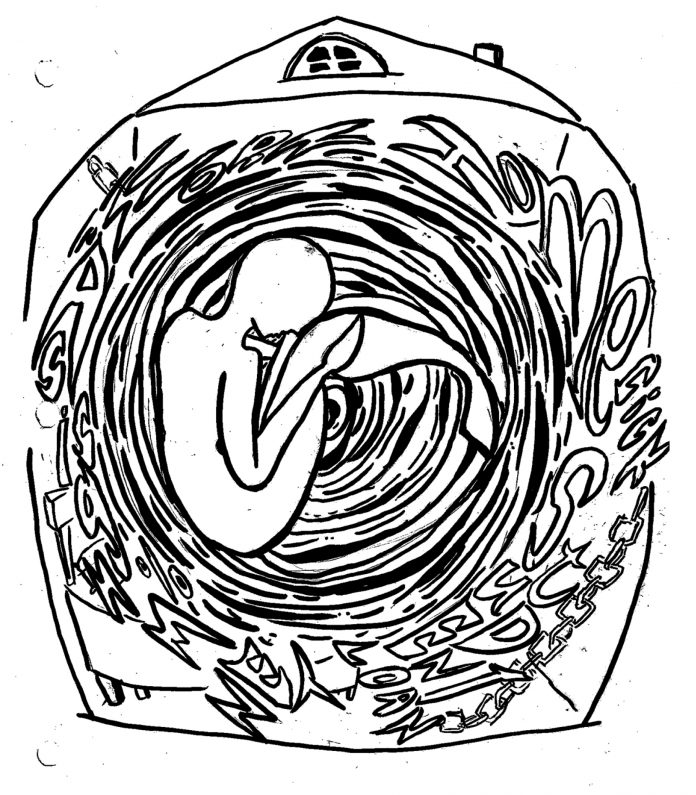
[dropcap]M[/dropcap]y story with mental health officially begins in my senior year of high school, when I was diagnosed with anxiety. My doctor discovered that my intestines were literally empty — I had stopped eating — and were digesting themselves because there wasn’t any food to digest instead. Given a prescription for therapy and antacids to combat the physical symptoms, I was sent on my way.
It took me six months to actually go to therapy. It was August, and I was leaving for my freshman year of university in three weeks. According to my therapist, I should’ve been having two appointments per week minimum. She gave me a list of therapists she knew in British Columbia, but therapists were the last thing I wanted to think about upon arriving here. I was in a new country attending a new school. I believed this fresh start would somehow magically reconfigure my brain chemistry and make me healthy. The opposite occurred.
Panic attacks happened two or three times a day, I couldn’t talk in class, and the idea of approaching TAs during office hours sounded like my worst nightmare. I was also becoming depressed. Mistakenly feeling unloved and unwanted, I broke up with my boyfriend, stopped texting friends from home, and became flakey with friends at university. I found every excuse to stay in my dorm on weekends.
To this day, I have not made an attempt to seek help from the Health and Counselling Center, nor have I contacted any of the therapists that were recommended to me. Considering the preceding three paragraphs, this may sound self-sabotaging. Let me explain.
Problem one: the irony surrounding anxiety is that it makes you too anxious to get help. The irony surrounding depression is that you’re certain nothing could help you. So, why even bother?
Problem two: my residence advisor warned it could take up to a month to get a consultation. To a depressed brain, that screams, “Why even try?”
Problem three: you’re allowed six appointments per term before the student health insurance stops covering them. I could gripe about this for all eternity. Why is there a limit on how much help the most vulnerable demographic can receive? I was worried I would ‘use up’ my appointments on trivial problems, and then be ‘SOL’ later if my problems worsened. I was supposed to have two appointments per week, not once every two weeks.
I do have a friend who sought help from the centre. The results were even more dissuading than my own doubts. My friend was told the centre “wasn’t taking appointments right now,” with no hint as to when she should return. She has since dropped all of her classes and moved home to focus on recovery.
Nothing is more anxiety-inducing than the idea of going to the front desk (you can’t make appointments online), confessing to needing help for something incredibly stigmatized, and being turned away. Admitting to needing help puts you in an incredibly vulnerable position, and this system of in-person admittance only exacerbates the feeling. Being turned down after working up the courage to ask for help is an indescribable nightmare.
The second friend was able to make an appointment, but was put on anti-depressants that didn’t work out for her in the end. According to her, she had to wait months before they changed her medication.
You don’t need to be mentally unstable to understand why this system is unappealing. For most students, especially international ones, the university’s health centre is the only option, for both financial and geographical reasons. Exploiting already miserable students by setting a cap on how much assistance they can have is inhumane.
It isn’t enough to offer the service; you have to be good at it, too.
The protest on January 23, drew hundred of protestors who gathered outside the Delta Burnaby Hotel, where the hearings took place. - Photo by Kevin Rey
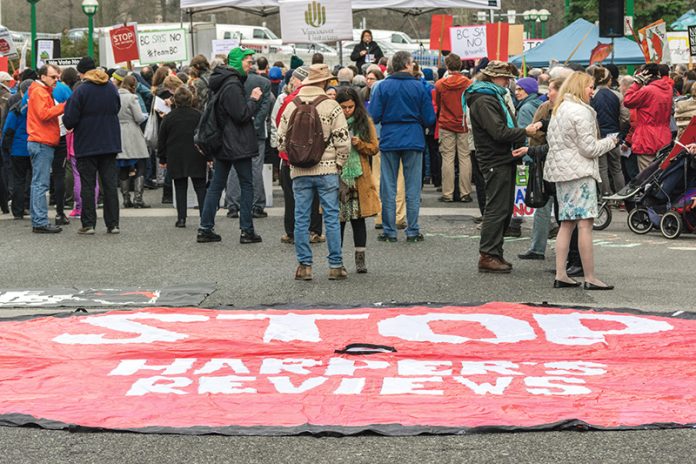
Three protesters, including two SFU students, were arrested during a sit-in of National Energy Board hearings for the proposed Trans Mountain pipeline expansion, on Jan. 22 in Burnaby. The protesters, SFU students Amy Widmer and Mia Nissen, as well as UBC student Destiny Sharp, were protesting the NEB approval process, among other issues.
These arrests follow the 100 that were made when protesters defied a court injunction to remove themselves from survey sites for the pipeline on Burnaby Mountain in November 2014.
The Peak sat down with Widmer and Sharp to talk about their experience when they tried to enter the hearing.
“Immediately, NEB employees stood up and put their hands on Mia, the third woman who was with us, and tried to physically move her,” Sharp said. Widmer added that RCMP and private security quickly formed a blockade to prevent them from moving forwards.
“After a while where they were asking us to leave, we just sat down [. . .] we were like ‘No, we’re not leaving, let’s make the point that we’re going to be here until you let us inside.’”
Security was tight but calm at the venue, with about two dozen police officers present on the sidelines and in the hotel. Widmer and Sharp had protested earlier that week by locking themselves the the National Energy Board offices, and Widmer said they saw a very different response.
“The two of us locked down to a building, to the front doors [. . .] there was no police response,” explained Widmer. “The police response was to come and say, ‘Hey you guys, you know you’re a fire hazard?’ And we said ‘yes’, and then they left us alone. Whereas when we tried to enter a public hearing we were arrested.” The three had charges of mischief laid against them, and have a court date scheduled for April 28.
The 10 days of hearings saw oral arguments from lawyers, Indigenous leaders, and environmental groups against the pipeline expansion. If the project goes through, it will cost $6.8 billion and enable the pipeline to transport 890,000 barrels of oil a day. The hearings were not open to the public, but the proceedings are available online.
Hundreds of pipeline protesters rallied outside the hearing room that Saturday. The rally included groups such as the Wilderness Committee, Dogwood Initiative, Burnaby Residents Opposed to Kinder Morgan Expansion (BROKE), along with other community and environmental groups opposed to the pipeline.
This included the Simon Fraser Student Society and Graduate Student Society, whose members presented oral arguments to the NEB on Friday and Saturday.
SFU professor Lynne Quarmby spoke to the crowd, responding to recent news that there would be additional requirements for the Trans Mountain pipeline to be approved. She explained that problems remain in the NEB process, including the lack of oral cross examination and that the scientific evidence has not been not peer-reviewed.
“We need to pressure our new government that yes, we are happy that you’re paying attention [. . .] but it needs to be done right,” said Quarmby. “We have at least three newly elected Liberal MPs that campaigned very strongly on the promise that this sham would not be continued. Pamela Goldsmith Jones, Jonathan Wilkinson, and Terry Beech [. . .] need to be held to account.”
Protestors gathered outside MP Terry Beech’s office on January 29.
This Friday, some Burnaby residents and activists did just that, gathering at Terry Beech’s constituency office. They delivered letters, reports, and a petition with over 6,000 signatures to the Burnaby North-Seymour MP, and presented him with a framed picture of his previous promises regarding the pipeline.
Speaking to the next steps, Quarmby had some advice for those who want to get involved.
“The more you can engage people, the more they will feel empowered. Empower your friends, empower your neighbours,” she said. “We still got a long way to go on this project, and this project is not the only one. It’s together that we have power.”
Widmer spoke to the power of taking direct action during a protest, saying that being arrested as a part of a protest is “not as big of a deal as everyone tells us it is. It’s not going to ruin my future.”
Her hope is that her story “will get to students in a way that makes them know that they are capable of doing it too, and that it’s not going to fuck anything up for them. It’s going to be fine.”
City of Vancouver & BC join SFSS in objection to pipeline
Two weeks ago, the province of British Columbia joined the City of Burnaby, the City of Vancouver, and other organizations that have officially stated their opposition to the pipeline.
They cited the lack of “information around its proposed spill prevention and response for the province to determine if it would use a world-leading spills [prevention] regime.”
Safety concerns, especially regarding emergency protocols if a fire were to break out at the Burnaby Mountain tank farm, have been among the primary concerns for Simon Fraser University groups like the Simon Fraser Student Society.
SFSS VP External Relations Kathleen Yang explained that SFU has been unable to develop emergency response plans because Kinder Morgan “failed to provide them with adequate risk assessment and emergency preparedness information.”
She also brought attention to previous Burnaby Fire Department reports that suggest that there is a “lack of safe firefighting positions” at the tank farm. Said Yang, “it’s likely that they’re just going to have to leave the fire to burn itself out,” which could put SFU at risk and trap students on campus for days.
Yang explained “[the SFSS is] against this project, not for ideological reasons, but just for the fact that we want to ensure the safety and wellbeing of SFU students, today and in the future.”
While SFU is an official intervenor in the National Energy Board process, they chose not to present oral arguments to the board. Said SFU President Andrew Petter at a January 28 Board of Governor’s meeting, “Sometimes it is helpful to have oral submissions, sometimes less so.”
He added, “It should not be read as a signal of us being any less concerned or determined to ensure that the health and safety concerns that have been the focus of our intervention are going to be pursued.”
Not only is Kinder Morgan facing criticism, but the NEB itself came under fire when an audit by the Commissioner of Environment and Sustainable Development found that “the Board did not adequately track company implementation of pipeline approval conditions, or consistently follow up on deficiencies in company compliance with regulatory requirements.”
The NEB responded to the audit with promises to address the recommendations made by 2016. Currently debate is ensuing not only over the Trans Mountain project but also the Energy East pipeline in Eastern Canada. The federal government has pledged to reform the pipeline review process.
Said Prime Minister Justin Trudeau in a speech in Montréal, “The responsibility of the federal government is to establish a clear process whereby people can evaluate the projects in a rigorous and open manner.”
[dropcap]C[/dropcap]anadian post-secondary students are literally hungry for their degrees.
While Food Banks Canada states that over 850,000 Canadians turn to food banks every month, impoverishment has influenced an upsurge in campus food bank usage across the country in recent years.
All students are entitled to three food vouchers valued at $25 a semester. The most recent statistics show that Simon Fraser University saw 872 food voucher requests in 2014 — an increase from the 75 reported semesterly users of the original food bank program in July 2013. This past fall, UBC saw the number of its food bank visits triple compared with the previous year, and a plethora of other universities are experiencing the same problem — a situation that The Canadian Federation of Students calls troubling.
Why the sudden epidemic? Ever-increasing tuition costs, lack of affordable housing, and low-income student jobs in combination with rising food prices and textbook costs are most likely to blame. To wield the life of a student in today’s post-secondary climate is not an easy task: a life riddled with financial strain, employment stress, school-related pressures, and social anxiety also often results in students who let their food needs fall to the wayside.
No student should have to attend lecture hungry, yet thousands of young, struggling students are being forced to choose between an adequate education and their livelihoods; a bitterly ironic reality given that Canada is one of the wealthiest, most sustainable countries on the planet.
So, where is SFU in this growing crisis? Up until December 2013, SFU had an on-campus food bank, run by Student Services and the SFSS, which provided hungry students with food options for 20 years. Located in the Maggie Benston Centre, the food bank served as an inconspicuous location for hungry students. Though, in the summer of 2013, Student Services identified various problems with the service — a lack of accessibility and convenience, as well as the social stigmas experienced by students — which resulted in the discontinuation of the project.
To entirely abolish the old campus food bank system seems to be a step in the wrong direction.
The issue was then relayed to the Simon Fraser Student Society (SFSS), who created a Food Bank Working Group to implement a food access strategy on campus. Cognizant of the fact that the closest food bank is in Port Moody — a tedious 40–50 minute transit ride away — SFU’s new Emergency Food Bank Program began its pilot phase; one that would allow hungry students $75 worth of food vouchers for Nester’s grocery stores each semester.
Former SFSS President Chardaye Bueckert told The Peak in July 2013 that the goal was to create “a high quality, accessible, stigma free service.”
SFU’s current food voucher program: a real solution?
Keyword: stigma free.
Issues with stigma have plagued campus food aid services before. If students feel self-conscious while using these programs, many are deterred from taking advantage of these services — especially if they feel it’s not confidential.
While SFU’s SFSS Emergency Food Bank Program has undisputedly been of benefit to many users, the most recent report displays many comments — including a handful of negative ones — received from fall 2013 to summer 2014. Negativity was awkwardly wedged between one-sentence expressions of gratitude, conveying that students are still plagued by the social stigma of having to use the program.
While some users express their concerns with the program’s increased lack of confidentiality, other users hint at their deep financial distress — that the $75 limit on food just isn’t enough. Remarks surface such as “the food at Nester’s is too expensive, even for milk and eggs,” and “. . .it would be great to be able to obtain more than three [vouchers] per semester.”
Additionally, The Peak recently came into contact with a number of Reddit users, a number of whom expressed displeasure with their use of the food voucher program.
“Holding up a massive line in Nester’s while the cashier attempted to figure out how to redeem [my vouchers] (she had to call a manager over) was definitely uncomfortable for me,” one user divulged. “The ‘FOOD BANK PROGRAM’ written on the coupons in large letters certainly [doesn’t] make them feel as discrete as I would like them to be either.”
“Students would definitely benefit from a real food bank,” said another anonymous user. “Especially when Nester’s prices are a little steep.”
Bringing back SFU’s original food bank
The SFSS is very vocal of the fact that their food voucher program is used for ‘emergencies’ only. Though one must consider that at a time when food insecurity continues to skyrocket, the definition of ‘emergency’ is unclear. Due to this, to entirely abolish the old campus food bank system is a step in the wrong direction.
Housing, food, and tuition prices will continue to rise, and increasing numbers of hungry students will have to seek other means to quickly provide enough food to get them through their education. With hundreds of SFU students requiring these services, the fact that the SFSS hasn’t increased the amount of voucher-money for each applicant since the program was instated, is an unnerving prospect, even with a funding increase of up to $16,000 annually from Student Services, which was implemented last spring.
To have a food bank re-instated on campus would work in tandem with the voucher program to provide the rest of what these vouchers cannot — an instant, easily accessible resource to those in perpetual need.
Students would be able to utilize a campus food bank whenever they pleased — a benefit especially to those graduate students who currently make use of their grocery card, which takes up to two days to be made available, and only offers a maximum $50 per semester, according the Graduate Student Society website.
Additionally, a food bank would help to alleviate some of the problems with social insecurity. Ogling bystanders can create an awkward environment for hungry students. A food bank would be more inconspicuous than a grocery store, and would place all users ‘in the same boat.’ Because of this, the SFSS would have much less difficulty campaigning to decrease the stigma of having to use the food bank. Though, as more students are forced to use the program, the stigma may begin to diminish on its own.
Moreover, a campus food bank would allow students higher quantities of food. The current system comes with a hefty price to provide simple produce, bread, meat, and eggs. The purpose of an actual food bank is not so much to provide amazing nutrition, but to ensure that students receive enough food — a service that could directly address extreme hunger for longer periods.
It just might be time for SFU to step up to the plate and realize that students are perpetually poor to the point that being hungry becomes a near everyday occurrence.
In a wealthy country, students shouldn’t have to find themselves in these situations. If SFU wants to help alleviate hunger, reviving the food bank program may just be cheapest, most reasonable way to do that. No one should have to choose between paying for breakfast or paying for their education.
The board approved a Request for Proposal (RFP) for the Residence Master Plan so that the university could engage a private or public partner to finance the project. This follows a recent Request for Information (RFI), which had the university gauging “interest in the market” for proposed residence expansion.
Board member June Francis expressed concern over how this plan might “dovetail” the university’s strategies around distance education in the future. Said Francis, “A physical geographic expansion [is] predicated on an assumption that students will continue to physically be present on the campus in the numbers we predict.”
The Associate Vice President of Students, Tim Rahilly, responded to these concerns: “I think we can assume that the university has a mix of programs, has had a history of some distance education [. . .] Of course, our enrollment plan, our recruiting, and retention strategies would all be aligned with what we’re doing with building a physical environment. And with this five-phase approach, we would be doing a demand analysis at each stage. We wouldn’t go out and suddenly build 1,800 residence beds.”
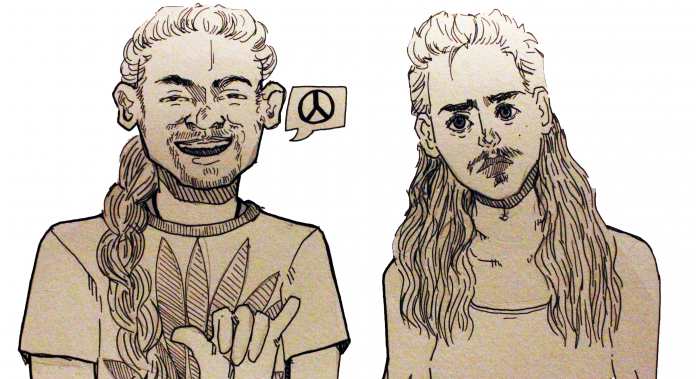
The man braid has come into contact with a lot of bogus negativity over the last couple months. And these indiscretions cannot be allowed to stand any further, man. As a strong supporter of the man braid and all that it stands for, I have decided break my pact against aggressive and hostile negotiation to say my peace. I am extinguishing my doob of Maui’s finest green to make a stand against the unsettling attack on Mother Earth’s gift to the world of haircuts.
So this message goes out to all you haters: Back off, bros, because the man braid is here to stay. And we’re willing to take this fight as far as it needs to go non-violently to see it through.
Why you got to be uncouth about it, man? Our hair isn’t hurting anybody. If anything, it’s breaking down barriers, dude. It’s dissolving the gender binaries set up by the corporate pigs. It bringing about true change in this corrupt and damaged world we live in.
So, when you really think about it, the man braid is a message of peace and justice promoting a new way for the world to come together. It’s revolution in the way we live our lives, man. And we need to preserve that at all cost. Because if we don’t, who will?
People need to release themselves of this most heinous hostility riddling their life force and just hug it out with their internal conflicts. Man braids are love. Man braids are life.
Besides, chicks totally dig them, man. And who knows? Maybe you’ll get, like, lucky if you have one, too.
No, bring back the mullet instead!
By Chaz Goodman, SFU Alum
What in the hell is this world coming to? It took all my humanly energy not to put a fist through my computer when grown men started putting their hair in buns. And now — goddammit, I’m in the market for a new computer screen and on the way to emergency for a bleeding set of knuckles.
Who do these hipsters think they are exactly? Mythical centaurs? Jedi-in-training? Mermen? Well, I’ll tell you exactly what they are. They’re twits with too much bloody time on their hands who believe themselves to be God’s gift to fashion.
If you ask me, I think it’s just a cry for attention. There’s nothing sexy about it whatsoever and it comes off more than a touch insecure in my eyes. It doesn’t matter if Daisy Beckham or that Harriet Styles are repping the newfound “dew” either; they ought to be ashamed of themselves for tricking their fans into thinking it’s “swank.”
You see, it’s things like this that make me miss the mullet. Now, that was a hairstyle worth emulating. A short uniform hair cut at the top with long greasy strands of hair swaying majestically to the back. Business in the front and party in the back — aah, what a time that was to be alive!
Say what you will, but if it worked for Patrick Swayze and Joe Dirt, it sure the hell should be good enough for the rest of us. It was sexy then and it can be sexy again! This generation just has come to its senses and give it another chance.
However, if that seems like a sacrilegious option for those French-braided buffoons, I’d suggest they shave their butts and learn to handstand, because even that would be a significant improvement from the moronic, soul-suckling, brain stupefying wretch of a travesty that is the man braid.
What do the signs about standing on the AQ pond mean? Why can’t I stand on the AQ pond?
Thank you,
Alexandria
Hi Alexandria,
Please do not stand on the Burnaby AQ pond. It is not safe to stand on in the winter months, because the pond is completely liquid. A quick look into the water – the completely unfrozen water – would provide you with this information. This is probably due to the modern weather patterns we live with, unfortunately.
The salt that was added to the pond also completely removes the possibility for it to ice over. The salt, of course, helped to dispose of the magic koi fish that usually inhabit the pond throughout the year. And now, as they do every year, they can be found at their visual hiding spot, safe from the salt: hovering above the spinning W at SFU Woodward’s for the winter.
Fortunately, the salt in the pond makes an ideal environment for the serpent-like, aquatic animals that replace the koi for the winter. If you would have taken the time to look down into the pond, you would have known these facts, and you probably wouldn’t have to ask why you shouldn’t stand in or on the pond for the time being.
Do not fear the pond’s eyes, though. Deep in the pond’s centre, they have opened, as they do every January, and they are glorious, as they become every February. They will consume the serpent creatures in no time, and we will have at least one amazing week of unobstructed eye viewing.
They’re a golden-brown this year! And surrounded by a smoky, light blue hue. Truly glorious.
The eyes guide SFU Burnaby, as the effervescent ears of SFU Surrey guides them, and as the disembodied voice of Charles Woodward guides the performing arts building.
Maybe just look down into the pond next time, or look up the history of SFU Burnaby, Alexandria!








 Security was tight but calm at the venue, with about two dozen police officers present on the sidelines and in the hotel. Widmer and Sharp had protested earlier that week by locking themselves the the National Energy Board offices, and Widmer said they saw a very different response.

 While SFU is an official intervenor in the National Energy Board process, they chose not to present oral arguments to the board. Said SFU President Andrew Petter at a January 28 Board of Governor’s meeting, “Sometimes it is helpful to have oral submissions, sometimes less so.”