Home Blog Page 871

Former city councillor celebrated in staged reading

0

The fourth annual memorial for Jim Green, former Vancouver City Councillor and community activist, celebrated his life with a staged reading of his book, Against the Tide: The Story of the Canadian Seamen’s Union.

While studying at UBC in the early 1970s, living in the Downtown Eastside, and working as a casual longshoreman, Green became acquainted with former members of the Canadian Seamen’s Union (CSU), and was approached by a committee with the request that he record the history of their union.

The staged reading was commissioned by SFU’s Vancity Office of Community Engagement and shone light on a lesser-known chapter of Canadian labour history, featuring the CSU. The memorial was held in partnership with the Institute for the Humanities at SFU, SFU’s Department of History, and the BC Labour Heritage Centre.

Vancouver City Councillor Geoff Meggs, who was the original editor of Green’s Against the Tide, explained in the foreword to the event guide: “Most Canadians have forgotten, if they ever knew, that our country once boasted one of the largest merchant navies in the world, a key to victory in the Second World War crewed by men and women organized into the Canadian Seamen’s Union.”

Charles Demers, a local writer, and SFU history alumni, adapted Against the Tide for this special performance.

The production was directed by Amiel Gladstone, and featured Andrew Wheeler as Jim Green, Carmen Aguirre as Labour, and Kevin MacDonald as Capital. Local musician and SFU MFA graduate Corbin Murdoch performed live on the set, singing lyrics that originated as poetry in the CSU’s newsletter, Searchlight.

Am Johal, Director of SFU’s Vancity Office of Community Engagement, explained that “the story of the Canadian Seamen’s Union is not just an historical tale. The relationship between labour and capital is also a very contemporary story.

“Taking this book that is rarely read these days and giving some life to the first-person narratives that are in the book was a great way to bring to life these memories in a way that they wouldn’t be forgotten,” he said.

Director of Research at the BC Labour Heritage Centre, Robin Folvik, explained, “it is important to acknowledge all of the information contained in this book that would likely otherwise have been lost without Green’s research and writing. His extensive interviews across the country and access to former CSU members’ memorabilia and clippings captured things that otherwise would have been impossible for us to access today.”

Their reading highlighted some of the key moments in the history of the CSU, including the 1949 strike, which ended in victory for the union.

The lines were divided between the three actors: Wheeler read the words of Jim Green, Aguirre read testimonies from members of the CSU, and MacDonald read the lines of the government and corporations who opposed the CSU and its ties to the Communist Party.

“Jim did these interviews in the ’70s and the ’80s — many of the people he interviewed have passed on. The interviews are held at the national archives, but it’s a very obscure story and hard to find. Jim spent a lot of time traveling the country trying to capture these stories so they wouldn’t be forgotten,” said Johal.

“We thought that at this annual memorial event, it would be an interesting time to land this text down in the present in a way that still resonates with us today.”

The reading was filmed and is currently being made into a documentary.

Folvik reflected, “although working people have always been cultural producers, using a wide range of creative practices to reflect their experiences, they are rarely the ones to receive funding or support to bring their projects to a broader audience.

“SFU’s Vancity Office of Community Engagement’s backing of this production, particularly one that is so focused on the struggles and solidarities of working people in Canada, fills an important gap.”

University Briefs

0

U of A study finds shift in Canadian attitudes to marriage

[EDMONTON] – University of Alberta sociologist Lisa Strohschein, in her study of Canadian perceptions of marriage, found that matrimony is no longer of central importance to Canadians. Her findings suggest that people are getting married later in life, are having children without worrying about marriage, and are far more focused on their careers and concerned with their financial stability than in the past century.

This study said that marriage is still important to Canadians and viewed as an end goal, but the findings suggest that our attitudes surrounding its necessity have loosened significantly.

With files from CBC News

Laurentian University’s chili lunch supports literacy program

[ONTARIO] – Laurentian University’s Equity and Social Justice Committee has raised funds for Frontier College’s literacy program by successfully organizing a chili lunch.

The literacy program aims to support Aboriginal groups across Canadian provinces. It has allowed Aboriginal children to be more immersed in reading books, a result confirmed by the parents of these children. Six thousand children have already participated in this program, which continues to grow and expand.

With files from The Lambda

McGill researchers develop model biological supercomputer

[MONTREAL] – McGill University professor Dan Nicolau and his team of researchers have developed a book-sized model for a biological supercomputer that uses proteins propelled by Adenosine triphosphate (ATP), a key chemical in the process of metabolism.

Due to the biologically-based processing providing less heating issues, these supercomputers are said to be more energy efficient than their current counterparts. The researchers are uncertain as to when full-scale versions will be available.

With files from McGill Newsroom

Social hiring initiative develops work skills with DTES residents

0
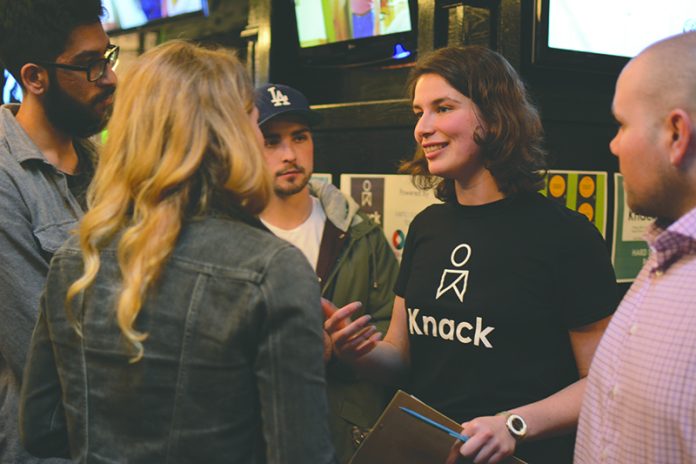
Anna Migicovsky co-founded the Knack program during her MBA studies at SFU

If you have ever hunted for a job, you know how hard it is to find one all too well. That struggle is 10 times greater for low-income individuals living in the poorest neighbourhoods in East Vancouver, many of whom are physically unable to work in full-time positions and are often dismissed by employers.

SFU MBA Candidate Anna Migicovsky is hoping to make that job search a little easier. She is the project coordinator of an employment platform called Knack, which aims to connect businesses with those who are looking for employment in Vancouver’s Downtown Eastside. Migicovsky developed the program along with two others as part of her internship at LEDLAB, a social innovation lab that is a branch of RADIUS SFU and EcoTrust Canada.

Knack was created as a community program in partnership with the Potluck Cafe Society, which has been providing good food and employment opportunities for the community for over 15 years. Migicovsky and her team also work with other nonprofit organizations within the Downtown Eastside, such as Union Gospel Mission, an organization that also provides career advising as part of the services it offers.

According to Migicovsky, around 7,000 people in the Downtown Eastside are currently collecting social assistance, and these individuals are not necessarily working. “The Downtown Eastside is currently very volunteer-focused, but these volunteers are actually doing a lot for the organizations [of which they are part],” explained Migicovsky. “We want to create more income-generating opportunities for these individuals. We’re trying to use the knowledge and wisdom that Potluck has in order to increase the number of employment opportunities.”

Knack focuses on educating employers about inclusive employment, and that people are coming from unstable backgrounds and might be unable to work 40-hour weeks. The program also offers several workshops to develop soft transferrable skills such as time management, teamwork, and conflict resolution, to name a few. Upon completing these workshops, participants earn digital badges that act as certifications of the skills they have developed. They are similar to badges that one would earn by being part of a Scouts Canada troop, and veer away from qualifications one might include on a traditional resumé.

Essentially, Knack wants to create a mutually beneficial relationship between employee and employer. “There is an untapped labour market right now that is about providing low-skill jobs at affordable rates. This program is not just about educating individuals, but also about understanding what the employer wants,” said Migicovsky. “It’ll increase quality of life for the individual and also create casual part-time work positions for the employer.”

But most importantly, what Migicovsky wants individuals to take away from the Knack program is a better quality of life. “Employment isn’t only for people who are healthy and stable,” Migicovsky said. “It is also a pillar of health.”

Female genital mutilation procedures do not deserve any respect

0

[dropcap]T[/dropcap]he argument on behalf of female genital mutilation (FGM) has been happening for thousands of years, as the procedure has been practiced for centuries globally. According to the United Nations, over 30 countries have practiced FGM.

FGM is generally practiced as infibulation, where young girls’ or infants’ labia lips are cut off, as well as their clitoris. The vaginal opening could also be sewn nearly completely shut, with just enough room for menstrual bleeding to emerge. These procedures can cause irrevocable complications for childbirth and sex, as well as psychological trauma.

Although FGM is criminalized in Canada and depicted negatively throughout mainstream media, gynecologist Dr. Allan Jacobs argues that minor vulvar procedures should be legalized as a “compromise.” He states that to disallow “small vulvar nick[s]” would be discriminatory towards different cultures that uphold this practice, and that allowing them could “forestalls subsequent vulvar infibulation done under dangerous conditions.”

His intention is to replace major infibulation procedures with smaller, less invasive procedures; ones he claims are completely harmless to the child at the time, and as she grows into womanhood. In an interview with CBC radio, Jacobs compares ear piercings, circumcision, and breast enhancement surgeries to female genital mutilation procedures.

Though, when creating analogies like these, it is crucial to look to the reasons for a procedure. Female genital mutilation procedures are based in patriarchal traditions, can be meant to inhibit sexual pleasure for women, can cause dangerous repercussions, and are simply harmful operations that young children cannot consent to.

If Allen Jacobs intends less invasive procedures to be a compromise, it is a compromise that will most likely fail. According to Ruth Macklin of the Albert Einstein College of Medicine, cultures that are inclined to perform extreme mutilation of female genitals would not be likely to acceptless invasive alterations just because they’re available. In fact, the practice of genital mutilation was often done in many cultures to determine whether a women was essentially ‘marriage material.’

If less invasive vulvar ‘nicks,’ as Jacobs proposed, were carried out as harmlessly as he describes, then there would be no evidence on the woman by the time of marriage; and therefore could be seen as obsolete.

The fact of the matter is, not every cultural practice deserves respect. Historically, the United States used female genital mutilation to cure hysteria in the 19th and 20th centuries, until people began to question the ethics of the practice.

To preach cultural acceptance surrounding a violent and non-consensual procedure in nonsensical. It is undeniable; some cultural practices are harmful. Culture is a dynamic force that can shift and change, and to accept a practice as harmful as FGM is regrettable at best.

Maryum Saifee has written for The Guardian about her experiences with ‘less invasive’ FGM, and hopes to be an inspiration for other women to come forward with their experiences. Saifee, when speaking on air to CBC, states that her experience with type one female alteration procedures was a “blocked out the memory because it was so traumatic.”

Instead of making loose inferences about whether or not “less invasive” FGM procedures are psychologically and physically traumatic, Jacobs should turn to survivors of the procedure he is recommending in order to learn the real effects it can have. As Saifee adamantly insists, “any form of structured gender-based violence [. . . is] just wrong,” and in no way should we condone or accept it.

Contributor’s Corner: How I learned to stop worrying about the coming of Galactus

0

Maintaining my grades has always been a struggle as a student at SFU. It’s not that I lack commitment to my English major and History minor, it’s that something hovers over me that provides me with great anxiety. It’s not mental illness, work, or family issues, but rather something much greater. You see, what I really fear is the coming of Galactus.

Yes, that’s right: the great world destroyer of the cosmos, who eats up planets like Cookie Monster does a box of Chips Ahoy! Just knowing Galactus is out there and could pounce upon the Earth at any moment absolutely terrifies me. I mean, the Fantastic Four can only stop him so many times — eventually he’s going to succeed at one point and just eat us up. Galactus consumed my thoughts to the point that anytime I saw anyone wearing a purple helmet, I started screaming.

I realized I needed help for my issues, but no psychiatrist was qualified in helping me resolve my issues with intergalactic world-eaters. There was only one known professional in the galaxy who might understand me. So I set out to contact an ex-employee of Galactus, Norrin Radd aka The Silver Surfer.

Mr. Radd told me that “fearing Galactus, much like the cosmos themselves, is meaningless.” After a long discussion in which he described to me a lot of random shit I didn’t understand about the nature of the universe and some dude named Uatu who watches shit, I left feeling dissatisfied. Ultimately it seemed I was doomed to never feel any comfort whatsoever, and that I would have to resign myself to a lifetime of worrying about the destruction of the Earth.

That was until I saw an offer in the paper for a job serving as a translator for an intergalactic entity hoping to communicate with various planets. I figured it had been a while since my last job in telemarketing and that I enjoyed talking with people enough that I might as well apply. When I arrived at the office, I was teleported into space where, face-to-face, I finally met Galactus himself.

I screamed for a solid three minutes until Galactus yelled at me to be silent. He explained he wanted me as a herald for him to devour other worlds across the galaxy. In return for my service, he would not destroy Earth, but he also demanded I make a great sacrifice.

Yes, dear reader: he demanded that I drop out of SFU.

I told him that I couldn’t after spending so much money on my BA and investing so much time in school. At first, he scoffed at the notion until I told him what my fees were, which according to him were “cruel even in the eyes of a world eater.” His promise to pay for my tuition in return for part-time work helping him decimate civilizations across the galaxy was an offer I couldn’t refuse.

And that, dear reader, is how I learned to stop worrying and love Galactus. Sure, I’m now an accessory to the genocide of multiple alien races, but this bachelor’s degree wasn’t going to pay for itself. Now I must bid you farewell, as Galactus told me to quit this Peak crap because it was making me late for world consumption work.


Campus group advocates for on-campus sexual assault centre

0

Studies show that one in five women will be sexually assaulted on a university campus as students. These incidents are an unfortunate reality on post-secondary campuses — and SFU is no exception.

Student groups at SFU have been campaigning to open a centre for sexual assault prevention and support on campus to raise awareness and to offer resources to survivors of sexual violence. SFU is one of the few Canadian universities not to have already established one.

An independent, student-run working group was formed in August, 2015 to develop a proposal for a Sexual Assault Prevention & Support Centre at SFU (SAPSC), that would ne inclusive to all genders, not just women.

“Anything less than a centre would be inadequate on campus,” stated Kaayla Ashlie, a fifth-year gender studies student who sits on the committee for the SAPSC.

Although there are services in place on campus, Ashlie believes that it is not clear enough where victims should seek help — and that one localized and dedicated centre would make help more accessible for those in crisis.

Current resources at the university include Campus Security, SFU Health and Counselling, Out on Campus, and the SFU Women’s Centre, which offers a 24-hour safe space for women, to name a few.

The idea behind the creation of the SAPSC would not be to develop new resources from the ground up, but to create a hub that can connect people to the services already in existence, thereby relieving the burden on groups that are going beyond their mandate to support victims of sexual assault.

Ashlie expressed a need for “ongoing educational campaigns to really shape the culture of SFU, and what is acceptable and not acceptable on this campus.”

Laura Scheck, who also sits on the committee, commented that it can take people a long time to come to terms with something that has happened to them — and it’s not always black and white. “Unless you believe that a blatant crime was committed against you, you’re not going to go to security,” she said.

“A lot of people don’t identify as being in crisis when they’ve experienced sexual violence. And this has to do with those weird grey areas, where you’re not sure what happened to you and you’re not comfortable with it.”

She explained that it would be a starting point for seeking help, and provide support if people wanted to go to counselling, have a rape kit test done, or take legal action.

Administration has stated that SFU takes the issue of sexual assault very seriously. Associate Vice-President, Students Tim Rahilly told Burnaby Now, “This is very serious business and has a huge impact on the lives of people when this happens, so we take it very seriously.”

The Consent Matters campaign was launched earlier this semester to open up a dialogue around consent and to educate the SFU community about how to prevent sexual violence.

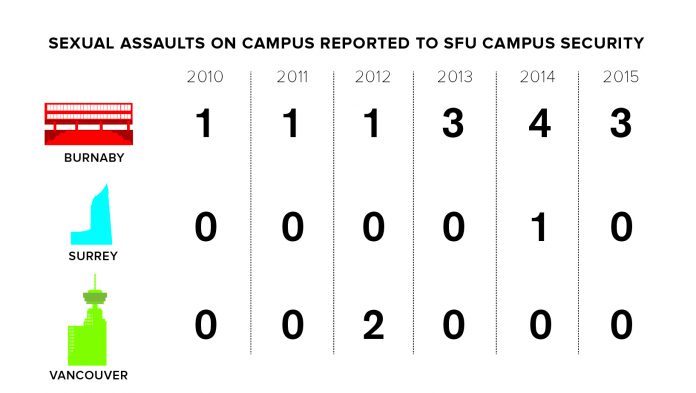
There were three reported assaults across SFU’s three campuses in 2015, and five total in 2014. While these numbers may seem comparatively low to other institutions, research shows that these statistics across Canadian universities are not an accurate representation of sexual violence on campuses, which is believed to be largely due to underreporting of sexual assault occurrences.

For the working group, the centre cannot be established soon enough. The student-led committee plans to ask for support from the student body by referendum in Fall 2016. Their final proposal will be based on consultations with various SFU offices, faculty, administrators, and student groups, as well as research on similar centres running at other Canadian universities.

The group’s original aim was to put the question to Simon Fraser Student Society (SFSS) members in the upcoming general election, but the referendum has been delayed while their legal status as a non-profit society under the BC Society Act is pending. The group will continue consultations with the SFU community as they work on the proposal.

The current cost the group has calculated puts the proposed student levy at $2 a semester, but that figure is subject to change as more research is done and efforts have been made to involve other groups on campus that could potentially pay into the centre as well.

The SFSS board of directors passed a motion to look into what sort of services could be offered through the SFSS to aid in prevention of sexual assault and to provide support to those who have been assaulted.

The centre would be run autonomously from the university. SFSS VP External Relations Kathleen Yang said, “I think independence with these types of organizations is absolutely critical.”

Boxer Briefs

0

Seven-year-olds come out for first annual pre-fetus Chitter gathering

[BURNABY] – Makers of the popular confession-app Chitter held their first gathering for pre-fetuses, a term coined by the Chitter community to refer to those who have yet to become the adult age of 18. The event took place right outside the Highland Pub on Saturday. Participants had shots of chocolate milk and created their own makeshift identification cards by drawing on cardboard with crayon — all while Chitting about it, naturally.

Fraser library game room taken hostage by sleep deprived students

[SURREY] – A group of students suffering from the common condition nofucksgivenitus hijacked the Fraser Library game room last Friday. The group of 20 extremely sleep-deprived students resembled a zombie herd, reported witness Guidi Gardio.

“They also had terrible taste in video games,” Gardio told The Peak. “They were playing the Ice Age 3 game on the Wii, Xbox, and PlayStation for a solid three hours.”

Elderly travellers mistake SFU’s downtown campus for airport

[VANCOUVER] – A couple heading to Brazil for a weekend getaway missed their flight as they mistook the study areas at the Vancouver campus for their boarding gate. They had ‘checked in’ at the student services counter and sat comfortably in their seats for a good two hours. “I was loving how lax the airport security in Vancouver was,” marvelled Antonio Bandera, an elderly gentleman from Portland, Oregon. “Then I realized that stress-free travel is still a dream.”

Men’s basketball season review

0
Oshea Gairey (right) averaged 13.3 points per game, and was in consideration for GNAC Freshman of the Year.

Some nights they’d look competitive. Heck, on some nights they’d even have a lead at the end of the first half. But even on those nights, usually the other team took over and dominated the second half, leading to yet another loss.

“We would have [good] halves here and there, but it could never be two halves in the same game,” said Head Coach Virgil Hill. “We showed moments — brief flashes of solid play — but we just couldn’t be consistent enough stringing that together for an entire game.”

In the end, the men’s basketball team finished with a 2–24 record, and won just one conference game.

“Ultimately, it’s about winning and that’s what we weren’t able to do.”

The other win came against Douglas College, who plays in a lower level league and whom SFU regularly trounces — last year SFU beat them by 90 points and three years ago handed them a similarly impressive 70 point loss. This year? A relatively close 78–58 victory.

This is a team that underwent an 18 game losing streak. After finally winning a surprisingly dominant game 90–70 against Concordia, for their first and only conference win, in the middle of some very competitive losses, the team closed out the season with five straight losses — losing the last three by 20 points or more.

It’s an understatement to say that this team didn’t fare too well in the wins column.

“The challenge was probably greater than my expectations, I mean I expected that we were going to be able to manipulate some wins and coach them up a little bit and be able to surprise people and perhaps get more wins than we did,” said Hill. “Internally, we had higher expectations for ourselves as coaches and as a team. I think we found out the hard and cold truth, that we weren’t as good in all facets and we have to get better.”

To say it was unexpected, however, is not a true assessment of the season either. The team lost its four top scorers from last season: senior point guard Sango Niang, who led the Great Northwest Athletic Conference in points per game and was 13th in the entire NCAA Div II; junior Roderick Evans-Taylor transferred to Cal State-LA; senior Justin Cole; and promising 6’8” freshman Patrick Simon transferred across town to UBC.

With the combination of the loss of graduating seniors, and a high turnover caused at least in part due to a change in coaching staff — Hill taking over from coach James Blake, who had coached the team for five years, the result was a rebuilding year.

“Ultimately, it’s about winning and that’s what we weren’t able to do. So if you look at it in that perspective, it certainly wasn’t successful,” said Hill.

“Would I call it a failure? Partially, but it’s part of the process — you don’t win overnight and the program has struggled, especially in the era of the NCAA, and we haven’t quite found the right formula, in terms of how it’s going to be successful moving forward. And that’s what I’m trying to do now, trying to find that right formula, in terms of the right guys you need to recruit, given our budgetary constraints, how that’s going to play out.”

The term success — if it could be used to describe this season — would perhaps be used to describe the development of some of the younger players.

Oshea Gairey came in ready to play in this division in his freshman year, averaging 13.3 points per game and hitting the 20 point mark four times this season. If he stays for four years, he will almost certainly be the star of the program.

Redshirt freshmen Andrew Williamson and Bowen Bakken, two players Hill said he “didn’t expect anything from [. . .] at all,” have come into the lineup and become effective role players. Bakken has shown an ability, at times, on the three point line, playing more minutes than in an ideal situation — averaging 20.25 minutes in February after only averaging 8.9 minutes a game before that. Williamson has emerged as a workhorse, regularly putting up 30+ minutes in his last three games, with an ability to produce points, hitting double digits in those games.

“You don’t win overnight and the program has struggled.”

Redshirt-sophomore JJ Pankratz could also put up points and looked impressive on the three point line. He will be undoubtedly expected to jump into a bigger role in his junior season.

Gibran Sewani, who is in his junior season and as of now will be SFU’s only senior next season, showed flashes of brilliance, often making or attempting impressive plays like slam dunks or alley-oops, but couldn’t find consistency. If he finds that consistency, he’ll probably be one of the most exciting players to watch. And with senior Michael Harper’s departure, they’ll need it.

Perhaps the biggest disappointment, aside from the losses of course, was the departure of junior transfer Max Barkeley. He led the team in points per game and was always exciting to watch, with a visible passion on the court. With four games left, he left the team, and his absence was particularly noticeable in the final three games — one of which SFU shot only 58 points. However, being a junior, Barkeley only had one more year, and would not have fit into long term plans.

One of the biggest things Hill believes the current players need to work on is their “strength, getting bigger and stronger” and being “able to play at the next level of speed and be productive” at the Division II level.

“We need to get more athletic. To me, that’s obvious. You look at other teams in warm-up and we’re the least athletic team in the entire conference,” explained Hill. “Now, there aren’t many great athletes in the province of BC, so that begets another problem, now you have to go outside of the province to find that type of athleticism. That’s expensive, it’s hard because now you’re trying to recruit people where you’ve never really met them,” which makes it difficult to get a feeling for their character, says Hill. “You can be the best athlete, and if you’re a low character guy, it doesn’t really matter.”

As of now, the men’s basketball team has two new signees. Guard Kedar Wright, who played two seasons at UBC, was supposed to play for SFU this year, but will instead play next year. Wright averaged 11.8 points per game, and put up 23 points in 40 minutes in a CIS playoff game.

The other signing is Chase Hobenshield, 6’7” centre from GP Vanier Secondary on Vancouver Island, where he plays under SFU alumni Larry Street. Street told the Comox Valley Record that Hobenshield “may be the best post in the province.” Hobenshield is expected to redshirt.

Hill hopes that next season the may even compete for a playoff spot.

“I don’t know if this is realistic or not, I mean I’m being optimistic when I say this, but battling for that last playoff spot, battling for sixth place, that sort of seventh or sixth spot,” explained Hill. “But again, I don’t know how realistic that is at this point without recruiting. Obviously recruiting can change those fortunes quite quickly, and all of a sudden we go from the one win to 10 wins in a hurry.”

“Everyone just has to get better, and they don’t understand that you  have to be ready for this — mentally, physically, emotionally, technically, you have to be ready in all phases — and a lot of the guys just weren’t, and they didn’t really know.”

Mathew Berry-Lamontagna’s journey with hockey

0
Berry-Lamontagna is third on the team in scoring this season, with 19 points in 23 games.

It takes a great amount of commitment to get to a high level in hockey, and Mathew Berry-Lamontagna is a perfect example of this commitment. Having started playing the game at an early age, he has been to many towns and a part of many leagues — including the highest level of junior hockey in Canada — before coming to SFU to join their hockey team.

“I would have been probably around four,” said Berry-Lamontagna on when he started playing hockey. “[I] played in the basement with my dad and just started skating around. He was the one that really got me into it. I’ve been playing ever since.”

From there, Berry-Lamontagna was picked up at 16 by the Prince Albert Raiders, a team in the Western Hockey League.

“I was playing Major Midget in my region, which is the Vancouver region. I played two years there, when I was 15 and 16. In my second year, I kind of had a bigger role [. . .] I was captain, got to develop a bit more.

“[The team] approached me after one of the games — I guess they had been watching me for a while, they had put me on their 50-man protected list, so I became their property, they owned my rights in the WHL. I went to spring camp, and then the main camp in the fall, and they offered me a contract.”

In Prince Albert, Berry-Lamontagna had the chance to play with and against elite level players, including teammate Mark McNeil, a first round draft pick of the Chicago Blackhawks.

“It was really cool,” he said. “You get to play with some really highly talented players. First round picks, guys that are sent down from the NHL back to their WHL teams. I kind of learned what it’s like to be a professional, see how those guys conduct themselves and work ethic, and stuff like that. So that was good learning experience for me.”

After two years in the WHL, it was off to the BCHL. He played a full season for the West Kelowna Warriors, before being traded to the Coquitlam Express, and again midseason to the Cowichan Valley Capitals. That made it four different cities in three seasons for Berry-Lamontagna.

“It’s really cool, actually. You get to meet people you probably wouldn’t get to meet otherwise,” he said on moving around so much. “You live with billets, so these people open up their homes to you, to live with them and experience living with a different family and living away from home for the first time.”

We have a pretty special team this year and there’s guys that we want to win it for.

“My first time I was away, I would have been 16 when I went to Prince Albert. [. . .] It makes you grow up pretty quick. But all the families I stayed with were great and made my transition really easy.”

Players “age out” once they hit 20 in junior hockey, meaning they are no longer eligible to play. That’s when SFU Hockey Head Coach Mark Coletta came calling.

“Mark Coletta contacted me my last year of junior. [It was] kind of getting to the end of the year and around the time where he starts his recruiting. I got a call from him, we talked, went through the recruiting process, and decided this was a good spot for me.

“I had never met [Coletta] before. Just through the phone calls. My coach in Cowichan at the time, Bob Beedie, he had known Mark, so I kind of had an idea what he was about, knew he was a good guy, good intentions, so it made it a little easier.”

It has turned out to be a good decision. Berry-Lamontagna has become an integral part of the team, and a constant on the back end. He is third on the team in scoring, with 19 points in 23 games this year, including a three-goal, six-point performance earlier in the year against rivals Trinity Western. The hat trick was the first of his career. “That was kind of cool, something that doesn’t happen too often for a defenceman,” he said.

“It was a weird game, a high-scoring game. [. . .] Our play play went four for five, we scored on our first four ones. It’s one of those things where everything seemed to be clicking, especially for myself. Shots from the point sometimes don’t get through, sometimes they get blocked, but that day they were getting through and hitting the back of the net.”

With the playoffs approaching and their spot ensured, the team is solely focused on winning the elusive BCIHL championship, something that came very close to happening last year before they fell to Selkirk College.

“I know the guys here, from last year especially, are pretty bitter about it. We got guys [like] Jono Ceci, he’s been here for five years, all-time leading point getter in the BCIHL, and he hasn’t won it yet. We don’t talk about it too much, but I think everybody knows that we have a pretty special team this year and there’s guys that we want to win it for, like the senior guys. We have a special team, but it’s going to be a lot of work.”

After school, Berry-Lamontagna plans to try to make it professionally, wherever that may be.

“I’ve kind of always liked the idea of trying to go play pro somewhere overseas [. . .] I’ve put so much time and hard work into the game I think it would only be fair to myself to give myself that opportunity if it came. Obviously school, to get my degree comes first. But after school is done, I’d like to try to do that.”

Fun Fact

Mathew Berry-Lamontagna is no muggle. “I’m a big Harry Potter fan, to be honest with you. I grew up on the Harry books. I was a big Harry Potter fan when the movies came out.”

Why I’m done with Starbucks

3

[dropcap]S[/dropcap]tarbucks, why you gotta play me like this? I thought we had something special. Now you’re throwing away what we had and are replacing it with something awful.

The general principles of your Rewards system remain the same — register a Starbucks card, spend money, get stars in return, and use stars to redeem free rewards. But your new system you’re rolling is ridiculous compared to your current one.

First, instead of three levels in the Rewards system (Welcome, Green, and Gold), the new system will only have two (Green and Gold). Instead of beginning in the Welcome level and progressing to the Green after attaining five Stars, everyone is automatically given Green status. To progress to Gold in the current system, it only takes 30 Stars. In the new system, it takes 300.

The way to earn Stars has changed, as well. Instead of earning one Star per transaction, the new system awards two Stars per dollar spent (or one Star per fifty-cents spent). To redeem these Stars for rewards, the 300-Star Gold level must first be achieved. After this, for every 125 stars collected, a person obtains one free reward.

Simply put, you’re fucking over me and tons of other tight-budget students with your new and “improved” Rewards system. Please tell me it’s just a dream, because I cannot jump from 30-star to a 300-star Gold status, along with all this other ‘rewards’ baggage.

Maybe this is where we part ways, my old friend.

Sure, you’re trying to soften the blow by offering monthly ‘double Stars’ days, but when you already send me email-offers for extra Stars in the current rewards system, I can’t help but feel cheated because a Star goes a lot farther right now than it will in April when you officially introduce your revised program.

How about this — after collecting 125 Stars, I get a share in your company.

One hundred twenty-five stars for a free drink? That’s a whopping $62.50 to get those stars! And you only get that free one once you’re a Gold-level customer, which requires 300 stars on top of that.

And I’m sure you’re thinking that I should just take my coffee business elsewhere. You’d be losing out on couple hundred bucks a year — a mere drop in the bucket for you. But multiply that $200 by every other student who can find more buying power at another coffee chain and maybe you’ll understand why this is such a crap deal for us and for you.

Don’t tell me it’s because you can’t afford to keep the system as is, Starbucks. Don’t lie to me on top of breaking us apart. If you can afford to pay Howard Schultz, your CEO, $149.8 million in 2013, I think you can afford any money you’d be ‘losing’ without your new program.

So how about this — with every purchase, I collect my Rewards Stars according to your ridiculous new ratios, and after collecting 125 I get a share in your company (valued at about $78 CDN at time of publication). That would make this a win in my book. Or, you know, instead of screwing yourself over by giving me more in stock than it would cost you to just keep things the way they are, you could just forget about this entire bad idea.

Think about it: all the reprinting costs, new marketing, and media strategies, the blowback from people like me who’ve crunched the numbers and decidedly deemed that this is whole ordeal is crap — you could avoid all of this. Personally, I believe spending less money for better return is always preferable. Especially when things like post-secondary education cost money.

It was good while it lasted, mi amore, but now you’ve lost me forever. Farewell, Starbucks.