Home Blog Page 869

Learning about BC through art

1
The Common Grounds exhibition combines knowledge of various school subjects with art.

The ArtStarts gallery is a welcoming little building nestled in the heart of downtown Vancouver. The gallery feature artwork created by kindergarten to grade 12 students from across BC. The students worked with professional artists in their classrooms, learning not only artistic techniques, but also using the arts as a way to explore different studies, such as the environment, Aboriginal peoples history and sustainability.

For example, one of the pieces on display in the gallery oversaw fourth and fifth graders from Okanagan Landing School on a trip out to their native forests to learn about invasive / non-invasive species of plants, pollinators, and birds, and their effects on the environment; in turn, the students sewed together two impressive wall to ceiling quilts with hand crafted cut outs of plants, pollinators, and birds that were separated to show which were invasive and non-invasive.

This project, with additions from other schools in BC, has developed into the gallery’s current exhibition, intelligently named Common Ground. The exhibition is showcasing the works of students from all over BC, who have explored their respective natural ecosystems, or culture and have channeled their new found knowledge into an art piece — a “common ground.” The most unique art pieces include a life size pollinator house — made by sixth and seventh graders from Strathcona Elementary in Vancouver — and hand woven, Aboriginal-inspired, miniature pouches — made by first to sixth graders from Manoah Steeves Elementary in Squamish.

Let us not forget, though, the form of art more commonly associated with galleries: paintings. While pollinator houses, miniature pouches, and enormous quilts sound unique on their own, they are art pieces that require more physical work rather than a dedicated attention to detail. And it is a fact renounced the world over, that anyone can splat colours on a canvas, but it is the artist who paints; for this, the paintings hung in the gallery are from thinkers and engineers of an older age and understanding.

Biology and art students from Mount Sentinel Secondary in South Slocan, are the focus of a collagraph printmaking type of painting piece. These students, who explored the Slocan river with the help and instructions of a field guide, were taught at first the techniques of field mapping and note taking and later, were taught to transform their findings onto a foam plate — placing actual flowers along with etched symbols, sealing the plates and dying them in an ink to make prints on paper of the original template.

To make it a more ‘common ground’ for all people to enjoy, the gallery’s entrance welcomes you with a literal display of the ground: soil jars with water, collected from all over BC, that show the dynamic breakup of water, clay, silt, and sand common to all us BC folk. The combination of art, culture, and nature is evidently strong in the exhibition’s message, and resonates effectively between the walls of the gallery. The exhibition is quick to draw an avid nature lover and art lover alike into its displays, which constitute not specifically of either content — nature or art — but, represent a perfect blend of both. More metaphorically, they represent a ‘common ground,’ an abstractness present in the human makeup of every individual: the calm balance of our natural physique and our artful intellect.

The Common Ground exhibition is running until March 2016, free of cost, at the ArtStarts gallery, located at 808 Richards Street, Vancouver. For more information, you can visit the gallery’s website at www.artstarts.com/exhibitions/commonground.

St. Lucia wows Venue Nightclub

0
St. Lucia draws their musical inspiration from global sources.

The dedication that St. Lucia has to their fans is on another level. On Tuesday night the band played Venue Nightclub on Granville St., but they only just made it. In the early morning hours as the band was travelling from Spokane Washington along the I-90, they were stuck in a homicide investigation.

After the show during a brief conversation with Patti Beranek, the band’s keyboardist, she said that their manager and tour manager felt there was no possibility of making the show that night. It was only Jean-Philip Grobler, the lead singer and creative force for the band, who was convinced that they would be able to make it. And he didn’t want to cancel the show since that was something that they had never cancelled one before.

Grobler’s belief in the band being able to make it to Vancouver was put to the test as they only arrived three hours before the took the stage at 10 p.m. This rushed set-up meant that there was minimal stage production, and the open act Grace Mitchell was unable to perform.

While it would have been nice to see Mitchell — who is a rising star — and the stage production that St. Lucia normally has, there was never a moment when it felt like something was missing from the show. This could have been related to their performance being flawless and filled with energy from start to finish, or that by performing in a nightclub there was enough lights that they could use to suit their needs — since they did not have time to set up their normal lighting beforehand. In any event, it never felt like this was a rushed show.

If you are able to see St. Lucia next time they come to Vancouver or near Vancouver on tour or for any other show, don’t pass up the opportunity. Their constant energy is infectious, and their musical performance is on point, even without fancy stage production.

CENTRE STAGE: Great Russian Ballet touring Canada and reviews of Janeane Garofalo, This is That, Betroffenheit, and Spellbound Contemporary Ballet

0
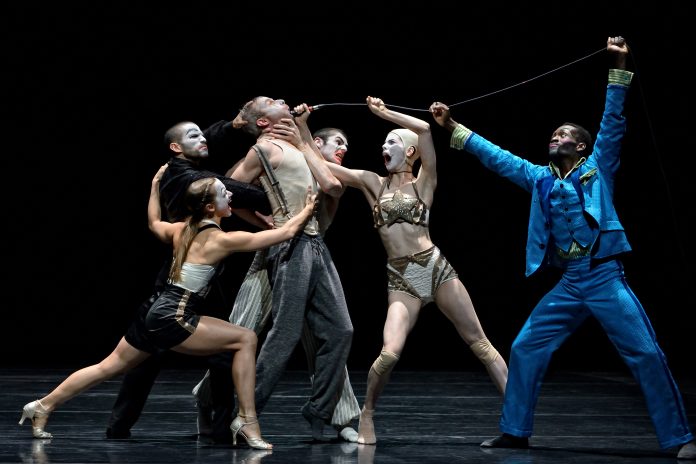
Performers (L-R) Bryan Arias, Cindy Salgado, Jonathon Young, David Raymond, Tiffany Tregarthen and, Jermaine Spivey capture the theatre-dance hybrid of Betroffenheit

Great Russian Ballet’s Giselle currently touring Canada

March 14 in Abbottsford; Vancouver show postponed and TBD

Most people would assume that Russians are used to the cold, but Viorel Balan, founder of Great Russian Ballet, assured me that when his company landed in Montreal, they were not prepared for the -35 degree weather. With 37 dancers and 10 crew members, the Great Russian Ballet began their Canadian tour on Valentine’s Day in Montreal and are now making their way west, stopping in 18 cities over just 30 days.

Balan’s sister Natalia stars in their production of Giselle, a story of love and betrayal. The role is very demanding for the prima ballerina, and involves a wide range of emotions. Giselle, first performed in 1841, is one of the most popular classical ballets, and I can’t wait to see this company full of world class talent.  

The company is using Marius Petipa’s choreography and has updated it slightly while using traditional Victorian costumes and sets, explained Balan. After their Canadian tour, the company has a break in Russia and then moves on to Germany, Brazil, and back to North America this summer with Swan Lake.

The Vancouver performance was originally set for February 23, but had to be postponed due to logistical difficulties. The company is currently looking for a new venue and date for that performance to go ahead; meanwhile, it might be worth the trip to Abbottsford to see this stunning classical ballet that has been selling out in Eastern Canada.


Janeane Garofalo

JFL Northwest

Feb 23, Rio Theatre

With her self-deprecating style of wry, wordy humour, Janeane Garofalo had the Rio Theatre in stitches talking about “that documentary The Walking Dead,” and her views on everything from gluten (we need it) to Spanx tights (she lives in them).

One of the best things about Garofalo’s humour is her ability to be so casual and act like she’s just having a conversation with the audience. She can tell a complex story, with plenty of large words, and she doesn’t have to dumb it down. Fans of her humour appreciate her linguistic knack and wouldn’t have it any other way.

While she likes to talk about politics, there were only a few mentions during her set — a quick reference to Harper being gone and Trudeau being much better — but for the most part she focused on ridiculing reality shows such as I Didn’t Know I was Pregnant and expressing the contempt she feels while watching House Hunters.

Garofalo also manages to throw in plenty of observational humour, including a hilarious scene where she overheard one woman say to another in Nordstrom Rack, “Remember, your eyebrows are sisters not twins.” It’s Garofalo’s ability to take a phrase like that and pack it with meaning and then unpack it with humour that makes her a master at her craft.


This is That

JFL Northwest

Feb 27, Vogue Theatre

Satire always runs the risk of being taken as fact by unassuming readers or listeners, and This is That is no exception. Pat Kelly and Peter Oldring host this popular CBC radio show, and along with producer Chris Kelly, they are always surprised when a story goes viral and is taken as fact. Their sleek production might sound like real news at first, but it soon becomes clear that their sophisticated humour is poking fun at everything from politics to parenting.

Their live show was set up as if we were watching them record one of their episodes in studio, with Kelly and Oldring performing multiple characters with many different accents. Between stories, a video screen played a montage of Canadian images, sending up our cultural identity and adding to the tradition of self-effacing Canadian humour.

Some of the funniest moments in the show were the (very real) listener call-ins responding to the stories, including people who think they have finally figured out what “This is That” really means. In September 2013, several media outlets, including USA Today and the Washington Times, reported on a This is That story about a youth soccer organization that had decided to play soccer without a ball to remove competition from the game.

Kelly and Oldring have backgrounds in improv, and their show involves a great deal of it. They explained after the show that they write the introduction for each story in advance and may think of some interview questions, but when they interview each other as guests on the show, their responses are not scripted and the interview can go many different ways.

My favourite stories from the show included the prison in Texas that has allowed inmates to bear arms and the infants’ rights activist that was interviewed to share her views on baby-proofing parliament.

Intelligent, hilarious, and very Canadian, This is That is my new favourite podcast.


Betroffenheit

Kidd Pivot and Electric Company Theatre

Feb 25–27, Vancouver Playhouse

This monumental collaboration between Crystal Pite of Kidd Pivot and Jonathan Young of Electric Company Theatre is a poignant theatre-dance hybrid that deals with the complex topics of trauma and addiction.

A voiceover talks of coping mechanisms and resisting temptation as Jonathan Young struggles to understand what he should do. He’s in an industrial warehouse-type room with white walls, two doors, and a pillar in the centre. As he contemplates his next move and repeats the mantra that “the user gets used,” he succumbs to the temptation of “showtime.”

The “showtime” dance numbers of ballroom, tap, showgirls, and flashy entertainment are a metaphor for the thrill of getting a fix of whatever you’re addicted to. Young, as the protagonist in the story, needs to feel the adrenaline of showtime, even though he knows it won’t lead to the desired result.

Pite’s choreography and Young’s writing and acting meld beautifully to create this world of inner turmoil. For the second half of the show, the stage is bare except for the pillar, and Young’s character seems to have come to terms with the fact that “there is nothing more down there to find” in his hole of addiction. The repetition of text and movement helps to solidify the message, and Pite masterfully translates that message in her choreography.

Pite explained in a talk before the show that the German word “betroffenheit” doesn’t translate directly to English, but means something close to shock, bewilderment, or impact. The word, found in a book about acting (And Then, We Act by Ann Bogart), was the seed of the show, and a personal traumatic incident from Jonathan Young’s own life was the engine that drove the creation. Not wanting to focus on the details of his own experience, Young worked with Pite to broaden the scope of the show, and the details of his own trauma are unimportant.

I look forward to seeing more from this duo, as Pite hinted that further collaborations are on the way. They are each immensely talented in their own fields and came together to create something unique and powerful.  


Spellbound Contemporary Ballet

Chutzpah! Festival

Feb 27–29, Norman and Annette Rothstein Theatre

Italy’s Spellbound Contemporary Ballet, led by choreographer and Artistic Director Mauro Astolfi and Executive Director Valentina Marini, was founded in 1994 and tours to prestigious international festivals. It was a treat to see them presented at Chutzpah! with a packed show of five different pieces.

Astolfi’s choreography features a great deal of floor work, with the dancers rolling over one another and using momentum to push and pull each other in intricate formations. With dexterity and grace, the dancers not only performed the complex and demanding choreography, but also infused it with emotional depth and nuance.

I especially enjoyed a duet between Maria Cossu and Giovanni la Rocca that had Cossu rejecting la Rocca’s advances while he remained determined to get her attention. After that piece, la Rocca came down from the stage and took a seat in the front row, chatting with the audience members beside him. Moments later one of the female dancers walked down the aisle to yell at him (in Italian) and sent him back on the stage. She paused to speak to us in English, apologizing that we couldn’t understand what she had been yelling and saying that la Rocca was tired from dancing for three days in a row.

In the next piece la Rocca gave her a flower, but instead of keeping it, she gave it to an audience member. This unique sense of humour added to the variety of emotions displayed by the dancers, and while the choreography contained similar elements from one piece to the other, the emotional colouring was very different.

Seeing international companies like Spellbound is what makes the Chutzpah! dance programming so valuable, and I look forward to Israel’s Maria Kong, Gallim Dance from the USA, and Ballet Kelowna.


Rare owl spotted on SFU campus

0
Owl watching sure is a real hoot!

[dropcap]Bus[/dropcap] riders on the 145 may have seen a gaggle of individuals with camera and binoculars, setting up camp on the side of Gaglardi Way this past week. The onlookers have gathered to see the Great Gray Owl, an elusive species which is not native to the Vancouver area.  

DSC07435It is a very large owl, the largest in size in North America. While the Great Horned Owl and Snowy Owl are far heavier with larger talons, the Great Gray is essentially just a big ball of feathers. However, its colorization and crescent-shaped face are simply transcendent.

According to one bird watcher, the owl has been spotted on Burnaby Mountain in the vicinity of the SFU sign for the past two weeks.  Crowds have formed along the roadside on days it is visible to motorists.

This reporter spotted the owl due to the presence of one lone photographer. A small crowd soon formed to gaze at the majestic species perched so close and visible to the roadside. One woman enthusiastically exclaimed, “I work here and finally I have a chance to see it!”

The Great Gray Owl is such a prize for birders that it was prominently featured in the birding movie, “The Big Year.”  In the most poignant scene of the movie, the protagonist, played by Jack Black sees a Great Gray Owl on a nature hike with his father. Nature lovers are highly encouraged to check out the owl while it graces SFU with its presence. It may be a once in a lifetime experience to see such a rare treasure so close.

My childhood camping conundrum

0

[dropcap]I [/dropcap]will admit that I dislike the outdoors. Ever since a misguided hike with my father at the age of six, I’ve been wary of the majesty that Mother Nature has to offer. Yet, in the summer in between grades eight and nine, I decided to tempt fate and camp with four of my cousins and one of their friends in a tent in my cousin’s backyard.

That night started out much like any other: we goofed around, ate dinner, goofed around some more, and then got ready for bed. By the time we were ready for sleep, it was dark outside, but this didn’t matter since there was an outside light and we had a flashlight to protect us. So once we were all situated in the tent it was lights out — literally. It was pitch-black in that yard even though we were technically still in town.

Around midnight we decided to call it a night. Naturally though, someone had to go into the house to use the bathroom (oh, Teresa), which meant that those of us in the tent were without a flashlight.

Typically, if someone needs to use the restroom, my cousin Emily then decides that she needs to pee as well. The other person who had the flashlight had already been gone for about two minutes, so I told Emily to wait until we got the flashlight back. This was an unsatisfactory response, and she countered with, “This is my backyard. I know it well enough to not get lost in it.”

I didn’t think it was possible to move that fast, or scream the way that I did.

I couldn’t argue with that logic — it was her backyard, after all — so I let her go against my better judgement. About 30 seconds later Teresa returned. I asked her if she had passed Emily on her way back out to the tent and she confirmed. So that was that, we just needed to wait for Emily to return to the tent so we could all get some sleep. About two minutes into a random conversation, there was a thud as something bumped into one of the ropes holding the tent into the ground.

Well holy shit, I didn’t think it was possible to move that fast, or scream the way that I did. There we were, five of us dogpiled into the middle of the tent mostly screaming in high-pitched fear. I say mostly as the sound that I made was more of an “ARRRRRRAAAAAAGGGGGHHH,” about an octave lower than everyone else’s.

The screaming only stopped when the zipper of the tent started to make noise. I threw myself in front of the others so I could face the intruder. As the zipper opened further, I saw that it was Emily coming back from the bathroom. I pulled her into the tent while yelling, “Holy crap! In the tent, in the tent! There is a bear out there!” And instead of reacting like I expected, she simply laughed her ass off.

After having awoken the entire neighbourhood, and being yelled at by my aunt and uncle, it turned out that there never was a bear that ran into the side of the tent. It was Emily. Turns out she didn’t know her backyard as well as she thought, and instead of walking to the front of the tent she walked into the side of it.

Needless to say, it was a very long time before I trusted Emily again with anything, not just her knowledge of her backyard, and thankfully was one of the last times I went camping.

Universities should offer voluntary exit exams

1

[dropcap]T[/dropcap]hese days, it’s common to hear employers complain about the lack of skills that recent undergraduates have. They rant and rave that university students aren’t prepared for the real world, and some, like Harvey Weingarten, as reported by The Star, claim that universities should offer voluntary entrance and exit examinations in order to measure students’ basic reading, writing, and mathematical abilities. And while I strongly disliked provincial exams in high school, I firmly stand behind these entrance and exit examinations.

The same Star article reports that executives in 20 recent employer surveys feel recent graduates lack the simplest of skills.

It’s not so much that an undergraduate degree has lost value, it’s that there is now a common belief that an undergraduate degree must directly relate to one’s job or profession — that is, that there is a smooth transition between graduating and employment. It’s this prevailing belief that your major determines exactly where your workforce values lie.

One often hears, “well, what does that degree get you?” And it often results in an egotistical debate on the value of an undergraduate degree in fields where one’s major is perceived to land them a job in that specific field after graduation. But if there were entrance and exit examinations which tested a university level of reading, writing, and mathematical ability, then your major in history may just be a bonus to an employer.

If an exit exam can alleviate my employer’s skepticism about my ability, I would be glad to take it.

The fact is that there are certain skills that are essential in today’s economy, and while my knowledge of some abstract part of the brain may be useful at some point in time, basic skills in reading, writing, and math are more employable. If an exit exam can alleviate an employer’s skepticism about my ability, then I would be glad to take it, and so should you.

Moreover, I believe that in order to successfully pass these entrance and exit examinations, all university students should have to take mandatory courses in math, science, English, business, and computer science their first year. While this would undoubtedly be met with sharp criticism by students, the benefits would be two-fold.

Not only would you become more well-rounded and develop basic marketable skills, but a university degree would become far more valuable to employers. Knowing that all universities require that students have basic skills in reading, writing, math, and computers, I believe this would make them more comfortable hiring post-secondary graduates.

Your undergraduate degree definitely exposes you to things you would never have thought of if you had simply been working in some job or profession. And because there’s still value in an undergraduate degree, I believe that the system just needs a little fine tuning to make employers more confident in their future employees’ abilities. If this means offering entrance and exit examinations, then so be it. Employers would have a better chance at hiring skilled workers, and students would get an experience far beyond the day-to-day grind.

Multicolored Reptilian alien found beneath the ‘secret basement’ in Trottier Observatory

0

Like you, I have walked by the Trottier Observatory wondering tirelessly as to its “true” purpose on Burnaby mountain. While the mission statement upon the world wide web indicates this cosmic Peeping Tom stand is meant for stargazing, they didn’t fool me none. I could feel a resounding sense of eeriness from the start. And then it dawned on me one night when I was snacking on a bowl of Vicodins and sipping my peaches and cream bellini: aliens.

It had to exist because of aliens. Even without proof or factual evidence to backup my thesis, I knew in my heart it had to be true.

So, I set out under the veil of night covered in all the soot in my fireplace, searching for the answers to the most elusive question on campus. And what I discovered was nothing short of disturbing.

After breaking the lock off the door, I began to search the room in a fevered panic brought forth by a combination of high-power pharmaceuticals and an unnatural fear that security personnel would set forth a patrol dragon to devour me as a midnight snack. I knew that time was of the essence, and if I did not act quickly, my fellow students would never find the answers to the Trottier mystery.

Pushing all the buttons I could, I prayed for a miracle (or a hasty digestion, in case things did not go as planned). As luck would have it, though, the combination of buttons I pressed moved the telescope in such a manner to reveal a secret staircase, into which I promptly fell.

Dazed and very concussed, I crawled through the pitch blackness of the hidden basement in search of a light source. It was then I made my discovery. There, shackled in the darkness, sat an imprisoned alien of reptilian descent, with skin of soft magenta and a protruding bright green belly. He introduced himself as Barney and insisted that, on his home planet, he was a sensation. He promised to love me if I freed him and tempted to let me join his great big family.

However, before I could do anything, an SFU security eagle whisked me away. I screamed to Barney that I would bring him back home to his people before suddenly blacking out from the headrush and abundant mixture of drugs.

My friends, I beseech you — there is a reptilian alien under the Trottier Observatory who needs saving. Join me in my quest to save this jolly creature from whatever torments SFU staff wish to inflict upon him, and you too may find his loving grace and favour.

You can follow me at my website www.notbatshitcrazy.com for more info.

Softball team splits home opener

0
Taylor Gillis (centre) went one for four with three RBI’s in the team’s second game of the day.

This past weekend, the SFU Women’s Softball team opened up GNAC Conference Play with a home-and-home set of double headers against rival Western Washington Vikings. The Clan dropped the first two on the road 7–1 and 10–5 in Bellingham Washington. In Sunday’s home contests, the Clan fell 7–3 in a rain delayed opener before prevailing 7–1 in the nightcap of the doubleheader.

Despite the weather, there was a strong crowd on hand to support the home squad. In the second game, Center Fielder Taylor Gillis staked the Clan to a 2–1 lead in the second inning on a two-run double. Gillis would finish with 3 RBIs on the day. In the fourth inning, first baseman Nicole Ratel jacked a two-run home run to push the lead to 5–1. Alia Stachoski struck out seven, scattered six hits, and yielded just one run in a complete game gem. The win broke a 12-game losing streak against Western Washington.

Coach Mike Renney commented on the weekend action, noting that “Western has had our number for the past couple of years, and as our Conference’s preseason number one pick to win it all, we knew we were in tough to open with them in a Home and Home series.

“So, while we would have liked to have split the series, it was good to see the athlete’s character in bouncing back from three straight losses. It was also good to see that we competed in each game even though we came out on the losing end of the score, but for a couple of breaks we could have easily had different results.”

Renney previewed the upcoming games to take place this season, stating that, “having played this past weekend in our home opener, I am hopeful that the home field jitters are behind us and we can get down to business [. . .] we will continue to work on one of our team’s biggest weaknesses thus far and that is our responding to adversity; be it an opponent’s big hit, an error from our defense, or missed opportunities with baserunners.

“In our first three games versus Western Washington, after something bad occurred, we tended to lose focus resulting in us giving up runs; in our last game we responded much better, but still as a young team we have work to do.”

The Clan’s next game is on Wednesday against UBC. Their next home game will be March 19th with a double header against the Western Oregon Wolves, with the first game taking place at 1 p.m.

Renaissance Coffee celebrates 20th anniversary

0
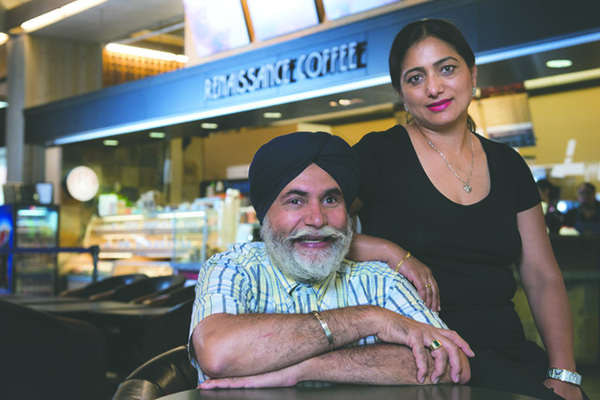
Parminder Parhar, pictured here with his wife Kamaljit, has become a staple of the culture at SFU.

SFU’s beloved Renaissance Coffee celebrated its 20th anniversary on February 23. Owner Parminder Parhar is well-known on campus by students and faculty for his unbeatable community spirit and impressive ability to remember the names of hundreds of regular customers.

Since opening day of the AQ Renaissance Coffee, Parhar has come a long way. His business now extends across Burnaby campus in owning and operating two Renaissance Coffee shops, two Subway restaurants, a Jugo Juice, and the Simon C’s Convenience Store.

SFU President Andrew Petter was present at the anniversary ceremony to award Parhar with a plaque recognizing his growing success and 20-year relationship with SFU. They offered free cake and coffee to customers that dropped by to congratulate them.

The inspiration to start Renaissance Coffee first came when Parhar he visited the Burnaby campus 20 years ago and noticed that there was no one serving affordable, good coffee.

Parhar saw a void and demand for coffee, and decided to seize the opportunity. He remembers the opening day on Feb 23, 1996 as a hectic one. However, with a profit of $328, he was proven right that SFU’s thirst for coffee was very real.

For Parhar, the best part of working at SFU is the personal interaction he has with the students and faculty. He explained that a major source of motivation for him is seeing the young people of SFU put so much work and effort into not only their own future but the future of their field of study in the real world.

“Everything I’ve learned about life, I’ve learned it here,” he explained. “When I face struggle or challenges in my life coming to work and seeing all these motivated people at SFU drives me to keep living: if he can do it, I can do it too.” He and his wife have established an endowment fund that they hope to grow to $1 million in their lifetime. “Everything I have, everything I am, is because of these students on campus [. . .] so this is my way of giving back.” The two are making a conscious effort to take care of their health so that they can be there to celebrate this milestone.

“I see students struggling every single day. They have the motivation to achieve things for the community at large but from interacting with these students regularly, I know how great and how real of a financial challenge it can be,” he expressed.

Parhar ended the interview with a plea for SFU to support local businesses like his so that he can achieve his dream of making a difference in the community. He explained that he can’t compete with the brand power of large coffee chains without the help of the SFU community and the individual student’s choices.

“When all of these graduates go into the world, I hope that they draw inspiration from my efforts and give back to the community as well. If I, as a small coffee guy can make a difference, then you can too.”

SFU Quidditch falls just short of top spot in Western Canada

0
Alec Boom leads a rush for SFU against the University of Victoria

A roller-coaster weekend for SFU Quidditch had the potential for a fairy tale ending — but just like the golden snitch, it slipped through their fingers at the last minute.

After winning in sudden-death double overtime to clinch their spot in the finals for the Western Regionals for Quidditch Canada, SFU lost by a score of 60*–40 to the Alberta Clippers, who defended their title having won last year as well. (Asterisk denotes which team caught the snitch.)

SFU was up 40–30, but Clippers seeker Fraser Duff was able to give Alberta the win. 

The regionals, held this year in Abbotsford on Feb. 27 and 28, featured the two aforementioned teams as well as the University of Victoria Valkyries, Calgary Mudbloods, and Vancouver Vipertooths. The Winnipeg Whomping Willows was unable to make the travel out west.

Despite only coming in second, team captain James Champion was happy with how the team played, and considered the weekend as a whole to be another good step for a team emerging as a constant threat in their league. 

“I feel like we’re a bigger player on the [Quidditch Canada] stage and that we’re a team to beat rather than just another team,” said Champion. “I think we’ve risen in the eyes of other teams just as much as our own eyes.”

This is not the same team that saw players defect to the University of British Columbia (who plays in the United States Quidditch league) at the beginning of the year to play for a better team. They feel like they’ve grown into a strong contender; just ask chaser Raunaq Singh.

“I feel like we’re a bigger player on the [Quidditch Canada] stage and that we’re a team to beat.”

“The team has immensely evolved as a unit since the beginning of the year,” said Singh. “This tournament was certainly our best so far. What I am really excited about is where we go on from this point onwards into the future.”

SFU would split their games on the first day, storming out to a 140*–10 victory over the Valkyries, but losing their round-robin match against Alberta by a score of 130*–70 in overtime. SFU was up in that game 70–10, but ended up getting cocky and fell apart and the Clippers roared back.

Their next day saw them take a decisive 120–70* victory over the Vancouver Vipertooths to set the stage for their final match against Calgary. Both teams entered the game with a 2–1 record, meaning that whoever won would face Alberta in the finals.

Jitters played a role for the inexperienced SFU squad, who was lucky enough to hang around and force a first overtime with the score tied at 90–90. The teams would trade one goal each during the first overtime, which sent them to the sudden-death second overtime.

With all eyes of team captain and offensive catalyst James Champion, he drew the Mudbloods to him which left chaser Janet Li wide open beside the hoops, who Champion was able to shovel the quaffle to leaving Li to immediately shove the ball through, setting up the finals.

Despite the heartbreak of the finals, SFU came into the weekend with a goal to send a message to the rest of Quidditch Canada that their recent run of success wasn’t a fluke, and they could perform on the regional stage as well. To that end, Champion was satisfied.

“I was really proud of the way we worked together and applied what we’d worked,” said Champion. “We were relentless when we had to be and big moments didn’t faze us.”

Disclaimer: Nathan Ross is a member of the SFU Quidditch team.