Home Blog Page 864

Lack of female candidates criticised by SFSS members

1
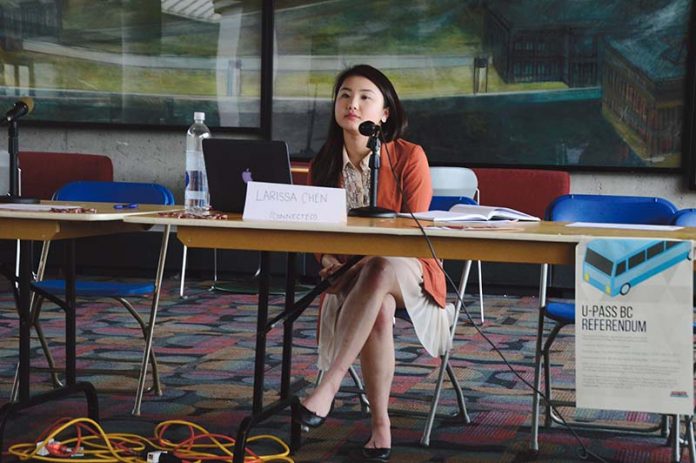
Larissa Chen is just one of two women running for an executive position with the SFSS

“Where are all the female candidates? Seriously!”

That’s the burning question on the mind of current VP External Relations Kathleen Yang. When asked what she wanted to talk about in regards to the Simon Fraser Student Society election, she nearly shouted it immediately.

“I think it’s so unfortunate that there is a huge disparity between male and female candidates, and even non-binary candidates,” she continued. “Candidates that aren’t cisgender males, where are you?”

While the overall number of candidates is down to just 24 this year for the 15 positions on the Board of Directors, only six of them are women. (Ed: We are relying on open knowledge as far as the gender identity of all candidates)

Christine Dyson (right) debates against her opponent for VP External Relations, Archit Bansal.

That’s just 25 percent of the candidates that aren’t men, for a school whose student population is assuredly not 75 percent men. In an election season that is marked by the lack of candidates, it’s a similar story for female representation among those running.

“It’s not just this year,” said one of those candidates Christine Dyson, who is running for VP External Relations. “I think if you look at all the previous years, it’s an ongoing issue. It’s always the case.”

While female turnout has been low in the past four years, it has been much higher in the past. In the 2013–2015 SFSS elections, out of all 108 candidates, 36 were female, which constitutes 33 percent.

Additionally, during these years two of the fifteen positions (VP Student Services and Business representative) did not have a single female candidate run. Another three (Arts and Social Sciences representative, Applied Sciences representative, and VP Student Life) only had one.

While these numbers do not accurately reflect the SFU student body, Dyson said that she hasn’t faced any trouble being a woman who wanted to be on the board.

“Once you’re on the SFSS, it’s a totally inviting environment being on the Board of Directors. I think perhaps leading up to it, with the elections and everything, it can be very intimidating.”

Dyson is part of a slate with four of the six women running, along with Larissa Chen (VP Student Services), Blossom Malhan (Arts and Social Science representative), and Prab Bassi (Communications, Art, and Technology representative). The other two, Raajan Garcha (Health Sciences representative) and Jaggy Kullar (At-Large representative), are with the Bridge the Gap slate. There are no independent women running this year.

Gender Gap InfographicDyson and Chen are the only two women running from all the eligible SFU students for executive positions. They’re also the only two women running who currently are on the Board of Directors, with Dyson serving as the Environment representative and Chen as the Health Sciences representative.

For Chen, while it wasn’t an issue that she realized at first, it’s something she is aware of now.

“This is the truth — and it can go on the record — at first you don’t really think about it. As an individual, you kind of just see the candidates not for their gender but for their work ethic,” said Chen. “Afterward, you realize how this mindset is that you naturally go towards not considering ‘Oh, there’s only six females, that’s a problem.’

“I think it is disappointing that there are only six candidates that don’t identify as male running, ‘cause I have the privilege of working with a lot of amazing females who could definitely be amazing in these positions.”   

Yang believes that one of the obstacles that arises for women running — and also men, explaining the lower number of candidates — is the awareness of what being on the SFSS entails.

“I think if you look at [. . .] what the society has done to our mental health, to our physical health, to overall well-being, I think they look at the student society and they ask themselves why would we ever want to be a part of that,” she said.

For Chen, who is a Health Sciences student, this kind of reasoning resounds more with women, potentially explaining their absence.

“I think that in terms of women, and I’m going to speak from personal experience, I think that women tend to take into consideration more of the other factors in their life other than politics, other than work, other than school,” she said. “As a Health Science student, it’s shown that women tend to seek healthcare more than men do.

“Definitely before I ran, I took highly into consideration what a toll this may or may not take,” she continued. All three women mentioned making this sort of preparation, as each were very aware of the burden that they faced with running and potentially winning.

With all that being said, never once did they advocate for women running just for the sake of having more women run. Chen talked about the process of making the slate, and the thought that went into it.

“There was a consideration that we don’t have enough females. But then me and Christine were saying how we shouldn’t base it just on sex, because that is unfair,” she said. “If we’re going to be advocating for feminism, it’s not just yay women, it’s yay women and men.”

As for Dyson, she affirmed that the slate went with the candidates who they felt were the best fit, although she did acknowledge that she does hope to see mixed representation.

Kathleen Yang, pictured here celebrating her SFSS election victory, wants to see more women run for the SFSS.

“We wanted to have mixed representation. That being said, we did choose the candidates that we felt were the best fit for the position,” said Dyson. “If there is more gender balance, I think that’s very important to have that on a slate, just because you don’t want it to be an all-male board next year.”

At the end of the day though, Yang believes that more needs to be done to encourage more women to run and bring their voice to the SFSS foray.

“I think it’s really up to the folks in power to make space for these individuals who are underrepresented, and actively invite these folks to sit at the table,” said Yang.

“It’s not enough to say, ‘Oh look, we are holding an election.’ You need to actively pull these people into our circles and encourage them to run and participate and do our best to dismantle the extra barriers that prevent them from running.”

The Clan’s March Madness predictions

0
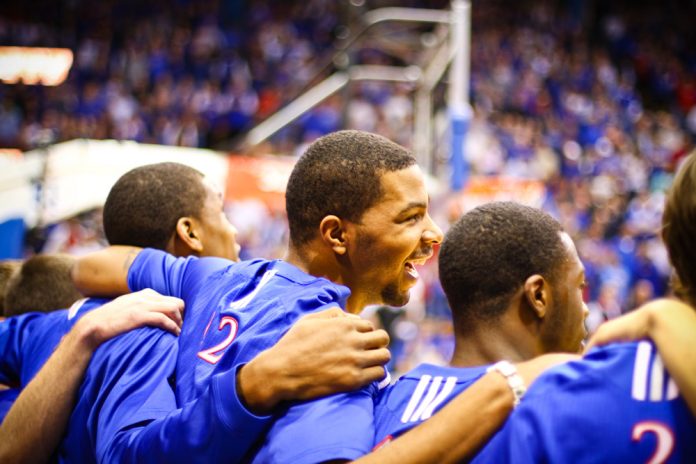
The Kansas Jayhawks are a popular pick to win the national championship.

This year, St. Patrick’s Day marks not only luck for the Irish, but the beginning of the NCAA basketball tournament known as March Madness. Originating back in 1939, the 64-team tournament draws basketball fans and gamblers alike to their TVs to see who will take home that year’s championship title.

After an initial “play-in” game between the 64th and 65th seeds, the tournament breaks into four regions of 16. The winning teams from those regions then comprise the Final Four, who meet in that year’s host city and compete for the highly coveted NCAA Championship Title.

ESPN documented 13.02 million brackets made by fans this year and entered into the Tournament Challenge (a competition hosted yearly to see if anyone is able to fill out a perfect bracket). The odds of filling out a perfect bracket have been calculated by math professors in the United States to be 1 in 9.2 quintillion. That’s 9.2 followed by 18 zeros. This is calculated based on selecting teams like the toss of a coin. Because the odds of a perfect bracket are so small, those of us at the Peak decided to turn to some people who knew the ins and outs of basketball pretty well to see who they predict will win the NCAA Championship.

Michael Harper, a small forward for the SFU Men’s Basketball team, predicts that Duke University will win the tournament. A “longtime fan of the Blue Devils,” Harper says that because Duke is in the Western division — which doesn’t include a lot of other powerhouse teams — they will “have an easier route to the tournament finals.” Harper also brought up the point that many upsets occur in March Madness, making it really hard to predict what is going to happen.

In fact, Ellen Kett, the point guard for SFU’s women’s basketball team, is hoping for a few upsets to occur. “Everyone loves an underdog; I would love to see a Cinderella story,” Kett said. Yale overtook Baylor in a 7975 point final earlier this morning for example, a move that wasn’t in very many people’s brackets. The UALR and Purdue game was also well-fought, with number 12 ranked UALR overtaking the Boilermakers 8583.

Gibran Sewani, another forward on the men’s team, agrees that it is hard to predict who is going to get that championship title saying that “every major program has gone down and lost big games.”

Sewani’s pick for the tournament title champions seems to be pretty foolproof. Twenty-five percent of ESPN analysts, along with Sewani, argue that the Kansas Jayhawks are the team to beat. Sewani’s faith in the Jayhawk’s capabilities stems from the fact that they have “a lot of older guys who have been with the team from the beginning. They know how to work together and get things done to get the win.” He also reluctantly admits “a lot of teams have a good shot at winning this year.”

We’ll have to wait a while to see if the Jayhawks do, in fact, make it to the Conference Finals. March Madness games continue tomorrow, narrowing down to the Sweet Sixteen who will play on March 24 and 25. Tune in to the NCAA March Madness Finals on April 4 to see if any of our SFU Basketball players managed to predict the 2016 reigning champs.

Grace N. Howl on the SFSS Campaign Trail ’16: Cry Hard with a Vengeance

0

Hello again SFU,

In hopes of starting off on the right foot after the horror that was the Surrey debates, I thought I would do something nice for my fans and show up early. I sacrificed some hard-earned beauty sleep to show up to a room that had two people attending. It occurred to me that no one really cared about the elections or had any clue what was happening. These are issues that all of you complain about day in and day out — I hear you talking non-sensical, Cro-Magnon gibberish — and you all decided to just stay home. Lazy, lazy, lazy.

As I sat back and tried so desperately to stay awake during opening statements, platforms, blah blah blah, I couldn’t believe that I was being subject to this nonsense and reduced to actually putting effort into this.

My speech was huge. I blew them all away with my speech that had such rigour and passion. I also inserted incredibly intelligent words, because clearly I know the best words. The audience were stunned into submission; so stunned, I think I saw a tear roll down some weakling’s cheek.

But what really pissed me off was the number of no-shows that people decided to pull. What, you think you’re too good to debate? I’ll tell you who’s too good: ME. And even I decided to show up and pity the masses. You all need to check yourself, because it’s not over yet. The only person that can pull of that no-show move is me.

I will be the greatest SFSS president that God ever created, one that can move people to tears with my word and come out on top even after being manhandled by some “security guards.”

Grace N. Howl

*All documentation has been personally received by Rachel Wong*

Want to learn more about Grace N. Howl’s campaign? Click here.

Check out the first entry of the web exclusive campaign diary here!

Valentine’s Day Prank: Will you be mine?

0

Would you be her Valentine? Gets lonely up here on this university mountain top.

More funny SFU videos: https://goo.gl/CwFl5h

Subscribe on YouTube: http://www.youtube.com/subscription_c…

Website: http://159.203.128.194/

Facebook: https://www.facebook.com/PeakSFU/

Twitter: https://twitter.com/peaksfu

Created by Paige Smith & Eric Smith
For inquires contact [email protected]

Chit Happens

0

The Chitter app allows students to make anonymous confessions. We complied some of our favourites over the past week.

Created by Paige Smith & Eric Smith

SFU hold Whitecaps FC 2 to scoreless draw

0
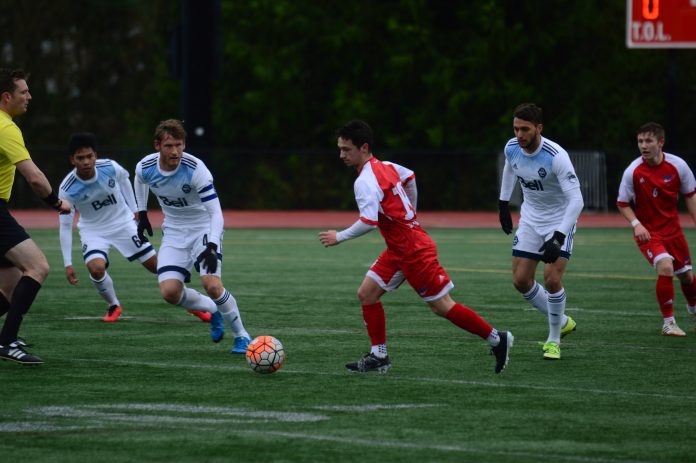
Kyle Jones (centre) and teammates couldn’t break the deadlock in rough weather.

On an incredibly stormy Sunday, the SFU Men’s soccer team took on professional side Whitecaps FC II. The team showed once again that they can compete with the best, as they drew 0–0. It was the exact same score that the team had against Toronto FC II two Fridays earlier.

“I thought we defended very, very well,” said Head Coach Clint Schneider afterwards. “The elements certainly equalized things, [so] that was nice. They’re a really good side, but I can’t say enough positives about the character my guys showed. We played this spring with 10 outfield players, and we haven’t conceded a goal at home in over a year. That’s pretty unbelievable.”

At the start of the game, the Whitecaps dominating possession, forcing the Clan to simply try and attack on the counter. The first good chance of the game fell to the ‘Caps, as SFU keeper Brandon Watson was forced to punch the ball out on a dangerous looking cross.

However, by the 30th minute, the weather started to become a huge factor. The rain was driving across the pitch, soaking everyone who wasn’t undercover, and the wind was so harsh that it knocked over equipment on the covered balcony I was standing under to cover the game. SFU, to their credit, continued to try and push forward, though they could have easily reverted to a defensive shell.

“No, we tried to play,” said Schneider. “I think they got into be a little bit more direct, and it punished them, because the ball would run out of bounds. But we kept things thing and compact, and it was good [. . .] it was nice to not concede a goal. But that’s football, it could have gone either way.”

The second half featured no let up on the weather. It got so bad that even Cedric left to go for cover. Surprisingly though, the second half featured the best chance for either team. In the 65th, Watson had to push an excellent Whitecaps free kick over the bar, saving what would have been a great goal. For SFU, their best chance of the match came in the 78th, when Mamadi Camara — wearing number 10 for this match — made a great run down the left flank, only to have his shot go right into the keeper’s hand.

The game also marked the return of former SFU Head Coach Alan Koch, who is now the head coach of Whitecaps FC II. He led SFU to two Final Four appearances in 2012 and 2013, as well as an undefeated season in 2011.

“Yeah, it’s always cool,” said Schneider, who served as an assistant coach under Koch during his time at SFU. “Those guys, I mean there’s a reason why they’re there. They’re very good at what they do. Any opportunity we have to play against alumni — it’s always very special. Again, I wish the weather would have been a little different for all of us, but I’ll take it. I’m very proud of our guys.”

The game marked the end of preseason friendlies for the Clan. The team went undefeated, and did not concede a single goal during preseason — although they didn’t score any goals either.

CENTRE STAGE: Virginie Brunelle and Maria Kong present strong narrative dance at VIDF and Chutzpah!

0
Open Source embraced interesting characters and expressive choreography.

Foutrement – Compagnie Virginie Brunelle

Vancouver International Dance Festival

March 3–5; Roundhouse Performance Centre

Quebecois choreographer Virginie Brunelle presented a beautiful, arresting work performed by three dancers. Wearing what can most accurately be described as tighty-whiteys, a male and female pair violently and without care collide with each other and fall into each other. No love is lost in their interaction, and we were left wondering what the context of their relationship was.

Another female dancer takes the place of the first one, and it becomes evident that there is some kind of love triangle or infidelity at play. The two women share a duet that has them walking diagonally across the stage, wearing belts all the way up their torsos. They seem devoid of emotion, unsure how to deal with their situation. Slowly they remove the belts and collapse.    

The weight and heaviness of the choreography coupled with bold, intimate movements created a stunning portrait of disillusionment and betrayal. All three dancers were physically impressive with their swift falls and daring throws.

The narrative of the piece was easy to follow and beautifully portrayed the angst of lost love and yearning. Brunelle is a sophisticated movement maker, and I hope to see more of her work make its way to Vancouver.


Open Source – Maria Kong

Chutzpah! Festival

March 5–7; Norman and Annette Rothstein Theatre

With a clear narrative arc, interesting characters, and expressive choreography, Maria Kong’s 2012 work begins on the eve of a woman’s wedding. She looks in the mirror and suddenly all her deepest, darkest fears and desires are revealed before her.

Every movement in this work has a purpose, and this made the story that Kong was telling through it all that much more clear. Each turn of the head or flick of the wrist added to the movement language and told the story of the woman, her groom, and a messenger boy who are trapped in a virtual game controlled by the “All-Time Gamer.”

This gamer was wearing unique digital gloves developed by Kong’s team that seamlessly sync sound to movement. One scene where this was on display most evidently had the messenger cutting the bride-to-be’s hair, and each chop of his fingers on her hair was perfectly matched by the sound effect of scissors. This was an impressive piece of technology I had not seen before.

Expressing the doubts, fears, hopes, and dreams of a woman about to get married, Kong’s choreography was nuanced, yet simple enough that, as soon as the groom laid himself gently on top of the woman, there was an immediate sense of resolution and finality. It was clear that the piece had come to a natural ending and the inner conflict had been resolved.


Coming up: Ballet BC Program 2

March 17–19; Queen Elizabeth Theatre

This program will be a new work commissioned French choreographer Mehdi Walerski who delighted Ballet BC audiences with his Petite Cérémonie and Prelude. This new work is said to build on the themes of Prelude, asking how to balance order and chaos. If it is anything like his previous works, it will become another audience favourite. To expand the company to over 25 dancers, the artists of Ballet BC will be joined by dancers from the Arts Umbrella Graduate Dance Program.


Coming up: Apollo e Dafne

Early Music Vancouver & Pacific Baroque Orchestra

March 18; The Vancouver Playhouse

This one night only performance of Handel’s Apollo e Dafne will also feature a performance of Bach’s lively Orchestral Suite in C Major and stars both the Grammy award-winning opera duo Douglas Williams and Yulia Van Doren, and accompaniment of the Pacific Baroque Orchestra led by conductor Alexander Weimann.

This extremely talented cast of musicians will bring these compositions to life as the drama between two lovers unfolds to display the human condition and the range of feelings in the spectrum between tragic and comic. This is not to be missed for any classical music or opera lovers.

Grace N. Howl on SFSS Campaign Trail ‘16: The Surrey Campus Screw Job

0

Hello SFU,

I cannot believe the sheer nerve that some of these self-proclaimed “politicians” have. How dare they neglect carry on the debate without my presence there? Do they not realize that there is an empty chair for me? It is common courtesy to wait for every person to arrive so that we can all passionately sing the anthem of SFU before starting.

Besides, I don’t just debate with any ordinary Joes. I’ve debated with Joe Biden on climate change and the war on terror! They should have waited – no, they should have sent out a SEARCH PARTY when I didn’t show up. Where could she be, they must have wondered. I’ll tell you where I was: TOO BUSY DOING IMPORTANT THINGS! I don’t have time to sit around a listen to you all whine about busses and books. I can’t even recall the last time I set a Christian Louboutin heel in one of those disgusting things.

So when I finally showed up, no one was there to greet me, no one was there waving their flags and sporting their “Make SFU Great Again” hats. Where is your spirit, people?? I don’t want to lead an army of ghosts to greatness. I’m surrendering my time and effort to help you and your little causes, and you thank me by leaving me behind? How rude.

In the end, I decided to have a bit of a debate with some of my supporters in the Mezzanine of the Surrey campus. Evidently, they weren’t super supporters at all because one of the weaklings actually called security on me. I could not believe the audacity they had to manhandle me the way they did, those monsters. What’s even more laughable was that one of them called me, ME, a monster under their breath. What are you, a little girl? Yeesh.

Whatever, it’s Surrey’s loss. I have Vancouver debates tomorrow, so I’ll destroy them there.

Grace N Howl

*All documentation has been personally received by Rachel Wong*

Want to learn more about Grace N. Howl’s campaign? Click here.

The Peak Board of Directors Meeting | 15 March 2016

0

Peak Publications Society Board of Directors Meeting Agenda

March 15, 2016

The Peak offices

Chair: Max Hill


In Attendance:

  • Maia Odegaard (Board Secretary, non-voting)
  • Max Hill (Editor-in-Chief)
  • Tamara Connor (Collective Rep)
  • Kevin Rey (Collective Rep)
  • Thadoe Wai (At-large Rep)
  • MuhammadQasim Dewji (Employee Rep)


  • Call to Order


  • Approval of Agenda

  • Approval of past minutes from February 16, 2015
  • Financial update


Maia to present the state of the Society’s finances through January 2016 (see appendix A)


  • Layout assistant stipend and job description update


Tamara to present a proposal submitted to the board from the Production team.


  • News Editor and Associate News Editor stipend


Tamara to present a proposal submitted to the board from the News team.


  • Features Editor stipend and job description update


Kevin Rey to present a proposal submitted to board from Tamara Connor.


  • In-camera session


Tamara and Kevin to speak to complaints launched against a collective member.


  • Web News Editor Proposal


Nathan Ross (if Nathan is unable to make it in time Tamara will will present and try to field

questions) to speak to a proposal submitted to the board.


  • Adjournment


Embrace SFU’s commuter culture

1

[dropcap]P[/dropcap]icture your Monday morning. You drag yourself out of bed, question whether you really need this university degree (as per routine), and grudgingly prepare for your day. If you’re like most SFU students, you rush out your door to catch the bus or SkyTrain for your morning commute. And, more often than not, you run right into a friend or classmate.

SFU is notorious for its commuter culture. Going to a university where the majority of students disperse after class as they must endure a significant transit journey to and from school each day really puts a damper on organized social gatherings. Put another way: rainy 6 a.m. bus rides and standing for an hour on the SkyTrain have not helped defend our university against claims of being ‘anti-social’ and ‘depressing.’ But I have to disagree wholeheartedly.

Firstly, I admit that SFU’s culture of commuting is incredibly convenient for me. Living independently is currently out of my financial capacity, and if I had attended a different post-secondary institution that wasn’t so keen on commuting, I’d be the sad, lone student commuting by my lonesome, day in and day out.

Instead, at SFU, I find myself surrounded with peers in the same situation. The common question then becomes not “what dorm do you live in?” but rather “what bus do you take down the mountain?” And in the year that I’ve been asking and answering that question, I’ve gotten to know a lot more people through commuting together than sitting in lecture.

At first I’d inwardly groan or dread the upcoming awkward encounter when running into a casual acquaintance on the bus with whom I’d only really ever exchanged a few words in lecture. However, the multiple meaningful friendships that have arisen out of those seemingly tedious morning encounters have since made me a more social and cheerful member of the student body in the wee hours of the morning.

Morning commutes spent relaying your nonsensical dreams whilst still bleary-eyed turn into a morning coffee run, then a morning sprint to the math class for which you are now officially late. An evening train ride home as you discuss the hilarity or tedious quality of your day effortlessly results in a sushi dinner with friends. For me, transit has only served to enhance, not quell, the unpredictability of university life, and truly emphasizes the notion that meaningful and enjoyable experiences can really be found anywhere.

And even if you’re left taking transit alone on a cold and dreary Thursday evening, a solitary, forced break in your day is not necessarily a bad thing. I had one friend remark that he finds his bus rides peaceful: they give him time to just look out the window and think. Another friend of mine swears that, if it weren’t for the hour break from school that transit forces her to take, she’d never be able to read fiction anymore, a hobby she greatly enjoys.

Our commuter culture, though it may brand us antisocial, is just that: a part of our culture. For me, it’s become a part of attending SFU, a routine in my day. Some days I find myself cursing my wretched fate as I shiver while waiting at the upper bus loop for the 145, but most days I genuinely appreciate the time I get to chat with unlikely friends I never would have bumped into otherwise.

For better or worse, our commuter culture is just another aspect that sets SFU apart from other universities, and something that will always be inextricably linked to my time here.