Home Blog Page 851

Mis Papás

0

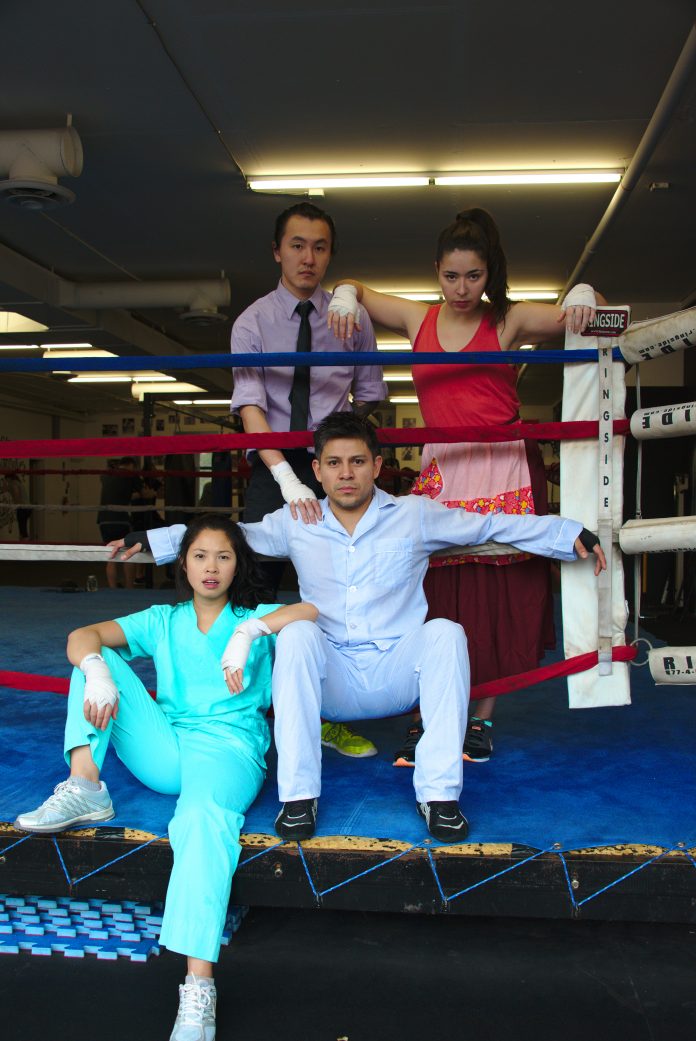
Mis Papás is a highly physical performance set as a 15-round boxing match.

Written and directed by Pedro Chamale Jr. — co-artistic director of rice & beans theatre — the bilingual (English and Spanish) performance follows Chamale’s parents Stella and Pedro Sr., years after making a life in Canada, where an illness “throws a monkey wrench into their life plans,” pushing Pedro Sr. to the edge of his life and back.

The Peak had an opportunity to speak with Chamale about the upcoming performance of Mis Papás at the rEvolver Festival.

The Peak: What lead you to perform Mis Papás again? What do you hope to achieve?

Pedro Chamale Jr.: After our last production, I wanted to do rewrites and tackle the script again. We also wanted to reach a wider audience by applying for the rEvolver Festival. I hope that the audience walks away with a sense of awe at the physicality of the performances and that the show will hopefully speak to those that have gone through a similar experience.

P: How closely does the script relate to the information your parents gave you?  

PC: The script came out of scenes that I had written while taking Block A [a playwriting class at Playwrights Theatre Centre]. A lot of the text is from talking with my parents and from what I remember as a child. It is not verbatim text and I have taken liberties to imagine what had been said. The story about my grandmother threatening the doctor is all true though! What an amazing lady she was!

P: What were the reactions from other immigrated families/individuals?

PC: One night, after a talkback, a Mexican family had stayed behind. They told us that the play was their story; and how much it meant for them to see Latinos on the stage and to see a story that tells a bit of what life can be like after immigrating. Although the events are not exactly the same for them, it spoke to very similar situations that they have had to face.

P: Why did you choose the form of a boxing match to retell the story?  

PC: My dad was an amateur boxer back in Guatemala. It is also something he trained me in. My playwriting teacher, David Geary, kept nagging me to think about boxing as theatre. So eventually I took the form of a boxing match and placed it into the show.

P: How was the process of preparing for this production and offering the actors real boxing training?

PC: Preparing for this show has been both a blast and a challenge — in the best sense though. It was important to get the actors’ bodies comfortable with hitting and being hit during the boxing scenes. With so much physicality and testing of endurance in the piece, it was essential that I could push the actors physically, and know that they would be capable and safe. With that said, a typical rehearsal begins with skipping rope, circuit calisthenics, shadow boxing, followed by mitt-training. This has all helped to make the fight scenes look as though two people were boxing and not two actors pretending to box.

Mis Papás is performing at The Cultch from May 11–15.

Kolejka

0

Kolejka is a heart-warming, grown-up puppet show, inspired by the Polish board game of the same name.  

In Kolejka, Babushka steals and makes her way to the front of bread-lines by any means necessary. The audience gets the sense that she’s looking for something, to fill a missing piece in her life.

star star theatre and The Troika Collective have jointly crafted a story about loneliness and human connections, featuring a combination of rod and shadow puppets, clotheslines, physical theatre, and rockin’ gypsy punk.

Randi Edmundson talked with The Peak about the inspiration, creative process, and bringing puppetry to Vancouver.

The Peak: What was the inspiration behind Kolejka?

Randi Edmundson: It was based on a Polish board game. In the game, you stand in bread-lines and try to complete a shopping list. You can thwart your fellow players, keep them from achieving what they’re doing, and try to get ahead yourself. It was intended to educate, remind people about communism in Poland, but it’s also really fun — kind of an interesting combination. In the show, you’ll see some bread-lines, waiting, and tricking each other to get ahead, but it’s taken a bit of a departure to something a little more narrative.

P: Can you explain the creative process in bringing this to life?  

RE: One of the cool things is that basically everyone has been in the rehearsals, contributing to the story development and throwing ideas for design elements. We spent a lot of the early rehearsals playing with the stuff we thought we wanted. It’s neat, because a bunch of the imagery we came up with, within the first couple of days, has been feeding the creation of the story.

P: Are there other puppets or human characters besides Babushka?

RE: We gave Babushka a little dog companion, Laeika — sort of modelled after the Russia dog sent to space. We added an old man, as a counterpart, we’re calling him Sergei.

We use hats, glasses, things like that, as puppets themselves in a way, to throw these side-community characters in the mix. The puppeteers take on different human characters and work pretty physically on stage to embody them.

P: What does star star theatre ultimately hope to achieve through telling this story?

RE: One of our main interests is to promote and encourage the development of puppetry in Vancouver. It’s interesting that a city as big and culturally active as Vancouver doesn’t have more puppetry, so we’re excited to bring that on one level to Vancouver.

In terms of the story, living behind the iron curtain, sometimes you couldn’t get your hands on things you needed, things as basic as toilet paper. What’s exciting is that the characters still manage to live on, to love, and to connect with one another, no matter how challenging it is to have this basic necessity that they are looking for. We all have challenges in our lives and finding connection within that, I think it’s something we understand.

Kolejka will perform at The Cultch, from May 11–22.

SFU builds better bionic hand for 1st cyborg Olympics

0

“The most exciting moment… was feeling my left index finger and the little finger for the first time since my accident.”

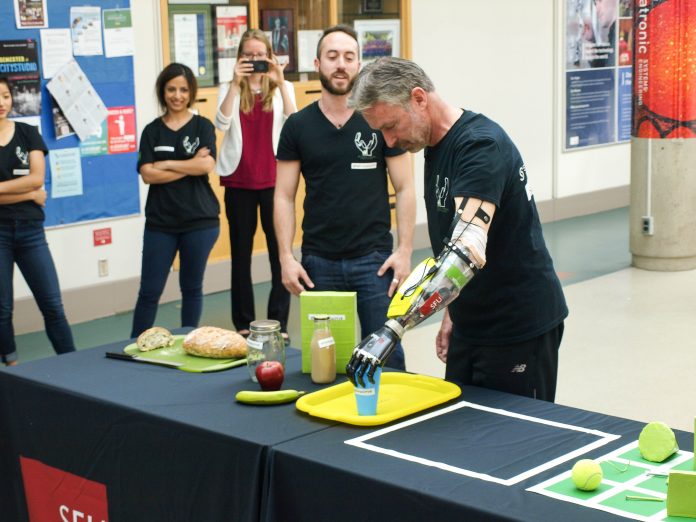
These were the words of Canadian Paralympic skier Danny Letain, after demoing a new bionic hand prosthesis built by SFU researchers from the School of Engineering Science. The team is working with Letain to help him compete in the inaugural Cybathlon competition in Zurich, Switzerland in October.

The Cybathlon is called the world’s first “cyborg Olympics.” The games will be hosted by the Swiss Federal Institute of Technology. SFU’s team is the only one from Canada participating in the Cybathlon. In total, there will be 80 teams from over 30 countries.

The team will have eight minutes to perform six tasks of everyday living using the prosthetic hand, including using kitchen items, completing puzzles, opening doors, and more.

The bionic hand, created in Engineering Science professor Carlo Menon’s lab, was originally intended to help stroke patients. Menon thought the technology could also be used by amputees. He explained that conventional prosthetics are not very intuitive.  

There is a high rejection rate among patients, and control systems have not significantly changed in over 50 years, he said.

The hand, a collaboration between SFU, Barber Prosthetics, and Steeper Prosthetics, is much more intuitive. It utilizes “a completely new approach to picking up signal and controlling an electric prosthesis from someone’s body,” said Barber Prosthetics head of Research and Development, Brittany Pousset.

She explained how “machine learning” might improve users’ motion availability. The hand itself is a Bebionic 3, on loan from Steeper Prosthetics of Leeds, England.

SFU’s contribution to the technology is the new control structure of the hand. Most systems used today were developed 50 years ago. These myoelectric devices are controlled by electromyogram signals that measure only two electric signals. SFU’s control structure uses force myography to detect intricate muscle movements along the surface of the remaining limb using a band of sensors around the forearm.

“With this new system, it feels like I’m opening and closing my hand,” said Letain. One of the greatest improvements of the device, according to Letain, is the ability to use the prosthetic limb above his head, something conventional systems fail to deliver. 

The SFU team, known as MASS Impact (Muscle Activity Sensor Strip), is part of the MENRVA Research Group. It’s made up of biomedical engineering and kinesiology research students and alumni. MASS Impact, Letain, and prosthetists from Barber Prosthetics have been working on this project since June of last year.

The hand takes a few minutes to “train” before use. Once activated, Letain cut bread, moved small objects, and even opened a jar using the prosthetic hand. The demonstration drew a large media audience including CTV, the Canadian Press, and many others.

Letain lost the lower part of his left arm in an accident while working on a CP Rail train on September 2, 1980. He said, “as an athlete… it’s the desire to win and the desire to do your best” that pushes him to persevere when things are challenging.       

“The SFU team is amazing, and they inspire me to want to be a part of it and want to do more,” said Letain. “I just see them as a bright, energetic group that is a true pleasure to be a part of.”


SFU’s fossil fuel investments subject to controversy

0
Will SFU follow other Canadian universities and reject the call to divest?

Should SFU divest its $367 million endowment from fossil fuels? For the divestment group SFU350, the answer is a resounding ‘yes’.

Earlier this month, SFU 350’s Raaj Chatterjee and Tessa Ramburn met with the SFU Responsible Investment Committee (RIC) to present the results of an SFU350 and Embark student engagement event that gathered opinions and suggestions from students in late March.

SFU350 collected input from 50 students, and gave a list of suggestions on how to build a divestment policy to the RIC, such as prioritizing social and environmental well-being ahead of the political repercussions of divestment.

They also suggest that future investments should be made under the Paris Pledge for Action that the university signed in late 2015. The pledge acknowledges the dangers of extreme climate change, and pledges to limit global warming to 2 degrees Celsius.

Chatterjee explained in an interview that even though SFU has signed this document, they have a long way to go when it comes to responding to requests for fossil fuel divestment.  He said that so far, SFU is “responding in line with other universities,” and that he hopes “that they follow through with the divestment policy.”

The recent trend in Canadian universities has matched that of SFU. Earlier this year, UBC, McGill, and University of Toronto all rejected calls to divest.

A common explanation for rejecting divestment is that fossil fuel shareholders themselves would be better able to exert pressure on the industry to reduce carbon emissions. That doesn’t sit right with Chatterjee, though. He argued that logic is “completely false, and even the RIC, a couple of meetings ago, had written out a report that confirmed that [remaining a shareholder] had very little effect” on the fossil fuel industry.

He explained that remaining a shareholder and asking for lower emissions is “like you’re telling the fossil fuel industry to not do something that would give [you] profit, which doesn’t make any sense.”

During their presentation, Chatterjee and Ramsburn also explained that they have have collected hundreds of signatures from students who have pledged to some form of direct action should SFU fail to divest.

This kind of response caught national attention in late March when nine members of Divest McGill staged a sit-in at McGill Vice Chancellor Suzanne Fortier’s office for four days. Many others camped outside in solidarity, and on the last day of the sit-in, 20 McGill alumni handed back their diplomas.

The group also received word that a $2 million donation to McGill had been withdrawn in response to its rejection of divestment.

The next Monday, the Principal issued a letter to Divest McGill stating that the Board planned to partially meet Divest McGill’s requests by providing open forums in the fall and publishing the expert testimony that led to the decision to not divest.

For those impatient to hear back from the RIC, some groups at SFU have already begun tackling the issue of divestment head on. The SFU Faculty Association voted “overwhelmingly” to create an optional pension fund divested from the fossil fuel industry and the SFU Graduate Student Society has also set a goal of complete divestment by 2019 — after starting to divest in 2014, currently only 1 percent of their portfolio remains in oil and gas.

As for SFU itself divesting, Chatterjee said that the first steps are straightforward: “I think we could definitely easily divest from all of the direct holdings that we have, which is not many.”


Views will be remembered as one of Drake’s best albums

0
After two years of speculation and two mixtapes Views finally has dropped.

Views (formerly Views from the 6) has been the subject of much speculation ever since Drake announced the project way back in 2014. Since then, Drake’s dropped the successful album/mixtape If You’re Reading This It’s Too Late, as well as Future collaboration What a Time to Be Alive, both of which have helped transition Drake’s sound into more trap territory, shifting away from earlier, more atmospheric songs such as “Marvin’s Room.” Read below for our track-by-track review.

“Keep the Family Close” – A surprisingly orchestral track, a sharp contrast from his two previous efforts. Drake sings about the usual feeling of betrayal and heartbreak. Something different from his previous songs, but I like it.

“9” – A great track that combines a hard-hitting trap beat with a synth backing that feels like it’s hovering above the whole thing. “I turned the 6 upside down / It’s a nine now” is a great line.

“U With Me?” – Gives off a great late-night vibe. As Drake says on the song “I made a career off of reminiscing,” and this song is no different, with Drake thinking back to one of his many past relationships.

“Feel No Ways” – Sounds like something straight off a mid-’80s pop song. Sounds very similar to “Find Your Love,” arguably Drake’s best song off his first studio album. And it all ties in well with the lyrical theme of changing feelings and moving on. Great track.

“Hype” – A return to recent Drake songs that listeners may be familiar with. A very basic beat with Drake hyping himself up with lines such as “Views already a classic.”

“Weston Road Flows” – Named after a major road out in the 6, on this track Drake reminisces about the life he had before he blew up and became the cultural phenomenon he is today, as well as some shots against the competition. “I’m lookin’ at their first-week numbers / like what are thoooooose” is probably the best line on the whole album. He even managed to get a line in about Kevin Durant. Perhaps a tampering charge is coming to the Raptors?

“Redemption” – A very laid-back track, in which he sings about an ex-girl and wonders what to say to her. Harkens way back to his So Far Gone days, a very simple beat and heartfelt singing and lyrics. The last verse is especially poignant, talking about how his friends and family have changed since he got famous.

“With You” – An absolute banger. PartyNextDoor nails the hook, and Drake’s verse is great. Very similar in structure to “Come and See Me,” given both songs boast a single verse, but this track is way more upbeat and fun.

“Faithful” – A track that was leaked a few weeks ago. It’s a throwback to the emotional and sensitive tracks from Take Care. Drake discusses his feelings for a girl, but laments that she is too busy working. The first verse is one from the late Pimp C, taken from the Tom Ford remix. Also features a verse from one of my favourite new artists right now, dvsn, who are signed to Drake’s OVO label.

“Still Here” – A song to separate the real from the fake. Drake talks about how he started from the bottom, and thus can spot the outsiders from a mile away. Production-wise, sounds very similar to Future, from the beat to the slightly auto-tuned singing throughout the song.

“Controlla” – Gives off a similar vibe to his remix of “Sweeterman.” A very mellow track that you can just zone out to, with a catchy hook and a great beat.

“One Dance” – Described by Rap Genius as a “afrobeat song with dancehall inflections” it’s a super-catchy song with a great beat that drives the song. This song has also been around for a few weeks now as well, but it’s still a great track.

“Grammy” – I have to say, Future’s verse on this track is very underwhelming. It’s very repetitive, and I know that’s his style, but it just does not suit the song.

“Child’s Play” – Drake raps about how buying girls items is nothing to him now, thus it’s child’s play. A fun track, but is overshadowed by other great tracks on the album.

“Pop Style” – The album version notably does not feature the verse from the throne, aka Kanye West and Jay-Z. But it’s still a great track. The lyrics deal with Drake’s ever-increasing trust issues, and the beat sounds very ominous. A great track.

“Too Good” – Drake and Rihanna team up once again on this song. The song is about a couple who think they’re both too good for each other, and it continues the Jamaican/African dancehall vibe that is prevalent on some of the other songs.

“Summers Over Interlude” – A complete 180 from the other songs, as it resembles a slow rock song more than anything else. Just a standard interlude that really didn’t need to be on the album, and it’s weird that he included it on it in the first place.

“Fire & Desire” – Drake displays his dedication to one woman in this song. Problem is, she’s already taken. Possibly a song about Nicki Minaj, given his comments about her to Zane Lowe on OVO Sound Radio the day that Views was released. 

“Views” – Arguably my favourite track on the entire album. Drake drops line after fantastic line on a great beat very reminiscent to “Lord Knows” off Take Care. Lyrically the song is similar to “6PM in New York, in that Drake talks about where he came from and where he’s headed.

“Hotline Bling” – The same “Hotline Bling” we’ve been listening to for almost a year. I would have liked to see a remix of the song, or the version from the popular music video where it gets right back into the beat instead of fading out. Still a great track, but I think “Views” would have been better as a closing track.

Overall: A grander album, very different from If You’re Reading This It’s Too Late. The songs flow together and more to the production, compared to the stripped-down songs on IYRTITL. You can’t really pin down a musical theme for this one; there’s just so many different ones from Jamaican afrobeat to trap to more traditional hip hop. If you don’t like it the first listen, give it a couple of more tries; it will probably grow on you. I think in a few years we’ll be looking at this one as one of Drake’s best.

The Peak Board of Directors Meeting Agenda – April 21

0

Peak Publications Society Board of Directors Meeting Agenda

April 21, 2016

Hub Restaurant

Chair: Max Hill

In Attendance:

  • Maia Odegaard (Board Secretary, non-voting)
  • Max Hill (Editor-in-Chief)
  • Tamara Connor (Collective Rep)
  • Kevin Rey (Collective Rep)
  • Thadoe Wai (At-large Rep)

Regrets:

  • MuhammadQasim Dewji (Employee Rep)
  • Call to Order


  • Approval of Agenda


  • Approval of past minutes from March 15, 2015


  • Financial update


Maia to present the state of the Society’s finances through March 2016 (see appendix A)

  • Investment update


Maia to present the state of the Society’s investment portfolio through March 2016 (see appendix B)

  • Pay increase for editorial team


The board will discuss raising the salary of editorial team members to adjust for inflation and as a result of increased expectations.

  • Adjustment of job descriptions


The board will discuss slight adjustments to job descriptions, including finalizing the web editor job descriptions and clarifying overtime pay, web producer/digital strategist role as it relates to web editor, etc.

  • Leaving InMotion Hosting


The current hosting company we are using for our website is at the root of all the problems we’ve had this past year and their customer service is subpar. The board shall discuss the merits of switching service providers.

  • News Editor and Associate News Editor stipend

Tamara to present a proposal submitted to the board from the News team.

  • Adjournment


———————————————————————————————————————————

Peak Publications Society Board of Directors Meeting Minutes

March 15, 2016

The Peak offices

Chair: Max Hill

In Attendance:

  • Maia Odegaard (Board Secretary, non-voting)
  • Max Hill (Editor-in-Chief)
  • Tamara Connor (Collective Rep)
  • Kevin Rey (Collective Rep)
  • MuhammadQasim Dewji (Employee Rep)
  • Nathan Ross (Guest)
  • Christy Lum (Guest)
  • Jessica Whitesel (Guest)

Regrets:

  • Thadoe Wai (At-large Rep)
  • Call to Order 4:34 p.m.


  • Approval of Agenda


Tamara/Kevin
Approval of past minutes from February 16, 2015


Tamara/Kevin


  • Financial update


Maia presented the Society’s finances through February 2016 (see appendix A)

Tamara/Kevin

  • Web News Editor Proposal


Nathan Ross proposed a pilot Web News Editor position to replace the current Associate News Editor for a period of one year beginning summer semester 2016, to be reviewed by the Board at the third meeting each semester, and up for a final review at the end of the spring 2017 semester. The position will have a slightly higher pay stipend and will work in tandem with a Print News Editor to ensure a web-first focus for news at SFU.

BIRT the Board temporarily dissolve the Associate News position effective summer 2016.

All in favour

BIFRT we implement the role of Web News Editor with the attached job description, pending changes made by a task force comprised of Nathan Ross, Max Hill, Tamara Connor, and Kevin Rey.

All in favour

Tamara/Qasim

  • Layout assistant stipend and job description update


Layout Assistant Christy Lum presented a request on behalf of her and Gabriel Yeung, asking that they receive additional pay in the amount of $975 each for the work they have been doing over the semester. The board discussed the need for assignments to be better distributed amoung members of the production team and that their job descriptions be amended to reflect a no paid overtime clause to prevent this situation from recurring.

BIRT the two layout assistants are retroactively awarded $650 each to reflect and additional $50 per week for all 13 weeks.

Tamara/Kevin

All in favour


  • Camera repair quote and update from Lisa


Tamara presented the quote to the Board at $230 to repair the damaged camera and it was less than the cost of a new camera, therefore it was approved.

Tamara/Kevin

All in favour

  • News Editor and Associate News Editor stipend


Motion tabled until further notice.

  • Features Editor stipend and job description update


BIRT Tamara be retroactively awarded an additional $50 for each week of the semester based on the fact that she has been doing the work of a full-time editor, and the Features Editor formerly received $300 per week.

Kevin/Thadoe (via proxy)

All in favour

  • Appointment of board representative for hiring panel


The hiring board for The Peak’s upcoming summer semester will be comprised of Max Hill, Maia Odegaard, and Nick Bondi.

No vote

  • In-camera session


Tamara and Kevin to speak to complaints launched against a collective member.

  • Adjournment 7:15 p.m.


Hiring: Photo editor for the summer semester

0

Are you an unapologetic shutterbug? Is your Instagram profile almost as popular as your Flickr account? Look no further: The Peak is hiring a photo editor the summer semester. Applicants should send in a resume as well as a brief cover letter and portfolio. Sample work relevant to the position(s) applied for is highly encouraged.

The Peak‘s hiring board is looking for a talented and driven SFU photographer to serve as our photo editor. You will work with writers and editors to provide a diverse and creative selection of photographs for our paper, as well as working with and guiding a team aspiring photographers across SFU.

Working for The Peak is an excellent way to gain hands-on experience in the fields of photography and journalism. You will meet like-minded individuals who work hard and play hard in a high-energy environment.

Applicants must be registered SFU students for the duration of the semester for which they are applying. Previous experience with our newspaper is preferred, but not required. Please address your applications to The Peak hiring board at [email protected], or drop them off at our offices in MBC 2900. Any questions about the process can also be sent to this address.

Applications are due Tuesday, April 18 by 11:59 p.m. The job description for the role can be found here.

CENTRE STAGE: Touchstone Theatre brings back Late Company; DanceHouse brings Brazil’s Companhia Urbana de Dança to Vancouver

0
Companhia Urbana de Dança brought joy and passion from Brazil to Vancouver.

Late Company

Touchstone Theatre

March 29–April 2 at the Evergreen Cultural Centre

April 5–9 at the Vancity Culture Lab

Debora Shaun-Hastings reads a letter aloud to her dinner guests. She describes coming home with her husband, Michael, one evening not long ago. She remembers being annoyed that her son, Joel, hadn’t left the outside light on for them. They assumed Joel must be asleep already. Once she got upstairs, she noticed that the bathroom door was closed and went to open it. Lying in the tub was Joel, as if asleep, a large pool of blood on the floor. She described running to him, slipping in the blood; she shook her son, checking for any signs of life while lifting him up out of the tub. Slipping again on the blood, she fell, Joel’s body landing on top of her.

Linda Quibell gave an emotional, heart-wrenching performance as Debora, a grief stricken mother hoping to find some kind of closure or emotional release by inviting Curtis, her son’s classmate who had bullied him, and his parents over for dinner. They plan to exchange letters and discuss how they are all feeling in the hopes that this exercise will provide some kind of solace.

Tamara, Bill, and Curtis are late arriving, and just as Debora and Michael discuss whether the whole thing is such a good idea and are about to choose a safe word, the doorbell rings. Their initial greetings are as awkward as can be expected under the circumstances. Things seem to be going well as the mothers discuss their similar taste in books, and the fathers realize their share an alma mater, but as the night wears on they all struggle to contain their true emotions. Blame is thrown back and forth as Debora blames Curtis’s actions for Joel’s suicide and Tamara suggests that Joel’s depression and Michael’s absence as an MP in Ottawa explains it. Bill suggests that Joel was asking for it by wearing eyeliner to school and openly presenting himself as gay.

Playwright Jordan Tannahill has created a gripping masterpiece of dialogue-driven theatre that deals with themes of sexuality, bullying, parenting, politics. Touchstone Theatre originally mounted this play in 2014, and director Katrina Dunn returns along with most of the original cast who all give exceptional performances. The story immediately draws you into the lives of these characters all looking for some kind of relief from their grief, but the story shows us that they may be no such thing as closure and an emotional letter of apology is not going to change a mother’s grief for her lost son.  


ID: Entidades and Na Pista

Companhia Urbana de Dança

April 1–2 at the Vancouver Playhouse

Everyone in the Playhouse audience was on their feet, clapping and dancing along to “Uptown Funk.” On stage, the dancers of Companhia Urbana de Dança showed off even more of their stunning moves during their energetic encore. I have rarely seen a dance audience so enthusiastic, nor have I seen an ovation go on that long — we stayed standing for the encore and revelled in the joy and exuberance of these dancers from the favelas of Brazil.

Choreographer Sonia Destri Lie explained during the pre-show talk that her company receives no funding from the Brazilian government nor from corporate sponsors, so it is very difficult to get by and she, along with her dancers who come from the favelas (slums) of Brazil is doing this for their sheer love of dance. That love is evident onstage, and along with the emotion pouring forth from them, the dancers were incredibly talented.

The first piece, ID: Entidades began in darkness, the dancers sitting hunched over at the back of the stage. One by one they begin moving around the stage with grace and strength. The eight men and one woman displayed their hip-hop- and breakdance-inspired moves and impressed with physical feats that were beautiful and full of emotion.

   Na Pista was much more upbeat and began with the dancers coming down the aisles, calling to each other and admiring their nice party outfits. After assembling onstage, they danced around a grouping of chairs at centre stage in a highly entertaining game of musical chairs. The chairs were then lined up at across the back of the stage and they took turns coming forward to perform. This piece was a lot of fun with a high energy party atmosphere, disco ball, and humorous moments such as their synchronized water breaks.

It’s baffling that a company this talented is not embraced in their home country as they are elsewhere. Destri Lie explained that Brazil is a very racially segregated and prejudiced country, and because her company is full of black dancers, they are discriminated against.

They may not be able to fill a theatre in Rio de Janeiro, but they had the entire Playhouse Theatre mesmerized two nights in a row.   

SFU chancellor Giardini: Your $10,000 dinner fundraiser for Christy Clark is not a gender issue

1

[dropcap]S[/dropcap]FU’s chancellor Anne Giardini was criticized in national media this past weekend for hosting, in her own home, a $10,000 per plate dinner fundraiser for SFU alumni Christy Clark. While Giardini claimed the criticism is due to Christy Clark being a woman, SFU students should be concerned with elitist political fundraising, and how our public university’s governors use their political power.

Giardini, who is also the wife of mining executive Tony Giardini, welcomed 10 people into her home to enjoy a multicourse meal. For $10,000 per plate, there’s no doubt they expected more than a nice steak and dessert — they wanted face-to-face access to Christy Clark.

When questioned, Giardini said she was not “comfortable” discussing the dinner, or divulging the names of those paid such obscene amounts of money to attend.

She went on to express the need to support women in politics. She said women are “particularly targeted” by stories of party finance, and women have a very hard time raising money to be in the political system. When questioned about whether she believes this is a gender issue, Giardini responded, “Yes, I think it is.”

No, this is not a gender issue. This is an issue of rising democratic inequalities where only the moneyed elites have access to political power. BC NDP leader Joe Horgan raises money through private fundraisers too, and it’s just as wrong. Jen Gerson from The National Post commented, “If there’s a correlation we should be considering, it’s not one of gender, but of totally inadequate fundraising laws.”

Fundraising through private events is currently completely legal, although Democracy Watch co-founder Duff Conacher said it may violate conflict-of-interest laws in Canada. Legalities aside, it is morally and ethically problematic; political power should not be for sale in Canada.

BC needs legislation that bans corporate and union donations, and caps individual donations.

This type of fundraising is commonplace in BC and across Canada in provinces such as Alberta and Ontario. Unpublicized fundraisers are commonplace, with attendees paying between $5,000 and $20,000 for the ears of our politicians. Bob Rennie, chair of fundraising for the BC Liberals said that they might hold about 20 more fundraisers between now and the 2017 provincial election.

Put bluntly, we need party finance reform in BC. In 2006, the federal government banned corporate and union donations, and capped individual donations. Christy Clark has promised more transparency and disclosure of donations, but this is not enough. BC needs legislation that mirrors the federal government’s actions.

If the recent Panama Papers leak has revealed anything, it’s that there is a growing dichotomy in the way the rich one percent and the rest of us are treated under the law. We are left to pay taxes and scrape by on student loans, to invest in an education that may not pay off, while the rich stash their money in offshore bank accounts, avoid taxes, and pay thousands for exclusive access to politicians, such as Christy Clark.

What can we students do about this? For a start, we can be visibly upset and spread the word. Educate your friends and family; make others aware of the issue. Make party finance reform a hot topic and force the government to address this issue. “Change doesn’t happen by itself,” Edward Snowden warned at SFU Public Square’s event in Vancouver earlier this week.

Political fundraising is not a gender issue, but an issue that affects all Canadians and alienates average voters from their elected representatives. More robust party finance laws in BC and other provinces would be a benefit to people, and would not affect genders disproportionately.

Dhesa bridges the gap, leaves Rapaport disconnected

0
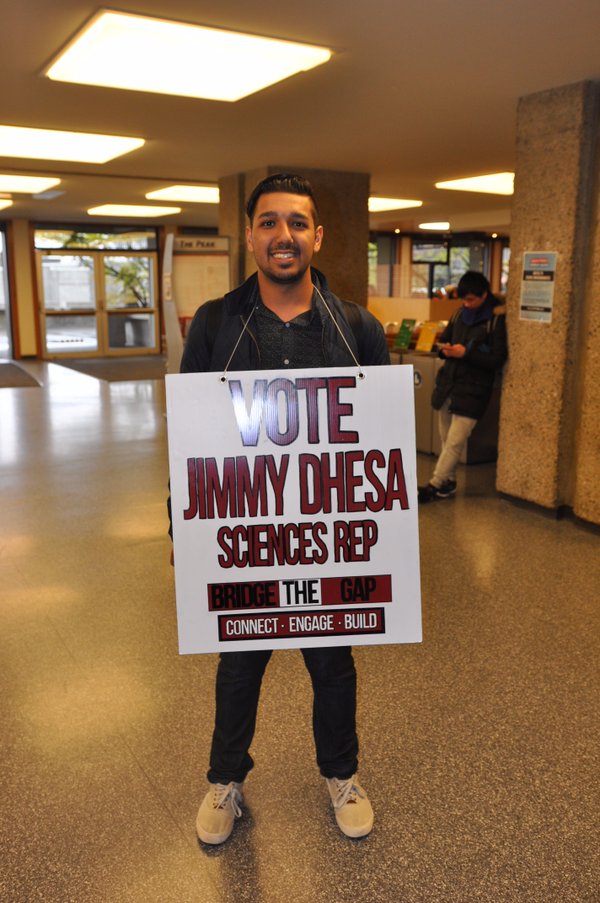
Victor Jimmy Dhesa is pictured here out getting votes during his second campaign period.

It was a race so tight they held it twice.  

Jimmy Dhesa eked out a victory over opponent Thomas Rapaport in a one day only re-vote on April 7 for the Science Representative to claim the last spot on the Simon Fraser Student Society Board of Directors. He defeated Rapaport by a vote count of 541 to 444.

He joins Health Science Representative Raajan Garcha as the only candidates from the Bridge the Gap slate to win their seats. Rapaport failed to complete the sweep for Connected, as every other Connected candidate won their seat in the original election which took place in March.

Dhesa was studying at the Surrey campus with friends when he found out, and the news caught him off guard when it broke around midnight.

“I didn’t expect the results to come out until the morning after,” said Dhesa. “All of a sudden, our phones started blowing up and then Raajan calls and she’s like, ‘Check the SFSS website right now.’

“As soon as we checked it, we started flipping out. Everyone in the room was screaming and people thought that something happened. I guess people around the campus started coming and looking in the room and asked ‘Are you guys okay?’ It was an amazing moment.”

It took a little longer than he would have liked, with the original election ending in 280 votes for each candidate, ending in a historic tie and leaving the Independent Electoral Commission no choice but to call a re-vote. However, any plans to celebrate will have to be put on hold, as he’s now firmly in exam mode.

“We had the first elections, in which I budgeted all my time for, and then I said to myself that no matter what, win or lose, I’m going to put all my time towards studying,” he said. “[With a second campaign] I didn’t have time to study, so now I’m going to hit the books once I get home.

“The celebration will be delayed until after finals.”

The time for celebration will have to short though, as come May 1, the new Board of Directors for the SFSS will be taking on their new roles, and starting their efforts to fulfil their campaign promises for the coming year.