Home Blog Page 845

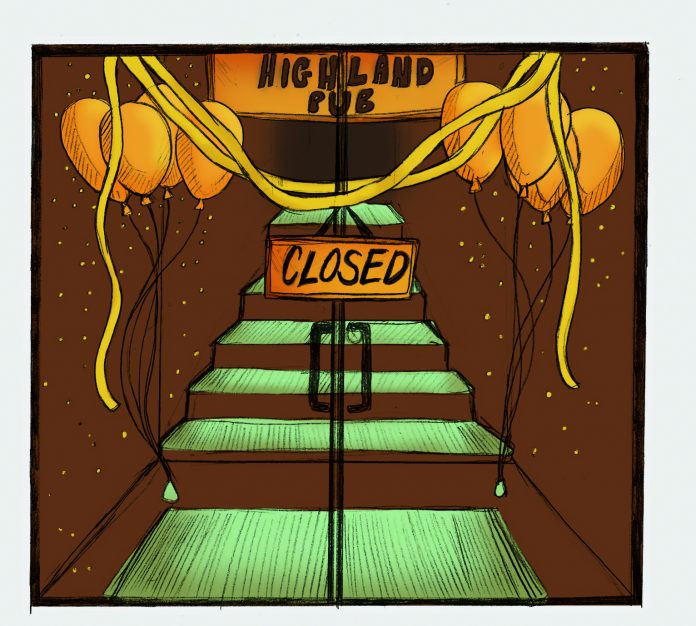
Is the Highland Pub closure a front for an SFSS secret “party house”?

0

A recently released anonymous report has suggested that the Simon Fraser Student Society (SFSS) has orchestrated the Highland Pub’s ongoing financial worries and recent closure for a secret purpose: seizing the premises for wild ragers in the comfort of their home campus.

The SFSS directors might be straitlaced, hard-working students with a desire to give back to the non-existent community of this commuter campus, but as the report mentions, that reputation comes with a cost: severe repression of the natural human need to get weird sometimes.

“They’re under great societal pressure to maintain squeaky-clean images,” remarked Psychology student, Baz Semke,“who can blame them for resorting to foul play and falsification of documents if it meant finally letting loose the way Blue Mountain State promised they would at university?”

All official documentation indicates that the popular student hangout has indeed been silent and sealed off around the clock. Yet there have been a number of eyewitness accounts of strange goings-on at night, up to and including a competitive dance-off conducted to a remix of “Hotline Bling.”

“I knew the SFSS was responsible right away,” asserted one student. “The glinting of VP Student Life’s distinctive earrings as he moved to the groove was unmistakable to me, even while half-asleep.”

Deepak Sharma, the President of the SFSS, denies all claims of foul play: from rumours of VP Finance faking the Highland’s bank statements to allegations that John Flipse, general manager of the Highland, was baked into a pie and replaced by a suspiciously similar substitute.

“Yes, the pub’s got a nice pool table, and sure, we’ve been tempted to divert funding towards Boozy Fridays. But our little meeting room is our home,” said Sharma. “Besides, if we really cared about the collegiate party scene, we would’ve transferred to UBC or UVic a long time ago.”

Peak Comics: Peers

0

Week7(3)

The double life lived by student sex workers

1

As Ava* embarks on the first semester of her master’s program, she is relieved that the admissions committee at her graduate school didn’t find out about one of her part-time jobs.

The University of Calgary environmental sciences student dabbled in a variety of work during her undergraduate studies, but by far her most lucrative gig was sex work.

For three months, Ava met with clients she contacted through the popular dating and escort website, Seeking Arrangements, to go on dates and sometimes have sex before collecting payment for her services.

“I paid for a year and a half of tuition,” she explained of her stint in the industry. “The downside to that was I suddenly had this money that wouldn’t be explained through the job [as a bowling alley attendant] I had at the time.”

Prompted by a bubbling curiosity, Ava became involved in sex work during the second year of her studies. She soon secured one main client who sought out her services twice a week, and she ended up going on two other paid dates over those three months.

Her main client, who she calls Steve*, would take her to dinner, on hikes, or to watch a movie, and then back to his place to have sex.

“Just to preserve yourself you have to stay silent, even if it’s something you really want to talk about.” – Ava

“More or less like how you would have a girlfriend, only if you didn’t talk to your girlfriend outside of your dates,” she remarked.

Hiding in plain sight

Even though she wants to speak out about her experience, Ava faces the tremendous stigma attached to selling sexual services.

Many post-secondary students who earn an income through sex work feel compelled to keep the nature of their work secret to protect themselves from discrimination. This is despite the fact that students gaining an income from sex work is neither new nor uncommon.

Simon Fraser University recently made news for having one of the fastest growing “sugar baby” populations in the country — that is, an increasing number of students signed on to the website Seeking Arrangements. While some users see it as just a dating app, others use it as a way to pay their tuition.

Ava used the site to meet clients who would in turn pay her for her services, which she considers sex work to be. However, she recognizes that the stigma attached to the sex industry means that many other website users do not view what they do in the same light.

As students may choose not to identify themselves with the sex industry, there are no representative statistics on how many may be involved in selling sexual services.

Stigma can also be a factor in the choices clients make when hiring a student sex worker, according to Ava. Those using sites such as Seeking Arrangements, she speculated, prefer to seek out a student in order to distance themselves from the stereotypical notion of sex work.  

Though our image of a sex worker might be someone working on the street to support a drug addiction, Canadian show a different picture: they place the figure of non-street-based sex workers between 80–95 percent of the overall sex worker population. This encompasses male, female, trans*, and non-binary workers providing a variety of sexual services from massage parlours and escorting to online sex work.

Despite the variety of services, one commonality remains: that dealing with those outside of the industry can often be a sex worker’s greatest challenge.

A study released by SFU researcher Raven Bowen earlier this year found that Vancouver women leaving the sex trade reported harassment when transitioning into mainstream careers and even faced losing their newly secured job due to “whore stigma.

Still, many sex workers are eager to voice their experiences so that people can relate to their work.

“People know about sex work, [but] they don’t know any sex workers,” Ava contended. “Sex workers can still lead normal lives within sex work, and then out of sex work, regardless of what the media thinks.”

Tricks of the trade

For Ava, balancing university life with sex work was rewarding — at least, for the most part. Besides earning substantially more per hour than she could at other jobs, Ava said that she found her friends to be largely open to the idea.

“My friends were really shocked at first, and then they were like. . . ‘I guess you’re doing what you want and you’re doing it safely,’ so they were okay with it,” she reflected.

Her arrangement with her main client didn’t pose any major problems, either.

From the start, Ava proposed a written agreement stating the boundaries of their interactions as well as her rates. For BDSM, which was also included in the agreement, she sought special limitations. She said that her client always respected the conditions of their relationship.

Though Ava admits that what she was doing was sometimes dangerous, she took precautions by notifying her sisters of her visits with her clients and telling them where she planned to be. Looking back, she wishes that she would have been even more careful.

“I witnessed myself becoming a victim to people in my life and I also witnessed a loss of my own voice, people stopped believing that my experience was the truth.” – Brenna

“If I was to coach somebody else on how to get into the industry, I’d [tell them] ‘make strict rules for yourself, don’t break them, they’re for your safety,’” she said. “I definitely met two of my clients for the first time in their car, and they were strangers — which is dangerous.”

However, Ava still found balancing her work with her professional and personal life to be her greatest challenge. The fear that her parents would find out about her work always loomed in the back of her mind.

“I was having constant anxiety about that,” she admitted.

As an advocate for normalizing sex work at university and having just completed an application for grad school, she also acknowledged how that experience could affect her education.

“I’m glad I didn’t talk about sex work on my Twitter account, because I know they vet you online,” she explained. “If they’d found that, whatever committee admitted me to grad school might have a different opinion of me. Because, of course, sex workers are still considered criminals.”

Despite her concerns, she speculated that she’d probably do sex work again if the opportunity arose. She broke off her earlier gig with the economic downturn in 2013, as her main client could no longer afford to buy her services. Ava said at the time she didn’t want to go through the hassle of finding another client who would accept her terms — so she quit.

Part of her reason for speaking out is that she feels it is important to tell people about her experience in order to dispel the overwhelmingly positive or negative views of sex work that many people hold.

“Really my experience was neutral,” she explained. “It was like having a job in a retail place for three months.”

A similar experience

Ava is not the only person who reports that they were drawn to sex work out of curiosity. Brenna chose to give online sex work a try when she heard how much she could earn, and worked extensively as a ‘cam girl’ while saving up to go back to school.

“I saw the opportunity to use it as a form of employment while I went back to school, which was the goal at the time,” she said. “I saw it as something to do while I was in school.”

Brenna, who identifies as a trans woman, found that her role as an online sex worker was a reliable and profitable job to support herself.

“I enjoyed a lot of things about my work. I enjoyed the freedom it allowed me to control my schedule, to control my financial freedom,” she explained.

“Often my work was just chatting with people about their life and making them feel a little less lonely. There were certainly many clients that I had very positive working relationships with, who I felt really respected me and valued their time with me. I always hoped that, at the end of the day, they felt a little less lonely and a little bit more validated in their life after talking to me.

“I had days where I didn’t want to log in or I just wanted to stay in bed or go to the beach with friends, but that can be said with any job.”

Over time, Brenna found that the stress of regularly facing the stigma of sex work really took its toll on her mental health. Shortly after she exited online sex work, she found a corporate job and said that she was worried, on a daily basis, about explaining the gap on her resumé or being ‘outed’ by co-workers.

“I started to burn out because of living two separate lives and not being able to communicate with people in my life,” she said.

Brenna was unable to divulge to some people — including roommates and colleagues — how she had been occupied during the time she worked online, knowing that it could put a strain on those relationships.

“There were more than a few times where I witnessed myself become a different person in someone else’s eyes when they found out what I did for a living,” she explained. “I witnessed myself becoming a victim to people in my life and I also witnessed a loss of my own voice, people stopped believing that my experience was the truth.”

Her counsellor at the time felt he was unequipped to help her with issues surrounding sex work and referred her to a support service for sex workers, which proved to be a turning point in Brenna’s career.

“It helped me rebuild my self-esteem — which, I feel like the stigma around the work and the constant message that I was receiving that I, myself, as a sex worker was damaged goods — has really had a huge impact on my sense of self-worth. The secrecy around it had created a lot of anxiety for me,” she disclosed.

Not long after, Brenna found a position working for the agency which had helped her manage the stigma of sex work. She now works as the communications person for the Vancouver-based PACE Society.

The reality

Both Brenna and Ava feel they experience stigma because of their association with the sex industry.

With the potential for stigma and discrimination to become debilitating in someone’s life, it doesn’t come as a surprise that students keep their work a secret.

“A student who was discovered for being a sex worker could be harassed out of [their] education, and it certainly does happen,” Brenna said.

The recourse which often comes from going public with one’s background in sex work is something that Ava finds very concerning.

“That’s a form of stigma, having to stay silent,” she said. “Just to preserve yourself you have to stay silent, even if you don’t want to, even if it’s something you really want to talk about.”

        Sex worker advocacy agencies such as the PACE Society commonly contend with forms of discrimination, including evictions and loss of employment.

When a sex worker who works from home is discovered, Brenna explained, the association with criminal activity or the fear of receiving a rent cheque funded by sex trade income often prompts landlords to evict the worker.

Sex workers can also be fired from other jobs because of their involvement in the sex industry. Both Brenna and Ava agreed that these instances constitute a violation of basic rights.

“If [employers] find this one thing about you, they’ll make a judgement and that’s definitely a human rights issue, it’s a discrimination issue,” Ava said.

But discrimination based on involvement in the sex industry is not considered a violation of rights in Canada, according to Robyn Durling of the BC Human Rights Clinic.

Even though legislation makes it illegal to deny a person tenancy based on their job, Durling explained that the legal grey area associated with the criminalization of sex work clients would make the case non-viable.

Still, Ava’s sentiment that sex worker treatment is a human rights issue was echoed by Brenna, who related the problem to Canadian laws on prostitution.

“It is absolutely a human rights issue,” Brenna said.

Criminal law in Canada has essentially legalized the selling of sex, but maintains that buying sex, advertising sexual services, or allowing a person beyond the worker themselves to benefit from the earnings of sex work is illegal.

“I saw it as something to do while I was in school.” – Brenna

Back when the laws were first revealed in 2014, critics were quick to denounce them as pushing sex workers further underground, something which Brenna argued jeopardizes their safety.

“They are forced to engage in risky behaviour by not being able to tell the people in their lives what they do,” she contended. “It’s removed people’s ability to have a voice about the work they’re doing, and it sends a very clear message to society at large that these are problematic individuals and that it is okay to think of them that way.”

These factors considered, it isn’t surprising that students choose to stay quiet — the potential consequences are quite real.

Both Ava and Brenna reference the stress of “having a double life,” which circumstances make commonplace in the sex work industry. Though they didn’t find that providing sexual services for clients was a negative experience, public attitudes towards sex work proved to be their biggest obstacle.

“That [stigma isn’t] going to change until the people who are doing the work are able to speak out about the realities of the life,” Brenna asserted. “And people won’t be able to speak out about the realities of the life until it is safe for them to do so.”

What services are available for sex workers at SFU?

Health and Counselling Services

Free appointments with SFU Health and Counselling Services are available with doctors or nurses on the Burnaby and Vancouver campuses for general medical concerns including sexual health check-ups. Services include birth control dispensing, pregnancy testing, and sexually transmitted infections testing. Free counselling services are available at all three SFU campuses. Health and Counselling maintains a policy of patient confidentiality within their unit and will only share any personal details with third parties when required by law (details online).

Out on Campus

Out on Campus is a community advocacy centre open to people of all genders and sexual orientations. The centre upholds a safer space policy which does not tolerate oppressive language or behaviour. At their location on Burnaby campus, they offer a lounge, resource library, peer support, crisis referrals, free phone, and free and diverse safe-sex supplies (including external and internal condoms, gloves, lube, and dental dams; non-latex options are available). To maintain confidentiality, all names, telephone numbers, and addresses are never disclosed and members are not publicly identified.

The Simon Fraser Student Society – Legal Clinic

The Simon Fraser Student Society operates a free legal clinic accessible to undergraduate and graduate students. In order to make an appointment, students need to disclose if they are an undergraduate or graduate student, their student ID and basic contact information, and specify if they are requesting advice, information, or notarization. Visits to the legal clinic are confidential.

The Women’s Centre

The SFU Women’s Centre hosts a resource area for people of all genders, a feminist library, and a 24/7 lounge for self-identified women on the Burnaby campus. They provide peer support and crisis referrals as well as free snacks, safer sex and menstrual supplies, pregnancy tests, and a volunteer program for persons of all genders. The kitchen, non-sectarian prayer nook for Muslim women, and the safer nap nook are only available to self-identified women, with a zero-tolerance policy for gender-policing. The centre maintains a confidentiality policy except in the case where there is a threat to safety. Staff are trained to provide crisis referrals around many issues such as sexual assault, mental health, pregnancy, access to abortion, and housing.

*Names have been changed to protect the anonymity of the source.

Student-faculty romance is dangerous and unacceptable

1

[dropcap]A[/dropcap]dam Van der Zwan’s opinion piece entitled “Student-faculty romance. Sorry, where’s the problem?” further perpetuates the need to constantly satisfy our every desire instantly. In the age of fast food, fast fashion, and instant messaging, we have become so used to fulfilling our needs quickly, diminishing the need for waiting. We neglect to really take time to think and look seriously at the potential consequences. Pursuing a relationship with a professor will indeed incur many consequences that can be incredibly damaging to both parties.

Like many other students, I too have come across professors and faculty members who are incredibly attractive. Every week, I feel my heart beat faster whenever they begin their lecture, and always find excuses to go talk to them during breaks and office hours. But fantasizing and whispering with friends is as far as I will ever go, because embarking on a relationship beyond a professional one is not just unprofessional — it’s wrong.

Professors are people who have spent a considerable amount of time researching and studying, and because of that they deserve their students’ respect. But make no mistake, this level of respect also comes with great responsibility. According to SFU’s Code of Faculty Ethics and Responsibilities, professors have a responsibility to ensure that they do not “exploit students for their private advantage.”

Embarking on a relationship beyond a professional one is not just unprofessional — it’s wrong.

Even if the student initiated the relationship, the professor has the responsibility to realize that this is a boundary that cannot be crossed. Conflict of interest, favouritism, potential blackmailing, and sexual assault are all problems that can be prevented if professors and students alike realize that the relationship between both parties must be a professional one.

Further, I stand behind UBC interim president Dr. Martha Piper’s consideration to ban romantic relationships between students and faculty. There is indeed an “inevitable power imbalance” that comes about from these kinds of relationships, and this can lead to exploitation.

Ultimately, there will be people who you find attractive that you just cannot touch, either by virtue of social norm or just because it is absolutely not your place. Trust me, I’ve been there and I’ve drooled over certain professors, too. It’s never easy to put aside your feelings and your pride, but the last thing you need is a black mark to your name — and their name — before you finish your degree.

If you absolutely can’t keep your feelings to yourself, then I urge you to wait until you have your diploma in hand and you have tossed your mortarboard in the air. I urge you to pursue graduate studies away from the institution where you fell in love with Professor McHottie. No one can guarantee that this relationship will work out. If it doesn’t, both parties are in for an emotional roller-coaster and a host of problems.

Take a breath and step back. Love may be blind and irrational, but that doesn’t mean that you should be too.

Big Wild is a professor of EDM

0
Big Wild is able to create energy and happiness with his music.

Electronic house DJ Big Wild graced Vancity on May 7 with a performance at Fortune Sound club. Has my life changed since then? No. Do I have a new perspective? YES. Just as I thought I knew what to expect, I was blindsided. I’ve never been so pleased about being blindsided!

Big Wild’s riveting performance catapulted me into a mini-identity crisis. I arrived at the show knowing comfortably that I am a hip-hop enthusiast with a slight fetish for EDM. I left with a newfound love in EDM, and a resistance towards other genres of music. Okay, I exaggerate. But allow me to let the beat drop on what made the night particularly captivating.

Wild’s entrance was emphatic. His silhouette appeared before he did, casually bobbing to the incessant thud of a futuristic, gentle beat whose intensity raised with every second. He emerged shouting “Hello everyone! I’m BIG WILD!” and the energy of the room trembled as people cheered to the sound of an evolving melody that, throughout the evening, bridged the gap between pop, hip-hop, and electronic sounds. I admired that he would introduce himself, even though we obviously already knew who he was. Brownie points for crowd engagement.

The first minutes of his set made me feel as though my heart was running determinedly to a sanctuary somewhere between here and heaven, if such a place exists. The feeling was transcendental.  At this point, I decided to take a step back and almost remove myself as a member of the audience so that I could play “the observer.” I meandered through the sea of bodies in the club to assess the atmosphere and reaction of people in different parts of the club. The vibe was ubiquitous. Everyone was on the same wavelength — energy and happiness.

I managed to find him afterwards, as he helped to load equipment into the van that his crew came in. This is part of the conversation that ensued:


Me: Are you religious? A lot of people use their faith as motivation.

Big Wild: I do believe in something bigger than myself spiritually but it’s hard to define. Something just drives me to want to create music and make people happy.

M: You did that! Typically, artists get big and then their relationships change. Would you say you’ve encountered fake friends along the journey?

BW: Yes, you can tell certain people are being more friendly than usual. I try not to let it get to me but some people are so obvious about it, it’s blatantly evident that they have an ulterior motive.

M: A lot of negativity is cast upon people who chase their creative dreams. On your side, is that something that was really pressing? Did any family members feel shaky about you choosing to go this route?

BW: My family were really supportive. A lot of people don’t like my music, but I have to be willing to accept that.  If I stick to what I enjoy, at least they’ll respect it.

M: Agreed. If you’re not being true to yourself, then you are playing yourself. Have you been to Africa?

BW: Not yet.

M: Where would you go?

BW: Ghana. I actually have an adopted brother from there!!

M: What?! Are you serious?!

BW: Yeah he is super cool, he’s actually a guitarist and helped me explore music.

M: Oh wow. He’s black, right? I hate to go with the stereotype but did he teach you how to dance?

BW: [Laughs] If anything, I taught him how to dance.

M: Beautiful. Who would you say inspires you, outside of music?

BW: Anybody who has the desire to succeed and who I can tell just has a mindset of wanting to do what they are passionate about, despite the obstacles.


At this point, we were hounded by a group of audience members who wanted to take pictures with Big Wild. One of them poured his heart out about how Wild’s performance at Shambala had inspired him to pursue music and quit his day job. This guy looked emotional! Honestly, that almost brought tears to my eyes, too.

Just kidding — I wasn’t about to cry on the night I learned to love EDM.

National Energy Board recommends proceeding with Trans Mountain

0
On May 14 protesters converged on the Westridge terminal in North Burnaby in a kayak floatilla. - Photo courtesy of The National Observer

There are 157 conditions, but the Trans Mountain Expansion Project has been recommended for approval by the National Energy Board (NEB).

In a 533-page report released by the NEB, they suggest that the Governor in Council approve the project, which has a very controversial history.

Earlier last week the federal government appointed three individuals to the National Energy Board review panel for the proposed expansion of the Kinder Morgan pipeline.

Kinder Morgan is looking to invest US $5.4 billion to almost triple the capacity of the current Trans Mountain pipeline to 890,000 barrels a day. The original pipeline was built in 1953, to act as a conduit between Edmonton and Burnaby.

Natural Resources Minister Jim Carr announced a three-person review panel on May 17. Among those named is Tony Penikett, former Yukon premier and visiting professor at the SFU School of Public Policy. Penikett has authored numerous books, including Reconciliation: First Nations Treaty Making in British Columbia.

Also named were Annette Trimbee, University of Winnipeg president and former deputy finance minister of Alberta, and Kim Baird, former chief of BC’s Tsawwassen First Nation who owns a consulting agency for indigenous policy. The proposed expansion has come under scrutiny from environmentalists, First Nations, and the mayors of both Vancouver and Burnaby.

Vancouver Mayor Gregor Robertson has expressed his opposition to the expansion. Robertson has said that “Vancouver continues to be very much against the expansion,” and that “there’s no confidence in the community in the ruling.”

Alberta NDP Premier Rachel Notley looked to Ottawa for a go-ahead on the pipeline. In an address to the United Steelworkers’ National Policy Conference in Montreal, she said, “Let’s work together. Let’s get to ‘yes’ on a pipeline.

“It’s critical to the future of our country and to the well-being of every Albertan and every Canadian.”

Conservative natural resources critic Candice Bergen voiced her support for the pipeline, as The Globe and Mail reports.

“Oil workers have been through so much. They’ve been to hell and back,” she said. “Alberta needs to see something positive; they need to see some light at the end of the tunnel.”

Alberta’s budget shows a deficit of roughly $10 billion. Low oil prices and the recent fires have crippled the Albertan economy. The CBC reports that “Royalties from oil and gas projects are expected to decrease by 90 percent next year.”

The BC government has officially come out against the Kinder Morgan pipeline expansion, according to a written submission to the NEB in January. Their primary concerns include Kinder Morgan’s ability to respond to oil spills, something that must be “world leading” in order to be approved.

The NEB review has been in the process for nearly three years. The aforementioned final report and recommendation have been in deliberation since February 17, when Trans Mountain filed its last written rebuttal.

Another proposed pipeline, TransCanada’s Energy East, has run into opposition in Quebec. The Obama Administration also disallowed TransCanada’s Keystone XL phase 4 pipeline expansion in November 2015.

Those in support of the Trans Mountain Expansion Project claim it will generate “almost $1 billion in economic activity and nearly 34,000 jobs annually,” according to the Conference Board of Canada.

Though the NEB review panel has recommended going forward, the final decision will come from Trudeau’s cabinet.

NEW MUSIC FRIDAY

0

By: Sarah Finley, Courtney Miller, and Jessica Whitesel

Follow The Peak on Spotify to stay up to date on New Music Friday.

“Don’t You Need Somebody” – RedOne feat. Enrique Iglesias, R. City, Serayah, and Shaggy

Jessica Whitesel: This song is catchy as hell and it makes you want to stop whatever you are doing and dance. It harkens back to like 2011 when it was one dude featuring 20 other people, but as an updated throwback it is pretty good.

Courtney Miller: Combined with the tropical island poster adorning my cubicle, all I need is a tequila sunrise to let my problems float away. It’s a fun song. Try not to read too much deeper into the ska/reggae beats.

Sarah Finley: Enrique Iglesias and Shaggy may not be the first listed artists, but they certainly dominate the track. Created by a fun blend of artists I never would’ve guessed would collab, this is a track for singles who are exploring the flirting stage of relationships.

“Mayflies” – Benjamin Francis Leftwich

JW: Maybe I forget how BFL actually sounds, but this was much more upbeat musically than I was anticipating. The lyrics aren’t super upbeat but they aren’t totally depressing either. There’s plenty of emotional ambiguity, but they more than make up for it in relatability.  

CM: The vocals are soft and breezy, but it works with the fantasy-style track he has going on. That being said, I’m not feeling it. It’s not that it’s bad, it’s just pretty mellow and breathy.

SF: Breathy vocals with muted percussion and soft guitar make for a very calming and uplifting track. Optimistic lyrics perfect for a rainy, reading-in-pajamas kind of day.

“I Am a Nightmare” – Brand New

JW: Oh man, I remember “Sic Transit Gloria. . . Glory Fades” being my jam back in the day. But this is not what I expected from them. It is less moody and more popped up, and feels like it could be from that period in the ’80s when bands were trying to capitalize on the punk sound but not actually doing right.

CM: It was unobtrusive in that I didn’t realize I was listening to anything until it was pretty much over. It’s like slightly rockier elevator music. I’d probably pass.

SF: Angsty lyrics like “I am a nightmare and you are a miracle” just sound like the emo version of “I’m a nightmare dressed like a daydream” to me. This track relies too heavily on electric guitar and Jesse Lacey’s very limited vocal range is put on full display. Pass.

“Send My Love (To Your New Lover) – Adele

JW: I just want Adele to make a happy song once. Her voice is amazing, but I’m super over her never-ending heartbreak. That being said, I really do like this one: it’s paired down, but the focus is put on the beat and her vocals, making for a pretty stellar song. Also the chorus is 10/10.

CM: I love the low drum, guitar-picking intro. I like that Adele is branching out and trying new sounds, it’s pretty fun. I’d add it to my music collection easily.

SF: A suitable track for someone who’s just broken up with their wildly unimpressive (ex) partner. Empowering and devoid of any of the typical awful pettiness that accompanies break-ups, Adele demonstrates her radness once again.

“Life Itself” – Glass Animals

JW: This song is fashun. It doesn’t seem like something that people should enjoy or want to keep going back to, but damn it grows on you. I wasn’t fully convinced by the weird video game intro, but it works with the song, and I probably would listen to it again.  

CM: It’s got a bit of that world-feel with the non-drum-kit drums. It has excellent beats, but dime-a-dozen vocals. It’s fun and a decent uptempo song that I’d listen to again, but not of my own volition.

SF: Glass Animals is back with their unique sound: upbeat and eclectic array of percussion combined with an electronic indie vibe. It’s not my favourite of their tracks, and certainly won’t top “Gooey” as most popular, but it’s a hit for sure.

“Say My Name” – Ólafur Arnalds feat. Arnor Dan

JW: I was expecting this to just be all instrumental. But then Arnor Dan comes in and sings this slowed down version of Destiny’s Child’s “Say My Name” and holy fucking shit I got chills. I’m a huge fan of the original but like this is just so pretty, and so raw. And just listen to it for the love of God, you will not regret it.

CM: Soft, measured opening, the layering of the different instruments results in a bittersweet, nostalgic instrumental. So much more emotion in the subdued but confident voice. I much prefer it over the original.

SF: The combination of string instruments with piano could probably bring me back from the dead. I 100 percent wish this cover didn’t have the detracting vocals accompanying it; the instrumentals are beautiful enough on their own.

“Svartskallar” – Stor

JW: So this is Swedish rap. It’s not bad, and he has really good flow — the beat isn’t too bad. But I feel like I might appreciate it more if I actually spoke Swedish. If you don’t care about words but like rap then this might be the song for you.

CM: As far as raps go it was inoffensive. Possibly because it wasn’t in English so I have no clue what he was saying, but still. It had rhythm, repetitive cowbells, and a virtually unchanging melody — listen at your own risk.

SF: Is this. . . Swedish rap combined with chimes? Alright. Although I have absolutely no idea what Stor is saying, I’m sure it’s straight fire. Anyone with the confidence to add a child’s favourite part of the garden section at Home Depot to their rap clearly knows what they’re doing.

“Can’t Let You Do It” – Eric Clapton

JW: Clapton is a guitar god. This song is blues-tinged and is clearly Clapton. I know my dad would love this song because he’s liked Clapton from the beginning. I wouldn’t even be mad if he made me listen to this in the car, so that is high praise.

CM: I like the horns and the harmonica. It’s easy to listen to, with just the right amounts of everything. Good laidback song, with a little guitar showing off.

SF: I didn’t realize Eric Clapton was still around doing things, but apparently so. This track isn’t particularly interesting or attention-grabbing. It’s just skilled guitar playing with repetitive, boring vocals.

“Nattpojken & Dagflickan” – Kent

JW: This is just so darn pop-py! But also super Swedish. That being said they all have good voices, and even though some of the words seem abrupt in comparison with English, it is a really good song. Side note: I have come to the conclusion that I need to learn Swedish.

CM: I get a musical’s climax-feel from the intro. Can’t tell you what the lyrics are saying, but the beat is solid, the music isn’t too monotonous, and the vocals — though gentle — are good.

SF: OooOOOooO more foreign tracks! This song sounds like it should be in a Disney film with the major chords and soft harmonizing between the artists.

“DOPE” – T.I. feat. Marsha Ambrosius

JW: T.I. can do better. This is better than “No Mediocre” mostly because Iggy Azalea isn’t on it, but that is setting the bar pretty low since she is kind of the worst. So if you were excited for new T.I. be prepared to be disappointed.

CM: The intro was fine but then no way. Nope, super turned off by the mediocre rap that’s got too many “motherfuckers” for its own good.

SF: I flinched as soon as I saw the track name and cautiously pressed play. I wasn’t pleasantly surprised, either. The first 30 seconds of this track are literally just, “Dope, dope, dope, dope” being faintly whispered, followed by the repetition of “high as a motherfucker.” Yawn.

“Don’t You Forget” – CAFUNÉ

JW: I want to like this but it’s just not my thing. There are too many things happening with the weird computer sounds in the background and then the change just past halfway through just seems like they were trying to do something so they could create the singing equivalent of a bass drop before the end; but the drop never comes and it’s just an anticlimactic build to the end.

CM: Crystalline crisp vocals, cheerful, yet a little seductive musically — I think this is a worthy song, both to listen to and to show your friends.

SF: “Put some red on your lips, give your reflection a kiss,” are lyrics I definitely needed to hear today. While not a 10/10, I would listen again. CAFUNÉ’s soft vocals are gentle and soothing and perfect for a candlelit bubble bath.

“Gucci Coochie” – Die Antwoord feat. Dita Von Teese, The Black Goat, and God

JW: The best way to describe this is early- to mid-2000s Eurotrash club jams. It is a hot mess. Dita Von Teese is talking throughout the whole thing, and someone is talking about how great someone’s boobs are. It is just like the audio equivalent of being hit on in a club, but you know it’s only because you are feeling yourself. It’s just a super weird song.

CM: Weird club/Alvin and the Chipmunks/Indian World music mix — and it does not work at all. Annoying noise that I couldn’t wait to be finished. Then the rap comes in and it is so bad, so monotonous, so inane. Cannot deal with this, I’m out.

SF: God bless this name, and who else could this have possibly been thought up by other than Die Antwoord? Dita Von Teese seductively mumbling “She gets everything she wants, she gets everything for free, she will fuck up your whole life” underneath Yolandi’s very childlike voice is a juxtaposition if I’ve ever heard one.

rEvolver Theatre Festival 2016

0

[sangar-slider id=”91692″]

SFU visited by High Commissioner of Cyprus to Canada

0
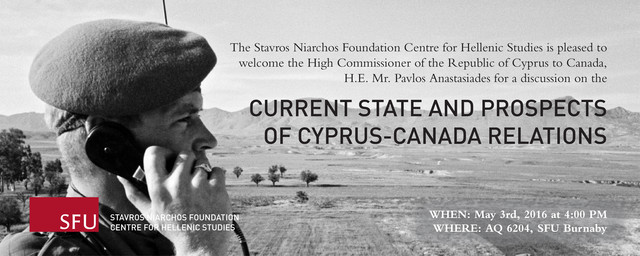
The event at which Anastasiades spoke

Simon Fraser University played host to Pavlos Anastasiades, the Republic of Cyprus’ first resident High Commissioner to Canada, who presented an informal discussion on current and future prospects for Cyprus-Canada relations.

In a talk at the Stavros Niarchos Foundation Centre for Hellenic Studies, faculty, students, and staff were welcoming to the High Commissioner. It featured a variety of historical, cultural, and educational links between the two countries.

The role of High Commissioner to Canada is a new diplomatic mission initiated in December 2015. Educated at the University of Birmingham, Anastasiades served in Washington from 2010 to 2013 as an ambassador to both Canada and the US.

Anastasiades spoke with much esteem of Canada’s history of relations with Cyprus — specifically Canada’s peacekeeping mission with the United Nations. Named operation SNOWGOOSE, it has been running for over 50 years.

“Canada showed how peacekeepers should operate,” said Anastasiades, remembering Canada’s successful defence of Cyprus in 1974 when Turkey invaded. The “Canadians forced the aggressors to stand down” through active peacekeeping.

All Canadian regiments did rotational duties in Cyprus throughout the mission. The Commissioner spoke of a recently erected monument in Cyprus, in honour of the 28 Canadians who have died in service there since 1964.

The Canadian Armed Forces currently has one staff member in Cyprus. The High Commissioner jokingly remarked that Canada may “triple” its presence next year.

The Commissioner is interested in strengthening academic relationships between Cyprus and Canada to include SFU. The “niche” SFU has in Hellenic Studies could be of “great significance and mutual benefit” if developed.

Canada likewise has a “niche of federalism,” said Anastasiades. Cyprus is looking for a federal solution to their governance from the UN, and Canada’s experience and expertise could be beneficial to Cyprus.