Home Blog Page 844

Local police warn about increase in unicycle thefts across the Lower Mainland

0

Unicyclists in the Greater Vancouver area are being advised to be extra-cautious with their rides this summer, as the number of unicycle thefts across the Lower Mainland have nearly doubled since last year.

“Our research has shown that men between the ages of 18 and 35 are the most likely to have their unicycles stolen — mostly because no one else would even think about riding a unicycle in the first place,” Police Chief Will Schneider told reporters last Wednesday. “Follow-up interviews did reveal that some individuals would consider riding a unicycle if they were in a situation that called for one, like maybe being part of a circus or if they were dared to do it, but other than that, it’s a mystery.”

In a statement released in conjunction with the press conference, police revealed that over 40 unicycles have already been reported stolen across the Greater Vancouver area in 2016. Police suggest that the number might even be higher, as some individuals fear the ridicule that comes with being publicly known as owning a unicycle. Trevor Stills is one of those 40 who reported their unicycle stolen.

“I had just left my barber shop for my bi-weekly moustache conditioning when I noticed my fixed-gear unicycle wasn’t where I’d locked it up,” Stills explained. “That’s when I knew that some thief with probably modest-but-refined taste had stolen my ride.”

Stills’ story is a common one, and Vancouver police are utilizing new tactics in hopes of preventing future unicycle thefts. Following the press conference last week, authorities released a map using collected data to show the areas of the city where thefts are more likely to occur. Included amongst these “hot spots” are outside the Urban Outfitters on Granville Street, several vegan juice bars located in the downtown Vancouver core, and literally every block of Main Street.

“If it’s impossible to stay away from these high-risk places 100 percent, then we recommend that people use alternative modes of transportation,” advised Schneider.

“In the ideal world, we want potential future unicyclists to reconsider and instead purchase bicycles. Bike thefts in the Lower Mainland are actually higher in sheer number and frequency, but at least those folks don’t look like assholes when they’re riding around town.”


Fuck Donald Trump — really?

7

[dropcap]I[/dropcap] used to be extremely anti-Trump. “He’s a racist, the wall is ridiculous, he’s a bad businessman, and he has no experience,” I would say. Like many, I was quick to attack the man but not his policies. Last week, The Peak produced the front-page opinion-editorial by Sarah Finley called “Fuck Trump.” Now, there’s a lot of misinformation causing unjustified hate toward the Donald that needs to be cleared up.

Is the wall a stupid idea?

Trump’s wall is his most controversial proposal. People sometimes overlook the fact that there is already a border wall. It doesn’t function well at all, and illegal immigrants — specifically unescorted children — have poured into the United States recently, causing what’s known as the “2014 American Immigration Crisis.” Getting Mexico to pay for it is a long shot, but it is possible if you read his plan.

A nation is not a welfare system for other countries’ citizens. Canada has geographic luck on our side, and we don’t have to worry about walls to keep out illegal immigrants. Countries should have full control over who comes in, and a wall would do just that.

Is Donald Trump a bad businessman?

Trump has oddly come under criticism for his supposed business failures. He said he started off with “a small loan of a million dollars,” as Business Insider reports, and turned it into his multi-billion dollar empire and some of the most renowned buildings on Earth.

Oh, Trump’s companies have declared bankruptcy? Yes, he admitted in a 2015 debate on Fox News that he “used the Chapter laws” in four cases to legally protect his businesses when they were closing. The Trump Taj Mahal in Atlantic City became a subsidiary of Icahn Enterprises in 2016; but in the last few years, several Atlantic City casinos have declared bankruptcy or shut down.

Finley called Trump a “reality television personality,” something I’ve heard time and time again. He was famous before his appearances on The Apprentice, though: his book The Art of the Deal, released in 1987, was on the New York Times’ bestseller list for 51 weeks.

How about we hate on the GOP instead?

Fuck Donald Trump? Fuck the GOP for not producing any strong candidates. John Kasich was the managing director of Lehman Brothers, the Wall Street investment bank that went bankrupt in 2008 and almost took the US economy with it. And the Bush dynasty simply shouldn’t hold another US presidency for obvious reasons.

Finley said Trump is “the harshest GOP candidate,” partly because he said he would “bomb the shit out of [ISIS].” Meanwhile, Ted Cruz’s policy was to “carpet bomb [ISIS] into oblivion,” adding that we’d soon find out if “sand can glow in the dark.” Former speaker of the House, Republican John Boehner called Ted Cruz “Lucifer in the flesh,” and said he has “never worked with a more miserable son of a bitch in [his] life.” Would you prefer Cruz to Trump?

Trump is by no means perfect — just like Bernie Sanders and Hillary Clinton, the only other candidates still running. His position on torture is horrifying, and his lack of experience is a drawback.

But in the end, many of Mr. Trump’s policies are actually well-done. His China-US trade policy addresses the $365-billion trade deficit through tariffs. For those of you interested in policy, and not perception, check out Trump’s positions on immigration, healthcare, and especially the wall. I think you may be pleasantly surprised.

Opening of Menchie’s upsets Yeti Yogurt fanatics

0

A group of students calling themselves the FroYo Freedom Fighters (FFFs) are livid with the recent opening of a Menchie’s yogurt bar at SFU. According to them, Yeti Yogurt is the one true frozen yogurt place, and the new Menchie’s is an affront to the purity of what Yeti Yogurt brings to the mountain.

Connor Anderson is one of the students affiliated with the dessert disruptors. He said that he’s been loyal to Yeti Yogurt for years now, aggressively pulling out his Your Yeti rewards card during our interview and shoving it in my face.

“You see this shit?” he asked, oblivious to the fact that it was now the only thing in my line of vision. “I’m a Frosty Member. That’s next-level dedication right there. I don’t have a whole lot going for me, but I’ll be damned if Menchie’s takes anything from me.”

Anderson acknowledged he has no plans to physically take action against Menchie’s — “I love frozen yogurt as much as the next guy, but I’m not going to jail over this,” he said — but plans to spend a few hours over the upcoming weeks telling anyone who will listen to him that the Yeti Yogurt versus Menchie’s debate actually matters.

Over at Menchie’s, located within the Simon C’s Convenience Store, customers aren’t necessarily feeling the same obsession with their new treat on campus, but acknowledge it is nice that it’s there.

“It’s perfect just in time for summer!” said Amy Evans. “I’m still kind of bummed I have to take summer courses up here, but it’s much nicer having a Menchie’s than not having one.”

When asked about the FroYo Freedom Fighters, she was taken aback: the group hadn’t yet infiltrated her life in any way, for which she had been thankful.

“I think both places are nice!” she said, remaining blissfully unaware of the gravity of the situation. “I don’t understand why people have to be so weird about these things. It’s just frozen yogurt.”

So far, the Menchie’s seems to be a big hit, but is still in the honeymoon phase where anything new to campus is still exciting and hasn’t been tainted yet like most things available to students. Anderson and the rest of the FFFs are trying to hasten that, standing outside the location with picket signs and yelling at potential customers.

“Give it time,” scoffed Anderson. “They’ll come crawling back to the Yeti way.”


Meanwhile, the Highland Pub remains closed, which is what everyone on campus really wants open.     

SFU could be doing more to combat waste

0

[dropcap]S[/dropcap]FU continually boasts about its commitment to environmentalism, often while citing the Zero Waste Initiative. That kind of thing sounds great on a brochure that’s handed out to naïve prospective students. But is SFU truly doing its part to cut down on waste? The answer is no.

With more than 25,000 students, a proper waste management initiative could actually make an impact on a large scale. We have compost, and plastic- and paper-recycling — but that’s it. We could take initiative and recycle batteries (pretty much every science and business student has a calculator), metals (tinfoil included), and extruded polystyrene foam — also known as styrofoam.

My main beef with our recycling system is the fact that we still have styrofoam containers on campus. Styrofoam is not only a possible human carcinogen, but it is not easily biodegradable. It lingers in landfills long after most other waste.

Zero waste plus styrofoam equals ‘does not compute.’ True, not every restaurant on campus uses foam products — but a handful do, and that can add up in a hurry. If one percent of the student population, or 250 students, buy a meal complete with styrofoam packaging every day, then over the course of the year that’s more than 90,000 foam containers heading to our landfill.

Yikes.

Instead of styrofoam, food vendors on campus have a wide array of recyclable and compostable take-out packaging to choose from. Eco Products®, GreenWare®, PrimeWare®, and many other manufacturers have greener options. There are paper containers and compostable plant-made plastic containers to suit any possible food-related need.

Yes, there is the concern that it could cost a couple more cents per container, but I for one would happily pay the extra nickel to avoid using styrofoam for both food and beverages. It would be great for SFU’s current vendors that don’t use compostable coffee cups to make the switch.

A second major problem we should all look into is the recycling of soft plastic. With Nester’s, Subway, and now the BC Liquor Store sharing our campus space, recycling plastic bags, plastic wrap, and other similar items would do a lot to boost our ‘Zero Waste’ reputation.

Would this mean that every current four-bin waste stop would have to grow to six bins? Not exactly. But soft plastic could be part of another recycling category, and it might be best to take away the trash option on these Zero Waste stations, as there are plenty of standalone trash cans as it is.

Will it take students three seconds longer to put their shit in the right receptacle? Probably. But three seconds of your life in order to ensure that there’s a life-sustaining planet in your future seems like a small price to pay.

For me, studying political science is personal

0

[dropcap]H[/dropcap]i, my name is Tamara and I’m a fourth-year political science student.

I have taken a lot of different courses here at SFU, but I started as a political science major, and I will graduate as one — one day. When I enrolled in political science at SFU, I knew it was not my greatest passion. It wasn’t even my second greatest passion. Those titles are reserved for English and communication, respectively. Nor did I choose to study political science for any promise of money or a career.

I was drawn to politics by the memory of my late grandparents. I know it must sound ridiculous, and sometimes during those late nights when I’m up writing about the Canadian Senate it seems like a ridiculous reason to me too.

My Nana and Grandad died during my adolescence, and I have always felt robbed of so many years with them. But before they were taken from me, they inspired me, they educated me, and they showed how important it was to do good in your community.

Grandad grew up in the foster care system during the Great Depression, after my great-grandmother abandoned him. By the time he was 12, he was working full-time as a farmhand for a small wage. As a teen, he paid a woman to pretend to be his mother and joined the army to fight in the Korean War and WWII. He then came back to Canada, met my Nana, finished his high school diploma, and got a job at a printing press.

Soon after, he had four children and became the president of his local union. Through the union he fought relentlessly for his fellow workers, but his fight didn’t stop there. He went on to help progressives get elected. In the ‘70s, when Tommy Douglas ran for MP in Coquitlam, my Grandad was his campaign manager. And when it came time, he himself ran for city council in Burnaby and became a sitting councillor for four terms.

I picked political science because I wanted to honour my memories of the community leaders I can call Nana and Grandad.

Despite his rough start, and despite not having any good reason to want to give back to a world that had given him so much to be angry about, my Grandad always wanted to make our community better. And so did my Nana. She was in the background of each of Grandad’s campaigns, doing everything from the nitty-gritty campaign tasks to caring for the family at home. She, like many other women supporting their husband’s careers, will not be remembered for her contributions. But I remember — well, I remember the stories at least.

They taught me what it means to influence, and what it means to do good by your home and neighbours. So fast-forward to 2011, when a young and awkward-looking me was applying to SFU. My best grades were always in social studies and English. I loved creative writing and was fascinated by media. But I picked political science and have never looked back because I wanted to honour my memories of the community leaders I can call Nana and Grandad.

Maybe I would have received better grades in a different department. Maybe I would have been on a better career path if I’d chosen a different program. Maybe I would have enjoyed more of my classes in a field that indulged in all my interests.

But in the end, it’s my grandparents I care about. So Nana and Grandad, I don’t know if you are in a place where you can hear me or not, but know that I think of you all the time. I hope I can do some good through public service in our community to make you proud.

We can’t ignore the role of climate change in Fort McMurray

3

[dropcap]W[/dropcap]hen a tragedy like the fire earlier this month in Fort McMurray strikes, we absolutely have to acknowledge the terrible loss of homes, the displacement of thousands of residents, and the devastation it leaves behind. But we also have to talk about the causes of the tragedy, and that includes climate change.

To ignore that the intensity of the fire in Fort McMurray is a result of increased temperatures, longer fire seasons, and hotter, drier weather would be to ignore an opportunity to illustrate what can happen in these conditions and what is likely to be more frequent as these conditions are only exacerbated by climate change.

Due to climate change and higher average temperatures, fire seasons are being extended and we are experiencing more frequent, intense fires. According to Natural Resources Canada, “recent years have seen more destructive fires in terms of area covered,” as the CBC reports. David Andison, an adjunct professor in the faculty of forestry at UBC, was quoted by the CBC as saying that “climate change models and research all point to the idea that fire season is going to be longer in the coming years, and the fires will be more severe.”

The question isn’t whether we should be talking about this reality, but how. There is no need to frame the dialogue as a kind of ‘I told you so’ message; but we do need to point out that there is more where that came from, and our wildfire seasons are going to become longer and more intense. Mentioning the link to climate change is not a negation of the suffering that the residents of Fort McMurray have experienced, and it is not meant to be insensitive. It is, in fact, only natural to question the cause of tragic events.

The question isn’t whether we should be talking about this reality, but how.

It’s a shame that climate change — a topic that affects us all and threatens our very survival — has become politicized and taboo. Green Party leader Elizabeth May was met with backlash when she stated that there is a link between forest fires and climate change, even though she was simply speaking the truth.

Justin Trudeau said, “What we are focussed on right now on [sic] is giving the people of Fort McMurray, and across Alberta, the kind of support that they need.” While saying that it’s not time to lay blame, he sidestepped the question of climate change and avoided angering those at either end of the political spectrum. By taking the ambivalent, balanced approach, Trudeau may have also made May look too reactionary — but ignoring the link is a detriment to us all. 

It’s never too soon to talk about something that affects everyone, and we can’t ignore that climate change played a role in this devastation. With an unusually dry and warm winter, low precipitation, early snow melt, and a warmer than usual spring — all effects of climate change — the fire quickly grew out of control.

When it comes to the cause, we are all to blame. We are all users of oil. We are all responsible for acknowledging the connection to these extreme weather events and taking action to prevent the continued warming of our planet.   

Universities should adopt a uniform grading scale

0

[dropcap]S[/dropcap]tuart Rojstaczer is not exactly a household name, but he has caused quite a frenzy. A retired professor from Duke University, he has titled himself as “America’s grade inflation czar.” 

Rojstaczer left his teaching position at Duke to pursue researching grade inflation, and his findings have since caused quite a stir. From his research came a list of the 16 universities in Canada and the United States where it is most difficult to receive an A letter grade. Included on this list are MIT, Princeton, and Purdue; Simon Fraser University ranks 16th and is also the only Canadian university to be found on the list.

In a video interview with The Voice, Rojstaczer provided a short summary of his paper, “Where A is Ordinary: The Evolution of American College and University Grading, 1940–2009.” He described how universities have always had unregulated grading systems, which leads to a lack of uniformity. According to Rojstaczer, grades were reasonably consistent until the 1960s when professors in the US began to give higher grades to male students so they could avoid being drafted into the Vietnam War. In the 1980s, he said the “culture of colleges changed”: grades steadily increased, and haven’t stopped since.

There’s not only a lack of uniformity in how grades are achieved, but there’s also a noted discrepancy between grading systems. At SFU, an 80 percent in the history department would be in the A- range on a transcript. That same percentage would fall in the B or B+ range in other departments. At the University of British Columbia, an 80 percent is in the A- range no matter what faculty you’re in.

A UBC student might have a better chance of being accepted to grad school.

Furthermore, when one delves deeper into the issue of GPAs, there is very little similarity between SFU and other schools. Schools like SFU have a GPA scale of 4.33, but the University of Toronto, for example, uses the much more common 4.0 GPA scale.

So why does any of this matter?

This might all just seem like a solid excuse when you’re explaining to your parents why you failed a 101 course — but it could cause long-term damages. A UBC student and an SFU student with the same percentage average have wildly different GPAs, which can have devastating impacts on merit-based scholarship and grant applications. When applying for grad school, said UBC student could have a better chance of being accepted if the grad school in question isn’t fully cognizant of the different grading scales.

The better alternative would be to adopt a universal grading scale. Since it’s nearly impossible to successfully guarantee that all schools will grade fairly and with the same level of leniency (although some high school programs such as International Baccalaureate have given us a pretty great example of how it could and should be done), universities will gain reputations as either easy or hard grading schools.

Our methods of measuring student success are long-outdated, and indeed our teaching strategies in general need some revamping; a good place to start would be for universities to adopt similar grading schemes. Then we can delve into the issue of overly lenient professors and flawed college cultures.

Peak Comics: Creator’s Pet

0

CP_029

Peak Comics: Serious Bananas

0

SB_001

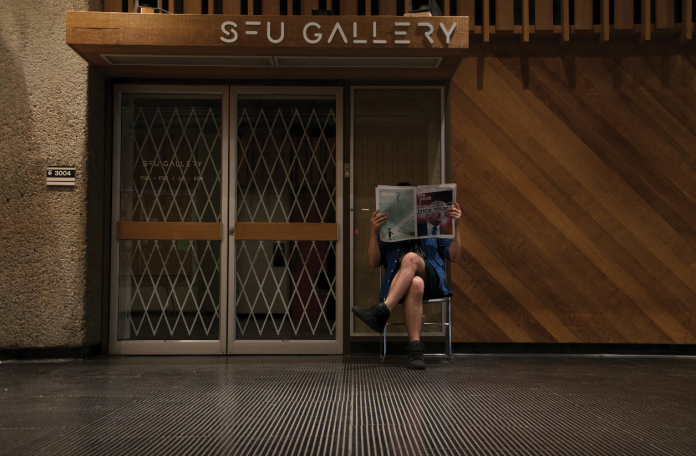
The AQ art gallery needs to be relocated

0

[dropcap]T[/dropcap]he SFU Art Gallery in the Academic Quadrangle only serves a small portion of the population while occupying one of the busiest spots on Burnaby campus. Because of this, those who run the gallery need to either make their exhibits more interactive and accessible, or consider relocating elsewhere.

The Art Gallery was established for the purpose of helping us contemplate art both politically and socially. A recent exhibit by Alex Morrison was focused on bringing attention to how physical locations affect our behaviour. However, this is 2016, and these functions may be better fulfilled today by Internet forums, social media, informative pamphlets, or even a well-written essay. Using such a large space in the AQ is overkill.

Another concern is that the average undergraduate is not able to fully appreciate the exhibits that are currently being displayed. Simply put, the gallery is a little pretentious, and seems to have failed its intended function by not providing enough information about the artwork. This problem could be remediated by providing, on each display, detailed information that spells out exactly what the intent of the artist is in relation to each piece, and the relationship between the pieces themselves.

Moreover, the Art Gallery doesn’t engage undergraduates or create a space for interaction and dialogue between visitors. This could be easily remedied by implementing exhibits that are more interactive. It would allow visitors to contribute to the display, rather than being a bystander absorbing ‘wisdom’ and ‘inspiration’ from a great artist. That said, there are occasionally events and tours that help visitors engage with the exhibitions, even if those events seem fairly sparse.

Another solution would be to relocate the Art Gallery and repurpose the space in the AQ as a multi-use room for daily activities, such as board games, video games, arts and crafts, casual improv or theatre games, drop-in jam sessions for SFU musicians, or weekly events or contests. The space could also be used to hold workshops and to teach students skills that we might actually be interested in.