Home Blog Page 751

Embark shares future plans after successful referendum

0

By: Elise Burgert

In the fall 2016 semester, SFU students voted in a referendum to increase the levy that SFU provides to the Embark Sustainability Society. This resulted in a small increase in the tuition paid by students, but has given the organization the opportunity to expand its projects. Three months after the vote, Embark’s vision has come to encompass the new funding.

Dima Lavrentyev, the Embark member relations officer, has provided an update on what Embark has done with its funds. Firstly, Lavrentyev “thank[s] all of the students who supported us and voted ‘Yes’ in the November referendums.” In character with its mission of sustainability, Lavrentyev said, “sustainable growth is the best path” for Embark, and the organization will be taking a “step-by-step approach in order to achieve everything that we planned.”

He emphasized that while the referendum was held in November 2016, the levy increase will not begin until September 2017. As a result, at this point the organization is “in the process of strategic planning and capacity building in preparation“ for the increase.

Lavrentyev gave two main objectives of the organization. The first is to “restore and maintain our current programs, events, and advocacy efforts” while accounting for inflation, which has decreased the value of its previous funding. In order to continue its operations, an increase in levy was needed, according to Lavrentyev.

Events and activities currently hosted by this organization include “weekly Food Rescue, recently held Career Night and National Sweater Day, and many other events” related to sustainability. One of the most prominent programs of the organization is the Embark Learning Garden located at SFU Burnaby, south of TASC 1. Another Embark program, the Food Rescue program, reduces food waste by delivering unsellable, but still good produce, to university students. Embark also offers monetary grants to those with plans to pursue sustainability-related projects.

The second objective of the organization with this new source of funding is to expand its programs to the Surrey and Vancouver campuses. Lavrentyev expressed positivity, stating that the organization is “prepared to make it happen!” With the new increase in funding, he said “It is truly an exciting time for Embark and our members, as we move forward and enter a new stage in our development.”

The expansion of programs to the other SFU campuses will increase the number of students who can participate in the events provided by Embark, in addition to spreading more awareness for the issues that they support.

Lavrentyev extended an invitation to all undergraduate and graduate students to Embark’s Annual General Meeting, which will take place on February 23 at 4:30 p.m. in the Halpern Centre. For interested students, Lavrentyev noted that “additional information about our advocacy, programming, and events can be found on our website.”

More updates on Embark’s progress with its increased funds can be expected in September 2017, when the organization will receive and apply the funds to their projects.

Trump’s historic pick for Education Secretary

0

By: Benjamin Mussett

Despite a fight from Senate Democrats, Betsy DeVos, a wealthy Republican party donor and school-reform advocate, was confirmed as education secretary this week following a confirmation process fraught with controversy. Ms. DeVos, a previous chair of the Michigan Republican party, was barely approved after vice-president Mike Pence broke the Senate’s 50-50 tie in an historic deciding vote.

While previous vice-presidents have broken Senate ties before, Tuesday’s event represented the first instance where a vice-president has voted to ensure a cabinet member’s confirmation. The Senate came to a tie after two Republicans, Senators Susan Collins of Maine and Lisa Murkowski of Alaska, voted against Ms. DeVos’ confirmation.

A Rocky Start

President Trump’s choice for secretary of education generated immediate resistance from Senate Democrats who claim Ms. DeVos is unqualified for the position. This assertion is due in part by her lack of experience with public education. Ms. DeVos has not attended any level of public school nor have her children.

According to Vox, Ms. DeVos’ Senate confirmation hearings bolstered Democratic claims of ineptitude. When asked for her perspective on whether student performance should be measured based on overall growth or proficiency testing, Ms. DeVos seemed confused by Senator Al Franken’s question. The Senator expressed significant concern with Ms. DeVos’ unfamiliarity. The growth versus proficiency debate has been a constant in education policy circles over the past few years.

Democrats also voiced worry over Ms. DeVos’ reported conflicts of interests as her and her family have long donated substantially to the Republican party and hold financial stakes in numerous businesses. Like President Trump, Ms. DeVos could potentially see financial reward from government decision-making she is involved in. The newly-appointed secretary drew particular disapproval for failing to complete her ethics and financial review paperwork prior to her confirmation hearings, as is tradition.

At one point during her hearings, Senator Bernie Sanders of Vermont asked Ms. DeVos if she believed she would have been nominated “if [her] family had not not made hundreds of thousands of dollars in contributions to the Republican Party.”

The moment from the hearings which arguably drew the most public attention, however, was when Ms. DeVos suggested that the presence of guns in schools may be necessary in some cases “to protect from potential grizzlies.”

The Public vs. Private Debate

“She led the most effective public school reform movement over the last few years,” said Senator Lamar Alexander, a Republican from Tennessee and former education secretary, in response to Democratic criticism. The appointment of Ms. DeVos has once again raised the common education debate over whether government should prioritize public education or increase support for the private option.

Indeed, Ms. DeVos has been an avid supporter of private education, advocating for more charter schools and an emphasis on voucher programs. Voucher programs allow parents to divert taxpayer dollars away from public education in order to pay for their child to attend private or religious schools instead. Charter schools, on the other hand, receive public funding, but operate autonomously. According to The Economist, advocates of vouchers and charter schools, like Ms. DeVos, believe they grant parents more choice in their child’s education and, further, allow lower-income students in areas with poor public schools to receive a better education through private schooling.

However, critics claim numerous problems with such programs. In an op-ed for The Hill, Jerusha Conner, a Villanova professor specializing in education, argued that voucher programs actually “exacerbate educational inequality.” According to Conner, vouchers “drain” much-needed funding from the public education system and give it to wealthy private schools, “creating even more of an imbalanced, two tiered system.” Conner also contended that the money voucher programs provide is typically not enough to actually cover tuition costs, nor are lower-income students guaranteed to be accepted into private schools.

Another Controversial Choice

The circumstances of Ms. DeVos’ confirmation as secretary of education were unprecedented, however the unusual has so far proven to be the norm in Trump’s administration. The president has chosen to defy longheld practices, breaking diplomatic protocol by speaking with the president of Taiwan and his refusing to release his tax returns.  

He has also made a habit of appointing controversial cabinet members and White House staff, often roiling both media commentators and his Democratic counterparts. Moreover, Trump appears to prefer placing individuals in charge of departments they have previously challenged.

For instance, Scott Pruitt, an attorney general from Oklahoma, is Trump’s choice to lead the Environmental Protection Agency (EPA), which Mr. Pruitt has sued 14 times; some of these suits are ongoing. Similarly, Rick Perry (governor of Texas from 2000 to 2015) who is slated to be secretary of energy, once called for the department he will soon be running to be closed altogether. In equal measure, Ms. Devos, a long-time private school advocate, will soon be making key decisions on public education.

In 2016, many voted for Donald Trump because they were fed up with what they perceived as status quo politics.Consistent with this “outsider” brand, a number of Trump’s cabinet nominations, like him, have no previous political experience. Most appear ready to roll back the legacy former president Barack Obama worked to construct over the past eight years.

While these picks cause Democrats consternation, to the president’s base, they may fulfill a crucial, albeit vague, campaign promise: “drain the swamp.” For Trump, the beauty of such a promise lies in its ambiguity.

With files from the New York Times, Business Insider, Vox, CNN, Mother Jones, The Economist, The Hill and the Guardian.

Vancouver Valentine’s Day date ideas

0

It’s Valentine’s season! If you’re stumped for plans, here are five things you can do with your valentine, your friends, or even solo.

Starting with something a little formal, a little on the expensive side, but something very unique — a blind dinner date. Quite literally. This one is tried and tested by my closest of friends. Dark Table is a restaurant in Vancouver whose servers are blind. It’s pitch black in there, too! This gives you a sense of the servers’ everyday life and allows you to wholly and completely experience the food and the company of your special someone.

This has to be one of my favourite ideas, simply because of the destination — Gastown. This is a lively and extremely beautifully lit part of town. Be it a café, a restaurant, or a bar you decide to eat or drink at, you are bound to take a romantic stroll, hand-in-hand, on the lit-up streets. Options here vary in price, offering something for everyone, and leaving you mesmerized at the same time.

If your partner-in-crime likes to drink, and if their drink of choice is beer, then Yaletown is where you need to be! Along with an array of house-brewed beers, the Yaletown Brewing Company has a large variety of tapas and meals, and patio seating that is perfect for both sunny brunches and romantic dinner dates!

This one is an affordable favourite — so long as Vancouver doesn’t turn into Raincouver. A stroll to and around Stanley Park. Start from Burrard Station and head towards Stanley Park, walking hand-in-hand with flowing conversation and a warm drink you picked up on the way. Seems ideal, doesn’t it?

Finally, to give this list a sweet ending, why not cook for your significant other and then go out for dessert? A spot that comes to mind is Sweet Revenge Patisserie. Although a little far away from the Burnaby campus, it is apt for a late-night indulgence and has a gothic and picturesque ambience.

Women’s basketball defeat Seattle Pacific 72–60

0

Since their last game earlier this year, both Simon Fraser’s and Seattle Pacific’s seasons have taken very different paths. In that game, the Clan was able to defeat the Falcons after a comeback fourth quarter. The win left SFU with a 7–1 conference record, and SPU with a 52 record, just behind them.

Since that 7161 victory, SFU has only lost twice and has racked up 21 wins heading into this contest. SPU, meanwhile, have lost four and slipped back into a somewhat distant fourth place. With a chance to solidify their top three position, SFU took care of business with a 7260 victory on the road.

The game was very tight to start. After jumping out to a four-point lead, SPU battled back to within one in the first. Unlike in their last game, SFU had a very strong second quarter. They scored 20 points and got strong contributions from the connection of Rachel Fradgley and Meg Wilson to end the first half with a nine-point lead.

Once the second half got started, both teams traded baskets before SFU managed to extend their lead to as much as 15 near the end of the frame. In the fourth, the Falcons cut that lead to seven before freshman Tia Tsang hit a clutch corner three that effectively put the game away for the Clan. Both teams shot below 40% from the field, but SFU was able to hit shots in crunch time, while SPU missed a few high-percentage shots to hurt their chances.

Both teams were unable to hold onto the ball well in this one, and that ultimately helped decide the outcome of the game. A total of 37 turnovers were recorded between SFU and SPU, with the Clan turning the ball over 17 times.

However, SFU was the team able to capitalize on their opponents’ mistakes, scoring 28 of their 72 points off turnovers 38.8% of their offence. SPU only managed eight points off turnovers.

With the win, SFU have assured themselves of a top three place in the conference. With both teams having four conference games to play, the best Seattle Pacific can do is tie SFU’s record if they win their remaining games and SFU loses all of theirs. But with SFU having the tiebreaker in their head-to-head record, the Clan would still be in third place. The focus now for the team will be trying to remain focused down the stretch.

Next Game: SFU will make the short drive down to Bellingham to take on Western Washington in a rare Tuesday night contest. Western Washington are in second place in the conference with a 151 conference record. A win would move SFU up to 14-3 and drop Western Washington down to 15-2. If the Clan want any hoope of finishing second, they’re going to have to get a result. 

Last time these two teams played, SFU led by one at the half before Taylor Peacocke scored 27 in the second half more than the rest of her team combined and singlehandedly led the Vikings to victory. She finished with 41 points in the game overall.

Peacocke leads all of Division II women’s basketball with 23 points per game, and the key will be to try and contain her offensive output. She will get her points, but if SFU can limit her to her average or just below, they should have a shot at victory.

Tip-off is at 7 p.m.

SFU Confessions brings us together in anonymity

0

“Here’s a confession for you: I definitely follow the SFU Confessions page more closely than I follow the UBC one. Ours is kinda lame.”

These are the words of a friend who goes to UBC and also follows the SFU Confessions page religiously. If you’re not aware of what it is, SFU Confessions is a Facebook community page run by an anonymous administrator that allows all SFU students to post their crazy transit stories, lament over how a class screwed them over, and tell wholesome, Nicholas Sparks-esque love stories.

Beyond that, there is drama, comedy, intrigue, and thoughts from all ends of the political spectrum. Having followed the page ever since I started at SFU three years ago, I’ve witnessed many courageous stories come forward, and watched the community come together in support of the confessor.

I’ve always been fascinated with how this concept has amassed a following of roughly 24,000 SFU and non-SFU students alike. To be able to come out and tell all these strangers the issues you might be going through, even though you are anonymous, is a big deal.

During my time at SFU, I found myself in this digital confessional many times: a blank message box blinking back at me, waiting for me to confess my darkest desires. My very first confession was to openly, albeit anonymously, say that I was depressed and that I wanted to commit suicide.

Of all the many people and institutions I could have turned to, I decided to turn to a faceless entity and broadcast my troubles and self-worth to hundreds of strangers.

Though I was scared to death that someone would expose me, my message vanished with no questions asked, and a day later it appeared on the page. But as hours and days passed, many people put up messages of support, linked me to resources, and even invited me  — a complete stranger — to message them in future times of distress.

I see posts similar to mine every so often, and my heart breaks a little each time I see them. But that all melts away when I see the respect and kindness that goes into some of the comments that follow. I also try to be someone whom those in need of someone can access at any time — the same way that many others offered their support to me.

This diverse community is able to come together and offer simple words of encouragement to those who may have no one else to turn to. If I hadn’t posted my own confession, I probably wouldn’t be able to speak and write so openly about mental illness in the way that I do now.

There definitely are times where our differences cry far louder than the similarities, but I believe that there truly is a comforting sense of community present on this page. Yes, we are all different and unique, but in times of heartbreak and suffering, the anonymity suddenly makes us more alike than we realize. There are people who are here for you if you are going through a hard time — even if you don’t know them yet.

Q&A with SFU alumnus and digital cupid, Justin Long

0

[dropcap]I[/dropcap]f you’re still swiping left and right on Tinder, looking for a special someone to see this Valentine’s day, have no fear. SFU alumnus Justin Long has developed the artificial intelligence (AI) to help you find your dream partner.

Having been consistently identified as one of the leading cities for the technology and innovation, Vancouver has steadily been making its mark on the digital age and all it entails. Innovators and entrepreneurs now comprise an industry worth over $23.5 billion in British Columbia — and much of that industry resides in Metro Vancouver.  

One of those innovators includes Long, who launched an artificial intelligence app, warmly named Bernie, this past summer. Bernie works by being applied to a dating app, registering the characteristics a user seems most interested in, and rendering matching options that would most likely appeal to them.

Though Long’s SFU degree is in general studies, he’s long had an interest in technology and software development. The Peak sat down with Long to talk about Bernie and his mission to get more singles swiping right.

Peak: What is Bernie?

Justin Long: Bernie is the world’s first artificial intelligence designed to help people start dating. Bernie uses deep learning to understand the type of [person] someone finds attractive, and then seeks them out on dating apps. Not only does he pull together a deeper understanding of who makes you “tick,” but he even starts the conversation to ensure mutual interest.

P: What does Bernie do when applied to a dating app?

JL: Bernie essentially acts as a filter, where he takes out all of the legwork and nuisances involved in online dating. After installing Bernie, you’ll spend some time swiping on Tinder with him so that he can be trained on who you find attractive and who you, well, don’t. From there, Bernie starts a conversation with the profiles that you’ve matched with and determines if they’re interested in continuing the conversation. If they are, Bernie then allows you to take over.

“I was determined to get people away from their phones and back to real love” – Justin Long

P: Could you describe Bernie’s target user?

JL: Anyone who’s busy, or feels like they don’t have an endless amount of time [for] swiping through profiles and people that you have no interest in. He especially works for people with busy schedules, and who are interested in enjoying a more genuine experience than what online dating sites currently offer.

P: How did you come up with the idea for Bernie?

JL: First, very few people know that the inspiration for Bernie comes from Bernd Dittrich, an old friend and dorm-mate from SFU residence. Bernd was at the height of his SFU football career when we lost him to an unfortunate heart condition in 2009. It was unusually fitting that his heart was too big; I watched his relationship with his girlfriend turn into a really special connection, and he was loved by anyone who knew him.

Fast forward to 2014 when I was sitting in a bar watching a trending app called Tinder begin to consume my friends. I became frustrated with how everyone was sucked into their phones. I joked “I can automate Tinder” to the hysterical and unbelieving faces of my friends. Two months later I had a working prototype. Once I left my job doing research and development for a Vancouver software company, I turned the prototype into something — a real usable app. I was determined to get people away from their phones and back to real love, and I thought Bernie was a fitting name.

P: How did you first get involved with software/tech?

JL: When I was three years old my dad taught me how to program this MS-DOS app that was a simulation of traffic lights. Unfortunately, much of that skill was replaced by a superb ability to dismantle computers into unusable pieces until I was 15, when my grandmother gave me a copy of Macromedia Dreamweaver. At 16, I had my first paying web design client and ever since I’ve been learning to code on my own.

P: Are there any plans for the future of Bernie that you can tell us about?

JL: Everything that Bernie is learning from dating is proving to be extremely valuable. Bernie is gaining cognitive abilities, being able to read personality traits and put photos into context. We’re actively looking at applying his brains to the advertising world, and are currently working with undisclosed universities and companies to research how far we can take him.

P: Was there any point during Bernie’s development at which you thought the AI wouldn’t work? Why or why not?

JL: In the very early stages we released Bernie to a small group of testers. One of them came to me in person and said, “Justin, look at what Bernie is doing. . .” Well, Bernie was relentlessly messaging people and making very obvious incompatible choices. That’s when we made an emergency effort to become experts in deep learning, which has paid off ever since.

P: What would your advice be for students hoping to get into AI development?

JL: When Google built FaceNet, its research team used 250 million photos to achieve 99.67% accuracy. Students rarely ever have access to so much data, and you don’t need it. There are tricks to bootstrapping tiny datasets you need to get started and to training AI with very little information. Learn those tricks and make your life easier!

P: Could you tell us a bit about how you got together with your girlfriend?

JL: That’s a great story. I initially met her while I was attending SFU back around 2010. We lived near each other and had a bunch of mutual friends, so we’d always talk and flirt when we ran into one another, but nothing ever happened, which was something I regretted because after I graduated we went our separate ways. . . Until six years later.

Shortly after I created Bernie, I was testing the app and saw her profile show up on my account. I took over the conversation before Bernie said anything and asked her out on a date the next day. I’m happy to say that we’ve been dating ever since and we’re moving in together at the end of this month. I guess I’m a living example of how Bernie can be successful.

SFU falls just short of first conference win in last-second heartbreaker

2
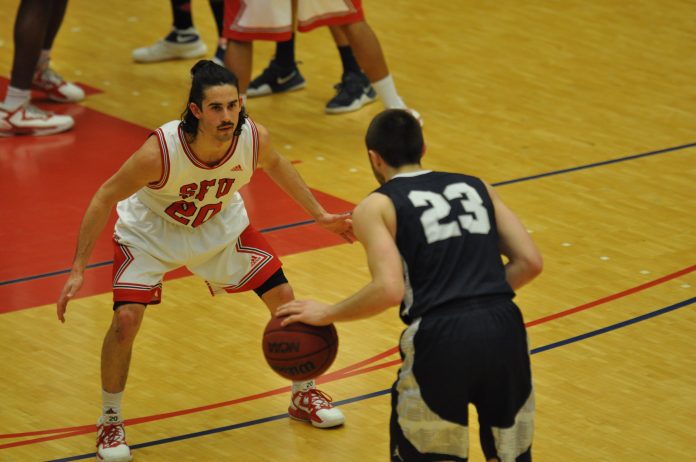
Michael Provenzano (#20) had 21 points and four assists while playing a game high 37 minutes.

While every loss must sting, Thursday night’s must have been especially painful.

Having battled back from a seven point halftime deficit, SFU were up 73–70 with 7.8 seconds left, seemingly seconds away from their first conference win. Izaiah Sherman-Newsome just needed to move the ball from the baseline and out of harm’s way.

He did so with a pass to Kedar Wright, but a foul was called on the Concordia Cavaliers, and Sherman-Newsome had to repeat the process with just .9 seconds killed off the clock. Again, he passed it to Wright, who seemed to have an opening to clear it out of SFU’s zone.

However, this is where it went wrong. In a rather questionable call, Wright was called out of bounds as he caught the ball. (While the replay’s angle is far from conclusive, he definitely doesn’t look out of bounds).


Well, that was a turnover. Concordia got the ball, and guard Latrell Wilson sunk a three with 1.8 seconds left. Tie game.

But it didn’t end there. Hidde Vos was assessed an iffy foul, and the Concordia shooter was awarded a free throw. Wilson made the shot. 74–73.

“Hidde, he doesn’t want to move his feet there, gets as tight into a guy as he can, a guy who takes out his legs and is known for flopping a bit,” said head coach Steve Hanson. “You’ve got to give [Wilson] credit. He hit a tough shot and he hit the free throw.”

The building that was filled the sound of an excited crowd — probably the loudest all year — just seconds ago fell silent.

JJ Pankratz made one last attempt to save the game with a long shot from half court, but to no avail.

“It’s just tough; I feel for our guys,” said Hanson. “We played hungry tonight, we just didn’t play that last seven seconds perfect[ly].”

Nearly a year to the day since their last conference win (on February 11, 2016), against the same team, and with 18 consecutive losses beforehand both times, the circumstances seemed eerily similar to their first conference win. Instead, the losing streak now extends to 19, one more than last year’s streak.

It’s a tough result for a game that SFU played so well in, and really, probably should have won. But even if you believe the calls that cost SFU the game were wrong, SFU did leave a few points on the table.

The Clan opened the game by allowing eight consecutive points, and missing three attempts from the field. Wright broke the drought with a three-pointer just after the two-minute mark.

However, after dropping the initial eight points, SFU did keep the game fairly tight, trailing at most by 12 points, and ending the half down by only seven.

“The way we started was terrible,” explained Hanson. “[But] guys did some good things, we actually turned them over a lot after they hit their first five or six. We kind of dug in defensively. We forced 12 turnovers in the first half and that was good — we played tough.“

While in the first half the Clan had a hard time finding good spots to shoot — going 10-for-27 from the field (37.0%) — the second half turned that around.

Michael Provenzano and Wright led the comeback attempt, each draining shots, with Provenzano draining 13 points and Wright putting up 15 in the second half.

“When you get late in the game, both coaches are making adjustments, we’re doing different things defensively; they’re doing different things. It really comes down to players making shots,” said Hanson. “Kedar and Mike hit some shots.”

“We played hungry tonight, we just didn’t play that last seven seconds perfect.”

SFU took the lead when down by five points with 10 minutes left; they scored eight straight points. Wright started the sequence by sinking two free throws, then Tyrell Lewin and Provenzano scored layups, before Wright put in a final jumper.

Beside the last-second heartbreaker, SFU never trailed from this point on, and led by as much as five.

With two minutes remaining, Concordia — with a dunk and three consecutive free throws — tied up the game at 68–68.

Wright scored a three to regain the lead. Concordia answered back with a layup, and were down by one.

With 23 seconds left, Provenzano put up two more points, and SFU had a three-point lead. When Concordia missed a three-point attempt and Wright collected the defensive rebound, the game should’ve been over.

Unfortunately, that wasn’t to be.

Wright and Provenzano shared the points lead with 21, while Sherman-Newsome put up 15 and led the team in steals with four. Lewin led the team in rebounds with six — five of them defensive. While not registering a point, Gibran Sewani, who started for the fourth consecutive game, put up three blocks.

Provenzano played 37 minutes during the game, and had played a 40 minute game on the last road trip.

“It’s something we talk about as a staff a lot. We wanted to maybe get him out for one or two minutes, but we’re just not that trusting of the other young guys on the bench,” said Hanson. “He looked tired at times, but he was like, ‘Coach, I’m okay,’ and I kind of trust him. Right after I said that, he scored two quick hoops.

“In a perfect situation, he’s probably playing 33, 34 minutes a night, but that’s not where it’s at. His conditioning is outstanding; there’s not a better conditioned guy in our league.”

Other players spent much of their time on the bench. Andrew Williamson — who averages 15.3 minutes per game — and Othniel Spence — who averages 14 minutes per game — got two and five minutes of court time respectively. Along with Graham Miller, neither player got on the court in the second half. Bongani Moyo, Bowen Bakken, and Vinnie Safin did not receive any minutes.

Tonight: SFU will face off in a rematch against the Western Oregon Wolves, who made it to the NCAA Division II Final Four last year.

In their last matchup on the road, SFU came out to an early lead, going on an 11–2 run to take a 19–11 lead. However, the Wolves answered back with 21 straight points of their own, and were up by nine at the end of the half. SFU never recovered and fell 80–65.

Western Oregon currently sits at third in the conference with a 10–5 conference record. They are a strong defensive team, allowing the second-last amount of points-per-game with 72.1.

“We’ve just got to keep focusing on ourselves, there’s nothing that better teams can do that dictate what we need to do,” said Hanson after Thursday’s game. “We’ve got to have a good practice tomorrow.”

Tip-off is at 7 p.m. in the West Gym.

The Canada 150 and colonial legacies: views from the university

0

As Canada prepares to celebrate its sesquicentennial year, it seems that the fervor of national pride has also reached the university. Simon Fraser University has put forth a number of specially curated courses and invited the community to experience Canada 150 from its campuses.

We are often told that Canada has much to celebrate. A century and a half after confederation, the draw of freedom and respect for differences makes this ‘nation’ unique in the world. Yet we need not look far to see the hypocrisy of the Canadian identity.

There are very fundamental problems that undermine the Canadian state, ones built on colonialism and, in the case of a large portion of the country, its continued existence on unceded Indigenous territory. Moreover, there are a myriad of instances that undermine those values of cultural diversity and acceptance that we are told underpin the nation.

With this in mind, I spoke to some members of the SFU community who shared their insights on the 150th anniversary and its significance at the university.

Neglecting history

Maddi* is a First Nation student majoring in gender, sexuality, and women’s studies (GSWS). This semester, she was part of a team that gathered perspectives of Indigenous students on the Canada 150 for the publication of this month’s Indigenous Alternative Media zine. She said that most of the students whom she interviewed felt strongly that the anniversary celebration “was neglecting the history of First Nation people and it was capsulating Canada into 150 years.”

For these reasons, Maddi explained, she felt that there were problems with the university — and the country — marking an occasion which comes on the heels of 150 years of colonialism.

“This is a brand-new wound and we are still healing,” Maddi noted. She also expressed that the university had a long way to go to make her, and other Indigenous students, feel comfortable. It’s the little things such as following protocol during territorial acknowledgements at events — seeking a proper welcome to the land — that make a difference, she said.

This sentiment was echoed by another member of the zine team, Matt*, a First Nation student in communications. The university in many ways still carries the baggage of the country’s colonial past. Its namesake, after a prominent explorer and settler on the local territory, Simon Fraser, and scenes portrayed in the large mural  overhanging the AQ north concourse are in many ways tied to the anniversary that the Canada is celebrating.  

“I think that’s what is missing is people don’t understand what they’re celebrating,” Matt said. “They’re willing to celebrate colonialism.

“It has never been easy for an Indigenous person to strive in this society [and] I’m not going to be celebrating anything about that.”

Both of the students identified themselves as First Nation, not Canadian.

Mixed feelings

The perspectives held by the community at SFU seem to be understandably mixed, according to William Lindsay, director of the SFU Office for Aboriginal Peoples.

“We’re celebrating Canada’s 150th year as a country and I would say that for most of those 150 years, the Aboriginal peoples of this country have faced colonialism, colonization, discrimination, [and] racism,” he said.  

“Especially since 1867, there has been a tremendous amount of colonization happening in this country and it has just been turning around this last short while. When it started is debatable, but it has been a constant effort on the part of Aboriginal peoples to change their situation for the better in this country.

“There are a lot of things that people need to become aware of in mainstream Canada,” he noted. The legacy of colonialism is still very much present today, from the enduring Indian Act, first established in 1876, to the reserve system, residential schools, and the denial of Indigenous rights and titles. These, said Lindsay, are only some of the concerns on Indigenous peoples’ minds.

It was only last year that Canada fully adopted the United Nations Declaration on the Rights of Indigenous Peoples. Eight years earlier, the Conservative government objected to the clause requiring that officials obtain the consent of Indigenous peoples wherever matters concerned them.

Lindsay noted that if he was asked to share his thoughts on the 150th anniversary as a whole, he would mention those things pertinent to Indigenous peoples before he would mention any of the celebratory things for Canada.

“If I was asked as a representative of this university to attend a public event, invited by the government of Canada to come and celebrate Canada’s 150 years, I’d have to give some thought if I’d do it. Others might [attend], but some of us wouldn’t,” he said.

The multiculturalism myth

        At least on the exterior, Canada’s official stance of multiculturalism presumes that the country has accepted cultural difference into its mainstream narrative and entered a new era. However, the history of discrimination against various immigrant and Indigenous peoples continues to erode Canada’s claim to a multicultural identity.

        Am Johal, the director of SFU’s Vancity Office of Community Engagement, felt that Canadian multiculturalism was a kind of “nationalist stereotype” that needs to be looked at critically in terms of day-to-day lived experiences.

        “When we are talking about it in the context of the 150th anniversary of Canada, I think that national narratives have historically left out certain views and perspectives and experiences of what being Canadian is, from Indigenous perspectives to the experiences of Chinese railroad workers,” Johal explained. “We need to look in a much more complicated way at multiculturalism because it tends to paint a rosy picture between and amongst immigrant communities, minority communities, [and] the dominant culture.”

        Subtler in its contradiction to the multiculturalism narrative is the profound view of colonial values as the default, while all others are viewed as part of the cultural mosaic of an accepting nation.

        Maisaloon Al-Ashkar is a third-year student in First Nations studies and GSWS who is part of the Racialized Resistance and Healing Action Group on campus. She also shared her perspective on what multiculturalism means in Canada’s 150th year.

        “I see the colonial state of Canada using the ‘multiculturalism’ myth to portray itself as a welcoming white savior,” she said. “It employs tokenistic ‘diversity’ to Other immigrant bodies,” she said.

        “As a Muslim woman and displaced Palestinian, my identities are systematically attacked by the state,” she continued. “This also intersects with the reality that I am a racialized settler complicit in the ongoing dispossession of Indigenous peoples and lands.”

A way forward?

In light of the problems in Canada’s national narrative, the question remains as to what the university and the country should do during a year marking a (supposedly) large milestone. The inclusion of Indigenous peoples in any events on campus is the least that should be done, Matt noted. However, the changes must be much more expansive than that.

“I think having more indigenous voices brought forward in general is necessary, as an organizing voice, not a tokenized voice,” said Maddi. “[To] stop stigmatizing Indigenous people and just bring some into organizing [and] allow people to be informed.”

Johal explained: “I think the colonial context of Canada has had a profound amnesia over its past.

“More work needs to be done particularly around having a historical narrative of Canada that places Indigenous peoples at the center of it.”

Nationally, Lindsay viewed the country as having made progress in some areas compared to the past. Yet the consultation of Indigenous peoples remains largely unfulfilled on a governmental level. As for the university, Lindsay wished that the progress he sees here continues.  

“I hope that those who are going to put on the 150th anniversary celebrations here, I hope there is an acknowledgement of the Aboriginal peoples of this country as a part of it,” he said. “I don’t expect them to go into the dark history, but an acknowledgement that the First Peoples are an important part of this country, they always have been and always will be.”

Thus far, the faculty of arts and social sciences at SFU has rolled out a semesterly line-up of public talks and courses to mark the ‘national’ 150th  in the university setting. More initiatives are expected to be announced as the year progresses.

*Full names were not published at the request of the interviewee

Simon Fraser defeats Saint Martin’s 57–41

0

After a stunning defeat in the overtime battle against Central Washington on Saturday, Simon Fraser travelled to Washington on Thursday to take on the Saint Martin’s University Saints. They took care of business, playing arguably their best defense of the season, and holding the opponents to only 41 points.

Things did not start ideally for the Clan, however, as they struggled in the first quarter. They were unable to separate themselves from Saint Martin’s, who is dead last in the Great Northwest Athletic Conference (GNAC) with a conference record of 1–14. A layup by Hannah Reynolds to end the quarter had the Saints up 14–13 heading into the second.

Simon Fraser did not start the second quarter convincingly. Their first field goal didn’t come until 5:38, as a Sophie Swant three made the score 18–17 for the home team. Swant also scored the last basket of the half, tying the score at 25 heading into the break after a fastbreak layup. At this point, Ozi Nwabuko was leading the team with six points, as the Clan had one of their lower scoring halves of the season. They shot a measly 31.3% from the field, and only went to the free throw line three times, evidence that their offence was off.

The game was beginning to look a lot like their loss to Central Washington, where an inefficient offence cost them the game. Except this time, they came to play in the second half.

The Clan began the second half on a 12–3 run in which four players scored. They extended the lead to as much as 12 behind a Rachel Fradgley layup, before finishing the quarter with a 42–35 lead. They had three threes in the frame, matching the amount they had in the first half.

In the fourth quarter, Simon Fraser played probably their best defensive quarter of the season. They gave up only three field goals in the entire frame, holding the Saints to only six points in the quarter, and scoreless in the final 3:24. They would eventually go on to win 57–41.  

Point guard Ellen Kett’s passing was on full display, as she assisted four baskets in the final quarter. She finished the game with 12 assists and five steals, which were both game-highs after having 30 points a couple of games before. Kett’s 12th career double-digit assist game set a GNAC conference record in the process. Meg Wilson had a game-high 17 points in the game, including three three-pointers and three steals. Rachel Fradgley played a key role on the inside throughout the game, finishing with 11 points, 10 rebounds, and three blocks.

With this win, Simon Fraser improves to 12–3 in the GNAC (good for third place), and 21–4 overall. This win will hopefully put them back to their winning ways, after a disappointing loss to Central Washington last week ended their previous winning streak.

Next Game: Simon Fraser will make the short trip to Seattle Pacific University, where they will visit the Falcons on Saturday night. This is a big game for the Clan, as they will look to extend their lead over their fourth place opponents, who have a conference record of 9–6.

Discriminatory bans turn American dream into nightmare

0

Any good newspaper is invested in the people behind the events they report on. The Peak is currently looking for sources who have been affected or know people who have been affected by the US travel ban. Please contact us to help us fulfill our responsibility to give SFU students the space to tell their story. This article will be updated as people step forward. Contact [email protected] if you’d like to share your story.

The American election last year was an event so unprecedented and unpredictable that it stumped pollsters and the mainstream media across the globe. Donald Trump rose to power, seemingly irrespective of what he said or did, blasting aside his opponents in the polls and on Twitter, or both. He was a bull elephant in a china shop.

On November 8, 2016, Donald Trump, despite losing the popular vote by 3 million ballots, won more electoral votes than Hillary Clinton, and on January 20, 2017, became the 45th president of the United States of America.

During his campaign, it seemed virtually impossible that such an irreverent person could win the presidency. There was a constant media storm surrounding Trump, including a video leak of him apparently bragging about sexual assault and him accusing journalists of asking him unfair questions.

But through all of the noise, he repeatedly made campaign promises that ranged from decidedly partisan to completely absurd. He bragged that he would build a wall along the Mexican border, and that Mexico would pay for it, and that he would repeal the Affordable Care Act and replace it with something “much better,” without giving any specifics. Possibly his most controversial promise? A ban on Muslims entering the United States.

Last month, the newly-inaugurated Trump wasted no time and signed 18 executive orders within his first 12 days in the Oval Office and shocked the world by following through on his divisive rhetoric.

Trump and the bad beginnings

On Friday, January 27, Trump signed an executive order that restricted travel from seven predominantly Muslim countries to the United States. Refugees, immigrants, and asylum seekers from Iran, Iraq, Libya, Somalia, Sudan, Syria, and Yemen were labeled by the Trump administration as threats to national security, and were barred from entry to the United States even if they were already permanent residents or had visas.

Trump’s executive order prevents the entry of those from those seven countries from entering the United States for 90 days and places a cap on the number of refugees allowed entry; 50,000, down from previously 110,000. Perhaps to invoke maximum irony, the ban was signed on Holocaust Memorial Day.

At its height, the ban affected 90,000 people, and resulted in chaos at borders and airports as travelers and security were unsure how to handle the situation. 109 people were detained at airports in the United States, although the number of those prevented from entering is likely much higher. Initially, the ban also targeted those with dual citizenship with one of the banned countries, prompting the Canadian government to get clarification that those who were traveling on a Canadian passport would not be affected.

Even so, about 200 people have also reportedly lost their Nexus card access to the United States, and several have since been barred from entering because of their religious or political views, some even with Canadian passports.

According to a statement by SFU president Andrew Petter, the ban affects 450 students, staff, and faculty members.

Since being introduced, there has been international outcry, and people across the globe asking the question: is this even legal? A question, shared by the federal appeals court in the USA. On February 9th, the court ruled unanimously to uphold a temporary pause on the ban, while its validity is investigated. Outraged, Trump took to Twitter to express his unhappiness. Many though, are feeling some relief know family members can travel home.

A response from the North

Response to the ban has been rapid and fierce from citizens and politicians alike, prompting protests all over the world. Many critics reference the fact that the ban is ostensibly about preventing terrorism, and yet no acts of terrorism have been committed from travelers from the those countries. Others point to the fact that terrorism causes less than 60 deaths a year in the United States, while gun violence kills over 30,000.

Canada has weighed in, with Prime Minister Trudeau tweeting a message of support soon after the ban was enacted, extending a Canadian welcome to refugees regardless of their faith.

The Great White North has also seemingly walked the walk. While Canada’s foreign policy isn’t perfect, it has certainly tried to keep up with the international refugee crisis. To date, almost 40,000 Syrians have been resettled here, with those taken in during 2016 almost tripling the Syrian refugees admitted to the United States. However, some have criticized Trudeau for not publicly denouncing the travel ban and President Trump.

With all of this Canadian goodwill and politeness on the world stage, social media has become something of a rallying point for smug Canucks. It doesn’t take much scrolling through Facebook comments to see that there are Canadians who think that nothing like this could ever happen here, but the nation’s 150-year history isn’t all sunshine and maple syrup.

Canada is not immune from hate

At the risk of invoking Godwin’s law, it’s worthwhile to remember that Canada was hostile to Jewish refugees during World War II. Infamously, a vessel carrying 907 Jewish refugees was turned away from Canadian ports in 1939, leading to it eventually returning to Europe. Almost a third of the refugees died in concentration camps. Other similar refugee ships, like the Komagata Maru in 1914, the MS Sun Sea in 2009, and the Ocean Lady in 2010, all received welcomes of which many Canadians today would be ashamed.

Disregarding the history of tragedy, some politicians at home have attempted to use the same kind of rhetoric behind the US travel ban to win favour with voters. During the 2015 federal election, the Conservative Party of Canada took a firm stance against a woman’s right to wear the Muslim face veil, and went as far as to propose an anonymous tip line that citizens could use to report what the party was calling “barbaric cultural practices.” This line of politicking has apparently persisted, with Conservative leadership hopeful Kelly Leitch insisting that immigrants be tested for “Canadian Values” before being allowed entry.

With this kind of political environment at home and abroad, some thought that it was only a matter of time before the xenophobia manifested in an act of violence.

On January 29, it was perhaps not surprising, but no less tragic and senseless, when a lone terrorist shot and killed six Muslims in their Quebec City mosque while they were praying. Prime Minister Trudeau condemned the act of terrorism and vigils were held around the country. Funeral services in Quebec City and Montreal drew thousands of mourners.

Soon after the attack, the suspected shooter, Alexandre Bissonnette, was taken into custody. The Quebec City native was reportedly enamoured with far-right politicians Donald Trump and Marine Le Pen.

A campus community coming together  

Despite being on top of a mountain in a different country, SFU has felt the effects of the US travel ban. About one in eight SFU undergrads are international students, a number that is expected to grow as the US closes its borders to many.

In wake of Trump’s ban, many universities — SFU included — have released statements condemning the executive order. On January 29, SFU president Andrew Petter shared his thoughts in a message that was sent to every SFU student.

“[The ban] has generated fear and anxiety on the part of many members of our community, and has implications that are real and disturbing,” the statement reads. “Simon Fraser University is proud to be a globally engaged university and to welcome students, faculty, staff, and visitors from around the world. These international members of our SFU community bring a wonderful diversity of knowledge, experiences and perspectives, and make our university a better place for learning and living.”

The statement, however, made no mention of Donald Trump or his administration, and steered far from making any kind of political commentary.

Petter’s message was paired with an event that took place on the Burnaby campus on February 2. Around 1,000 students gathered in Freedom Square to participate in the “We Are All SFU” event. The gathering aimed to make students feel welcomed at SFU, no matter their faith or ethnicity. The afternoon festivities included free food, speeches, and activities for students to voice supportive words, as well as a moment of silence for those who lost their lives in the terrorist attack on the Quebec City mosque.

#Respect #SFU #weareallsfu

A photo posted by Chiara (@chiarakreutz) on

Later that week, law and public policy students from UBC and SFU rolled up their sleeves and participated in Research4Refugees. The event was a tangible show of support for those affected by the travel ban and had students help in the “drafting of legal opinions in response to questions posed by the Canadian Council for Refugees (CCR).”

SFU needs to heal the divide

On Burnaby Mountain, SFU seems to be protected from world events because university students are in a strange purgatory before ‘real’ adulthood. But for the first time, perhaps since 9/11, something in the United States has demanded our attention.

This university is, and will hopefully always be, incredibly diverse. It is a place where we rub shoulders with people who have never seen snow, or who have never tried sushi. We also learn that it can be weird to enjoy watching curling, or to only know one language. While we’re here, we’re also exposed to the breadth of opinions which exist on things like public health are and women’s rights. We meet our friends, but we also meet people we don’t like. We’re a community of humans.

The bad news is that humans have this natural tendency to repeatedly treat each other like complete garbage. All along human history, races, nationalities, and religious beliefs have all been good enough reasons for people to be marginalized, enslaved, or killed.

The good news is that humans also have a history of rising up in the face of incredible adversity and permanently changing the world for the better. The suffrage movement, civil rights movement, and the women’s rights movement were all fought in communities that valued some people less than others.

So on this mountain, we need to decide how we will respond. We’re not immune to isolating ourselves from those who are different, and we’re certainly not immune to hate. In this place, only barely separate from our rowdy neighbour to the south, we have to really think about the community we want, and how that community will respond to the travel ban and the fear behind it.

It will take real work. Lawyers around the world are volunteering their time to help people affected. Tech companies, scientists, and Canadian universities are adding their voices to the opposition. Petter’s statement and the events held on campus were a start, but speeches and photographs are short-lived.

We can’t share a tweet with a #NoBanNoWall and expect it to change anything. Although the ban has been temporarily blocked by a Federal Court judge in Seattle and the White House lost the appeal, they could still ask the Supreme Court to overturn the ruling.

The future of those affected by the ban, as well as their friends and families, is uncertain, and it’s not clear how much what we do here matters on the global scale. But not doing or changing anything at all definitely won’t help.

Petter said it himself: we are all SFU. We are affected by this. In this community at least, we decide what happens next.