Home Blog Page 749

SFU vs. UBC: the decades-old rivalry lives on today

0

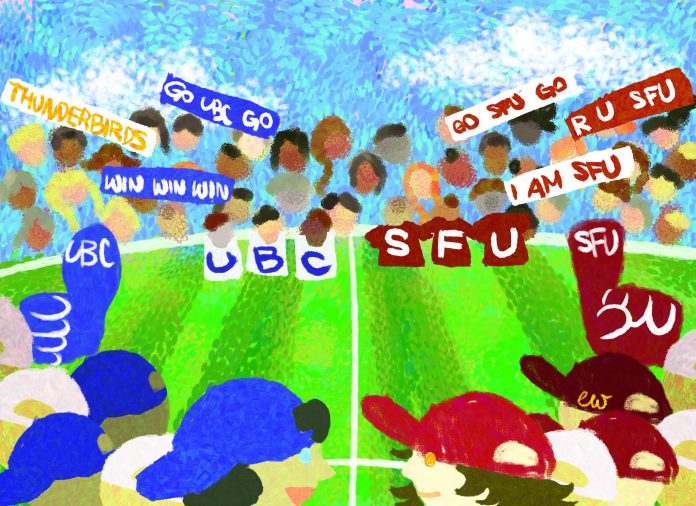
An ongoing, light-hearted feud between my grandfather and I is whose alma mater is better. When I bought him an SFU T-shirt for Christmas, I was pleasantly surprised he didn’t burn it. I was also surprised that when I asked him where this rivalry came from, he wasn’t able to tell me.

Despite not knowing why he scoffs at SFU, after a short conversation, it’s evident that he does and probably always will. “I was 35 when I started second year at UBC and being much older than my fellow students, there wasn’t much of a bond. I don’t remember attending any sporting events between the two [universities],” which, for many, is the most obvious instance of rivalry in the past.

“I did attend a football game once at Thunderbird Field, not against SFU, and there were a few moms, dads, and girlfriends, and that was it. Simon Fraser was not very old at that time [1973], and was thought of as ‘that little college on the hill’. Perhaps a rivalry existed, but nothing that I saw. My main rivalry with SFU started a couple of years ago, when I learned that a blood relative was attending.” I’d like to note that he’s talking about me. . . as I’m interviewing him.

“I am beginning to recover, but it has been a long process. I believe that SFU has come a long way and is now likely to be the second-best university in the province.” Even after admitting he did not get caught up in the rivalry during his time at UBC, he still insisted on making fun of SFU over four decades later. So why does this rivalry exist? And how has it changed in the past fifty years?

A peek back in time

Back in 2015, a former sports editor for The Peak, Austin Cozicar, wrote a feature in The Tartan magazine — a brief side project of The Peak’s — about the history of the Shrum Bowl. For those unfamiliar with it, the Shrum Bowl was an annual football contest between UBC and SFU that started around SFU’s second anniversary.

Founded by SFU’s first chancellor, and former UBC professor, Gordon Shrum, the Shrum Bowl was famous for its antics: a topless woman on horseback, a fight broken up by police, and fans stealing the goalposts during the final quarter, to name a few.

The Shrum Bowl was the beginning of the SFU vs. UBC rivalry. Despite SFU’s age and size, the university was able to win the first five Shrum Bowls. Cozicar believes there was more to this rivalry than just football.

“One big thing between [the two institutions], at least from an athletic standpoint, [is that SFU] decided to go the ‘American way.’ [SFU athletics] went to the National Association of Intercollegiate Athletics (NAIA) which is sort of like the National Collegiate Athletic Association (NCAA), but not as cool,” Cozicar added.

“UBC was old school Canadian football.” And as far as Cozicar is concerned, this was a rupture of sorts in the athletic rivalry between both schools. “The main reason SFU [entered the NAIA] was because they offered scholarships.” While universities in most, if not all, leagues today can offer scholarships, this was a big deal back then. “I think SFU rubbed a lot of them the wrong way by doing that,” said Cozicar.  

Chris Connolly, who graduated from SFU in 1996 and completed a one-year bachelor of education at UBC in 2001, said there was very little rivalry at the time. “Having the perspective of attending both universities, it is apparent that SFU students care more about what is happening at UBC than UBC students care about SFU,” Connolly stated, adding that many no longer cared about the Shrum Bowl by this point.

Deborah Preddy, an SFU alumna who completed a BA and PDP between 19921998, also thought this once-great sports rivalry had lost a lot of its fire. Most of the rivalry Preddy saw during her time at SFU was more conversation based. “Overall it was more good-natured rooting for your home team kind of discussions,” she said.

What’s left of the rivalry?

Our once-great rivalry now seems to have stagnated. Most current students, both at UBC and SFU, don’t even know the famous hijinks of the Shrum Bowl. It makes sense; ever since SFU switched to the NCAA, it has been next to impossible to schedule games, which is why there hasn’t been a Shrum Bowl since 2010.

Even administration has shied away from the rivalry in recent years; a much different attitude than they in held in the 1960s. All of this begs the question: is there still a rivalry between SFU and UBC? “Definitely,” said Soraya Bellou, a third-year UBC biology major.

While Bellou was unclear on the rivalry’s origins, she said she’s always been aware of it. She believes that what remains of the rivalry is rooted in the past, but has taken on new aspects in recent years.

In my opinion . . . the rivalry stems from the [idea] that UBC has a higher reputation internationally and is . . . viewed as [a] more prestigious institution than SFU. [. . .] There’s [also] a resentment towards SFU campus[es] for having more flexible course schedules than UBC.”

Fourth-year BPK and chemistry student, Anupama Rangi, seems to agree. Having the unique perspective of being an SFU student who works at UBC as a residence front desk service representative, Rangi has seen both sides of the rivalry.

When asked if students from either university treat her differently when they find out her situation, Rangi said they mostly just ask why she would transit to get from work to school or vice versa. “If there are any judgements, it’s never been said to my face.”

While admitting there is still a heavy comparison between the two schools, Rangi seems hesitant to call it a rivalry. “I think the general opinion is that UBC is the better university, because of higher admission requirements [faculty specific], a bigger campus, a more widespread reputation, and more people. This comparison is rather inbred — I listened to my parents telling me that UBC was better, I listened to other people’s parents telling me that UBC is better. [. . .] I think it’s less of a ‘rivalry’ now, and more so of a comparison that doesn’t need to be made anymore.”

Cozicar, now the host of CJSF’s Sports Report (Thursdays at 9:00 a.m.), also weighed in on the changes to the SFU vs. UBC rivalry. “From what I gather, back in the sixties there was a lot of perception of snobbery from UBC, which I think we still kind of believe nowadays.”

Touching on what is the most notable form of modern rivalry between the two schools, Cozicar referred to the common ‘Oh, I got rejected from UBC so I went to SFU’ myth that has been perpetuated for years. “It’s actually a matter of pride [for me. . .] I didn’t even try to go to UBC. Only place I tried to go was SFU.”

The nature of our sports rivalry has also dramatically changed. With no Shrum Bowl, where do we see the competition between the two? “I think it’s hard to say there’s one athletically,” said Cozicar. However, Cozicar mentioned there are still soccer games between the two schools, but they don’t bring the same spirit that the Shrum Bowl did.

Picking between the two

Even alumni see how the nature of the rivalry has changed. Connolly, now a teacher at Thomas Haney Secondary, oftentimes has to help grade 12 students pick between several universities. “I think the rivalry is now with smaller institutions such as University of the Fraser Valley (UFV), Trinity Western, and places in the interior. There are more university colleges out there trying to create a name so that they may draw students,” he said, while acknowledging the still existing tensions between SFU and UBC.

“For Thomas Haney students, distance is the factor. SFU is within bus/driving distance, while UBC is just a little out of reach. UBC does have a sort of prestige about it, probably because of that.

“Much of the rivalry, interestingly, centres around the business schools and the education programs. SFU spends a lot of time making a fuss over the PDP program, when really, in my experience, both programs are comparable. In some ways, I do prefer the practicum offerings of UBC as it is a little more ‘hands off.’”

So how should students decide which university is right for them amidst comparison and rivalry? “I recommend students to attend both universities,” said Connolly, adding “if money was not an object, I would give UBC the edge. The campus is beautiful, and there are more networking opportunities due to its size. I also recommend both institutions over smaller colleges if the student is comfortable navigating a larger community.

“No matter where students go, they should stay away from the marketing, and visit each campus and ask themselves, ‘Would I like to spend four years of my youth here along with my hard earned money/loans?’”

Rangi has similar sentiments. “What people should consider when choosing a university at least, what I thought of when choosing where I wanted to go is ultimately what you want to study, what opportunities do you see yourself having, and of course, practical things like tuition feasibility and distance from home. UBC and SFU are both highly-ranked universities with opportunities for success wherever you go.

“What matters in the long run, is what you do and what you experience. If you do nothing to enhance your degree and up your experience, then it doesn’t really matter if you go to UBC or SFU.”

SFSS turns Highland Pub into marijuana dispensary

0

In an effort to curb the constant money hemorrhaging of the Highland Pub, the Simon Fraser Student Society (SFSS) has decided to turn it into the City of Burnaby’s and SFU’s first marijuana dispensary.

“It’s a great idea. I don’t know why they didn’t do it sooner,” said Brendan Bunkis, a first-year business student. “Finally, I can indulge two of my passions — supporting student-run businesses and getting really, really stoned.”

The dispensary has a number of amenities, including a lounge area where students can discuss the latest Steven Universe episodes and how they can “totally start a YouTube channel.” It also includes on-site tutors who will be able to assist you in any schoolwork you have and help you roll a fat joint.

“The dispensary has been a lifeline for the SFSS,” said director of finance, Hangue Kim. “Not only has the entire debt of the old pub gone, but we actually have a surplus. Now, we can afford to book even more obscure EDM acts for our Spring Kickoff.”

But at what cost has the new attraction had on student performance? Some people, including Zoe Moore, a professor in the biology department, don’t see the benefits.

“SFU is a place of higher learning,” she explained. “Students should be focusing on furthering their education, not getting high on the devil’s pollen all day.

“Did you know that 100% of people who smoke marijuana die in their lifetime? It’s proven science.”

She also pointed to the fact that the cumulative GPA of undergraduates has fallen by 40% to a measly 2.25.

“Now, I’ve got students showing up to my lectures who just start laughing when I start discussing the female anatomy. They show up to quizzes high as a kite and just draw penises all over the paper. It’s not a conducive environment for learning.”

Reached for comment, the SFSS said it is working on a campaign to help educate students on the effects of marijuana use, but not before they decide what multimillion-dollar project to cancel next via Twitter.

A journey with hockey leads back home for Jordan Liem

0
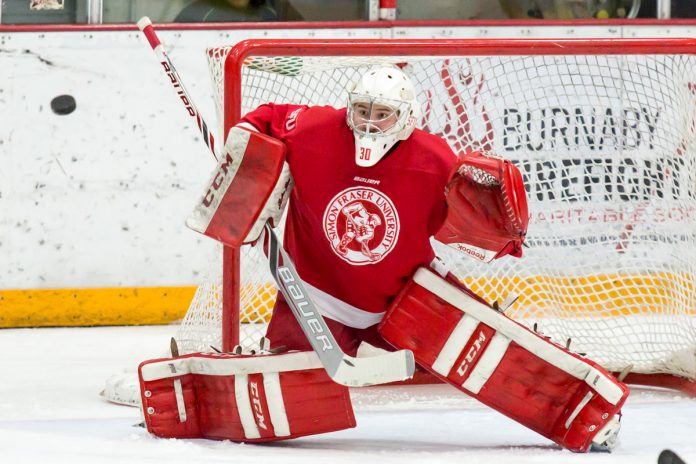
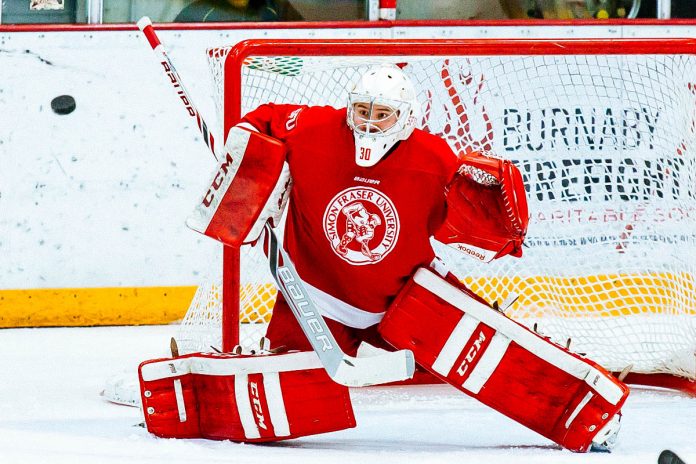
So far this season, Liem has six wins, along with a 2.34 GAA and a .917 save percentage.

Being a goalie in hockey poses some unique challenges. If you have a good game, you can single-handedly win it for you and your teammates. Have an off night, however, and you risk letting everyone down.

Throughout his SFU career, Jordan Liem has been a model of consistency. The third-year goalie from New Westminster has become an integral part of a SFU team that is always near the top of the BC Intercollegiate Hockey League (BCIHL) standings.

“I wanted to stay at home,” said Liem on his decision to come to SFU. “I played in Saskatchewan for a bit, so I wanted to come back home and start playing here again, close to family and friends. My sister actually came to SFU and said she liked it a lot. That kind of persuaded me to come here and they contacted me to come try out.”

Liem’s hockey career began with being drafted to the Western Hockey League. He was a ninth-round pick of the Tri-City Americans back in 2008.

“It’s quite the process,” explained Liem on getting drafted. “It’s definitely something you’re always focused on in your second year of bantam at 15 years old. And when I look back at it now, I think, ‘Wow, these 15 year-olds are getting this huge opportunity to play in a league where you’re getting seen by NHL scouts.’

“For me, I was at school; it was just a regular school day. We knew the draft was going on, so we were trying to keep posted and see if we were going, because a lot of us get contacted throughout the year from interested teams.”

After spending time at the junior B level in BC with the North Van Wolf Pack and not getting “much interest from junior A teams,” Liem then was off to Nipawin, Saskatchewan — population around 4,000 — to try out for the Nipawin Hawks. He ended up making the team.

“It was like the Canadian hockey cliché: move to a small town and play away from home,” Liem said of the experience. “It was kind of like living out that adventure you always envisioned yourself doing. The people were nice; you’re like a town hero. You’re always kind of under scrutiny, because people recognize you all the time. But you’re always welcome everywhere and people are really nice to you.”

After finishing last season with 11 wins in 17 starts with a 2.87 GAA and .915 save percentage, this season has been a bit different. Although he’s improved his GAA and save percentage from last season, he’s been splitting a lot more starts with the team’s other goalie, Lyndon Stanwood.

“There’s never a lull where anyone on the team thinks that we’re shutting down for the rest of the night.”

“I’ve been in some tandems where you kind of butt heads, especially if you’re competing with ice time. But with us, with how good he’s been playing, I have no problem splitting ice time with him.

“We feed off each other a lot and we bounce ideas off each other a lot, which makes it a lot easier. It’s competition within the framework of your team, but it’s not like socially competitive. We’re not angry at each other about anything, it’s just the regular competition that comes between teammates.”

This goalie tandem has led to a brilliant season thus far for SFU hockey. The team is currently top of the BCIHL standings — but they were last year around this time, as well. The trick for this year’s edition will be to avoid the late season collapse that put them in second place, and eventually bounced them out of the first round of the playoffs.

“It’s hard to pinpoint,” said Liem on what makes this year’s team different. “I think I’ve said all year the leadership group is a little bit different. We’re kind of overall never out of a game.

“There’s never a lull where anyone on the team thinks that we’re shutting down for the rest of the night. I don’t know how many comeback wins we have this year, but at no point in any game have we felt like that’s it; we’re done. We’ve never felt out of it all year, and I think this year, too, just the attitude everyone has coming to the rink is pretty positive.”

Liem’s ultimate goal is to win the BCIHL championship after coming so close his first year. After that, the future is uncertain, but Liem says he does have a passion for goalie coaching.

“There’s a former SFU goalie, Justin Mulholland, who’s starting a goalie school. It’s been getting a lot of popularity and he’s been keeping in contact with me and he gives me some opportunities to coach younger kids. [. . .] I don’t know if I’d want to do team coaching, but goalie coaching is kind of an interest in mind.”

FUN FACT: Favourite place to eat on campus?

“Definitely Mackenzie [café]. Their sandwiches are just killer.”

Ontario judge stands up with residential school survivors

0

By: Manon Busseron

Canada failed to protect thousands of Indigenous childrens’ cultural identities during the “1960s Scoop,” Superior Court Justice Edward Belobaba stated.

After an eight-year lawsuit, Ontario judge Edward Belobaba stated that the Canadian government did not fulfill its “duty of care“ to the children by placing thousands of Indigenous children in non-Indigenous families and residential schools. The term “Sixties Scoop“ was coined by Patrick Johnston in 1983, and refers to the forced mass removal of Indigenous children from their families.

Between 1965 and 1984, about 150,000 Indigenous children were forcibly removed from their families and taken to residential schools run by the church. The government decided that it was its responsibility to assimilate Indigenous children into white society. They were prevented from speaking their languages and had to abandon their traditional customs. Those who refused to obey were beaten and severely punished. Many were separated from their siblings and faced physical, moral, and sexual abuse.

In his decision, Justice Edward Belobaba acknowledged the psychological harm caused by residential schools and the responsibility of Canada in the loss of Indigenous identities for many of the children at that time, saying that it “left the children fundamentally disoriented, with a reduced ability to lead healthy and fulfilling lives. The loss of Aboriginal identity resulted in psychiatric disorders, substance abuse, unemployment, violence, and numerous suicides,” according to the CBC.

Over one billion dollars are at stake in the lawsuit on behalf of 16,000 Indigenous children from Ontario who claimed being harmed after being sent to a residential school or non-Indigenous homes. Justice Belobaba argued that the state did not respect the child services agreement by failing to consult with First Nations regarding the transfer of children to non-Indigenous environments. The government responded that the consultation would not have changed anything for these children, but Justice Belobaba strongly disagreed, calling this opinion “odd and frankly insulting.“

Justice Belobaba has not settled a financial arrangement yet, but intends to negotiate with survivors. Indigenous Affairs Minister Carolyn Bennett said that the government will not appeal, but will try to prevent the release of the decision and ask for “technical clarifications.“ Bennett insisted that money was not the most important part of the decision, declaring that “getting their language and culture back, making sure their children will be able to speak the language, and getting their culture back, is so important.“

The lead plaintiff in the action was Marcia Brown Martel from the Temagami First Nation. After being adopted by a non-Indigenous couple when she was nine, Canada “declared her original identity dead.“ She said, “Our voices were finally heard and listened to. . . It is a gain for all of us a step forward and a step closer to reconciliation.“

With files from CBC and Indigenous Foundations at UBC


Ellen Kett sets GNAC single-game record with 20 assists in 87–65 Victory

0
Kett’s (#5) 20 assists in one game were not only the most in GNAC history, it was also the fourth-most in NCAA Division II history.

Ellen Kett’s dominant season continued Saturday night, as the senior point guard recorded a record 20 assists in one game against Montana State Billings. This set the record for most assists in a game in Great Northwest Athletic Conference (GNAC) history, as well as the fourth-most all time in NCAA Division II history. Kett smashed the old record of 16 assists, previously set by Ally Schmidt of Central Washington in 2012.

Kett’s phenomenal passing ability was on display throughout the game, and her teammates were able to convert on the opportunities she gave them — evidenced by SFU shooting 61.8% from the field.

The team got off to a great start behind a 102 run to begin the first quarter. Of the five baskets scored during this run, Kett assisted four of them, establishing herself as a primary playmaker early on. The Clan struggled for the rest of the quarter. However, the Yellowjackets went on a 102 run of their own to make the score 1212 heading into the second frame.

In the second quarter, Simon Fraser was able to separate themselves from their opponents. As expected, Kett’s passing ability was on display throughout the quarter, as she added seven assists to her total in the frame. Going into the half, she had a game-high 11 assists. Meg Wilson and Rachel Fradgley were both a perfect 44 from the field, with nine and eight points respectively. Rachel Swant scored eight points off the bench in the half as well, including two three-pointers. The teams headed into the half with a score of 38–30 for the visiting team.

Simon Fraser stretched the lead out a little more in the third quarter with a 155 . During it, SFU dominated the paint and propelled the Clan to a 5742 lead with three and a half minutes to go in the quarter. At 2:21, a Tia Tsang three-pointer marked the 16th assist by Kett, tying the previous GNAC single-game record. The score was 6251 heading into the final quarter, and Kett had 10 more minutes to create a new record.

She broke the record convincingly, adding four assists as well as eight points in the final quarter to finish the game with a line of 14 points and 20 assists. The team won by a blowout score of 8765, ensuring the team will finish third in the GNAC.

For those who have followed the Clan this season, a breakout game like this by Kett is no surprise. Her playmaking ability at the point guard position has been the catalyst of the team’s success throughout the year. Head coach Bruce Langford has always trusted in his senior point guard, playing her for big minutes in almost every game this season. Games like this are simply a reminder as to why she is so integral to the team’s success. As Langford told SFU athletics, “Our offense is designed to put the ball in [Kett’s] hands for a reason.”

The Simon Fraser front court were beneficiaries of Kett’s passing in this one. Wilson led the team in scoring with 19 points on a very efficient 8–9 from the field and 22 from the free throw line. Fradgley had 12 points on a perfect 6–6 from the field. Elisa Homer had 11 points, including three three-pointers. Tayla Jackson rounded out the double-digit scorers with 10 points off the bench.

With this win Simon Fraser are now 144 in the GNAC and 23–5 overall. They will finish as the third seed in the GNAC with only two conference games left to play.

Next Game: Simon Fraser will host the University of Alaska Fairbanks in their second-last game of the season on Thursday, February 23. The Nanooks are an even 9–9 in conference play and 13–12 overall. Last time these two teams played, SFU squeaked out a 79–77 victory, behind freshman Tia Tsang’s 16 points.

Tip-off is at 7:30 p.m.

Team Canada unable to claim victory against USA in Americas Rugby Championship

0
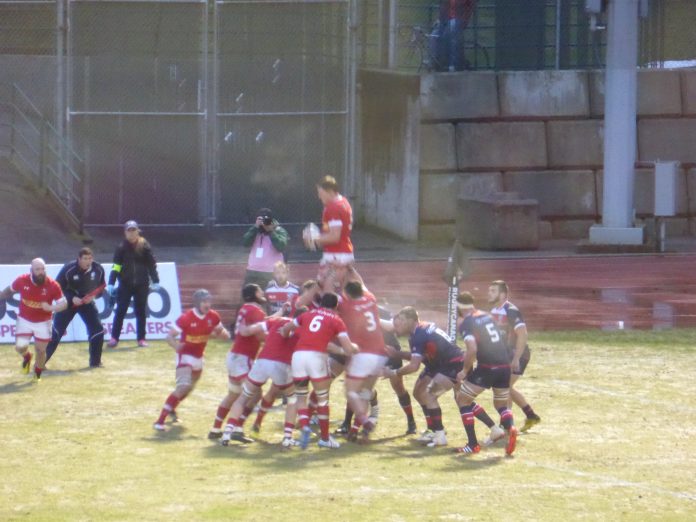
Canada's Reegan O'Gorman claims a lineout in their loss to the USA.

With less than two minutes on the clock, it was the USA who made the dream start in front of the Swangard crowd.

Fly-half Will Magie’s long pass opened up space out wide, before captain Todd Clever’s offload sent Ryan Matyas sprinting under the posts for the game’s opening try. Shaun Davies added the conversion for the extra two points, and the Eagles led 70.

It was to get even better for the visitors just two minutes later. A stolen lineout saw the ball spun wide, and Mike Te’o’s lethal combination of footwork and pace saw him cross out wide. Davies was unable to add the tricky conversion from out wide, but the USA led 120 with less than six minutes played.

The USA continued to dominate the early exchanges. They also added another three points when Magie was on target with a penalty after referee Damian Schneider punished Canada for an infringement at the breakdown.

The home side finally had the chance to get themselves on the scoreboard on 13 minutes, after the USA was penalized for not rolling away from the tackle. However, Robbie Povey pulled his penalty attempt wide of the posts.

Povey almost immediately made amends, though. Spotting a gap in midfield, the fly-half accelerated through the USA defence before feeding Taylor Paris, who sprinted home for his fourth try in two games. The conversion was wayward, leaving the score at 155 in the USA’s favour after 15 minutes.

The home side was fighting their way back into the game, and were rewarded with their second try on 20 minutes. After finding some success at the scrum, Phil Mack darted through a gap close to the try-line to score. Povey was on target with the conversion, and the gap was down to three points.

Davies extended the Eagles’ lead on the half-hour mark, taking his side’s lead to 1812 with a penalty after Canada was penalised at the ruck. The home side soon hit back though, with Povey’s kick reducing the deficit once more.

However, just before halftime, the Canadians were dealt a blow as captain Ray Barkwill was shown a yellow card for a dangerous tackle. In his absence, the USA struck, a rolling maul powering over the try-line, to allow Tony Purpura to score. Davies converted to give the USA a 2515 lead at the halftime interval.

Once again, the USA got the ideal start to the half. With five minutes of the second half played, Magie’s cross-field kick was knocked down by Matyas, with Te’o following up for his second try of the evening. Davies was off-target with the conversion, but the USA led 3015 as Barkwill returned to the field.

Canada’s indiscipline was costing them, and the USA was capitalizing. Another penalty was kicked into the corner, and from the resulting maul, Clever was able to crash over for the try. Davies converted, and the Eagles had a 3715 lead with 55 minutes played.

The home side responded in the best possible way. Substitute scrum-half Gordon McRorie found Paris on an outside arc, with the former Glasgow Warriors wing scything his way past three defenders en route to the line for his second score of the night. McRorie was unable to add the extras, with the USA’s lead now standing at 3720.

In an end-to-end affair, it wasn’t long until the next try came. After maintaining possession for a number of phases, USA replacement back row John Quill latched on to a delayed pass from Davies to score the visitors’ sixth try. Davies converted for a 4420 lead.

With the result now looking beyond them, the Canadians were still looking to play enterprising rugby. With referee Schneider holding an advantage against the USA, Povey’s chip over the top was gathered by replacement winger George Barton, who was able to touch down despite the attentions of two defenders. McRorie added the extras for his first successful kick of the night.

Just seconds later, however, the USA responded. The impressive Te’o was first to the kick ahead from Magie, touching down for his hat-trick out wide. Davies conversion took the Eagles past 50 points, as they took a 5127 lead into the final 10 minutes.

There was still time for another Canadian score, and it was possibly the most popular of the evening. From a scrum five metres from the American try-line, number eight Admir Cejvanovic, a member of the Burnaby Lake club, drove over the line to score. McRorie was once again on target with the conversion, leaving the final score at 5134 to the USA.

The Americans, therefore, keep pace with Argentina at the top of the Americas Rugby Championship as they travel to Chile next week. Canada, meanwhile, will look to pick themselves up in seven days’ time when they face Uruguay.

Canada: Brock Staller, Dan Moor, Nick Blevins, Guiseppe du Toit, Taylor Paris, Robbie Povey, Phil Mack; Rob Brouwer, Ray Barkwill, Matthew Tierney, Conor Keys, Reegan O’Gorman, Lucas Rumball, Oliver Nott, Admir Cejvanovic.

Replacements: Benoit Piffero, Djustice Sears-Duru, Cole Keith, Liam Chisholm, Lucas Albornoz, Gordon McRorie, Gradyn Bowd, George Barton.

USA: Mike Te’o, Ryan Matyas, Bryce Campbell, JP Eloff, Nate Augspurger, Will Magie, Shaun Davies; Tony Purpura, Peter Malcolm, Chris Baumann, Nate Brakeley, Nick Civetta, Todd Clever, Tony Lamborn, Cam Dolan.

Replacements: James Hilterbrand, Ben Tarr, Dino Waldren, Siaosi Mahoni, David Tameilau, Ben Cima, Aaron Davis.

Previewing the NBA trade deadline

0
Serge Ibaka, seen here with the Oklahoma City Thunder, will help the Raptors for the rest of this season, but it remains to be seen if he stays beyond that.

What’s already happened

Denver trades C Jusuf Nurkic and a 2017 first-round draft pick to Portland for C Mason Plumlee, a 2018 second-round draft pick, and cash.

Denver Grade: C+

While the Derek Jokic/Jusuf Nurkic frontcourt experiment didn’t work, this doesn’t do much to fix the issue. The only reason the Nuggets are given a C+ is that Plumlee’s passing ability will allow them to play very similarly with him or Jokic on the floor, and could make for some fun offensive sets if they can figure out how to play defense together.

Portland Grade: A-

Nurkic is finally given a role where he can reach his potential, and Portland gets a 2017 first-round draft pick as well. Nurkic has one more year on his rookie contract than Plumlee, making this a great value trade for a team that may not make the playoffs.

Orlando trade PF Serge Ibaka to Toronto for SG/SF Terrence Ross and a 2017 first-round draft pick (lower pick from Toronto or Los Angeles Clippers)  

Orlando Grade: B-

Aaron Gordon can finally move to starting power forward, Terrence Ross is having his best NBA season and fits in nicely in Orlando, and the Magic gets a first-round pick for a player who would leave this off-season. In the moment, this trade makes sense. Rewind back to this off-season, when Orlando traded Victor Oladipo, Ersan İlyasova, and Domantas Sabonis for Ibaka, and signed Jeff Green and Bismack Biyombo in free agency, and you have to question the Magic’s front office.

Toronto Grade: B+

Toronto’s search for a power forward is finally over, and Ibaka looks like he will fit in perfectly. Norman Powell will finally get the minutes he deserves, and should flourish as the first wing off the bench. While they lose a first-round pick, they will still have one come June and have plenty of prospects. Acquiring Ibaka probably reclaims the title of second-best team in the east for the Raptors, but they will still be a tier below the Cavaliers when Kevin Love returns. This trade also falls short of an “A” for the Raptors, as they may have been favourites to sign Ibaka this free agency without giving up assets, and there is still the possibility of him just being a rental.

Predicting what else will happen

The “call back in the off-season” guys:

As much as yours sports news source will try to encourage otherwise; Jimmy Butler, DeMarcus Cousins, and Paul George will not be changing jerseys this month. A team like the Boston Celtics will make some calls and maybe even submit an offer, but big trades like these tend to happen in the off-season. Carmelo Anthony was the last superstar to get traded in February, and he was an impending free agent.

The all-stars that may move:

Carmelo Anthony:

Speaking of Melo, Knicks’ president Phil Jackson is insistent on getting rid of the nine-time all-star before the deadline on February 23, but Anthony’s no trade clause has gotten in the way. The three teams he has accepted to go to (Cleveland, Boston, and Los Angeles Clippers) have been unconvincing in trying to acquire him, with the Clippers being the only team that seems at all interested. A trade packaged around Austin Rivers, JJ Redick, or even Jamal Crawford should not be enough to acquire Anthony, however, no matter how much Phil Jackson would like to move him.

Prediction: Anthony stays in New York

Paul Millsap:

After the Kyle Korver trade looked to be the beginning of a fire sale for the Hawks, they are now insistent that Millsap is off the market. While this is likely a way to increase his value, Millsap’s most likely suitor just traded for Serge Ibaka. Millsap doesn’t make sense for any contenders, and any other team should be careful about trading for an aging all-star who could leave this off-season: that doesn’t necessarily mean that they will.

Prediction: Millsap stays in Atlanta, or pit stops in Denver or Miami before testing free agency.

Expiring deals:

Rudy Gay and Danilo Gallinari:

Two more forwards who are likely to test free agency after this season, the Kings and Nuggets will be smart to trade them before they lose them for nothing (like the Pelicans with Ryan Anderson last year).

Potential deals:

Sacramento trades SF Rudy Gay and PG Ty Lawson to Oklahoma City for PG Cameron Payne, SF Kyle Singler, PF Nick Collison and a second-round pick.

Denver trades SF Danilo Gallinari to Los Angeles Clippers in three-way trade.

Next tier trade candidates:

Ricky Rubio:

While Kris Dunn looks like the future PG for Minnesota, he is not ready to take over yet. A Rubio trade seems inevitable, but it probably won’t be this season.

The Centres:

Greg Monroe, Jahlil Okafor, and Brook Lopez have all been involved in trade rumours throughout the season, and may finally be moving this month. While it is unlikely that all three will be traded come the trade deadline, a team like New Orleans is likely to pull the trigger on one of them.

Potential deals:

Milwaukee trade C Greg Monroe and SG Tony Snell to New Orleans for SG Tyreke Evans, PG Tim Frazier, and C Alexis Ajinça.

Philadelphia trade C Jahlil Okafor to New Orleans for PG Tim Frazier, C Alexis Ajinça, and a first-round pick in 2018.

Brookland trade C Brook Lopez to New Orleans for SG Tyreke Evans, PG Tim Frazier, C Alexis Ajinça, and a top three protected first-round pick in 2017.

Other guys to look for

Tim Hardaway Jr. – Atlanta

Taj Gibson – Chicago

Wesley Matthews – Dallas

Wilson Chandler – Denver

Lou Williams – Los Angeles Lakers

Brandon Knight – Phoenix

PJ Tucker – Phoenix

Kosta Koufos – Sacramento

Mike Jones retiring as head coach of women’s wrestling

1
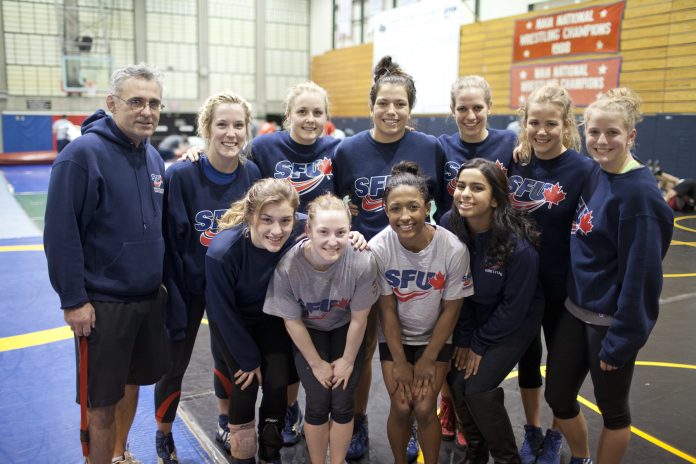
Jones (far left) with the 2012–13 women’s wrestling team that took home the WCWA Championship and the WCWA Duals title.

For the first time in a long time, there will be a new face coaching SFU women’s wrestling. After more than 40 years at SFU, head coach Mike Jones has announced his retirement.

In his bio on the BC Sports Hall of Fame website, Jones is regarded as “not only as Canada’s greatest wrestling coach of all-time, but one of the country’s great coaches in any sport in terms of unmatched success at the national and international level.”

“I’ve been toying with it before, but I made it before the national tournament,” Jones told The Peak. “We’d kind of decided that April will be my last day but [the national championships were the] last tournament that I [will] go to.

“I’m going to be looking at it from a cheerleader’s point of view next year. [. . .] It’s going to be exciting for somebody, a new head coach, to come in with that strength on the team. Could be frustrating if it doesn’t [go well], but I can’t see this group with their personalities not doing well.”

Although Jones will not be the head coach, he will still be a consultant of sorts for the team, helping out with the wrestling side when he can.

“I’m [going to] come in and help with the wrestling side of it, mostly,” he explained. “Get rid of the administration side of it. In that way I’m looking forward to it, because sometimes you get to work a little bit more on the actual wrestling part of it.

“But [it’s] the kids I’m going to miss. You get pretty close to them when you work with a group that has high goals and all the anxieties that go with that.”

It’s been a remarkable time at SFU for Jones. The longtime coach has had a hand in multiple national champions since starting at SFU back in 1976.

“it took us into the ‘82–83 [season] until that whole belief, that yes we can win at this and it doesn’t matter that we’re going to a different style; we can compete at this top level,” reflected Jones on his beginnings at SFU. “It definitely is ego to think that you can do it quickly, but it takes you seven to eight years to really put it together.”

Perhaps even more impressive was his hand in the Olympics. Jones served as the head coach of Canada in two Olympics, and has coached a number of Olympic medalists recently as well, including three who won gold — Daniel Igali in 2000, Carol Huynh in 2008, and Helen Maroulis in 2016.

“I’d like to be able to tell people that I built them from scratch, but that’s not the case,” said Jones. “Those were good athletes to start with and in some ways, you just feel good that you didn’t screw up their chance. You just kind of get them into the matches that they need and let them go.”

Although he won’t be a part of it, Jones is looking forward to the future of the program, whoever is in charge next year.

“Definitely exciting to see those things happen and I’m going to be excited [to see] who’s going to be the next head coach,” he said. “I don’t want the program to go down; I want the program to keep going forward.”

New Music Friday

0

Follow The Peak on Spotify to stay up to date on New Music Friday.

“How Would You Feel (Paean)” – Ed Sheeran

Jessica Whitesel: Don’t get me wrong; I love Ed Sheeran, but he needs to stop with the love songs. It’s like he is trying to one-up himself over being able to write the most touching love song. Seriously though, he’s thissssss close to becoming the world’s first multi-platinum wedding singer.

Rita Ovis: This could maybe be a Disney song! Who doesn’t love a good love song that sounds like it could be straight outta The Little Mermaid.

“Shining” – DJ Khaled feat. Beyoncé and Jay-Z

JW: I guess this song is OK, but both Bey and Jay have done better work. Maybe it was DJ Khaled that threw it off? In any event, even though this will probably be a huge hit, they’ve both done much better work.

RO: Without Beyoncé this song would be NOTHING! Without Beyoncé, modern culture would be LOST! We need Beyoncé!!!

“P.O.W.A.” – M.I.A.

JW: Well, this sure is a song. I either love or hate M.I.A.’s music, there is no in between, and this song falls under hate. There is just something about her flow that seems off in this track and I’m not sure if it’s the backing track or what, but it just didn’t sound right.

RO: Acronyms run strong for M.I.A. She also rhymes Osama with Obama and the Dalai Lama, so that’s pretty creative.

“It Ain’t Me” – Kygo feat. Selena Gomez

JW: I had to listen to this song about three times before I realized that it just wasn’t going to happen and I should give up. It’s pretty much the perfect poppy background song. Bland, repetitive lyrics sung a tad too high, a super basic beat, and a strange fondness for being 17. DO YOU EVEN FUCKING REMEMBER 17? IT WAS THE WORST FFS.

RO: I’ve always been convinced that Selena Gomez’s musical career has been balancing on good producing and autotuning, and this song just further proves that.

“Rich Boy” – Galantis

JW: This song is a little too summery for February with how upbeat it is, but as soon as the snow starts to melt and I can drink on patios with my squad, I’ll be all over this song.

RO: Oh, this is a good party song, people! Too bad reading week is over ☹.

“A Kindly Reminder” – Passenger

JW: Passenger is fucking clobbering Donald “Tiny Hands” Trump with a fucking mic. Holy shit. It’s fucking fire. “And if I could offer a kindly reminder / It’s not OK to grab women by the vagina,” which is a pretty kick-ass phrase to pull the title of the song from. It also talks about the wall, the travel ban, and of course, his tiny hands. It kind of reminds me a bit of Bob Dylan, but you can actually understand the words.

RO: No literary devices were used in the making of this song. This might as well be a very opinionated SNL parody song about Trump and his doings. Honestly, I thought Passenger was so meek, too! Now, they’re rhyming reminder and vagina in reference to Trump.

“Cold” – Maroon 5 feat. Future

JW: I’m not loving this at all. It’s just the same thing over and over and over and over, and then Future comes in. Which is different, but by that point, there isn’t really anything anyone could do to make this song better.

RO: Even to this day, when I think of Maroon 5, I think of “She Will Be Loved,” so I’m always thrown off guard when collaboration with all these new funky artists like Future come out. I just can’t keep up with the kids these days.

“Heavy” – Linkin Park feat. Kiiara

JW: WUT? This is not the nu-metal Linkin Park I listened to in middle school. I don’t know how to feel about this. Like, the lyrics are classic Linkin Park, but the sound is not, and I just don’t know how to feel about this. But like, kudos for changing with the times, unlike some other bands *cough* Nickelback *cough*.

RO: This is a little angst I definitely would have enjoyed as a 13-year-old. Not so much now, though, since I can get my feelings out on Twitter.

“Love Incredible” – Cashmere Cat feat. Camila Cabello

JW: NO. I DO NOT LIKE THIS. Maybe this is a hot take, but Camila Cabello can’t sing worth shit. And that is literally all that this song is. I WANT EAR BLEACH.

RO: Ooh, I really like Camila Cabello’s voice in this — it’s so floaty and cool. All in all, it’s just another banger for the club, it doesn’t really stand out too much, other than the voice.

“Some Way” – Nav feat. The Weeknd

JW: I mean, this sure is The Weeknd. I’m still not sure who Nav is, but I’m guessing they are probably a DJ. . . probably. It sounds like non-single The Weeknd if you really want to know more about this song.

RO: Which way is “some way” though? Like, I get it, I get the slang, I really do, but also I don’t.

“Safari” – Jidenna feat. Janelle Monae, St. Beauty, and Nana Kwabena

JW: I couldn’t make it through this one. I feel like since I’m the arts editor, I should listen to all of it, but I just couldn’t. Sorry fam.

RO: I truly enjoy how the concept of safari in this song is used as both a metaphor for a kooky and wild party, as well as the Internet browser, Safari. Google Chrome is better, though, in my opinion.

“Nimble Bastard” – Incubus

JW: This is the Incubus I remember! I don’t know if I even ever liked them, but at least they are recognizable, so that is nice.

RO: This is a bit head-bangy and reminds of Green Day, so I guess it’s alright.

A journey with hockey leads back home for Jordan Liem

0
So far this season, Liem has six wins, along with a 2.34 GAA and a .917 save percentage.

Being a goalie in hockey poses some unique challenges. If you have a good game, you can single-handedly win it for you and your teammates. Have an off night, however, and you risk letting everyone down.

Throughout his SFU career, Jordan Liem has been a model of consistency. The third-year goalie from New Westminster has become an integral part of a SFU team that is always near the top of the BC Intercollegiate Hockey League (BCIHL) standings.

“I wanted to stay at home,” said Liem on his decision to come to SFU. “I played in Saskatchewan for a bit, so I wanted to come back home and start playing here again, close to family and friends. My sister actually came to SFU and said she liked it a lot. That kind of persuaded me to come here and they contacted me to come try out.”

Liem’s hockey career began with being drafted to the Western Hockey League. He was a ninth-round pick of the Tri-City Americans back in 2008.

“It’s quite the process,” explained Liem on getting drafted. “It’s definitely something you’re always focused on in your second year of bantam at 15 years old. And when I look back at it now, I think, ‘Wow, these 15 year-olds are getting this huge opportunity to play in a league where you’re getting seen by NHL scouts.’

“For me, I was at school; it was just a regular school day. We knew the draft was going on, so we were trying to keep posted and see if we were going, because a lot of us get contacted throughout the year from interested teams.”

As a draft pick, Liem got to attend their pre-season camps, which was an eye-opening experience for him at the time.

“I got to go to camp for two years and see what a junior main camp was all about,” he said. “The workouts, the ice times they expect you to do, and the professionalism that comes along with it, because it’s something you don’t really get a taste of at 15 usually. Not until you’re older and maybe getting into a junior A level.”

After spending time at the junior B level in BC with the North Van Wolf Pack and not getting “much interest from junior A teams,” Liem then was off to Nipawin, Saskatchewan — population around 4,000 — to try out for the Nipawin Hawks. He ended up making the team.

“It was like the Canadian hockey cliché: move to a small town and play away from home,” Liem said of the experience. “It was kind of like living out that adventure you always envisioned yourself doing. The people were nice; you’re like a town hero. You’re always kind of under scrutiny, because people recognize you all the time. But you’re always welcome everywhere and people are really nice to you.”

After finishing last season with 11 wins in 17 starts with a 2.87 GAA and .915 save percentage, this season has been a bit different. Although he’s improved his GAA and save percentage from last season, he’s been splitting a lot more starts with the team’s other goalie, Lyndon Stanwood.

“I’ve been in some tandems where you kind of butt heads, especially if you’re competing with ice time. But with us, with how good he’s been playing, I have no problem splitting ice time with him.

“We feed off each other a lot and we bounce ideas off each other a lot, which makes it a lot easier. It’s competition within the framework of your team, but it’s not like socially competitive. We’re not angry at each other about anything, it’s just the regular competition that comes between teammates.”

This goalie tandem has led to a brilliant season thus far for SFU hockey. The team is currently top of the BCIHL standings but they were last year around this time, as well. The trick for this year’s edition will be to avoid the late season collapse that put them in second place, and eventually bounced them out of the first round of the playoffs.

“It’s hard to pinpoint,” said Liem on what makes this year’s team different. “I think I’ve said all year the leadership group is a little bit different. We’re kind of overall never out of a game.

“There’s never a lull where anyone on the team thinks that we’re shutting down for the rest of the night. I don’t know how many comeback wins we have this year, but at no point in any game have we felt like that’s it; we’re done. We’ve never felt out of it all year, and I think this year, too, just the attitude everyone has coming to the rink is pretty positive.”

Liem’s ultimate goal is to win the BCIHL championship after coming so close his first year. After that, the future is uncertain, but Liem says he does have a passion for goalie coaching.

“There’s a former SFU goalie, Jesse Mulholland, who’s starting a goalie school. It’s been getting a lot of popularity and he’s been keeping in contact with me and he gives me some opportunities to coach younger kids. [. . .] I don’t know if I’d want to do team coaching, but goalie coaching is kind of an interest in mind.”

FUN FACT: Favourite place to eat on campus?

“Definitely Mackenzie [café]. Their sandwiches are just killer.”