Home Blog Page 73

This Week at SFU: November 7 – 10

0
Members of the women’s soccer team, wearing red uniforms with white lettering, celebrate with a group embrace.
PHOTO: Courtesy of @sfuwsoc / Instagram

By: Yasmin Hassan, Staff Writer

Home games:

Thursday, November 8: women’s basketball vs. Vanguard Lions at West Gym at 3:15 p.m.

Saturday, November 9: women’s basketball vs. Westmont at West Gym at 3:15 p.m.

  • Makenna Gardner, playing guard, had 31 game points in the 2023–24 season

Saturday, November 9: women’s soccer vs. Seattle Pacific at SFU Stadium at Terry Fox Field at 5:00 p.m.Soccer – W – Simon Fraser University Athletics

Away games:

Thursday, November 7: women’s soccer vs. Montana State Billings at Yellowjacket Soccer Field in Billings, Montana at 2:00 p.m.

  • The team’s last game against Montana State Billings resulted in a 20 win for SFU

Thursday, November 7: men’s soccer vs. Western Washington at Harrington Field in Bellingham, Washington at 5:00 p.m.

  • SFU’s last matchup against Western Washington ended in a 3–1 loss 

Thursday, November 7: volleyball vs. Seattle Pacific at Royal Brougham Pavilion in Seattle, Washington at 7:00 p.m.

  • The Red Leafs prevailed in their recent game against the Western Washington University Vikings

Friday, November 8: men’s basketball vs. Cal Poly Humboldt at WECU Court at Carver Gym in Bellingham, Washington at 5:00 p.m.

Saturday, November 9: cross country at NCAA Cross Country West Region Championships at Amend Park in Billings, Montana for the West Region Championships

  • At the recent Lewis Crossover, Rachel Watkins came in 24th, bringing the women’s team to 14th place among the approximately 330 participants

Saturday, November 9: volleyball vs. Montana State Billings at Alterowitz Gymnasium in Billings, Montana at 11:00 a.m.

  • The team brought in a 31 win against Montana State Billings at their last GNAC Conference match
  • Live video available

Saturday, November 9: men’s soccer vs. Saint Martin’s at Saints Field in Lacey, Washington at 2:00 p.m.

  • At their last matchup with Saint Martin’s, the Red Leafs brought home a 71 win
  • Live video available

Saturday, November 9: men’s basketball vs. California State, Dominguez Hills at WECU Court at Carver Gym in Bellingham, Washington at 5:00 p.m.

  • Part of the West Region Crossover

Saturday, November 10: men’s wrestling at Mike Clock Open at Stoller Athletic Center in Forest Grove, Oregon

The team’s last matchup with Pacific University resulted in a 459 point win, with the longest win streak being four matches

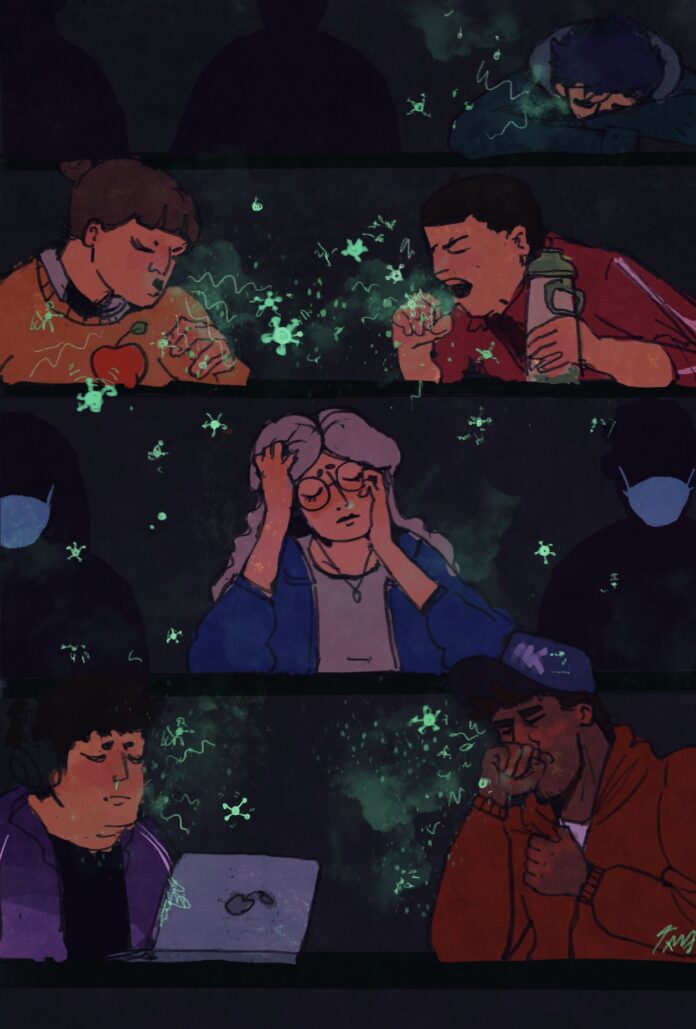
Comic: The ghost job

0
COMIC: Cindy Wang / The Peak


Monday Music: Original Pilipino Music (OPM) classics

0
The word 'Manila' written in green light against a dark background.
PHOTO: Project Atlas / Unsplash

By: Dani Santos, SFU Student

Manila” by Hotdog
International students can surely relate to the feeling of missing home, and “Manila” by Hotdog perfectly encapsulates this. Released in 1976, this Manila sound (a genre blending rock and roll, jazz, funk, and disco) track talks about an individual’s desire to leave home, but constantly feeling out of place when they’re away. They sing they’ve gone to places like San Francisco, Disneyland, and Sydney, but nothing compares to being in Manila. Hotdog even describes this sensation “like a girl that you really can’t forget:” “Parang babaeng and hirap talagang malimutan.” The iconic sounds of jeepneys in Manila and the dialogue from a driver, along with the mix of Tagalog and English lyrics, make the song unique to the Manila experience. 

When I Met You” by APO Hiking Society
APO Hiking Society introduced one of the most classic love songs in original Pilipino music (OPM) history back in 1982 with this ballad. The main character compares himself to “an empty piece of a shell” at the beginning of the song, not knowing what being in love with a person would bring into their life. He then recounts all the things that being with her has done. He says, “You gave me a reason for my being,” and promises her a lifetime of love. The mellow tempo with just the right inflections gives the song a relaxing feel, and the heartwarming lyrics make “When I Met You” the epitome of a harana (serenading) song. 

With A Smile” by Eraserheads
When times get rough, it’s hard to think about the good things in life, but the Eraserheads are here to remind us to stay optimistic with their 1994 hit, “With a Smile.” The main character sings to a girl, encouraging her to keep her head up and smile, and reassures her that he will be there for her even throughout the bad times. While they may be referring to the anxieties that can come from being in a relationship, the sentiments can be applied to everyday life. The song starts off slow, but it builds up and eventually peaks with the chorus of “do do do’s” in the middle and towards the end. An ensemble of vocalists paired with the Eraserheads’ motivating words make “With a Smile” the perfect tune to sing with a group of friends at karaoke or with thousands of strangers at an Eraserheads concert.

Bill C-64 passes as federal law, promising free prescription contraception and diabetes medication in Canada

0
This is a photo of an intrauterine device (IUD) and a type of contraception pill.
PHOTO: Courtesy of AccessBC

By: Sofia Chassomeris, News Writer   

On October 10, Bill C-64, or the Pharmacare Act, received royal assent and became federal law. The bill works towards a “national pharmacare plan” that will “provide universal, single-payer, first-dollar coverage” across Canada for “specific prescription drugs and related products intended for contraception or the treatment of diabetes.” A group of advocates from the AccessBC campaign “applauds this important step.”

The Peak spoke with Dr. Teale Phelps Bondaroff, AccessBC committee chair and co-founder, for more information about the bill. AccessBC has had “the goal of making all prescription contraception in BC free” since its start in January 2017.

Phelps Bondaroff explained BC already signed a memorandum of understanding (MOU) with the federal government prior to the bill’s royal assent. Signed on September 12, the MOU is a confirmation of the provincial and federal government’s “intention to work together to improve contraception and diabetes coverage for residents of BC.” The MOU also outlined how the Pharmacare Act will expand BC’s current free contraception program, which came into effect in April 2023. “Canadians currently pay for prescription drugs through a mix of private, public, and out-of-pocket plans,” but the new bill promises fully covered contraception and diabetes medication.

“We already have free prescription contraception in BC, so my understanding is that the provincial government [is now] entering into agreement to work on free diabetes medication, which is critically important,” said Phelps Bondaroff. Medications including different types of insulin are life-saving for those with type 1 and 2 diabetes and can cost up to $15,000 annually. In addition to diabetes medication, the MOU also stated BC’s plans to expand the program to include “free treatment of menopausal symptoms with hormone replacement therapy,” which would ensure that people who can get pregnant have access to reproductive health medications throughout their lives.

BC currently has twelve PharmaCare plans to help residents afford prescription medications and medical services. The Fair PharmaCare plan covers a percentage of medical expenses based on income once a family unit has reached a minimum deductible.

“We need to see additional changes and improvements to access to sexual and reproductive health services and contraception in BC,” said Phelps Bondaroff. “This is going to be a transformative policy across the country.”

Phelps Bondaroff said since BC’s implementation of free contraceptives, 252,000 people have been able to access free contraceptives in BC and “exercise reproductive autonomy without having to worry about paywalls.” The amount of people who benefitted from the program “showed that cost is a significant barrier making it hard for people to access contraception. 

“Free prescription contraception improves health outcomes, it makes life more affordable, it makes life more equal, and it actually saves government’s money,” added Phelps Bondaroff. BC’s MOU cited a 2010 Options for Sexual Health study, which stated that “every $1 spent on access to contraception can save as much as $90 in government spending” for social programs and support.

Phelps Bondaroff hopes “the next steps would be [to] build toward an actual national pharmacare plan that covers all prescription medication,” but pointed out that “a lot of this depends on the government in power.” He also emphasized that a federal election could have consequences for the future of a potential universal pharmacare plan. 

AccessBC has more campaigns across the country that work to increase access to prescription contraception.

Advocates call on Canadian government to impose sanctions on Israeli settler organizations

0
This is a photo of the group Independent Jewish Voices protesting for Palestine.
PHOTO: @ijvlondon / Instagram

By: Sofia Chassomeris, News Writer

On October 16, Just Peace Advocates (JPA) and Independent Jewish Voices Canada (IJV) held an online press conference to discuss a joint report released with Dr. Miles Howe of Brock University. The report calls on the Canadian government to “expand its sanctions to include high-ranking Israeli officials and organizations that enable settler violence and support settlement expansion.” This includes organizations such as the World Zionist Organization (WZO) and Jewish National Fund (JNF). 

JPA stated these organizations “receive millions of dollars in funding” annually for Israel’s “greatest needs in social and environmental infrastructure.” According to the report, both the WZO and JNF “facilitate illegal land grabs and settler violence under the guise of ‘development’ and support for ‘at-risk youth.’”

Speakers at the press conference emphasized the need for the Canadian government to take meaningful rather than symbolic actions against these organizations. The report states, “sanctions by Canada and other countries have thus far focused primarily on relatively low-level actors,” which JPA and IJV referred to as “a small, albeit grossly insufficient, step in the right direction.” One of these low-level actors includes Amana, an Israeli settler organization, which has been sanctioned for their “violent and destabilizing actions against Palestinian civilians and their property in the West Bank.” Karen Rodman, executive director of JPA, spoke to The Peak following the press conference, saying, “The call is for sanctions to be put onto [ . . . ] settler organizations especially.”

The report indicates that “extremist settler violence” in occupied Palestinian territories is facilitated by Israeli government officials and supported financially by “a network of entities” around the world. “Canada, as a third-party state, has the responsibility and accountability to not be in any way aiding and abetting, providing support to war crimes,” Rodman continued. She said the Canadian government should be holding Israel accountable “through their actions, like not allowing arms or charity dollars to go to a settlement or to support functions of the Israeli military.”

In terms of meaningful action, Rodman gave the example of the Canada Revenue Agency’s (CRA) recent decision to revoke the charitable statuses of the JNF and Ne’eman Foundation of Canada. “Revoking charities would be another action of the government that is tangible,” said Rodman. The charities the CRA determined had disobeyed the rules of the Income Tax Act are no longer subsidized by Canadian tax dollars or exempt from income tax.

JPA and IJV are also calling on the Canadian government to cut diplomatic ties with high-ranking Israeli officials and enact a “comprehensive two-way arms embargo.” An arms embargo would mean Canada ceases to sell and purchase arms to and from Israel. In March, Canada motioned to “halt future arms sales to Israel,” but the final motion was amended to “no longer called for [a] total suspension.” Instead, “Canada has since ‘paused’ export approvals due to the risk that they could be used to violate human rights.” 

“Certainly, if a full arms embargo was put in place that would be [a meaningful] action, rather than the rhetoric of words that may sound like they have something in them, but there’s no substantial action coming from them,” said Rodman. A full arms embargo would involve the “total suspension of all trade in military goods and technology with Israel.” 

“The arms embargo — it’s just the right thing to do, right? It’s just right not to arm.”

Halloween needs to be more sustainable

0
excessive Halloween decorations/waste, potentially in a store setting like Spirit Halloween or a house that's decked out
ILLUSTRATION: Winnie Shen / The Peak

By: Hailey Miller, Staff Writer

Halloween is just around the corner, and the unsustainability that comes with it is what should really give you a scare. Halloween waste amounts to a staggering 2,000 tonnes of plastic waste, equivalent to 83 million plastic bottles. To add to that, over 83% of Halloween costumes are thrown into landfills each year. Halloween is my favourite holiday, and every year, I try to put an effort into celebrating sustainably. Just because Halloween thrives on consumerism doesn’t mean you have to buy into everything that’s advertised. Halloween can be just as fun and festive when it’s eco-friendly. 

Each year during the haunting season, waste from festivities, decorations, costumes, individually wrapped candies, and more end up in landfills. Avoiding individually wrapped chocolates and candies is hard — I get it, there are health and safety concerns in accepting unsealed candy from strangers. It’s difficult to do much about this candy-coated truth, but that doesn’t mean you shouldn’t try at all. There are other ways that Halloween lovers can enjoy the holiday without being wasteful. While we can’t reduce our waste with a flick of our witchy spell-binding sustainability stick, making conscious decisions can help save the planet and your wallet. 

There’s no shame in jazzing up an old fit and giving it a makeover. You can make your own costumes from old clothing, or reuse ones from previous years. Another activity that’s been growing in traction these days is costume swaps — either in an organized group, or among friends and family. Consider checking out your local thrift store for used outfits and accessories. It’s time to move past the consumerist idea that you need to have the newest, trendiest costumes every year. The same is true for Halloween decorations and any holiday decorations, for that matter. 

It’s easy to assume that one day a year can’t do much environmental damage, but that couldn’t be further from the truth. Small actions add up, especially considering that almost half of Canadians participate in Halloween. 

Remember to compost your Jack-O-Lanterns and any other pumpkins that aren’t edible. Have some extra leaves lying around in your yard that you spent way too long raking? Use them for fall props and add a little autumnal pizzazz to your outdoorsy décor. If you’re hosting a party or get-together, try to use reusable cutlery, plates, and napkins. If this isn’t possible, look for paper plates and napkins that can be composted in your city compost or recycled properly. When decorating, try to use repurposed and recycled decorations, and if you’re making decorations, use old craft supplies and materials that you’d find around your house or lawn. DIY costumes and homemade décor are not only a great way to participate in a more sustainable Halloween, but they also make the experience more personal. Why not create a one-of-a-kind handmade decoration, or add a personal touch to your costume if you can? The reduce, reuse, recycle rule applies to Halloween too — loving the holiday isn’t a good reason to participate in mass consumerism.

Transit to SFU should be improved

0
a busy SFU parking lot
PHOTO: Prerita Garg / The Peak

By: Yasmin Hassan, Staff Writer

This isn’t the first time we’ve written about the unfortunate parking circumstances at the SFU Burnaby campus, and it’s clear that it won’t be the last until some real reform happens. It seems my silly idea of driving into the pond was not the first of its kind, either. But why is it that, as an institute that is largely a commuter school, the everlasting issue of effective parking and bus routes persists every year? The inaccessible and inconvenient modes of transportation available to students are in dire need of improvement.

While the R5 RapidBus, 143, 144, and 145 lines are there for students to get to SFU, most people have to transfer between lines to get to them and make their way up the mountain. This is especially true for people from smaller cities like Maple Ridge, Langley, and rural areas. This highlights a bigger issue of public transportation needing to be prioritized and elevated to a higher standard for efficient use among people. This is especially considering it’s difficult to opt out of the U-pass — not using transit or having a vehicle isn’t a valid reason to opt-out. While the distant gondola project may be helpful, it wouldn’t hurt if the university pushed for bus access that would actually take you to SFU directly. 

When there’s a convocation, I don’t even bother driving up to campus because I know the parking lots will be jammed up until the early evening when all my classes are over. Seeing the construction, which is somehow always going on around UniverCity, makes me think about how  a majority of the parking lots at SFU have now been sold as realty developments for highrises and apartments. I find it quite interesting that the school’s priorities lie within generating wealth by selling off land (which, really, isn’t theirs in the first place) to developers that turn plots into apartment buildings that will most likely be twice as expensive as the cost of residence. And don’t get me wrong, I’m all for more housing. But the reality is that these units aren’t built to be affordable, and many students — especially those who travel a long distance — rely on finding parking. 

I don’t mind driving, nor do I mind bussing, but there’s a clear issue when both modes of transportation are equally mediocre and obviously not a priority to SFU. Perhaps if transit options were more accessible, fewer students would even feel the need to drive to campus. The system is inefficient and needs reform. If I’m taking a substantial amount of time out of my day to get to school an hour or two earlier, counting for traffic, bus cancellations and delays, it almost makes me not want to show up to class in the first place. And while TransLink certainly plays a role in this dilemma, public universities do have a sway in public policy. For a school that’s rated the top comprehensive university on a yearly basis, it’s concerning how inaccessible it can be — especially for the majority that commute to class.

SFU women’s soccer is off to a red-hot start

0
A player with a red uniform on and a maple leaf in the top corner kicks the ball around multiple players in white.
PHOTO: Gordon Kaslich / FastTrackSportsPhotography

By: Hailey Miller, Staff Writer

The SFU women’s soccer team is off to a fleeting start this season with a .731 winning percentage as of October 25. The Peak interviewed the two senior captains on the team, Katie Richardson and Kate Cartier, to discuss their leadership roles, the team’s success, and more. 

“Starting off really strong is indicative of how hungry we are this year for this win,” Richardson said. “Having the taste of that winning style and attitude we had last year, it just has made us even more eager to do well this year.

“Our team is so fantastic this year and we have such a tight-knit group that our care for each other on and off the field is honestly what drives our winning mentality.” 

Leadership roles are invaluable when it comes to supporting new members on the team. The transition to university-level soccer is a tough one, especially regarding the “intense and competitive” nature of the NCAA. “It’s a lot of physicality and athleticism, where certain teams ride on skill, but also more of a physical game,” Cartier said, stressing that “each team plays very different and specific to their strengths.” 

With Cartier being from Kelowna, and Richardson originally from Ottawa, they both understand firsthand the struggles of being away from home. “It made me realize that I need to dial in to the process and understand who I am as a young individual on the team and understand my role,” Richardson said of joining the team in 2020. This helped her progress the following year, when Cartier joined the team. “You’re so good at your club team when you’re younger, but when you come to university everyone’s good,” Richardson said. As a leader, letting the team know that “they’re allowed to be upset” is key to moving on from a loss. “Your perspective of a loss changes how you compete and how successful you are,” Cartier added. 

“You really don’t know what you’re getting yourself into until you get past that one game, and then you’re moved onto the next,” she said of taking the season day-by-day. “You can’t look too far forward. You really gotta be in the moment, and focus on what’s next, and prepare for each game so specifically.”

From “balancing academics and friendships and relationships,” to handling sports-related pressures and the drive to keep up winning streaks, university athletes deal with lots. “It gets really overwhelming,” Cartier added. “The days that we miss in school get to be very challenging, and I know that’s another type of stress and a hurdle that people have to go through, and I don’t know if people truly understand what it takes to stay on top of things.” With SFU being “a tough academic school,” she said, “you just can’t afford to fall behind in soccer or academics.” However, having mentors and resources to reach out to is key to “development and success,” and making the situation easier.

As the only Canadian member of the NCAA, there’s a sense of pride. “It’s rewarding,” said Cartier. “You’re at a school that people recognize.

Playing at the elite level against Canadian teams, Richardson said, is “a great battle” but doesn’t compare to “the caliber that the American teams have, in terms of physicality.” The school spirit in the US is something that the team has to grapple with while staying focused.

“Everyone believes and knows we’re capable of so much, but to start a season off as well as we have, it’s just like more motivation to keep pushing, and it’s nice to be rewarded,” Cartier noted. Playing back home all summer and honing their skills is fundamental to the team’s success during the season. 

“We’re just looking to surpass what we accomplished last year,” Richardson added, praising the team’s energy and commitment. “That’s a really big driver in how we’re gonna progress, and what we’re gonna do in practice.”

The team’s current record comes from the efforts of all staff and players involved. “Everyone is so committed, and they just want to see how far we can go,” said Cartier. “Our staff is the most supportive, and they go into training sessions understanding, but they are also there to push us each day and remind us of what we’re doing it for.” 

Performing under pressure is the team’s incentive in quenching their thirst for success. “We’re not just fighting to get to the top, we’re also fighting to just stay at the top,” Cartier stated passionately. “It’s new to our team to have the pressure of being at the top of the table,” she added of the season’s fiery start. “We’ve always been a team fighting for a spot into the top four to compete in the semi-finals and finals.” The team wants to make the comfort of their top position “a little less stressful” going into this year’s finals. 

Both Richardson and Cartier spoke with passion, holding their coaches and teammates in high regard. It’s clear to see why they’re the captains of the team. As their season progresses, they’ll be bringing their leadership and expertise with them both on and off the field to take the SFU women’s soccer team to the top, one goal at a time.

October 31 is approaching and I’m not ready!

0
Six students sitting in a lecture hall. Three are wearing Halloween costumes. One is dressed as Darth Vader, one is dressed as Santa Claus, and the other is dressed as a lion.
ILLUSTRATION: Cliff Ebora / The Peak

By: Hana Hoffman, Peak Associate

Are you still contemplating whether to be cute or scary? A character or an object? Don’t you worry; I’ve got tons of ideas in store for you. Take a look at this list of Halloween costume ideas from a genius.

The Deceptive Benefit-Maximizing Employee

Are you looking to save up money to spend on Halloween candy clearance sales on November 1? Avoid the parking fee at SFU by driving the rare ‘80s Domino’s Pizza delivery car to campus. To make this ruse more convincing, you must dress as a Domino’s Pizza delivery person (just walk into a Domino’s Pizza and ask the employee for their uniform). Pretend you’re just quickly bringing some pizzas to an SFU club party, but in reality, you’re attending the party for the rest of the day. The campus parking security probably won’t charge you for doing your delivery job. If they do ask you to pay, just give them some yummy pizza, and they’ll probably let you go!

Darth Vader says “later”

On October 31, you need to nap during the day to save energy for the Halloween parties happening later. If you have school, fully dress up as Darth Vader so you can close your eyes and sleep during the lecture without anyone noticing! If you’re a good student and still want to review the lecture materials after the Halloween chaos, press the red button on your suit, and it’ll record the whole lecture. You’re welcome for this clever idea!

The Intelligent Intimidator

Safety first! Those concerned about safety while trick-or-treating at night should consider dressing up as a lion so that if you come across a coyote, they’ll get scared and run away. Maybe I should call this costume the lie-on because you’d be spreading a lie that you’re a lion. Don’t just dress up as any lion; try to be like Scar from The Lion King for the scar-iest look!

The “October Fools” Initiator

If you’re a class clown type of person, then here’s a good prank. Dress up as Santa Claus on Halloween and say phrases like “Ho ho ho, Merry Christmas!” This will confuse people about what occasion it is. And encourage your friend to dress up as Rudolph so they can say, “Oh deer, did y’all not realize it’s December 25 today?”

The Spotlight Taker who saves the day

For those who, unfortunately, have a long lecture to attend on October 31, I have a solution for you and your homies. Have a conversation with your professor to get to know their interests, and dress up as their favourite character so they’ll spend the whole lecture talking about how awesome your costume is! That might even lead to the professor ending the lecture early due to the excitement of Halloween. It’s worth a try, ain’t it?

The Guilt Exposer

I sense that some people previously wrote to Peakie for advice but didn’t take Peakie’s input seriously and gradually forgot about those words of wisdom. So, dress up as Peakie’s envelope from Dear Peakie (IYKYK), go talk to the people who’ve written to Peakie before and ask them how their life has been going ever since their questions were answered. Look at the guilty reactions of those who forgot about Peakie’s advice. (By the way, Peakie will tell you who to find).

Dat Boi” who’s never late

If you struggle with being fast, dress up as the meme with the green frog riding a unicycle, also known as Dat Boi. That way, you’ll be equipped with an extra wheel to help you get to places twice as fast! Just think about how much more candy you’ll end up with than regular kids who travel by foot from door to door.

Ninan Auassat platforms the self-told stories of Indigenous youth

0
A group of Indigenous youth sit by a lake and watch as the sun begins to set in the background.
ILLUSTRATION: Yan Tin Leung / The Peak

By: Abigail Streifel, Peak Associate

Content warning: mentions of genocide, racism, and suicide.

Filmmaker Kim O’Bomsawin wants us all to learn from Indigenous children and young adults. Her documentary, Ninan Auassat: We, The Children, premiered at the Vancouver International Film Festival (VIFF) and focuses on the lives of individual Indigenous youth. The documentary is invitingly familiar, celebrating the mundane beauty of everyday life, and powerful, addressing the struggles faced by Indigenous Peoples.

The film follows children and youth from three different First Nations across Quebec — the Eeyou Istchee Cree, Atikamekw Sipi, and Innu — as they go about their lives, sharing their thoughts and aspirations. The experiences of many different age groups are represented, including four siblings ranging from early childhood to young adulthood, three preteen boys, and a group of teenage girls. The film is unique in that adults are almost entirely absent. Instead, young people are given the space to express themselves. The lack of narration from adults allows them to tell their own stories in their words. I felt like I was really getting to know them through listening to them speak and watching their day-to-day activities.

Between beautiful shots of serene lakes and snow-covered streets, the film’s subjects talk directly to the camera, often about their goals. Their passion for their communities is clear: one hopes to open a shelter for stray dogs in Pessamit, while another wants to become an architect to improve the buildings in Manawan. Watching Ninan Auassat feels somewhat like visiting these communities yourself. I felt like a guest encouraged to tag along on a fishing trip or a bike ride through the community. The film invites us to experience life alongside the people in it, taking us on a journey from one child’s first day of high school to another’s first birthday. This welcoming atmosphere is what makes it work so well. 

The documentary seamlessly blends happy moments with candid discussions of difficulties. I found this to be an important reminder to adult audiences that children’s struggles are no less real or difficult. The transition between more lighthearted scenes and poignant moments addressing their challenges — including intergenerational trauma, racism, and suicide — feels respectful and natural. Both positive and negative aspects of life are explored, making for a successfully thorough film.

O’Bomsawin, an Abenaki director known for her documentaries on Indigenous issues, answered questions about the film following the screening at VIFF. She spoke about being inspired by the need for positive portrayals of Indigenous youth in the media. With this compelling motive and emotional depth, it’s no wonder Ninan Auassat: We, The Children won the TIDES Award for Best Canadian Documentary at VIFF. The film took over six years to create, and the care put into it is obvious. It is sincere and thoughtful in its focus on the details of its protagonists’ lives. The unique perspectives it explores are also important. Young people need powerful platforms from which to speak, and this film gave many Indigenous children and young adults that opportunity. The best way to learn about someone’s life is to listen to what they have to say, and this documentary makes that possible.