Home Blog Page 680

How to write a YouTube comment

0
Image courtesy of Youtube

By: Gene Cole

It’s a normal night. You’ve gotten home from a long day of dull lectures and uncomfortably silent tutorials, and haven’t spoken to anyone all day. Most nights you may be too tired to do more than chuckle at your YouTube videos deep into the night, but sometimes you need more in your night to feel fulfilled. Thankfully, for those who like to multitask, there’s a social warzone known as the “Comments Section” below most of your favorite videos where nearly anything goes. But if you dare to enter this text-based hellscape (be it from boredom or an intense passion for your favourite content creator) it’s important to be efficient and effective, and hopefully this guide can be a perfect framework for your poorly-worded ramblings.

TIP #1: Bring up an old meme
There’s nothing people love more than dated Internet references which are barely related to the content they’re watching. Between reaction images, your addiction to your Twitter timeline, and the comfort you get from RIP Vine compilations, you just can’t help it. The people NEED to know what is in your head, making you laugh for personal (and hard-to-relate-to) reasons. Or you might be thinking of an old meme from a YouTuber, and need to share how good your memory is of their semi-viral funny scream during an unboxing video from two years back. This also lets all newcomers know that they aren’t welcome to share thoughts or ask questions because they’ll immediately feel alienated. This will leave you and your like-minded commenters safe and distant from all the casual trash that came here from the Trending page.


TIP #2: Offer up some unsolicited advice
Are you ever watching a Let’s Play and suddenly feel the need to yell at the screen about how it took them two hours to do something you did in five minutes while you were a toddler? Or maybe they’re mixing the batter in a cooking tutorial in a way that would ruin the texture. Either way, these people should be perfect professionals at everything they do, and even when they don’t seem to want it, it’s important to force every suggestion towards them. While they may not ever read your advice or improve, this kind of comment will allow you to feel like you have some degree of control over these pre-recorded videos. Your stupid and annoying voice must be heard, and it is sure to help the YouTuber’s self-esteem to know that they’re so incompetent in making the content that you’re already watching and being entertained by.


TIP #3: Ask about different, unrelated content
If you find that the video auto-playing at 2 a.m. just isn’t your favourite YouTuber’s best work, you should feel free to show your raw desire for what you’d rather be watching. Maybe it was a cancelled recurring segment, or maybe you miss an old partner that left the channel due to legal drama. The context doesn’t matter, and the place that will definitely make your favourite segment come back is the mass of generic statements below an unrelated video. The YouTuber may never read it, or possibly gets their viewer data from much more reliable and tolerable sources . . .  but who has time to fill out surveys or send a polite email.


TIP #4: Never read the other comments
The biggest challenge in making use of a comment section is that there are many functions that may seem important. These can include the “like” button that lets you boost a post you agree with, “dislike” buttons that let you express disapproval of posts, and reply buttons for each individual comment. It’s important to ignore all of these and just put down your own thoughts in a vacuous statement, as the other functions and the other people in that section simply don’t matter. You must make your version of a previously stated point heard, as a statement from these like-minded commenters is definitely somehow not as correct or helpful as you are.


The best way to save frogs and snowboarders

0
The Oregon spotted frog is Canada’s most endangered amphibian. (Photo courtesy of Reptile Park)

By: Agnetha de Sa


Saving endangered species on a budget

The best method to recover Canada’s endangered amphibian, the Oregon spotted frog, is captive breeding, according to SFU researchers.

SFU ecologists Amanda Kissel and Wendy Palen worked with the BC Ministry of Environment conservation specialist Purnima Govindarajulu and created a cost-benefit model to study different methods that would help remove the species from the endangered list. By analyzing various “last-resort recovery methods,” Kissel, Palen, and Govindarajulu found that captive breeding was the most cost-effective recovery method.

Captive breeding involves breeding females that are held in captivity and releasing their offspring into the wild, whereas the other method studied, known as head-starting, involves collecting eggs from the wild, growing them in captivity, and then re-releasing them into the wild. Kissel, Palen and Govindarajulu learned that for every $100,000 invested, head-starting lowered the extinction risk by 2% while captive breeding reduced the risk by almost 4%.

As these approaches are the last-resort methods for extinction prevention, the full range of negative impacts are unknown, but as decisions surrounding how to recover endangered species are made quickly, Kissel, Palen, and Govindarajulu hope that their findings will provide a framework for other recovery teams tasked with saving a species from “blinking out of existence.”


Studying avalanche risk management with GPS

SFU’s avalanche expert Pascal Haegeli is hoping to make the “mountains safer for backcountry enthusiasts,” according to SFU’s Issues & Experts.

Haegeli and his research team are equipping Western Canada’s commercial backcountry guides in Revelstoke, Terrace, and Whistler with GPS devices so as to gain a better understanding of avalanche risk management. The operational knowledge of the experienced guides will be collected via the GPS devices, enabling better and more efficient training of future guides.

Annually, avalanches kill around 13 people, with most of the deaths occurring in BC and Alberta. Avalanche victims are not necessarily backcountry recreationalists, as avalanches can cause hazards in traffic and threaten utility lines and resources.

Haegeli is SFU’s industrial research chair in Avalanche Risk Management, and has been receiving support for his research from SFU, National Sciences and Engineering Research Council of Canada, Avalanche Canada, and Avalanche Canada Foundation.

Clan pull off huge 79–77 win over Western Washington

0
Tayla Jackson's 19 points and late block were huge in the victory. (Photo courtesy of SFU Athletics)

On Tuesday night, the SFU women’s basketball team won possibly the most exciting game of the season so far. Not only was it a tightly competitive game, but it also had huge implications on who will make the playoffs, with only one more game to go for both teams. The Clan came into this one just one game behind the then-sixth-placed Western Washington University (WWU) Vikings in the Great Northwest Athletic Conference (GNAC), with the top six teams making the GNAC Championships. The teams are now tied for sixth place at 8–11, with the Clan holding the season series, and will both be playing must win games to end the season.

While the Clan struggled out of the gate, they bounced back in the first quarter to take the lead heading into the second. They then began to pull ahead, holding a double-digit lead for much of the second quarter, before a three-pointer by Claudia Hart gave the home side a 13-point lead heading into halftime.

Sophie Swant played a great first half for SFU with 10 points and three assists heading into the break. For Western Washington, Anna Schwecke did all she could to keep her team in the game, leading the game with 14 points, more than half of her team’s combined points.

The second half is when the playoff intensity really started to build.

After being down by as much as 16 points in the early third quarter, Western Washington responded with a 13–0 run to cut the deficit to three. This would be a major turning point in the game, as the teams battled back and forth for the rest of the third quarter before the Clan took a 57–52 lead into the final frame.

In the fourth, the Clan maintained a seven-point lead with under two minutes to go, before things got really interesting. Switching to a full court press, WWU was able to score seven straight points, cutting SFU’s lead to one with 54 seconds left in the game. After a timeout by SFU, Swant was fouled, giving her an opportunity to give the Clan a three-point lead. Swant is the best free throw shooter in the entire GNAC, and was 103–113 in free throws heading into the game.

She missed both.

This set up an opportunity for Western Washington to win the game. On the ensuing possession, however, Tayla Jackson came up huge for the Simon Fraser, blocking Gracie Castaneda’s layup attempt, and securing the rebound with six seconds left. A free throw from Jessica Jones would then make the score 79–77, give SFU the win, and save their playoff aspirations.

SFU had four players in double digits: Jackson (19), Tayler Drynan (16), Swant (15), and Jones (10). Jackson led the game in blocks with two, including the huge block to save the victory.

For WWU, Schwecke had a career-high 28 points, shooting an impressive 13–17 from the field.

With the win, the Clan is now 8–11 in GNAC play this season. Simon Fraser University will next host Montana State University Billings (MSUB) on Thursday night, in what is as must-win of a game without it technically being a must-win. A win puts the Clan in a great position to finish as the sixth seed, while a loss leaves the door open for Western Washington (8–11), Concordia (7–11), and Western Oregon (7–11), the latter two having two games left to play. MSUB is 11–7 in GNAC play, good for fourth in the GNAC. Tipoff is at 7 p.m.

SFSS ELECTION HOW-TO: The candidate debates

0

Written by Corbett Gildersleve, Alumnus

You’ve built your team, made your posters, and you’ve been campaigning your heart out. What comes next is the Burnaby debate, which will be the only debate occurring this election. Let’s go over the history of the debates, what they’re all about, and how you can succeed in this election with this year’s debate in mind.

For years, the debates have struggled to capture the average student’s attention, and you can’t solely blame student apathy. My first experience with the debates was in the spring of 2015, when I ran for the Applied Sciences Representative position.

The first one was at the Vancouver campus debate, held in Harbour Center 2270. The only attendees were candidates and their friends, and even then only about half the candidates actually attended. Even so, it was useful for a newbie like me to get some practice making my pitch and answering a few questions. The second debate, held in the Mezzanine at Surrey campus, was a little bit better, with more candidates attending. But little interest was paid by students, even though it was out in the open.

Burnaby was the “big one” split up over two days: one for the at-large and faculty reps, and one for the executives.

You can view the executive debates on the SFSS’s YouTube channel, but that year saw some technical issues in video recording. If you watch the Vancouver debate recording, most of my section got cut out and I’m not sure why. Future election cycles had similar issues. Some of the debates were livestreamed, and only the 2017 spring election debates are on Youtube.

Both 2016 and 2017 saw changes to the debate schedules. Last year’s debates happened particularly early on the timeline; Burnaby’s occurred only a few days after the campaign period started, and Surrey’s was held the following day. Vancouver’s got cut entirely, allegedly due to its historically low turnout. The reasons for this might range from the Independent Electoral Commission (IEC) team being selected later than normal, to a lack of training materials and funding to pay for the commissioners’ time, to deficient advertising.

What does all of that have to do with prepping for the upcoming debate? Because of their low student turnout, the debates often are only useful for sizing up other candidates and seeing who you might be working with. However, while the debates are kind of useless as a means to market yourself to voters, you still need to make a good showing. That involves attending the debate, presenting yourself well, making solid criticism of your opponents’ platforms, and defending your own — just like you would need to do at the board and committee tables.

Even if most students don’t come to watch, there will still be board members, other candidates, and their friends in attendance. If you don’t know the job you’re running for well enough, or understand why your ideas might cost too much, then they will call you out on it during the debates.

It’s possible that this won’t matter at first, since so few students attend the debates. But if you manage to win after a poor showing, it will affect your interactions with other board members for at least the first term. It’s a lot easier to work with people if there is mutual respect.

The last few debates were lacklustre due to the debate schedule and candidates not submitting their platforms on time. In some cases, like in 2017, it was due to the unexpectedly early debate schedule. In others, it was because of political strategy: you can’t be attacked on your ideas if no one knows them!

As a candidate, you should be calling out that kind of political cowardice hard. After all, those who fail to submit platforms on time can and do  still attend the debates and campaign. A lack of a platform just means it’s not on the IEC website, making it difficult to contradict or argue against. Another related issue is creating social media campaign pages and then not answering platform questions; some guilty parties on the current board know who they are.

This election will also be the first one to fall under the new elections policies. Staff will be in charge for planning and running the debates, with the IEC moderating. It might functionally be better, but I disagree with taking away student opportunities to do this work, especially since this is part of the process for selecting the new bosses of the SFSS.

RELATED:The Independent Electoral Commission: independent no more?


I would have preferred a more comprehensive training system for the IEC commissioners, instead of SFSS staff taking over core parts of the election system. The goal should be finding ways to expand the debates, reach and attract more students, and involve them in the process.

Furthermore, there will only be one set of debates, and since the whole reason for changing the policy was low turnout at Surrey and Vancouver, that set will almost certainly be in Burnaby. Shrinking the debates down to just Burnaby campus, even in an attempt to retool it, doesn’t help with our relationship with Surrey and Vancouver students. We already have enough of a Burnaby bias. Why add to it?

While the debates have been a little rocky recently, and not many students get involved, it’s still important to attend and present your position well. This will help later down the road while working with other Board members and defending your points at the board table. However, this election’s debate will be a bit different, so you’ll need to prepare more than in past years, where you could use the Vancouver and Surrey debates to practice. Good luck!

Things millenials have killed

0
Illustration by Emma Wu

In 2017, millennials were accused of killing basically everything. From diamonds, to marriage, to Hooters (wow, God forbid we would rather women not be objectified), to the oil industry, to motorcycles, millennials have killed a lot of places/things/industries that should’ve met their demise ages ago. Now, if we haven’t already ruined all things baby boomers enjoy, here is a list of some more bullshit we have a grudge with.

  1. Community bake sales

OK SUSAN, we get that you have deep-seated daughter issues (you’re constantly reminding her of what a failure she is for not wanting to pursue a degree in neuroscience.) However, organizing a community bake sale is NOT the way to go. Listen, you’re pandering to broke 20-something-year-olds who’d rather spend that $5 on some cheap weed. No one gives a fuck that you’ve “wasted” your entire weekend baking brownies with the highest quality cocoa. You brought that onto yourself. Millennials want many things — sex, free textbooks, a will to live — but your overpriced oatmeal raisin cookies are not one of them. If you truly want to show the world what an amazing mom you are, pay some of our damn tuition.  

  1. Happiness

Have you ever met a millennial who isn’t depressed? I haven’t. With all of the baby boomers breathing down our necks, houses we can’t afford, and people who don’t love us back, it’s hard to not feel like you’re a piece of shit. The last time any of us experienced happiness was when we found out how to remove that U2 album off our iPhones. Between crippling anxiety, depression, and self-hatred, who has time to be happy? I mean, it’s not like it gets us anywhere. We’re expected to be more productive members of society, whatever that means. I’ll embrace my daily tear-stained face, thank you very much.

  1. Cable TV

There are approximately 20-something channels on TV, and like . . . three worth watching. Cable is as outdated as that cardigan from high school with puke stains you refuse to throw out. Why pay $30 to watch home improvement shows and the occasional lifetime movie about some athlete when you can bum a friend’s Netflix and not pay a cent? I mean, the majority of millennials only paid for cable to watch someone’s innovative spoon fork straw chopstick hybrid get rejected on Shark Tank anyways.

  1. Fuck Bois™

Dear Tom/Alan/Peter/Patrick/John, for the love of your never-ending amount of polo shirts, can you SHUT your crusty ass up about how hard your life is? I’m just saying, that waaay out of your league girl probably rejected you because your perfect first date is a cocktail of Netflix and not-so-subtle racism. This isn’t the 1950s anymore. Women nowadays are more than capable of telling you to fuck off. Do you really think moaning about your job at daddy’s law firm and gloating about the drugs you did at your frat party was gonna get you anywhere in life? HINT: It’s not.

  1. Ice wine

Doesn’t ice wine just scream middle-aged lady having an existential crisis to you? Who wants to pay $50 for disappointment when you can get that for free just by thinking about the price of avocados and your roommate’s ear-splitting one-night stands?

The Tiger is a gritty book that shatters reality and your perception of the world

0
(Image courtesy of Vintage Canada)

By: Maxwell Gawlick

John Vaillant’s The Tiger: A True Story of Vengeance and Survival is a visceral tale of man versus nature. It flips our human-focused perspective upside-down and puts us in the tiger’s domain. Vaillant incorporates fascinating historical details into his storytelling, the combination of which will pull you into this immersive, far away — but still very real — world as if you were there in the flesh.

     The Tiger, published in 2010, follows a group of hunters tracking one of the world’s few remaining Amur tigers through a Russian forest after the tiger committed a series of brutal murders. The hunters quickly come to learn they are outmatched as they witness the tiger’s incredible feats of strength, agility, and most of all, intelligence. The novel leaves readers wondering if humans truly are the smartest and most powerful beings on this planet, and what place we have in damaging it.

     Several pages into The Tiger and you’ll forget you’re reading a book; your feet will be cold and your stomach will growl as you trudge through deep, oppressive snow in search of what will surely be your end. You’ll be left with a feeling of awe and wonder, and you’ll come to think about it years later, with snippets of Russian folklore randomly escaping your lips. You’ll come away with newfound respect, knowledge, and love for nature, as well as a healthy dose of fear.

I’d recommend The Tiger to anyone, but especially to those who are either passionate about the environment or grew up in an urban area and haven’t had much experience with nature.

SFU alumni develop innovative wristband that simulate haptic sensations

0
The prototype will be competing in the Coast Capital Savings Venture Prize. (Photo courtesy of SFU)

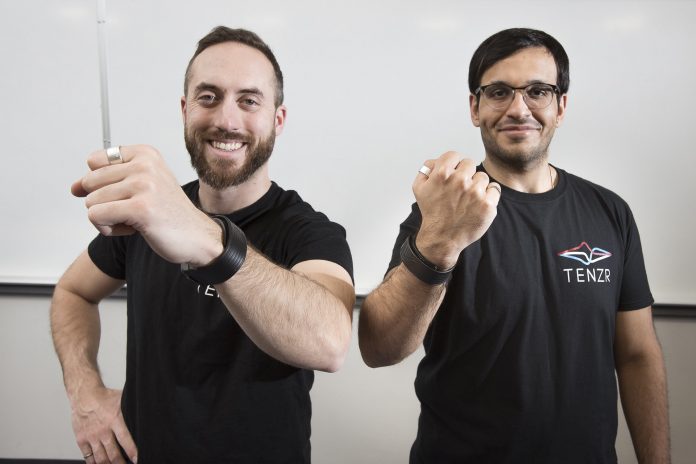
A pair of Simon Fraser University alumni have developed an innovative wristband that recognizes and understands hand gestures. The product, which is branded as TENZRTM, allows users to perform virtual actions, such as pausing a video or scrolling down the page, without the need of physically touching a computer mouse or a controller. When an individual uses the wristband, their hand in a sense becomes a controller because their hand motions emulate the haptic sensation of clicking on a computer mouse.

Lukas-Karim Merhi and Gautam Sadarangani, co-founders of BioInteractive Technologies, showcased their new product to the community last week at SFU Surrey. Merhi and Sadarangani have spent the last three years developing the gesture recognizable wristband, TENZRTM, and the product is currently gaining traction in the virtual reality and augmented reality world.

The wristband is currently designed to recognize six hand gestures: up, down, left, right, hand open, and hand close. In addition, the wristband does not need a camera to operate — it uses Bluetooth technology instead to transmit and receive signals.

“Its algorithms can predict and detect [finger movements and hand gestures] by using machine learning algorithms. The sensing technique does not measure electrical signals therefore it is accurate and reliable,” according to its website.

The wristband is currently sold for CAD$199 and its battery life lasts approximately 12 hours. The device also has the possibility of being used in health-care settings. For example, physicians are trying to determine the wristband’s potential in helping stroke survivors who suffered a motor deficit in their upper extremities. The wristband could potentially help these patients restore their hand movement, as stated on its website.

In fact, the innovative wristband can also be used to monitor the way berries and grapes are picked via haptic feedback. Users can customize their wristband for different applications, from recording motor movements to movement rehabilitation, with the latter still being explored.

Moreover, Merhi and Sadarangani’s company was shortlisted as one of the 10 companies accepted into the highly competitive Techstars Anywhere program, according to a media advisory by the university.

The program has an acceptance rate of less than 1% and applications were received from all over the world, according to its website. Companies who are accepted into Techstars Anywhere program receive mentorship from one of the US’s top tech accelerators, Techstars. This allows them to gain expert feedback so that they can start selling their product on the market.

The Peak reached out to Merhi and Sadarangani but did not receive a response by our print deadline. However, the duo will be competing in the upcoming Coast Capital Savings Venture Prize for their new prototype.


With files from PR Newswire.

Lack of support for First Nations Studies at SFU, says Senate

0
Concerns over the small size of the department was noted when it was created in 2012. (Chris Ho / The Peak)

Discussion regarding the current status and role of SFU’s department of First Nations studies (FNS) broke out in the latest SFU Senate meeting on February 5.


Single-digit faculty

When a motion to approve the action plan for the department resulting from its external review was proposed, senator David Burley began the discussion by commenting that he had noticed in the Dean’s summation and commitment of resources that the faculty consisted of only 3.5 members.

“I don’t know if any department in any university on the scale of SFU would have a department of 3.5 members,” he said. Senator Burley also expressed concern regarding the proposed action plan for the department, particularly the three limited-term appointments suggested.

“I am really concerned about how the program became a department six or seven years ago, and why there has been no support since that initial transition from a program to a department. [. . .] And it really makes me angry seeing how First Nations studies has been treated over the years, and how it’s being treated at this present time in terms of a commitment of resources to allow the department to move forward. [. . .]  I note that it’s an extremely difficult challenge to recruit First Nations individuals, and you’re not going to get them with limited-term appointments,” he ended.

The decision to convert the First Nations studies program at SFU to a full-fledged department was noted in the minutes of the March 2012 Senate meeting. As quoted by senator Colin Percival from the 2012 minutes: “A concern was raised regarding the small size of the department. It was clarified that members from other departments and faculties will be recruited when necessary to help meet the requirements of the department.”  

In place of First Nations studies chair Deanna Reder, dean of the faculty of arts and social sciences Jane Pulkingham represented the department, and she agreed that while FNS was currently SFU’s smallest department, it was not by a long stride. She also noted that since the development of the action plan, she had committed one continuing faculty position to First Nations studies. Pulkingham also indicated to the department’s three fairly new multiple-year term appointments as an indicator of progress within the department, as they are an improvement over the sessional appointments the department used to hold.


Graduate program plans thrown into question

Further on in the discussion, the viability of a graduate program in First Nations studies, which has been recently talked about within the faculty, was brought into question. “Even with one continuing-term position and two limited-term positions, the plan as it’s been laid out by First Nations studies in terms of a graduate program, in terms of all other things they want to do, is virtually impossible to implement,” commented senator Burley.

Pulkingham agreed with this observation and noted that the faculty currently has a priority on expanding capacity to move towards making this goal more realistic. “The graduate program is an aspiration, it’s not a commitment,” she said, “And it’s a commitment that would not see its feet hitting the ground for several years should it happen.”

“I agree with you that it cannot be done with that complement [of faculty], but we are looking at how we might get there.”


Ethical implications for reconciliation 

Senator Daniel Laitsch broadened the implications of the discussion when he motioned to speak. “I’m just a little trouble by lumping the [FNS] department in with all the other departments, as if there’s not an ethical imperative at this time and in this place and at this university to support reconciliation, to support our Indigenous faculty and colleagues,” he said.

Pulkingham commented that, to this end, there had been discussion among the chairs and directors of the faculty that “perhaps the faculty should adopt a stance that all hires will be Indigenous,” but it was too early to make a comment concretely on the possibility.        

On the same vein of the university’s broader ethical commitment, senator Jamie Scott said, “The intentions are not clear, and I don’t think the vision is either at SFU for this idea of ‘indigenization.’ [. . .] And then having a unit that is, no offence or anything, that is wimpy, and it’s small, and it’s not moving ahead, and yet there’s this large vision that we’re supposed to indigenize the university.”    

“It seems to me that this idea that we’re going to indigenize the faculty is not run by Indigenous people, it’s not from an Indigenous point of view necessarily.” – Senator Jamie Scott

Senator Scott agreed that the issue was a catch-22, but she emphasized that “if you don’t have a strong group of Indigenous scholars that are somehow working together [. . .], it’s going to be real hard to attract those folks, and to actually accomplish the end that we’re envisioning.”

 Vice-president, academic and senator Peter Keller commented for the record that “increasing the number of Indigenous faculty at Simon Fraser University is a strategic priority.” He referenced a financial obligation placed upon himself as VP, where he has agreed to pay the first few years’ salary of any Indigenous appointment. “That is to incentivize all of you,” he said towards the Senate members present, “to do your absolute best to try and attract Indigenous faculty to Simon Fraser University.”


SFU President Andrew Petter wrapped up the discussion after the motion on the action plan was approved by saying, “Our concerns are about a single department and its capacity, but the need for a more Indigenous faculty across the university is [. . .] certainly one that I think the university has a high priority on.”

Play Animal Crossing: Pocket Camp for the aesthetic, if nothing else

0
Pocket Camp is only as cute as you want it to be; you can build a prison, because why not? (Image courtesy of Nintendo)

By: Natasha Tar

In November 2017, Nintendo released the free mobile game Animal Crossing: Pocket Camp, and it was one of the motivators that got me through finals. I had been looking forward to it, since the other Animal Crossing games across consoles are usually entertaining. For those who’ve never played one before, you start most Animal Crossing games by arriving in a place that’s inhabited by talking animals. From there, depending on the game, you can alter the place by completing tasks for the animals, planting stuff, decorating your house, and creating monuments and amenities. They’re simple games to begin with, but Animal Crossing: Pocket Camp takes it a step too far.

     A few plays in, I was somewhat disappointed. Animal Crossing: Pocket Camp is almost nothing like its predecessors. Sure, it has the same kind of bizarre charm you get from Wild World and all the characters you love from New Leaf, but much of the substance has been removed. In this game, you arrive at a campsite and are told you’re the manager. From there, you can customize the space and invite the aforementioned talking animals over once you unlock their favourite pieces of furniture. Everything is adorable, but everything is also simplistic. You basically complete the same tasks over and over to level up; it’s like any other addictive mobile game.

     One thing that’s great about it, however, is that the developers are incredibly receptive to consumers and are trying to improve the game based on their feedback. It’s cool seeing how with every update, Pocket Camp grows into something more user-friendly and dynamic. Things as small as being able to put down more than one rug at your campsite have been updated based on feedback.

     That said, nothing but an entire revamp can prevent this game from becoming monotonous. As I write this, I haven’t actually touched Pocket Camp for weeks. Just thinking about it makes me want to play one of the older Animal Crossing games, but not Pocket Camp itself. While I do like the new details and events that come with this mobile game, to me it just doesn’t have the options other Animal Crossing games had in the past and it becomes mindless quickly.

     If you’re into collecting furniture and meeting anthropomorphic sheep in sweaters, this game will probably keep you entertained for a while. For newcomers to the Animal Crossing series, Pocket Camp will definitely have more of an ability to charm you. I’ve seen creative souls like you make your campsites into elaborate gothic weddings, knitwear shops, and lamp cults. As for the old fans, you might want to play just to see some of your favourite characters again and put your decorating skills to the test in this strange new world.

Animal Crossing: Pocket Camp is available at the App Store and Google Play for free.

Clan comes up just short on Seniors Night

0
JJ Pankratz spent played all four seasons with the SFU Clan. (Photo courtesy of SFU Athletics)

On Saturday night, the men’s basketball team hosted Alaska Anchorage on Seniors Night for the Clan. The team and fans paid their respects to seniors N’Kosi Kedar Salam, JJ Pankratz, and Iziah Sherman-Newsome. The game went down to the last second, where SFU had a chance to tie, and then win the game, but ultimately fell short and lost 66–64.

Pankratz, who has been struggling with injury as of late, started the game in an attempt to reach 1,000 career points. Unfortunately, he went 0–2 from the field in two minutes of play, and would not return to the game, leaving him at 998 career points. As long as he is healthy, he should have no problem reaching the feat, as the team will play two more games in Oregon next week.

Similar to Pankratz, the Clan as a whole struggled mightily out of the gate. Alaska pulled ahead early with a 13–0 run to start the game, and would get ahead by as much as 16 at the 10-minute mark after a three from Drew Peterson. Despite these early struggles, however, Simon Fraser would bounce back to put themselves within striking distance by the end of the half. A 12–0 run by the Clan, in which Othniel Spence scored 10 points and assisted a basket, cut the deficit to three, before a buzzer beater jumper by Alaska’s Josiah Wood would put the score at 37–32 heading into the half.

In the second half, the Clan did everything they could to stay in the game, tying the score twice, but were never able to take the lead. Despite this, the ending could not have been more exciting. Down three points with less than a minute to go, Spence hit a huge three-pointer to tie the game up at 63 with 50 seconds left. Alaska responded with a jumper by Malik Clements to go up by two, and then extended their lead to three after hitting a free throw. This put the Clan down three with possession of the ball at 13 seconds to go. They would not be able to get the three-pointer needed to tie the game after two missed attempts by Michael Provenzano separated by a free throw from Tyrell Lewin. The game would end with the Clan coming up just short, and losing 66–64.

The story of the night, however, was that this was the final game that the seniors will play at the SFU Burnaby campus. All three seniors were major pieces for the team this season and in years past, and were all regular starters as well as the three highest scorers for the Clan this season. Salam currently leads the Great Northwest Athletic Conference with 19.7 points per game, while Pankratz and Sherman-Newsome are first and second in rebounds and blocks for the team. Sherman-Newsome did not play in this one, as he is out for the rest of the season with a hand injury.

The team will next travel to Oregon for games on February 22 and 24 to wrap up the season. The first will be against the winless Concordia Cavaliers. Tipoff is at 7 p.m for both games.