Home Blog Page 668

Jas Randhawa is the next SFSS president

1
(Chris Ho / The Peak)

This morning, The Peak received the results for the 2018–19 Simon Fraser Student Society (SFSS) Board of Directors elections from the Independent Electoral Commission (IEC). Without further ado, Jaskarn (Jas) Randhawa has been elected as the next SFSS president.

     This year there were two presidential candidates for the 2018–19 SFSS elections, Jas Randhawa and Amar Singh. Randhawa received 1,206 votes, while 952 votes were cast for Singh.

     “I couldn’t be more excited to be the next SFSS president . . . This was a very competitive and intense campaign process, and I want to take this chance to congratulate everyone who ran, regardless of the results. It takes a lot of courage to put your name forward and go through the stress of this campaign, and I hope we’ve all grown a little from it,” said Randhawa. “Right now, my mind is focused on the future . . . there are some really important things on the horizon for the student society, and I look forward to ensuring that the student body is well represented. I can’t wait to get in a room with our new team, meet everyone, and set a positive tone for the year ahead.”

     Moreover, it was a close race for the five other executive positions. Samer Rihani, who was elected as the next vice-president (VP) of student services saw a total 1,061 votes, while his opponent, Simran Sanghera, received 1,024 votes. In the end, it was Rihani who triumphed over Sanghera by a total of 37 votes.

     A similar pattern was seen for the vice-president of finance position. Matthew Chow, who was elected as the next VP finance, received 1,086 votes, while runner-up Vikramaditya Chandhok received 940 votes. Jasdeep Gill, who was elected as the new vice-president of external relations, triumphed over candidate, Livleen Sidhu, with a total of 1,125 votes to 930.  

     In addition, Jackson Freedman and Tawanda Masawi were elected as the new vice-president of university relations and vice-president of student life, respectively.

     The Peak reached out to Rihani to share his thoughts on the elections results, to which he replied, “Firstly, I MUST [sic] say a huge word of gratitude to Simran Sanghera. There is no one who made a better opposition for the role. She was kind, humble, and the entire time we ran against each other, it wasn’t a battle of jabs or insults, but rather a display of who could push hard and truly do the best to represent the role . . . It was a difficult campaign, and a gruelling one to say the least . . . but I’m so blessed to have been elected and want to tell the student body on behalf of the newly elected board that we are ecstatic to work alongside and for the students to create the most positive experience for any student and staff within SFU.”

     Freedman also commented to The Peak, “I’m absolutely thrilled with the victory and I’m so excited for the year ahead. I want to thank everyone for the support I received throughout the process . . . receiving a thousand votes from your fellow students is a really humbling experience. This was a hard-fought campaign, and I’m really proud of everyone who put their name forward to give it a shot and try and make a change here on campus.”

     The Peak reached out to the IEC, but did not receive a response by our print deadline regarding this year’s voter turnout. The Inspire SFU slate was the main winner for this year’s elections as 10 of its members were elected into the 2018–19 SFSS Board of Directors positions.

The worst times to Hulk out

0
Illustrations by Alice Zhang

By: Ahmed Ali

As you all know, constantly turning into a 10-foot-tall Rage Monster when you get angry is never the most convenient superpower. There are times where it will be a minor inconvenience, and there are other times where when going Green is a HUGE inconvenience — here is a list of those awful times.

  1. Sex, blowjobs, and masturbation. 

As you know, Bruce is a pretty thin guy, so we assume his junk is pretty standard — but The Hulk’s junk is going to be massive. This is going to make sex a real gamble because you might end up with a 20-inch-long and 7-inch-wide veiny rod of tissue in one of two orifices . . . neither of which is going to pleasant. On top of that, when the Hulk cums, he’s probably going to blow through you and through the next building over. Going out by an overpowered ejaculation is probably pretty unique, though.


  1. During an exam

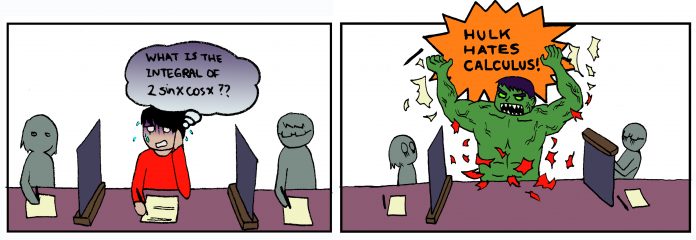
When taking an exam, you’re already going through a lot of questions and emotions: “What is the integral of 2sinxcosx?” and “Why didn’t I study this part instead of watching Netflix?” and “If I drop out now can I make minimum wage by rapping about memes on SoundCloud?”

Going through so many emotions is why being the Hulk is a bad power for exams. You start not being able to answer 10 questions, and the next thing you know is that you’ve turned big . . . ripped the paper in half, and smashed through the exam hall, looking for some way to escape the pain.

And the worse part is that the admin will fail you right there instead of helping you.


  1. Bathroom at a party

You’ve had a long day. You’re at a party looking to chill but you gotta go take a S@$t first. When you’re pushing too hard and then — you go Green! You burst through the door and run off in a panic.

The worst parts are 1) everybody has seen your dong and 2) your Hulk dump would make it better to just nuke the house from orbit than even try going back there.


  1. The bus

Buses have a certain type of atmosphere — one that makes you feel like you’re light years from civilization. You’re in this cramped cave like thing with NO air conditioning and cavemen everywhere, and that’s enough to stress anyone out . . . imagine if you were the Hulk.

In this case, at least the bus would be air conditioned once you Hulk out and smash all the windows open (along with, like, half the bus) — trying to flee a place that’s more a prison than the Vault.


  1. Family reunion

You know all those aunts, uncles, cousins, half cousins, and obscure brothers of an uncle’s  sister’s cousin’s brother’s dad’s roommate named Phil? All those random people you might know who all just converge together to talk about random things? Sometimes it’s just meaningless chit chat . . . sometimes it all turns to you: “You’ve gotten taller, did you find a girl yet? How goes your science stuff, how goes your search for a job — and bankruptcy after your arts degree? Why are you getting taller? Why are you getting green? My, how much you have changed in the last 10 seconds?”

Dealing with the military as a giant Green indestructible monster is much easier than dealing with obnoxious relatives. At least the former won’t question your life decisions and passion for theatre.


Arguments against gun control often force a false ultimatum between prayer and logic

0

Written by Eva Zhu, Staff Writer

On February 14, a former student of Marjory Stoneman Douglas High School in Parkland, Florida murdered 17 of his schoolmates with an AR-15. This has already been the eighth school shooting of 2018 (eight in seven weeks!) that that have culminated in death or injury in the United States. Since 2007, at least 173 people have been killed with different versions of semi-automatic AR-15s. These shootings include those that have happened in Las Vegas (58 dead), San Bernardino (14 dead), Sandy Hook Elementary (27 dead), and the Aurora Century 16 movie theatre (12 dead).

An AR-15 is a semi-automatic rifle that is capable of firing around 150 rounds in less than five minutes. A weapon of this calibre has no business being in the hands of civilians — especially not the hands of 19-year-old boys who have exhibited histories of disturbing behaviour.

This might come as a shock, but from 1994 to 2004 — after two back-to-back shootings in 1993 — the Federal Assault Weapons Ban was put in place. The law banned 18 models of assault weapons, and those featuring military-style accessories. Although the overall rates of gun crime stayed fairly consistent, the number of mass shootings decreased dramatically. During those 10 years, there were only 12 mass shootings, compared to the 63 mass shootings since 2004.

Immediately after the law expired, efforts were made by Democrats to renew the law. However, all proposals were unsuccessful. Former president Barack Obama tried to propose the same law again in 2012 after the Sandy Hook massacre, this time without a ten-year expiry date. Unsurprisingly, the bill did not pass the Republican-controlled House and Senate.

The chances of President Donald Trump enacting any sort of gun control during his time in the Oval Office is slim to none. He is paid obscene amounts of money by the National Rifle Association (NRA) to continue endorsing semi-automatic rifles. In 2016, they spent over $21 million on Trump’s election campaign, which explains why he praises them to no end.

Some of the current administration’s favourite phrases to utter after a shooting are things like “it’s too early to politicize this tragedy” and “we need to pray for the victims.” By appealing to these sorts of traditionally minded, “common decency” arguments, we lose sight of coming up with actual practical solutions. Prayer is fine; grief is fine. But prayer and grief cannot, and do not need to, come at the expense of our problem-solving capacities, and we need to stop framing gun control discussion as an either-or.

Prayers are nice. What are prayers going to do when people are being gunned down left and right? Prayers aren’t going to bring the dead back to life, nor will they reduce the mass shootings in America. Besides, you can pray and also take tangible measures to prevent gun violence! They aren’t mutually exclusive. The current administration won’t even think about enacting a gun control policy until one of their own children is gunned down.

Additionally, gun violence and mass shootings will always be politicized. Why do you think the Clinton Administration passed the Federal Assault Weapons Ban? When hundreds of people are murdered in a year, not talking about gun control is a surefire way for Americans to lose faith in you. Just because you’re sticking your head in the sand and pretending the issue isn’t there, doesn’t mean anyone else is.

Emma Gonzalez — a senior at Stoneman Douglas — is a force to be reckoned with. Since the shooting at her school, she has made gun activism her main goal. Her “We call BS” speech at a gun control rally was a “fuck you and your prayers” to the current administration that we all needed to see happen eventually.

Despite the ridiculous far-right conspiracies suggesting that teens like Gonzalez are crisis actors paid by “the Left,” Gonzalez isn’t being paid by the NRA to keep silent, nor is she sprouting falsehoods, since she has actually seen her friends and classmates die, and lived to tell the tale. Since her speech, we have seen fellow schoolmates interrogate Marco Rubio at a Town Hall for school shootings and stage a lie-in outside the White House to protest the way Donald Trump is handling the topic of school shootings and demand gun reform.

As long as people continue to play smoke and mirrors with the gun control debate, trying to switch the narrative through appeals to tradition, courtesy, and downright tinfoil-hat behaviour, no logical solution to gun violence can be developed.

New Music Friday

0
(Linda Shu / The Peak)

By: Alex Bloom, Louise Ho, Courtney Miller, Elisha Summers, and Natasha Tar

“Not Exactly an Overture” – Long Time No Time

Elisha Summers: Fun beat, but where is the singing? The instrumentals are extensive, and the song only contains a small segment of vocals.

Louise Ho: This song reminds me of something a pit band would play while the actors play on. I definitely wasn’t expecting a song like this, so the experience was quite unique. Probably not something that I would listen to again, but we’ll see.

Alex Bloom: I’ll stay neutral on this one since my cousin is in this band . . .

Courtney Miller: Reminds me of a polka, which means I’m not drunk enough for this. Then the vocals . . . I’ll never be drunk enough for this.

Natasha Tar: CIRCUS MUSIC. Yes, this is angry polka.

“Anarchy” – Kieran Mercer

ES: Oooooh super funky! Here’s a case of pretty fly for a white guy!

LH: For some reason, I got an R5 vibe here. I think it’s catchy!

AB: Funnily enough, I got a bit of an Adam Levine on “Sugar” vibe from this.

CM: I love Kieran, he’s been great solo and before then as part of Jackie Valentine; he’s just a good music guy. It’s not “Someone To Go Home With” which I highly recommend, but it’s a fun time nevertheless. He’s opened for Carly Rae Jepsen, so like, he’s good. Also great live. OK, I’m gonna leave it there.

NT: This is nice! A good beat, but nothing too special.

“The Most Obvious Song” – James Clayton

ES: This song almost put me to sleep. A good song if you’re looking for a lullaby.

LH: Not sure if I liked this song, but I could feel the emotion within it.

AB: It isn’t obvious what makes this song so obvious . . . An OK ballad nonetheless.

CM: Yep, this is a slow song for sure. It’s like a forlorn kind of angst? I dunno, I’m not all that into it, but I don’t dislike it.

NT: I feel like if this song was sped up a little, it’d be more interesting.

“Freedom” – Dorothy

ES: Oooh, I like this chick’s raspy voice, she sounds like a badass!

LH: Not a song that I think I’d listen to, but it’s powerful!

AB: The first few seconds made me think I was going to hear a song by Garbage, but the vocals remind me of Creedence Clearwater Revival, and the music of that era.

CM: I feel like Dorothy would have slayed in the eighties and nineties when Whitney Houston, Tina Turner, and other powerhouses were in high demand. As it is now, I’d rather listen to Whitney, but Dorothy’s pretty decent.

NT: This is pretty fun. I never would have guessed it was a new song.

“Remind Me to Forget” – Kygo, Miguel

ES: Catchy song! I wouldn’t mind jammin’ out to this one while getting ready to go out!

LH: Thought it was fine until 0:51 hit: personally not a fan of beats like those. Gives me a headache, but it is catchy.

AB: Miguel delivers vocals similar to his duet, “PrimeTime” with Janelle Monáe, and I like that — but this song just doesn’t have Janelle, sorry.

CM: Like, vocally, I’m into the first part of this song. It’s good. But then, yeah, 0:51 hits and things go downhill to the valley of mediocrity quickly. It sounds like everything else.

NT: A bit too throbby for me, sorry.

“Powerless” – Classified

ES: If you like chanting, autotuned children backing a soundtrack, this one’s for you. I appreciate the message of this song, but don’t like the way it’s put together with layered voices, rhythms, and singing.

LH: Powerful anthem. I don’t think it’s bad at all. The lyrics are so relevant, as well as the use of all the voices; cheesy to say, but those powerless voices united as one to become powerful.

AB: The last time I remember hearing Classified was his weirdly patriotic song about Canada. This song delivers a much more serious message, and with more craft than his previous tracks.

CM: Bastille is the only one who can insert random news-like dialogue and get away with it. OK, I actually don’t hate this. I was ready to be savage, but the beginning didn’t deserve it. Once the autotuned children come in, it nosedives.

NT: I feel like this could be a lot worse. I don’t like the rap, but the sentiment is good. So there’s that.

“The Middle” – Zedd, Maren Morris, Grey

ES: One of my favourite songs on the radio right now! This song has a special meaning to me, as my soon-to-be boyfriend referenced it before telling me he loves me. Now I can’t help but smile every time I listen to it!

LH: This song, like many of the others, is catchy. Not atypical of Zedd at all. Feels like another song made for the radio.

AB: To be honest, when songs like this start playing I just tune out all auditory input.

CM: I love Maren Morris. She’s doing a lot of crossover work. I think it’d be better without Zedd and Grey because Morris is so strong on her own, but like, I guess I ain’t mad at it.

NT: Unfortunately, this song will never be special to me in any way. It’s so typical, I could mistake it for a million other songs.

“We All Die Young” – The Decemberists

ES: Why do all of the singers seem so happy about stating that they all die young? Children singing “we all die young” is just uncomfortable.

LH: I haven’t heard the Decemberists in years! I don’t like this one as much as some of the previous tracks that I’ve heard by them, but the vibe ain’t half bad (it does get a little repetitive, though.)

AB: I’m only listening because there aren’t many bands that reference Russian history. Not into it though.

CM: I have no idea what he’s saying. And yeah, creepy kids is a no-go.

NT: I agree @Courtney. Kesha definitely did this song better.

“TieksVie” – Damso

ES: Skip! Shuffle! Pass! Next!

LH: I quite like international tracks, and I haven’t really been listening to French music very much as of late. This track is OK, but when I get the time I would like to see if I can translate any of the lines to see if I can understand.

AB: Again, my ears are turning off.

CM: [crickets chirping]

NT: I have nothing to say. The beat is all over the place and I don’t like it.

“Habibi” – Tamino

ES: The most exciting part of this song for me is my discovering that “Habibi” means “love” in Arabic.

LH: Chilling. I can picture this song in a movie during the aftermath of destruction. I did find it hard to hear what he was saying, but not a bad track!

AB: I enjoy how strange this piece is. His vocals have an unearthly quality that almost remind of Corpse Bride for some reason.

CM: Yeah, this is Pretty Depressing™ and Fairly Creepy™.

NT: Yes, this is a spooky song.

“Do It Like You Do” – KAWALA

ES: Interesting song and good beat. I am not completely sold on this track, but I don’t dislike it!

LH: I liked the intro, the happy beat drew me in. Again, like “Habibi,” I found it hard to hear what was being sung. I did feel the summer indie-folk vibe though.

AB: Quite a shift in tone from the last song. Is this in English? Serious question, I’m actually not sure.

CM: I love the guitar. It’s chill. I’m open to having this song find me again in future, but not too often.

NT: I like the voice! This isn’t too bad.

Tavşan Çukuru” – Evren Besta, Evrim

ES: There is a reason that I have never heard this one on the radio, and you likely haven’t either.

LH: Not really my style. I personally thought there could’ve been more variety in the backing track.

AB: I love the strange little yelp at the beginning of the song.

CM: Love the intro sans the weird gaspy “oh”s. Then the vocals come in all monotonous and lacking melody, and I’m tapping out.

NT: Going out with a bang not a whimper. A confusing, unpleasant bang.

Kerr and Crisologo shine for men’s golf, while women’s teams tournament gets cut short

0
Chris Crisologo's 212 strokes were just one behind teammate Scott Kerr. (Photo courtesy of SFU Athletics)

On Monday and Tuesday this week, both the men and women’s golf teams from SFU competed in tournaments in California. The men travelled to Jurupa Valley to compete in the The Joust at Goose Creek tournament, while the women travelled to Pebble Beach to compete in the Otter Invitational. The men finished with a solid third-place finish at their tournament, while the Otter Invitational was unfortunately shortened due to rain.

For the men, the standout athletes were definitely Chris Crisologo and Scott Kerr, both finishing with top 10 finishes over the two days. Kerr finished in fourth with one over-par, with rounds of 71, 71, and 69 on the par-70 course. Right behind him was Crisologo, who kept the seventh-place position he held after day one through Tuesday. Crisologo shot rounds of 70, 72, and 70, for a final score of 212, just one stroke behind Kerr, and two over par. The highlight of the event was an eagle that Crisologo shot during the tournament.

To round out the team were SFU’s Marcus Brown, Sy Lovan, and Ryan Stolys. Brown (72-69-83) had a rough final round to hurt his chances of finishing in the top ten, and tied with Lovan (74-76-74) with a final score of 224, good for 47th place. Stolys (74-75-84) finished with a score of 233, good for 82nd place out of 104 golfers.

The men’s team would finish in third place out of seven teams with a final score of 870. They were 12 strokes behind second-place Chico State and 20 behind first place (and home team) California Baptist. They also finished just two strokes ahead of Colorado-CO Springs. Colin Prater from Colorado-CO Springs won the tournament with a final score of 204 (six under par) shooting rounds of 67, 70, and 67.

For the women’s team, the tournament was unfortunately cut short due to rain. They faced tough competition, with six of the 20 teams in the tournament being nationally ranked, but still came out with an 11th-place finish. “We knew the weather was going to be tough and they embraced the conditions today,” said SFU head coach Matt Steinbach to SFU Athletics, adding, “I’m very proud of the way they managed themselves out there and it’s unfortunate that we were not able to complete the tournament.”

Since the tournament only lasted 18 holes, it’s difficult to know exactly how it may have played out. Estee Leung led the Clan, shooting 76 on the par 71 course (finishing five over par), and tied for 24th place. Unofficially, she also posted a 74 on the second day, including an eagle 3 on the last hole, but due to not every golfer being able to finish the course, the score was erased.

Emily Leung, Belinda Lin, and Michelle Waters all finished with 79 strokes (eight over par), tied for 54th place. To round out the team, Erin Farner finished with 88 strokes (17 over par), in 108th place.

Both teams will next compete on April 2 and April 3, as the men travel to Goodyear, Arizona to compete in the Mustang Intercollegiate, and the women travel to Rohnert Park, California to compete in the Sonoma State Spring Invitational.

Max Porter’s Grief is the Thing with Feathers is a short, but powerful read

0
(Image courtesy of Graywolf Press)

By: Aaron Richardson

Often during periods of mourning, the grief you are experiencing can feel almost physical in its presence. It can feel as if it is following you around, inhabiting the room with you, sitting beside you, and putting a stain on every moment. In Grief is the Thing with Feathers, Max Porter turns this feeling into a character. After the death of his wife, a father and his two sons are visited by a creature known only as Crow. Not one for subtlety, Porter tells the story of this family and their time spent with this thing with feathers. Told from the perspectives of the father, the sons, and the crow itself, it is a mix between a typical novel and a book of poetry. Short enough to be read in no more than a couple hours, it is an emotional experience from beginning to end.

     Vulgar, frequently mischievous, and extremely rude, the crow is the perfect personification of grief. Grief is pain. It hurts, and it breaks you down until it seems like there is nothing left to put back together. But it is this pain and destruction that allows you to move on when such an essential part of your life suddenly vanishes into thin air. It is pain, but it is also the start of the healing process.

     This is a novel that brings the reader along the path of healing that this family takes. It’s not an easy experience. If you are lucky enough to have lived without grief, it is a beautifully painful look into the experience one goes through. If you have experienced grief yourself, it may very well be a difficult read. But it is that difficulty that makes the journey worthwhile.

Peak Speak: Is SFU Boring?

0
On this week’s episode of Peak Speak, we ask students if they think SFU is boring.

Is universal basic income an effective social policy?

1
The lecture was presented as part of the “Brave New Work” summit run by SFU’s Public Square. (Brandon Hillier / The Peak)

This year’s “Brave New Work” summit, run by SFU’s Public Square, examined the role that “work” will play in the future. In the talk Basic Income: Progressive Hopes and Neoliberal Realities, John Clarke, an anti-poverty organizer at the Ontario Coalition Against Poverty, discussed universal basic income (UBI), a form of income support. Responders were Jenna van Draanen, a UBC post-doctoral sociologist; Michal Rozworkski, a self-proclaimed ”lefty economist”; Trish Garner, a BC Poverty Reduction coalition activist with a PhD in gender, sexuality, and women’s studies; and Duane Fontaine, a SFU PhD candidate with a background in accounting.

Pilot projects for UBI range from the UK, Sweden, and Dauphin, a small town in Manitoba, during the ‘70s. The current BC NDP and Green coalition government opened an inquiry into UBI through the formation of the Fair Wages Commission.


The argument against UBI

Clarke’s view was that UBI would not only be in the wrong direction, pulling resources and attention away from more important struggles, but would contribute to the continued exploitation of workers. While he is anti-capitalist, stating that “I don’t believe the rich should be rich,” he admits that capitalism will not die from social policy, and that the social struggle must continue.

Quoting the historical basis of “dispos[ing] the peasantry and their land” to force them to work in factories and industries, he argued that even the current system degrades people, making welfare payments and eligibility unpleasant enough to push people into the workplace.

While he acknowledged that while many Canadians are going through difficult times, and that he, “feels for them,” he will not support UBI.

He mentioned ongoing social struggles against capital, such as the national fight for a $15 minimum hourly wage, protests from McDonald’s and Amazon employees, and the success of some German unions for a 28-hour work week. Invoking the “Spirit of ‘45” (referring to the post-WWII British boom in social services such as the National Household Service, council homes, public schools), he argued that we must fight for “free, expandable, accessible public services,” and against “bureaucracy and moral policing.”


UBI as an equalizer

Jenna van Draanen presented opposition to Clarke’s points, focusing on UBI being a step forward by giving agency to the labour market. She argued that the current system leaves behind people of colour, women, the disabled, and the unpaid labour force, whereas UBI could give space to workers looking for better jobs, increase bargaining power, and humanize the current system.

She summarized it with “what if, in 1947, Tommy Douglas held back because [universal healthcare] wasn’t perfect? Because it doesn’t have perfect, equitable services and dental? What we have isn’t perfect, but it’s better.”

“[UBI] is for all of us and we’re stronger together.” – Jenna van Draanen


Is UBI beyond Canada’s means?

Economist Rozworkski, supporting Clarke’s arguments, argued that current UBI projects are just PR stunts. He claimed that moving to the poverty line (approximately $20,000 per person/year, with variations) could cost $30 billion with current systems intact. Even with savings from removing redundant services like EI, and from healthier citizens, they would be a huge expense.

He dismissed claims of a “new world of work,” mentioning that articles from the 18th and 19th century claimed that machines would destroy the labour market. He states that, “capital can always find ways to exploit us” and that this fight is essentially the “terrain of the social struggle.” Proving himself as the “lefty economist,” he finished with his vision for an economy based on human needs, and that the market-based approach for the provision of these specific goods and services is wrong.


The poor reality

Garner stuck to her field of expertise (poverty reduction) and did not take an stance on UBI, something that her BC Poverty Reduction Coalition, an association between more than 400 individual organizations, does not do either.

However, she presented the human face of poverty, with the sobering facts that BC has 678,000 living in poverty, one in five kids living in poverty, and that BC is the last province without a unified poverty reduction plan. Currently, with welfare providing $710 per month, which is only 40% of the money required to surpass the poverty line.

“[There is] deep, deep poverty [maintained] here in BC.” – Trish Garner

She presented a thought-provoking video from her organization about a man applying for permanent medical disability payments, the highlights of which involved three 45-minute phone calls for the paperwork, a 94-page online form to receive the application, two months preparing documents, and more than a year’s wait to hear back, only to have the office claim to have never received the papers, and finally to declare them all to be expired, promoting a restart of the entire process.

She ended by stating that a UBI project would be a huge jump, one that society probably cannot achieve. She proposed, like Clarke, a “British” approach; an expansion of universal services like childcare, and later free housing, information access, food, and transport, with a total estimated cost of 2% of Gross Domestic Product (GDP). She argues that while 2% of GDP is not trivial, it is a small cost to prevent the perpetuation of societal issues into the market system by feeding welfare needs with cash.


The role of technology in the debate

Finally, Fontaine examined automation and the sustainability of the current system. He argued that robots might be different from previous machines because artificial intelligence and computers challenge both manual dexterity, handiwork and physical skills, and creativity, the one human faculty remaining.

He claimed that the current system of jobs is ecologically unsustainable, since while society is relatively more efficient, the absolute amount of resources needed to sustain the economy is increasing, given the exponential increases in population and consumption. Thus, a UBI system could be an emancipatory solution, allowing a return to non-consumptive leisure time, such as increased engagement with democratic institutions.

The core of the debate boiled down to whether a universal basic income was going to be the social policy that would reduce poverty, or if it would just add more costs with little results. Clarke viewed it as a neoliberal attack, allowing a low-wage, precarious work environment to sustain itself, since it would “top-up” low wage jobs. Others agreed that it is imperfect, but in the right direction. While more money would make any individual at least a little better off, it is evident from the talk that citizens must start to engage the government in a healthy debate so that the living conditions of fellow citizens and residents are not forgotten and buried.


Album Reviews

0

By: Neil MacAlister

The Matrix by Hoodrich Pablo Juan and Brodinski

Atlanta rapper Hoodrich Pablo Juan has had some recent success in his local trap scene. His signing to Gucci Mane’s record label, and the release of his studio debut, Designer Drugz 3, was a big step up for a relatively unknown rapper, but something about Hoodrich’s music always felt like it should extend out of the conventional trap sound.

     With his new EP The Matrix, Hoodrich paired up with French electronic producer Brodinski, to some undeniably excellent results. Brodinski broke through into Western hip-hop through a couple of placements on Kanye’s Yeezus album. He has since delved into the Atlanta trap scene, ultimately leading to his and Hoodrich’s fantastic collaboration.

     Brodinski provides some hauntingly apocalyptic electronic production that matches perfectly with Hoodrich’s menacing monotone, giving the rapper not just excellent accompaniment, but an opportunity to experiment with his flow and delivery. Like Vince Staple’s Big Fish Theory, the tasteful pairing of electronic production and perfectly-suited delivery creates amazing results. Tracks like “Graveyard Shift,” and the Lil Dude-assisted “Thug Life” are some of the most enjoyable tracks released this year. – NM

Lil Boat 2 by Lil Yachty

There’s always a risk that comes with making a sequel to your best album. Lil Yachty’s debut, Lil Boat became one of 2016’s biggest albums, and its quirky, autotune-drenched melodies launched Lil Yachty into a successful career. A handful of mediocre subsequent releases, however, dimmed Yachty’s shine, as Summer Songs 2 and Teenage Emotions failed to impress. Lil Boat 2 seems like it ought to be a return to his roots, and while it’s definitely the rapper’s best work since his debut, there’s very little of the original Lil Boat in the sequel.

     Instead of relying on melodies, Lil Boat 2 finds Yachty attempting to prove his skills as a rapper — to some unexpected success. On Lil Boat 2 Yachty holds his own against a fantastic 2 Chainz verse on “OOPS,” trades bars with the likes of NBA YoungBoy and Tee Grizzley, and has a surefire new single in the Trippie Redd-assisted “66.” Most of the album is unfortunately repetitive, and the album as a whole fails to live up to its namesake, but Lil Boat 2 finds Yachty determined to defy expectations and keep his career interesting. – NM

Modern feminists shouldn’t be so quick to dismiss their radical sisters

0

I am a feminist. My definition of a feminist is anyone who, like me, feels that men and women should be treated equally. I think that everyone should be supportive of gender equality, and therefore, feminist.

Some feminists are radical feminists. Traditionally, this means that they believe our current society is inherently patriarchal, and therefore, to achieve gender equality, it must be completely overthrown. Here, I define a “radical” feminist as any feminist that behaves in a radical way. Behaving in a “radical way” includes behaviours that some would call “extreme,” “progressive,” “revolutionary,” “attention-grabbing,” and so on.

When I say “modern” feminists, I’m referring to those that are products of and participants in the Third and Fourth Waves of feminism, from the 1990s and onwards. Most likely, the feminists reading this are modern feminists. I’m a modern feminist, myself. I don’t hate modern feminists, and certainly not all of them act out the behaviours I’m about to call out.

That being said, I think it’s time for many modern feminists to gain some respect for radical feminists of both past and present, as well as to stop dismissing their chosen forms of protest.

The term “radical feminist.” makes many people uncomfortable. Images of irate, aggressive women, bras aflame and legs unshaven, may come to mind. I know many women and men who cringe at the word “radical feminist” or use it as mockery or a joke. Most recently, I’ve noticed self-identifying feminists distancing themselves from radical feminism completely. Just check out some of the tweets relating to the Slut Walk and you’ll see women cursing out and mocking other women who participate.

“I’m not angry, I don’t hate anybody, I’m fine,” seems to be the new manifesto of modern feminists, who distance themselves from anything that isn’t calm and unthreatening. But, isn’t moving past the constraints of “calm and unthreatening” the entire point?

Stop me on the street and ask me if I’m mad about female oppression and gender inequality. I’ll give you a huge “yes!”. Why shouldn’t I? Gender inequality is threatening to all women. So be angry about it. Be threatening. When did that become such an atrocious thing?

A person I’m friends with Facebook shared an article a few days ago showing topless women protesting reproductive rights. They had pasties over their nipples and slogans written on their bare stomachs and chests. The poster had captioned it: “I don’t understand what this does for women. They’re coming off really aggressive and angry. That’s not a good look. Not cute.” Comments below echoed the sentiments, saying that this isn’t the right way for feminists to protest, that these girls should put their clothes back on.

Feminists that act too radical and out-of-the-box are getting shunned for it. As if feminism, in itself, isn’t and hasn’t always been radical.

Jessa Crispin, author of Why I’m Not a Feminist: A Feminist Manifesto sums up my thoughts well in her book: at some point, feminism has lost its identity in the pursuit of universality and become toothless. What used to be a criticism of culture has been mellowed to the point that it neatly fits into the current system.

“Feminism used to be outside the culture. It used to be a way of criticizing the culture. It used to be a way of imagining a different kind of culture. But somehow in the last 10 years or so, feminism became another part of the culture,” Crispin says.

There was once a time when the very thought that a woman is a person was considered radical, never mind the idea that these things deserve rights. In the same way that outsiders used to criticize and scoff at feminists, many modern feminists now criticize and scoff at radical feminists.

Feminism will never be accepted by every single person in the world; it’s just impossible. There will always be those who don’t think it’s necessary, and don’t agree with it – and that’s fine. So why are some feminists trying so hard to water down the cause so it’s easier for everyone to swallow?

“I’m not angry!” “You know, lots of women have it worse than me, I really shouldn’t be complaining that much.” “You’re making people uncomfortable when you protest like that.” “Those girls are really extreme. . . You don’t need to be that extreme.”

“Those girls”, meanwhile, are causing change.

For decades, radical feminists have been causing dramatic change with their out-there, extreme protests and ideas.

Take Mary Wollstonecraft, for example, who wrote A Vindication of the Rights of Women in 1792. In her time, the ideas of equality between sexes, equal access to education, women being single, women having relations out of wedlock, and a classless society were beyond radical, and she experienced backlash for these opinions. In exchange for that backlash, she is still well-known today by many.

What about militant suffragettes, who petitioned radically for the female vote? They smashed windows, destroyed mailboxes, cut telephone wires, and many died for the cause – for the vote that many women and modern feminists enjoy. And Coco Chanel, who dared dress women in pants when it was socially inappropriate to do so? As well as Sojourner Truth, a former slave who spoke passionately about racial inequalities in her “Ain’t I a Woman?” speech? bell hooks, who encouraged “radical openness” in teaching, thinking and learning. Consider Ellen Willis, the co-founder of the Redstockings and a vehement speaker on women’s sexuality – a taboo topic?

I could go on and on, listing more influential and radical women. Do you think these women wasted their time apologizing for their radicalness? Do you think they assured those around them that they’re ‘not angry’ and avoided aggressive debates? Do you think they scoffed and turned their backs on sisters who screamed, took their clothes off, smashed things in the name of the cause?

No. These women were radical and made changes that have benefited many, many women for decades, including the modern feminists that treat them with disdain today.

Modern feminists, radical feminists, feminists of every type are fighting the same gender equality battle.

The more feminists that exist and are passionate about this cause, the better, and everyone should choose how they want to express that passion. It’s okay to be radical and angry – you’re more than allowed, I encourage you, in fact, to be angry about the threats to women’s safety and rights that still exist today world-wide – and it’s okay to argue and protest.

Be memorable; be out-of-line. Feminism is and hopefully always will be radical, a counterculture, and a demand for change. There’s no point in pretending it’s not a threat, because threatening the status-quo is an incredibly important part of feminism. Be threatening to the status quo, and be forceful, or you risk going unnoticed and not making change.

It worked for Wollstonecraft, Truth, hooks, and Willis, it works for the “sluts” on the front-page paper and your Facebook feed, and it’ll work for you.