Home Blog Page 632

At the Rio Theatre

0
Image courtesy of The Rio Theatre

By: Courtney Miller

Ambience: B-

Picture it. The stench of stale sweat is paired with the confusingly appetizing smell of fresh popcorn. Performers in costumes are selling raffle tickets by the single, triple, or butt-or-bust-circumference. Weird Al Yankovic covers are serenading you with extra repetitions of the Star Wars-inspired parodies. One poor lady named Raquel is being run off her feet by the booze-demanding attendees.

     It’s like you were there, right?

     Having never attended any sort of comic convention or other nerd-tastic event, the 400-ish geeks in one place was the largest gathering of the kind I’ve ever seen. The speakers and emcees were on point, using “guys, gals, and non-binary pals” as their greeting and making corny meme references throughout their preliminary introduction.

Music and dance: A+

Did the cast and crew of Geekenders perform their own music? Of course not. But it was still really awesome to see up to 30 geeks perform choreography to crowd-pleasers such as “Under Pressure,” “I Will Survive,” and “Do You Believe in Magic?”

     Now, to the butt-shaking, breast-whipping, and overall shimmying, all of which is what you’re truly reading this for: they were all top-notch. There was no fear of baring a little too much, and each performer was energetic, enthusiastic, and committed. Plus, it was the first burlesque show I’ve attended where someone didn’t lose a nipple covering. Good glue jobs, all!

Acting: B

Basically, if you ever wanted to see The Last Jedi, but with dance battles and tasteful stripping instead of special effects, it was great acting. They even brought out toy blasters and lightsabers for some of the more battle-based scenes. BB-8 came out on a unicycle, R2D2 wore roller skates, and it was hilarious watching them navigate the stairs leading up to the stage without injuring themselves.

     While it was clear that the performers are fans of the franchise, they had no problem referencing memes like Poe ‘Hot’ Dameron, nor did they refrain from calling out the franchise’s stupidity regarding easy plot fixes that apparently no one, except every single audience member, could figure out (see: vice-admiral Holdo unnecessarily dying with the ship instead of using autopilot).

     Special shout out to the person who played General Hux. Not only was my friend in love with his fuckboy portrayal, but he easily commanded every scene which he graced with his presence. To echo the performers, “You can’t fix shitty dudes!”

Bar service: C

They didn’t have Growers Peach Cider which was the first flaw, and honestly, the fatal flaw for my friend. The second was that poor Raquel the server was overworked, and my friend and I, who had already made the people near the aisle let us in and out no less than three times, could not evict them yet again to go to the bar. Otherwise, it was fairly standard.

Accessibility: A

With zero stairs leading from the entrance to the seating, this place is fairly accessible. They even cleared out front row seats back in the day to have permanent wheelchair seating at the front. They don’t get an A+, however, because while their washrooms are somewhat accessible, for truly wheelchair- or scooter-accessible washrooms, they ask that you go two doors down to Broadway Sushi to use their accessible washrooms instead.

OVERALL: A-

For $20 a person, this was a great night out filled with non-stop laughs, fellow nerds, and a pleasing variety of nipple tassels. What more could you really want?

World News Beats

0
By: Nathaniel Tok, Peak Associate 


Malaysia’s former prime minister banned from travelling

After losing an election, the former prime minister of Malaysia, Najib Razak, has been banned from travelling. The new prime minister of Malaysia, Mahatir Mohamad, who is also the oldest elected leader of a country, stated that Najib was under investigation for mismanagement of state funds. Najib, who had recently announced he would be going on holiday with his family, said he would respect the travel ban. He also resigned from his position as chairman of Barisan Nasional, the coalition which had lost the election and which had held power in Malaysia for 60 years.

With files from Al Jazeera.


Hawaii volcano erupts

As feared by experts, Hawaii’s Kilauea volcano erupted in the early morning of May 17, hurling ash and boulders as high as 30,000 feet into the air and releasing more ash, steam and sulphur dioxide. Since its first eruption on May 3, the volcano had been releasing lava for a week, destroying over two dozen structures and causing the evacuation of almost 2,000 residents in the district of Puna. Some residents did not evacuate due to the risk of their homes being looted in their absence. While there are no homes in the proximity of the summit crater, the Hawaii Volcanoes National Park is located in the surrounding area and has announced that it will not be open on Friday. Kilauea is considered to be one of the most active volcanoes in the world.

With files from ABC News Australia and AP News and CNN.


A new cure for baldness is in the works


A drug originally designed to treat osteoporosis might hold the key to curing baldness. In a study published in PLOS Biology, researchers in the lab found the drug had an ability to stimulate hair follicles, making them grow by targeting a protein that is related to baldness. The drug, WAY-316606, which was originally intended for the treatment of osteoporosis, was able to cause 2mm of hair growth in less than a week. Future clinical trials will determine if compounds in the drug are safe for human use to treat baldness. Only two drugs are currently used to treat baldness — minoxidil and finasteride — and both have side effects, and are often ineffective.

With files from BBC News and New Zealand Herald.


Donald Trump and Kim Jong Un summit planned, then threatened, but continues


The summit planned in Singapore between United States President Donald Trump and the North Korean leader, Kim Jong Un, was threatened due to the US’s call for nuclear disarmament from North Korea. The military request was rejected by North Korea’s disarmament negotiator. However, in absence of any official schedule changes, US officials have publicly claimed that Un is “posturing,” and plan to move forward with the talks. This will be the first meeting between a current US President and a North Korean leader. Singapore was chosen as the site due to its neutrality between the two countries and its experience hosting high-level talks, including the annual Shangri-La security dialogue. The announcement came after North Korea released three US citizens from its prisons. Trump announced the location of the meeting on Twitter, stating “we will both try to make it a very special moment for World Peace!”

With files from The Straits Times and CNN.


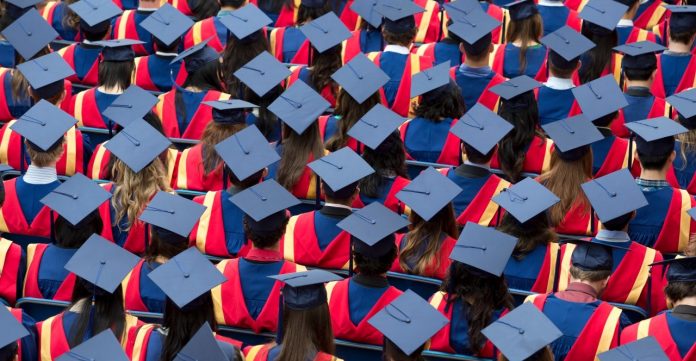
Although some may try to forge a future without higher education, a university degree is worth it

0
Courtesy of SFU

Written by Amal Abdullah

The concept of higher education has existed since the ninth century, when Fatima Al-Fihri, a woman who moved from Tunisia to Morocco, created the first university. Nearly 1,160 years later, a university education is considered an essential milestone in a successful life trajectory. However, in recent years, more and more arguments are being raised that a degree is not required in order to make a career, and certainly not to make a life.

From what I’ve heard, the no-school camp reasons that one can build a successful life, saving all the years of grueling effort and time spent in university, by being enterprising and innovative. They also claim to argue that the supplementary years spent after high school gaining an institutionalized education creates conformists, prevents people from taking risks, and stifles creativity. They use the many cases of jobless university graduates as an example of university not working out. 

“Why bother following the traditional route,” some ask, “when the end result is the same?” This school of thought usually seeks to earn its bread and butter through entrepreneurial and innovative ways, and its graduates have seen both sides of success and failure.

I am going to argue against this notion. If this model has worked for centuries, and the vast majority of people still attend school, then we cannot call university completely useless. While everyone has their own reasons for going to university, with the most common being finding well-paying employment, there are two reasons that I feel are the most pertinent.

Firstly, a university education provides students with skills and experiences, both inside and outside the classroom, which put them on the path to professional success. At the classroom level, students must juggle multiple courses that require high levels of commitment, read through incredibly dense content, complete assignments, and study for tests on short, stressful deadlines. Most students also work part-time jobs, sometimes taking on multiple jobs at a time, which only add to the already hefty schedule on
their backs.

With all these responsibilities and commitments, students are forcefully put into a position where they must learn to manage their time well and spend it productively, milking the little free time they have to do things that they enjoy. As a result, students adapt to an accelerated lifestyle that builds character and teaches professional work ethic. Students are better suited for the workforce than their no-schooler counterparts.

Furthermore, the university experience opens the door to creating connections and forging relationships that are important in a professional life. As the no-schoolers argue, a degree is not sufficient in order to obtain a good job and one’s personal networks are infinitely more important in realizing a successful career, a fact embodied by the common saying “it’s not what you know, it’s who you know.”

The expectation, or at least the hope, is that the students pursuing a post-secondary education are the brilliant minds who will become the movers and shakers of our communities once they graduate. Being in a university setting is the best way to get in touch and build connections and friendships with these people. This is not to say that all our friendships are for self-serving reasons, but there is no doubt about the fact that connections and networks are important for professional success.

Bill Gates and Mark Zuckerberg, globally renowned for their success, dropped out of university before finishing their degrees. While this seems contrary to my argument, it is important to note that they dropped out of Harvard University, one of the best universities in the world, after having created the foundations for their respective softwares with their peers. If they had not been influenced by the bright minds at Harvard, it is possible that Facebook and Microsoft would not exist.

Overall, is a university education helpful for a successful life in our day? I do not think that anyone can deny that it is, though there will always be risk-seekers among us who will embark on the journey to go out and create their own futures. The university experience allows students to gain coveted skills and experiences, and it opens the doors to professional networks and connections, which are essential in the professional world. If you are reading this, you probably believe that a degree is useful to some
extent, too.

SFU mural is an unwarranted reminder of Canada’s colonial past

2
Photo courtesy of SFU

Written by Treena Chambers

What do you do when you get a pair of pants as a present and they don’t fit? Most people ask for a receipt and return them. They don’t empanel a number of experts and talk about what they can learn about the pants’ perspective. They don’t talk about how these pants remind them of the importance of going to the gym regularly or eating better. They don’t talk about how important a gift these pants were even though they didn’t fit. Instead, they offer a teachable moment for considering how modern society has shaped our eating and exercising habits. They don’t hold onto this un-Comfortable, awkward, and ill-fitting gift as a reminder/memorial.

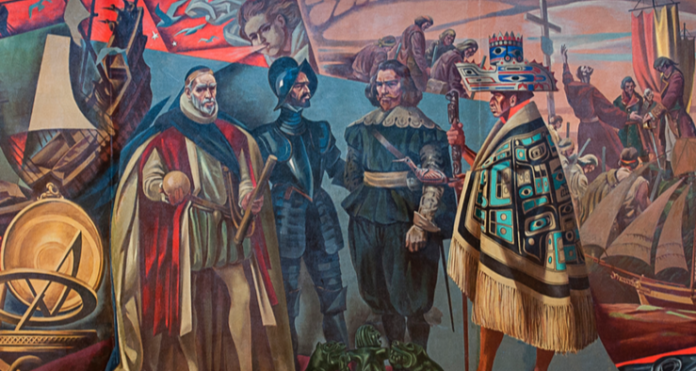
Now imagine that instead of pants, we are talking about a mural, specifically the British Columbia Pageant mural painted by Charles Comfort in 1951. This piece of corporate art was donated to SFU by the Toronto Dominion Bank in 2004. I am not going to question why, given all that we knew about the history and impact of colonialism in 2004, a university named after a colonial exploiter — sorry, I mean explorer — would accept this uncalled-for gift. However, I will point out that there has never been a time when Indigenous students and staff were not questioning the installation of this mural. Never a time when we were Comfortable with it.

I am not going to question why a vice-president university relations — Warren Gill, in 2005 — would say: “Being painted over 50 years ago, it can be seen to be male-centric and to glorify colonialism, thoughtless resource exploitation and environmental degradation in a way that we all would question today. On the other side, the mural is an important piece of Canadian art and contains some progressive elements for its time.” If I had to question that statement, I would have to wonder how a mediocre piece of corporate art, created for a bank by someone who was once an interesting and provocative artist but is no longer so, is still considered an important piece of Canadian art.

Is there any inherent value to a piece that glorifies colonialism, resource exploitation, and environmental degradation in the present? I would have to ask why a male-centric piece of work that glorifies colonialism, resource exploitation, and environmental degradation was accepted in the first place. I could raise these questions but, like the other Indigenous people who have already been consulted, I suspect that no good answer would be forthcoming.

Let me be clear: Indigenous students, staff, and their allies are not asking SFU to burn the mural. They’re not asking SFU to denounce the artist. They’re saying that at this time and place, they do not want to be confronted with a second-rate memorial to colonialism. They do not have the energy to continue having this conversation about the challenges of colonialism and racism over and over again. We’re already having that conversation in class, and it is often exhausting and painful for us all to constantly do the work to teach others. We don’t need another “opportunity” to have this conversation. We have to get to class.

The “teachable moment” upheld by this university is hurting the same people SFU claims to want to teach. These are not people in the abstract. These are people who have to walk past this affront every time they walk through the Academic Quadrangle. The price of this “teachable moment” comes at the expense of some of the most marginalized students on the SFU campus. Our pain and discomfort is a “learnable moment” that those in power never seem to learn.

Instead of wasting our time and energy by re-setting the cedar table or empaneling experts to talk about Why Art Matters’, SFU can put the Comfort mural in that closet with the awkward fitting pants and the itchy sweater that you only wear when your mom comes to visit. Heck, I bet if you read the SFU Abroriginal Reconciliation Council’s (ARC) report, there might even be a call to action that would echo this idea. I would suggest starting on pages 31 and 75.

WHAT GRINDS OUR GEARS: Tim Hortons in 2018

0
Courtesy of The Peak

Written by Liam Wilson, SFU Student

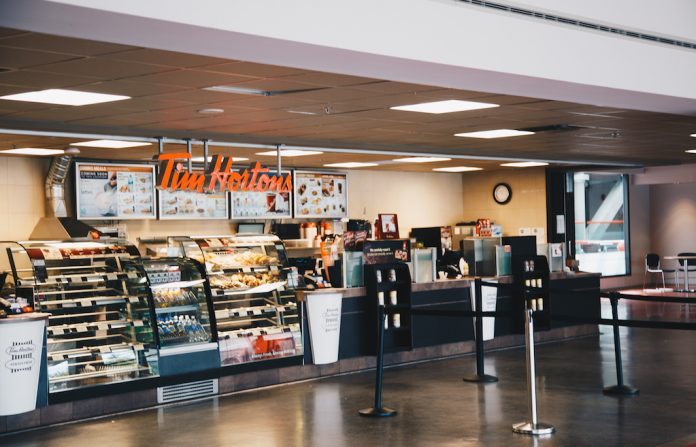
Let’s face it: Tim’s is not the champion of Canada that it used to be.

If you’ve kept up with Tim’s in 2018, you’ve probably heard of the public outcry, and the protests that erupted after it was announced that the heirs of the franchise would be cutting paid breaks and benefits for employees in Ontario due to increased minimum wages. Don’t you hate it when the government cuts into your profits in order to pay your employees a better living wage?

These events, coupled with rounds of layoffs along with animosity between franchisees and the parent company, have resulted in the company’s reputation disappearing faster than their best donuts — seriously, they’re always sold out of all the good kinds — sinking to number 50 on the Leger Reputation Study in 2018 after coming in at number four in 2017.

The cherry on top? Tim’s has completely ruined their sandwiches by introducing their new “rustic bun.” Trust me Tim’s, the only thing rustic about your bun is the fact that it tastes like dry, chewy shingles that somebody ripped off of an old barn in the countryside.

Sorry Tim’s, but I think I’ll be taking my business to Starbucks this year.

Gallimaufry brings an exciting jumble of art to SFU Woodward’s

0
Paige Smith / The Peak

By: Paige Smith

A weirdly wonderful assortment of works was presented at this year’s first-year Master of Fine Arts candidates’ spring showcase, Gallimaufry. Four artists from a range of disciplines attempted to expand their viewers’ understanding of art.

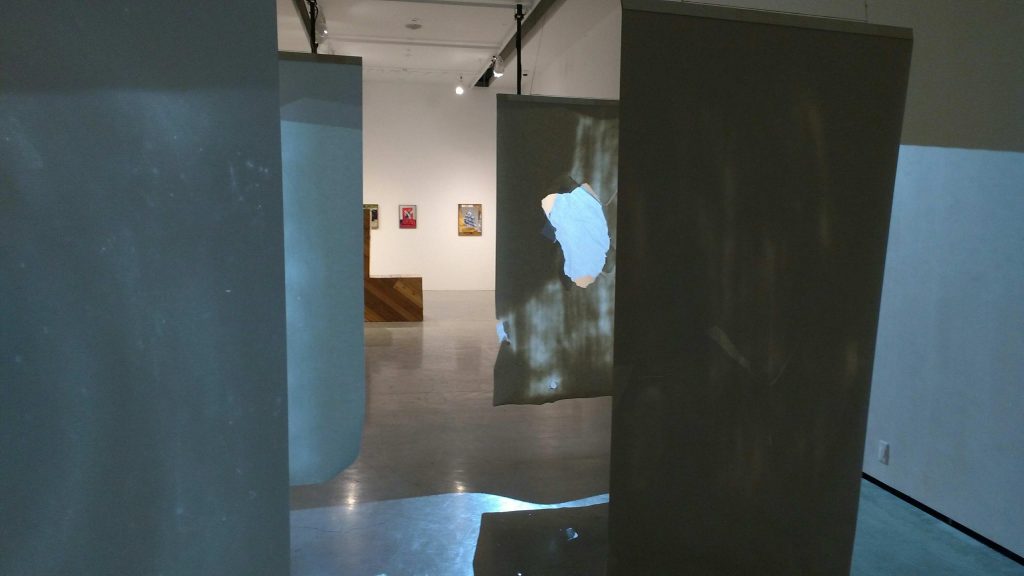
     Entering the Audain Gallery at SFU Woodward’s, I’m immediately jostled by the overwhelming soundscape of Minahil Bukhari’s After Aftermath, a video installation where abstract images of crumpled paper are projected upon large sheets of hanging fabric and papers.

Paige Smith / The Peak

     The projected images first hit the sheets nearest them, and then slip around the edges and through large ripped holes in the sheets, allowing the light to hit every layer of them. The holes are messily patched with transparent papers, never allowing the stressful images of the crumpling to escape any of the sheets. Walking around and through the work allows the viewer to experience how the light affects the sheets in surprising ways.

     The second work one might notice is Jennifer Anderson’s Instrumental Alchemy, which consists of both viewer experimentation and Anderson’s performance of playing her handmade instruments. Five different bowls sit upon a table, some glass and some ceramic, each with a wooden rectangle strung with piano wires placed atop them.

     Guests are encouraged to try plucking the wires of these bowl instruments, along with piano wires strung into an oddly shaped wooden piece. When plucked, the wooden piece echoes back, striking a curiosity for further exploration. The handmade aesthetic of the pieces allows for a playful interaction between the viewer and the instruments, where each pluck can bring new questions.

     Anderson’s performance utilized electronic looping to create a cacophony of melodies from the vibrations of both the plucked wires and the bowls, now filled with water. Slamming the wooden rectangles upon the bowls, donning some sort of vibration-detecting glove that was electronically wired into her computer, and splashing pots of water upon her instruments, Anderson never failed to incite new imaginings of what an instrument can look like, or how one should play an instrument.

Paige Smith / The Peak

     Stumbling deeper into the gallery, guests encounter small fields of fungi-filled rugs, hanging artworks, and plastic bags. Amy Wilson’s Living Objects melds human structures made of metal frames or plastic containers with the organic construction of mycelium from the fungi. The works seem to ask us to question human and non-human forms of making, and how the two interact together to create objects. The rugs were of particular interest, showcasing the beautiful textures and colours that mycelium can create.

Paige Smith / The Peak

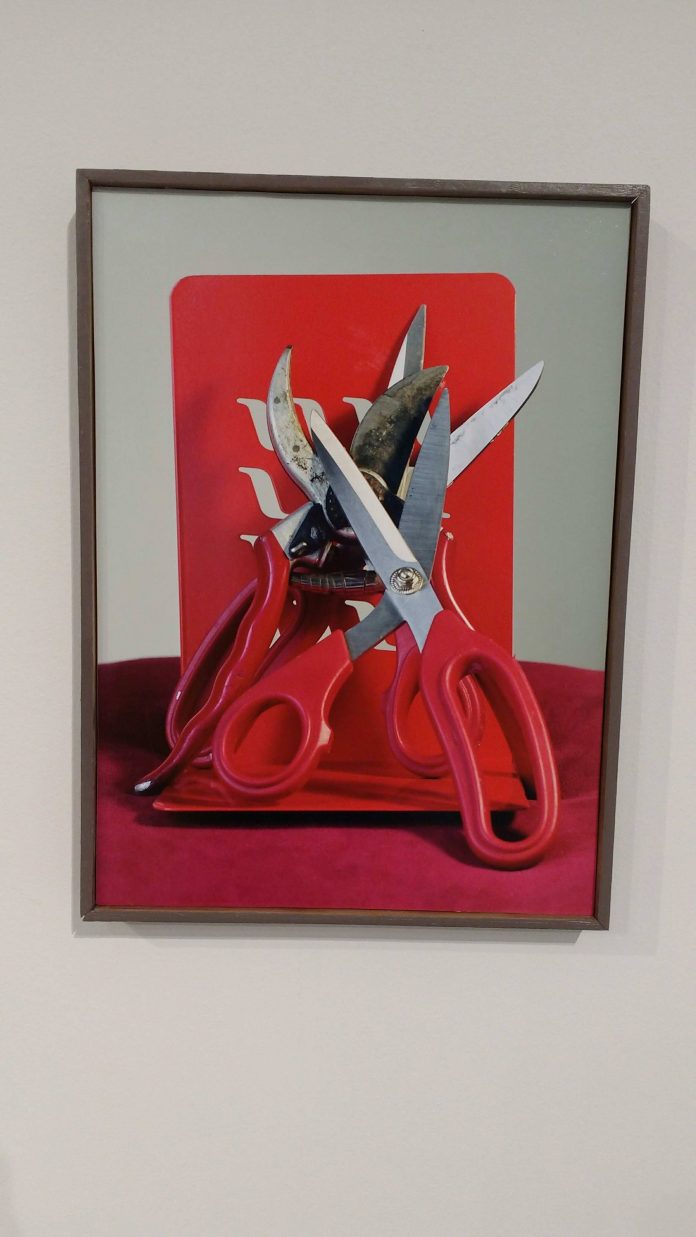
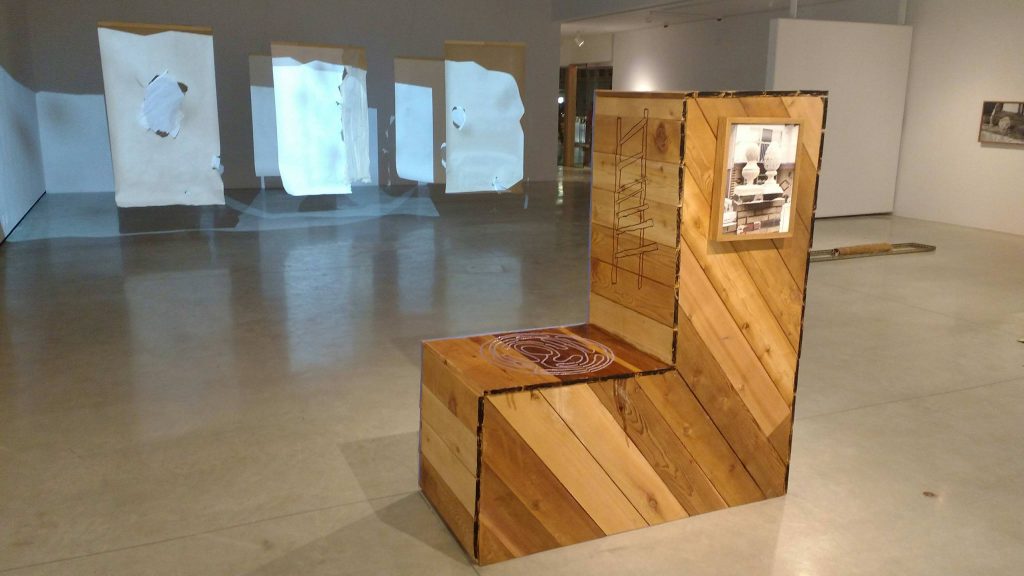
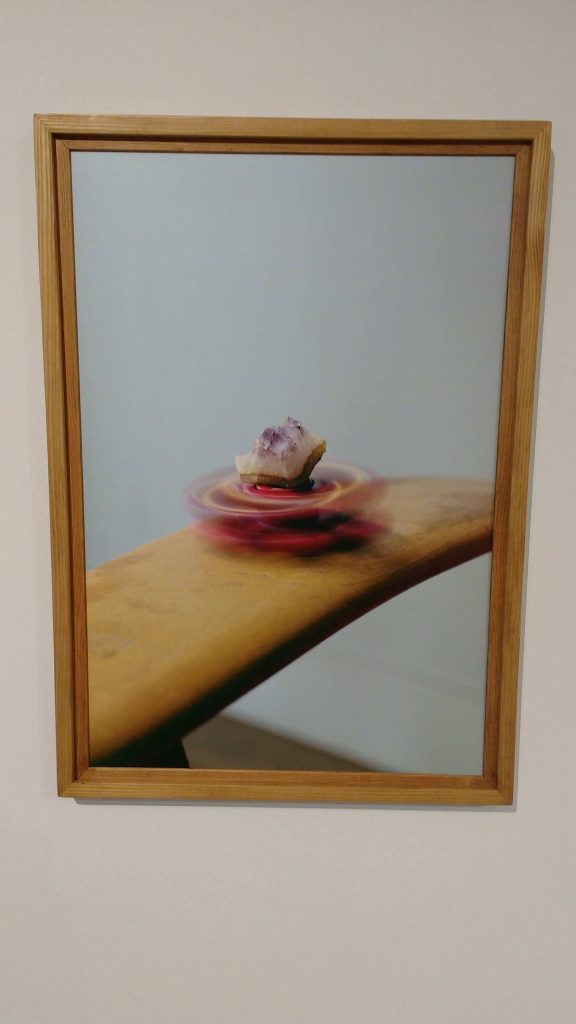
     The final artist on display at the gallery was Graeme Wahn, with his work Wrap Around Patio, which asks viewers to encounter the many wooden-framed photographs hanging on the walls from the vantage point of an L-shaped bench. The bench itself has patterns and sketches scratched into it, and the photographs depict objects ranging from bright red scissors to stacks of Kokanee playing card pyramids.

     The photographs seem unconnected other than their object-oriented aesthetics, but with the vantage point of the wooden bench, Wahn challenges viewers to question how the material structures surrounding the images affect the images’ meanings.

     The showcase was definitely a gallimaufry, with all the works mixing together to create a wonderfully odd collection of works all aimed at evoking curiosity in their viewers.

Paige Smith / The Peak

The election report falls short by missing key areas of discussion

1

Written by Corbett Gildersleve

This is the third year where I’ve been involved with a Simon Fraser Student Society (SFSS) election in some form. The first time it was as a candidate for the applied science representative position, while the other two were as a student or stakeholder asking difficult questions, and waiting for bland non-answers from an SFSS incumbent. This year’s election was different in that more people ran for positions and the board slate didn’t sweep. The way the election was run also differed from ones in the past. It’s hard to say why, though, since the election report is missing key information that could provide context, especially concerning the eight recommendations listed in it.

Now, I won’t be trashing the Independent Electoral Commission (IEC) Chief Commissioner while reviewing this report since I’ve never done their job. However, I do know that it’s generally a thankless but necessary role. To me, some of their recommendations make little sense without additional information and context. Here, I will try to provide some historical and policy context in my review — future articles will explain my counter-recommendations. (Are you as excited as I am?)

For the candidates, board members, and regular students who have complaints about the election, remember that accountability falls on the Administrative Supervisor and the Campaigns, Policy, and Research Coordinator (CPRC) as they’re the ones who interviewed and recommended the IEC
to the Board for hiring as per the election policies.

Let’s talk about the election report as a whole. According to the election policies in the Chief Commissioner’s report must include at least: 

  • The dates of the various election periods.
  • The names and positions of candidates.
  • The wording of referendum questions.
  • The results of the vote.
  • A list of issues that occurred and how they were handled.
  • A set of recommendations for improvements.
  • An appendix including all infractions, complaints, and decisions made regarding electoral and referendum campaign regulations.

The recommendations are generally only a few sentences long, and lack the context that the bolded parts would provide, if they were included. Furthermore, according to that policy, all the points listed above are needed for the Chief Commissioner to be eligible for their final stipend. The new Board should check with the old Board to see if they accepted and ratified an incomplete election report.

One possibility is that the report template that was given to the IEC is missing those sections. This might be possible, because the Fall 2017 referendum report contains the exact same sections. No more, no less. If the template is missing key parts, then that’s on the CPRC staff members, as they’re responsible for the creation of the template.

Do you know what else is missing from both the report and policies? The cost of the election! The previous election policies clearly required an expense report, and every election report going back to at least 2007 has that information. The new policies do not. That’s a problem, as it actually directly relates to one of the recommendations involving IEC work hours and costs. I really hope this was just an oversight and not another example of the SFSS becoming less transparent.

I’d like to give the 2016-2017 board the benefit of the doubt, but the minutes where the policies were passed (April 24, 2017) are barebones with no discussion points. So, either the entire governance committee of that year missed it, or it was intentional. I hope the new Board changes that, as it is a very easy policy amendment. If someone tries to say that, with the inclusion of staff in almost every area of elections now, it’s harder to figure out costs, tell them that financial transparency is never easy, but it’s necessary. It’s why we have audits. Or, you could just revert it back to the old election policies and ask the governance committee to redo them. You might want to do that anyways to fix the staff/admin conflict of interest issues.

However, for all that it’s missing, the report touches on some issues within the SFSS and elections through its recommendations. They cover everything from scheduling and booking issues to excess hours, IEC task autonomy, slates, and endorsements. Like most past IEC recommendations, some issues can be fixed, some cannot, and some the SFSS will just ignore.

So, stay tuned for the next article, which will go through each recommendation and try and provide some historical and policy context, as well as my own suggestions for possible fixes.

The Peak’s Tourist Guide to Vancouver

0
Photo Courtesy of Tourism Vancouver

By: Aaron Richardson

As the summer slowly approaches here in Vancouver, tourists will start flooding the streets like the parasites they are. Every year, they come here for the summer to experience the weather, the food, and the unfounded feeling of superiority that they  get just by being here. Now that tourists have started arriving, the city has begun its yearly tradition of futilely trying to convince them that Vancouver’s biggest attractions are actually worth the effort they take to experience.

Grouse Grind:

One of the many attractions Vancouver consistently attempts to promote is the Grouse Grind. Climbing the Grouse Grind — an activity known by the locals as ‘Grinding’ — is a two-to-four hour hike up Grouse Mountain just at the northern edge of Vancouver. This term should not to be confused with its sexual counterpart: ‘Grinding.’ This is when sexually inexperienced teenagers manage to convince themselves that rubbing their genitals together is a legitimate substitute for sex. While both forms of Grinding are undeniably different, they have both been described by users as “useless, time-consuming, and sexually frustrating.”

While the city’s official statement is that the Grouse Grind is “a beautiful and scenic adventure through one of Vancouver’s most beautiful trails,” many locals consistently describe it as “just a bunch of fucking stairs.” Often, while Grinding, tourists will look around at the ‘beauty of nature’ and wonder when exactly the fun is supposed to begin. They’ll get to the top of the stairs thinking that it was just preparing them for the great time they were about to have, only to realize that these “great times,” like the long lost days of their youth, were already behind them and never coming back.

This kind of criticism is difficult for the city to ignore. Yet, as always, it tries its hardest. While Grinding may not be worth the time, it’s important to set your standards low for the rest of the tour of Vancouver. Plus, admittedly, the view is actually pretty nice . . . so there’s that.

Steam Clock: Keep your eyes peeled for the Vancouver Steam Clock. Tourists walking the streets of Gastown will frequently look out for the famous Vancouver Steam Clock, only to notice that it was right in front of them the whole time, as annoying as it is unimpressive.

The Art Gallery, Science World, the Aquarium, and Playland: These attractions — aside from being worthwhile in their own right — are great representations of Vancouver themselves. They are beautiful, interesting, and even thought-provoking places that are ruined by the omnipresent haze of pot smoke, the incessant shouting of dozens of screaming children, and the pain of being surrounded by fish, fish, and . . . guess what . . . more fish.

Richmond Night Market: After a long day of visiting these locations, it’s best to stop by the Richmond Night Market. It’s a great place to spend an evening that — like Vancouver — is filled with delicious food whose names white people are too afraid to try pronouncing.

Capilano Suspension Bridge: This is a great place to end your trip in Vancouver. Upon arriving at the Capilano Suspension bridge, tourists are often dumbfounded by its unexpected beauty and elegance. After the confusing and frustrating effort of trying to enjoy Vancouver’s most popular tourist attractions, you’ll be typically unprepared for the oddly pleasant experience at the bridge. While still not worth the price, this pleasant experience will end your trip on a high note and will serve to convince you that your time here was actually worth while.

Admittedly, as with most Vancouverites, I haven’t actually visited any of these places myself. I live in Coquitlam, and just went off what my cousin told me last year when he visited. What am I gonna do, go out and take the hour and a half transit into Vancouver for a fucking steam clock? Don’t be ridiculous.

Muslim holidays and what they mean to SFU students

0
Image courtesy of The Muslim Skeptic, Daniel Haqiqatjou

By: Amal Javed Abdullah (Staff Writer), Hamza Malik (SFU Student), Ali Najaf(SFU Student), and Zach Siddiqui (Copy editor), compiled by Gabrielle McLaren (Features editor)

Dates to remember for 2018 – Zach Siddiqui

  • Ramadan: May 15—June 14. Due to the dates being decided through the lunar calendar, the first day is considered to start in the evening of May 15; therefore, the first day of fasting is projected to be May 16.)
  • Eid al-Fitr: June 14–15
  • Eid al-Adha: August 21–5

Note: The following dates may vary depending on your geographical location and mosque, as many of them are decided through the lunar calendar rather than the Gregorian one.


On Ramadan – Amal Javed Abdullah

Ramadan is commonly known as the month of fasting, where Muslims around the world abstain from food and drink from sunrise to sunset every day. The idea is that as physical distractions are lessened, the observer of Ramadan is forced to focus on internal reformation, self-reflection, and connecting with God. It serves as internal retreat, often likened to a boot camp for the soul, which is intended to renew and refresh oneself internally for the rest of the year.

However, it is not only about becoming a mystic or an ascetic; Ramadan is about recognizing the importance of family and community, about spending time with your loved ones, about meeting new friends and reconnecting with old ones. Ramadan is about recognizing your privilege and being grateful for your blessings, about volunteering your time and energy in food kitchens or handing out sandwiches to the homeless to help those who are less fortunate. Ramadan is about – though it may seem like a contradiction – food! One of the highlights of the day is iftar, the meal at sunset that breaks the fast: my experience has generally included more than an average share of samosas and pakoras.

The SFU Muslim Students’ Association holds free community iftar dinners at Burnaby campus on most Fridays of Ramadan. To experience the Ramadan spirit, attend an iftar! Details can be found on the SFU MSA’s Facebook page.


How does the lunar calendar work? —  Zach Siddiqui

If you’ve been paying attention to the coming and going of Muslim holidays year by year, you have probably noticed something interesting: the dates seem to change every year! Why might that be?

Well, you could say that the dates change from a certain point of view — namely, the Gregorian calendar, which is the calendar that the West has operated on for centuries. First adapted from the Julian calendar in the 16th century, Pope Gregory XIII’s calendar is based around the rotations of the Earth around the Sun. However, important days in the Islamic faith, of course, would hardly be dictated by a calendar designed by Christians in faraway regions. . . especially not a calendar created so long after the birth of Islam, which historians believe to have taken place in roughly the seventh century of the common era!

The Islamic calendar is a lunar calendar, which means that its months and years are measured by the cycles of the moon. Like the Gregorian calendar, it has twelve months, but unlike the Gregorian version, it only has 354 days.

So, what does this have to do with how the dates seem to change? Imagine for a second that January 1 on the Gregorian calendar were to match up with the first day of Muharram, the first month of the Islamic calendar. Now jump forward 353 days. Assuming neither year is a leap year, that puts us at the last day of Dhu-al-Hijjah, the last month on the Islamic calendar. But 353 days later on the Gregorian calendar puts us at December 20 — not the last day on the Gregorian calendar. So, if we were to go one more day forward. . . we would be on the first day of Muharram in the second year of the Islamic calendar, but on the Gregorian calendar, we would only be at December 21 of the first year, not January 1. To put it in simple terms: each year, the Islamic equivalent of any given date on the Gregorian calendar is 11 days earlier than it was the year before. This means that, if you’re measuring time on the Gregorian calendar, as much of the highly-globalized world now does, the dates of Muslim holidays look like they are changing, when, in fact, they’re exactly when they’ve always been.

Of course, aside from that cultural drift, there are small disagreements about when things are supposed to happen even within the Muslim community itself. The beginning of Ramadan is a prime example of this. Some Muslims simply check online for when the new moon is supposed to be visible in their country of residence, since, with modern technology, we can determine the exact date with ease. Others wait on word from their local masjid — mosque — to find out when their local community recognizes Ramadan to have begun. Still others take cues from Saudi Arabia, or else their family’s country and/or city of origin, to figure out when to start fasting.

The latter cases happen partially because many practitioners of Islam still rely on a literal moon sighting to confirm when the proper day to begin fasting is — something which is made difficult by adverse weather conditions and the fact that the new moon, being a black disk against a night sky, is not the easiest thing to see. This, incidentally, leads to a further divide: some will use the sight of the new moon as their signal, while others will wait until the moon’s crescent starts to become visible, which some interpretations of the Holy Qu’ran would suggest is the correct approach.

That said, I did find it interesting  how this Vox article summarized the stance taken by proponents of the scientific approach to calculating the date: “Islam has a strong tradition of reason, knowledge, and science, and [. . .] if Mohammed were around today, he’d choose the more precise scientific calculations over sending the guy at the mosque with the best eyesight outside to squint at the night sky.”


Ramadan far from home – Ali Najaf
Ramadan is one of the 12 months of the Islamic lunar calendar, where Muslims keep fast during the whole month. Fasting is also one of the Five Pillars of Islam. It teaches self-patience and compassion for others, as well as the importance of community building as in many communities. People break the fast together to keep the community spirits high.

Happiness on every face, big feasts, and late night markets come alive after a month-long spiritual journey of Ramadan, when celebrating Eid al-Fitr.  It’s a three-day festival where families and friends meet with each other and celebrate.

Living as an international student makes you miss home during ethnic celebrations. Ramadan is not celebrated with the same zeal and zest as back home, especially as you are away from your loved ones. Fortunately, I can say that we have a big Muslim community in Vancouver. Groups like the Muslim Student Association at SFU help bring back the feeling of home as they arrange events throughout the month.


Fasting teaches you what you choose to learn from it – Zach Siddiqui

Food and I have a tumultuous arrangement. I switch between extremes of consumption like a pendulum, swinging from carefully starving myself to forcing torrents of sugar and slick oil into myself. It is incredibly unhealthy; my way of eating tends to eat me up inside. Yet I still manage to overcome that and fast for the duration of one lunar cycle in twelve, for as long as the sun shines.

People don’t believe it. No food? Nothing to drink? All day? You? But it isn’t so mysterious. Like the cotton that stuffs a doll, when I breathe in the air of the month of Ramadan, it fills me up and strengthens my shape. I feel powerless sometimes, not only against my gustatory urges but against the greater part of living; the roza of Ramadan is my strength.

To me, fasting is the reminder not to waste what you have been given; the revelation of what it means to go without. It is the release from having only material sources of joy, and a recourse for becoming closer to God. The fast means many things to many Muslims.

(Of course, it doesn’t always feel so poetic. There are times where the hunger feels like too much — times where your temper runs short, or your energy runs dry. No one is perfect, and so none fast perfectly. Nonetheless, we continue, and happily.)

Ramadan means my family dines together, and together, my mother and father experiment with traditional Afghan dishes in fascinating yet economically sensible ways, in preparation for nightfall. Always, they have taught us not to fast for the wrong reasons. There is no point giving up luxuries during the day if all you do is gorge and waste at night, my mother taught me. No point teaching yourself the meaning of going without food, if you can then continue to watch others starve without feeling any sympathy. No point making sacrifices, if your foul mood forces others to sacrifice their own happiness just to placate you. You can follow the word of Islam even as you think critically. That agency, that restraint, that balance is what you could call self-control in its truest sense.


Eid al-Adha – Hamza Malik

Eid al-Adha is one of two key Islamically ordained holidays celebrated by Muslims across the world. It commemorates the Prophet Ibrahim’s (Abraham) willingness to sacrifice his son Isma’il (Ishmael) as an act of obedience to God. As recognition for Ibrahim’s act of obedience, God instead brought forth a male sheep for slaughter. Eid al-Adha also marks completion of the annual Hajj pilgrimage performed by millions of Muslims in the holy city of Makkah.

Some hallmark customs for Muslims on this day involve attending a special morning prayer, followed by the mandatory sacrifice of certain cattle, as an homage to the story of Ibrahim. The meat from the sacrificed cattle is then distributed into three parts: one third is designated for the poor, another third for neighbors, friends, and other relatives, and the final third is for one’s immediate family. The celebratory aspects of this day involve the meeting of family and friends, the distribution of gifts and coming together as a community to reflect upon the blessings of God.


Mawlid al-Nabi al-Sharif —  Zach Siddiqui

This is both the birthdate and the death date of the Prophet Mohammed (peace be upon him)*. Whether or not one observes this time varies from culture to culture. Some countries celebrate it with street processions, charity-giving, and festive decorations. In others, such as Saudi Arabia, it is directly forbidden to celebrate Mawlid.

The debate of whether or not the Prophet’s birthday should be celebrated at all is a longstanding and prominent one. Those who are against it argue that, because the Holy Qu’ran does not instruct Muslims to observe the Prophet’s birthday, to do so is in fact a false addition to the faith — also known as a bid’ah — that must therefore be abolished. Others balk at the very idea of failing to celebrate the Prophet.

One particular argument a Huffington Post article poses on the topic is that “. . . adding anything to Islam is a bid’ah, and . . . it violates and compromises the sanctity of divine revelations. But . . . rendering what is permitted as forbidden is just as bad as deeming what is forbidden as permitted. We must be careful about how we define bid’ah.”


*Note: “Peace be upon him” is the translated form of an honorific epithet often used to follow the name of any prophet in Islam, commonly seen with the name of the Prophet Mohammed.

Local asshole thinks it’s fine to take up a whole booth in MBC by himself

1
Illustrated by Reslus

By: Winona Young

Earlier this week in SFU’s Maggie Benston Center (MBC), students were shocked to find a local asshole taking up an entire booth all to himself with his smug ass and all his shit, like it was entirely fine.

The student was first spotted in the MBC eating area at approximately noon, the height of the lunch rush. He allegedly passed by multiple empty white tables and made a beeline toward the booth, alone. He apparently then tossed his Herschel backpack to the opposing booth seat, and sat down without a care in the fucking world.

With marginally less seating in the MBC eating area, local SFU squads and crews were left without a comfortable place to sit. “I didn’t know how to break the news to my group chat,” a distraught student said. Second year Criminology student, Throckmorton Lee, reportedly approached the MBC area in hopes of finding a booth for his group mates, but was surprised to see that this son of a bitch had taken the last one available.

“He wasn’t even working, he was just on Reddit while he spread out a bunch of open notebooks on the table!” Lee exclaimed. “Like, just because you put your shit everywhere doesn’t justify you taking up that much space, you selfish bitch.”

Other students reacted to such a monstrous act with resignation. Third year English major, Boris de Binch, commented that while he felt annoyed by this dickbag’s claim to an entire MBC booth, he would not in fact confront the sick, sick man. “Like, yeah, I’m annoyed,” Boris explained, “but I’m not gonna actually do anything about it. I don’t know how to talk to another human being.”

The whereabouts of this absolute fucking beast have remained unconfirmed. The asshole in question was last spotted in the back of the 95 bus. He allegedly manspread his legs to take up a total of four seats alongside his Herschel backpack, and continued to act like a goddamn douche.
Go figure.