Home Blog Page 547

SFU keeps hope alive for second place finish with huge 6–2 win in Nanaimo

0
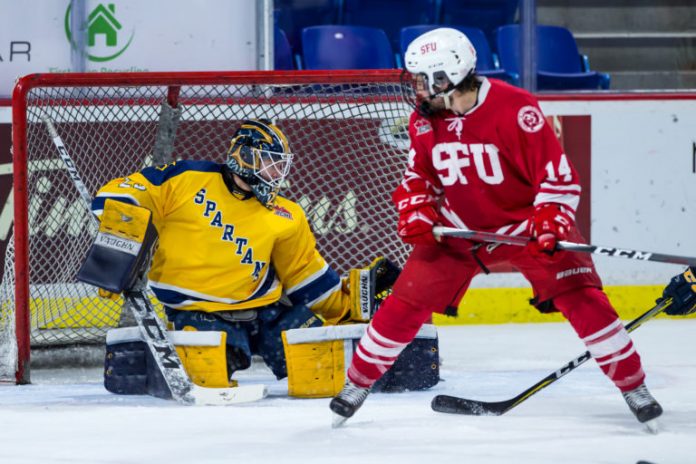
The Clan still have time to move up the standings. (Photo courtesy of SFU Hockey)

By: Dylan Webb

The SFU hockey team rolled into Nanaimo on Friday night in fourth place in the BCIHL standings with multiple games in hand on the rivals they trail in the standings. The team’s currently facing an uphill battle to secure home ice advantage in the first round of the playoffs, requiring a a 5–1 record over the remainder of the BCIHL season. With that in mind, the Clan arrived at the Nanaimo Ice Centre focused on taking it one game at a time.

After a delayed start due to the VIU (Vancouver Island University) Mariners’ celebration of their graduating class of seniors, the Clan unleashed an offensive assault early in the game and built up a lead they would never relinquish.

The first period saw the Clan jump out to a 2–0 lead on goals from team point leaders Mac Colasimone and Nic Holowko. Throughout the first, the team did a great job of using their team speed and maintaining team discipline.

While the Clan would continue their strong play into the first half of the second period and add two more goals to take a commanding 4–0 lead, the team allowed their emotions to get a bit out of control, which allowed the Mariners back into the game late in the second.

After a series of penalties and disorganized power-play attempts on behalf of the Clan, the Mariners pulled within two goals just before the end of the second period to set up an intense third in which the Clan would do their best to protect their two-goal lead and their faint hopes for home ice advantage in the first round of the playoffs.

Fortunately for the Clan, goaltender Ryan Sandrin slammed the door on the Mariners’ offense in the third period to secure the 6–2 win. Sandrin stopped 35 of 37 shots to notch his sixth win in eight starts this year. While the Clan carried the play for most of the first half of the game, Sandrin had to be sharp with multiple big saves throughout the last half of the second and the third periods. His repeated strong performances in key games down the stretch this season appears to have solidified his position as the go-to goaltender for the Clan as the playoffs rapidly approach.

The Clan now face a quick turn around with their next game at 3 p.m on Monday at the Bill Copeland Sports Centre. A big two points will be up for grabs on Monday that would go a long way toward securing the second playoff seed and home ice advantage in the first round for the Clan.

With this in mind, The Peak caught up with defenseman Daniel Nussipakynov, post-game, while he was riding the exercise bike to hear some of his thoughts on the team’s dominating performance. Asked what the biggest improvements were for the Clan in their win over VIU this Friday versus the loss to the Mariners last weekend, Nussipakynov pointed to the fact that “we came out flying with an awareness of the importance of the two points and with a stronger commitment to using our team speed and maintaining team discipline and emotional control.”

When asked how the team should approach the tall order of winning at least five of their remaining six games to secure home ice advantage in the first round, Nussipakynov noted that “every game is extremely crucial for us, so we have to take it one game at a time. Our end goal is capturing the BCIHL championship, so we are motivated by that goal while understanding the process required to get us there.”

The Clan will continue their drive for a second-place finish in the BCIHL standings on Family Day at home at the Bill Copeland Sports Centre.   

SFU needs to address how construction noise makes campus dysfunctional

0
Photo by Chris Ho/The Peak

Written by: Gabrielle McLaren, Features Editor

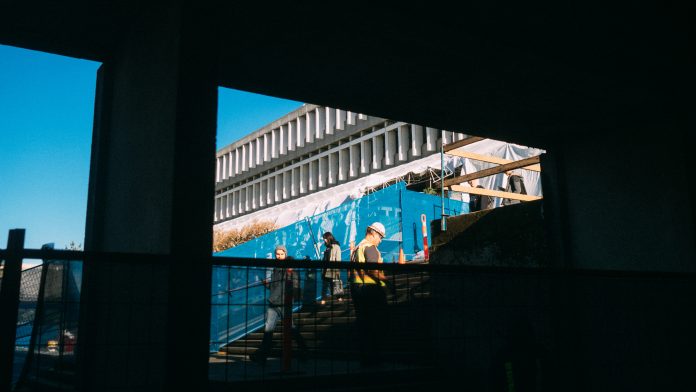
Three of my five classes are on the Burnaby campus. Twice last week, we were forced to move because of construction noises.

When I say “forced to move,” I mean that my discussion-based seminars got up and left for another space because we were simply unable to get any work done over the sound of cement being drilled in. And with everyone engaging in this mass exodus from the AQ’s construction choir, officially or unofficially relocating classrooms is frustrating and time-consuming.

In a few of our classes, we had to get creative. One professor literally brought us to Club Ilia and we split nachos and pop while talking about human rights, which sounds hilarious until you realise how ridiculous and unsustainable that is. Another professor gave us some options about how to proceed and put it to a vote, and our fourth-year seminar elected to search for another spot on campus to continue our discussion.

On both counts, professors were helpful, professional, dedicated, and attentive to the needs of students — but they shouldn’t be the only ones accommodating for the school’s noise.

I know that our school is basically a Cold War-era cement pop-up shop, and that construction is a necessity to maintain and improve our infrastructure. But that shouldn’t come at the price of students’ education. If it does, we’re losing sight of why this brutalist monstrosity crowns Burnaby Mountain in the first place.

Noise pollution has known negative effects on your health, from hypertension to anxiey. According to WorkSafe BC: “An employer must ensure that a worker is not exposed to noise levels above either of the following exposure limits: (a) 85 dBA [decibels] Lex daily noise exposure level.” Construction workers are notoriously at-risk for work-related hearing loss, not only because of long-term exposure, but also because their sites are regularly above peak limits. If the workers are subjected to this degree of noise, it shouldn’t be a surprise that the classes in the same building are going to find it disruptive.

While I wasn’t whipping out decibel meters to check the numbers during lecture (although I hear there are apps for that), our work was absolutely disrupted. Other students looked tense and uncomfortable, one of my friends whose first language wasn’t English was straining to figure out what was happening, and Advil became a hot commodity among the entire class.

I’m pretty sure that students don’t need their institution trying to nerf their performances and stressing them out furthermore. We do enough of that ourselves, thanks.

More than that, this amount of noise is also a serious accessibility problem for students with any kind of hearing impairment, migraine problems, or with anxiety disorders who may or may not be registered with the Centre for Accessible Learning. For these students, the harm from this noise can be especially harmful; having concerns about the construction on campus is not petty or whiny at this point.

It’s made more frustrating since we’re still paying around $750 for every class we take. While I don’t like thinking of my education as being reducible to its monetary worth, it feels necessary to say how much value is being ruined for us. On a basic level, if I’m going to be paying for my education like a customer, I’m comfortable pointing out that a healthy learning environment should be included in the per-credit cost of my BA. My classmates have joked about getting refunds for missed and disrupted class times, but if we’re going to put a price on education this logic isn’t crazy.

Since we’re in a system where students are customers, maybe those bright-eyed twelfth graders with post-secondary dreams should go shop elsewhere. SFU needs to do a better job of thinking of students’ needs and learning conditions when it’s scheduling construction and classes, and think logistically about how those two affect each other.

What grinds our gears: The difficult and confusing stairs and pathways of Burnaby campus during construction

0
Illustration by Cora Fu/The Peak

Written by: Jennifer Low, Peak Associate

Getting to places around Burnaby campus has been the bane of SFU student existence since even before the construction began. After nearly getting trampled at the Production Skytrain station due to that tradition of sprinting down the stairs, we already had to deal with that steep flight at Saywell. The absolute last thing you want after all that is the lengthy walk up and down more flights of stairs just to get to West Mall.

Now, though, the stairs and walkways of this campus are an ever-changing labyrinth thanks to the construction on campus. You thought navigating the routes through Robert C. Brown Hall or the technology complexes were a challenge? Try it when the entire school has become a shifting maze of arrows, fences and “Public Walkway” signs. Forget about going to the Lorne Davies Center to work out, just getting there from the AQ through several closed pathways is tiring enough.  

It’s bad enough normally, but it only gets worse when the frequent rainfall (and recently snowfall) hits the flights outside. Remember the good old days when SFU students could at least say that they could get everywhere on campus without getting wet? With construction clogging and closing up the indoor staircases, those days are now a distant memory — almost as distant as the upper walkway we need to take now that the AQ’s so closed off.

Tapiwa Samkange discusses SFU rugby community and living away from home

0
(Photo courtesy of Al Riede)

By: Beatriz Fernandes

Year: Freshmen

Hometown:  Harare, Zimbabwe

Major: Molecular Biology and Biochemistry

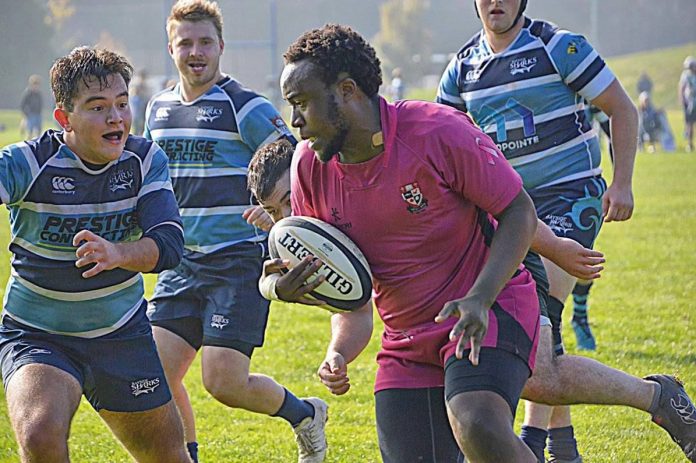
Tapiwa “Taps” Samkange is an international student from Harare, Zimbabwe. Beginning his journey at Fraser International College (FIC), and currently in his freshman year at Simon Fraser University, Taps moved to Canada three years ago, and has been an active member of the SFU Rugby Club ever since.

Taps chose to attend SFU in order to experience a new country and simultaneously pursue an academic career. Tenacious and joyful, the player is loved by his coaches and teammates, who describe him as a pivotal member not only to the club, but to the entire community built around it. Although he has been playing rugby since he was 13, Taps finds the community at SFU to be particularly loving and engaging.

Currently playing tight head prop (the cornerstone of rugby scrums), Taps has collected skills, friends and memories from the club that he holds very dearly. His love for the sport and the team are as apparent as his results on the field. Although Taps first saw rugby as a way to bring something familiar to the unknown, he currently describes the club as his family.

The Peak: How did you first learn about SFU Rugby?

Tapiwa Samkange: I learned about it from my CA (Residence Community Advisor). He told me I should try out, so I went down for a practice… and the rest is history, I guess.

P: How do you manage between an academic and athletic career at SFU?

TS: Obviously I wouldn’t say it’s as intense as other athletic careers because we only practice twice a week, but you just have to strike a balance and prioritize what’s important. I think people often try to schedule their lives around things as opposed to committing to what they enjoy, and I think that’s the biggest mistake. You should state your priorities and then go from there.

P: Who would you say is the most important person in your life?

TS: It has to be my mom. She is always looking out for me. I can’t explain how much she carries me and keeps me going all the time. Even though I’m far from home and communication is not the same, I know that no matter what happens, whatever I do, she’ll always have my back. She’ll always be there.

P: You mentioned that you used to play rugby in Zimbabwe. What do you find the main difference to be between playing here and back home?

TS: They’re definitely different styles. We play in an open age group so there’s a lot more older kids that play an underhand, “older style rugby” that you don’t experience in high school. But playing back home it’s more of a “faster play,” more geared towards grinding harder and harder.

P: Could you take me through your first game here at Simon Fraser University? How much has changed since you first began playing with the team?

TS: My first game was an away game and I was on the bench. It was cold, oh my god, so much cold. I remember getting to play the second half and yeah! It was just weird because there were older people than I expected, and a couple guys bigger than I expected too. I think I touched the ball once during the whole game and it didn’t go great. But afterwards, the whole team just got together and it made me want to come back and play more. It’s very different now – I get to start now! Compared to back then, I’ve gained a bit more confidence because I know what it takes [to play] the game. Before, I was younger and fresher to the team; now I feel confident enough in my role and my tackles. I feel more established.

P: What is your favourite thing about SFU Rugby?

TS: The SFU community and the family bond. Even with rugby as a whole in the Lower Mainland, it’s just so community driven. Not a lot of people do play rugby, so the people who do . . . everyone is just great! From all walks of life, doing all sorts of odd jobs, and coming together every Saturday, come rain or snow, and just beat the heck out of each other.

P: What is the environment around the field like? How is the community at SFU rugby?

TS: Before the game there’s a lot of different people. Some people are more quiet and just want to play music and focus on the game. Other people relax with talking and juggling around. And then when the game happens the view changes. Stuff gets real. Afterwards though, everyone is great with everyone. Like I said, there’s a big community. After the game you feed the other team. You get to know other teams, and once you’ve played for a couple of years, you remember a couple faces and it’s just easy to kick around. There’s a lot of people that through injuries had to stop playing, but they still show up to the games just for the community aspect of it.

P: How has SFU Rugby changed your course at the University, and in your life in general?

TS: Oh so much! It helped me settle in, as coming from Zimbabwe I knew only a few people, so it helped a lot because it’s such a family bond playing rugby. Everyone was nice to me. If you need help with something they’ll be there. It really helped me make friends.

P: Who would you say is the funniest guy in the locker room?

TS: I would say Aidan [Brown]. He could make anyone laugh. He has witty comebacks for everything that no one else could think of. He’s just a treat!

P: How is being from somewhere so far away impact the way you live your life here in Canada and SFU?

TS: When first coming here there was definitely a culture clash. Like, it’s a lot more liberal around here, a lot different compared to back home. But it’s nice because I chose to go somewhere different, and it’s the difference I wanted. Vancouver is a great place, and a great place for me. But being far away, it’s not always easy – you get homesick and you miss home. Zimbabwe is super far away, but with technology it helps a little bit. It just helps you have a different perspective. It makes you think about how different everyone is and the places they came from. Changing your scene is a good thing. The world is so much bigger than I think people realize. So just always expose yourself to as much of it as possible.

P: Do you see yourself staying in Vancouver in the long run?

TS: I would like to stay here a while. I don’t know if I will live here forever, but yeah, so far I’ve enjoyed the city and the people. Like I said, the rugby is sort of my family away from home. Coming from far away, your friends become your family, and it’s a good enough family to stick around with. So I’m not necessarily in a rush to go back home.

P: To the people who might be considering trying out for the team, what would you say?

TS: Come and have a try out. Rugby is a sport that can take all body types. You don’t have to be the tallest or the biggest. You can be small and fast. It allows all bodies to play, as long as you have determination. You have to want it, because rugby games are very intense on the field. You have to be determined to win it. I hope that people feel free to come out, it’s a lot of fun.

Athlete’s corner: As an international student, Tapiwa recommends being engaged and becoming part of a community that shares the same interests as you. Currently ranking at 6th place, the Simon Fraser RFC [Rugby Football Club] is on the track to make it to playoffs, and Taps encourages everyone to come and join the community on its journey there. SFU Rugby holds games most Saturdays, often on Burnaby Mountain, and no matter the results, a party is always guaranteed.

Don’t rely on campus or transit announcements when deciding whether or not to stay home

0
Illustration by Joy Tian/The Peak

Written by: Gene Cole, Opinions Editor

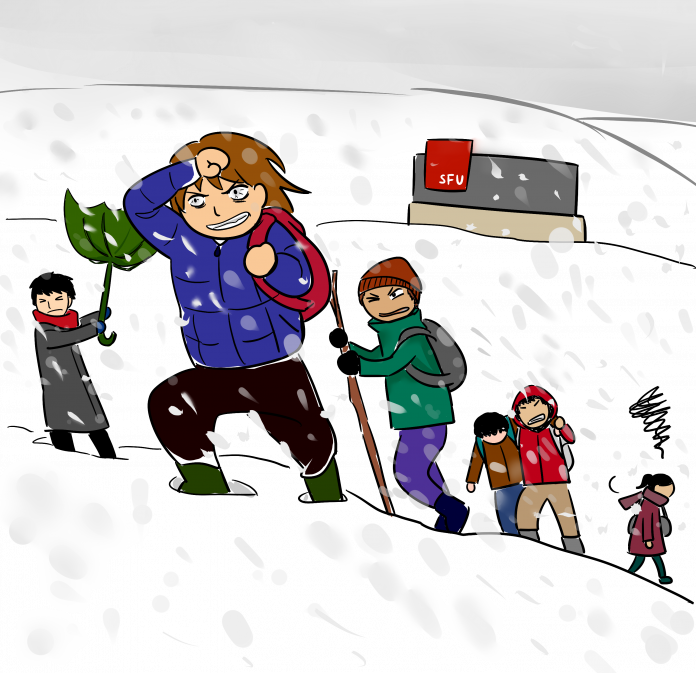
I’ve been trapped on top of Burnaby campus during snow cancellations on two separate occasions. Both times, I’d woken up nonsensically early to beat the transit crowds and weather in case class was on, because I felt behind in the class and needed every lecture. After the class was cancelled part way through the day, I would inevitably see the horrendous crowd at the upper bus loop before deciding to walk down the mountain slowly and carefully, then waiting several hours for a shorter bus ride back home.

Was it painful? Absolutely, but I braved the weather because I knew from the moment I left the house that I could walk down the mountain if absolutely necessary. This was something I did out of my own necessity with a lot of caution and consideration, and no student should reasonably be expected to do something that dangerous when they attend a lecture. Many of the other students at the upper bus loop those days looked like they’d powered through because the the campus was open, as if they had no choice.

I’d urge every student to make sure you aren’t putting yourself at risk if you don’t have to.

This isn’t to say you shouldn’t be looking out for TransLink’s online updates, SFU’s social media posts, or even your SFU Mail to check if your professor’s are preemptively cancelling things. Those are important things to know. But all they really tell you is whether or not you’ll miss something, and won’t always be accurate about just how bad your journey might be. A lot of the university experience is planning for your own personal productivity, as well as your own safety, and nobody else is able to dictate what you should do in your position.

Much of the time, this does mean staying at home. But obviously there’s more to skipping a class than just not showing up. This could mean asking your peers or TA what you might have missed, doing extra reading, or dedicating time at home to your assignments to make up for missing attendance marks.

Skipping does not inherently mean you’ve lost a percentage of your tuition or education, it just means you’re reorganizing it. If you can’t get up the mountain, you should never hesitate to make a new plan.

After all, if you do have to force your way up the mountain for some unfair reason — perhaps because of an exam or assignment that the professor hasn’t delayed — there’s just as much planning you must do to ensure your safety. Starting your journey earlier, dressing warm, packing food and water, and even just charging your phone are things you’ll have to do to make sure you’re minimizing the risks. If you have the time and ability to do these things, or even to walk down the mountain if needed, that’s great, but obviously not everyone can.

Nobody can reasonably expect you to risk your time and safety if you don’t feel comfortable or confident. You just need to do what’s best and safest for you, and as a post-secondary student, you’ve got the power to make up for any lost time. If you think that there’s a factor stopping you from getting up that mountain safely, never push yourself unless you have to. Just be careful, and do whatever you have to do.

Clan win ninth game out of 10 against Seattle Pacific University

0
Sophie Swant leads the Clan with 15.3 points per game this season. (Photo courtesy of SFU Athletics)

On Thursday, February 14, the women’s basketball team hosted the Seattle Pacific University Falcons on Burnaby Mountain. It may have been snowing outside, but it was much hotter in the West Gym as Sophie Swant caught fire for a career-high 34 points to lead her team to victory.

From the tip off, it was evident that Swant was going to have a special night. She scored back-to-back triples early in the first quarter, helping the Clan get off to an early lead. By the end of the first half, she had 15 points, including three-pointers.

SFU led by a slim margin at this point, by a score of 37–34.

In the second half, however, they blew the score open behind an amazing half from Swant. She scored three three-pointers in the third quarter, two of them coming in the final minute of the frame. She stayed hot through the break, also knocking down a three in the first minute of the fourth quarter that gave the Clan a 10 point lead. She finished the second half with 19 points, including going 5–7 from behind the arc.

When it was all said and done, SFU won by a score of 82–61. Apart from Swant, point guard Tayler Drynan also had a strong game, finishing with 17 points and eight assists. Kendall Sands was the only other player in double figures for SFU, finishing with 10 points.

With the win, the Clan are 11–4 in the GNAC this season, and 15–7 overall. In their last 10 games, however, SFU is 9–1, playing some of the best basketball in the West Region right now. They sit comfortably in third place in the GNAC, behind Alaska Anchorage and Northwest Nazarene, who are both 14–1.

Player of the game: Sophie Swant

The obvious choice, Swant may have played her best game in a Clan jersey on Valentine’s Day. She finished with a career-high 34 points, and was absolutely unstoppable from behind the three-point line, going 8–13 from behind the arc. She was also tenacious on the defensive end, leading the game with six steals, and also got her teammates involved with four assists. On the season, she leads the Clan with 15.3 points per game (tied for second in the GNAC), as well as leading SFU with 2.1 steals per game.

What’s next:

The Clan will now host Saint Martin’s University on Saturday, February 16. Since it is the last home game of the season, the team and fans will be saying goodbye to the Seniors on the team for Senior Night. Come say bye to Sophie Swant and Samantha Beauchamp as they play their last basketball game on Burnaby Mountain. Tipoff is at 7 p.m.

There should be no comparison between Jordan and Brady

0
Who's the G.O.A.T? (Photo courtesy of Ben Pitcher via Science)

By: Youeal Abera

On Sunday, February 3, the New England Patriots won the 53rd SuperBowl. Consequently, the win against the Los Angeles Rams provided legendary football player Tom Brady with his sixth SuperBowl win.

Adhering to the typical post-SuperBowl celebrations, Patriot fans celebrated their teams’ big win by cheering in bars and taking to social media to brag. However, the very second that Tom Brady became the football player with the most SuperBowl rings, an interesting debate instantly erupted online.

This furious debate sought the answer to a supposedly imperative question: if Tom Brady has six SuperBowl rings and Michael Jordan has 6 NBA championship rings, who truly is the greatest athlete between the two?

The arguing opinions went back and forth on Twitter for the duration of the week after the SuperBowl, with fans of Brady and Jordan earnestly working to defend their sport idol.

One Jordan fan tweeted, “Let’s stop the Tom Brady vs Michael Jordan talk. Michael never lost to the Lions.”

In the same widespread debate, an ardent Brady fan tweeted “IT’S OFFICIAL TOM BRADY IS THE GREATEST NFL PLAYER OF ALL TIME…..EVEN BETTER THAN MICHAEL JORDAN IN GOAT TALK.”

In spite of the vehement conundrum, I found myself disinterested in the comparisons between Jordan and Brady. Yes, both players are legendary athletes who have created impeccable legacies in the world of sport. However, in my own humble and honest opinion, there is no comparison between Jordan and Brady. By looking beyond their single similarity, one can distinguish between the two sport titans by analyzing their influence.

The only striking similarity between Michael Jordan and Tom Brady is that they’ve accumulated six championship rings. Brady and the Patriots won the SuperBowl in 2002, 2004, 2005, 2015, 2017, and 2019.

Jordan helped the Chicago Bulls win the NBA championship 6 times, taking home a ring in 1991, 1992, 1993, 1996, 1997, and 1998. In addition to creating an impeccable connection with his hometown of Chicago, Michael Jordan has built himself an empire through both a pristine image in the NBA as well as an illustrious shoe brand.

It would be easy to compare the careers and accomplishments of Jordan and Brady by only viewing their championship wins. Nevertheless, it’s not only silly, but also impractical. Both players are phenomenal, but fans, in comparing and contrasting the their respective careers, seem to forget the undying impact that Jordan has made.

Jordan’s iconism peaked in the 1990’s. On top of achieving two three-peat championship wins, in this decade Jordan has fostered an athletic drive and play-style perceivable in some of today’s biggest NBA athletes. More so than any of the great players that came before him (William Bill Russell, Larry Bird, Magic Johnson), Jordan set the bar for what defines excellence in the world of basketball. When people think of Jordan’s legacy, they think of iconic moves like when he performed the legendary switch of the hands against the Lakers in the 1991 NBA finals.

Yes, Tom Brady has also displayed plays that defined excellence in football, but not to the same standard. Before Tom Brady, there was Jerry Rice, Walter Payton, and Joe Montana. Sure, Brady was able to take the Patriots to the SuperBowl more times than any other football player has done for their own team. Of course, Brady managed to present awe-inspiring plays (like when he threw a 79-yard touchdown to Deion Branch in a 2010 thanksgiving game). However, in the world of football, Brady’s plays don’t outshine the playstyle of all the legendary football players that came before him. Additionally, Brady’s individual highlights don’t define the bar of excellence within the NFL.

Although Michael Jordan hasn’t set foot on an NBA court in 16 years, he is still referred to as the greatest athlete by many. Disregarding a small amount of expressed frustration towards his unwillingness to speak on issues in the Black community, Michael Jordan is still widely loved and adored.

Brady, on the other hand, has faced a significant amount of criticism within his career. Perhaps the greatest backlash Brady has faced (and still receives today) comes from Deflategate, an event where Brady allegedly helped the Patriots deflate the footballs used in their American Football Conference match against the Indianapolis Colts on January 18, 2015.

Joseph Stromberg, in his article for Vox titled Tom Brady’s Deflategate scandal, explained, said that the deflation of the Patriots’ footballs during the AFC match would significantly help Brady’s performance. Stromberg stated that the deflated footballs would “be easier for Brady to grip and for the team’s running backs and receivers to catch and hold on to during the game’s rainy conditions.”  Stromberg also explained that since both teams have a different set of footballs in the match, the act of the Patriots deflating their own balls would greatly contribute towards their chances of winning.

Therefore, this cheating allegation against Brady provides a striking contrast between the football icon and Michael Jordan. Even though Michael Jordan and Tom Brady have the same amount of championship rings, Jordan has never been caught or extensively accused of cheating to win.

In the world of sports (and not just in the NBA), Michael Jordan is the original superstar. Disregarding his impressive six rings, Jordan’s playstyle and skill has fostered today’s current roster of A1 athleticism, and his career style will continue to inspire future athletes for generations to come. Therefore, if you’re going to compare a player to Michael Jordan, using the amount of championship wins as a measure of greatness is undoubtedly insufficient.

Unfriend and block your loose connections on social media

0
Photo by Gene Cole/The Peak

Written by: Gene Cole, Opinions Editor

Primary and secondary school can be socially painful. You’re growing, learning, and — most importantly — spending almost every day surrounded by peers going through the shared social experiences of school and youth. Unless you’re somehow popular with every circle, there’s always going to be problem people regularly seated with you, disrupting your day like clockwork.

So why would you make the same kind of environment on your social media?

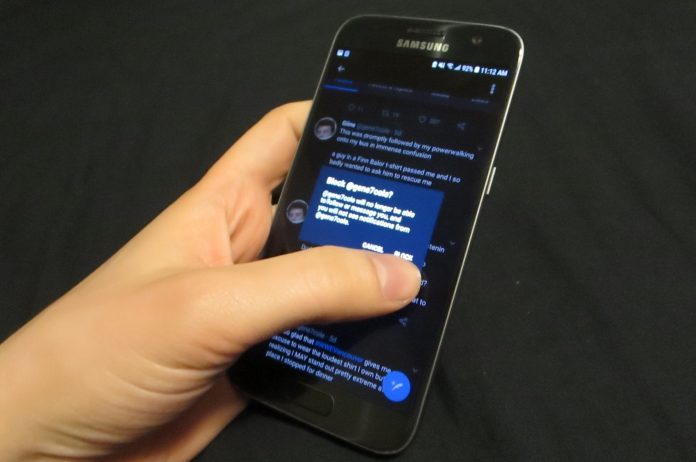
Our online world is a very personal space that a lot of people are often afraid to clean and tidy. Even though we’re spending more time with people online than in-person, there’s this taboo around unfriending or blocking people they don’t want to talk with. When people find themselves left with online “friends” who they don’t actually like, they will often just mute their posts or keep them in their timelines without thinking about it.

I get the idea that you never want to burn bridges or make someone offended by detaching from them online, but it surprises me just how quick people are to hoard followers and Facebook-friend everyone they encounter. This could be a random person at a party, a classmate from a first-year group project, someone you had a single conversation with in high school, or even just someone who left a positive comment on the photo you posted.

But these people aren’t important when you put them next to the family and close friends you open these apps to see! They take up space on apps and websites that should bring you joy, and they contribute nothing but a chunkier, more complicated timeline. Even if they post things you like to see, like interesting news articles or high tier-cat memes, there’s always somewhere better to get those things than these minor connections.

Plus, when you don’t tend to your garden of followers, it’s easy to get complacent even while those you keep around become troubling or toxic. You might be keeping people on your list to seem polite, but when they start sharing offensive jokes or unpleasant content, there should never be a question of whether to hold on to that person.

Be selective. Be picky. If you spend time on social media, you should be choosing the places and people that bring pleasure. You have the options to curate your online content, so use those features to your will! Life’s too short to spend your free time among people you have no obligations to keep up with.

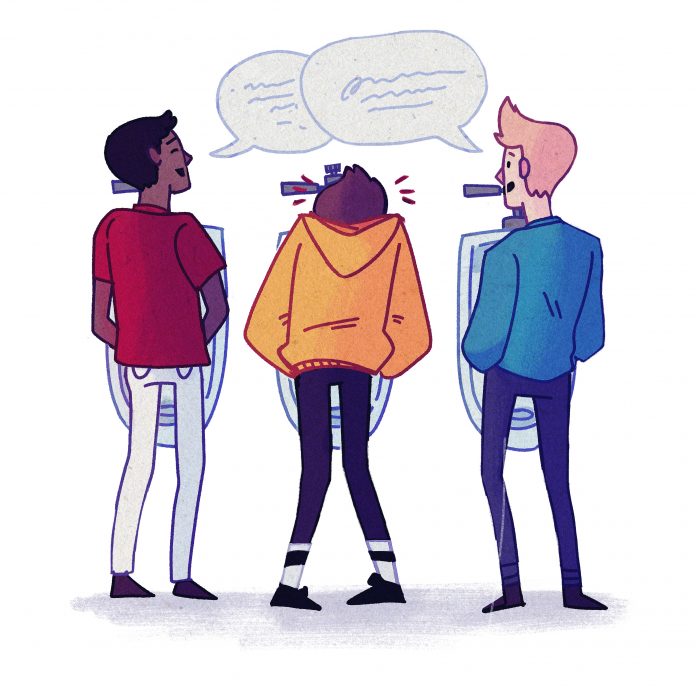
What grinds our gears: Bathroom talkers

0
Illustration by Jarielle Lim/ The Peak

Written by: Tiffany Chang, 

There is no doubt in my mind that every SFU student has experienced rush-hour traffic in the halls on campus. Seeing thousands of sleep-deprived, young adults pouring out through classroom doors isn’t anything new.

While I usually don’t have a problem weaving through the crowds, there’s one kind of crowding I absolutely cannot stand. It’s when the washrooms are just as littered with people, yet some individuals are inconsiderate enough to carry on full-fledged conversations at the sinks even after they’ve finished doing their business, blocking others who need to use them.

To clarify, I have nothing against speaking to someone while hands are being washed. If anything, it actually puts a smile on my face whenever I see friends bump into each other during a break . . . at least, when it’s a short exchange and they aren’t keeping everyone else from washing up and leaving.

If it’s a more extensive interaction, take it elsewhere, specifically when washrooms start feeling like sardine cans! There are so many places besides a wall of sinks to have a giant conversation. If someone begins a discussion in the washroom with you and you notice more people coming in, please ask or signal the other person to talk more after the two of you leave. The rest of us have places to be and hands to wash.

Scientists gather to explore cosmology and gravitational physics

0
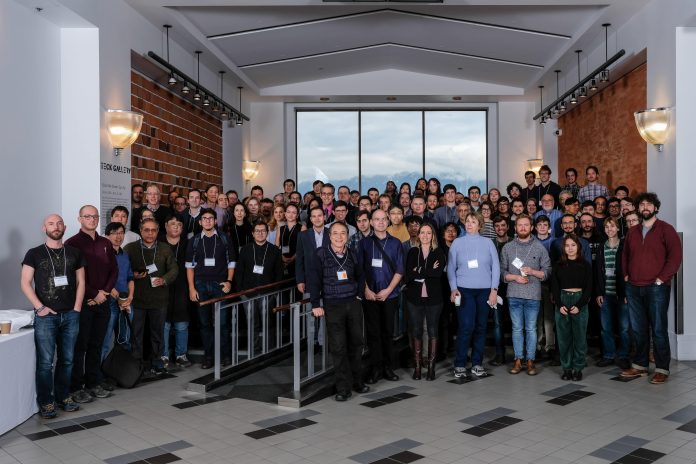
Image courtesy of Testing Gravity

By: Kitty Cheung, Staff Writer

To explore the mysteries surrounding gravity and dark matter, SFU invited cosmologists, astrophysicists and expert theorists to Testing Gravity, a biannual conference aimed at investigating the laws of gravity.

The conference was organized by SFU physics and cosmology professors, Dr. Levon Pogosian, Dr. Andrei Frolov, and PhD candidate Tomas Galvez. With its first edition taking place in 2015, this year’s conference was held from January 23–26 at SFU Harbour Centre in Vancouver, garnering participation from 120 students and scholars from 16 countries.

“We wanted to encourage conversation between separate scientific communities working on topics related to gravity. For example, cosmologists work on gravity to explain the evolution of the universe, while another group would focus on studying black holes, and a third group would test laws of gravity in the lab to check [if] there are extra dimensions of space,” said Pogosian in an email interview with The Peak.

Traditionally, there hasn’t been much exchange between these communities and it has become apparent to us that they would benefit greatly if they regularly met and exchanged notes.”

This four-day event consisted of a “school” of review lectures presented by speakers on key conference topics, around 70 different talks, and a poster session. Featured updates included findings on how to test gravity with gravitational wave detectors, such as the Laser Interferometer Gravitational-Wave Observatory, which announced the discovery of gravitational waves radiating from colliding black holes in 2016, as well as the Event Horizon Telescope, which is used to study the black hole in the Milky Way. Updates were also announced from the Dark Energy Survey, a project to observe supernovae and map hundreds of millions of galaxies.

Galvez, having assisted in the organization of the conference for the past three editions, found that “As a current graduate student . . . the opportunity of interacting with the main players of our field allows us to know about what are the ongoing challenges and open questions in cosmology and strong gravity.” The attendance of graduate and undergraduate students both from SFU and internationally allowed for discussions with “world-class scientists . . . in a welcoming environment,” he further commented.

When speaking of the importance of sharing ideas within the academic community, Pogosian stated, “[Often] people tried solving these problems [in understanding gravity] in isolation, one at a time. But it is possible, and maybe even likely, that these puzzles are connected and a single idea could help us solve several of them at once … [Testing Gravity] stimulates discussions across a broad range of ideas and encourages the community to think ‘out of the box’.”

It’s extremely rewarding to see all [of these] brilliant people come from around the world to meet at SFU, and have a great time talking to each other about their latest work,” Pogosian continued. “It’s rewarding to see a lot of students, both from SFU and outside, getting exposed to this and seeing first hand how progress in science is made.”

Testing Gravity was held with support from the Pacific Institute for the Mathematical Sciences, TRIUMF, the Perimeter Institute for Theoretical Physics, the Canadian Institute for Theoretical Astrophysics, and the Canadian Institute of Particle Physics.

The fourth Testing Gravity conference is planned for January 2021. “Our formula is simple — invite the best people from around the world, provide them with some coffee and opportunity to talk to each other, and they will have a great time doing science together. That’s how it [has] worked so far,” Pogosian concluded.