Home Blog Page 546

Reading break adventures

0
View of Stawamus Chief Provincial Park (Photo courtesy of Husam Mohammed)

By: Sakina Nazarali

Things to do during reading break:

1) A Riverdale day tour – For all of you Riverdale fans, I got you!

Riverdale fans, you know the franchise in and out. However, you might have felt the feeling of “I have been there” while watching. Seeing a celebrity off-screen and then seeing them on-screen is always weird, and this is your chance to visit places your favorite Riverdale celebrities shoot at.

The best part? You can use transit to get to all of these places. You can follow Narcity’s Riverdale Guide to Vancouver to visit Riverdale High School (Point Grey Secondary), Archie’s House, the Pembrooke, Pop’s Chock’lit Shoppe (Rocko’s family Diner), and more.

2) Rosewood Hotel Georgia – Everyone needs a little “me time,” which is why Rosewood Hotel Georgia is the perfect staycation, right in downtown Vancouver. This might be a little heavy on the financial side, but assuming that you will be headed there during reading week (hopefully without your books), you might get better prices.

Daily Hive reviewers write that the hotel’s retro-chic vibe lets you submerge into an atmosphere of luxury, one that you can treasure temporarily but cherish forever. Whilst at it, make sure to enjoy some fine dining at Hawksworth restaurant. Besides, they also offer an amazing boutique-style spa, and beautiful sweet treats at Bel Café.

3) Find yourself a bargain airline – While flying has been costly in the past, ultra-low cost airlines like Swoop allow passengers to fly across Canada and even Mexico and the US for as low as $40. The best deal during the reading break (at the time of writing this piece) would be an unbeatable $37 round-trip from Abbotsford, B.C. to Edmonton, AB.

4) Stawamus Chief Provincial Park, Squamish – Can you deny the beauty of a spectacular view from the top of a mountain? Well, head to the Chief Towers above the town of Squamish. This is a popular hiking destination but, heads up, if you aren’t the enthusiastic type, this six-hour hike probably isn’t for you. Take advantage of being in Squamish by also adding the sea-to-sky gondola on your to-do list.

5) Steveston Village – This is for you students who would like to spend reading break studying more, with a moderate amount of time allocated to leisure. If the option of going for a hike and visiting a river doesn’t amuse you, this beautiful village tucked in Richmond might. 15 minutes away from the Canada Line, this location is easily accessible through public transport. Spend your day strolling through the village for retail shops, cafes, crafts and thrift stores.

Additionally, if history amuses you, visit the Gulf of Georgia Cannery. The Britannia Heritage Shipyards National Historic Sites also encourages the audience to view how life was like for workers at the peak of business in Steveston. A 10-minute walk away from Steveston Village would bring you to Seabreeze Adventures, which assures customers whale sightings the majority of the times.

6) Bowen IslandGetting to Bowen Island is a 20-minute ferry ride from Horseshoe Bay to Snug Cove after which, you can either take your car or walk on to the island. At Bowen Island, take a break from the strains of daily life by having a yoga retreat in a geodesic dome at Nectar Yoga BNB. And how could you say no to kayaking? You can hit the ocean by renting single and double kayaks right off the marina at Bowen Island Sea Kayaking and enjoy the beautiful mountain scenery. Last but not least, fill up on treats at Branch & Butter. This guide on “5 breathtaking things do on Bowel Islandhas other ideas for you too!

7) Othello tunnels – If you’re looking for a fairly short road-trip with your friends and family, consider Coquihalla Canyon Provincial Park, where you will see the Othello Tunnels. A two-hour drive away from Vancouver, the short but scenic trail (3.5-km) at this park is one that is worth it.

In the 1900s, the Othello tunnels served as a railway which was built by cutting a 300-foot-deep channel in granite; a project part of the Canadian Pacific Railway’s construction. The park goes beyond just the tunnels, with a very appealing scenic view, which is what you might just need for a break from the hustle and bustle of life.

8) A day out just for yourself – Who says you have to go for a hike or a hotel or to a waterfall or a lake to enjoy your day? Take time to go places you have been craving to go to within Vancouver but never got the chance to. Here are a few places I would love to go to, and maybe you would too:

  • Breka Bakery and Café
  • FlyOver Canada
  • The Museum of Anthropology at UBC
  • The Vancouver Aquarium
  • Try a type of cuisine you have never tried before
  • Ride a bike at Stanley Park
  • Visit the Vancouver Lookout
  • Have an ice cream at La Casa Gelato or Earnest Ice Cream.

Overall: just make sure to take care of yourself during reading break!
Simon Fraser Public Interest Research Group hosts town hall about space in Student Union Building

0

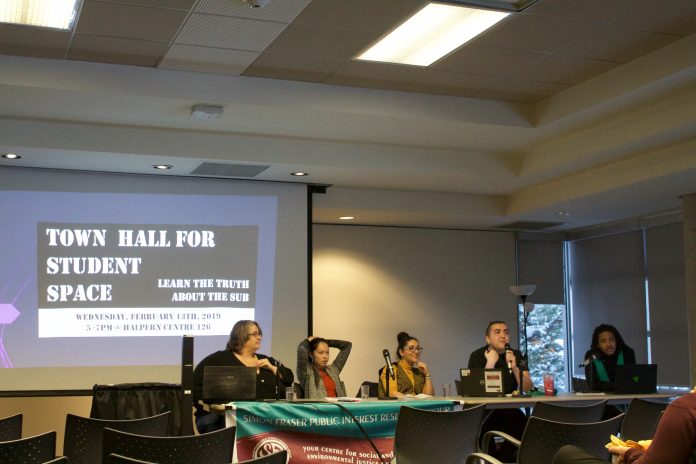
On Thursday, February 13, the Simon Fraser Public Interest Research Group (SFPIRG) held a town hall to discuss space allocation in the new Student Union Building (SUB).

In addition to providing an in-depth overview and background on the situation, the event involved discussion from four panelists, including a previous SFSS board member who was present during the early stages of the SUB decision-making process.

Kalamity Hildebrandt, director of education and research at SFPIRG, started by providing some context about the issue, explaining that SFPIRG’s main concern is that the SFSS is treating “all possible interest in SUB space as being exactly the same [ . . . ] all of this we were told is in the interest of fairness.”

Hildebrandt noted the distinction between equity and equality. “This is not a world in which everybody’s needs are the same [ . . . ] we’re going to want to look not just at treating everybody the same [sic] we’re going to actually be wanting to strive for equitable outcomes for people.”

The first panelist to speak after this was Maisaloon Al-Ashkar, an SFU alum who has been involved with SFPIRG over the last four years as a volunteer and later as a board member.

She explained that although their early communication with the SFSS implied that SFPIRG would be housed in the SUB, “In more recent years it has become very clear how uncooperative and manipulative the SFSS has been in terms of the tactics that they are using to divide communities, to divide groups, and to deny people [sic] access and resources into the SUB.”

She emphasized connecting these struggles to “greater struggles around displacement, around colonial violence, around racialized violence.”

Giovanni Hosang, SFU student and President of SFU Students of Caribbean and African Ancestry (SOCA) spoke next. He talked about how he found a home with SOCA, which is one of the Rotunda groups that has not been granted space in the SUB.

In terms of the SFSS’s approved shared-space model for the SUB, Hosang notes that “I don’t know who in their right minds would come up with such a model [ . . . ] this doesn’t work for anybody.”

The next panelist was Kathleen Yang, former SFSS VP External Relations during 2015–16 term — a term Yang referred to as “the year the board secured an 85% vote in favor of obtaining a $60 million dollar loan for the purpose of constructing a student union building.” According to her bio, she also served on the Build SFU working group and was, for a while, part of the sublease negotiations with SFPIRG.

“As you can all tell, the SFSS is kind of a hot mess, and it’s always been a hot mess, so [sic] not much has changed,” Yang began. She later noted that “everyone who has been in the SFSS knows that for a fact so I don’t think it’s wrong for me to make that statement.”

She explained that her board in the year of 2015-16 did not prioritize figuring out space allocation for the reason that they were not sure if they could even build the SUB at the time, as they had yet to apply for bank loans.

Yang expressed her appreciation for the Rotunda groups, noting that “I learned so much about community organizing and myself and my interests through the Rotunda [ . . . ] it taught me so much and I would have never been elected without the support of the Rotunda groups.”

In regard to the decision of space allocation, Yang said “I think it was purposely left ambiguous [ . . . ] which groups were going to be allocated rooms [sic] because as soon as we would say, ‘this group is for sure not getting a space,’ obviously they would be against the Student Union Building.”

Yang is not surprised that the issue has come to this, “just because of the fact that it was put off for so long.”

In speaking about the SFSS, Yang noted that “it’s a very adversarial place.”

The last panelist was Steven Hall, a current SFU student and former Langara student. Hall experienced a similar situation previously at Langara, where the LGBTQ+ space was taken away.

Although Hall described having a home on campus that was strictly within the urban Aboriginal spaces at Langara, Hall mentioned having friends who were engaged in the Langara LGBTQ+ spaces who were deeply affected by the closure.

“To see how it affected the people that I love was quite scary [ . . . ] it was truly a lost and helpless situation.”

After describing this experience at Langara, Hall concluded “I’m very much against a shared-space model. I think it’s not supportive of our history, it doesn’t acknowledge [sic] the ancestors of our university.”


Join the Club: Muslim Student Association

0
Image courtesy of the Muslim Student Association's blogspot

By: Mishaa Khan 

The Muslim Student Association (MSA) is a club at SFU which aims to provide Muslims with a voice, a place to pray, resources, and a sense of community.  The MSA was created in the early 1970s, and it’s one of the oldest clubs at SFU.

Even though the club attracts primarily Muslims, its activities give all SFU students a chance to learn more about the religion of Islam, interact with Muslims, affirm or debunk any passing information about Islam they might have heard from third parties, and have a good time. SFU needs the MSA because the current political climate, which has become increasingly hostile for people who identify as Muslims since 9/11, has resulted in an immense number of misconceptions surrounding Islam and a lot of backlash for Muslims.

In an email interview, MSA president Ahmed Khan talked about how he has faced Islamophobia on campus, and recounted one encounter where other students “stated vile remarks which I took offense to, which left me feeling bitter afterward. But this is why we speak openly about Islam so people can dispel their misconceptions about the faith.”

Despite the accepting atmosphere towards people of all backgrounds in the Lower Mainland, there have been occasions where Muslims have been mistreated. For example, when Noor Fadel was assaulted in a SkyTrain station in 2018, only one man came to her aid. Other cases across North America include the Quebec mosque shooting, another mosque bombing in Minnesota, and another shooting in Chapel Hill where the aggressor entered the homes of his neighbors and shot them.

Being brought up in a predominantly Muslim country, I felt lost when I arrived in Canada in the fall of 2017, and I ended up joining the MSA in January 2018. Now, I am a club executive.

Since joining, MSA has provided me with a sense of community that I was lacking, and a place where I could share my struggles and learn how to navigate them with advice from other MSA members, like where I could buy halal food or new hijabs. I was able to celebrate important religious events like Eid and Ramadan with the other members, making my homesickness a little less painful. It has also helped me stay grounded in my faith at a time where Islam is constantly critiqued and when I get weird stares from strangers whenever I’m out and about.

Since SFU has a large international community, it is important for Muslims who are away from home to be able to find a sense of community here. It is also even more important for international students who may have never heard of Islam or have heard of it only in a negative light to get a chance to learn more to prevent misunderstandings and create a place of peace and understanding.

To dispel misconceptions surrounding Islam, the MSA hosted United Islam Awareness Week (UIAW) from January 21–25. Club executives invited four prominent Muslim North American speakers to speak about Islam in public lectures, on one evening from Tuesday to Friday. There was also a booth in the North AQ which operated from 10 a.m.–4:30 p.m. everyday with resources about Islam, Islamic trivia, henna, free snacks, tea, and friendly volunteers who were present to talk about Islam. As a club executive who was present, I thought that the event turned out be a great success, with the last lecture having around 150 attendees.

“Personally, I had an amazing experience,” Khan wrote. “It was truly one of the greatest experiences of my life.”

He also saw the impact that UIAW had on other students. He recounted that an individual converted to Islam after one of the lectures, and another individual became more confident about his faith once a question that had been concerning him for over a year was answered by U.K. speaker Hamza Tzortzis.

Saiyora Imamkulova, a first-time volunteer with the MSA, expressed that taking part in the event gave her the opportunity to strengthen her relationship with Allah (the Arabic word Muslims use for God). Her experience with UIAW made her want to be more involved in the Muslim community and she has now decided to volunteer with other events that the MSA holds.

“I believe it is a good platform for students to practice their religion Islam and stay connected to it, as MSA has and offers a variety of events, lectures and gatherings for students to enrich their knowledge on Islam and outside of it as well,” she wrote in an email interview.

While UIAW was a one-time mega event, MSA runs other events. One regular event is Sister’s Speak, which is all about empowering Muslim women by bringing in role models from the local community to present a certain topic, facilitate a workshop, and create a sense of community. In previous sessions, they have ranged from being informative lecture-style topics, such as hearing about a PhD student’s work on Bangladeshi sweatshops, finding a work-life-school balance, or sharing biographies of some of the greatest women in Islam. Others have been more social-oriented, intended for Muslim women to come together and find fun company with each other, through activities like henna and learning how to decorate cupcakes.  

If you’re more interested in learning about Muslim individuals from the past, Knowledge Circle is the event for you! It is a series of lectures where Muslim intellectuals are covered, such as the four greatest imaams in Sunni Muslim history. On February 28, the MSA will be discussing Malcolm X.  

While there are many other events, one big event that only happens once a year is called Ramadan iftaars. Ramadan is a month in the Islamic calendar where Muslims fast from before dawn to dusk, and the meal during which they have to break their fast at dusk is called iftaar. Multiple MSA volunteers get together after their fast to clean the area, get food ready for everyone, and welcome all the attendees. This event has also seen a significant amount of non-Muslim attendees who want to celebrate the breaking of the fast with Muslims, learn more about Ramadan, or just want to hang out and socialize!

Additionally, one of the pillars of Islam is praying five times a day, and this can be difficult to do when you’re out and about. Fortunately, the MSA provides Muslims with a prayer area that is found in the Interfaith Centre (AQ 3200). There, Muslims can perform wudhu (a mandatory washing of hands, feet, arms and face before performing prayers), a place to pray and a set of prayer mats, hijabs, and Qur’ans that people can borrow.

They also have weekly Jumu’ah prayers (Friday congregational prayers). These prayers currently start at 1 p.m. (the time changes with the seasons) where an individual will give a khutbah, a reminder or lecture about different aspects of Islam. The khutbah can include topics like giving to charity, controlling your speech, the importance of remembering Alla Prophetic stories, etc. The khutbah is then followed by the prayer. There have been several occasions where non-Muslims have attended the Friday congregational prayer to see what it is like.

Currently, the organization is also working with the BCIT MSA to create a page called Muslims on Campus, similar to Humans of New York. The goal of the page is to showcase Muslims on campus by sharing their stories in hopes to breakdown the stigma surrounding Muslims in the lower mainland and across the world.

Whenever you enter any SFU MSA event, you will hear people saying an Islamic greeting asalam alaikaum (may peace be upon you), with smiles to whoever that enters. I believe that that in itself is enough of an indicator that you will encounter friendly Muslims at the event who will welcome you with open arms (and maybe some food too).

If you want to get in touch, the MSA can be reached at the following links:

  • sfumsa.ca
  • Email: [email protected]
  • Facebook: facebook/com/sfumsa
  • Instagram: @sfu_msa
  • Twitter: @sfu_msa


Sexy, thrilling, and hilarious, The Favourite is a one-of-a-kind period drama

0
Emma Stone and Olivia Colman in the film THE FAVOURITE. Photo by Yorgos Lanthimos. © 2018 Twentieth Century Fox Film Corporation All Rights Reserved

By: Kate Olivares


Warning: this review contains mild spoilers for the film!

In true Yorgos Lanthimos style, The Favourite is batshit crazy. As he also directed The Lobster and The Killing of a Sacred Deer two films that fuel my nightmares to this day I was very pleased to see him take on a period piece. With the general constraints this well-trodden genre entails, his frenzied madness in The Favourite was restrained in favour of some plot and character development.

This film centres around Sarah Churchill (Rachel Weisz) and Abigail Masham (Emma Stone) fighting to be Queen Anne’s (Olivia Colman) closest confidante and top courtier. Each with distinct and coherent motivation, they deceive, manipulate, and seduce their way to getting what they want (whatever that may be).

In a film with three protagonists, The Favourite does an excellent job with balancing each perspective, letting these characters engage in rambunctious power-plays while keeping the audience in suspense. The movie deals with lust, greed, pain, and the best unexpected dance sequence since Ex Machina.

The techniques it uses to convey its themes are superb. The cinematography is lush and innovative, effectively using a fisheye lens to illustrate the distorted world of the Queen’s court and highlight the audience’s position as flies on the wall throughout the story. The set design of Queen Anne’s castle is both divine and creepy, emphasizing the duality of the grandeur the court tries to maintain and the twisted reality unfolding behind closed doors.

Most importantly, however, the performances make the intricate tonal balance of the film come together spectacularly. What a wonderful experience it is to be able to watch women do what they want to do.

That being said, there are some exciting elements of the story that I really hoped the film explored more, namely: sex. It introduced sex as a fascinating tool to exchange power, freedom, and defiance against the stifling society of 18th-century royalty. Comparing Lanthimos’s past films, he seems completely fine with showing a dead dog on frame for 10 seconds or an uncut scene depicting graphic murder, but when it comes to adult women having consensual sex with each other, the camera pans away.

Period pieces have long been a part of the prestige indies and Academy Awards conversation. The Favourite includes all of this genre’s usual traits: English war, monarchy, and political upheaval. However, Lanthimos adds absurdity, a refreshingly fast pace, and most exciting of all, three female characters at the lead each one vivacious, bold, and distinct. Not only does this pass the Bechdel test, expanding female representation in film, but when was the last time a period piece was this fun?

The Favourite is currently showing in limited theatres around the Lower Mainland.

Staying In: Final Space

0
Image courtesy of Netflix

By: Marco Ovies


Best for: Rick and Morty fans, sci-fi fanatics, heartfelt comedy lovers


If you’re looking for your next animated comedy, look no further than Final Space. The cartoon follows Gary, an astronaut who is a prisoner aboard the Galaxy One. He comes across Mooncake, a cute green alien, who he promises to keep safe . . . but unbeknownst to Gary, Mooncake is actually a planet destroyer. Together, they go on numerous adventures to figure out the mystery that is “Final Space.”

The show starts as a goofy nonsensical space adventure that is funnier than anything else. But give it a few episodes, and what audiences will find so great about the show is that it constantly plays with comedic moments that are followed by tear-jerking scenes. This makes Final Space surprisingly heartfelt, and has viewers care deeply for the characters. But the animation style by itself looks gorgeous, too: the planet and stars in black-light colors really make the cartoon visually stunning.

At face value, Final Space appears to be a goofy comedy, but behind that mask is a remarkably deep and challenging series. This cartoon goes much further than most animated shows, having Final Space be a great example that animation can be more than just a platform for children’s television.  


Opinions of the Hour

0

Written by: Encina Roh, SFU Student

“Mind your language, professors” – Liang Chenglu, China Daily

Liang’s article is a sobering critique of Megan Neely, an assistant professor at Duke University, who sent an email regarding international students having conversations in Chinese. In the email, Neely called these students “unprofessional” and “impolite.” The email quickly went viral on social media, leading to Neely resigning from her position as the director of graduate studies in response to the outrage.

Liang’s article talks about the uncomfortable implications of Neely using her position of power to “coerce” international students into speaking English, and her implied intent to eliminate the familiarity that international students have with their native language in a foreign country. She follows that it would be vastly discriminatory if internships and research positions were indeed given based on Neely’s absurd value of using exclusively English in private conversations. After all, these foreign students would not have been enrolled at Duke had their English skills been deemed insufficient in work and school.

Liang calls out Neely’s email as a deplorable example of the subtle yet ongoing discrimination against Asians in the West that hides under a cruel guise of well-meaning advice. For Duke to uphold their identity as an “elite university,” they’re right to be discouraging this sort of behaviour in their professors, and they have to protect student diversity and inclusivity through their language.

SFU researchers discover a way to combat HIV mutation

0

In November 2018, Simon Fraser University researchers along with a group of South African academics from the University of Kwa-Zulu Natal published a study that revealed how certain HIV-positive individuals possess immune cells that enable them to control their HIV viral load. This research provides further clues in the quest for developing an HIV vaccine, which is an epidemic that affects millions worldwide. The team plans to use their results to conduct future experiments that could lead to a more comprehensive understanding of a T-cell response associated with HIV.   

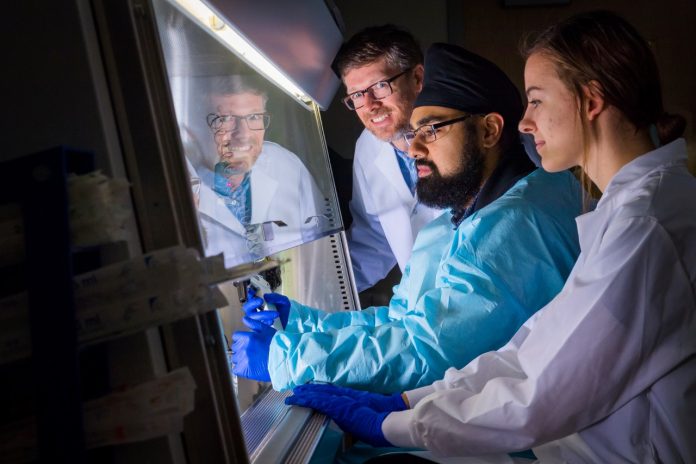
The study, Dual HLA B*42 and B*81-reactive T cells receptors recognize more diverse HIV-1 Gag escape variants, was conducted from 2017–18, and the methods used in the study took approximately six years to establish, according to Gursev Anmole, a PhD candidate in molecular biology and biochemistry and one of the lead authors of the study.

In an email interview with The Peak, Anmole explained that the human immune system has immune cells called CD8+ T cells, also known as “killer T-cells.” Killer T-cells recognize virus particles (antigens) presented on virus-infected cells. Because of this unique ability, the CD8+ T cells are critical in destroying virus-infected cells.

When HIV infects a host cell, it expresses antigens on its cell surface via the human leukocyte antigen (HLA) protein, said Anmole. Killer T-cells have a receptor called the T-cell receptor (TCR) which identifies cells displaying the HLA protein. The killer T-cells destroy these cells to stop them from further damaging their host.

Uniquely, Anmole says, the HIV virus can mutate rapidly, which lets it evade this defensive mechanism to keep reproducing copies of itself and infecting nearby cells. However, some HIV-positive individuals possess CD8+ T cells that can still recognize and destroy these mutated HIV variants, keeping the concentration of HIV in their blood at a low amount.

“This recognition of mutated HIV variants by killer T-cells is made possible by “cross-reactive” TCR that can recognize mutated forms of an HIV antigen,” explained Anmole.

“Identifying and studying the characteristics of HIV-specific TCR in individuals that show HIV control can therefore help us identify mechanisms behind TCR-mediated HIV control, which in turn can be used to better design HIV vaccines and therapeutics,” he further added.

According to Anmole, the study analyzed two highly similar HLA proteins, HLA-B*81 and B*42. Both respond to the same HIV antigen, TL9.

Dr. Mark Brockman, who is an SFU health sciences professor and senior author of the study explained to SFU News that, “A person’s T cell “repertoire” is made up of a possible 20-100 million unique lineages of cells . . . To reduce the complexity of [this] study, the team examined [these two HLA variants].”

Anmole also noted that: “Since these HLAs are similar and the antigen they present is identical, [any] difference in HIV control between these groups may be [due to the fact that] B*81 individuals may have cross-reactive TCR able to recognize HIV escape variants while B*42 individuals may not.”

The researchers confirmed that individuals with B*81 could control their viral load much better than B*42-expressing individuals because they had cross-reactive TCR that were more sensitive to HIV variants, according to Anmole. This study demonstrated that some HIV-specific TCR recognize HIV escape variants better than others and that there may be a clinical benefit of possessing cross-reactive TCR, he further added.

When asked about the obstacles the team faced while conducting this study, Anmole shared: “Research is full of challenges as we are discovering new ideas . . . There were many challenges along the way, from complex assay design to late nights in the lab when things did not work and 7 a.m. Skype calls with our collaborators in Durban, South Africa!”

Anmole concluded the interview by saying the Brockman team will use the results from this experiment to conduct future experiments that include individuals with different HLA proteins who recognize different HIV antigens. This will lead to a more comprehensive understanding of a T-cell response associated with HIV control across a larger population.

With files from SFU News

Foolproof ways to cheat on your midterms!

0
Photo courtesy of Flickr

By: Alannah Wallace, Peak Associate

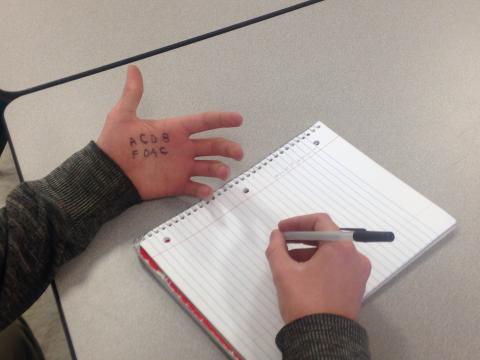
University is hard. Why put in the time studying when you PAY to be here. Don’t worry, I have done some research and found a few foolproof ways for you to cheat on those pesky exams.

Friendship
If you can plan at least one semester ahead, find out who TAs the hardest course you will be taking. Discover where they reside and “accidentally” bump into them. From there, infiltrate their life. Become their best friend.
Then, you’re going to need to hire an actor. One day, while you two are walking along the street, the actor will run up to your TA, point a gun at them, and demand that they hand over their wallet. Cue fake battle in the middle of the street. Roundhouse kick the (toy) gun out of the robber’s hands. The gun will spin through the air and land in your hand. “Not today buddy, back off of my best friend, or else!” The robber flees the scene, and you are left as the hero.
Another actor you have hired who has been observing the scene exclaims to your TA, “Wow, that was amazing! You owe them your life!” Your TA is so thankful that they don’t even open your exam on test day. Instead, they write A+ in large letters on the front of your test.

Composter
Plant scrap pieces of kitchen waste around the exam room. On the bottom side of these vegetable peels, write down any information you need to remember. Get up to ask if you can go to the bathroom during the exam and on your way, pick up a piece of garbage. Make a facial expression that says, “Why is this here, I guess I will slightly inspect this object and then throw it out!” while getting a good glance at the information. The best part is, the scraps will biodegrade naturally, ensuring you won’t get caught.

Bionic Bee+
Alright, this one gets a bit techy, so listen up. You’ll train a bee to fly around the exam room and look at exams for you while wearing a microscopic GoPro. You will need to hook up the GoPro to a pair of glasses that you will wear. When you tap a button on the glasses, you can see what the GoPro is filming inside your lenses.
While you are writing the exam, release the bee. As the bee examines the tests of your peers, keep note of their answers by watching the screen on your lenses. You may want to take a Gravol in advance; the footage will be a bit shaky!

Black Mirror in the AQ
Clone yourself and teach your clone to care about studying. (That will be the hardest part) The cloning process is simple enough: take a cell from anywhere on the body, separate out the nucleus, place it within an egg that has had its own DNA removed, find a surrogate, and voila! The technology on how to do this is not fully developed, and the internet says it may take hundreds of failed surrogates, pregnancies, and births to make it happen, but it’s better than studying!

Once you have your clone, make sure you keep them hidden so no one will suspect a thing when you send them out into the real world as yourself. While they are being hidden for months and years at a time, give them books and cognitive training games. Feed them mounds of vegetables and other super foods and play them only classical music. You will create such a genius that your course material will be no problem for them.
Dress them up in your clothes and drop them off at your exam while you head off to the mountains for a ski day. Just make sure they don’t talk too much to anyone; apparently, clones are always a bit “off.”


Sex Education breaks through the taboo around teenage sex but falls to overplayed clichés

0
Image courtesy of Netflix

 By: Yelin Gemma Lee


Sex Education is a nitty-gritty, in-depth exploration of high schoolers’ sex lives, fully loaded with awkwardness, charming characters, and physical comedy.

The new British Netflix show follows Otis, a sexually inexperienced outcast in school whose mom is a sex therapist. He teams up with the school’s notorious bad girl, Maeve, to give sex advice to other students at the school — whether it’s on getting a better shag, destigmatizing females wanking, or helping couples learn about communication. While their scheme starts with motives to find social liberation and get some cash, the two underground business partners become unlikely friends.

The show is remarkably unique from any other show revolving around sex comedy. Sex Education is centred around teenage sex lives, but it approaches the taboo topic with such openness and lack of filter.  It discusses fetish, masturbation, abortion, queer sex, etc. Through Otis’ personal development and the advice he gives, the show conveys the importance of communication, connection, and consent — in sex and overall in life.

Although the show deserves high praise, and it will likely go down as a Gen. Z iconic show, it was full of classic high school comedy clichés that I was disappointed to find in an otherwise brilliant show. The mean teacher/headmaster. The flamboyant gay best friend who gets bullied by a dumb mean jock. Of course Maeve, the hot bad girl of the school who is actually whip smart and has heartbreaking family issues that make her outwardly cold. And of course the main protagonist, an awkward lanky outsider, is absolutely in love with a girl that the show presents as someone that is way out of his league.

If these stereotypes sound familiar to you, it’s probably because you saw them in every teenage coming-of-age indie movie and YA book ever.

Aside from that, the show’s attentiveness to character quirks and details are unique and clever as hell, and the actual premise of the show being based around healthy conversations about sex (finally!) is daring and powerful. If this show was so set on breaking barriers and looking good while doing it, why didn’t they go all in and throw stereotypes and clichés out the window? What about a queer-as-hell protagonist? A happy ending for the suppressed gay son of the headmaster?

Netflix announced that Sex Education is renewed for a second season, so here’s hoping that they go big instead of going home. Sex Education is progressive, inclusive, fearless, funny, and charming, but if they can be all that, they have the potential to be even better in season two by throwing in some plot twists to put it off it’s current predictable course.


Seth Rogen and Evan Goldberg bring their voices to The Vogue

1
To top off the evening, Rogen and Goldberg brought in Canadian Mounties to feed Timbits to audience members

By: Youeal Abera


Seth Rogen and Evan Goldberg are some of the funniest people to ever break out of Vancouver, and this was further proven on the evening of February 15 at the Vogue Theatre. As a part of Just For Laugh’s Northwest Comedy Festival, Rogen and Goldberg held an event where fans were treated to an intimate evening with the stars through a facilitated Q&A session.

Audience members asked questions about their well-established filmography, and many were directed towards the iconic, coming-of-age film Superbad. In addition, fans asked questions about their personal lives, with one fan having the audacity to ask how the stars each lost their virginity.

During the event I was reminded that Rogen and Goldberg’s personability has helped them maintain their considerable success. Fans were presented with the amazing opportunity to seek advice from Rogen and Goldberg about the world of film and production. Luckily, I was able to ask the duo about any insight they could provide to young writers and actors aspiring to make their marks in the industry. Rogen and Goldberg were nothing short of funny and genuine, adhering to their well-established reputations.  

Those present at the Vogue Theatre were also treated to a number of  exclusive sneak-peaks of the upcoming productions Rogen and Goldberg are soon releasing. Perhaps the most exciting revelation was a scene from the upcoming film, Long Shot, a story that follows the hilarious misadventures of a vehemently bold journalist (played by Rogen). Although I’m not permitted to reveal the contents of the scene, I would be remiss in not stating how emphatically brilliant the writing was in the film’s short clip.

Rogen and Goldberg even provided glimpses into the early drafts of some of their most famous productions. Towards the middle of the evening’s event, the stars shared an earlier version of their rated-R animated film, Sausage Party. Although the film has become infamous for its extremely raunchy essence, the deleted scene that Rogen and Goldberg revealed was perhaps a bit too grotesque . . . even for a film called Sausage Party. I think it’s best to describe the deleted scene as shockingly repulsive.

At the end of the evening, I looked around the Vogue Theatre and perceived how fans lovingly clapped and cheered for Rogen and Goldberg. Consequently, I came to fully realize just how much the comedic legends  have made the city of Vancouver proud. Rogen and Goldberg may have gained legions of admirers around the world, but their most ardent fans still remain in Vancouver, the city they once called home.