Home Blog Page 507

SFU’s decision to phase out single-use plastics is a good one

0
SFU is among the many institutions pledging to eliminate plastic straws, among other plastics. Photo: Agency France-Presse

By: Naaz Sekhon, SFU Student

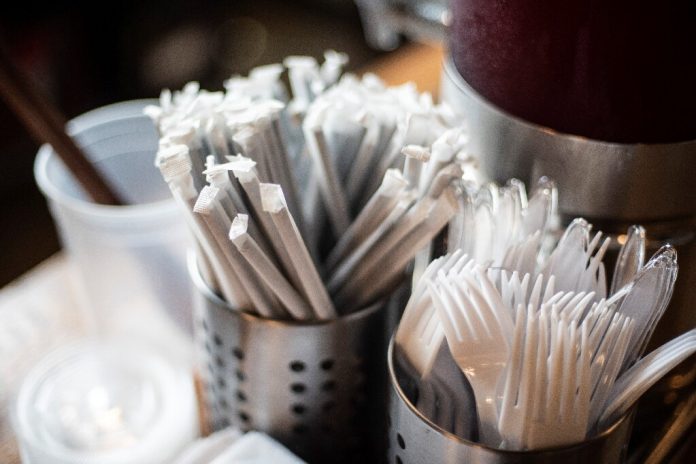
This September, SFU is acting in support of a ban on plastic straws. Led by a task force including the Simon Fraser Student Society (SFSS), the university is set to eliminate single-use plastics from its campuses. Their action plan includes two phases: Phase 1 (starting this September) involves removing plastic straws and replacing plastic utensils with metal ones; Phase 2, which is scheduled for 2020, addresses single-use beverage cups, plastic bottles, and coffee pods. SFU’s action plan is notable as it not only includes a plan to reduce plastic waste, but it also has a plan for implementing programs to reduce container waste at Mackenzie Café. 

Importantly, SFU will still take into account people with disabilities — bendable plastic straws will still be available if required for accessibility.

As a student, I fully support SFU’s decision to reduce single-use plastics. It makes me happy to know that I attend a university where meaningful actions are being taken to help save the environment. Knowing that SFU considers people with disabilities further demonstrates that their plan is considerate of everyones’ unique situations. Their decision to be more sustainable sends a great message that shows dedication to climate crisis changes. 

Although banning plastic straws may seem like a minuscule step to resolving the current climate crisis, the benefits are impactful when examined on a larger scale. In Canada alone over 3 million tonnes of difficult to recycle, single-use plastics are thrown away annually. This translates to millions of injured or dying wildlife through ingestion or entanglement when these plastics inevitably end up in our waterways. By reducing plastic waste, not only are we prioritizing animal life, but our oceans and beaches will be cleaner as well.  

The current climate situation is slowly being seen as a priority by businesses under increased pressure from climate activists. Through their activism, young people have increasingly shown that they value putting the climate first. This has resulted in companies, such as Starbucks, opting to pledge their commitment to save the environment by phasing out plastic straws. It’s gratifying to know that our university, having similar environmentally-conscious ambitions, is taking a step in the right direction in accordance with these companies.

Responsible and positive change towards addressing the state of the environment has to begin somewhere. We are currently seeing the shift from concern to action in the policies and commitments of more and more institutions and governments. Hopefully, SFU’s action plan will also promote and instil sustainable habits in the students who graduate from this university.


Keep an eye out for art you may not expect along the 95 B-Line

0
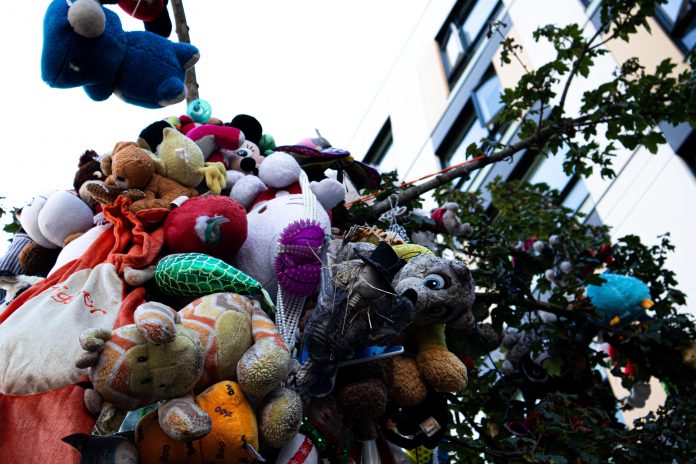
The stuffed animal tree on East Hastings is a unique public art piece. Photo: Zeh Daruwalla/The Peak.

By: Gabrielle McLaren, Editor-in-Chief

My roommate was born and raised in Vancouver, so I asked her if she knew the story behind the stuffed animal tree one day as our bus drove by it. The tree, dripping with stuffed animals, stands out against the cityscape, but it also fits in with how busy and populated this particular stretch of the Downtown Eastside is. If you’ve ridden the 95 B-Line to get from SFU Burnaby to Harbour Centre in the last two semesters, you’ve probably seen it too.

Neither of us knew the story behind the tree, but we both agreed that it had been around for a while and that there was obviously some kind of significance to it. It was big, yet it was left untouched by passersby and the City of Vancouver alike. The previous morning, I’d seen someone adding stuffed animals to its branches — quite obviously taking care of and curating it. 

The Tyee’s piece popped up as soon as I plugged the words “stuffed animal,” “tree,” and “Downtown Eastside” into Google. That’s how I learned about the story of Joze Macculloch, a Downtown Eastside (DTES) resident and artist. Macculloch collects stuffed animals that he finds in the area and hangs them himself, each one commemorating a person lost to the opioid crisis. 

The tree has over a hundred toys on it, according to Macculloch. He began the project in January.

At the time of writing, the Overdose Crisis was declared a provincial public health emergency 1225 days ago, in 2016. Over 3,600 people have lost their lives, with a weekly average of seven deaths per week in 2018 according to the Vancouver Police Department. While we often talk about the overdose crisis in numbers, like I just did, Macculloch’s stuffed animal tree sparks a different conversation. With its unique colours, shapes, and textures, it decomposes those generalized numbers into individual people and the losses, deaths, and pain that make up a seemingly overwhelming tragedy. In the branches, recognizable cartoon characters like Garfield and the Minions mix with brands like Webkinz and Beanie Babies. Macculloch told The Tyee that “anything that [he] find[s]” can become part of this installation. As a result, the tree is in constant evolution and growth.    

When I moved to Vancouver, my first landlady explicitly warned me about going to the Downtown Eastside alone. The first time I rode a bus through the area, I was shocked by the amount of people, shopping carts, and tents I saw. Previously, I had only heard about the city’s social issues through national media stories that didn’t quite grasp the complexities of the neighbourhood, the people who called the DTES home, or the crises they faced. In these stories of tragedy and sickness, the individuality and humanness of the opioid crisis was quickly lost. Not to mention the fact that, as Macculloch told The Tyee, the DTES “isn’t as bad as everybody seems to think it is.” Despite the challenges faced by its residents, it remains a rich, vibrant community.  

I’ve been in Vancouver for a while now, and this has allowed a lot of the stigma, ignorance, and fear that came with my original introductions to the Downtown Eastside to dissipate. If you’ve just moved to Vancouver to kick off the school year, chances are you’ve heard similar things and have had a similar perception of the area. If you’re going to be bussing from the Burnaby campus to downtown for classes for the first time, you might also see the stuffed animal tree for the first time. When you see the tree, keep in mind that it’s two things: thoughtfully put together public art, and a memorial for a resilient community that has faced immeasurable loss. 

The stuffed animal tree is located at 144 East Hastings, between Columbia Street and Main Street.

SFU’s negligence at the Transportation Centre is putting commuting students at risk

0
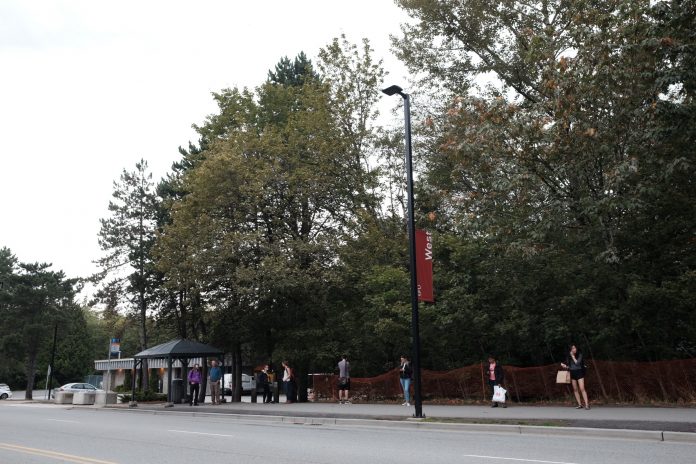
Dimly lit, forested bus stops far from campus buildings create unsafe situations for students. Photo: Chris Ho / The Peak

By: Gabrielle McLaren, Editor-in-Chief

Last spring, I found myself commuting home late on a Friday night, which isn’t unusual for me. The Peak’s publication days are on Friday, and they stretch out. On this particular Friday I was with two male coworkers/friends. We locked up the office, made our way through the Maggie Benston Centre’s parkade, and down to the Transportation Centre. But as most students know, this lower bus loop isn’t in use at the moment — so we crossed University Drive West and stood at the temporary stop that has been set up. 

At first sight I told my friends that somebody was going to get hurt here.  

For those who don’t spend time at the Burnaby campus, when you’re waiting for the bus at this temporary stop you’re standing on the sidewalk across the street from West Mall Centre, with a looming forest stretching out behind you. There is a lamp post lighting the area, but it feels more creepy than actually illuminating and secure — probably because you’re quite far from any buildings, in a part of campus that’s quiet to begin with. There’s a gazebo if it rains, but there are no blue SFU Security phones nearby. Also, there’s a sign warning commuters about wildlife — although, to be frank, bears weren’t the predator I had in mind. 

So when the news broke in July that a female student had been stalked and assaulted near University Drive West and West Campus Road? I was mad. I’d seen this coming, as had many other women students — which isn’t to say that this set-up is safe for men and non-binary students either. The area just doesn’t feel safe, period.

The Friday after that story broke, I stood at that same stupid bus stop again and nothing had changed, despite the fact that someone had been attacked a stone’s throw away. When I looked around, there was no extra lighting to keep the area better-lit, nothing separating students from the woods that someone had nearly been pulled into, no way to call for help if something happened, and no hint at all that this was a safe place for students to stand as we tried to leave our unsafe campus. 

After seeing that? I was livid, because someone had nearly gotten hurt and because the university had continued to allow this unsafe situation to exist by not taking additional steps to adapt the infrastructure its students were using. A full month later, as I finish writing this piece in the office, this is the same bus stop I’ll use to get home — thankfully, in broad daylight. 

I’m happy and thankful that this student’s story didn’t have a worse ending, but the fact that this attack happened at all is unacceptable. I started this piece by talking about my work with The Peak, and so I’ll circle back to that now to express how concerned I am by the increasing number of reports regarding violence and dangerous situations on our campus that I have read, seen, and heard of. This is a complicated issue, but there are simple things that I as a student want to see to feel safe on campus — my university providing safe infrastructure is one.   

The concept that university campuses can be unsafe places (for women in particular) isn’t news, but it leaves SFU with an institutional responsibility to be mindful of its students and to protect us. The Transportation Centre’s redesign has always struck me as unsafe, but now that violence on campus is escalating it feels purely negligent. If something else happens on University Drive — while I dare hope that nothing will — our university shares the blame.

If you’re new to campus, you should know about the following resources:


Kristie Elliot: The first female player to earn a spot on the SFU football team

1
Kristie Elliot - Photo Credit / SFU Athletics

By: Dylan Webb – Sports Editor

A dramatic video of the second day of training camp, uploaded to Twitter by the SFU Football account, provides a glimpse of the swift adjustment that the Clan’s new place kicker, Kristie Elliot, has made to a sport she has only formally played for the first time in the last few weeks. 

In the video, Elliot, just weeks into her university football career, nails a 30-yard field goal, splitting the uprights with plenty of yardage to spare, thus saving her teammates from a post-practice run. 

Though fellow freshman David Eisenkraft was recruited this off-season to be the primary place kicker, SFU Football’s head coach Thomas Ford, in an interview with Howard Tsumura, indicated that Elliot will get an opportunity to help the team during gameplay based on her performance in camp. 

“Kristie is a first-year player, but she has already put herself in some pressure-packed situations and done well [ . . . ] she is definitely a player that can help us, so her future is bright if she wants to keep on kicking,” Ford told Tsumura.

According to an interview conducted by CityNews, Elliot, a member of the SFU track and field team, originally considered the idea of kicking pig skins for the Clan only because of a friendly wager amongst friends. In fact, Elliot kicked her first successful football field goal, a 40-yarder no less, in her Vans sneakers after track practice

“This isn’t about her being a female, this is about her being able to do a job we need someone to do,” Ford told CityNews when asked about the novelty of a female player in what is typically a male dominated sport.

On the strength of her right leg, Elliot will make history as the first female SFU football player to suit up for a regular season game. She is far from being the first female NCAA football player though — the list is actually quite extensive. While Elliot won’t even be able to claim the record for first female to kick a field goal in NCAA football, since that feat was achieved by Tonya Butler in 2000, she will become the first female Clan football player to score points for her team in an officially sanctioned match — if she were to convert a field goal this season.  

Though Elliot lacks the usual years of football experience expected of an NCAA football player, there is little doubt about her athletic abilities and their potential transferability to the field. Ford noted that, in track, “you’ve got to do a lot of training and you don’t get many live reps, and when you do, it’s a pretty high-pressure situation to perform in that one rep. I think mentally, that experience will help her.”

While the degree of NCAA football success Elliot achieves in her budding career remains to be determined, one thing is clear: Kristie Elliot has set an exciting precedent for female athletes with the ability and desire to compete on an NCAA football field wearing Clan red.

Soundtracks for your major

0
Illustration courtesy of Michelle Chiang.

By: Kelly Chia, Nicole Magas, Lubaba Mahmud, Marco Ovies, Andrea Renney, and Winona Young

There are several factors that can contribute to a student’s choice in major: eventual career prospects, passion for a subject, or pressure from family. Sometimes we’re happy with our decision, sometimes we regret it, sometimes we change our mind and pick a new major. And sometimes, we turn to music for guidance, inspiration, comfort, and validation when we’re making our academic choices.

The Peak staff come from a variety of academic backgrounds, and we’ve curated playlists specific to our chosen majors to give you an idea of our feelings towards them. These feelings span the spectrum from adoration to exhaustion to dread. Happy listening!

Andrea Renney, Arts Editor

Fourth year computing science major

I chose to major in computing science because it seemed like the “easiest” way to land a job in California post-grad. Turns out, the courses required for the degree are hard and all anyone wants to discuss is coding. Who knew? My playlist reflects my current, jaded feelings towards my academic pursuits.

Playlist:

“I’m Writing a Novel” – Father John Misty:

What I wish my major was actually like.

“You Are Going To Hate This” – The Frights:

What I wish someone had told me before I decided to devote four years of my life to writing code.

“It’s Gonna Go Away” – Shannon and the Clams:

A comment on my motivation to go to class after the first week.

“Leave Me Alone” – FIDLAR:

My message to all of the guys who slide into my DMs when they finally see a girl in our class’s Discord channel.

“No Way Out” – Twin Peaks:

When you’re three years in and switching majors would cost a lot of time and money.

Marco Ovies, Staff Writer

Fourth year English major

I went into the English program thinking that it would be super easy and that I’d love every reading. I soon figured out that having to read a new book every week sucks and I’m drowning in essays. Please, someone, help me. 

Playlist:

“Mr. Know-It-All” – Young the Giant:

This one goes out to all of the guys who use big words in class to sound smarter — you know who you are.

“Mistake” – Middle Kids:

What my papers are full of when I hand them in.

“Coffee” – Sylvan Esso:

The real reason why I’m late to lecture everyday.

“Who Knows Who Cares” – Local Natives:

How I feel about literally any assignment ever.

“Oxford Comma” – Vampire Weekend:

I mean, the first line in the song says it all: “Who gives a fuck ?” 

Lubaba Mahmud, Staff Writer

Second year economics and international studies major

I’m planning on taking a double major — because I hate myself — in economics and international studies. I liked studying economics in high school, but surprise surprise! Turns out it involves a ton of math in university. Luckily, I also took IS 101 as an elective to try something new and it quickly piqued my interest in the IS major. This playlist describes my love-hate relationship with my majors.

Playlist:

I Can’t Find You” – SolarSolar:

Where art thou, oh my perfect source for that IS essay that’s worth 60% of my grade? I’m on page six of Google and desperation isn’t a good look.

Poison” – Cavetown:

Calculus. ‘Nuff said.

Unbelievers” – Vampire Weekend:

Can I do this double major or am I kidding myself?

Am I Doing It Right?” – Alex Lahey:

My thought process while studying, summed up in one phrase.

Global Citizens” – The Cardboard Crowns:

On a more positive note, studying IS is so interesting to me because I believe it truly makes me a global citizen. 

Kelly Chia, Staff Writer

Third year English major with a minor in publishing

I came to SFU intending to major in criminology because I wanted to ensure a stable career post-grad. During my first year, I had an epiphany that the freshmen around me weren’t necessarily studying criminology because they were passionate about the field. And so, I bit the bullet and chased what I adored. I consider myself lucky for making this decision early, as I love what I study — most of the time. Literature has always been my way of connecting to the world around me.

Playlist:

“What Do You Do With a BA In English?” – Avenue Q:

This is definitely how I felt before declaring my major.

“A Thousand Years” – Christina Perri:

And, after taking on a minor, this is how long I felt it would take to finish my undergrad studies.

“Right Words Wrong Time” – Carly Rae Jepsen:

When I have a good idea for a thesis in the shower or on the bus, but conveniently forget it when I’m in front of my computer.

“Sleep” – Joseph & Maia:

As an undergrad student, it goes without saying that I adore sleep. I also live for this comforting song playing in the background as I stare at a formidable pile of work.

“Ophelia” – Roo Panes:

One of the papers I’ve written that impacts me to this day was on Hamlet’s Ophelia, imagining what it was like for her to navigate the patriarchal society of Elsinore and failing miserably. I’ve always been interested in writing about women in literature, and, to this day, Ophelia is the character that fascinates me the most.

Winona Young, Features Editor

Fourth year (aspiring) joint major in communication and English

I can guarantee that if you’re an English major, you will identify with at least one (1) of these songs. If anything, they definitely help with the inferiority complex you harbour towards your peers while you relate every one of these songs to Shakespeare. 

Playlist:

“Mrs. Darcy – From the ‘Pride and Prejudice’ Soundtrack” – English Chamber Orchestra:

Ideal study music, and for when we pretend to be a Jane Austen protagonist as we stroll through campus.

“Heaven Knows I’m Miserable Now” – The Smiths:

Because we’re constantly forced to identify with sad, straight, cis white men. We will most likely read only their literature for the majority of our academic career. Splendid!

“My Shot” – Hamilton soundtrack:
All English majors are definitely, or were previously associated with, a former Theatre Kid™. 

“Act Up” – City Girls:

Rap is poetry, period. My friend brought this to their contemporary literary analysis lab. Get on their level. 

“Up the Wolves” – The Mountain Goats:

This is for when life is getting hard, but you also want to analyze the hell out of some text.

Nicole Magas, Opinions Editor

Fourth year honours sociology major

I got into sociology out of my desire to be a fiction writer. I thought that if I studied how people and societies work, I might be able to write more believable people and societies. What I didn’t know was just how much of a mess real people and real societies are. There are so many problems in the world that are much stranger than fiction that I don’t think I actually could write a believable novel based off of anything that I’ve learned.  

Playlist:

Mad World” – Gary Jules and Michael Andrews:

In general, this is an ode to being a fourth year, but there are weeks when I leave a sociology class completely bummed out by everything.

Kabul Shit” – Lily Allen:

This major really shows you just how many of our problems are caused by human constructs, and sometimes it feels impossible to enact meaningful change.

Crazy” – Gnarls Barkley:

Trying to explain these things to people outside of my major makes me feel like I’m the one who’s gone crazy.

Paint It, Black” – The Rolling Stones:

At times I just want other people to be as frustrated and angry at the world as sociology makes me feel.

The Last Saskatchewan Pirate” – The Arrogant Worms:

And if I don’t find some way to turn this frustration into meaningful employment soon, “pirate” is at the top of my career list.

Universities need to rethink their finances in the interest of equity

0

By: Nicole Magas, Opinions Editor

Back in July the Vancouver Sun published a list of the top 10 highest paid public executives in B.C., along with a detailed breakdown of their compensation packages. Of the ten, four were university executives, with the president of UBC, Santa Ono, predictably pulling in one of the highest incomes ($601,772). SFU president Andrew Petter also made the list, with a total compensation package for the 2018–19 year of $439,910. This was only slightly higher than UVIC president James Cassels, who saw a total compensation of $432,979 for the same year.

Students who remember the controversy surrounding SFU’s 2019–20 budget decisions may be disgruntled by these figures. In March, the school’s Board of Governors voted to increase tuition across the board, with international students being hit the hardest. Increases of 12–20%, depending on academic program, will be levied against incoming international students starting this semester, while domestic students will see their tuition rise by the maximum 2%

A six-figure income is something I can only dream about at present. My current income just barely covers my tuition every semester, and certainly doesn’t cover my living expenses. It is widely acknowledged that Vancouver is the most expensive city in Canada to live in, and yet, when looking to balance the university’s budget, money is squeezed from those who make the least, rather than those who make the most. 

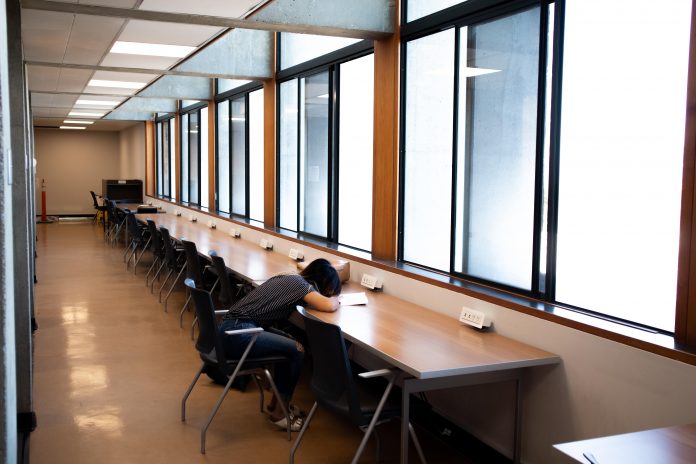
Am I alone in thinking that this is a backwards way to do things? Has the image of the “starving student” become so accepted that we don’t think twice about laying on yet more financial burden? Reports of students unable to afford Vancouver’s rising rents being forced to sleep in classrooms are more than just campus rumours, as a recent story in The Globe and Mail reported.

If the argument being made in favour of the current income of SFU’s president is that it is required in order to draw and maintain a talented administrator, then let me also make the following counterargument: if tuition rates become prohibitively expensive, the university also risks driving away the student talent that fuels a university’s credentials. This is particularly true of international students who are already looking outside of their domestic academic landscape for potential universities, and may choose a more affordable option outside of SFU — or even Canada for that matter. 

It is unconscionable for university administrators to make such obscene amounts of money while at the same time increasing the tuition of students who are just barely scraping by. If there is enough money in the SFU budget to pay our president over $400,000, then there is enough room in the budget to pay for talented faculty and building upgrades without raising student tuition to such a drastic degree.


Caring that isn’t impossible: An SFYou with Mission Possible’s CEO, Matthew Smedley

0
Photo Courtesy of Mission Possible

By: Winona Young, Head Staff Writer

Name: Matthew Smedley

Pronouns: He/him/his

Profession: Executive Director & CEO at Mission Possible

Education: Simon Fraser University (graduate certificate in Community Economic Development), Regent College (course work in theology and sociology), and Cairn University (bachelor of science, field of theology, biblical studies and sociology). 

Fun fact: Smedley says that the least known fact about him is that he is an ordained minister

An office, a window, and a tremendous capacity to care for Vancouver’s Downtown Eastside community — three things I quickly learn that SFU alum, Matthew Smedley, currently has. 

After several rescheduled emails, we finally sit down for an interview, both in our respective offices, linked by our cell phone lines. I, in a cramped space tucked away in SFU Burnaby’s Maggie Benston Centre, and Matthew, in his office somewhere in the Downtown Eastside. 

Amidst the awkward fumbling of recording devices, Smedley’s voice is clear and strong through the static of my iPhone. I begin by asking him to describe his role at Mission Possible (MP), a community organisation dedicated to helping the Downtown Eastside homeless population.

“I get to essentially support and help manage a team who are doing amazing work which is busy impacting lives of people who are experiencing poverty,” he says. “We’re creating impact ultimately through employment opportunities that lead to empowerment for individuals are experiencing isolation and marginalisation.”

In the morning haze, I do not put two and two together that Smedley, being the Chief Empowerment Officer, is also the company’s CEO. It’s safe to say that Smedley is familiar with the Downtown Eastside, as he has been with Mission Possible for a little over 11 years, being the CEO for almost five of them. 

Smedley starts by telling me that the Downtown Eastside is a neighbourhood. 

“Well, not a neighbourhood. It’s actually five neighbourhoods,” he later amends himself, “but it’s a community of 20,000 people. And of that 20,000 people, half of them are living in poverty. So the per capita rate of poverty is extremely high.” Throughout the interview, I notice something about Smedley: not once does he use the term “homeless people,” and opts for calling them as they are, people. 

“People often just assume that people don’t have the ability or motivation to work, or those kinds of things, but it’s really the opportunity, they need just the right opportunity,” he emphasizes. 

“You know, one of our individuals who was running our MP Neighbours program started out volunteering with our organisation,” he offers eagerly, sharing the story of an individual who came through Mission Possible’s program only to end up working in it permanently. “Someone who was going through recovery, and was volunteering, and then he was referred to come work with us.” Smedley doesn’t waste a moment before praising the individual’s hard work. “He walked in [the] shoes [of a homeless person], and just that lived experience is so powerful.”

“My goal is that anytime we have positions where we can hire people, we always look for those who have come through our program,” Smedley explains,  “Those who have experienced what we do, and those people are going to have the biggest impact in supporting those who come after them.”

But how does one get into this line of work? For Smedley it was simple. Roughly 13 years ago, Smedley was working at a church. It was through there that he found Mission Possible.

 “I started volunteering serving some meals, and then I was able to start working part time,” he shares. “And this was before we had our social enterprises, and our employment readiness program.” 

When I ask Smedley whether or not his background as a pastor impacted his choice of current career, he agrees with an almost casual, “Yeah,” as if a life of social work from religious ministry was something most would do on their average weekday. 

“I would say that the connection was what helped me come in, but the work, really — as a pastor and training that I had — was what inspired and gave me the drive to really want to care for people who I feel like otherwise would not have the opportunities that they have,” he says. As Smedley continues talking about the marginalisation, it faintly occurs to me that Smedley has talked about his community more than himself throughout the interview — a testament to his selfless character. 

When I ask what Smedley finds most rewarding about his work, I’m not surprised with his answer. “It’s the people that motivate me,” he says, “It’s the team I get to work with, I just work with a fantastic group of people [ . . . ] But it’s also those we get to build relationships with and get to know who walk in our doors and get to see lives changed through the work that we’re doing.”

As he’s an SFU alum, I ask Smedley if his time at SFU helped to prepare him for his current career. Smedley states “it was a program that I did actually right before moving into the Executive Director role, and it was one that opened my eyes to the amazing work that’s being done across our province and across the country.” 

The program Smedley speaks of is Community Economic Development (CED) program, which aims to empower and equip its students with skills that will allow them to help strengthen communities. On the CED website, SFU calls their program a leader in CED across Canada, [with content that] is both progressive and unique compared to peer institutions.”

When it comes to Smedley’s fondest memories of his time at SFU, he doesn’t hesitate to describe the connections with other people that have made his work fulfilling and memorable. Given that the CED program is located in downtown Vancouver, Smedley mentions how fortunate he feels to still be working with some of the other members of his program. They all may not be in the same organization, but the connection is there.  “I’m just so thankful for the connections that have been made through that time at SFU.” he says. 

For any aspiring SFU students interested in learning how to make a difference, Smedley offers two ways to get involved with Mission Possible. 

“One is we currently have a co-op student working with us, and that has been fantastic [ . . . ] we have summer opportunities and things like that for short term, temporary work. We’re always looking to recruit great people.” 

Those interested in permanent positions can find them on the Mission Possible website as well on SFU’s job posting lists. 

Smedley emphasizes that he hopes to provide opportunities of all kinds, regardless of one’s major, whether it’s for communications or business students. “Anything from communications and marketing, you know — there’s fundraising roles, there’s sales roles, there’s training roles, doing employment training, [and] coaching.” 

Smedley suggests that the small size of the organization, roughly 23–25 employees, make the jobs at Mission Possible multifaceted. 

“We would love to give opportunities to students who are coming out with education, maybe in social services field, but even if not, there’s opportunities,” he says. “We’re running social enterprises, we’re running businesses, and so, I think there’s opportunity in a whole bunch of different areas that people may not expect when they think of a nonprofit.”

Even long after I ended the interview with Smedley, I am still in awe of his character. It gave me hope for humanity whenever he opted to say “we” rather than “I.” Inspired, and the slightest bit self-reflective, I look up Mission Possible’s next date for volunteering (it’s every Saturday, with a call time of 8:30 a.m.!). Smedley began his career serving the Downtown Eastside by serving meals, so I see no reason why I can’t do the same. 

For more information about Mission Possible, see www.mission-possible.ca. For further information on volunteering opportunities, Mission Possible’s Power Breakfast and Coffee House Volunteers meet every Saturday morning, and can email [email protected]


Paul Kennedy presents guest lecture to CMPT 320: “What would Marshall McLuhan say?”

0
Photo Courtesy of SFU

By: Ana Staskevich, Staff Writer

Paul Kennedy, broadcast journalist and former host of CBC’s “IDEAS,” presented a guest lecture to the CMPT320 students and additional guests at SFU’s Burnaby campus. Winner of the ACTRA award for best Canadian radio documentary, Kennedy spoke at length about his feats and challenges in academia and, later, at CBC. One of Kennedy’s main focuses centered on the works of Marshall McLuhan, a Canadian philosopher and media theorist with whom Kennedy worked with in academia and briefly in broadcasting.

“McLuhan was one of the most fertile minds that has ever lived . . . I learned a lot from [him],” said Kennedy.

McLuhan, who coined the saying “the medium is the message”, gathered a lot of his inspiration from his colleague and mentor Harold Innis, a Canadian political economist who opened up dialogue about the works and influence of media. 

“Nothing I have ever written or will ever write is more than a footnote to the work of Harold Innis’,” paraphrased Kennedy, referring to McLuhan’s introduction to the 1964 edition of Innis’ book The Bias of Communication

Kennedy went on to speak about the emergence of digitization and technological changes. While describing the tedious process of being a freelancer in the early days of his career, including carrying around a reel-to-reel machine for recording interviews, Kennedy admitted that he originally resisted the change in computers and technology. Near the end of the lecture, he emphasized the influence of technological changes and their less than positive effects on society.

“I have a daughter [who] loses her phone every three weeks, and every time she does, she loses her contacts and she doesn’t remember them anyway,” Kennedy stated. “I think there are cognitive changes happening in society because of digitization.”

The lecture concluded by opening up the discussion to the audience, in which students had the chance to come down and pose questions for Kennedy himself. 

Semiathletic: a new music project from an SFU Business student

0
The cover of Mark Falk's single from his new music project, Semi Athletic. Courtesy of Semi Athletic.

Two years ago I walked into an open mic event organized by SFU Reslife to welcome first year students living in residence. I remember seeing this long-haired guy with an acoustic guitar onstage and wanting to look up the songs he was covering online later — that is until he mentioned that these were his very own original songs! After that performance, I would say everyone that lived in SFU residence during Fall 2017 remembers the name Mark Falk.

Mark is currently a third year student in the Beedie School of Business, but also a full-time musician and song-writer, who has strategically chosen to use his major for the benefit of his musical career.

When I first met him, Mark had already released two albums and an EP under the name Mark Allan Falk. Now, he has finished recording an album for his new project Semi Athletic, and he was ready to share some details over the phone with The Peak.

Pamela: How did the Semi Athletic name come about? 

Mark: So, I feel like this album is better than the ones I’ve released in the past and I needed a separation from the new and the old stuff, so I decided that I should start a new band name and I wasn’t sure what to call it, ‘cause that’s pretty important since it should last for a while. After brainstorming with friends and family, I came up with Semi Athletic because when I was a kid I used to play a lot of sports and if I didn’t get into music I’d probably still be more into sports. It’s also kind of funny and it gets a good response from people I think, and there’s a lot of imagery that I can use for branding, and endless ideas are influenced by the name.

P: Tell me about your new album!

M: So I recorded it last August at my friend’s studio called Portside Sound. My friend’s Jamie Sego, and he helped engineer the album. I wrote the songs all throughout last year and then demoed a lot of them at school in my dorm room and then when I got to [my co-op in] Alabama I just went in to the studio on weekends, in the day here and there, recorded it there . . .  and got a lot of my friends from the South of Alabama to record with me and play on it as well as I got a couple of friends to play some drums, bass, strings, and vocals.

P: What global idea or style do you think the songs in this album share?

M: There’s 9 songs in total. 7 of them were written in my first year of university and I guess most of them correlate to things that happened back then, and 2 of the songs were written the year before so they’re close timeline-wise. And the sound of the songs, the studio, and the people playing on them had a big influence on how each song ended up sounding.

P: And what do you think distinguishes this new album from previous projects?

M: I feel like it was a natural progression, so with all of my releases in the past I gradually got more comfortable finding my own kind of sound and with every release I feel like my sound got more refined until this release (the one coming up and the two songs that are out). I feel like the songs are cohesive in comparison to what I’ve done before and they fit well together but they’re still different enough that it keeps it interesting.

P: Besides Bahamas (Mark loves Bahamas), who are your main artist inspirations?

M: Let’s see, I made a Spotify playlist before I started recording.  Some examples are Jackson Browne. I like the way his lyrics and melodies work well together and never feel like they’re fighting. Glen Campbell, a song in particular: “Wichita Lineman.” Then some newer artists would be Andy Shauf and Joey Dosik, as well as Frank Ocean and Daniel Caesar. I was also listening to the album Cranberry by Hovvdy. 

P: How hard was it to record the songs and make them what you want?

M: Honestly, recording comes pretty naturally to me by now, since I’ve already recorded some albums and EPs, and I was able to get the sounds that I was going for. Also, I was working with such talented friends and since we’re close friends, it was really easy to communicate with each other and get across the message, which was very beneficial to the songs.

P: What are your future plans for this album?

M: I’ve released two songs: “Push Pull” and “Casual,” and the next song called “Down” [has been] released on Friday July 19. I will be releasing a new song almost every other week.

Find the first three Semi Athletic singles on Spotify, bandcamp, Apple Music, and Youtube and follow Mark’s new project on Facebook and Instagram.

Burnaby Mountain roads need to be reassessed to keep all travellers safe

0
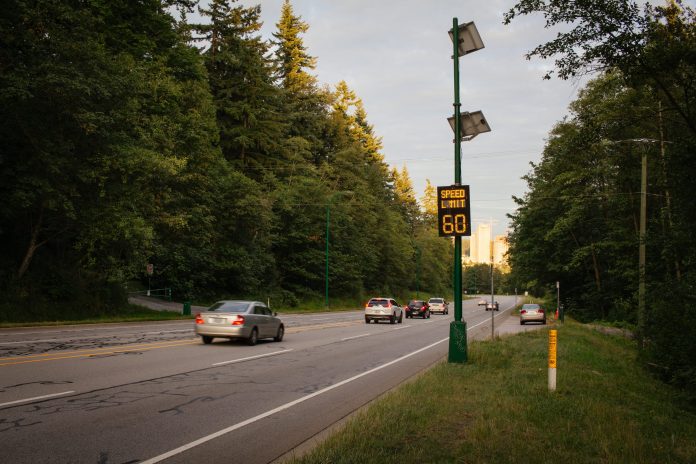
Current speed limits feel more like a suggestion than a law. Photo: Andres Chavarriaga /The Peak

By: Yasmin Khalili, SFU Student

Having a university on a mountain has its perks: nice views, nearby hiking trails, and beautiful natural surroundings. Campuses located in busy cities may not have these privileges. But this picturesque mountain comes with downsides as well, one of the major ones being the commute.

Because of SFU’s location and distance from most students’ living situations, many students find themselves bussing or driving to get to their classes. Any Burnaby Mountain commuter knows that the 60 km/hr speed limit going up and down the mountain has felt like more of a suggestion than a requirement — many vehicles go at least 80 km/hr and frequently even faster on the way down.

This has created a driving environment in which drivers feel pressured to go faster. Whether it be to avoid “riding their brakes” all the way down, or for fear of being honked at, from my experience, drivers going down Burnaby Mountain have been going much faster than they should.

Unfortunately, this reckless driving has resulted in several accidents, the victims of which include pedestrians, cyclists, and motorcyclists. Accidents such as these are almost always fatal due to the speed the cars are traveling. Yet even death isn’t enough to warn people to drive safe, as a recent heart-wrenching Vancouver is Awesome article describes the dangerous driving on Burnaby Mountain in the aftermath of a fatal accident.

Better understanding of road sharing between cyclists and motor vehicles, stronger reinforcement of speed limits, and significant penalties for negligence and breaking the law are good first steps toward making the roads around SFU safer for our community. But with motor vehicle collisions being the single largest contributor to accidental death in B.C., extra precautions must be taken to ensure the safety of everyone, especially those at higher risk of death or injury, such as cyclists and pedestrians.

Looking at how the roads entering and exiting SFU are designed can also be key to reducing accidents. Consider roundabouts, of which there are two at major SFU intersections. While these may be more convenient for drivers compared to stop signs as cars often aren’t required to come to a full stop, this convenience comes at the expense of pedestrians and cyclists who may be confused by how they should navigate the road space. Replacing SFU’s existing roundabouts with four-way stops may prevent this confusion. Placing additional traffic calming infrastructure such as medians along the roads leading to SFU may also reduce the problem of speed. 

On Burnaby Mountain, stronger enforcement needs to be placed on safe driving. A greater  police presence is needed to check drivers’ speeds, and hold reckless drivers accountable before an accident occurs.

Eventually, SFU would benefit from a protected and wider bike lane to both encourage biking and protect cyclists from automobile traffic. Although this may not benefit everyone, as long as changes made make road conditions safer, we are going in the right direction.

As for the rest of our community who commute by car, please remember: it is better to get to class late than to not get there at all!