Home Blog Page 483

SFU Hockey comes up short in rematch against rival Spartans

0
Forward Arjun Badh scored the first two goals of his BCIHL career. - Photo credit / SFU Hockey

By: Michael Lenko, Peak Associate

Looking to bounce back after losing their first regular season meeting with the Spartans, the SFU Men’s Hockey team fell a goal short in a disappointing 5–4 loss at the Bill Copeland Sports Centre. 

In the second consecutive game between the lower mainland rivals, the Spartans took control in the first and fired 11 shots on net, compared to just five for the Clan. Despite this, the Clan struck first, as Arjun Badh picked up his first career British Columbia Intercollegiate Hockey League (BCIHL) goal by beating Spartan netminder Isaac Labelle just over five minutes into the opening frame. The lead was short lived though, as Josh Bruce tied the game just a few minutes later. The Spartans jumped ahead soon after Bruce’s equalizer on a Dustin Deugau powerplay marker and took a 2–1 lead into the first intermission.  

The second period saw the game balance out a bit, with the Spartans outshooting the Clan 14–9. SFU evened the game with three minutes left in the frame on a Kyle Bergh powerplay marker that came on a two-man advantage for the Clan. The teams continued to trade blows, with the Spartans once again pulling in front as Elijah Vilio rushed the puck end to end and scored five hole with just 10 seconds remaining in the frame. Vilio’s tally gave the Spartans another one-goal lead heading into the intermission.

The third period saw an offensive explosion by both teams, as five goals were scored on just 16 total shots. Each team put up eight shots in the frame, and the third was easily the most evenly played period of the game. The Clan tied the game at three while shorthanded on Arjun Badh’s second tally of the game. The back and forth continued though, as the Spartans again reclaimed the lead 30 seconds later on Brandon Potomak’s powerplay marker. The Clan’s shorthanded success continued with Eric Callegari tying the game with just under seven minutes left. The game-winning goal came with less than five minutes left in the game, as Evan Last added to his impressive BCIHL career numbers with another clutch tally. The game offered a wild finish, as the Clan had multiple grade A scoring opportunities in the final minutes of the game, but SFU was unable to tie the contest and the Spartans held on for the win.

While the second consecutive loss against the Spartans is surely hard to swallow for the Clan, the offensive production from the penalty kill was certainly a silver lining. Another positive to be taken from the loss was the dominant play of Clan player Arjun Badh. Picking up the first two goals of his BCIHL career will surely be a major confidence boost to the second year forward. Ideally for the Clan, Badh will begin to produce more consistently and can start to provide some secondary scoring to ease the pressure on the top lines.

After a brief home stand, the team will embark on an equally brief road trip on the following weekend. Following their first visit to Vancouver Island of the season, the Clan will return home to face the University of Victoria Vikes on November 16. 

A little more clarity going into an exam would be nice, thanks

1
Don’t make midterms more stressful than they already are. Illustration: Sabrina Kedzior/The Peak

By: Lubaba Mahmud, Staff Writer

This Halloween I dressed up as a midterm exam guide. It’s, like, the scariest thing ever — next to, you know, midterms. My costume, “ghost of a midterm guide,” was basically pieces of scrap paper that I glued on myself with a few vague instructions such as “be on time” and “see syllabus” — but most were just blank. Instead of “trick-or-treat” I said, “Boo-hoo! So what if the midterm is 30% of your grade?” with a couldn’t-care-less attitude, yawning the entire time. This outfit required minimal effort, which is handy for a last-minute costume, but not great when students’ grades are hanging on the line.

Call me cynical, but I like to know exactly how I’m going to get shattered on an exam. Be it multiple choice questions that spark incomparable amounts of self-doubt, or short-answer questions that are just about as short as NBA players, please professor, for the love of God, just let me know what to expect!

I took a class where the professor stressed that the exam would mainly be based on multiple choice questions. However, on the day of the midterm most of the weight was actually allocated to long-answer math problems. This really hampers time-management during an exam as I had devoted most of my time to filling out the scantron. When I realized that I didn’t have enough time for the math problems nicely hidden on the last page of the question-sheet, it was already too late. While I do take some blame for not going through the entire booklet as soon as I was handed the exam, it is not entirely my fault. I went into the room expecting mostly multiple choice questions and left with a sense of betrayal and utter disappointment instead.

Professors should include the question pattern, along with estimated weights in the midterm guide. This would give students an approximate idea of how much time to spend on each section. The material to be tested on should also be included here so that students know what to study. It’s not always the case that all content taught in classes leading up to the midterm will be on the exam. Once, in class, the professor vaguely mentioned that the midterm would contain all content up to “here” in the middle of the lecture, and didn’t bother clarifying further.

Also, I can’t believe I have to point this out in university, but professors should post instructions at least a week ahead. This would give students enough time to email their instructors with questions and reasonably expect to get an answer before the exam.

And before I exhaust my grief with midterms, maybe — just maybe — test us on things we’ve actually done in class? I know it seems like a wild thought to test students on things you’ve actually taught, but we’re mentally, as well as financially, broke and deserve some justice. I once had a midterm where the class average was 38% because the questions on the exam were radically different from tutorial practice questions. When the class average is an F grade before the bell curve saves us, maybe that should be taken as a red flag that something isn’t right on the instruction side.

Midterms usually have a lot of weight attached to them, so it’s more than fair to ask for comprehensive instructions in a timely manner. Exams induce enough panic on their own, so the least professors can do is give us accurate hints about how to approach them.


SFU Special Collections hosts Eve Joseph for a charming afternoon of poetry

0
Joseph’s latest book of poetry, Quarrels, won the 2019 Griffin Poetry Prize. Image courtesy of Anvil Press.

By: Lubaba Mahmud, Staff Writer

My mother always says that the mark of a truly great person lies in their humility. When I attended a reading by award-winning writer Eve Joseph a couple weeks ago, my mother’s words echoed in my mind. On October 24, Joseph graced us with her presence in the W.A.C. Bennett Library’s Special Collections section. 

Books written by Joseph include Quarrels, which was awarded the Griffin Poetry Prize this year, as well as The Startled Heart and The Secret Signature of Things, which were both nominated for the Dorothy Livesay Poetry Prize. Her memoir In The Slender Margin won the Hubert Evans Non-Fiction Prize.

During the event, she read excerpts from all of her books as her audience listened with awe and admiration for her elegantly penned words.

She began her readings by declaring that “it’s not really a poet standing next to you it’s a failed actress,” and shared that she used to be in an improvisational theatre group. Joseph echoed the theme of uncovering the beauty in failure by reading her poem which, funnily enough, is about poems she doesn’t write.

Some brilliant lines include: “These ones know that the brain is only a photographer, intricately mapping what the mind explores” and “The poems I don’t write tire easily of metaphor.” Furthermore, she compared unwritten poems to actors with stage fright, who “dread the moment the curtains open, fearing no words will come, or if they do, [that] they belong to someone else.” She did an outstanding job of capturing the essence of stubborn poems that don’t want to be written, and amazed her audience with a clever piece of poetry.

Next, Joseph moved on to In The Slender Margin, which she described as a long meditation about death. She shared that she worked in a hospice for 21 years and faced a personal tragedy when her brother died at a young age. Joseph explained that her memories of her brother were fleeting, but it was heart-wrenching nevertheless. She found him again through writing this memoir.

Thinking back to the time when she discovered that her brother’s undergraduate thesis was on poetry, Joseph said, “Astonishing things happen, I think, when you undertake something close to your heart.” Contemplating the question of why we make art about death, she said that it’s about “the idea that art frees us from the literal. Art is the imagination’s take on death.”

She candidly expressed her interpretations and musings about death. It was a deeply personal, lyrical, and incredibly thoughtful account of one’s experience of coping with a loved one’s demise. As I recalled a similar experience I had, a strange sense of familiarity arose within me, as if the emotions were powerful enough to gently bind us — the author and the reader, together in a cocoon of mourning.

I would assume that the effortless connection I felt with Eve Joseph’s words is what most writers aim for. Little did she know that when she talked about unique writers and how to identify them, she was articulating exactly how I felt about her in that moment: “Writers show me things I didn’t know before. More than that, it’s when you find a writer and you recognize something you’ve always known, but didn’t [really] know it — those are the kinds of writers that become a part of you.” 

Peak Sports Mailbag: Week 11

0
Photo credit / Amazon

By: Katinka Neumann, SFU Student

Hello readers of The Peak sports section,

Our Peak Sports Mailbag topic this week is rowing and our host is SFU Rowing Club president Katinka Neumann.  

Thanks so much to all of our readers for submitting their rowing-related questions, and my apologies if your question didn’t make it into this week’s edition. Usually, the Mailbag host will only answer three questions. Don’t worry though, as all questions submitted count for an entry into the raffle draw whether or not they are addressed in the Mailbag. Now, onto the questions!

Question 1: What is the most common injury in rowing? – Priya 

Answer: The most common injuries in rowing are back injuries — specifically, injuries to the lower back. When rowing, you are engaged in a relatively uniform, repetitive pulling and pushing motion. If you don’t have the proper technique, it is very easy to strain the wrong part of your body.

There are also two kinds of rowing: sweeping and sculling. When sculling, you use two oars and your body constantly moves back and forth. When sweeping, you only have one oar, and you need to add a twist from the back when moving forward. This twisting motion, combined with the force applied in every stroke, will negatively affect the back over time. Therefore, back injuries happen more frequently with sweepers as opposed to scullers — though both are likely to get some kind of back pain at some point.

Question 2: What does a rowing competition consist of? Do teams race all at once or are time trials involved? – Derek

Answer: There are two common distances for regattas (rowing competitions). The first is 2,000 meters, which is considered a sprint race. This is the standard distance for a regatta and is the distance that is raced in the Olympics. The second distance is 6,000 meters, otherwise referred to as a head race. Both of these races are organized a little differently.

When racing 2,000 meters, there will initially be a time trial stage where boats will compete with everyone else at the regatta that is in the same age, weight, and boat class. Boats are sent off about 15 seconds apart, alternating between two lanes. Based on the time trial results, boats will be sorted into groups for finals. The fastest six boats will make the A final, the next six will make the B final, and so on. In a final, you are lined up with the other boats and all are sent off at the same time. Similar to swimming, the fastest boats (based on the time trials) will be in the centre lanes, and the slower boats will be in the outer lanes.

For 6,000 meter races, there are no time trials — just a final. Boats are sorted into a group based on their size/class. In their groups, boats are set off in 15 second intervals, with the largest boats going first, followed by the smaller ones. There are no lanes in 6,000 meter courses, as many of them have turns and bends. A slower boat is always expected to move out of the way of an approaching boat.

Question 3: What is the best/easiest way to give rowing a shot around the Burnaby campus/lower mainland area? – Christina 

Answer: If you are an SFU student, staff, or alumni, you are welcome to join the SFU Rowing club! We take on a group of novice rowers at the beginning of every semester. Rowing is known as a late entry sport, so don’t worry if you have no experience — we can teach you. 

If you are not a student, staff, or alumni, there are various rowing clubs throughout the lower mainland that take on new members. The Burnaby Lake Rowing Club and the Inlet Rowing Club are the closest to Burnaby campus. Many of these clubs have a learn-to-row program in the summer, which is a month-long introduction to the sport that allows athletes to row with the club competitively after completing the course.

If you would like to participate in future editions of the Peak Sports Mailbag and be entered in a raffle for an end-of-semester prize, here’s what you can send to [email protected]

  • Sports-related questions that our weekly host will answer
  • Weekly theme ideas to guide our questions

Or: sign up to host the Mailbag (and get paid)!

Thanks to all of you SFU sports fans for blowing up my inbox!

Next week’s theme is: Ultimate Frisbee

Next week’s host is: Dane Yule

Send in your questions to [email protected]

Clan volleyball splits final two games of four-game home stand

0
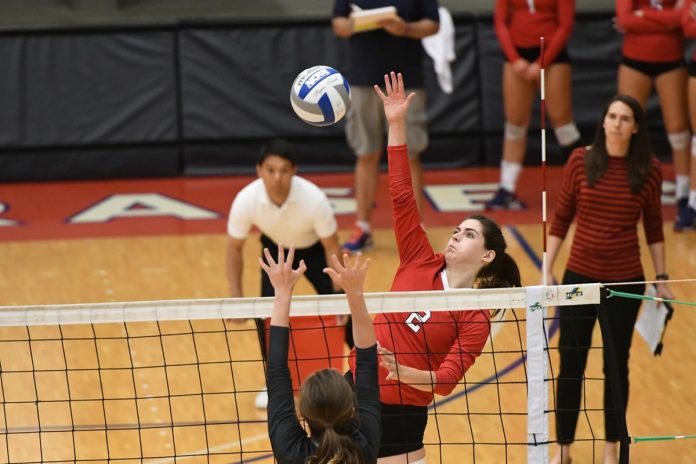
Kalyn Hartmann in action. - Photo credit / SFU Athletics

By: Dylan Webb, Sports Editor

After an impressive seven game winning streak was ended by a loss to Western Washington University (WWU), the SFU Volleyball team rebounded with a dominating straight-sets win over Montana State University Billings. With the win, the Clan moved their regular season in-conference record to 10–4, with the WWU Vikings responsible for two of the only four blemishes on an otherwise strong 2019 season. 

In the loss to WWU, the Clan came up short against a first-place team that continues to ride a wave of momentum. The Vikings have lost just one of their 21 games this season and SFU was, once again, unable to overcome a squad that has consistently executed a winning formula. While the Clan did claim the second set after blowing an early lead in the first set, that was the extent of their success as WWU took control from the third set on. 

In their second game of the week, the Clan righted the ship with a straight-sets pounding of the Montana State University Billing Yellowjackets. SFU was able to out-hit Montana State University by a large margin, recording 45 kills to the Yellowjackets’ 29. Freshman Middle Blocker Kalyn Hartmann had a standout performance in the win with three aces, four blocks, and 13 kills. 

As the team moves rapidly toward the playoffs, with only six games left on their regular season schedule, The Peak checked in with head coach Gina Schmidt to see which areas of play she felt the team has improved in the most since the start of the season. 

“Our team has improved in several areas over the course of the season, but I think it’s been a combination of our ability to sideout efficiently and score points when we are serving,” she said. Schmidt also noted that the team’s “block and defense has been doing a good job of making it difficult for our opponents to get kills.” 

Given the progress the Clan has made in these areas, The Peak asked Schmidt what role the new additions to the coaching staff have played in facilitating these on-court improvements that the Clan has made throughout the season. 

“Mandy Cao has been a great addition to our staff,” Schmidt responded, pointing to the fact that, “her international experience brings a fresh perspective to the team.” Schmidt also noted that, on a more basic level, “it’s helpful having more coaches in the gym as it allows our players to hear different voices and receive lots of feedback.”

The Clan will now look ahead to the final two home games of their regular season schedule in which they will host both University of Alaska teams. The game against the University of Alaska Anchorage Seawolves on Saturday November 16 is Seniors Night for the Clan as the team honours the achievements of its graduating players. 

SFU English department welcomes Carleigh Baker as newest Writer-in-Residence

0
Carleigh Baker is an award-winning poet, short story writer, and novelist. Image courtesy of Callan Field / The Globe and Mail.

By: Isabella Wang, SFU Student

On Friday October 18, the SFU English Department hosted a reception and evening of reading to officially welcome Carleigh Baker as the department’s newest Writer-in-Residence. As the fifteenth writer inaugurated by the Ellen and Warren Tallman Writer-in-Residence program, she is well-suited to follow in the footsteps of Daphne Marlatt, Fred Wah, Wayde Compton, and, most recently, Ivan Coyote.

Baker is a nêhiyaw âpihtawikosisân/Icelandic writer whose award-winning poetry and short story work has been published in Best Canadian Essays, The Short Story Advent Calendar, and The Journey Prize Stories. She is currently working on a novel about paddling the Peel River Watershed, which examines matriarchal relationships with the river as a symbol of a mother figure. One of her current writer interests includes using the tools of storytelling to acknowledge climate change grief while firmly moving toward action.

The evening began with warm introductions made by Dr. Jeff Derksen, Dean and Associate Provost of Graduate and Postdoctoral Studies. Dr. Derksen situated the Writer-in-Residence program as part of a cultural front that, through resistance, aims to “transform society through creative thinking, a new form of social relations within the university.” Past Writers-in-Residence were also present to celebrate the occasion, including Fred Wah, who was accompanied by his wife, writer Pauline Butling.  

Indeed, in what she has called a “brutalist rain palace,” Baker can be found in her office, listening to heavy metal and talking to other writers about their writing over her weekly community consultation hours. Her time in residency has also been spent towards finishing her first novel — a long time coming.

Baker’s novel arose following a canoe trip, paddling more than 100 kilometers through the 12 interconnected brooks linking the Yukon Watershed. Despite being well-intentioned, it was a fraught trip that drew into the problems of wanting to find oneself, and then finding oneself on someone else’s land. As she explained, however, she wrote the story in part with wanting to learn from the mistakes.

Baker went on to read from her short story “Where Were You?” a story about two girls questioning the ecological impact of hairspray on the ozone. On a deeper level, the duo-narrative is asking readers to consider the various forms of violence committed against the earth, in direct relation to the feminine beauty standards of the late 19th century and violence against women’s bodies. Thus, the story on climate grief draws into focus the notion of dark nostalgia, or memory as a safe haven. Simultaneously, this evokes a sense of shame, where, as she explained, “we can begin to look back and [identify] the places where we started to go wrong.”

In this way, Baker showed that through her story and the writing of her novel, we can grieve over loss, over poor behavior, or over the “lack of heroism in a situation [ . . . ] but [we] don’t move ahead until [we] acknowledge [our] grief.”

Baker also shared a powerful message with the audience: writing does not have to be a solitary act. She reflected on her canoe trip by saying that after she returned, “[I realized] community involvement needed to be my number one priority [ . . . ] It fills you up, whereas writing leaves me depleted until it’s over.” These are commitments that she is intent on carrying over to her time at SFU, through community engagement and through teaching.

For the remainder of the semester, Baker’s office is open for weekly writing consultations available to the general public, following which she will be teaching a creative writing course on ways to address ecological grief, civil disobedience, and apocalyptic narratives through poetry and fiction.

The week ahead in SFU Sports: November 11–17

0
Photo credit / SFU athletics

By: Dylan Webb, Sports Editor

With SFU’s volleyball, football, and men’s and women’s basketball teams all playing at home this week, Clan fans have a ton of opportunities to cheer on their team’s during the week of November 11–17. Here’s a brief breakdown of the SFU sports action lined up for the week. 

Volleyball:

The SFU Volleyball team will enjoy a short two-game home stand this week as they host teams from both the Anchorage and Fairbanks campuses of the University of Alaska. After hosting the Nanooks on November 14, the Clan will take on the Anchorage Seawolves on November 16. Tip off for both games is 7 p.m. in the West Gym.

Men’s Soccer: 

A two-game week for the SFU Men’s Soccer team begins with a visit to Western Washington University on November 14 at 7 p.m. The team will then travel to Lacey, Washington to take on Saint Martin’s University on November 16 for a 1:30 p.m. kickoff.  

Football:

The Clan will host Central Washington University at Swangard Stadium on Saturday November 16 at 1 p.m. It’s the final regular season game of 2019 for SFU Football and the team will celebrate its graduating players with a Seniors Night theme. 

Men’s Basketball:

A light week for the SFU Men’s Basketball team has the squad hosting Trinity Western University at 1 p.m on November 16. 

Women’s Basketball:

Continuing their pre-season, the SFU Women’s Basketball team will host three games at the West Gym this week. First, Hawaii Pacific University visits on November 12 for a 12 p.m. tip off. California State University, Los Angeles will then visit for a double header that starts on November 15 at 7 p.m. and concludes on November 17 at 12 p.m.

Hockey:

SFU Hockey hosts a single home game this week with the University of Victoria Vikes paying a visit to the Bill Copeland Sports Centre. Puck drop is 7 p.m. on Saturday November 16. 

No. 7 Cherry Lane paints a captivating portrait of Hong Kong with unconventional cinematic choices

0
No. 7 Cherry Lane was nominated for the Golden Lion award, the highest prize at the Venice International Film festival. Image courtesy of Far Sun Film Co Ltd / VIFF.

By: Kim Regala, Peak Associate

After a long 10-year hiatus, Hong Kong director Yonfan returns to filmmaking with No. 7 Cherry Lane, his first animated film. Presented in the recent Vancouver International Film Festival (VIFF),  No. 7 Cherry Lane takes us through a captivating love triangle between a young college boy and the mother and daughter that he falls for. As it is set in 1967 Hong Kong, the story pays homage to a crucial moment of political uprising between the Chinese and British. Through the film, Yonfan paints a beautiful portrait of the city that well encapsulates the atmosphere and sentiments of this historical moment in Hong Kong.

Perhaps the most intriguing aspect of No. 7 Cherry Lane is its unique animation style. Typically, a film only incorporates one type of animation, whether it’s classically hand-drawn, computer-generated, or even stop motion. Yonfan breaks this common mould to combine two traditional techniques. On the one hand, all of the background imagery appears hand-sketched or water-coloured, remaining motionless throughout each scene. This creates a rather Old-World aesthetic that is reminiscent of traditional Chinese paintings. On the other hand, the characters inherit a more modern animation style that is similar to the anime we see today. A film review from Hollywood Reporter describes this as “the result of a labour-intensive animation technique in which animators rendered caricatures in 3D before hand-drawing them in 2D.” As a result, we get a desirable contrast between the main subjects that hold our gaze and the world around them that feels frozen in time.

Continuing the unconventionality in Yonfan’s style is the overall slowness of the movement on-screen. While this could feel slightly frustrating for viewers anticipating a fast and action-packed film, this unique approach adds to the mummified effect of the world unfolding before our eyes. In a way, it allows us to truly pay attention to the details within the scenes and further immerses us into this particular time period in Hong Kong.

Being an animation and all, you may think that the film is rated PG by default — but be warned, there is nothing family-friendly about No. 7 Cherry Lane. Grounded by its love triangle narrative about a man who fancies two women, many of the scenes depict sexual fantasies and toe the line between dream and reality. Without a doubt, the film’s narrative holds a strong male gaze that caters towards the objectification of women’s bodies (and yes, there IS nudity involved). Even the scenes that center around female fantasies still feel as if they are meant to primarily have an erotic feel for male viewers. While moments like these did make me feel slightly uncomfortable as a female viewer, I still couldn’t help but appreciate the creativity in Yonfan’s presentation of these dream-like sequences that garnered an almost psychedelic influence. Additionally, his bold move of expressing sexual and provocative themes is largely admirable considering that Asian cinema as we know it is known for being more conservative than Western productions.

Despite catering towards the male gaze, I still found No. 7 Cherry Lane to be an impressive film that deserves great recognition beyond just the Asian audience that is familiar with the film’s language and culture. While it is a story that draws from Hong Kong’s revolutionary past, it can also serve as a mirror to the protests against China that are still happening in the present. Its imaginative animation style alone makes the film stand out from previous works, but it is especially this aspect of political awareness that separates it from the others.

Spotlight: UPhoto Photography Club

0

Board rejects motion to house CJSF, Embark, SFPIRG, and SOCA in the SUB 7–5

2
Image courtesy of sfss.ca

By: Gabrielle McLaren, Editor-In-Chief

Editor’s note: this piece will be followed by more in-depth coverage on the discussions surrounding both motions and concerns voiced about accessibility, feasibility, and financial responsibility. Other business from this meeting will be discussed in a future piece. 

A motion originally proposed by SFSS president Giovanni HoSang to house SOCA, SFPIRG, Embark, and CJSF in the Student Union Building (SUB) was defeated on November 1’s SFSS Board meeting. Another motion was adopted to renovate Forum Chambers and the Undergrounds in Maggie Benston Centre to house SOCA, SFPIRG, and CJSF instead — though SFU community members expressed concerns regarding this resolution. The other groups currently housed in the Rotunda — The Women’s Centre, Out on Campus, and the First Nation Students Association — have space guaranteed in the SUB.

Three guests spoke on this issue prior to the Board’s discussion: a student who had been involved with SFPIRG, Matt McDonald (Director of External Relations for the Graduate Student Society), and Magnus Thyvold (CJSF Station Manager). 

From the Board of directors; Jennifer Chou, Tawanda Nigel Chitapi, Osob Mohamed, and Shina Kaur spoke spoke in support of the motion. Simran Uppal expressed feedback she had received from students and departmental student unions executives who wished to see space in the SUB allocated majoritarily to students. Giovanni HoSang read an open letter supporting the motion signed by himself, Jennifer Chou, Shina Kaur, Fiona Li, and Osob Mohamed. 

HoSang’s motion, printed below along with vote results tallied by several Peak staff members, was originally proposed and postponed at the May 30 and October 18 Board meetings.  

Following the first motion’s rejection, the Board elected to take a break given the tension and emotion in the room. Many SFU community members left the meeting at this time or took advantage of the break to discuss frustrations and reactions to this decision in the hallway. 

After the break, the Board passed a motion to renovate Forum Chambers and the Undergrounds at a projected cost of $320,000 to house SOCA, SFPIRG, and CJSF. 

The last item before the Board went in camera was a question and answer period for guests in attendance. Of the 10 questions asked (five of which by The Peak), Board members answered five. As the last question of the Q&A period, The Peak asked Board members which independent student society’s services they had used or activities they had participated in, one group at a time. Less than half of the Board had used each service. 

Many speakers at the meeting reacted to the motion in the meeting itself. During the meeting, The Peak invited attendees to submit comments and concerns before 6:00 p.m. (due to our publication schedule). The Peak had the opportunity to talk to Giovanni HoSang, Jesse Wentzloff (CJSF’s Public Affairs Coordinator) and Robin Erikkson (Programming Coordinator). 

Wentzloff voiced disappointment at both the Board’s decision “to evict us and the other student groups by denying us space in the SUB.” 

He was also disappointed by “the cowardice of the Board members who voted against the proposal that would have housed all the groups [ . . . ] in that they uniformly refused to answer questions or provide any concrete reasoning for their decisions and were disrespectful throughout the process — not paying attention to speakers and checking their phones…”

CJSF’s disappointment is compounded by the fact that a move to Forum Chambers/the Undergrounds had already been discussed and deemed unsuitable for their society’s needs. Erikkson also discussed concerns regarding the financial feasibility and responsibility of this plan. Board members discussed this issue during the meeting and the Q&A, with VP Finance Tawanda Nigel Chipati explaining that the SFSS’ Space Expansion Fund would cover these renovations. The briefing accompanying the motion notes that CJSF has also been saving funds in preparation for a potential move. 

“Why would the SFSS choose to spend that amount of money [ . . . ] to renovate space when they have a brand new building that they’ve already spent millions of dollars on?” 

HoSang too was disappointed by the decision.

“It’s very disheartening that the vote went this way, but let’s see what happens in the next couple of months.” 

He reminded students that they could reach out to Board members and vote with this issue in mind in the next election. 

The issue of space in the SUB has deep roots on campus. Following a consultation period in 2013–2014, rotunda groups found out in December 2017 that they were not being given space in the SUB. Since, they have reacted with a variety of presentations, discussions, educational workshops, petitions, letters, and awareness campaigns. 


Vote Breakdown:

7.1 Alternative Shared Space Model – Improved Model for the SUB – MOTION 2019

Be it resolved that 8 of the 22 Bookable Open Rooms be assigned to clubs and DSUs for a period of one semester with the possibility of extension by additional periods of one semester at a time; Be it further resolved that each of the 8 open bookable rooms be assigned to one club or student union except if two groups wish to share a room;
Be it further resolved that staff be tasked to determine the next steps in the process of allocating the 8 Open Bookable Rooms as semesterly bookable spaces to clubs and student unions and to report back to the Board with recommendations. Be it further resolved that the remaining 4 organizational suites be allocated to SFPIRG, Embark, CJSF and SOCA, in addition to the ones already allocated to the SFSS Women’s Centre, SFSS Out on Campus and First Nation Students Association.

Votes in Favour

  • Jennifer Chou (Arts and Social Sciences Representative)
  • Giovanni Hosang (President)
  • Shina Kaur (VP University Relations)
  • Fiona Li (Communications, Art and Technology Representative)
  • Osob Mohamed (Health Sciences Representative)

Votes Against

  • Maneet Aujla (At-large)
  • Jasdeep Gill (VP External Relations)
  • Julian Loutsik (Environment)
  • Jessica Nguyen (VP Student Life)
  • Simran Uppal (Science)
  • Andrew Wong (Business

Abstentions

  • Tawanda Nigel Chitapi (VP Finance)
  • Emerly Liu (Education)

Note: Rayhaan Khan was not in attendance the vote but arrived later, and Nick Chubb was not in attendance during the meeting


8.1 Forum Chambers and the Undergrounds – MOTION BOD 2019-11-01:05

Be it resolved that the Board of Directors direct management to approach SFPIRG, CJSF,
SOCA, and Embark to discuss and implement the plan for permanent space allocation in MBC 2901 (Forum Chambers) and 3901 (The Undergrounds).

Votes in Favour

    • Maneet Aujla (At-large)
    • Jasdeep Gill (VP External Relations)
    • Julian Loutsik (Environment)
    • Jessica Nguyen (VP Student Life)
    • Simran Uppal (Science)
    • Andrew Wong (Business)
    • Tawanda Nigel Chitapi (VP Finance)
    • Emerly Liu (Education)

Votes Against

(None)

Abstentions:

  • Jennifer Chou (Arts and Social Sciences Representative)
  • Giovanni Hosang (President)
  • Shina Kaur (VP University Relations)
  • Fiona Li (Communications, Art and Technology Representative)
  • Osob Mohamed (Health Sciences Representative)