Home Blog Page 463

Your weekly SFU horoscopes: Jan 27–Feb 2

0
An illustration of a girl with long flowing hair. Astrological signs and stars shine around her.
ILLUSTRATION: Marissa Ouyang / The Peak

Written by Zach Siddiqui, Humour Editor

Aries — March 21–April 19

This week, you’re tempted to drop projects that have no fruitful end in sight — for example, your annoying friends. Resist the impulse. Your long-term investments will pay off; your bullying and condescension will upgrade your clueless cohort. 

Taurus — April 20–May 20

Everyone calls you a loyal friend. But you’re loyal to one thing and one thing only: your phobia of confrontation, particularly confronting your “loved” ones about how repulsive you find them. This week, it’s time to accept the truth: you are a pretentious snob elitist with bad breath and badder communication.

Gemini — May 21–June 20

They say there’s two sides to every story. So before you hate yourself forever for what you’ve done wrong, take a moment to check in with yourself about why you chose to steal that man’s drink off the Starbucks bar. Maybe it was a political statement in defiance of the Starbucks mobile order, a protest against the hyper-convenience used to manufacture consent to a neoliberal world. 

Cancer — June 21–July 22

Your job this week is to do nothing and look cute. Not whatever your angry manager is claiming your job is supposed to be. 

Leo — July 23–August 22

Descend down to the bustling Metro Vancouver masses this week and dispel the legends that surround you. Though you enjoy being at the centre of a mythology, it’s no good for people to be whispering that you marinate and eat any worshippers who approach.

Virgo — August 23–September 22

Glow with everflowing love this week. Love for humanity . . . love for your community . . . love for Pokémon Omega Ruby and Alpha Sapphire Versions. They are the superior 3DS Pokémon gaming titles and they will heal your twisted, jaundiced heart.

Libra — September 23–October 22

It’s true that you’re a natural at everything you do. Like lying to your friends and family about your (lack of) feelings and waterboarding people. But this week in particular, you must be careful not to rest on your laurels. Someone in your circle is coming to dethrone you and you need to identify them, fast, and take them out before they prove to the world that they have even less empathy than you do.

Scorpio — October 23–November 21

Eat the SFSS for clear skin this week.

Sagittarius — November 22–December 21

There’s a sweet side to you, under all the toxic behaviour you pretend to regret in your daily life. That sweet side is something that you might not even know about or recognize within yourself: a gentle affection for euhaplorchis californiensis. Inject those cuties into your veins. 

Capricorn — December 22–January 19

You’ll be confronted by your destiny this week. And I don’t get paid enough to suss out what said destiny will be, honestly. You Capricorns are literally the most random, tempestuous, opportunity-snatching people I’ve ever met. Go send an SFU Mail and stop wasting my time. 

Aquarius — January 20–February 18

You can’t afford real crystals from Granville Island. So take this week to buy and line your bed with juice crystals from the nearest convenience store. Purify your energies and putrefy as ants come to devour your saccharine body while you sleep in yet again. 

Pisces — February 19–March 20

This is another fragile week for you. Just cry. A lot. And drink your own tears to satisfy your thirst.

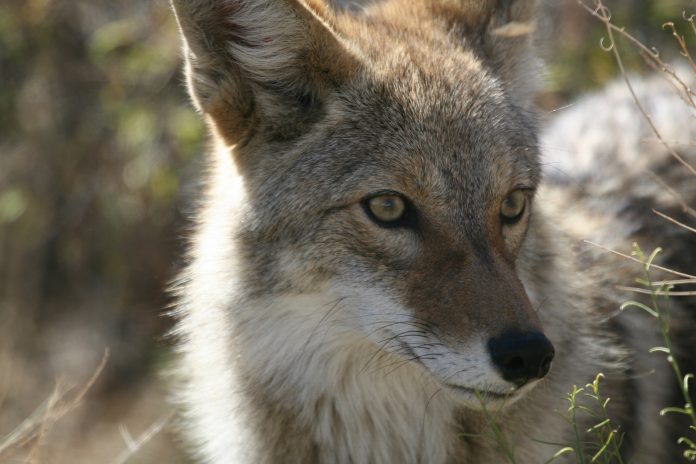
SFU invites students to Feral Coyote Therapy

0
Photo courtesy of skeeze via Pixabay

Written by Maxwell Gawlick, Peak Associate

After the great success of the school’s recent Dog Therapy sessions, SFU’s Health & Counselling Services is bringing the initiative back this winter — albeit with a cheaper alternative. By laying out a variety of appealing snacks in the middle of Convocation Mall, such as Dining Hall leftovers and organics bin waste, SFU has attracted a pack of wild coyotes.

According to an email from Health & Counselling Services, Feral Coyote Therapy (FCT) involves students befriending the coyote pack, recent migrants from the woods on Burnaby Mountain, while eating or roasting marshmallows. The pack then mauls the students, bleeding them out in much the same way the university bleeds out their wallets. 

Students will crawl out of the altercation feeling “refreshed” and sometimes “grateful to go back to class,” according to the email.

It’s unclear what inspired SFU to introduce FCT to campus, and students and staff alike are somewhat skeptical of the project. Faculty in particular are concerned about how little FCT appears in overpriced peer-reviewed literature. 

At least one student theorized to The Peak that SFU didn’t leave the appealing snacks and leftovers in Convocation Mall to facilitate FCT at all. Rather, certain administrators may have gotten sick and tired of sorting their trash for the sake of SFU’s globally recognized Zero Waste Initiative.

“You just have to warm up to them [the coyotes],” reads a second email from SFU in response to this allegation. “As long as you keep them fed, they’re quite docile.”

According to Health & Counselling, coyote therapy was slated to begin February 1. But there are some (medical) reports stating that it may have already begun. 

SFU Security seems to have been kept totally in the dark about the Health & Counselling initiative.

“A dramatic increase in the number of coyote sightings has been reported in the last week,” SFU Security Tweeted on Thursday morning. Students should take caution and avoid dark side paths. If doglike yipping and barking is heard, students should seek shelter immediately.” 

Though classes are still in session, students are now stranded in the AQ and are warning others to stay home, as the rest of SFU Burnaby is basically comprised of dark side paths.

From brutalist to boo-talist: SFU turns Robert C. Brown Hall into a year-round haunted house

0

Written by Meera Eragoda, Staff Writer

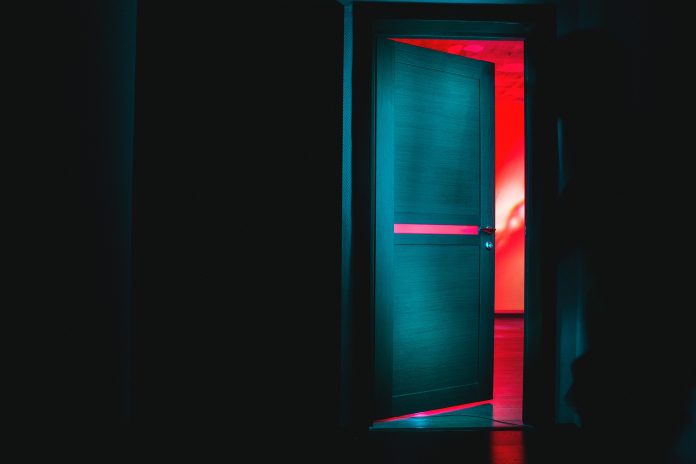
In a move to facilitate easy fundraising, SFU has decided to turn Robert C. Brown Hall (RCB) into a year-round haunted house. After much discussion on where to hold their new money-making attraction, SFU decided it would be most cost-effective to use RCB because “it’s basically already a haunted house,” according to one SFU spokesperson.

All those who dare to enter will face some of the following scares:

  • Zombified students who, in previous semesters, took a wrong turn and were lost to the caverns of SFU. (And there are many turns to RCB.)
  • Ghosts of graduates who have sold their souls in order to afford living in a city with increasing housing costs.
  • Kettlebells precariously hung from the ceilings, symbolizing the impending weight of tuition costs.
  • The darkness of existential doom lurking at every turn to make you question your worth.
  • The monotone voices of professors droning on and on and on and on, lulling you to sleep to be savaged by the other attractions, while you try and stay awake enough to make it out.

The decision has garnered much excitement around campus.

We asked a third-year student, Charlie Wolf, what they thought of the haunted house. They responded, “Honestly, this makes sense. My friend had a class in RCB last semester, and I haven’t seen him since. Maybe I’ll run into him today.”

SFU opened the RCB Haunted House attraction to the public for the first time on Tuesday, January 14, with more dates planned for February.  The Peak is not actually sure what SFU was fundraising for, and the school has declined to answer this question. We were, however, assured that their cause was “engaging” and “totally something good.”

For a special bonus scare, the January 14 opening included the chance of being stranded because of the snow, never getting off the mountain again, and turning into Jack Torrance from The Shining.

Leaked transcript: a hostage negotiation with a stupidly rich man

0

Written by Rodolfo Boskovic, SFU Student

DIAL TONE. 

A PHONE IS PICKED UP OFF THE RECEIVER.

???: Who is this!? Listen! I’m holding a lit match and five litres of gasoline and I’m not afraid to use’em!

FBI NEGOTIATOR: Sir, I understand you are stressed. This is a difficult situation. We just want you to understand that we’re here to help in whatever way we can. We just want the release of the hostages without any harm.

???: I don’t need your help! I’m a self-made man! I drank baby formula as a baby so my mother wouldn’t think I owed her anything!

FBI NEGOTIATOR: No offense was intended—

???: Offended!? I’m not some snowflake!

FBI NEGOTIATOR: Of course, but then why keep the hostages, sir?

???: I have a right, don’t I? I made them. I kept them down here safe in my bunker for years! Far from creeps like you! Who are you, or anybody, to tell me what I can and can’t do?

FBI NEGOTIATOR: Sir, please, think this through. Wouldn’t you want what’s best for them?

???: You people just want to take them away! All to some freaking charities or needy orphanages somewhere. I’m not having it! They’re gonna burn up with me!

FBI NEGOTIATOR: Think of your children, sir. They deserve better than this.

???: Children? What children? Those bums never worked a day in their lives! I’m not leaving a cent for them. They were always eyeing my Swiss bunker! Trying to get at my fortune!

FBI NEGOTIATOR: I’m sorry, sir. Who exactly do you have as a hostage, then?

???: My money, boy! I’m burning down my millions before you health-care lovers get to it. Taxes are a sin!

A PHONE IS PLACED BACK ON THE RECEIVER.

???: Hello? Are you listening? I won’t be ignored anymo—

A LIT MATCH IS DROPPED. 

???: Oh.

THE LINE GOES DEAD.


New Westminster Museum & Archives hosts a 100-year history of the Sikh community

1
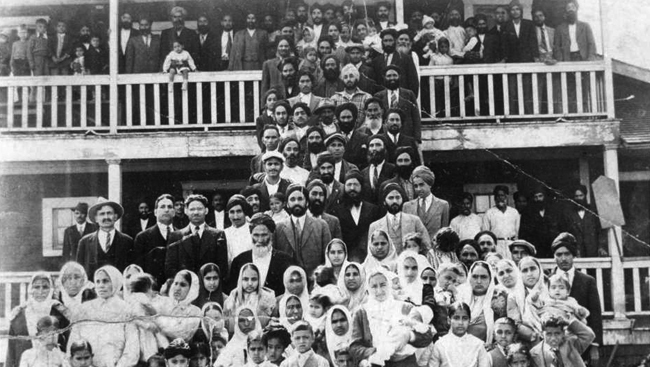
Photo via Gurdwara Sahib Sukh Sagar (Khalsa Diwan Society New Westminster, B.C.) / Facebook

by Prabhdeep Dhaliwal, SFU Student

In the heart of downtown New Westminster is the exhibit An Ocean of Peace: 100 Years of Sikhs in New Westminster, hosted by the New Westminster Museum & Archives and the Gurdwara Sahib Sukh Sagar (Khalsa Diwan Society). As a label at the gallery states, “Sukh Sagar” translates to “an ocean of peace.”

The exhibition is displayed in a small blue room at the end of Gallery 7 of the New Westminster Museum & Archives. Devotional singing plays on the speakers in the room, and on the right there is a timeline with pictures and documents starting from the early 1900s and ending with 2019. Examples of these prominent events include the lot Bhai Bishan Singh bought for the building of the gurdwara, a protest against Operation BlueStar, and the first Nagar Kirtan (a religious procession commemorating the fifth God). 

There is also a glass display case featuring several Sikh relics including several sizes of  kirpans, a kind of sword, displayed along with brief descriptions of each item. Attention is brought to the fact that these swords were not meant to convey violence, but rather used for protecting oneself and others. 

Another exhibition label speaks of various celebrations and commemorations. On the wall to the left of the display there is a photo album and a bride’s wedding attire. The exhibit label entails the relevance of these artifacts as being from one of the first weddings at the Gurdwara Sahib Sukh Sagar, which was the first Sikh temple in New Westminster. 

On the wall next to the adjoining room’s entrance, the holy book, the Guru Granth Sahib, is displayed along with a smaller prayer book called a Gutka. This adjoining room features a green chalkboard and a singular desk and chair. The chalkboard shows a few letters from the Punjabi alphabet; on the desk sits an alphabet book. This exhibit explains the use of the Gurdwara as a learning place where children and adults can come to learn how to read and write Punjabi.

Across from this is an exhibit label about a prominent member of New Westminster’s Sikh community, Bhai Mewa Singh, an activist who fought for India’s freedom from the British while living in New Westminster.  This section of the exhibit features pictures of his funeral, letters, and a ticket to view his hanging that was located outside of the New Westminster jail. Lastly, there is a display of personal items of a former Punjabi School teacher, including several pens, his turban, and a notebook featuring his writings. 

An Ocean of Peace: 100 Years of Sikhs in New Westminster is an informative and well-thought out ensemble of Sikh history in New Westminster. Each archive is carefully picked to commemorate 100 years of the Gurdwara Sahib Sukh Sagar. Anyone who wants to learn about the history of the Gurdwara Sahib Sukh Sagar would be enriched by visiting this exhibition. 

This exhibition curated by Paneet Singh and Naveen Girn is running from January 16 to May 31 at the New Westminster Museum and Archives. For more information you can check out the Facebook event.

The hidden treasures at the Shelf of Reciprocity

0
Photo taken by Kim Regala

By: Kim Regala, Staff Writer


Photo taken by Kim Regala

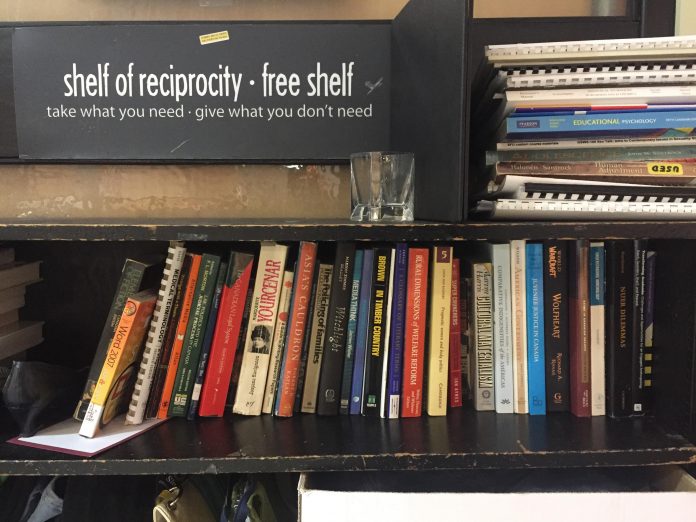
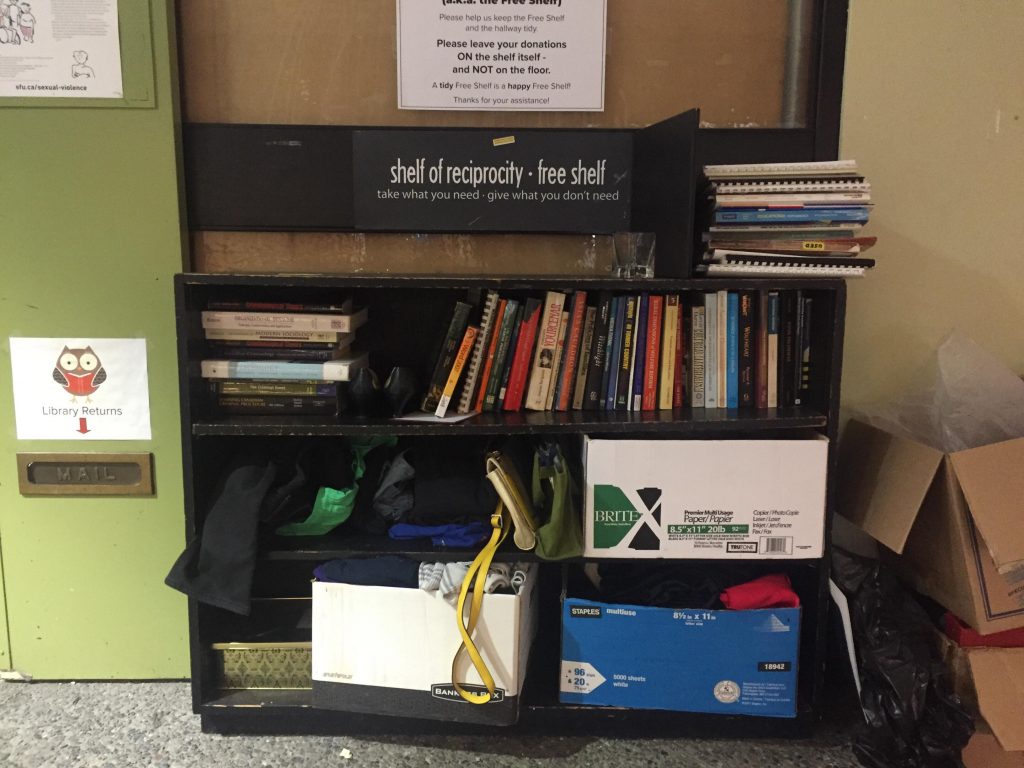
Across the Burnaby Rotunda and in front of the Simon Fraser Public Interest Research Group’s (SFPIRG) office rests an assortment of books and cardboard boxes overflowed with clothes and other personal items. This is SFPIRG’s Shelf of Reciprocity, a designated space for any and every member of the school eager to donate items that — while no longer serving a purpose to them — may serve a newfound purpose for someone else. All the items displayed on the shelf are free to take with no strings attached, except for the voluntary option to reciprocate the kind gesture of leaving something in return.

Photo taken by Kim Regala

Given the Shelf of Reciprocity’s name, I expected to find only a bookshelf filled with tons of old and worn out books stacked in every row. I was pleasantly surprised, however, to see plenty of cardboard boxes filled with more than just literature. Sitting on top of one the boxes was a fairly sizeable blanket, along with a variety of sweaters and jackets tucked neatly inside. I found the warmth and comfort of these items especially suitable for our current chilly climate, perfect for anyone who may be looking to add to their possibly lacking layers department.

Photo taken by Kim Regala

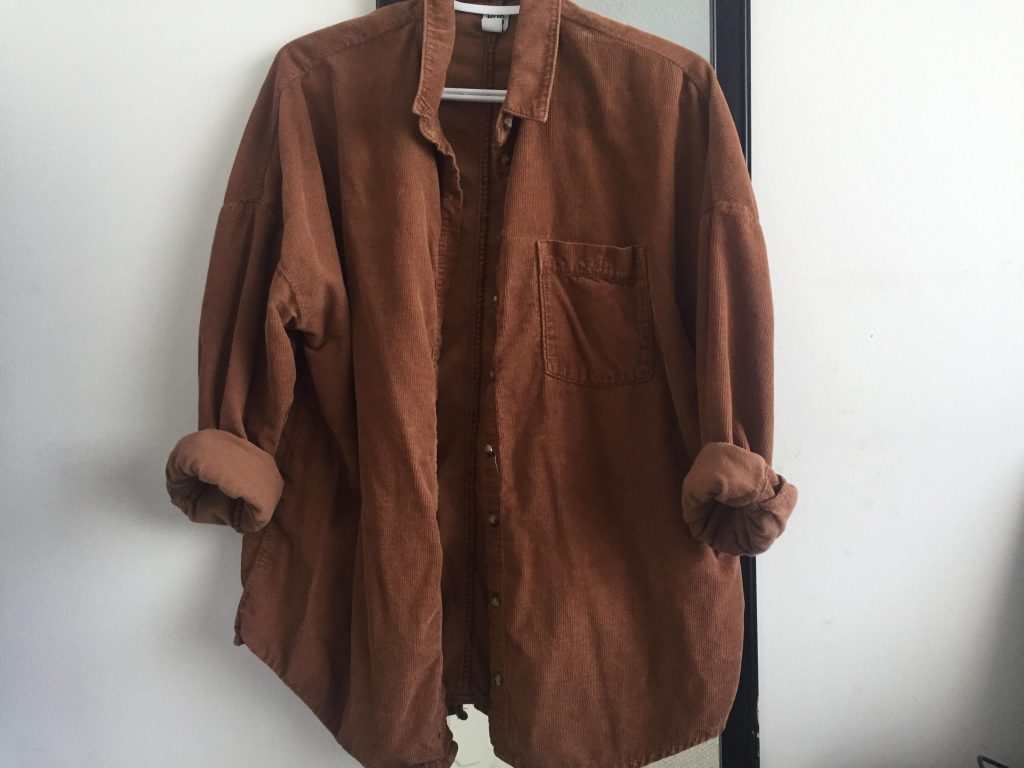
While I personally wasn’t too sold on keeping those for myself, I was instantly attached to a brown corduroy button-up hidden in one of the clothing bundles. Any good friend of mine knows that I’m a sucker for anything brown and corduroy, so naturally I grabbed the gem with no hesitation and made a run for it. That may explain why this photo is taken straight out of my bedroom. I found it incredibly heartwarming to know that I could extend the longevity of this piece again, and at no cost.

Photo taken by Kim Regala

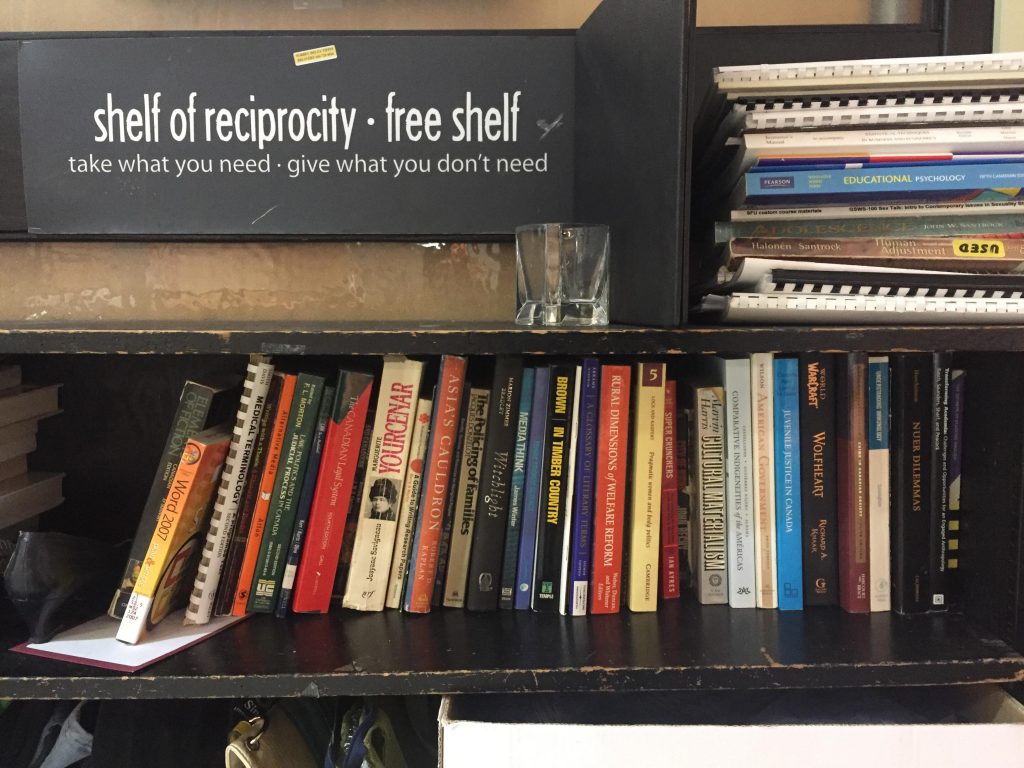
The Shelf of Reciprocity also has a plethora of books resting on its shelves. Various texts with a wide scope of genres stood out as interesting reads to me. One was the adventurous World of Warcraft: Wolfheart by Richard Knaak, a fantasy fiction. I also eyed a biography detailing the curious life of Belgian novelist Marguerite Yourcenar.

Photo taken by Kim Regala

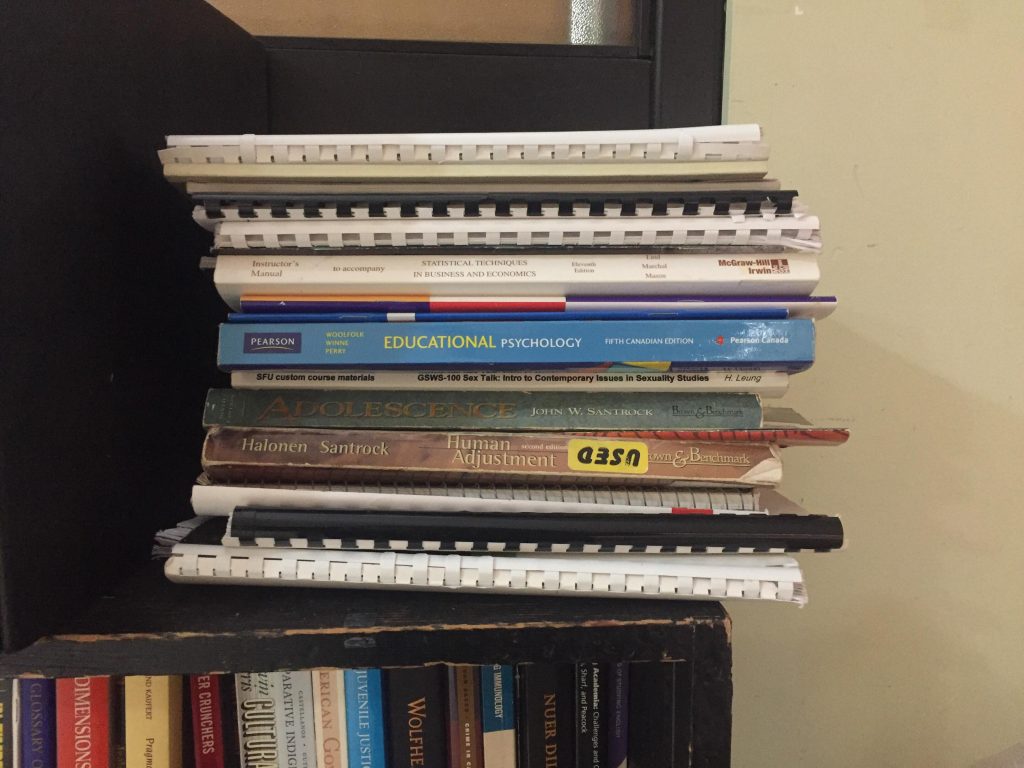
What I didn’t expect, however, was to spot plenty of course materials for a variety of subjects. Textbooks were available for classes in educational psychology, sociology and criminology, while instructor manuals for gender studies and business courses were also up for grabs. As we all know, buying course materials through the SFU bookstore can be extremely time-draining given the long line-ups. And frankly, as one of the many students on a budget, these expenses can easily add up to our already dreaded school tuitions. It was refreshing to see an alternative to attaining these costly requirements — an option that is both easily accessible to anyone and is free of charge.

The Shelf of Reciprocity offers a great source to students looking to donate items that may no longer require space in their lives, but could still be meaningful to someone else. So the next time you walk by SFPIRG, be sure to glance over and stop by the shelf, and you may just find yourself coming home with a new treasure.


Post-secondary students assemble to plan for climate justice

0

By: Madeleine Chan, Staff Writer

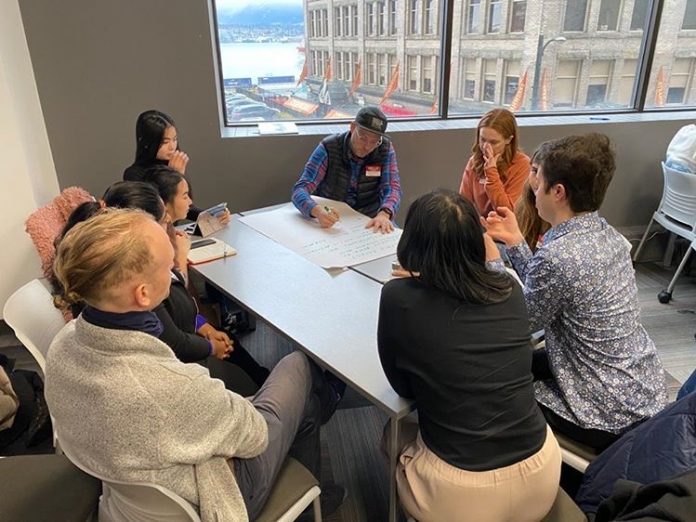
Post-secondary students from across Metro Vancouver came together on the afternoon of Sunday, January 19 at SFU’s Harbour Centre to start a coalition for climate justice.

The first meeting of the Metro Vancouver Post-Secondary Students Coalition for Justice consisted of setting respectful conversational boundaries, brainstorming the vision for the collective, and group discussions on the topics of goals, values, and how to work towards climate justice. Attendees included students from SFU, UBC, Langara, Capilano, BCIT, and Emily Carr. 

Climate justice is a somewhat different topic than, but not exclusive of, environmental justice. It advocates for both climate action and human rights issues in the hopes of creating a better future for all.

After a rousing rally cry of “WHAT DO WE WANT? CLIMATE JUSTICE! WHEN DO WE WANT IT? NOW!” from SFSS president Giovanni HoSang, the collaborative session ended with the students breaking off into four distinct groups to plan the coalition’s next steps.

This initial meeting was organized by, but not directly affiliated with, individual members of the youth-led groups Climate Strike Canada, SFU 350, Sustainabiliteens Vancouver, and UBC 350. Building off of the momentum from September’s Climate Strike, which saw over 100,000 people attend, the event aimed to bring together existing communities of climate-justice-aware students interested in sparking renewed, collaborative change.

One of the organizers of the event and SFU 350 member WeiChun Kua hopes that these meetings will bring Metro Vancouver post-secondary schools’ existing activists together.

“We see so much potential on campuses for students. There’s a lot of great people, a lot of great organizing going on [on] campuses, but it’s not very connected [ . . . ] We basically organized this [coalition] to hopefully be a hub where students can come together and rally and share resources and show solidarity with each other on different campuses on issues.”

Examples of issues that Kua highlighted include:“climate justice or tuition hikes, affordable student housing, and basically anything related to student life.” 

Amongst the clamour of students passionately, but respectfully, discussing climate justice and its importance is Shakti Ramkumar, a recent UBC grad and member of the global not-for-profit organization Student Energy. While stopping to talk with The Peak, Ramkumar gives her reasoning for this gathering’s relevance.

“I feel like the people in this room and a lot of the front line communities fighting climate change have the most at stake if we don’t take action in the limited decade that we have.” 

She also believes that “breaking the isolation that can [follow] the typical ‘university job life’, and building a really supportive and nurturing community [ . . . ] [through] this kind of in-person organizing [by] building relationships on top of building strategy is really important.” 

Another attendee, Raaj Chatterjee, an SFU student and member of SFU 350, felt similarly when asked what outcome he would like to see from these meetings.

“I hope that we’re able to empower students to advocate for what they believe in, and change the power structures that we’re all exposed to at the university — and even on the federal and provincial levels,” said Chatterjee.  “[These meetings] allow students to advocate for the change we need for climate justice, social justice, and all these issues that are really impacting people across the world today.” 

The coalition plans to hold monthly general assembly-type meetings, though no future dates are set as of now. If any students are interested in joining, Kua suggested that they reach out to their local climate justice student group on campus, for example SFU 350, or contact Climate Strike Canada. Recent high school graduates can also connect with Sustainabiliteens for more information. 


Heating coil bursts open at SFU’s Interfaith Centre, leaving space unusable and damaged

0
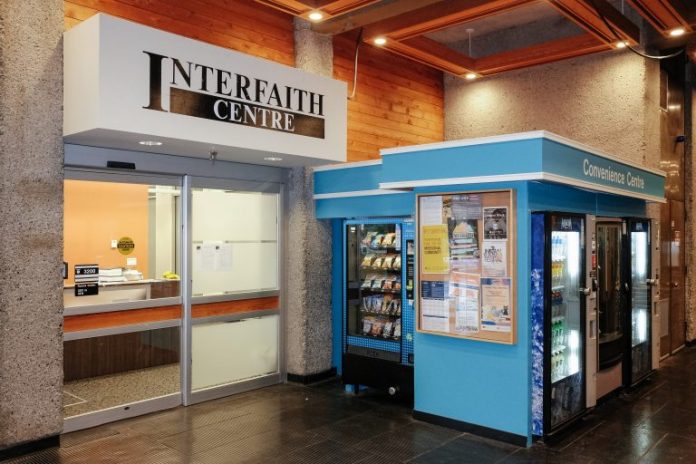
SFU's Interfaith Centre has been moved to MBC due to flooding

By: Jess Dela Cruz, News Writer

Flooding in SFU’s Interfaith Centre has temporarily caused it to be moved to the Maggie Benston Centre.

The Peak spoke with Victor Thomas, Director of the Interfaith Centre, and Todd Gattinger, P.Eng, Director, Maintenance & Operations of Facilities Services, about the flooding and temporary relocation. According to Thomas, the flooding began in the early morning on Tuesday, January 15. It was caused by a pipe that burst above the ceiling boards in the back room, releasing water and steam. Gattinger explained that the problem arose due to a combination of the age of the building and the cold weather.

Thomas added, “An incredible amount of water came out very quickly.”  

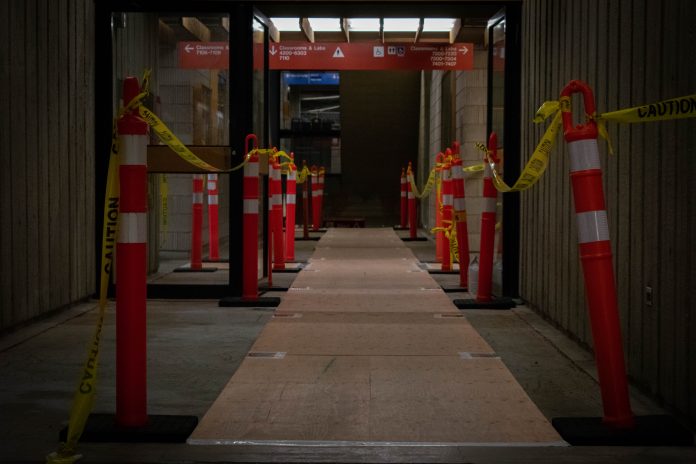
The AQ hallway was blocked off with yellow tape and signs indicating that the floor was slippery, while maintenance workers tried to fix the leak. 

Thomas added that chairs, tables, sound equipment, and religious objects were also damaged by water and steam. SFU retained the company FirstOnSite Restoration to assist with restoring the space to its original condition.

Over 1,500 students use the space weekly, including groups such as SFU’s Muslim Student Association. Mishaa Khan, the Muslim Student Association (MSA)’s Social Media Coordinator, spoke with The Peak regarding the temporary closure.

Khan told The Peak that the Interfaith Centre’s prayer mat “got completely soaked from the pipe burst [ . . . ] this is especially frustrating because it cost a little less than $800 and was paid mainly through donations from the MSA community.” She adds that other resources and equipment were damaged as well. 

Khan stated that there is already a lack of space for Muslim students and staff to pray at SFU, and the temporary closure exacerbates the problem. The space provides only enough room for 7–8 people. 

“This results in individuals praying outside the prayer room or waiting in line, risking being late for class,” she said. “Why not provide an adequate space for people of faith to practice their faith because of the role it plays on their mental health?”

The displacement of the staff and visitors of the centre is estimated to last around 4–6 weeks. The temporary rooms are in MBC 1304 and 1306. Thomas requests that students check the Interfaith Centre’s website or Facebook page for further updates.


SFU Gallery’s latest exhibition leaves us questioning the implications of physical materials from our past

1
Photo: Blaine Campbell / SFU Galleries
SFU Gallery - Lyse Lemieux: No Fixed Abode

by Kim Regala, Staff Writer

Drawing inspiration from Franz Kafka’s short story The Cares of a Family Man is Lyse Lemieux’s No Fixed Abode, SFU Gallery’s latest exhibition. It borrows its title from the book’s character Odradek, an abstract figure that blurs the lines between subject and object. When asked “where do you live” it simply responds by saying “no fixed abode,” indicating its lack of origin or source. Similarly, Lemieux takes on a rather surrealist approach that attempts to understand and uncover the narratives of artifacts that belong in the past. Constructing her pieces through two-dimensional and three-dimensional drawings, No Fixed Abode begs us to question the larger implications of materials that we hold close in our memories and how they have constructed our own identities.

Hung up on the walls are the Odradek Bundles, three-dimensional drawings which may only be described as compacted clumps of assorted textiles and materials. Curator Melanie O’Brian describes how, “the bundles, or beings, bind together thrift store finds — wool tartans, cotton madras, gingham and plaid — with personal items — a cow hide stiletto once worn by the artist’s mother, a racoon coat — and lines ‘drawn’ with the deft snip of the scissors.” 

All of these seem arbitrary at first; however, these artifacts draw deeply from Lemieux’s memories. The patterns connect to the pleated plaid skirts that she wore in private schools for most of her childhood, while the stiletto hints at a looming feminine presence within her past. In constructing these pieces, Lemieux creates something tangible, giving form to materials that once appeared meaningless and inconceivable to her. At the same time, there is a sense of confinement that can be interpreted from the way that these textiles are tightly bound together.

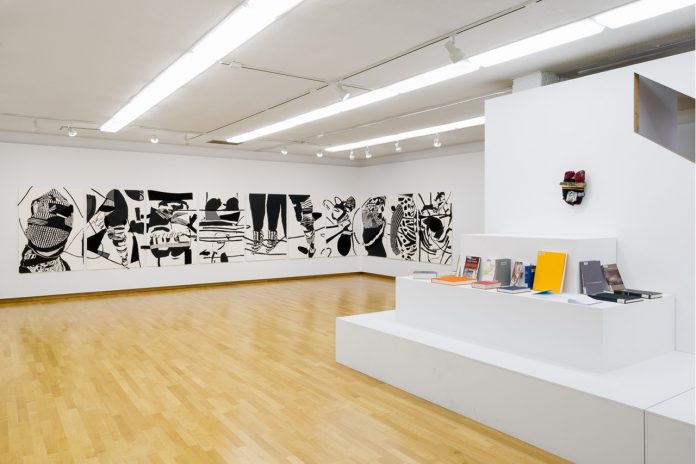
Extending the Odradek Bundles’s narrative are Lemieux’s Odradek Drawings. Unlike the bundles, these tall black and white canvases immediately establish an overwhelming and alluring presence in the room. We may recognize that these pieces bear a close resemblance to the wrapped materials, and this is by no coincidence. O’Brian further explains that “each of the ten works on paper references a bundle, not as a sketch but as a subsequent work where the flat drawings follow the three-dimensional ones.” As a result, the patterns and silhouette of the materials dominate the overall structure and outcome of the drawings.

Viewing them up close, we are able to admire the intricate details that imitate the various textures, linings, and shadows that come from the bundles. From afar is an even more desirable view, as Lemieux makes it clear that these pieces are in dialogue with one another. While each drawing exists individually in their own canvas, felt lining crosses the borders, weaving across each piece to physically connect one another. Like the Odradek Bundles, the textured drawings take on an abstracted form, leaving us with deep uncertainty — yet more liberty — regarding how to interpret these images. 

Frankly, even as someone who has had experience interpreting artworks, I still find myself lost in attempting to unfold a clear narrative within the piece. However, it seems that this was Lemieux’s intent all along: to constantly keep us questioning the implications and impacts of the artifacts and materials from our past.

No Fixed Abode is a free exhibit that can be found in the SFU Gallery at the Burnaby campus from January 11 to April 25.

The Peak interviews SFU’s incoming president, Dr. Joy Johnson — Part 1

4
Photo courtesy of SFU

Written by: Gurpreet Kambo, News Editor

After a prolonged consultation and hiring period, Dr. Joy Johnson was hired as SFU’s next president. The Peak sat down with Dr. Johnson for an interview, which will be published in three parts. Some of the following answers have been edited for length.

The Peak: Congratulations on the position. What you would like students to know about you, or how you’d like to introduce yourself to SFU students?

Dr. Joy Johnson: I have been at SFU for just over five years, and serving as the Vice-President of Research and International. And I have seen the potential of this amazing university. I think we’re just at such a fortunate place at SFU, in terms of the three campuses, exciting things happening like the New Student Union Building opening, the new Energy Systems Engineering Building out in Surrey, and more potential to come. So that excites me a great deal, and that’s partly why I put my name forward, because I do believe there’s so much potential — so much more that we can do.

I do want students to know that students come first. They’re at the heart of the university. It’s really important that the learning environment be front and centre for the president to be thinking about — the ways in which we provide an excellent education for students.

I’m really aware of the literature that suggests that some of the most important learning that students have takes place outside of the classroom, not necessarily inside the classroom. [For example] The Peak [is] such a great example of this opportunity to engage in real world work, and learn[ing] from that is really important and something that our university values.

P: [We] understand that you previously earned a PhD in nursing and were a professor at UBC. Is there anything else you would want students to know about your background?

J: So I did my first degree in nursing and worked as a nurse for five years before I returned to graduate school. And I loved that work. It’s really a privilege to work with patients and families [ . . . ] and I found it very rewarding. But I found myself also kind of interested in other opportunities as well and went back to school to do my graduate work in nursing, as you mentioned. I really caught the research bug there and really loved the university as an institution [ . . . ] And so [I] did my PhD and then was recruited to UBC. And I had a faculty appointment in nursing at UBC. So I taught at the undergraduate and graduate level. 

P: I think a lot of students know the president is the public face of the university, but I don’t think a lot of students really know what the role of the president actually is. Could you give us an outline of this position?

J: The president is the public face of the university and [ . . . ] plays an important leadership role in terms of creating relationships with other entities, be they industry, community, etc. [ . . . ] You can kind of think of it as the CEO role, to lead the leadership team. So the leadership team consists of the vice-presidents and the associate vice-presidents, and to make sure that we are talking to one another, that we are strategically aligned [ . . . ] You can think about the president also though, as the chief academic officer in some ways because the president chairs Senate, and that’s where academic matters come to be considered at the university [ . . . ] And the other important role that the President plays is also sitting on the Board of Governors, right. [ . . . ] the President is unique and in sitting on both of these bodies and making sure that they’re coordinated and and operating in the best possible light. [ . . . ]  make no mistake. I mean, universities are complex, big, big organizations.

P: In terms of your previous position as the Vice-President of Research, how does your day-to-day role change? We understand this may involve a lot more direct involvement with students?

J: A lot of my work [as VP Research] has been with faculty and staff, looking at ways that we can encourage and facilitate research across the university and engage with students primarily through very specific initiatives [ . . . ]  I had interaction with students, but not as much direct connectivity. I know that one of the things I need to do as president is spend more time listening to students and learning more about student concerns, and [I’m] really looking forward to engaging directly with the SFSS, [which] has not been part of my role. 

P: In a broad sense, what would you like to express as your goals for the five-year term as the president?

J: A vision for a university is not an individual president’s vision. It’s a shared vision. And so in my early months, I will be out meeting with students, talking to them, understanding what their concerns are. I’ll be meeting with faculty and staff, community members, alumni as well. [As VP Research], I have not had a sense of the whole university. And that’s something I need to take the time to do [ . . . ] I have made a personal commitment to three areas that I’m passionate about. 

The first is students, and making sure that we really are focused on students first, and our learning environments — making sure that we are providing the best quality experiences for our students. And there’s been a lot of great initiatives on learning and teaching here at SFU. But, I think there’s more that can be done. I think we can be more creative, I think we can think longer and harder about ways in which we can provide these real world experiences, the ways in which we can align students’ concerns and societal issues.

[ . . . ] Another is equity, diversity and inclusion [ . . . ] I’m passionate about making sure that the university is a university of inclusion, that everybody feels welcome and feels that they can show up as their best and authentic selves. And I make no illusions about the fact that we’re not there yet, that, you know, we are a reflection of society. Let’s be clear: society has elements that are sexist, racist, homophobic, etc. I think that we need to have to have a conversation and to be thinking about the ways in which we can enunciate our values as a university and make sure that barriers that are there for our students, faculty, and staff to be who they need to be at the university, so they can do the best work they possibly can, need to be addressed. And so that’s part about what equity, diversity inclusion is about, and my vision really is about an inclusive campus. So that’s a priority for me to continue that work, to think about how to continue forward. 

And then the third personal priority for me relates to reconciliation. We received a report from the Aboriginal Reconciliation Committee, I think that was about three years ago, and we haven’t delivered on all the commitments that we’ve made in that report. So there’s more work to be done. I think that the president needs to provide leadership in that area, needs to demonstrate commitment to that work as we decolonize, Indigenize, [and] think about ways that we again can provide better access to our Aboriginal students, to the university, and support them. So that’s another kind of personal commitment.

These are things that the university is already committed to, but I really want to enunciate that these are things that are top of mind for me, and things that I want to be able to say everyday ‘I am thinking about how to move the dial on these things’ and thinking about how to, how to resource them appropriately.